We study the Korteweg-de Vries equation posed on the quarter plane with asymptotically t-periodic boundary data for large . We derive an expression for the Dirichlet to Neumann map to all orders in the perturbative expansion of a small in the case of the asymptotically periodic boundary data. More precisely, we show that if the unknown Neumann boundary data are asymptotically periodic for large t in the sense that and tend to periodic functions and for large t, respectively, then the periodic functions and can be characterized in terms of the given asymptotically periodic Dirichlet boundary datum . Moreover, we determine effectively the Fourier coefficients of the functions and by solving a certain recursive algebraic equations.
In this paper, we consider the Korteweg-de Vries equation (KdV) posed on the quarter plane
where vanishes sufficiently fast for all t as and we assume that the given initial condition decays rapidly fast as . The equation is remarkable as it describes surface gravity waves in a shallow-water channel and it is of great interest for integrable systems theory. The KdV equation on the quarter plane was considered in [10] using a unified method, also known as the Fokas method, which can be considered as a significant extension of the inverse scattering transform for boundary value problems [8,9] (see also the monograph [12] and references therein). The most difficult problem in the implementation of the method is the characterization of the unknown boundary values, known as the Dirichlet to Neumann map for the boundary value problems [11]. For example, in the case of the Dirichlet boundary value problem for the KdV equation posed on the quarter plane, the Dirichlet boundary datum is given, whereas the Neumann boundary data and are unknown. The generalized Dirichlet to Neumann map was derived in [23] by using the so-called Gelfand–Levitan–Marchenko integral equation.
It should be noted that the Fokas method presents a novel integral representation of the solution in terms of the solution for a matrix Riemann–Hilbert problem with explicit exponential -dependence. Thus, for the case of vanishing boundary conditions for large t, it can be possible to characterize the large t behavior of the unknown boundary values by using the Deift–Zhou and Deift–Zhou–Venakides methods for the asymptotic analysis of Riemann–Hilbert problems [4–7]. However, for the case of periodic boundary data in t, which is physically important, it is necessary to characterize explicitly the Dirichlet to Neumann map. Pioneering results in the case of the t-periodic boundary conditions have been achieved in [1–3] for the nonlinear Schrödinger equation (NLS). Furthermore, an effective characterization of the Dirichlet to Neumann map for the NLS equation on the half-plane was presented in [19] (see also [13,14]). The formulation in [19] is based on a perturbative scheme for the solution in a small (cf. [15,17,18] for further applications such as the KdV, modified KdV and sine-Gordon equations).
Here, we consider the KdV equation posed on the quarter plane with asymptotically periodic boundary data. We denote boundary data , and as
which are assumed to be sufficiently smooth. Moreover, we suppose that the boundary values are asymptotically t-periodic for large in the sense that
where , , are periodic functions in t with period τ. Without loss of generality, we consider the case of for simplicity. Here, we utilize a new perturbative scheme presented in [20,21] for the NLS (see also [16] for the modified KdV equation). More precisely, we expand the solution for (1) in a small and then we characterize the Dirichlet to Neumann map for the unknown boundary data and in the limit of large t and small . Moreover, we show that if the boundary data are asymptotically periodic as , the Fourier coefficients for the functions and can be uniquely determined by solving an infinite system of algebraic equations. In contrast to the case of the nonlinear problem, for the linear KdV equation posed on the quarter plane, it is not necessary to assume that the unknown boundary values and are asymptotically periodic. More precisely, we show that the solution for the linear KdV on the quarter plane is asymptotically periodic as provided that the Dirichlet boundary value is asymptotically periodic for large t. In addition, it can be shown that for the linear KdV equation, the unknown boundary data and are asymptotically periodic for large t.
The study in this paper is analogous result for the nonlinear Schrödinger equation in [21] and the modified KdV equation in [16]. It also should be noted that compared with the earlier result in [18] for the KdV equation, which involves rather complicated integrals, the approach presented in this paper is much easier; however, the perturbative approach in [18] does not require to assume that the unknown boundary values and are asymptotically periodic.
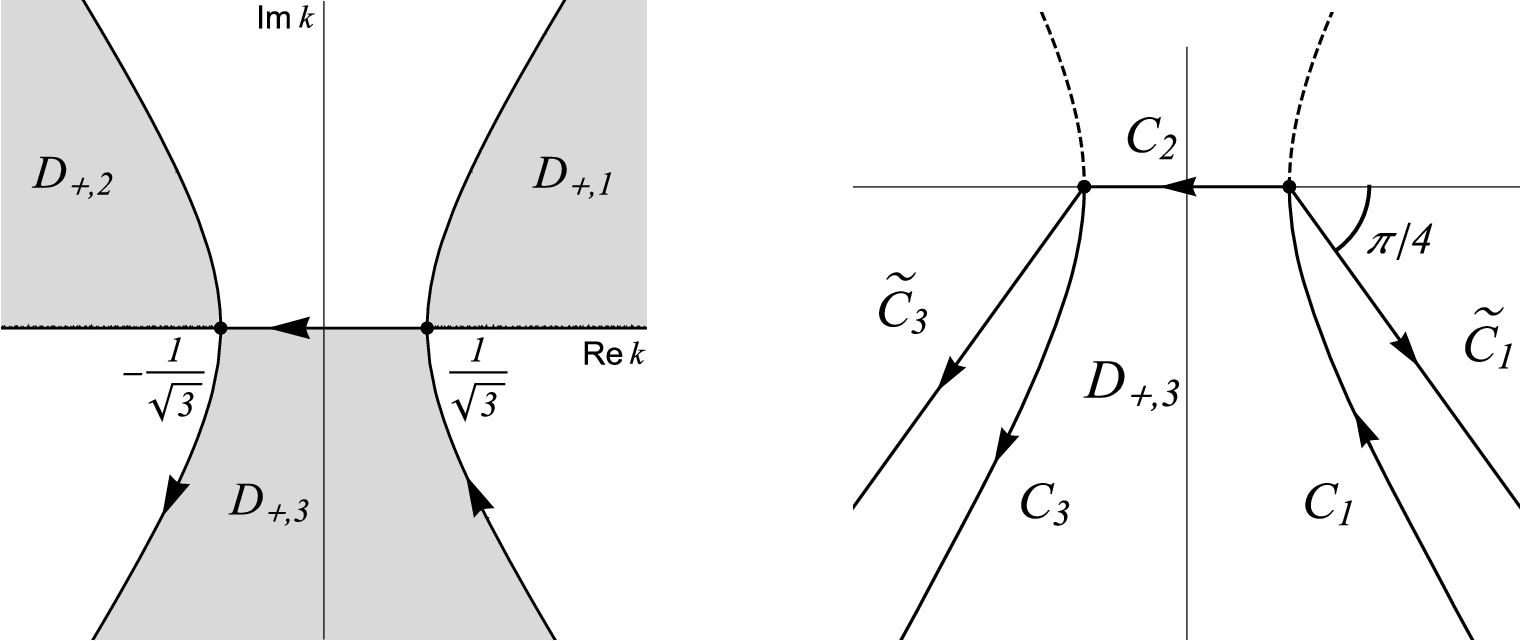
(Left) The region (shaded) in the complex k-plane where with . (Right) The steepest descent contours and .
The linearized KdV equation
In this section, we first consider the linear KdV equation posed on the quarter plane
The equation can be written as an overdetermined linear system, known as Lax pair
where the dispersion relation is given by . We introduce the domain and we decompose the region into (see Fig. 1). Letting the closed differential 1-form given by
we write the Lax pair (5) as
Employing the Green theorem on , we find the global relation for the linear KdV equation
where
with
Multiplying (7) by and applying the inverse Fourier transform, we find
We deform the contour to for the second integral in (8) and then equation (8) can be expressed as
Note that the representation of the solution (9) involves the unknown boundary data and via , . Thus, for the explicit representation of the solution, it is necessary to determine these unknown boundary data. To this end, we use the global relation (7).
Note that if , the transformation leaves invariant. As a consequence, is invariant under this transformation. The equation has a trivial root and nontrivial roots
Equation (10) is a double-valued expression and in particular, it has branch points at . In order to make (10) single-valued, we define a branch cut along . Also, we choose that satisfies for large k. Thus, we denote these roots by
Note that and , respectively, for .
Thus, letting and in (7) for , we find the following equations
and then we solve the linear system (12) for and :
Finally, substituting (13) into (9), the solution of (4) is given by
where we have used the fact that the terms involving in (13) yield a zero contribution to (9) due to the Cauchy theorem.
The representation of the solution given in (14) allows to show that the solution for the linear KdV equation with a periodic Dirichlet boundary datum is asymptotically periodic for large t. The similar result of the Proposition 2.1 also can be found in [22].
Assume thatis a function of the Schwartz class, denoted byand, whereis a periodic function with period τ. Letbe the solution given by (
14
). Then for any,whereis a periodic function with period τ and. In particular, for any,is asymptotically periodic in the sense that
We write given in (14) as , where
We will evaluate each integral in (17) for large t in order to show (15). For , we write
and then we consider the following integral
Note that has critical points at and as . Thus, we introduce the steepest descent contours and , where and are the rays starting at with directions and , respectively (see Fig. 1). Deforming the contour to the contour , we know that
where the contour is given by (cf. Fig. 1). Using the steepest descent method along the contour and applying the stationary phase method along the contour , respectively, we find
Thus, the following estimate for can be derived
for some constant .
For , we first consider the integral
Note that
Thus, using the steepest descent and stationary phase methods for the integral with respect to k in (21), we find the asymptotic evaluation
A similar asymptotic analysis is also valid for the second integral in (17b), and hence the estimate for can be obtained as
for some constant .
Regarding , note that by integration by parts, as . Hence, by the Cauchy theorem, we deform the contour to and then we write as
where
Note that since ,
As before, the steepest descent and stationary phase methods yield that as .
We now prove (15). In this respect, let be the sequence given by
where for . From (20) and (23), it follows that
which implies that
For , consider the following series
Since is periodic, we know that
Then, since as , we find the following estimate
for some constant . Thus, the series given in (28) converges and so does the sequence as . As a consequence, the limit of the sequence given in (26) exists for any and this limit, denoted by , is a periodic function with period τ. Indeed, note that
Taking , we find . Moreover, implies . □
Next, we study the asymptotically periodic boundary data for large t. We note that by integration by parts, the function can be written as
Deforming the contour to pass to the right of the singularity , which is denoted by , equation (14) can be expressed as
Differentiating (30) with respect to x and evaluating at , we find given by
Similarly, is given by
Letbe a smooth periodic function with period. Assume thathas the Fourier serieswherewith. Then, there are unique periodic functionsandsuch thatandMoreover, the functionsandhave period τ and the Fourier series are given bywherewith.
Let be the solution given in (30) with . We first prove that as . We write (31) as , where
Note that using Integration by parts, we find
and hence, from the equations
it immediately follows that as , where is the Airy function.
For the integral , we consider the following integral
The asymptotic evaluation for the integral (38) is similar to the proof of Proposition 2.1. We first decompose the contour into , where the contours , and are depicted in Fig. 1. Then we deform the contour and to the steepest descent contours and , respectively (cf. Fig. 1). Note that
Thus, using the steepest descent method, we find that the integral along the contour in (38) is of as , that is,
The integral along the contour in (38) can be evaluated by using the stationary phase method and it is of as . Thus, we find
In similar ways, we evaluate
and hence as .
Regarding the integral , integration by parts yields
Substituting the Fourier expansion (33) into the above equation, we find
For each , given in (36) solves the equation in . Thus, we deform the contour to passe to the right of the singularities , which is denoted by , before we split the integral (41). As a result, we find
The first integral in (42) can be evaluated by the residue theorem:
For the second integral in (42), we deform to the steepest descent contour and then the steepest descent and the stationary phase methods yield
Thus, as .
In similar ways, we can prove that as where and are given by (32) and the second equation of (35), respectively. Also, the uniqueness of and follows from the fact that (see [21] for some details). □
The KdV equation
Eigenfunctions
In this section, we study the KdV equation posed on the quarter plane
We assume that and are given, while and are unknown. It is known that (43) admits a Lax pair formulation of the form
where is a spectral parameter, is a matrix-valued eigenfunction and
with the usual Pauli matrices defined by
Letting the closed differential 1-form given by
we define the normalized solutions of (44) at and in terms of the linear Volterra integral equations:
We introduce the domain
which will also be convenient to decompose as , where , and with the first and second quadrants and of the complex k-plane (cf. Fig. 1). Note that the regions and are similar, but the hyperbolas for the linear and nonlinear cases are slightly different.
In order to define an additional eigenfunction , let be the solution of the background t-part of the Lax pair with the asymptotically periodic boundary data
where is the matrix-valued function defined by replacing , and by , and , respectively. More specifically, we denote as
where
We seek a solution of (49) in the form of , where is a periodic function with period τ and is a complex-valued function. Then, the solution can be defined by
where . From the exponential terms in (51), the domains are denoted by
The functions and are defined as follows (see [20] for some details). Assume that is a solution of the background t-part (49), which is normalized by . Let be the monodromy matrix. Then and are the eigenvalues of , where
Let be the set of branch points defined by and be a branch cut connecting all points in . By the Floquet theory, the periodic function is defined by
where is the matrix consisting of the eigenvectors corresponding the eigenvalues of with and the matrix is given by for . Then the function in the form of for is the solution of (49), where .
Perturbative expansions
We assume that the solution of (43) has a formal power series in a small :
and then we substitute this expansion into (43). At each order in the perturbative expansion, we find
where denotes the coefficient of . We also expand the t-periodic asymptotic boundary data in a formal power series in ϵ:
Assume thatare smooth periodic functions with periodandis a perturbative solution for the KdV (
43
) such that for each,andwhere,andfor. Assume that the functionhas the following Fourier seriesThen the Fourier coefficients ofare given bywherefor,andwith
The proof of the proposition is similar to that presented in [21] (see also [20]). Thus, we will prove the relevant perturbative formulas and quantities. Letting
we note that as , for . Since solves the background t-part (49), the function solves the Ricatti equation
We expand the functions , , and as Fourier series
Then equation (62) can be written in terms of the Fourier coefficients
where is given in (60).
Letting together with the expansions (53), we find at and at
where
We expand and . Then, as
Thus, as , and hence we find
As a consequence, we know that and as , which immediately implies that the domains and deduce to and as , respectively. Moreover, we find
where .
Hereafter, the rigorous proof is similar to that discussed in [21]. Thus, it remains to derive the formulas for the Fourier coefficients , and . To this end, let , where we expand as
Note that the function solves the Ricatti equation (62) for each . More specifically, at each order , we find the equation
and in terms of the Fourier coefficients,
for . Let . Note that solves the equation and for . Since the transform leaves invariant, we obtain the following additional equation
for . The equation has roots , where is defined in (59). Evaluating (68) and (69) at , we find two algebraic equations
Solving the linear system (70) for and , the Fourier coefficients and are given by (57) and (58), respectively. Also, from (68) with (57) and (58), it follows that the Fourier coefficient is given by (61c). □
For , equations (57) and (58) implies
and substituting (71) into (61c) with , we find
Note that the Fourier coefficients of the terms in the summations in are always given in the known lower order terms. Thus, continuing this process, we can determine recursively the Fourier coefficients , and for .
References
1.
A.B.de Monvel, A.Its and V.Kotlyarov, Long-time asymptotics for the focusing NLS equation with time-periodic boundary condition, C. R. Math. Acad. Sci. Paris345 (2007), 615–620. doi:10.1016/j.crma.2007.10.018.
2.
A.B.de Monvel, A.Its and V.Kotlyarov, Long-time asymptotics for the focusing NLS equation with time-periodic boundary condition on the half-line, Commun. Math. Phys.290 (2009), 479–522. doi:10.1007/s00220-009-0848-7.
3.
A.B.de Monvel, A.Kotlyarov, D.Shepelsky and C.Zheng, Initial boundary value problems for integrable systems: Towards the long-time asymptotics, Nonlinearity23 (2010), 2483. doi:10.1088/0951-7715/23/10/007.
4.
P.Deif, S.Venakides and X.Zhou, The collisionless shock region for the long time behavior of the solutions of the KdV equation, Commun. Pure Appl. Math.47 (1994), 199–206. doi:10.1002/cpa.3160470204.
5.
P.Deif, S.Venakides and X.Zhou, New results in small dispersion KdV by an extension of the steepest descent method for Riemann–Hilbert problems, Int. Math. Res. Notices6 (1997), 286–299. doi:10.1155/S1073792897000214.
6.
P.Deift and X.Zhou, A steepest descent method for oscillatory Riemann–Hilbert problems, Bull. Amer. Math. Soc.26 (1992), 119–123. doi:10.1090/S0273-0979-1992-00253-7.
7.
P.Deift and X.Zhou, A steepest descent method for oscillatory Riemann–Hilbert problems. Asymptotics for the mKdV equation, Ann. Math.137 (1993), 295–368. doi:10.2307/2946540.
8.
A.S.Fokas, A unified transform method for solving linear and certain nonlinear PDEs, Proc. Roy. Soc. London A453 (1997), 1411–1443. doi:10.1098/rspa.1997.0077.
9.
A.S.Fokas, On the integrability of certain linear and nonlinear partial differential equations, J. Math. Phys.41 (2000), 4188–4237. doi:10.1063/1.533339.
10.
A.S.Fokas, Integrable nonlinear evolution equations on the half-line, Comm. Math. Phys.230 (2002), 1–39. doi:10.1007/s00220-002-0681-8.
11.
A.S.Fokas, The generalized Dirichlet-to-Neumann map for certain nonlinear evolution PDEs, Comm. Pure Appl. Math.LVIII (2005), 639–670. doi:10.1002/cpa.20076.
12.
A.S.Fokas, A Unified Approach to Boundary Value Problems, CBMS-NSF Regional Conference Series in Applied Mathematics, SIAM, 2008.
13.
A.S.Fokas and J.Lenells, The unified method: I. Non-linearizable problems on the half-line, J. Phys. A: Math. Theor.45 (2012), 195201. doi:10.1088/1751-8113/45/19/195201.
14.
G.Hwang, A perturbative approach for the asymptotic evaluation of the Neumann value corresponding to the Dirichlet datum of a single periodic exponential for the NLS, J. Nonlinear Math. Phys.21 (2014), 225–247. doi:10.1080/14029251.2014.905298.
15.
G.Hwang, The Fokas method: The Dirichlet to Neumann map for the sine-Gordon equation, Stud. Appl. Math.132 (2014), 381–406. doi:10.1111/sapm.12035.
16.
G.Hwang, The modified Korteweg–de Vries equation on the quarter plane with t-periodic data, J. Nonlinear Math. Phys.24 (2017), 620–634. doi:10.1080/14029251.2017.1375695.
17.
G.Hwang and A.S.Fokas, The modified Korteweg–de Vries equation on the half-line with a sine-wave as Dirichlet datum, J. Nonlinear Math. Phys.20 (2013), 135–157. doi:10.1080/14029251.2013.792492.
18.
J.Lenells, The KdV equation on the half-line: Dirichlet to Neumann map, J. Phys. A: Math. Theor.46 (2013), 345203. doi:10.1088/1751-8113/46/34/345203.
19.
J.Lenells and A.S.Fokas, The unified method on the half-line: II. NLS on the half-line with t-periodic boundary conditions, J. Phys. A: Math. Theor.45 (2012), 195202. doi:10.1088/1751-8113/45/19/195202.
20.
J.Lenells and A.S.Fokas, The nonlinear Schrödinger equation with t-periodic data: I. Exact results, Proc. R. Soc. A471 (2015), 20140925. doi:10.1098/rspa.2014.0925.
21.
J.Lenells and A.S.Fokas, The nonlinear Schrödinger equation with t-periodic data: II. Pertrbative results, Proc. R. Soc. A471 (2015), 20140926. doi:10.1098/rspa.2014.0926.
22.
J.Shen, J.Wu and J.Yuan, Eventual peridocity for the KdV equation on a half-line, Physica D227 (2007), 105–119. doi:10.1016/j.physd.2007.02.003.
23.
P.A.Treharne and A.S.Fokas, The generalized Dirichlet to Neumann map for the KdV equation on the half-line, J. Nonlinear Sci.18 (2008), 191–217. doi:10.1007/s00332-007-9014-6.