We develop and investigate radiation conditions at infinity for composite piezo-elastic waveguides. The approach is based on the Mandelstam radiation principle according to which the energy flux at infinity is directed away from the source and which implies constraints on the (sign of the) group velocities. On the other side, the Sommerfeld radiation condition implies limitations on the wave phase velocity and is, in fact, not applicable in the context of piezo-elastic wave guides. We analyze the passage to the limit when the piezo-electric moduli tend to zero in certain regions yielding purely elastic inclusions there. We provide a number of examples, e.g. elastic and acoustic waveguides as well as purely elastic insulating and conducting inclusions.
In piezoelectric waveguides, the natural interaction of elastic and electromagnetic fields causes complications with respect to a routine consideration of the propagation of time-harmonic waves. In fact, the corresponding system of partial differential equations is not self-adjoint or is lacking formal positivity if transformed to another equivalent formulation, cf. Sections 1.2 and 1.3. This peculiar feature stems from the intrinsic energy transition between the above mentioned fields, and it renders many standard methods inapplicable requiring workarounds as in [17,26,33,35] and others. In the present paper, we develop an approach to impose physically relevant radiation conditions at infinity in composite periodic piezoelectric waveguides, based on the Mandelstam radiation principle, see [19] and, e.g., [44, Ch. 1], [32, Ch. 5], and [29]. For acoustic, elastic and quantum waveguides this principle includes the use of the Umov–Poynting vector.1
This vector indicates the direction of the energy transfer in acoustic and elastic bodies, and it was introduced by N.A. Umov [41] in 1873 and later, in 1884, by J.H. Poynting [37] for electromagnetic waves. In piezoelectric media such a vector has to be named after both scientists.
However, as we will see in Section 1.3, wave processes in piezoelectric waveguides are governed by another functional, namely the electric enthalpy [40], a sesquilinear Hermitian form, which is unfortunately not semi-bounded.
Since the piezoelectricity boundary value problems under consideration are elliptic, asymptotic decompositions of solutions at infinity follow directly from old results for monochromatic waves and wave packets in cylindrical and periodic waveguides, see [11,23] and also [32, Ch. 3, 5]. These results require neither formal self-adjointness nor formal positivity of the boundary value problem. Then, the introduction of an appropriate classification of “incoming/outgoing” waves becomes the most important question. With this aim in mind, we will derive in Section 3.1 a representation formula for the Umov–Poynting vector of the enthalpy. We show that it is proportional to a symplectic (sesquilinear and anti-Hermitian) form , which also appears as a surface integral in the Green formula serving the piezoelectricity problem. This is a crucial observation for our approach to radiation conditions. Indeed, concerning elliptic problems in domains with cylindrical or periodic outlets, there exist general results on the integral representation of the coefficients in the asymptotic expansions of solutions at infinity, see [21,24] and also [32, Ch. 3]; these results demonstrate that the form q is non-degenerate, cf. Section 3.3, and, therefore, induces an indefinite metric in the space of propagating waves. At this point we apply the classical algebraic theorem, cf. [15] on the existence of a convenient basis in such that
where and is the Kronecker symbol. Notice that the dimension is the even number , also due to the above theorem.
Normalization and orthogonality conditions (1.1) yield existence and uniqueness results for the piezoelectricity problem, once it is endowed with the corresponding radiation conditions (that is, incoming waves are excluded from the solution at infinity). They also yield the unitarity of the scattering matrix, see Section 4.3. For similar results in elasticity and electricity and a simpler version of the symplectic form q, see [32, Ch. 5, §6], [28,29].
It should be mentioned that the Sommerfeld radiation principle fails for vectorial problems and periodic waveguides (see [22], [44, Ch. 1], [29] in the case of elasticity and [5] for a scalar problem). At the same time, it has been observed in [28,29] that the limiting absorption principle leads to “strange” inferences, when the problem has “almost standing” waves [30] at the threshold frequencies, see Section 5.6. The Mandelstam principle does not have such defects and therefore must be considered as the universal one. Moreover, in Section 1.3 we will also show that, using the electric enthalpy instead of energy, one can circumvent the problem of the lack of formal positivity in the corresponding stationary problem, although positivity is always assumed in the existing literature on the Mandelstam principle.
Piezoelectric waveguides, which are used in the engineering practice, are composite materials and always contain purely elastic parts. These cause a complication for the statement of our piezoelectricity problem and they require some specification of our results. First of all, the waveguide must be periodic instead of cylindrical, because usually piezoelectric inclusions form a periodic subset in a cylindrical purely elastic body. Secondly, the physical moduli of the waveguide material must be piecewise continuous only. Finally, we will need to perform a passage to the limit, where the piezoelectric moduli vanish in a certain region and the piezoelectric material turns into an elastic one, and, thus, the radiation conditions themselves, the asymptotic decomposition of solutions at infinity and the scattering matrix must be handled in such a way that this limit procedure is possible.
In order to simplify proofs and shorten formulas we will consider only waveguides with a single outlet to infinity, but treating several outlets could be done using the same techniques.
Periodic composite piezoelectric waveguide
Let , be a bounded domain in the layer . We set
where is the set of integers, and assume that the interior Π of the periodic set (quasicylinder) is a domain with Lipschitz boundary and, thus, is in particular a connected set. The period has been reduced to 1 by rescaling and, therefore, the longitudinal and transversal coordinates, which are denoted by and () or (), respectively, become dimensionless. The piezoelectric waveguide Ω is also bounded by a Lipschitz surface and consists of two parts , where is the semi-infinite quasicylinder and is a domain with compact closure in the half-space () or half-plane () , see Fig. 1.
Waveguide: domains.
In order to describe the essential phenomena in the piezoelectric body Ω, we employ the vector-matrix notation known as the Voigt–Mandel notation, cf. [3,16,25] and use the superscripts and for the mechanical and electric characteristics, respectively. We introduce the displacement vector field and the scalar field , where is the projection of onto the -axis, φ is the electric potential and ⊤ stands for transposition. In this way, vectors are realized as columns in the Euclidean space with the fixed Cartesian coordinate system . We also define the mechanical strain and electrical strength columns of height and d, respectively,
where
We emphasize that
with the Cartesian components of the strain tensor; the factors and in (1.4) and (1.5) are to equalize the natural norms of symmetric tensors of rank 2 and columns of height d, when substituting tensors in the Voigt–Mandel notation. The stress column , which has the same structure as in (1.5), and the electric induction column of height d are related with columns (1.3) by the central laws of piezoelectricity
where and are the rigidity and dielectric permeability matrices of size and , respectively. These are both symmetric and positive definite, while the piezoelectric -matrix may be arbitrary. These matrices include elastic, dielectric and piezoelectric moduli, respectively, and they are composed in a standard way in accordance with definitions (1.3)–(1.6), see e.g. [3,17,25,35].
We will describe the dependence of the -matrices
on the variables in the next section. It should be emphasized that in the case , which is the null -matrix, elastic and electric fields do not interact, and the piezoelectricity problem decouples into a pure elasticity and an electricity problems, cf. Section 6.1, and, moreover, both matrices (1.7) become symmetric. However, if , then the matrix A looses symmetry, while stays symmetric in all cases.
We combine the mechanical and electric quantities by putting
Then, the piezoelectricity system of partial differential equations reads as
see for example [9,36,40]. Here and are the spectral parameter and the frequency of time harmonic oscillations, is the material density
and is the unit -matrix.
We assume that the waveguide is mechanically clamped over the surface of an ideal conductor. The remaining part of the waveguide surface is traction-free and in contact with an ideal insulator, for example, vacuum. The corresponding boundary conditions are
Here, is the outward unit normal and the matrix function is obtained from in (1.4) by replacing .
The absence of the spectral parameter Λ in the last, “electrical”, line is caused by the null component in the diagonal matrix E in (1.10), and this means that we treat the low- and mid-frequency ranges of the spectrum of the piezoelectric waveguide, neglecting the electro-magnetic oscillations, cf. [9,36,40]. Furthermore, we need to assume that the subset is 1-periodic in the longitudinal direction, in order to keep the wavequide periodic. For a technical reason, cf. Section 6.4, we assume in addition that Γ is an open connected set. Indeed, the electric potential is defined only up to a constant on each connected component of the conductor surface γ and, thus, can be set to zero as in (1.11) only in the case γ is connected. The disconnected case would require several additional formulations and arguments, which we want to avoid, as our paper is devoted to different aspects.
Energy and enthalpy
The weak formulation of problem (1.9), (1.11), (1.12) is written as the integral identity [14,18]
Here is the natural scalar product in the Lebesgue space and is the Sobolev space of functions satisfying the Dirichlet condition (1.11). We will not distinguish between spaces of vector valued functions and scalar functions in the notation.
The form , which is defined by the left-hand side of (1.13), is not Hermitian, because of the minus sign in the first matrix (1.7). However, if the vector function u is real, it gives rise to the positive quadratic functional
which is equal to the sum of elastic and electric energies in the body Ω. Yet, the piezoelectric matrix is missing from the functional , hence, it cannot serve the complete piezoelectricity problem (1.13), nor can the Mandelstam principle be based on this governing functional. In order to derive appropriate radiation conditions we need to choose a different weak formulation of the problem and introduce a different governing functional.
It is noteworthy that the Griffith fracture criterion [8], which is based on the calculation of the elastic energy in a damaged solid, does not work directly in piezoelectricity for the same reason as just above, cf. [36]: when restricted on real-valued functions, the piezoelectric functional (1.14) loses information on the interaction of mechanical and electric fields. Another functional, namely the electric enthalpy, is considered in the paper [40], see also [13] and many others, with the purpose of adapting this classical fracture criterion to cracks in piezoelectric media. This gives rise to the sesquilinear Hermitian form to be introduced in (1.19).
Our purpose is to apply the general theory in [32, Ch. 3, 5], which deals with formally self-adjoint elliptic boundary problems, and in view of the above mentioned problems we modify the structure of the differential operators on the left-hand sides of (1.9) and (1.12) with the help of the second matrix in (1.7), which has been made symmetric. This will compensate the lack of formal self-adjointness, caused by the non-Hermitivity of ; however, the resulting Hermitian form will not be semi-bounded and in particular not positive, with potential problems for the structure of the spectrum. The latter problem will be overcome in Lemma 2.1, where the positivity of the spectrum is proven.
We thus continue by changing the signs on the electrical line of the system (1.11) and rewriting it with
Then, the boundary conditions (1.11), (1.12) turn into
Furthermore, taking the scalar product of (1.15) and a test vector function v, integrating by parts in Ω and using the boundary conditions (1.16), (1.17) yield the variational (weak) formulation of the piezoelectricity problem
with the sesquilinear Hermitian form
This is not semi-bounded, due to the evident observation
Indeed, notice the minus sign of the right lower block in the second matrix (1.7) and recall that the blocks and are positive definite.
The functional is called the electric enthalpy [40], and in the sequel we will use the latter formulation of the piezoelectricity problem in the waveguide Ω.
To cover the case of composite waveguides we assume that the entries of the matrix and the density ϱ are measurable bounded functions in Ω and satisfy the usual positivity conditions
where , and are positive constants. Moreover, in the quasicylinder there should hold the representations
where the components and are 1-periodic in z and still satisfy conditions (1.20), whereas the remainders and are subject to the estimates
with some positive constants α, and .
The matrix differential operators in Π and in are constructed in the same way as in (1.15) and (1.17), respectively, replacing by . Here, is a 1-periodic subset of the surface such that .
In the case the system (1.15) decouples into the elasticity system
and the stationary electricity equation
with “wrong” sign in the differential operator. We will discuss in Section 6 various limit procedures as in [17], which allow us to consider composite piezoelectric waveguides with conductive or isolating pure elastic parts.
Piezoelectric Floquet waves
Model problem in the periodicity cell
General properties of the problem (1.15)–(1.17) in usual or weighted Sobolev spaces are determined by the spectrum of an auxiliary (“model”) problem in the periodicity cell ϖ, (1.2), as has been shown in [23], see also the book [32, Ch. 3 and 5] and the review paper [27]. For the sake of the clarity of the presentation and references to the book [32], we assume that the coefficients of the differential operators and the boundary are smooth, for instance, of the Hölder class . The model problem is obtained from the following “completely periodic” problem in the infinite quasicylinder
by means of the Floquet–Bloch–Gelfand-(FBG-)transform (see [6] and [12,32,39])
where is the dual variable (the Floquet parameter). Notice that on the left of (2.2) but on the right. Since is 1-periodic in z and , the model problem reads as
Here, for and are the ends and the clamped part of the lateral surface of the periodicity cell. Moreover, is a new notation for the spectral parameter,
while and are taken from (1.21).
The variational formulation of the problem (2.3)–(2.6) reads as2
In this section the Floquet parameter η is real so that can be changed into η in (2.8).
where is the Sobolev space of functions vanishing on γ and satisfying the first periodicity condition in (2.6). We emphasize that in the case the constant vector satisfies the problem (2.8) or (2.3)–(2.6) with and any . Thus, to make the spectrum of the problem (2.3)–(2.6) discrete, we always implicitly assume that
The spectrum of the problem (
2.8
) (or (
2.3
)–(
2.6
) in differential form) is discrete and forms an unbounded monotone sequenceThe functionsare continuous and-periodic.
The embedding is compact and both sesquilinear forms in (2.8) are Hermitean, while the requirement (2.9) makes their common null space 0-dimensional; thus, according to [4, Ch. 10], the spectrum is discrete. Moreover, given , an eigenvalue and its vector eigenfunction , we insert into the integral identity (2.8) and obtain
The first and second scalar products on the left-hand side of (2.11) as well as the right-hand side are real, therefore, the sum of the third and fourth products vanishes. Thus, in the case in ϖ. If in ϖ, then and we have in view of (2.9). □
The problem (2.8) can be transformed into an abstract spectral equation with a positive self-adjoint Hilbert-space operator using a reduction scheme given in [26], see also [35]. The scheme is cumbersome, but it also proves Lemma 2.1.
Simple Floquet waves
If is a vector eigenfunction corresponding to an eigenvalue of the problem (2.3)–(2.6) for some , then the Floquet wave
satisfies the problem (2.1) in the infinite quasicylinder with . In the general case is an eigenpair of the variational problem (2.8), and the wave (2.12) fulfils the integral identity
since the wave (2.12) does not decay as , test functions v in (2.13) are taken in , where is the linear space of infinitely differentiable functions with compact supports.
Both multipliers on the right-hand side of (2.12) are periodic in z with periods (any number in the case ) and 1, respectively. Thus, the Floquet wave (2.12) happens to be bounded in the quasicylinder, and it is called simple in contrast to the polynomial Floquet waves in Section 2.3.
If and are independent of z and the domain is a straight cylinder , where ω is a bounded domain in and , , then the waves in problem (2.1) reduce to a much simpler form
where is the Fourier dual variable and is an eigenpair of the model problem on the cross-section ω of the cylinder
This case is of course contained in the material of Section 2.1, because the straight cylinder can be regarded as a quasicylinder with the periodicity cell . Let us demonstrate how the wave (2.14) converts into the Floquet wave (2.12). Let be such that and put
so that U becomes 1-periodic in z. Clearly, (2.14) turns into (2.12).
Polynomial Floquet waves
The spectral problem (2.8) has two interpretations. The first one is of common use in the theory of periodic waveguides and it was presented in Section 2.1, when the Floquet parameter is fixed and therefore becomes a spectral parameter in an eigenvalue problem. The second interpretation is due to V.A. Kondratiev [11], see also the paper [23] for periodic quasicylinders, and the book [32, Ch. 3 and 5]: M is fixed and is a spectral parameter (recall the complex conjugation in (2.8)). In this way the weak formulation (2.8) of the model piezoelectricity problem (2.3)–(2.6) gives rise to a quadratic polynomial operator pencil (see [7, Ch. 1] and [32, Ch. 1])
where and stands for the dual space. The explicit form of the pencil will be specified in Section 5. To determine the pencil, one rewrites the integral identity
of the inhomogeneous problem (2.11) in the form
where F is an (anti)linear functional in and stands for the duality between and .
If is an eigenvalue in the context of the first interpretation, then is an eigenvalue of the pencil with the same eigenfunction. However, the structure of the spectra of operator pencils is much more complicated than those of the standard self-adjoint operators. Indeed, in addition to an eigenvector they may have associated vectors , which are solutions of the abstract equations
where . These and the eigenvector form the Jordan chain
of length ϰ. The Jordan chain is called non-extendable, if the equation (2.18) with has no solution. We will study equations (2.18) in more detail in Section 5, too.
Associated vectors are not determined uniquely, but only up to a linear combination of eigenvectors (cf. formula (5.22) in the proof of Lemma 5.3), hence, an eigenvector corresponding to a multiple eigenvalue may generate Jordan chains of different lengths. To remove this ambiguity, one introduces the notion of a canonical system of Jordan chains,
cf. [21] and [32, Ch. 1]. Here, J and are the geometric and partial algebraic multiplicities of the eigenvalue of the pencil , and is the total multiplicity of the eigenvalue . We will return to the discussion on canonical systems of Jordan chains in Section 5, and detailed information can be found for example in the book [32, Ch. 1].
In addition to the simple Floquet wave (2.12), the Jordan chain (2.19) generates the polynomial Floquet waves
Each chain in the system (2.20) of course gives rise to its own family of Floquet waves (2.21).
In the case of the straight cylinder , the weak formulation of the problem (2.15) can be written as
and this also produces a quadratic pencil in , whose Jordan chain generates the polynomial and oscillating waves
The functions (2.23) are converted into (2.21) by using the formulas like (2.16).
Spectrum of the pencil
The analytic Fredholm alternative, cf. [7, Thm. 1.5.1], provides two possibilities: the spectrum of the pencil (2.17) with a fixed M is either the whole complex plane or a countable set of normal eigenvalues without finite accumulation points. The first alternative is pathological, because then the pencil has infinitely long Jordan chains and the problem (2.1) or (2.13) in Π has an eigenvalue of infinite multiplicity. Clearly, this may happen only, if M belongs to the sequence , see (2.11), that is, only for at most countable subsets of . However, the impossibility of this pathology has been proved only for scalar problems in specific situations, while in elasticity and, a fortiori, piezoelectricity such results are not known yet. Moreover, for general elliptic problems in cylindrical waveguides it has been shown in [2] that only the second alternative can occur.
In what follows we always assume that the spectrum with a fixed M is normal. Owing to [7, Thm. 1.5.1], it suffices to assume that there exists a point such that the mapping is an isomorphism.
If and solves the problem (2.8), then also satisfies this problem with the Floquet parameter . Since the coefficients of the differential operators are real, is also an eigenpair of the problem (2.8) with . Finally, since is the adjoint of the operator , we conclude that and hence
In other words, the spectrum of the pencil (2.17) is invariant with respect to the shifts by along the real axis and mirror symmetric with respect to the real and imaginary axes.
Umov–Poynting vector and outgoing and incoming waves
Transport of the electric enthalpy
For the simplicity of the presentation we assume in this section that the coefficients and boundaries are smooth, cf. Section 2.1. We introduce the time-dependent vector function
with displacement field Re and electric potential . The total electric enthalpy, contained in a finite part Θ of the piezoelectric body, is the sum of the electric enthalpy and the kinetic mechanical energy, i.e.,
The Umov–Poynting vector [37,41] for the transport of the functional (3.2) describes the vectorial flux through the interior part of the surface of the chosen volume , that is,
where is the outward unit normal and is the surface area () or arc length () element. We emphasize that the boundary conditions (1.16), (1.17) are valid on the exterior boundary , and they prevent the transport of the electric enthalpy through so that integration along can be omitted in (3.3). Differentiating (3.2) in t and integrating by parts in Θ yield
Here, we have used the notation of (1.9). Furthermore, taking into account that the multiplier in (3.1) fulfils the system (1.15) in Θ and the boundary conditions (1.16), (1.17) on , we reduce (3.4) to
Comparing (3.5) and (3.2), we see that the projection of the Umov–Poynting vector to the -axis with the unit vector is equal to
Mandelstam radiation principle
According to the original work [19] by L.I. Mandelstam, the energy radiation principle in acoustic and elastic media relates the direction of wave propagation with the direction of the energy transfer; see also the books [44, Ch. 1], [32, Ch. 5] and the papers [28,29]. As we have observed in Section 1.3, the energy functional (1.14) is not able to reflect all properties of a piezoelectric waveguide and thus it has to be replaced by the electric enthalpy functional (1.19). We mention that the same substitution is used in the energy Griffith criterion in fracture mechanics of piezoelectric solids, see the original paper [40] and also [13,34]. Applying the energy functional leads to incorrect conclusions on the growth of cracks, when elastic and electric fields are interacting, cf. [36, Ch. 7, formula (33.23)] and the discussion in [13].
Based on the above considerations, we reformulate the Mandelstam radiation principle as follows. We say that the time harmonic wave (3.1) is outgoing (respectively, incoming) in the waveguide Ω, Fig. 1, that is, it propagates towards (resp. from) infinity in the outlet, if and only if the following integral of the z-component of the Umov–Poynting vector is positive (resp. negative),
where the integration domains and are the time period and the cross-section of the quasicylinder at .
Inserting (3.6) with into (3.7) yields
where
is a symplectic (sesquilinear and anti-Hermitean) form, which appears as the surface integral in the Green formula on the truncated waveguide
for the piezoelectricity operator , (1.15).
If we replace the matrix in (3.9) by the z-periodic matrix of (1.21), we obtain a symplectic form, which is independent of the parameter R for all Floquet waves and their linear combinations, because of an application of the above mentioned Green formula to the solutions of the homogeneous boundary value problem (2.1). In particular, integrating over leads to the representation formula
where is the shifted periodicity cell of (1.5). Notice that the integral in (3.11) is properly defined for all u, , in particular for all waves which are weak solutions in of the integral identity (2.13).
As a conclusion we write that given a wave w, which is for example a linear combination of Floquet waves with possibly different Floquet parameters, the Mandelstam radiation principle regards w as outgoing, if and incoming, if .
The space of oscillating waves
Given a fixed spectral parameter , the spectrum of the pencil (2.17) consists of normal eigenvalues without finite accumulation points, by our assumption. Hence, there exists a number such that the pencil has only real eigenvalues in the rectangle
although the top and bottom of the rectangle,
also contains eigenvalues of . Each eigenvalue gives rise to a canonical system (2.20) of Jordan chains and a family of simple and polynomial Floquet waves, where is the total multiplicity of the eigenvalue . All these waves form the space of oscillating waves, and the dimension of equals the total multiplicity of the spectrum on the segment . If all systems of Jordan chains are fixed, the space can be identified with the space .
The symplectic form (3.11) defines an indefinite inner product and thus an indefinite metric on ; see [15]. This form is non-degenerate, if for any one can find an element such that
In the case of the cylindrical waveguide , the form (3.9) turns into the following integral over the R-independent cross-section ω:
The paper [21] is devoted to the calculation of coefficients of asymptotic decompositions for solutions in cylindrical outlets to infinity, and it is proven there that for any wave w in (2.23) there is a wave with such that the relation (3.14) is true; here
and and are polynomials in z. This fact in particular assures that the form (3.15) is indeed non-degenerate on the space in cylindrical waveguides. Notice also that for real the form (3.15) with and becomes , and thus it must vanish, since it is independent of R.
The same conclusion can be made for periodic waveguides by using the method of the paper [24]. This uses the above mentioned coincidence of the forms (3.11) and (3.9) with , and the argumentation in [21], which provides integral representation for coefficients in asymptotic decompositions of solutions in quasicylindrical outlets to infinity.
The fact that the symplectic form (3.11) induces an indefinite metric in is crucial for the use of the Mandelstam radiation principle. In this respect we remark that the classical theorem of Sylvester, see [15, Ch. XIV, §7, Thm. 4, Cor. 1], states that, first, the dimension is an even number and, second, there exists a convenient basis
such that the key relations for the Mandelstam radiation conditions, namely the normalization and orthogonality conditions (1.1), hold true.
In the sequel we will first present the formulation of the piezoelectricity problem with the Mandelstam radiation conditions in weighted Sobolev spaces with detached asymptotics. Then, we will demonstrate in several typical sitations how to choose the basis (3.17). It should be mentioned that in [32, Ch. 5, §2 and §3], a general procedure to satisfy the conditions (1.1) is given, but unfortunately it is quite cumbersome and thus becomes very difficult to realize in concrete problems.
Operator setting of the piezoelectricity problem
Weighted Sobolev spaces
We denote by the weighted Sobolev space, which is the completion of (infinitely differentiable functions with compact supports) with respect to the exponentially weighted norm
where is the weighted Lebesgue space with norm . Equivalently, the space consists of functions for which the norm (4.1) is finite. Clearly, , but for () the elements of decay (may grow) at infinity at a rate which is limited by the weight exponent .
By a weak solution of the inhomogeneous problem (1.15)–(1.17) in the subspace
(see (1.16)) we understand a vector function satisfying the integral identity
On the right, F is a continuous (anti)linear functional in . For example, in the case a right hand side is added to the system (1.15) with homogeneous boundary conditions (1.16) and (1.17), we have
where is the duality between and . We emphasize that the system (4.3) is not variational in the interesting case , since the sign of the weight exponent is different for test functions.
The problem (1.7) is associated with the continuous mapping ,
This operator has “good” properties under additional restrictions on the weight exponent. Recall that was defined in (3.13).
The operator, (
4.5
), is Fredholm, if and only if. If an eigenvalue of the pencilis contained in, then the rangeis not a closed subspace.
Notice that the operators and are mutually adjoint and thus Fredholm simultaneously, cf. formula (2.24). In particular,
Let us choose some , where is fixed as in Section 3.3, in other words, the rectangle of (3.12) contains only the real eigenvalues of the spectrum , and the space is generated by the corresponding oscillating waves. We also fix a positive number β such that , where and are the number in (3.12) and the decay rate in (1.22), respectively.
Letbe a solution of the problem (
4.3
), where β is replaced bybut the right hand side F belongs toinstead of. Then there holds the decompositionwhere χ is a smooth cut-off function such thatforandfor, the coefficients,belong toand the remaindersatisfies the estimatewith a constantindependent of F and u.
This assertion is nothing but the theorem on asymptotics. Indeed, the functional F in Theorem 4.2 is defined on the space of functions with possible growth when and hence, F itself in a sense decays exponentially at infinity, cf. (4.4) with . The remainder also decays at an exponential rate, while the sum of the oscillating waves expresses the detached asymptotics of the solution u.
Comments on the proofs
In the case of the cylindrical outlet Theorems 4.1 and 4.2 follow from the well-known Kondratiev theory [11]. However, similar results [23] on periodic outlets are much less known. Both types of results are presented in parallel in the book [32], and we outline the second one here. We emphasize that the general theory was originally developed for classical, differential formulation of elliptic boundary problems, but it was shown in [27] that one can also pass to the weak formulation like in (4.3).
Theorems 4.1 and 4.2 are used for the piezoelectricity problem in the waveguide , Fig. 1, with periodic coefficients (1.21). However, a general scheme appearing in the papers [11,23] and for example in the book [32] allows us to reduce the whole study to the problem (4.9) in the intact quasicylinder with purely periodic coefficients. As for Theorem 4.1, the traditional way is to construct a pseudoinverse, namely a bounded linear mapping
such that
where is the identity operator and and are compact and small operators in , respectively. This proves the Fredholm property of (4.5). Concerning Theorem 4.2, it suffices to observe that, first, the functional
belongs to due to our assumptions (1.22) and , and, second, the multiplication of u by a cut-off function only causes a compact perturbation. This scheme can be found in any of the above mentioned citations.
Now we consider the inhomogeneous problem (4.3) in the infinite quasicylinder Π,
where and is the weighted Sobolev space with the norm (4.1), Ω replacing Π. Notice that since Π has two outlets to infinity, and , a function with for e.g. decays as but may grow as , namely in .
We apply to (4.9) the FBG-transform (2.2) with parameter . As well known, cf. [6], [32, Ch. 3, §4], the original transform (2.2) establishes the isometric isomorphism and the isomorphism , where and is the Lebesgue space of abstract functions with values in Banach space X and the norm
Hence, the FBG-transform also provides the isomorphisms
Moreover, the inverse transform is given by
where and is the integer part of z.
The FBG-transform converts the problem (4.9) into the family of inhomogeneous model problems with ,
which by the assumption have for all η a unique solution subject to the estimate
Now, applying the inverse transform (4.12) and taking into account (4.11) as well as the above mentioned assumption shows that the operator of problem (4.9) induces an isomorphism between and .
We can, thus, apply a standard scheme (see, e.g. [32, Ch. 4, §1]) to construct the right parametrix , for the operator (4.5). This implies the compactness of the mapping in and thus also the Fredholm property for .
In order to derive the asymptotic decomposition (4.7), we first multiply the problem in Ω with the cut-off function χ, that is, insert the test vector function and commute the differential operators with χ. As an intermediate step, we obtain a problem in Π for . Furthermore, moving the terms and to the right of the integral identity leads to the problem (4.9) with a new right-hand side , which depends on both F and u, but still belongs to (recall that , cf. (1.22)). Moreover, it vanishes for and therefore belongs to , too. We thus see that the FBG-image of is the abstract function , which is analytic in the open strip , see Fig. 2, continuous up to its boundary and -periodic along the real axis.
Integration path.
The problem (4.9) with the right hand side
(which decays as ) is uniquely solvable, but it also has two different solutions
where (respectively, ) decays only as (resp. ). These are represented as integrals along the bases of the rectangle , see (3.12) and (3.13),
Here, is the resolvent of the operator (2.17) of the problem (4.9), and it is holomorphic in the closed strip and -periodic in , but has poles and Laurent series at the points and their translates , . To shorten the notation we assume that and that they thus are contained in the interior of (otherwise one has to shift the rectangle along the real axis). Now, we apply an abstract formulation of the classical Cauchy theorem to reduce the path integral of the integrand from (4.14), see Fig. 2 again, into the sum of the residuals at the poles . This integral is, thus, a linear combination of the oscillating waves (3.17) (see also (4.7)), because of the evident similarity of the structures (2.20) and (2.21) of the canonical systems of Jordan chains and polynomial Floquet waves.
It remains to observe that according to (4.14) the path integral along turns into the difference , because the integral along is taken in the negative direction and the integrals along the lateral sides cancel each other, due to the -periodicity of the integrand and the opposite directions in the integration path. Since and for , and also , it is straightforward to conclude with Theorem 4.2.
Imposing the Mandelstam radiation conditions
The results of Section 4.1 were taken from [11,21] and [23,24], see also [32], and they hold true for general boundary value problems, which are elliptic in the Agmon–Douglis–Nirenberg sense [1], but are not necessarily self-adjoint or formally positive. The next part of our results is based on the classification of “outgoing/incoming” oscillating waves and, therefore, the self-adjointness, which is obtained by the changes and , will be needed (see Section 1.3). However, the positivity of the basic sesquilinear Hermitian form (1.19) will not be needed, see Section 3.
By we understand the pre-image of the subspace for the operator . According to Theorem 4.2, the space consists of vector functions of the form (4.7) and the induced topology makes it a Banach space3
This space could be endowed with a Hilbert space structure, which however would be of no use for our paper.
with the norm , which is the sum on the left of the estimate (4.8).
In view of Theorem 4.2, the restriction of the operator ,
inherits all properties of the original operator . The dimension of the quotient space is , and hence,
where is the Fredholm index of an operator O. Moreover, , since and are mutually adjont, cf. (4.6). Thus,
As a simple consequence of (4.17), we conclude that the restriction of the operator (4.15) to the subspace of codimension N,
becomes a Fredholm operator of index zero. The elements of the space (4.18) have the asymptotic form
where , , and they do not contain incoming waves so that the formula (4.19) exhibits the Mandelstam radiation conditions.
The problem (
4.3
), where β is replaced by, has a solution, if and only if the right-hand sidesatisfies the compatibility conditionsThis solution is defined up to an addendum in. If the orthogonality conditionshold, then the solution u is unique and has the bound
The subspace appearing in (4.20) and (4.21) is the kernel of the operator (4.5), i.e., the subspace of the solutions of the homogeneous problem (4.3) () in . Elements of are called trapped modes or localized waves because they decay exponentially at infinity and, therefore, have finite energy (1.14).
The kernel of the operator differs from by an N-dimensional subspace which is described in the next assertion.
The homogeneous problem (
4.3
), where β is replaced by, has the special solutionsinitiated by waves incoming from infinity in. Here,, the functionsdecay with exponential rate and the coefficientsfrom a unitary-matrix s, the scattering matrix.
The proofs of Theorems 4.3 and 4.4 are based on the normalization and orthogonality conditions (1.1), and they can be found in the papers [27,31] and the book [32, Ch. 4]. For the convenience of the reader we outline here the necessary calculations.
Let u be a nonzero element of , which has the decomposition (4.7), by Theorem 4.2. Supposing would lead to a contradiction as follows. Applying the Green formula in the truncated waveguide (3.10) to the solution u of the homogeneous problem, the formulas (1.1) shows that
Thus, the N-dimensional subspace has a basis consisting of solutions (4.23), where . A computation similar to (4.24) proves the unitarity of the scattering matrix:
As for Theorem 4.3, the compatibility conditions (4.20) imply the existence of a solution having the asymptotic form(4.7), and subtracting a linear combination of solutions (4.23) from u renders it into . Although u is defined only up to an addentum in , the orthogonality conditions (4.21) make it unique. Finally, the estimate (4.22) follows from the Fredholm property of the mapping (4.15).
Basic examples of outgoing and incoming waves
Preliminaries
As was mentioned in Section 3.3, both the classical algebraic theorem of Sylvester [15] and the general method in [27,31], [32, Ch. 5, §2] are only existence proofs which do not give a convenient concrete basis in the space of oscillating waves. Below we will describe particular examples of simple and polynomial Floquet piezoelectric waves, which satisfy the normalization and orthogonality conditions (1.1) (related to the Umov–Poynting vector) and the Mandelstam principle, and which are generated by a geometrically simple eigenvalue of the pencil in (2.17) (corresponding to the model problem (2.15) or (4.3)).
Complex conjugation transforms the simple Floquet wave (2.12) with into the wave
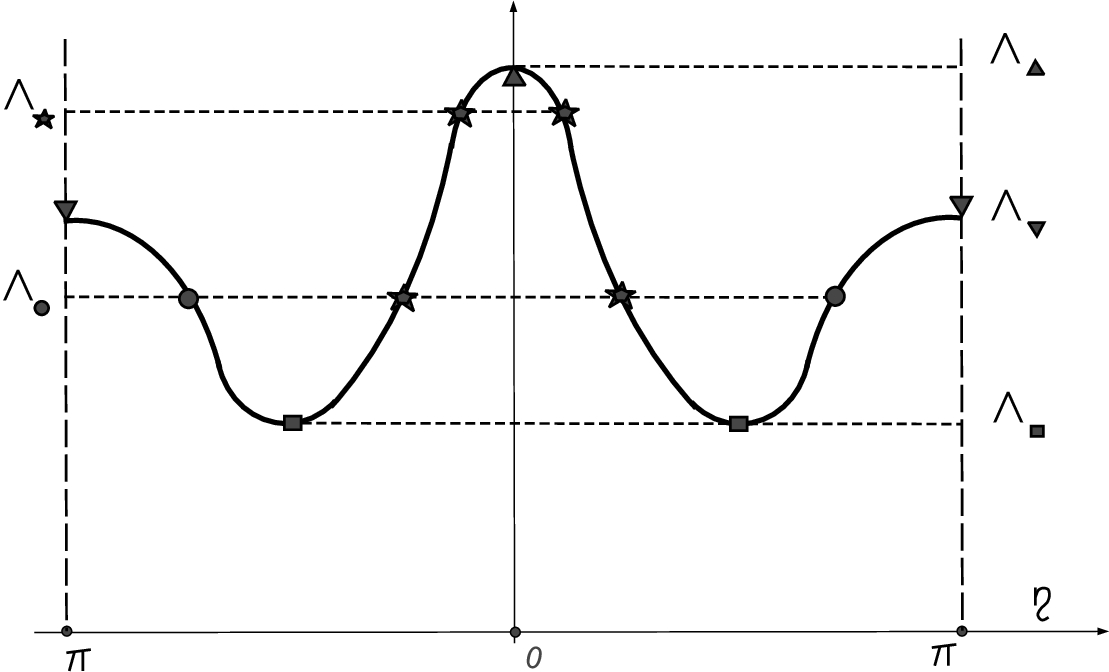
so that is still an eigenpair of the problem (2.15), since the coefficients of this problem are real. Hence, the graph of the function , where is an eigenvalue as in (2.10), is symmetric with respect to the ordinate axis, see Fig. 3.
Graph of a function .
We will consider several cases of geometrically simple eigenvalues4
Recall that if the eigenvalue is geometrically or algebraically simple, then there must hold or in the corresponding canonical system (2.20).
or has the algebraic multiplicity , cf. Fig. 3 with or ;
has the algebraic multiplicity , cf. Fig. 3 with .
Remark 5.1 will show that the case (i) is impossible for .
These are the typical cases. Our examples of the Umov–Poynting–Mandelstam classification of piezoelectric Floquet waves will explain the general approach in [27,31], [32, Ch. 5, §2]. The examples can be adapted to any canonical systems of Jordan chains.
We will also compare our Mandelstam radiation principle with the Sommerfeld and limiting absorption principles and show that the last two of them do not work in certain situations. For the classical Sommerfeld principle this is not new, since many examples of its failure are known, see the original publication [22], as well as [44, Ch. 1], [28,29] for elasticity and [5] for acoustics. However, a direct application of the above-mentioned results does not suffice to deduce the desired conclusion in piezoelectricity, because the Hermitian form (1.19) is not positive.
The limiting absorption principle was analysed in [44, Ch. 1] and [5] in the case (i), but not in the threshold cases (ii) and (iii). The threshold cases were considered for cylindrical and periodic elastic waveguides in [28] and [29], respectively. It was proven there that the limiting absorption principle does not always provide correct results. In Section 5.6, we will make a much more precise inference for the piezoelectricity problem.
Geometrically and algebraically simple eigenvalue
Let us set , and let , be the corresponding eigenvectors of the pencil . Recalling the definition of the pencil (2.17), the abstract equation (2.18) with , for the associated vector of the first rank, turns into the integral identity
Notice that the right-hand side of (5.2) is nothing but the -derivative of the expression
The assumed simplicity of the eigenvalue means that an associated vector does not exist, i.e., (5.2) does not have a solution. Hence, we deduce from the self-adjointness of the problem (5.2) and the Fredholm alternative that the number
does not vanish. Complex conjugation proves the equality
Substituting the Floquet wave
cf. (2.12) and (5.1), into the symplectic form (3.10) yields
Thus, the wave (5.5) is outgoing (respectively, incoming) in the case (resp. ). Moreover, the waves
fulfil the conditions (1.1).
Rejection of the Sommerfeld principle in piezoelectricity
In the references [44, Ch. 1], [28,29] (elasticity system) and [5] (acoustics) it was observed that the simple Floquet wave (5.5) is outgoing if and only if the point belongs to the ascending arc of the graph of with , and incoming in the case of the descending arc. The Sommerfeld radiation principle denotes as an incoming and as an outgoing wave according to the sign of the wavenumbers , which is correct for the points marked by ∙ in Fig. 3 but wrong for points marked by ⋆. In other words, the Sommerfeld principle does not work for vectorial problems and in periodic waveguides.
Let us verify the same feature for the piezoelectric waveguide Ω. To this end we make the perturbation
of the spectral parameter and derive asymptotics of eigenvalues
of the pencil by means of a general asymptotic procedure in [42, Ch. 9]. This book deals with non-self-adjoint, linear pencils, and reducing a quadratic pencil into such form is a very simple task. Furthermore, [42, Ch. 9] contains the justification procedure in the general case, and thus we only need to perform formal calculations without estimates of remainders.
According to [42, Ch. 9], we search for eigenvectors corresponding to the eigenvalues (5.9) in the form
where the last symbol is understood in the sense of the norm of . We insert (5.9) and (5.10) into the equation
and extract the coefficients of and . Rewriting the results as integral identities, we obtain the equation (2.8) for , and for we get
By the Fredholm alternative, the problem (5.12) has a solution if and only if the compatibility condition is valid. By (5.3), (5.4), this turns into the relation
and hence,
Comparing this formula with the classification (5.7) yields the above mentioned assertion on the ascending (out) and descending (in) arcs of the graph in Fig. 3.
Since the function is even in η and thus , the formula (5.14) implies that cannot be a simple eigenvalue of the pencil . Moreover, the same conclusion holds for the points and , since they are identified by the -periodicity.
An eigenvalue of algebraic multiplicity 2
Let be an eigenvalue of the pencil with only one Jordan chain of length . This chain generates one simple and one linear Floquet wave, (2.21),
The existence of the associated vector means that the functional , which is defined as in (5.2) by replacing and by and , satisfies the formula
Moreover, according to (2.18) with , the associated vector of rank 2 should be the solution of the integral identity
The non-existence of and the Fredholm alternative imply that
We write the problem (5.2) for and choose there . Simple transformations and complex conjugation yield
□
The associated vectorcan be fixed such that
To prove the second line in (5.20), we write using (3.10), (5.15), (5.16),
Here, we used (5.26), (5.19) to evaluate the last integral. Also, the second but last integral in (5.21) is null: it is equal to since (3.9) and (3.11) coincide, and on the other hand, it does not depend on z, so it must vanish.
The equality follows from (5.6) and (5.17). Since a solution of the problem (5.2) is defined only up to an eigenvector , we may make the substitutions
and obtain
It remains to note that is purely imaginary; thus, using Lemma 5.2 one can find which makes (5.23) into null. □
The relations (5.20) differ crucially from (1.1), and thus is not a convenient basis of . According to [31], [32, Ch. 5], we can select another basis
Lemma 5.3 proves that (5.24) satisfies the conditions (1.1).
The above consideration covers both cases (ii) and (iii) of Section 5.1. We only make the following comments: first, by -periodicity, the cases are identical with each other. Second, if with , then the quantities are computed as in (5.26) and (5.19) with evident changes, and they are equal to each other, contrary to the case of (5.3) and (5.4).
Let us consider the signs of in the graph in Fig. 3 with and , . To this end we again make the perturbation (5.4) to the spectral parameter , but replace the ansätze (5.9) and (5.10) by the following ones, according to [42, Ch. 9]:
Here, is a Jordan chain of length corresponding to the eigenvalue of and at the same time is the exponent of the small parameter .
Inserting (5.25) and (5.26) into the equation (5.11) and extracting the coefficients of , and also , yield the integral identities (2.8) and (5.12) for the functions and , respectively, and also the following problem for ,
where the functionals and are taken from (5.2), (5.3), and (5.26), respectively. Since the eigenvalue is geometrically simple, the compatibility condition in the problem (5.27) turns into the quadratic equation
see (5.17) and (5.19).
To conclude with the asymptotic procedure, we observe that the formulas (5.8) and (5.25) together with the equation (5.28) lead to the inferences
and
Since by (5.17) and the computation in Section 5.3, is a strict extremum of the function . Moreover, in the case of a maximum, (cf. Fig. 3 with , ) we take by putting the point below and thus find two real roots
for the equation (5.28). Finally, in the case with a minimum (cf. Fig. 3 with ), we take to put the point above Λ and again get two real roots (5.31) of (5.28).
The above consideration shows that the quantity (5.19) is strictly positive (respectively, negative) in the case of a local strict maximum (resp. minimum) of the function at the point .
We have determined the two lowest terms in the asymptotic expansions (5.25), (5.26) of the eigenpairs of the pencil . Skipping the third terms and replacing the remainders by completes the asymptotic analysis.
Limiting absorption principle
We apply a purely imaginary perturbation to the spectral parameter in the piezoelectricity problem (1.15)–(1.17), that is, we set
For anyand, the piezoelectricity problem (
4.3
) with the complex spectral parameter (
5.32
) has a unique solution.
Let us first consider the sign “+” in (5.32) and . Assume that the homogeneous problem (4.3) () has a nontrivial solution and insert it into the integral identity to obtain
Take the imaginary part and observe that according to (1.20), and thus so that , and , in view of the Dirichlet condition (1.16). In the case , the last argument fails, but assuming similarly to (2.9), again yields .
The same consideration works as such for , that is, for the adjoint problem, if . If , we must impose the additional conditions and , since the electric potential is defined only up to an additive constant. □
The limiting absorption principle, see the introduction and references in [5], states that a solution u of the problem with a real parameter Λ ought to be obtained as the limit of the solutions of the problem with the complex parameter (5.32). This limit may of course not belong to , although it satisfies certain radiation conditions at infinity, which have been regarded as “physically justified”.
First of all, treating the problem (4.3) in the weighted space with detached asymptotics will allow us to pass to the limit rigorously by using simple tools of perturbation theory of linear operators, cf. [10]. At the end of this section, a preliminary consideration will demonstrate that the existence of the limit requires at least the orthogonality conditions (4.20), which are natural in our formulation of the piezoelectricity problem with Mandelstam radiation conditions, see Theorem 4.3.
In the next section we will first prove that in the case of a simple eigenvalue of (Section 5.2) the compatibility conditions (4.20) are sufficient to obtain the limit u, and, moreover, that the solution u satisfies the Mandelstam radiation conditions. However, we will also prove that in a certain situation with an eigenvalue of algebraic multiplicity 2 (Section 5.3), the existence of the limit requires an additional orthogonality condition which has no physical sense at all. In this way the limiting absorption principle may become incorrect at a threshold of the spectrum of the problem (1.15)–(1.17).
Let us consider the formulation of the problem with the spectral parameter (5.32) in the weighted space with detached asymptotics, in order to simplify the technicalities in the next section.
We fix and such that in the rectangle , (3.12), the multiplicity of the spectrum is (the same as the multiplicity of ); we use here the stability theorem of the total multiplicity of the spectrum of a holomorphic pencil, [7, Ch. 1]. Since and , the total multiplicity of the spectrum in each of the smaller rectangles equals N; note that owing to [23], [32, §3.4] and the solvability of the problem (4.3) with in (Lemma 5.4), the interval is free of the spectrum.
Let be a subspace of the space of Floquet waves (3.8), generated by the eigenvalues , and let be a basis of . Since for , the exponential multiplier in (2.21) makes the function decay exponentially as and grow as .
The integral identity
(notice that β is replaced by in comparison with (4.3)) gives rise to the operator , see (4.5). Furthermore, the theorem on asymptotics [23], [32, Thm. 3.4.5] implies that the Banach space of vector functions
with norm
is the pre-image of for the mapping . The operator is the restriction of to .
The operator with is an isomorphism, because the problem (5.33) with is uniquely solvable in the Sobolev space, as was verified. This property is inherited by the restriction of onto the subspace
For everyand, the problem (
5.33
) has a unique solutionin the space (
5.36
).
We emphasize that the coefficient in the estimate
following from Proposition 5.5 depends on the small parameter and may grow when .
Both spaces and (Section 4.3) are isomorphic to the direct sum
where the first component contains the remainders and the second one the coefficient column in the asymptotic decomposition. However, the operators and can be close to each other only, if the spaces
coincide. In Section 5.6 we will give an example such that at a threshold value of Λ. However, this example does not harm the limiting absorption principle for this value of Λ, because one may assume that the radiation conditions with the linear subspace are physically correct, although the corresponding scattering matrix is loses the unitarity property. Also, the existence of the limit
requires some other condition on the right-hand side F in (5.33), and we will provide an example where the limit (5.40) does not exist even under the natural orthogonality conditions (4.20).
Success and failure of the limiting absorption principle
Let be a geometrically and algebraically simple eigenvalue of the pencil , and let and be defined as in Section 5.2. We change the real perturbation (5.8) to the imaginary one (5.32), but keep the ansätze (5.9) and (5.10) for the eigenpair of the pencil , and thus convert the equation (5.13) into
so that
In other words, the eigenvalue in (5.9) belongs to the rectangle in the case , but , if . Recalling our conclusion on ascending and descending arcs in Section 5.3 as well as the incoming and outgoing waves of (5.7), we observe that
where
In view of (5.9), (5.10) and the justification estimates in [42, Ch. 9], we have
Assume that all real eigenvalues of the pencilare geometrically and algebraically simple (cf. Fig.
3
with). Then, if the compatibility conditions (
4.20
) hold, the limit (
5.40
) exists and it can differ from the solution u of the problem (
5.33
) withand the Mandelstam radiation conditions (Theorem
4.3
) by an element ofonly, i.e., by a piezoelectric trapped mode.
We identify the spaces and by using the direct sum (5.38) and thus compare with . If , we take the terms of from (4.19) and set
i.e., and are the same elements of (5.38). Then
where is as in (1.21), and the operators and are defined as in (1.15), (1.17) using the matrix of (1.21). Clearly,
and by (5.42), (5.43) and (5.7) we have
because the commutators and have coefficient functions with compact supports. Finally, the estimates (1.22) imply that the coefficients of the operators and decay exponentially as . Recalling the assumption above Theorem 4.2, we easily conclude that
In this way, the norm of the difference of the last terms of (5.45) and (5.46) is seen to be , too.
Thus, the operator can indeed be regarded as a small perturbation of , and the assertion is a direct consequence of Theorem 4.3 and perturbation theory. □
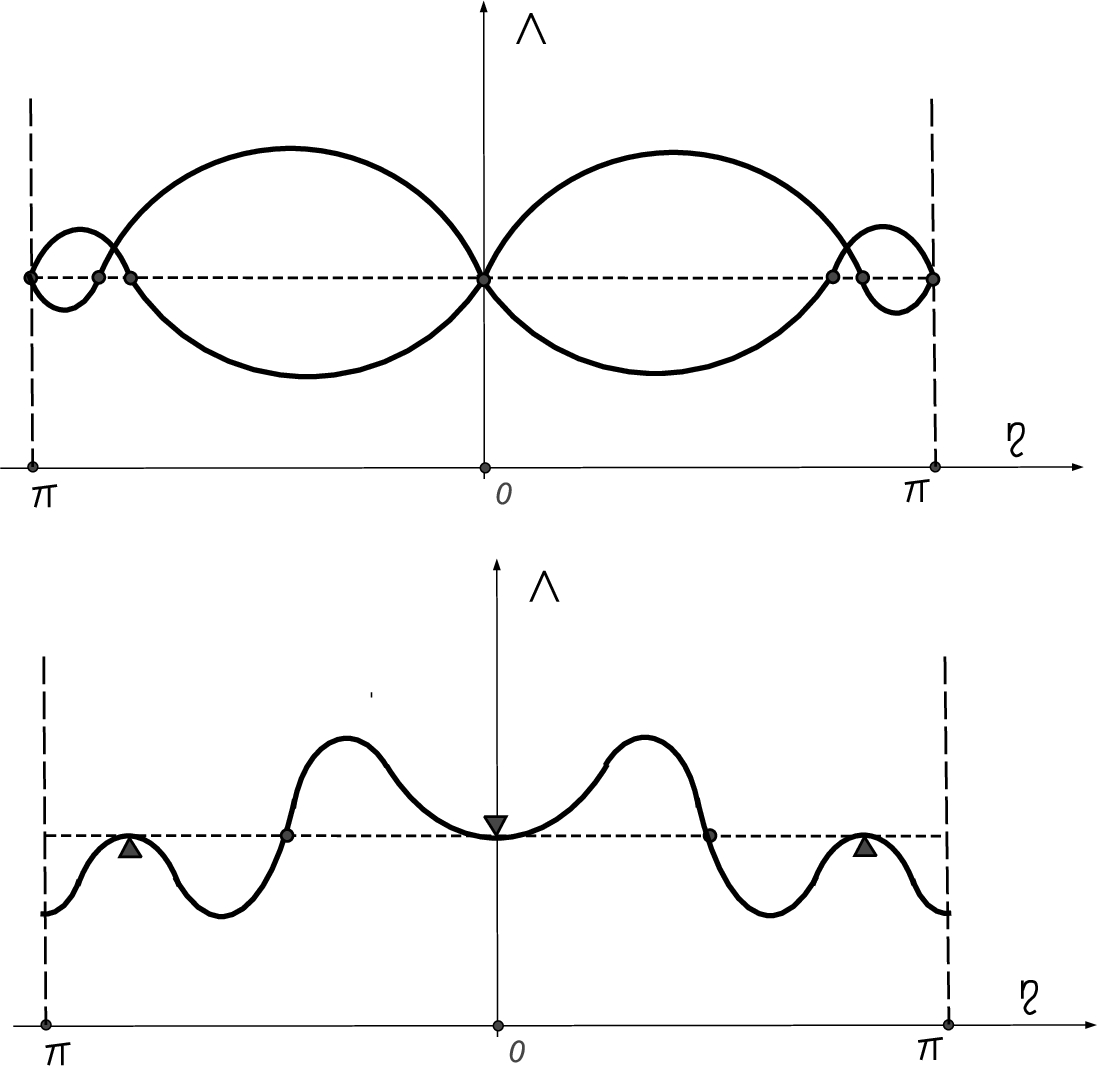
The conclusion of Theorem 5.6 holds true also for geometrically multiple but algebraically simple eigenvalues of the pencil. Moreover, the cases and , which could not be treated in Section 5.2, can also be included here. The multiplicities of the eigenvalues and must be even, cf. Fig. 4(a) with .
(a), (b) Various multiplicites of -eigenvalues.
Let now be a geometrically simple eigenvalue with algebraic multiplicity , Section 5.4. In order to construct the asymptotics of the eigenpairs of the pencil with the complex parameter (5.32) we follow [42, Ch. 9] and thus keep the ansätze (5.25), (5.26), but instead of (5.28) we obtain the quadratic equation
In the both possible cases , we get one root with and the other root . Thus, the eigenvalue belongs to and the corresponding Floquet wave
decays exponentially, when . Also, the limit of (5.47) is nothing but the standing Floquet wave (5.15), and
Recalling our definition of outgoing and incoming waves (5.24) according to the Mandelstam principle, we see that the subspaces and in (5.39) do certainly not coincide in the case of the eigenvalue with algebraic multiplicity 2, that is, for a threshold value of the spectral parameter Λ.
Let us now assume that all real eigenvalues of the pencil are geometrically simple and of algebraic multiplicity of 1 or 2 (see Fig. 4(b)) with signs ∙ and ▲, ▼, respectively). Then, according to the calculations above, we can compose a basis in from the outgoing and standing waves. Here, and are the numbers of eigenvalues with and , respectively ( and in Fig. 4(b)). In other words, a solution obtained by the limiting absorption principle has the decomposition
where the notation is similar to (4.19). The solution (5.49) is bounded in the same way as in the case of algebraically simple eigenvalues in , and this is why it is often considered as physically relevant. However, and thus, because of (5.49), it is not possible to define a unitary scattering matrix of full size , cf. the proof of Theorem 4.4.
Moreover, a result in [30] shows that the kernel of the operator related to radiation conditions (5.49) may be larger than . Elements of , i.e. solutions of the homogeneous piezoelectricity problem in Ω with asymptotic form (5.49) are called “almost standing” waves. The paper [30] contains a criterion for their existence in terms of the eigenvalues of the threshold scattering matrix of Theorem 4.4; the criterion is derived using the Mandelstam radiation principle. The almost standing waves are not stable, namely, small perturbations of the waveguide may cause them to vanish. They are closely related to many (in fact all those known by the authors) anomalies like Wood’s and Weinstein’s anomalies [43,45].
Assume that all eigenvalues of the pencilare geometrically simple and of algebraic multiplicity 1 or 2. Then, the solutionsof the problem (
5.33
) withhave a limit, (
5.40
), if and only if the right-hand sidesatisfies the orthogonality conditions (
4.20
) andThis limit has the asymptotic form (
5.49
), satisfies the problem (
4.3
) with β replaced by, and it is determined up to an addentum in.
The proof of this assertion is a repetition of the proof of Theorem 5.6 with evident changes, for example, the estimate (5.44) is replaced by (5.48).
If for some almost standing wave , i.e. the condition (5.50) fails, then an elementary asymptotic procedure [10,20,42] shows that the solutions have the terms , which do not have limits when . This phenomenon is in agreement with Theorem 5.8, and it can be interpreted as a failure of the limiting absorption principle in the present special situation. Namely, the additional orthogonality conditions (5.50) would be required to rectify the situation, and it is doubtful if they have any physical sense. Moreover, since it is not possible to determine a proper scattering matrix at any threshold of the spectrum of the piezoelectricity system, the authors tend to draw the conclusion that the limiting absorption principle does not work at thresholds at all. It should be emphasized that these deficiencies are not shared by the Mandelstam radiation conditions, which have been developed in our paper for the piezoelectricity system.
Limit passages
Elastic and acoustic periodic waveguides
Selecting makes the matrices (1.7) block-diagonal and causes the elastic and electric fields decouple in Ω. In this way one may adapt all the obtained results to pure elastic cylindrical and periodic waveguides. However, all these results are mainly known with the exception of Theorem 5.8, see [44] and [5,28,29]. The absence of the spectral parameter Λ in the electric line of the systems (1.9) and (1.15) prevents a direct application of our results to acoustics. However, we may change the statement of the problem in Ω artificially, namely, replace the block diagonal matrix E in (1.10) by the new matrix . As a result, we set up the “pseudo-piezoelectricity” problem (1.10)–(1.12) and go over to the formally self-adjoint problem (1.15)–(1.17) with the matrix
It is easy to observe that replacing by does not change any calculations or results in the previous sections, and in this way one can transfer our results to the scalar problem as well. This also complements the paper [5], where the same conclusions as in Sections 5.3 and 5.6 were drawn for the Sommerfeld and limiting absorption principles. The approach in [5] is different from [23], [32, Ch. 3, §4], and it does not deal at all with the threshold situation.
The above presented simple considerations do not suffice to treat composite piezoelectric waveguides with purely elastic inclusions, insulators or conductors, which are used in engineering practice. To deal with such waveguides we perform various limit passages similar to [17]. We emphasize that the corresponding asymptotic analysis is known and thus there is no need to present justification estimates; in addition to [17] we mention the book [38, Ch. 7]. Again, the absence of the spectral parameter on the lowest line of the system is crucial, since its presence would essentially modify the asymptotic analysis. The behavior of eigenvalues have not yet been investigated for the elasticity problem in the case of a high contrast of elastic moduli.
It is a most important observation that, in composite piezoelectric waveguides, the symplectic form (3.10) behaves well in all limit processes to be used. Hence, the formulation of the Mandelstam radiation conditions and the classification of outgoing/incoming waves remain the same as for the purely piezoelectric waveguides. We thus do not need to repeat the calculations and arguments performed in Sections 2–5.
Description of composite waveguides
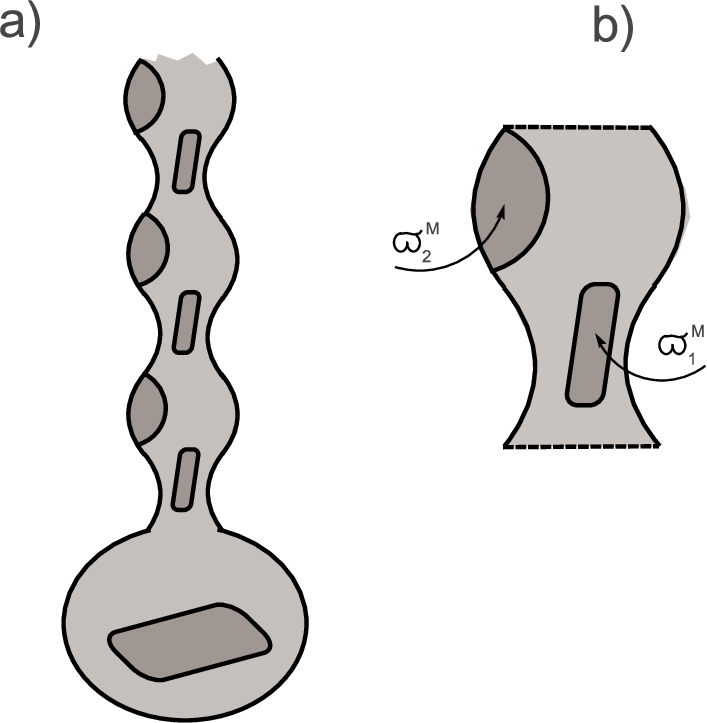
The purely elastic part of the waveguide Ω is an infinite open set , Fig. 5(a), such that
In other words, the inclusions are still periodic in . However, the subset is not necessarily connected, in contrast to Γ, and it thus consists of the connected components with piecewise smooth boundaries, Fig. 5(b). Some parts of boundary may intersect the exterior boundary .
Composite piezoelectric/purely elastic waveguide (a) and its periodic cell (b).
To adapt the results of Sections 3–5 to the composite waveguide we assume that the restriction of the matrix A, (1.7), to has the representation
where δ is a positive parameter and the blocks and are of sizes and , respectively, and also have the properties required for and in Section 1.2. Although the mechanical and electric fields decouple inside , the whole problem with is still piezoelectric. However, passing to the limits and makes the inclusion into a purely electric insulator and conductor, respectively.
Since the piezoelectricity problem is elliptic, both of these limit passages are well understood in the case of finite volume bodies, see, e.g., [17]. Thus, to make the desired conclusions on the composite waveguides it suffices to investigate the behavior of the elastic and electric fields at infinity, i.e., the behavior of the solutions of the spectral problems (2.3)–(2.6) or (2.8). We only formulate the assertions on the model problems in the periodicity cells; the analogues of Theorems 4.1, 4.2, and 4.3 for the composite waveguides can be proven word-by-word as in Section 4.
To simplify the demonstration, we assume that the 1-periodic matrices and are continuously differentiable in the subsets and of the periodicity cell . A similar continuity property is assumed on the density , too. Then, the differential form of the model problem (2.8) is the same as in (2.3)–(2.6) with the following transmission conditions on interfaces added:
Here, the notation is quite similar to (1.15), (1.17), (2.3), and (2.6), while the subscripts † and ∙ are related to the piezoelectric and, in the limit, elastic fragments of the composite cell. The superscript δ of the differential operators indicates dependence of the matrix (6.3) on that parameter.
The asymptotic analysis of the problem (6.4)–(6.6) becomes our next object.
Purely elastic insulating inclusions
Let δ be a small parameter, i.e., . We follow [38, Ch. 7], [17] and use the following asymptotic ansätze:
We insert (6.7)–(6.9) and(6.3) into (6.4)–(6.6), collect terms of order and derive the relations
At the same time the electric component in (6.9) must satisfy the scalar problem (recall the block-diagonal matrix (6.3) and the matrix E in (1.10))
Since the subset of the Dirichlet boundary is not empty, the mixed boundary value problem (6.13) is uniquely solvable, and this completes the treatment of the main terms in (6.7)–(6.9). Although the transmission conditions (6.12) involve the scalar Neumann boundary condition for on , the variational formulation of (6.10)–(6.12) can be derived in the standard way and it reads as
Here, the Sobolev space consists of vector functions with components and satisfying on . Notice that the restriction of to the subdomain does not have periodicity conditions, if , since in that case does not touch the ends and of the periodicity cell.
Our formal asymptotic analysis is justified by the following theorem.
Assume that the restriction of the matrix A tohas the representation (
6.3
) depending on the small parameter δ. For allandthere existand,such that the entriesandof the eigenvalue sequence (
2.10
) of the problems (
2.8
) and (
6.13
), respectively, are related byThe corresponding vector eigenfunctionsand,satisfy the estimate
Notice that the application of standard justification estimates requires the use of the energy functional (1.14) and the non self-adjoint form (1.9)–(1.11) of the piezoelectricity problem as well as the reduction to a self-adjoint operator, see [26] and also [17,33].
Associated vectors in Jordan chains and Floquet waves are solutions of the inhomogeneous problem (6.4)–(6.6) with a fixed spectral parameter . Hence, by an induction argument, one may compare elements of Jordan chains by means of estimates of type (6.16). According to general results [42, Ch. 9] and [7, Ch. 1], cf. Section 5.4, a perturbation of the problem may change the structure of the canonical systems of Jordan chains, but the total multiplicity of the spectrum of the pencil is preserved in a neighbourhood of a point. In this way Theorem 6.1 can be generalized to prove the proximity and convergence of Floquet waves restricted to the periodicity cell, cf. (5.44) and (5.48).
Purely elastic conductive inclusions
Let now δ be a large parameter, i.e. . We still use (6.7) and (6.8), but the representation (6.9) for in is replaced by
where are some constants. Inserting (6.7), (6.8), (6.17), and (6.18) into (6.4)–(6.6), taking (6.3) into account and extracting the terms of order yield the relations (6.10) in and (6.11) in , but the transmission conditions on become
where are the connected components of . At the same time, we observe that
However, in the case we need in addition to consider the correction electric term in (6.18), which must satisfy the following Neumann problem:
Here, and are the differential operators on the left-hand side of (6.13), and they clearly annihilate the main term in (6.18). The right-hand side with the electric component of the operator is explained by the coefficients δ of in (6.3) and of in (6.18). Since the problem (6.23) is formally self-adjoint, and is the only function satisfying the homogeneous problem, the Fredholm alternative gives just one compatibility condition
Note that the constants in (6.21) are arbitrary, if (6.22) does not fix them, but the orthogonality conditions (6.24) compensate this ambiguity. Hence, we write the variational formulation of the problem (6.10), (6.11), (6.19)–(6.21), and (6.24) as (6.14) in the Hilbert space , which consists of vector functions with components and satisfying the stable boundary and transmission conditions: namely, in addition to the Dirichlet conditions on γ and the -continuity of the displacements on , the restrictions (6.21) and (6.22) indicate a subspace of the Sobolev space. We also mention that the orthogonality conditions (6.24) have been derived from the integral identity (6.14) with the help of the Green formula and variation of constants .
We finish our consideration of the purely elastic conductive inclusions by formulating the following assertion similar to Theorem 6.1.
Assume that the restriction of the matrix A tohas the representation (
6.3
) with a large parameter δ. For allandthere exist,andsuch that the entriesandof the eigenvalue sequence (
2.10
) of the problems (
2.8
) and (
6.13
), respectively, are related byThe corresponding vector eigenfunctionsand,satisfy the estimatewhereare the constants in the conditions (
6.21
) for.
Conflict of interest
The authors declare that they have no conflict of interests.
Footnotes
Acknowledgements
The second named author was partially supported by the grant 18-01-00325 of the Russian Foundation of Basic Research and the grant 308829 of the Academy of Finland. The third named author was partially supported by a grant from the Väisälä Foundation of the Finnish Academy of Science and Letters.
References
1.
S.Agmon, A.Douglis and L.Nirenberg, Estimates near the boundary for solutions of elliptic partial differential equations satisfying general boundary conditions II, Comm. Pure Appl. Math.17(1) (1964), 35–92. doi:10.1002/cpa.3160170104.
2.
M.S.Agranovich and M.I.Vishik, Elliptic problems with parameter and parabolic problems of general form, Uspehi Mat. Mauk19(3) (1964), 53–160(in Russian).
3.
A.Bertram, Elasticity and Plasticity of Large Deformations, Springer, Berlin, 2005.
4.
M.S.Birman and M.Z.Solomyak, Spectral Theory of Selfadjoint Operators in Hilbert Space, Leningrad Univ., Leningrad, 1980. English transl.: Math. Appl. (Soviet Ser.), D. Reidel Publishing Co., Dordrecht, 1987.
5.
S.Fliss and P.Joly, Solutions of the time-harmonic wave equation in periodic waveguides: Asymptotic behaviour and radiation condition, Arch. Ration. Mech. Anal.219(1) (2016), 349–386. doi:10.1007/s00205-015-0897-3.
6.
I.M.Gelfand, Expansion in eigenfunctions of an equation with periodic coefficients, Dokl. Akad. Nauk SSSR73 (1950), 1117–1120(in Russian).
7.
I.C.Gohberg and M.G.Krein, Introduction to the Theory of Linear Nonselfadjoint Operators in Hilbert Space, Nauka, Moscow, 1965(in Russian). English transl.: Am. Math. Soc., Providence, RI, 1969.
8.
A.A.Griffith, The phenomena of rupture and flow in solids, Philosophical Transactions of the Royal Society of London, A221 (1921), 163–198. doi:10.1098/rsta.1921.0006.
9.
T.Ikeda, Fundamentals of Piezoelectricity, Oxford University Press, Oxford, 1996.
10.
T.Kato, Perturbation Theory for Linear Operators, Grundlehren Math. Wiss., Vol. 132, Springer-Verlag, New York, 1966.
11.
V.A.Kondratíev, Boundary value problems for elliptic equations in domains with conical and angular points, Trudy Moskov Mat. Obshch16 (1963), 219–292(in Russian). English transl.: Trans. Moscow Math. Soc. 16 (1967), 227–313.
12.
P.Kuchment, Floquet Theory for Partial Differential Equations, Oper. Theory Adv. Appl., Vol. 60, Birkhäuser, Basel, 1993.
13.
A.A.Kulikov and S.A.Nazarov, Cracks in piezoelectric and electrically conductive bodies, Siberian J. Industrial Math.8(1) (2005), 70–87.
14.
O.A.Ladyzhenskaya, Boundary Value Problems of Mathematical Physics, Nauka, Moscow, 1973(in Russian). English transl.: Springer, New York, 1985.
15.
S.Lang, Algebra, Springer, New York, 2002.
16.
S.G.Lekhnitskij, Theory of Elasticity of an Anisotropic Body, Nauka, Moscow, 1977(in Russian). English transl.: Mir Publishers, Moscow, 1981.
17.
G.Leugering and S.A.Nazarov, The Eshelby theorem and its variants for piezoelectric media, Arch. Ration. Mech. Anal.215(3) (2015), 707–739. doi:10.1007/s00205-014-0803-4.
18.
J.L.Lions and E.Magenes, Non-Homogeneous Boundary Value Problems and Applications, Springer, Berlin, 1972.
19.
L.I.Mandelstam, Lectures on Optics, Relativity, and Quantum Mechanics, Vol. 2, AN SSSR, Moscow, 1947.
20.
V.G.Maz’ya, S.A.Nazarov and B.A.Plamenevski, Asymptotic Theory of Elliptic Boundary Value Problems in Singularly Perturbed Domains, Vol. 1, Birkhäuser, Basel, 2000.
21.
V.G.Maz’ya and B.A.Plamenevski, On the coefficients in the asymptotics of solutions of elliptic boundary value problems in domains with conical points, Math. Nachr.76(1) (1977), 29–60(in Russian). English transl.: Amer. Math. Soc. Transl. Ser. 2 123 (1984), 57–88.
22.
R.D.Mindlin, Waves and vibration in isotropic elastic plates, in: Structural Mechanics, Pergamon Press, New York, 1960, pp. 199–232.
23.
S.A.Nazarov, Elliptic boundary value problems with periodic coefficients in a cylinder, Izv. Akad. Nauk SSSR. Ser. Mat.45(1) (1981), 101–112. English transl.: Math. USSR. Izvestija 18(1) (1982), 89–98.
24.
S.A.Nazarov, On the constants in the asymptotic expansion of solutions of elliptic boundary value problems with periodic coefficients in a cylinder, Vestnik Leningrad Univ.15 (1985), 16–22. English transl.: Vestn. Leningrad Univ. Math. 18(3) (1985), 17–22.
25.
S.A.Nazarov, Asymptotic Theory of Thin Plates and Rods, Vol. 1: Dimension Reduction and Integral Estimates, Nauchnaya Kniga (IDMI), Novosibirsk, 2002(in Russian).
26.
S.A.Nazarov, Uniform estimates of remainders in asymptotic expansions of solutions to the problem on eigen-oscillations of a piezoelectric plate, Probl. Mat. Analiz.25 (2003), 99–188. English transl.: Journal of Math. Sci. 114(5) (2003), 1657–1725.
27.
S.A.Nazarov, Properties of spectra of boundary value problems in cylindrical and quasicylindrical domains, in: Sobolev Spaces in Mathematics, V.A.Maz’ya, ed., International Mathematical Series, Vol. II, Springer, New York, 2008, pp. 261–309.
28.
S.A.Nazarov, The Mandelstam energy radiation conditions and the Umov–Poynting vector in elastic waveguides, Probl. Mat. Analiz.72 (2013), 101–146. English transl.: Journal of Math. Sci. 195(5) (2013), 676–729.
29.
S.A.Nazarov, Umov–Mandel’stam radiation conditions in elastic periodic waveguide, Mat. Sbornik.205(7) (2014), 43–72. English transl.: Sbornik Math. 205(7) (2014), 953–982. doi:10.4213/sm8286.
30.
S.A.Nazarov, Almost standing waves in a periodic waveguide with resonator and near-treshold eigenvalues, Algebra i Analiz St.-Petersburg Math.28(3) (2016), 111–160(in Russian). English transl.: St. Petersburg Math. J. 28(3) (2017), 377–410.
31.
S.A.Nazarov and B.A.Plamenevski, On radiation conditions for selfadjoint elliptic problems, Dokl. Akad. Nauk SSSR.311(3) (1990), 532–536. English transl.: Sov. Math. Dokl. 41(2) (1990), 274–277.
32.
S.A.Nazarov and B.A.Plamenevski, Elliptic Problems in Domains with Piecewise Smooth Boundaries, Walter de Gruyter, Berlin, 1994.
33.
S.A.Nazarov, K.Ruotsalainen and M.Silvola, Trapped modes in piezoelectric and elastic waveguides, J. Elasticity124(2) (2016), 193–223. doi:10.1007/s10659-015-9565-y.
34.
S.A.Nazarov and M.Specovius-Neugebauer, Singularities at the tip of a crack on the interface of piezoelectric bodies, Zap. Nauchn. Sem. St.-Petersburg Otdel. Mat. Inst. Steklov362 (2008), 241–271. English transl.: J. Math. Sci. 159(4) (2009), 524–540.
35.
S.A.Nazarov and J.Taskinen, Spectral gaps for periodic piezoelectric waveguides, Z. Angew. Math. Phys.66 (2016), 3017–3047. doi:10.1007/s00033-015-0561-7.
36.
V.Z.Parton and B.A.Kudryavtsev, Electromagnetoelasticity of Piezoelectric and Electroconductive Solids, Nauka, Moscow, 1988(in Russian).
37.
J.H.Poynting, On the transfer of energy in the electromagnetic field, Phil. Trans. Roy. Soc. London175 (1884), 343–361. doi:10.1098/rstl.1884.0016.
38.
J.Sanchez Hubert and E.Sánchez-Palencia, Vibration and Coupling of Continuous Systems: Asymptotic Methods, Springer-Verlag, Berlin, 1989.
39.
M.M.Skriganov, Geometric and arithmetic methods in the spectral theory of multidimensional periodic operators, Tr. Math. Inst. Steklov.171 (1985), 3–122. English transl.: Proc. Steklov Inst. Math. 171 (1987), 1–121.
40.
Z.Suo, C.M.Kuo, D.M.Barnett and J.R.Willis, Fracture mechanics for piezoelectric ceramics, J. Mech. Phys. Solids.40 (1992), 739–765. doi:10.1016/0022-5096(92)90002-J.
41.
N.A.Umov, Equations of Energy Motion in Bodies, Odessa, 1874(in Russian).
42.
M.M.Vainberg and V.A.Trenogin, Theory of Branching of Solutions of Nonlinear Equations, Nauka, Moscow, 1969(in Russian).
43.
L.A.Vainstein, Diffraction Theory and the Factorization Method, Sovetskoe Radio, Moscow, 1966.
44.
I.I.Vorovich and V.A.Babeshko, Dynamical Mixed Problems of Elasticity for Nonclassical Domains, Nauka, Moscow, 1979(in Russian).
45.
R.W.Wood, On a remarkable case of uneven distribution of light in a diffraction grating spectrum, Philos. Mag.4 (1902), 396–402. doi:10.1080/14786440209462857.