



Abstract
We study the large time behavior of solutions of first-order convex Hamilton–Jacobi Equations of Eikonal type
Keywords
Introduction
This work is concerned with the large time behavior for unbounded solutions of the first-order Hamilton–Jacobi equation
We always assume
Our goal is to prove that, under suitable additional assumptions, there exists a unique viscosity solution u of (1.1) and that this solution satisfies
This problem has not been widely studied comparing to the periodic case [1,4,7,12,13,15,25] and references therein. The main works in the unbounded setting are Barles–Roquejoffre [6] which extends the well-known periodic result of Namah–Roquejoffre [25], the works of Ishii [21] and Ichihara–Ishii [18]. A very interesting reference is the review of Ishii [22]. We will compare more precisely our results with the existing ones below but let us mention that our main goal is to make more precise the large time behavior for the Eikonal Equation (1.7) in a setting where the equation is well-posed for solutions with arbitrary growth, which brings delicate issues. Most of our results were already obtained or are close to results of [6,18] but we use pure PDE arguments to prove them without using Weak KAM methods and making a priori assumptions on the structure of solutions or subsolutions of (1.8).
Changing
Our first main result collects all the properties we obtain for the solutions of (1.8).
(Ergodic problem).
Assume that
If H satisfies (
1.2
) and
Assume that (
1.1
) satisfies a comparison principle in
If
Let
The situation is completely different with respect to the periodic setting where there is a unique ergodic constant (or critical value) for which (1.8) has a solution (e.g., Lions–Papanicolaou–Varadhan [24] or Fathi–Siconolfi [16]). We recover some results of Barles–Roquejoffre [6] and Fathi–Maderna [14], see Remark 2.3 for a discussion. As far as the case of unbounded solutions of elliptic equations is concerned, let us mention the recent work of Barles–Meireles [5] and the references therein.
Coming back to (1.1), when H satisfies (1.5), we have a comparison principle by a “finite speed of propagation” type argument, which allows to compare sub- and supersolutions without growth condition ([19,23] and Theorem A.1). It follows that there exists a unique continuous solution defined for all time as soon as there exist a sub- and supersolution.
Notice that the existence of a subsolution is given by (1.3) for instance.
We give two convergence results depending on the critical value
Assume (
1.2
)–(
1.3
)–(
1.4
)–(
1.5
),
(Large time behavior starting from particular unbounded from below initial data).
Assume (
1.2
)–(
1.3
)–(
1.4
)–(
1.5
),
Let us comment these results. The first convergence result means that, starting from any bounded from below initial condition (with arbitrary growth from above), the unique viscosity solution of (1.1) converges to a solution
To describe the second convergence result, suppose that (1.13) holds with the particular constant subsolution
Theorem 1.3 and Theorem 1.4 generalize and make more precise [6, Theorem 4.1] and [6, Theorem 4.2] respectively. In [6], H is bounded uniformly continuous in
Let us also mention that several other convergence results are established in [21] and [18] in the case of strictly convex Hamiltonian H and [17] is devoted to a precise study in the one dimensional case. We refer again the reader to the review [22] for details and many examples.
The paper is organized as follows. We start by solving the ergodic problem (1.8), see Section 2. Then, we consider the evolution problem (1.1) in Section 3. Section 4 is devoted to the proofs of the theorems of convergence. Finally, Section 5 provides several examples based both on the Hamilton–Jacobi equations (1.1)–(1.8) and on the associated optimal control problem.
The ergodic problem
Before giving the proof of Theorem 1.1, we start with a lemma based on the coercivity of H.
Let
Assumption (1.2) was stated in that way having in mind the Eikonal Equation (1.7) but it can be replaced by the classical assumption of coercivity
Let
We are now able to give the proof of Theorem 1.1. (i) We follow some arguments of the proof of [6, Theorem 2.1]. Fix We set (ii) Let (iii) Let We claim that v is a solution of (1.8). At first, by classical arguments [3], v is still a subsolution of (1.8) satisfying From (1.9), there exists (iv) Since To prove that v is unbounded from below, we use again the viscosity decrease principle [23, Lemma 4.1]. By (1.10), v satisfies, in the viscosity sense
For the second part of the result, we argue by contradiction assuming that (i) In the periodic setting, there is a unique (ii) In the periodic setting, the classical proof of existence of a solution to (1.8) [24] uses the auxiliary approximate equation
(iii) Neither the proof using (2.6), nor the proof of Theorem 1.1(i) using the Dirichlet problem (2.3) yields a nonnegative (or bounded from below) solution v of (1.8) for (iv) For (v) When (vi) Theorem 1.1 does not require H to satisfy (1.5) so it applies to more general equations than (1.7), for instance with quadratic Hamiltonians. (vii) The assumption that a comparison principle in
In this section we study the Cauchy problem (1.1). We start with some comments about Proposition 1.2 and then we prove it.
Existence and uniqueness are based on the comparison Theorem A.1 without growth condition, which holds when (1.5) is satisfied thanks to the finite speed of propagation. When (i) Let
The existence of such functions (ii) It is obvious that
Proof of Theorem 1.3
We first consider the case when
The first step is to obtain better estimates for the large time behavior of u. To do so, we consider
We have
There exist two constants
The proof of third inequality in Lemma 4.1 is obvious: since
The lim inf-one is less standard. Let
Next we have to examine the large time behavior of the solution associated to the initial condition
Assume (
1.4
) and let
To use it, we remark that the function
Then, by comparison (Theorem A.1)
The last assertion of Lemma 4.1 is obvious since
The next step of the proof of Theorem 1.3 consists in introducing the half-relaxed limits [3,9]
A formal direct proof of this inequality is easy:
This formal proof, although almost correct, is not correct since we do not have a local uniform convergence of u in a neighborhood of
For all
The following lemma, the proof of which is standard and left to the reader, collects some useful properties of
The functions
The functions
For all open bounded subset
For all
We are now ready to prove that
We now use the previous results to prove the convergence of u on
We claim that
At this stage, we can apply here the above formal argument to the locally Lipschitz continuous functions
Recalling that
We consider now the case when
But, from the first step, we know that (i) w converges locally uniformly to some solution
Let
To conclude this section, we point out the following result which is a consequence of the comparison argument we used in the proof.
Assume (
1.2
)–(
1.3
)–(
1.4
)–(
1.5
),
It is quite surprising that, though a lot of different solutions to (1.8) may exist (see Section 5.1), all the bounded from below solutions associated to
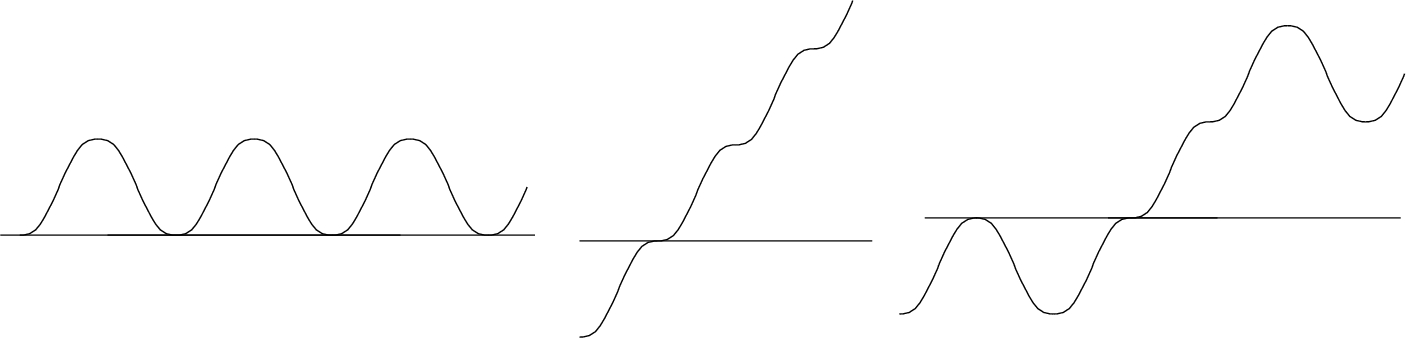
Some solutions of
By (1.13), there exists a subsolution
From Lemma 4.2,
In the same way, there exists unique viscosity solutions
Arguing as at the end of the proof of Theorem 1.3, the solutions of (1.1) associated to the initial datas
By comparison, we have, in Theorem 1.4 is very close to [18, Theorem 5.3]. In the latter paper, the authors obtain the convergence assuming that
Consider the one-dimensional Hamilton–Jacobi Equation
There exists a unique continuous solution u of (5.1) for every continuous
We can represent u as the value function of the following associated deterministic optimal control problem. Consider the controlled ordinary differential equation
Solutions to the ergodic problem
There are infinitely many essentially different solutions with different constants to the associated ergodic problem
Equation (5.1) with
For any solution
Let us find in another way the solution by computing the value function of the control problem stated above. Let
1st case:
The first one is to go as quickly as possible to 0 and to remain there (
The second one is to go as quickly as possible towards
2nd case:
The analysis of this case in terms of control will help us for the following examples.
Equation (5.1) with
with b bounded from below
To illustrate Theorem 1.3, we choose an initial condition which is a bounded perturbation of a bounded from below solution of the ergodic problem. To simplify the computations, we choose a periodic perturbation b.
For any x, an optimal strategy can be chosen among those described in Example 5.2. More precisely: go as quickly as possible to 0, wait nearly until time t and move a little to reach the minimum of the periodic perturbation. For t large enough (at least
Equation (5.1) with
with b bounded Lipschitz continuous
We compute the value function as above. Due to the unboundedness from below of
1st case:
2nd case:
In this case,
Equation (5.1) with
The solution of (5.1) is
Footnotes
Comparison principle for the solutions of ( 1.1 )
The comparison result for the unbounded solutions of (1.1) is a consequence of a general comparison result for first-order Hamilton–Jacobi equations which holds without growth conditions at infinity.
When
Barron–Jensen solutions of convex HJ equations
This result is due to Barron and Jensen [8] and we refer to Barles [1, p. 89]. Lemmas 4.3(iii) and 4.2 are consequences of this theorem.
As far as Lemma 4.3(iii) is concerned, the fact that the inf-convolution (respectively the sup-convolution) preserves the supersolution (respectively the subsolution) property is classical [2,3]. What is more suprising is the preservation of the subsolution property of the inf-convolution which comes from the convexity of H and the Theorem of Barron–Jensen B.1. For a proof, notice first that U, being a solution of (1.1), is a Barron–Jensen solution of (1.1). We then apply [23, Lemma 3.2] using that
Acknowledgements
Part of this work was made during the stay of T.-T. Nguyen as a Ph.D. student at IRMAR and she would like to thank University of Rennes 1 & INSA for the hospitality. The work of O. Ley and T.-T. Nguyen was partially supported by the Centre Henri Lebesgue ANR-11-LABX-0020-01. The authors would like to thank the referees for the careful reading of the manuscript and their useful comments.