We consider Dirac, Pauli and Schrödinger quantum Hamiltonians with constant magnetic fields of full rank in , , perturbed by non-self-adjoint (matrix-valued) potentials. On the one hand, we show the existence of non-self-adjoint perturbations, generating near each point of the essential spectrum of the operators, infinitely many (complex) eigenvalues. On the other hand, we give asymptotic behaviours of the number of the (complex) eigenvalues. In particular, for compactly supported potentials, our results establish non-self-adjoint extensions of Raikov–Warzel [Rev. in Math. Physics14 (2002), 1051–1072] and Melgaard–Rozenblum [Commun. PDE.28 (2003), 697–736] results. So, we show how the (complex) eigenvalues converge to the points of the essential spectrum asymptotically, i.e., up to a multiplicative explicit constant, as
in small annulus of radius around the points of the essential spectrum.
In , consider Dirac, Pauli and Schrödinger quantum Hamiltonians, described below, see Sections 1.1.1 and 1.1.2, with constant magnetic field of strength . To simplify the presentation, we shall not include any physical parameters. Namely, the particle mass, the particle charge, the speed of light, or the Planck constant are chosen equal to one. We denote the variables in , and the magnetic field b is generated by the magnetic vector potential
Let us recall and fix some useful definitions and notations. Let M be a closed operator acting on a separable Hilbert space . An isolated point λ in , the spectrum of M, lies in the discrete spectrum of M if its algebraic multiplicity is finite, being a small positively oriented circle centred at λ and containing λ as the only point of . We define the essential spectrum of M as the set of such that is not a Fredholm operator. When no confusion can arise in what follows below, we use the notation for , 2, and similarly , , 2.
Magnetic Schrödinger operators
The unperturbed Schrödinger operator acting in , describes a quantum non-relativistic particle of zero spin confined to the x-plane, and subject to the magnetic field of strength . It is essentially self-adjoint on and is defined by
In the literature, the operator is often called the Landau Hamiltonian, and it is well known that its spectrum is given by the set of the Landau levels (LLs) , , and each LL is an eigenvalue of infinite multiplicity. In other words, we have
In the sequel, we set , , and will denote the orthogonal projection onto the eigenspace . On the domain of , we define the perturbed operator
where V is the multiplication operator by the function (also) noted V, assumed to be complex-valued. For further use, we formulate the following different hypotheses on the potential V.
V does not vanish identically.
There exists a function for some such that , .
V is continuous on .
is mesurable, compactly supported, and holds on an open non-empty set of .
Magnetic Pauli and Dirac operators
In order to define the Pauli and Dirac operators, let us introduce the standard Pauli matrices
The choice of the matrices , and is not unique and is governed by the anti-commutation relations
where is the classical Kronecker symbol defined by if , and for .
The unperturbed Pauli operator acting in , describes a quantum non-relativistic particle of -spin confined to the x-plane, and subject to the magnetic field of strength . It is essentially self-adjoint on and is defined by
More explicitly, we have
showing, thanks to (1.3), that the spectrum of the operator is given by the set of the Landau–Pauli levels (LPLs) , , with
In the sequel, we denote the orthogonal projection onto the eigenspace .
The unperturbed Dirac operator acting in , describes a quantum relativistic particle of -spin confined to the x-plane, and subject to the magnetic field of strength . It is essentially self-adjoint on and is defined by
Furthermore, we have the identity
It is well know that the spectrum of the operator is given by the set of the Dirac–Landau levels (DLLs)
and each DLL is an eigenvalue of infinite multiplicity. In other words, we have
In the sequel, we denote the orthogonal projection onto the eigenspace .
On the domain of the operators and , we define the perturbed operators
where V is the multiplication operator by the non-hermitian matrix-valued function (also) noted
For further use, we introduce the following different conditions on V and the coefficients .
V does not vanish identically.
There exists a function for some , such that , , .
is continuous on , .
The coefficients that do not vanish identically satisfy: is mesurable, compactly supported, and holds on an open non empty set of .
Description of our results
Let denotes either , either , or . Under Assumptions 1.1(ii) or (iv), and Assumptions 1.2(ii) or (iv), we establish Schatten–von Neumann bounds implying in particular that V is a relatively compact perturbation w.r.t. the operator , see Propositions 3.1, 3.2 and 3.3 respectively. Thus, the Weyl criterion on the invariance of the essential spectrum implies that . However, [9, Theorem 2.1, p. 373] implies that the operator can have a discrete spectrum that can only accumulate at given by the set of the Dirac–Landau–Pauli levels (DLPLs).
Presently, the spectral analysis of non-self-adjoint quantum Hamiltonians is widely addressed, and, recently, accumulation problems on complex eigenvalues are investigated by several authors in various (non-self-adjoint) situations, see for instance the articles [1,3,5,7,17,22,23,27] and the references cited there. It is well known, see for instance [13,16,18] (see also the references therein), that when the operators are perturbed by self-adjoint electric potentials, then, accumulation of (real) discrete eigenvalues can happen near each point of their essential spectrum. However, as far we know, there are no such results when they are perturbed by non-self-adjoint electric potentials. The purpose of this paper is to fill this gap by announcing and giving an overview of new results in this direction. In particular, asymptotics of the counting function of the complex eigenvalues are obtained. More precisely, in a small annulus near a fixed DLPL, , we prove, see Theorems 2.1, 2.3, 2.5, the existence of the limit
for some oriented potentials , , with W of definite sign, and where denotes the orthogonal projection onto the eigenspace associated with the eigenvalue . As consequence, we derive from our main asymptotics results, non-self-adjoint extensions, see Theorems 2.2, 2.4, 2.6 and their generalizations, of Raikov–Warzel [19, Theorem 2.2] and Melgaard–Rozenblum [16, Theorems 1.2 and 1.3], showing how the (complex) eigenvalues converge to the DPLLs asymptotically. See also Remarks 2.2 and 2.6, together with their generalizations (2.12) and (2.32) for more details. Note that the nature of our accumulation phenomena is closely related to the degeneration of the DPLLs, which is characterized by the preponderance role of the Toeplitz operators . A key ingredient of the proof of our results is theoretical recent results established in [4].
Otherwise, it is also interesting to mention the following fact: the classical Lieb–Thirring inequalities could be interpreted as a bridge between quantum and classical mechanics, having important applications in the mathematical theory of stability of matter. If we consider an appropriate decaying potential , , with a non trivial negative part, and consider the discrete spectrum (namely the set of negative eigenvalues counted with the multiplicities) of the self-adjoint Schrödinger operator , then, the classical Lieb–Thirring inequalities, see [14] for the original work, read
with appropriate , and a constant which depends only on γ and d. Theorems 2.2, 2.4, 2.6 and their generalizations below, point out in particular the existence of non-self-adjoint perturbations V for which each element of is an accumulation point of a sequence of complex eigenvalues lying in . Therefore, this implies that the Lieb–Thirring inequality (1.17) cannot be satisfied in this case for the operators .
Our paper is organized as follows. In Section 2, we formulate our mains results. In Section 3, we establish preliminary Schatten-von Neumann bounds we need on the free operators. In Section 4, we reduce our problem and we give analytic interpretations of the discrete eigenvalues problem. Section 5 is devoted to the proof our main results.
Main results
Notations. We adopt mathematical physics and spectral analysis notations and terminologies from Reed–Simon [20]. Recall that a compact operator K, i.e. , defined on a separable Hilbert space belongs to the Schatten–von Neumann class ideals , if
We refer the reader to Simon [25] and Gohberg–Goldberg–Krupnik [10] for further information on the subject. In the sequel, as usual, the resolvent set of an operator M will be denoted .
Results on Schrödinger operators
We shall consider the following class of non-self-adjoint perturbations:
V is a complex-valued potential of the form:
, ,
W a real-valued potential such that .
We recall that , , defines the orthogonal projection onto for a given LL. Let V satisfy Assumptions 1.1(i)–(ii)–(iii) and 2.1, or Assumptions 1.1(iv) and 2.1. Firstly, this implies that is compact for any . To see this, consider for instance the formula for , and observe that
by Proposition 3.1 (see also [6]). Secondly, [16, Proposition 7.1] (see also [19, Lemma 3.5]) implies that . In the sequel, our results will be closely related to the Toeplitz operator , . Near a fixed LL, , the eigenvalues of the operator can be parametrized by , with k small enough, see Section 4 for more details. For , δ two positive constants fixed and tending to zero, we define the sector
and the counting function
Letsatisfy Assumptions
1.1
(i)–(ii)–(iii) and
2.1
, or Assumptions
1.1
(iv) and
2.1
. Fix a. Then, there exists a discrete setsuch that for all, the operatorsatisfies the following: there existssuch that:
,, satisfieswhere the sign ± in (
2.5
) is w.r.t. that of W in Assumption
2.1
.
The number of eigenvalues ofnearis infinite. Moreover, there exists a sequenceof positive numbers tending to zero such that
Theorem 2.1 remains valid if the condition is replaced by ω small enough.
When the function admits a power-like decay, an exponential decay, or is compactly supported, then, asymptotic behaviours of as are well known from [18, Theorem 2.6], [19, Lemma 3.4] and [19, Lemma 3.5], respectively. In particular, such asymptotics show that as . In this case, in Theorem 2.1, the eigenvalues of the operator satisfy near the LL,
Indeed, identity (2.7) can be obtained as follows: first, note that for satisfying [18, Theorem 2.6], [19, Lemma 3.4] and [19, Lemma 3.5], the quantity satisfies the hypotheses of [4, Corolllary 3.11] as . Then, we get (2.7) by mimicking the proof of Theorem 2.1(ii), replacing by r in (5.7), and by applying [4, Corolllary 3.11] instead of [4, Corolllary 3.9].
A consequence of Theorem 2.1 is the following result:
Let. Then, there exists a complex-valued potentialdecaying at infinity, generating near eachLL,, infinitely many eigenvalues lying in, which are concentrated near a semi-axis of origin.
According to Theorem 2.1, it suffices to consider any potential satisfying Assumptions 1.1(i)–(ii)–(iii) and 2.1, decaying at infinity, or Assumptions 1.1(iv) and 2.1, with . □
As shows the above proof, in Theorem 2.2, can be chosen compactly supported satisfying Assumptions 1.1(iv) and 2.1. In this case, according to [19, Lemma 3.5] together with Remark 2.1(b), we have
This shows how the (complex) eigenvalues converge to the LLs asymptotically. So, Theorem 2.2 can be reformulated in such a way we have a non-self-adjoint extension of Raikov–Warzel [19, Theorem 2.2] and Melgaard–Rozenblum [16, Theorem 1.2] (for ).
Generalization to higher dimensions: The magnetic self-adjoint Schrödinger operators in , , have the form , where is a magnetic potential generating the magnetic field. By introducing the 1-form , the magnetic field can be defined as its exterior differential. Namely, with , . In the case where the do not depend on , the magnetic field can be viewed as a real antisymmetric matrix . Assume that , put and . Introduce the real such numbers that the non-vanishing eigenvalues of B coincide with , . Consequently, in appropriate cartesian coordinates and , , the operators can be written as
If , namely when , the sum with respect to ℓ should be omitted and we get the Landau Hamiltonians with constant magnetic fields of full rank
defined originally on . It is well known, see for instance [6,16], that , where the eigenvalues
are known as the LLs. In the particular case , the LLs take the more simplest form , . The Schrödinger operator defined by (1.2) we consider corresponds to the case with shifted by . Nevertheless, in view of [16, Proposition 7.1], which is an extension of [19, Lemma 3.5] to higher dimensions , , Theorems 2.1 and 2.2 remain valid for the general Schrödinger operators in , , defined by (2.10). More precisely:
In Assumptions 1.1(ii)–(iii)–(iv), should be replaced by .
In Theorems 2.1 and 2.2, p should satisfy for and for . Actually, the condition for is the one we need to impose to get the analogous of Proposition 3.1 in the general case.
In Theorem 2.2, the complex-valued potential V should satisfy .
In (2.11), the number ϰ of different sets which determine one and the same LL is called the multiplicity of . In this case, in Remark 2.2, according to [16, Proposition 7.1], (2.8) will take the more general form
Results on Pauli and Dirac operators
We conserve the notations introduced previously. As above, we need to put an additional assumption on the matrix perturbation V as follows:
V is a matrix-valued potential of the form:
with ,
is hermitian such that in the form sense.
The Pauli case
Note that the matrix satisfies for . We recall that , , denotes the orthogonal projection onto for a given LPL. Thus, for V satisfying Assumptions 1.2(i)–(ii)–(iii) and 2.2, or Assumptions 1.2(i)+(iv) and 2.2, we have
by Proposition 3.2, for . Moreover, since
, , being the orthogonal projection onto , then, we have
so that
due to [16, Proposition 7.1] (see also [19, Lemma 3.5]). Our results will be closely related to the Toeplitz operator , . Near a fixed LPL, , the eigenvalues of the operator can be parametrized by , with k small enough, see Section 4 for more details. As above, we define the counting function
Under the above considerations, we establish the following theorem:
Letsatisfy Assumptions
1.2
(i)–(ii)–(iii) and
2.2
, or Assumptions
1.2
(i)+(iv) and
2.2
. Fix aLPL. Then, there exists a discrete setsuch that for all, the operatorsatisfies the following: there existssuch that:
,, satisfiesbeing the sector defined by (
2.3
), the sign ± in (
2.16
) being w.r.t. that of W in Assumption
2.2
.
If, the number of eigenvalues ofnearis infinite. Furthermore, there exists a positive sequencetending to zero such that
If, suppose moreover that. Then, the number of eigenvalues ofnearis infinite. Furthermore, there exists a positive sequencetending to zero such that
Theorem 2.3 remains valid if the condition is replaced by ω small enough.
Remark 2.1 remains valid with replaced by and the projection by .
Now, let V satisfy Assumptions 1.2(i)–(ii)–(iii) and 2.2, or Assumptions 1.2(i)+(iv) and 2.2, with
Then, (2.14) implies for that
Thus, as above, we have since
Therefore, this together with Theorem 2.3(iii) give the following corollary:
Under the assumptions and the notations of Theorem
2.3
, assume moreover that. Then, for(), the number of eigenvalues ofnear the fixed LPLis infinite, and, there exists a positive sequencetending to zero such thatsatisfies (
2.18
).
A consequence of Theorem 2.3(i)–(ii) and Corollary 2.1 is the following result:
Let. Then, there exists a non-hermitian matrix-valued potential, withdecaying at infinity, generating near eachLPL,, infinitely many eigenvalues lying in, which are concentrated near a semi-axis of origin.
Thanks to Theorem 2.3(i)–(ii) and Corollary 2.1, it suffices to consider any matrix-valued potential , , satisfying Assumptions 1.2(i)–(ii)–(iii) and 2.2, with , , 2 decaying at infinity, or Assumptions 1.2(i)+(iv) and 2.2. □
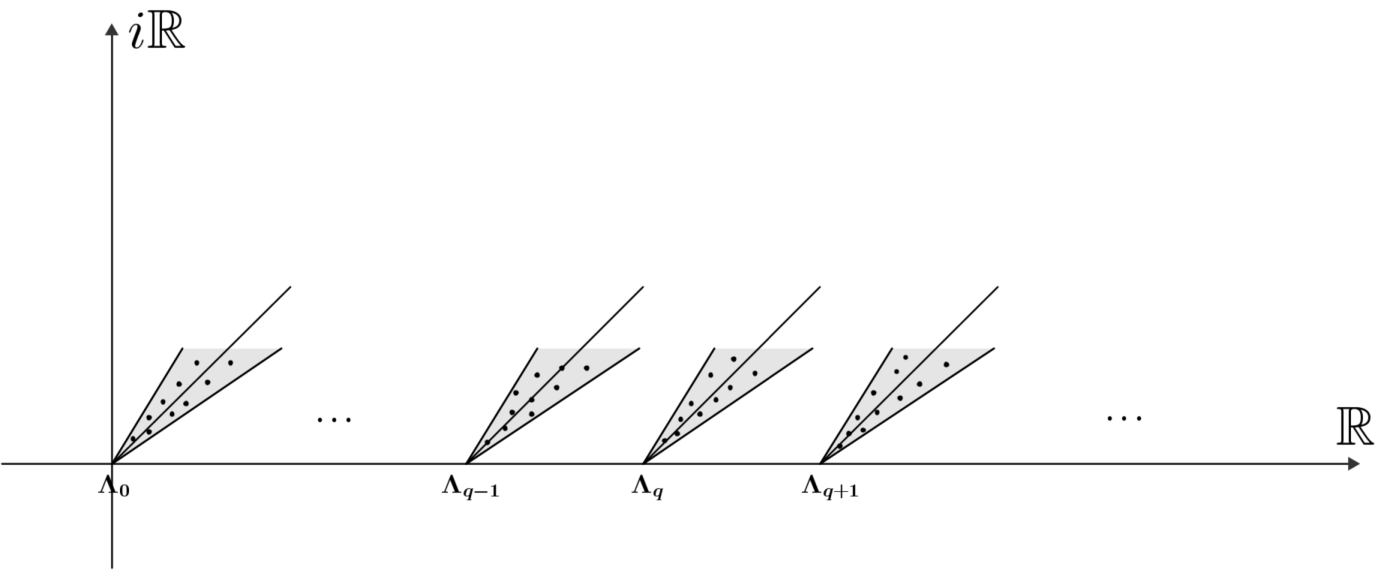
Similarly to Theorem 2.2, Fig. 1 illustrates graphically Theorem 2.4.
Illustration for the discrete spectrum generated near each LL by the potential V in Theorem 2.2.
The above proof shows that in Theorem 2.4, can be chosen such that , , 2, satisfy Assumptions 1.2(i)+(iv) and 2.2. In this case, if vanishes identically, then, (2.8) holds with replaced by .
Generalization to higher dimensions: Let , , be the Schrödinger operators defined by (2.10), and denotes the identity matrix. Then, see [24] and [16, Identity (4.12)], the Pauli operators with constant magnetic fields of full rank essentially self-adjoint in , , are originally defined on by
being the diagonal matrix having on the diagonal the sums , where belongs to the set . It is well-known, see for instance [16, Proposition 4.2], that the spectrum of the operator is given by the eigenvalues set of the PLLs with
The Pauli operator defined by (1.7) we consider corresponds to the case and . However, in view of [16, Proposition 7.1], Theorems 2.3, 2.4 and Corollary 2.1 remain valid for the general Pauli operators in , , defined by (2.20). More precisely:
In Assumptions 1.2(ii)–(iii)–(iv), should be replaced by .
In Theorems 2.3, 2.4 and Corollary 2.1, p should satisfy for and for . This condition is the one we need to impose to get the analogous of Proposition 3.2 in the general case.
In Theorem 2.4, the coefficients of the non-hermitian matrix-valued potential V should satisfy , .
The Dirac case
We recall that denotes the orthogonal projection onto , where , , and , , are the DLLs. Let V satisfy Assumptions 1.2(i)–(ii)–(iii) and 2.2, or Assumptions 1.2(i)+(iv) and 2.2. Then, we have
by Proposition 3.3, for . Near a fixed DLL, , the eigenvalues of the operator can be parametrized by , with k small enough, see Section 4 for more details. As above, we define the counting function
for a fixed DLL. Under the above considerations, we establish the following theorem:
Letsatisfy Assumptions
1.2
(i)–(ii)–(iii) and
2.2
, with, or Assumptions
1.2
(i)+(iv) and
2.2
. Fix aDLL. Then, there exists a discrete setsuch that for all, the operatorsatisfies the following: there existssuch that:
,, satisfieswhereis the sector defined by (
2.3
), andw.r.t..
Suppose moreover that. Then, the number of eigenvalues ofnearis infinite. Furthermore, there exists a positive sequencetending to zero such that
Now, let V satisfy Assumptions 1.2(i)+(iv) and 2.2 with . Then, by [16, Proposition 8.1], the Toeplitz operator , , obeys up to a multiplicative explicit constant, the asymptotic
Therefore, this together with Theorem 2.5 give the following corollary:
Letsatisfy Assumptions
1.2
(i)+(iv) and
2.2
. Assume moreover that. Then, in Theorem
2.5
, for, the number of eigenvalues ofnearis infinite, and there exists a positive sequencetending to zero such thatsatisfies (
2.25
).
Theorem 2.5 remains valid if the condition is replaced by ω small enough.
In Corollary 2.2, since is compactly supported, then, the eigenvalues of the operator satisfy near the DLL
A consequence of Theorem 2.5 and Corollary 2.2 is the following result:
Let. Then, there exists a non-hermitian matrix-valued potential, withdecaying at infinity, generating near eachDLL,, infinitely many eigenvalues lying in, which are located near a semi-axis of origin.
According to Theorem 2.5 and Corollary 2.2, it suffices to consider any matrix-valued potential satisfying Assumptions 1.2(i)+(iv) and 2.2, with . □
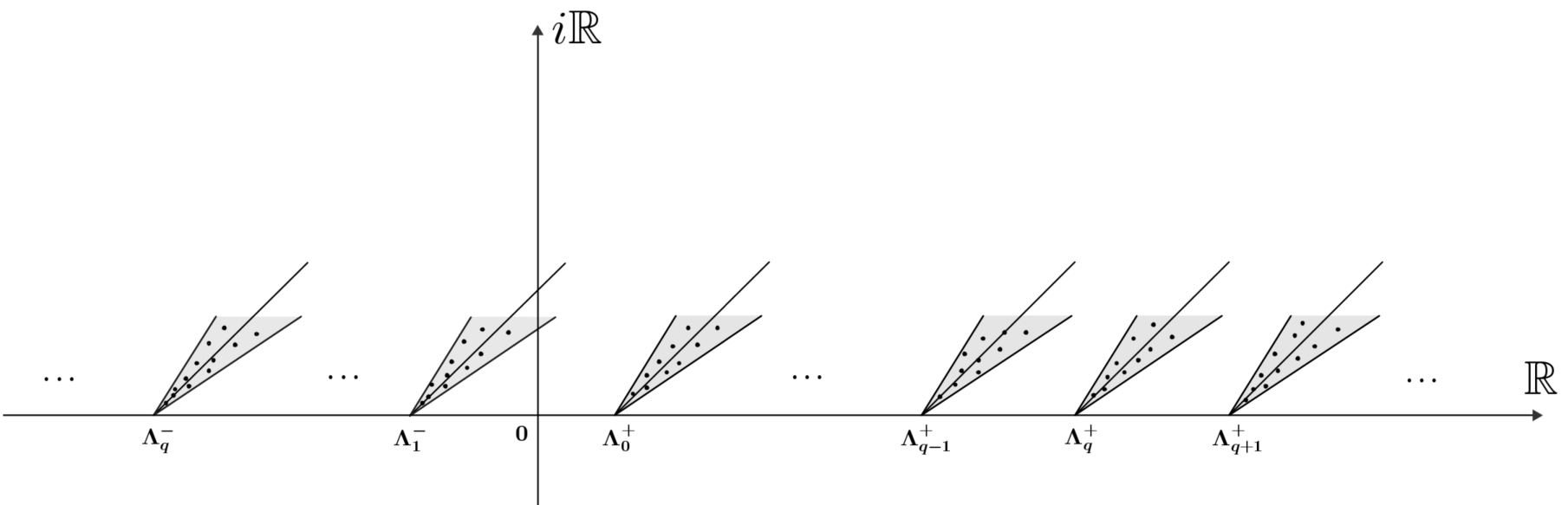
We refer to Fig. 2 for a graphic illustration of Theorem 2.6.
Illustration for the discrete spectrum generated near each DLL by the potential V in Theorem 2.6.
As shows the above proof, in Theorem 2.6, V can be chosen of the form , compactly supported satisfying Assumptions 1.2(i)+(iv) and 2.2. In this case, according to [16, Proposition 8.1] together with Remark 2.5(b), we have up to a multiplicative explicit constant,
In particular, this shows how the (complex) eigenvalues converge to the DLLs asymptotically. Hence, Theorem 2.6 can be reformulated in such a way we have a non-self-adjoint extension of Melgaard–Rozenblum [16, Theorem 1.3] (for ).
Generalization to higher dimensions: To define the Dirac operators with constant magnetic fields of full rank in higher dimensions , , we refer for instance to the description given in [16, Section 4] and [24] for more details. For a given , let be the Dirac matrices of size , governed, as in (1.6), by the relations
where denotes the identity matrix. For , , , introduce the operators and . Then, the Dirac operators with constant magnetic fields of full rank essentially self-adjoint in , , are originally defined on by
It is well-known, see for instance [16], that the spectrum of the operator is given by the eigenvalues set of the DLLs with
where can be expressed as . Note that in (2.31), the symmetry of breaks down for the “lowest” DLL corresponding to . It is either 1 or . The Dirac operator defined by (1.10) we consider corresponds to the case and . However, Theorems 2.5 remains valid for the general Dirac operators in , , defined by (2.30). Furthermore, in view of [16, Proposition 8.1], Corollary 2.2 and Theorem 2.6 remain also valid for the Dirac operators (2.30). More precisely:
In Assumptions 1.2(ii)–(iii)–(iv), should be replaced by .
In Theorems 2.5, 2.6 and Corollary 2.2, p should satisfy for . The condition , above, is the one we need to impose to get the analogous of Proposition 3.3 in the general case.
In Theorem 2.6, the coefficients of the non-hermitian matrix-valued potential V should satisfy , .
In Remark 2.6, according to [16, Proposition 8.1], (2.28) will take the more general form
up to a multiplicative explicit constant given by (4.17) of [16].
Schatten–von Neumann bounds
In this section, we establish useful Schatten–von Neumann bounds implying in particular the relatively compactness of the potential perturbation w.r.t. the free operators. We conserve the notations introduced above. Also, note that in the estimates or equalities appearing in the proofs below, the constants are generic, i.e. may change from an estimate or equality to another even if the same notation is used for simplification.
Bounds on Schrödinger operators
Let V be complex-valued satisfying Assumption
1.1
(ii), and. Then,and there exists a constantdepending only onand b, such that
Forcompactly supported, for each, the same conclusion holds withreplaced byin the r.h.s. of (
3.1
).
In particular, in both cases, V is relatively compact w.r.t. the operator.
(i) Due to Assumption 1.1(ii), there exists a bounded operator on such that . Thus, for some constant . Since , then, to show the claim, it suffices to prove that for any , we have the bound
(a) Firstly, we shall prove (3.2) for p even. To prove the general case, we shall use an interpolation argument. Let p be even. We have
The spectral mapping theorem yields
The diamagnetic inequality, see for instance [2, Theorem 2.3] and [25, Theorem 2.13], implies that there exists a constant such that
Now, since p is even, then, by the standard criterion [25, Theorem 4.1], it follows that
Thus, estimate (3.2), for p even, follows by putting together bounds (3.3), (3.4), (3.5) and (3.6).
(b) Let us show now that (3.2) is true for each . For any , there exists even integers such that with . Let with , and consider the operator
For , 1, let denote the constant appearing in (3.2), and define
Bound (3.2) implies that for , 1. By using the Riesz–Thorin Theorem, see for instance [8, Sub. 5 of Chap. 6], [21,26], [15, Chap. 2], we can interpolate between and to obtain the extension , with
Therefore, for any , we have
or equivalently estimate (3.2).
(ii) For compactly supported, for each . Thus, the claim follows according to (3.2). This concludes the proof of the proposition. □
Bounds on Pauli and Dirac operators
Concerning the Pauli operator, we have the following proposition:
Let V be non-hermitian matrix-valued satisfying Assumption
1.2
(ii), and. Then,and there exists a constantdepending only onand b, such that
Assume that V does not vanish identically and the coefficientsthat do not vanish identically satisfyand compactly supported. Then, for each, (
3.7
) holds withreplaced by,.
In particular, in both cases, V is relatively compact w.r.t. the operator.
It is left to the reader since the use of the identity (1.8) allows to mimic easily the proof of Proposition 3.1. Note that for V and the as in (ii), Assumption 1.2(ii) holds with , , for some constant . □
For the Dirac operator, we have the following result:
Let V satisfy Assumption
1.2
(ii) and. Then,and there exists a constantdepending only onand b, such thatwhere we have set,, being the LLs of the Schrödinger operator.
Assume that V does not vanish identically and the coefficientsthat do not vanish identically satisfyand compactly supported. Then, for each, (
3.8
) holds withreplaced by,.
In particular, in both cases, V is relatively compact w.r.t. the operator.
Since in the second point (ii) Assumption 1.2(ii) holds with , , for some constant , then, it suffices to prove only (i). Let , the resolvent set of the operator . We have
By setting
it follows from (3.10) that
Due to Assumption 1.2(ii), there exists a bounded operator on such that . Thus, it follows from (3.12) that there exists a constant such that
(a) Firstly, we estimate the second term of the r.h.s. of (3.13). Using (3.11), we find that there exists a constant such that
This together with the identity (1.11) implies that
We have
Since , then, the spectral mapping theorem implies that
Thus, reasoning as in the proof of Proposition 3.1, it can be shown by using (3.16), the diamagnetic inequality, the standard criterion [25, Theorem 4.1] and the interpolation argument, that
Similarly, we have
Since , then, the spectral mapping theorem implies that
Thus, reasoning as in the proof of Proposition 3.1, it can be shown by using (3.19), the diamagnetic inequality, the standard criterion [25, Theorem 4.1] and the interpolation argument, that
By putting together bounds (3.15), (3.18) and (3.21), we get
where and are defined by (3.9).
(b) Now, we estimate the first term of the r.h.s. of (3.13). Thanks to (1.11) and the identity , , it follows that
Thus, as in the proof of a) above, the use of the diamagnetic inequality, the standard criterion [25, Theorem 4.1] and the interpolation argument, allows to show that for , each term of the r.h.s. of (3.23) is bounded by , where is a constant depending only on p, b and α. In particular, for , we obtain
This together with bounds (3.13) and (3.22) give the proposition. □
Analytic interpretations of the discrete eigenvalues problem
For further use, let us recall some useful concepts by following [11, Section 4]. Let be a Hilbert space as above. We denote (resp. ) the set of bounded (resp. invertible) operators in .
Let be a neighbourhood of a fixed point , and be a holomorphic operator-valued function. The function F is said to be finite meromorphic at w if its Laurent expansion at w has the form , , where (if ) the operators are of finite rank. Moreover, if is a Fredholm operator, then, the function F is said to be Fredholm at w. In this case, the Fredholm index of is called the Fredholm index of F at w.
Letbe a connected open set,be a closed and discrete subset of, andbe a holomorphic operator-valued function in. Assume that F is finite meromorphic on(i.e. it is finite meromorphic near each point of Z), F is Fredholm at each point of, and there existssuch thatis invertible. Then, there exists a closed and discrete subsetofsuch that,is invertible for each,is finite meromorphic and Fredholm at each point of.
In the setting of Proposition 4.1, we define the characteristic values of F and their multiplicities as follows:
The points of where the function F or is not holomorphic are called the characteristic values of F. The multiplicity of a characteristic value is defined by
where is chosen small enough so that .
According to Definition 4.2, if the function F is holomorphic in , then, the characteristic values of F are just the complex numbers w where the operator is not invertible. Then, results of [12] and [11, Section 4] imply that is an integer. Let be a connected domain with boundary not intersecting . The sum of the multiplicities of the characteristic values of the function F lying in Ω is called the index of F w.r.t. the contour and is defined by
In order to simplify the presentation and to shorten the article, we will treat simultaneously the three Hamiltonians. Hence, we recall that denotes the operators , and . Thus, by (1.3), (1.9) and (1.13), we have
where and are the DLPLs. In the sequel, w.r.t. (4.3), we will write
, , will denote the orthogonal projection onto , and , , will denote the orthogonal projection onto . Thus, .
For a fixed spectral threshold , let
In the case fixed, we impose that
where denote the DLLs respectively on the right and the left on . Hence, we define . Put the change of variables and introduce . Thus, can be parametrized by
and we have the relation . We have the following proposition:
Letsatisfy the assumptions of Theorems
2.1
,
2.3
or
2.5
. Then, for any fixed spectral threshold,, the operator-valued functionis analytic with values in the Schatten–von Neumann class.
Assume that satisfy the assumptions of Theorems 2.1, 2.3 or 2.5. Then, thanks to Propositions 3.1, 3.2 and 3.3, together with for , we have .
Let us show the analyticity of the map . We have, using (4.6),
Now, each term of the sum (4.7) is analytic in . Then, so is the map . This concludes the proof. □
Propositions 3.1, 3.2 and 3.3 imply that the operator is of class , , for . Consequently, we can introduce the -regularized determinant
where . It is well known, see for instance [25, Chap. 9], that we have the characterization
Moreover, if the operator is holomorphic in a domain Ω, then so is the function in Ω, and the algebraic multiplicity of is equal to its order as zero of the regularized determinant .
Letsatisfy the assumptions of Theorems
2.1
,
2.3
or
2.5
. Letbe the operator defined in Proposition
4.2
. Then, for, the following assertions are equivalent:
is a discrete eigenvalue of,
,
is an eigenvalue of. Moreover, the following equality happenswhere γ is a small contour positively oriented containingas the unique point k satisfyingis a discrete eigenvalue of.
is a characteristic value of. Moreover, we have.
(i) ⇔ (ii) follows from (4.9) and the equality
(ii) ⇔ (iii) is a direct consequence of the definition of , , similarly to (4.8).
Let us prove (4.10). Let be the function defined by (4.9). By the discussion just after (4.9), if is a small contour positively oriented containing as the unique discrete eigenvalue of , then, we have
Now, (4.10) follows from the equality , see for instance the identity (2.6) of [4] for more details.
We conserve the notations introduced in the previous section. By (4.7), for , , we have
Thus, for satisfying the assumptions of Theorems 2.1, 2.3 or 2.5, we have
where the operator is holomorphic in . By setting
it follows from Proposition 4.3 that the study of the discrete eigenvalues near a fixed spectral threshold , , can be reduced to that of the characteristic values of
where and . In particular, we have . Furthermore, we have implying that . Let denote the orthogonal projection onto , and note that is a compact operator. Therefore, there exists a discrete set
such that the operator is invertible for each .
Thus, (i) of Theorems 2.1, 2.3 and 2.5 is an immediate consequence of [4, Corollary 3.4(i) and (ii)] with . More precisely, the discrete eigenvalues satisfy
for any , with the sector defined by (2.3).
Now, Proposition 4.3 together with (5.4) show that is a discrete eigenvalue of if and only if is a characteristic value of , with the same multiplicity. In the sequel, we denote this set characteristic values by . Futhermore, (5.5) shows that for , the characteristic values are concentrated in a sector , . In particular, for , we have
Due to (2.2), (2.13) and (2.22), we have . Then, if , [4, Corollary 3.9] implies that there exists a sequence of positive number tending to zero such that
Thus, by putting together (5.6) and (5.7), it follows Theorem 2.1(ii), Theorem 2.3(ii)–(iii), and Theorem 2.5(ii), with
Footnotes
Acknowledgements
Supported by the Chilean Fondecyt Grant 3170411.
References
1.
J.Almog, D.S.Grebenkov and B.Helffer, Spectral semi-classical analysis of a complex Schrödinger operator in exterior domains, arXiv:1708.02926.
2.
J.Avron, I.Herbst and B.Simon, Schrödinger operators with magnetic fields. I. General interactions, Duke Math. J.45 (1978), 847–883. doi:10.1215/S0012-7094-78-04540-4.
3.
S.Bögli, Schrödinger operators with non-zero accumulation points of complex eigenvalues, Comm. Math. Phys.352(2) (2017), 629–639. doi:10.1007/s00220-016-2806-5.
4.
J.-F.Bony, V.Bruneau and G.Raikov, Counting function of characteristic values and magnetic resonances, Commun. PDE.39 (2014), 274–305. doi:10.1080/03605302.2013.777453.
5.
J.-C.Cuenin, A.Laptev and C.Tretter, Eigenvalues estimates for non-selfadjoint Dirac operators on the real line, Ann. Henri Poincaré15(4) (2014), 707–736. doi:10.1007/s00023-013-0259-3.
6.
M.Dimassi and G.Raikov, Spectral asymptotics for quantum Hamiltonians in strong magnetic fields, Cubo Matemática Educacional3 (2001), 317–391.
7.
C.Engström and A.Torshage, Accumulation of complex eigenvalues of a class of analytic operator functions, arXiv:1709.01462.
8.
G.B.Folland, Real Analysis Modern Techniques and Their Applications, Pure and Apllied Mathematics, John Whiley and Sons, 1984.
9.
I.Gohberg, S.Goldberg and M.A.Kaashoek, Classes of Linear Operators, Operator Theory, Advances and Applications, Vol. 49, Birkhäuser Verlag, 1990.
10.
I.Gohberg, S.Goldberg and N.Krupnik, Traces and Determinants of Linear Operators, Operator Theory, Advances and Applications, Vol. 116, Birkhäuser Verlag, 2000.
11.
I.Gohberg and J.Leiterer, Holomorphic Operator Functions of One Variable and Applications, Operator Theory, Advances and Applications, Methods from Complex Analysis in Several Variables, Vol. 192, Birkhäuser Verlag, 2009.
12.
I.Gohberg and E.I.Sigal, An operator generalization of the logarithmic residue theorem and Rouché’s theorem, Mat. Sb. (N. S.)84(126) (1971), 607–629.
13.
V.Y.Ivrii, Microlocal Analysis and Precise Spectral Asymptotics, Springer-Verlag, Berlin, 1998.
14.
E.H.Lieb and W.Thirring, Bound for the kinetic energy of fermions which proves the stability of matter, Phys. Rev. lett.35 (1975), 687–689, Errata 35 (1975), 1116. doi:10.1103/PhysRevLett.35.1116.
M.Melgaard and G.Rozenblum, Eigenvalue asymptotics for weakly perturbed Dirac and Schrödinger operators with constant magnetic fields of full rank, Commun. PDE.28 (2003), 697–736. doi:10.1081/PDE-120020493.
17.
B.S.Pavlov, On a non-selfadjoint Schrödinger operator. II, Problems of Mathematical Physics, Izdat. Leningrad. Univ.2 (1967), 133–157, (Russian).
18.
G.D.Raikov, Eigenvalue asymptotics for the Schrödinger operator with homogeneous magnetic potential and decreasing electric potential. I. Behaviour near the essential spectrum tips, Commun. PDE.15 (1990), 407–434. doi:10.1080/03605309908820690.
19.
G.D.Raikov and S.Warzel, Quasi-classical versus non-classical spectral asymptotics for magnetic Schrödinger operators with decreasing electric potentials, Rev. in Math. Physics14(10) (2002), 1051–1072. doi:10.1142/S0129055X02001491.
20.
M.Reed and B.Simon, Scattering Theory III, Methods of Modern Mathematical Physics, Academic Press, INC., 1979.
21.
M.Riesz, Sur les maxima des formes bilinéaires et sur les fonctionnelles linéaires, Acta Math.49 (1926), 465–497. doi:10.1007/BF02564121.
22.
D.Sambou, On eigenvalue accumulation for non-self-adjoint magnetic operators, J. Maths Pures et Appl.108 (2017), 306–332. doi:10.1016/j.matpur.2016.11.003.
23.
D.Sambou, A simple criterion for the existence of nonreal eigenvalues for a class of 2D and 3D Pauli operators, Linear Alg. and its Appli.529(12) (2017), 51–88. doi:10.1016/j.laa.2017.04.004.
24.
I.Shigekawa, Spectral analysis of Schrödinger operators with magnetic fields for a spin particule, J. Funct. Anal.101 (1991), 255–285. doi:10.1016/0022-1236(91)90158-2.
25.
B.Simon, Trace Ideals and Their Applications, Lond. Math. Soc. Lect. Not. Series, Vol. 35, Cambridge University Press, 1979.
26.
G.O.Thorin, An extension of a convexity theorem due to M. Riesz, Kungl. Fysiografiska Saellskapet i Lund Forhaendlinger8(14) (1939).
27.
X.P.Wang, Number of eigenvalues for a class of non-selfadjoint Schrödinger operators, J. Maths Pures et Appl.96(9) (2011), 409–422. doi:10.1016/j.matpur.2011.06.004.