We consider Jacobi matrices J whose parameters have the power asymptotics and for the off-diagonal and diagonal, respectively.
We show that for , or and , the matrix J is in the limit circle case and the convergence exponent of its spectrum is . Moreover, we obtain upper and lower bounds for the upper density of the spectrum.
When the parameters of the matrix J have a power asymptotic with one more term, we characterise the occurrence of the limit circle case completely (including the exceptional case ) and determine the convergence exponent in almost all cases.
A Jacobi matrix J is a tridiagonal semi-infinite matrix
with real and positive . A Jacobi matrix induces a closed symmetric operator on , namely as the closure of the natural action of J on the subspace of finitely supported sequences, see, e.g., [1, Chapter 4.1]. There occurs an alternative:
is selfadjoint; one speaks of the limit point case (lpc), or, in the language of [1], type D.
has defect index and is entire in the sense of M.G. Kreĭn; one speaks of the limit circle case (lcc), or, synonymously, type C.
In the lpc, the spectrum of may be discrete, continuous, or be composed of different types. If J is in the lcc, then the spectrum of every canonical selfadjoint extension of is discrete, and each two spectra are interlacing. In this case, we fix one such extension and denote its spectrum by .
In general it is difficult to decide from the parameters , whether J is in the lcc or lpc. Two classical necessary conditions for occurrence of lcc are Carleman’s condition which says that implies lpc, cf. [8], and Wouk’s theorem that a dominating diagonal in the sense that or implies lpc, cf. [22]. A more subtle result, which gives a sufficient condition for lcc, is due to Yu.M. Berezanskiĭ, cf. [3, Theorem 4.3], [4, VII, Theorem 1.5] or [1, Addenda 5, p. 26]: Assume that , that the sequence of diagonal parameters is bounded, and that the sequence of off-diagonal parameters behaves regularly in the sense that (log-concavity). Then J is in the lcc. An extension and modern formulation of this result can be found in [5, Theorem 4.2]. In particular, instead of being bounded it is enough to require .
There is a vast literature dealing with Jacobi matrices in the lpc, whose aim is to establish discreteness of the spectrum and investigate spectral asymptotics, e.g., [7,10–12,21]. Contrasting this, if J is in the lcc, not much is known about the asymptotic behaviour of the spectrum.
The probably first result in this direction is due to M. Riesz [19] and states that the spectrum of a Jacobi matrix in the lcc is sparse compared to the integers, in the sense that ( denote the sequences of positive or negative points in , arranged according to increasing modulus)
A deeper result holds in the context of the already mentioned work of Berezanskiĭ. Under the mentioned assumptions, C. Berg and R. Szwarc showed that the convergence exponent of the spectrum coincides with the convergence exponent of the sequence of off-diagonal parameters of J, cf. [5, Theorem 4.11]. Recall that the convergence exponent of a sequence , which we denote by , is defined as the greatest lower bound of all such that .
In this paper we contribute to the study of the spectrum of Jacobi matrices in the lcc. We investigate Jacobi matrices J whose parameters have, for some , power asymptotics
with , .
In our first theorem, we show that, apart from the exceptional case that , a characterisation of the lcc is possible. Moreover, we give bounds for the upper density of the spectrum, in particular, determine the convergence exponent.
Our second theorem treats the exceptional case that , or equivalently and . Under the stronger assumption (2), we fully characterise the occurrence of the lcc and determine the convergence exponent of the spectrum in almost all cases.
Let J be a Jacobi matrix with off-diagonaland diagonalwhich have the power asymptotics (
1
) with some,,,and.
Consider the following two cases.
, andif
In this case, J is in the lpc.
, andif
In this case, J is in the lcc if and only ifis greater than 1.
In the lcc, the convergence exponent of the spectrum is. Moreover, we have the following bounds for the upper density of the spectrum,wheredenotes the counting function, and
Note that case (i) in Theorem 1 is equivalent to , whereas case (ii) corresponds to .
Having (1) implies that is log-concave. Hence, if , the above discussed extension of Berezanskiĭ’s theorem applies and yields . Note that the convergence exponent of a sequence with (1) is .
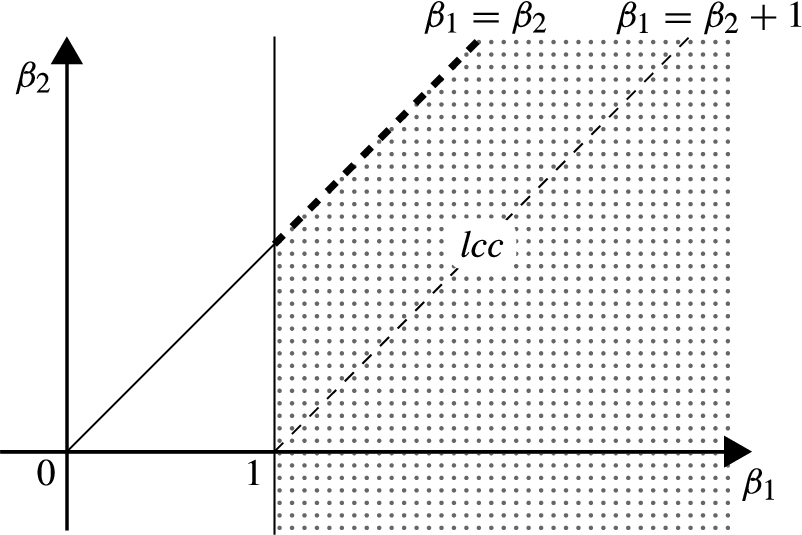
For , Theorem 1 refines this result by providing explicit estimates for the upper density of the spectrum. However, the main significance is that the statement remains valid for , and even in some cases where , i.e., where diagonal and off-diagonal parameters are comparable, see Figure 1.
Occurrence of the limit circle case.
In order to handle the exceptional case, we require the stronger assumption that the parameters of the Jacobi matrix J have, for some , power asymptotics of the form
with and .
Let J be a Jacobi matrix with off-diagonaland diagonalwhich have the power asymptotics (
2
) with some,,,and.
Assume thatand. Then, exactly one of the following cases takes place.
In this case, J is in the lpc.
In this case, J is in the lcc. If, then the convergence exponent of the spectrum is. Forwe have.
In this case, J is in the lcc if and only if, whereIn the lcc, the convergence exponent of the spectrum is.
When J is in the lcc, the following lower estimate of the density of the spectrum holds,
We strongly believe that the convergence exponent of the spectrum is equal to whenever J is in the lcc, even for in the case (ii).
In case (iii) of Theorem 2, the parameter β is already given by , , , . Hence, the condition can equivalently be written as the two conditions
Moreover, the notation , which is introduced in that case, relates to Wouk’s theorem, cf. (9).
In the proofs of these theorems we first establish that the power asymptotics of the Jacobi parameters, i.e. (1) or (2), give rise to the asymptotic behaviour of a fundamental solution of the finite difference equation (3) corresponding to J. This is achieved by applying theorems of R. Kooman. In the proof of Theorem 1, we use [14, Corollary 1.6], which is a generalisation of the classical Poincare–Perron theorem to the case that the zeros of the characteristic equation may have the same modulus but are distinct. In the exceptional case, the characteristic equation has a double zero and the more involved theorem [15, Theorem 1] is needed. In any case, the asymptotic behaviour of solutions directly leads to a characterisation of the lcc.
The crucial step is to estimate the upper density of the spectrum and determine the convergence exponent in the lcc. Here we use the fact that the growth of the counting function relates to the growth of the canonical product having the spectrum as its zero-set. The upper density of the spectrum is in our setting always bounded from below by a result of C. Berg and R. Szwarc, i.e. [5, Proposition 7.1]. In the proof of Theorem 1, we obtain an upper bound of the upper density by estimating the canonical product by hand. In particular, this determines the convergence exponent of the spectrum. If one is only interested in the convergence exponent, it is enough to apply [5, Theorem 1.2]. In the situation of Theorem 2, both approaches fail and a better estimate of the canonical product is needed, cf. Remark 5. This is achieved by writing the Jacobi matrix as a Hamburger Hamiltonian of a canonical system and applying [18, Theorem 2.7], which goes back to a theorem of R. Romanov, cf. [20, Theorem 1].
Let J be a Jacobi matrix with parameters and having the power asymptotics (1) with some , , , and .
Recall Wouk’s theorem, which is formulated in the Introduction. Since does not change its sign for n large enough, this theorem states that if , then J is in the lpc.
In case (i), we have , which implies
Hence, J is in the lpc by Wouk’s theorem. It remains to treat case (ii). Thus, assume , and if .
Step 1: Growth of solutions
We start with studying asymptotics of solutions of the difference equation
Dividing by yields
with
We denote by , the zeros of the characteristic polynomials, i.e.
Note that the limit
is negative by assumption. It follows that and are, for n large enough, complex conjugate numbers, which converge to distinct numbers, i.e.
Moreover, is summable for due to
Now [14, Corollary 1.6] yields two linearly independent, complex conjugate solutions , of (3) with
By using [15, Lemma 4], adding a summable perturbation, we get
for a constant . Hence, the normalized solutions for satisfy . In particular, they are square-summable and J is in the lcc if and only if .
Step 2: The lower bound in the lcc
From the first step we know that the corresponding moment problem is in the lcc. Thus, the Nevanlinna matrix which parametrizes all solutions of the moment problem is available, cf. [1,17]. These four entries are canonical products and have the same growth, i.e. the same type w.r.t. any growth function, cf. [2, Proposition 2.3]. In particular, they have the same order and type.
The zeros of B interlace with the spectrum of any canonical selfadjoint extension of . Thus, the counting function of the zeros of B, which we denote by , differs from by at most 1. Hence, knowledge about the growth of any entry of the Nevanlinna matrix can be used to derive knowledge about the distribution of the spectrum. In particular, the order of B coincides with the convergence exponent of the spectrum, and the type of B is comparable to the upper density of the spectrum with explicit constants.
The order and type of the entries of the Nevanlinna matrix are, by [5, Proposition 7.1(ii), (iii)], bounded from below by the order and type of the entire function
where denotes the leading coefficient of the n-th orthogonal polynomial of the first kind associated with the matrix J. The power asymptotic of yields
for a constant . By the standard formula for the order and type of a power series, cf. [16, Theorem 2], we get that the order of is , and the type w.r.t. this order is equal to .
Thus, we get and , where denotes the type of B w.r.t. the order . The inequality between the type of a canonical product and the upper density of its zeros, cf. [16, Eq. (1.25)], gives
Step 3: The upper bound in the lcc
In the first step we have seen that the difference equation (3) has a fundamental system of solutions with for .
The orthogonal polynomials of the first and second kind associated with the matrix J, denoted by and respectively, are also linearly independent solutions of (3). Therefore, both and are in for . By [5, Theorem 1.2] the order of B is at most, and hence equal to, .
We are going to estimate the density of the spectrum from above by analysing the growth of B more precisely. To this end, we write the Nevanlinna matrix as a product, i.e.
with
Here, , , and are polynomials, which converge to the corresponding entry of the Nevanlinna matrix, cf. [1, p. 14/54] and [5, Eq. (39)]. Hence, the spectral norm of the Nevanlinna matrix can be written as
Let T denote the regular matrix such that
Before we use the submultiplicativity of the norm on the right-hand side of (7), we rewrite the factors as follows.
When taking the product, the terms outside of the brackets give
which is a unitary matrix, whose spectral norm is 1. Also note that
Hence, pulling the norm into the product in (7) yields, with the notation
nothing but
with a constant which depends only on T. Therefore, order and type of the entries of the Nevanlinna matrix do not exceed the order and type of F.
Due to the first step, we have . Next, we compute the determinant of T by considering the relation
Taking the determinants on both sides and multiplying by gives, due to ,
The left-hand side converges to by assumption. By introducing the notation , we have . Recall that is the complex conjugate of , which gives
By (5) and (6) we have
which gives, due to (4),
where a is defined in the formulation of this theorem. Hence, we get and, thus,
The zeros of are real and negative, in fact . In particular, the convergence exponent and hence the order of is . It is straight forward to see that the density of the zeros of is equal to
where denotes the counting function of the zeros of . By [6, Theorem 4.1.1.], the type of is
Recall that the type of a canonical product is, up to a constant, not lower than the upper density of its zeros, cf. [6, Theorem 2.5.13]. Together with , cf. (8), this yields
Let J be a Jacobi matrix with parameters and having the power asymptotics (2) with some , , , and . Assume that and .
A calculation shows that the expression in Wouk’s theorem has the following power asymptotic (see also the beginning of the proof of Theorem 1),
with
As before, the proof is divided in steps. In step 1 we make a case distinction regarding the sign of , and characterise occurrence of the lcc in each case. The lower and upper bound of the convergence exponent in the lcc is settled in step 2 and step 3, respectively. In the last step, we finish the proof by showing how this relates to the actual statement of this theorem.
Step 1: Growth of solutions
We start with the difference equation,
Proceeding as in the proof of Theorem 1 is not possible here, since we are in the case that the characteristic polynomial has a double zero. Instead, set and divide (11) by to get
Introducing the new variable and setting gives
A computation shows
with some constant .
Case 1:. In this case, J is in the lpc by Wouk’s theorem, cf. (9).
Case 2:. Here, is negative and [15, Theorem 1,1.] gives two linearly independent solutions of (12), denoted by for , such that
The square of the absolute value of each factor is equal to
which leads to
for some , due to [15, Lemma 4] adding a summable perturbation. Thus, we get
Substituting back via produces two solutions of (11), denoted by for . Again by [15, Lemma 4], we have
for some . Together with (14) this results in the asymptotic behaviour
where . In particular, J is in the lcc if and only if .
Case 3:. In that case, we have , cf. (13). A calculation shows
where is defined in (10). Note that and already imply that J is in the lpc by Wouk’s theorem, cf. (9). We denote by and the zeros of the equation , i.e.,
For , there are two linearly independent solutions of (12) such that
This follows from either [14, Theorem 10.1, (1)], or [15, Theorem 1, 2.]. Actually, the case is already treated in [9, Theorem 10.3].
In the case of a double zero , we get two solutions of (12) with
To transform these solutions back to solutions of (11), note that
by (15) together with .
. In this case, and are two distinct complex conjugate numbers with , and we get two solutions of (11) with
Thus, J is in the lcc if and only if .
. Here, is a double zero, and we get
As before, J is in the lcc if and only if .
. In that case, and are two distinct real zeros, and we get two solutions of (11) such that
Here, J is in the lcc if and only if the dominating solution is square-summable, i.e,
which is further equivalent to .
Step 2: The lower bound in the lcc
This step can be done exactly as in Theorem 1. When J is in the lcc, we get as before , as well as
Step 3: The upper bound in the lcc
In the first step we have seen that the difference equation (11) has a fundamental solution , such that the dominating solution satisfies where either or for some .
Recall that the orthogonal polynomials of the first and second kind, denoted by and , respectively, are linearly independent solutions of (3). The quotient is bounded from above since and can be written as linear combinations of and . It is also bounded away from zero, since is a linear combination of and and is bounded away from zero. Thus, we obtain .
Now we write the Jacobi matrix as a Hamburger Hamiltonian of a canonical system, cf. [18] or [13] for details about this reformulation. We denote by and the sequences of lengths and angles of the corresponding Hamburger Hamiltonian. By [18, (1.5), (1.6)], we get
which enables us to apply results from [18].
Case 2:. If , then [18, Theorem 2.7] gives that the order of B, i.e. , does not exceed .
For an application of [18, Theorem 2.22, (i)] gives .
Case 3:. In this case, is necessary for occurrence of the lcc by the first step. We apply [18, Theorem 2.22, (i)], and get .
Step 4: Conclusion
Fist consider which is equivalent to . Hence, we are in case 1, and J is in the lpc by the first step.
Similarly, is equivalent to , which is case 2. By the first step, J is in the lcc if and only if . The statement about the convergence exponent formulated in case (ii) of the theorem follows from the third step.
Therefore, case (ii) in the formulation of the theorem is settled, as well as case (i) with the possible exception of . In this case we have , i.e. we are in case 3. Since , J is in the lpc as discussed in the first step.
Thus, it remains to treat case (iii), i.e. . Once more we have and, thus, fall into case 3. Recall from the first step that J is in the lcc if and only if
Next, we point out that and already imply . The assumptions ensure , and solving quadratic equations reveals
Hence, occurrence of the lcc in case 3 is equivalent to . In the lcc, we have by the third step.
The techniques used in the third step of the proof of Theorem 1 are, at least in the present form, too rough to handle the situation of Theorem 2.
To demonstrate this, consider the case 2, i.e. . By the first step, we know , and [5, Theorem 1.2] gives . Together with the lower estimate, we get . Hence, contrary to the situation in Theorem 1, this only shows that the convergence exponent is contained in an interval. The estimate of the Nevanlinna matrix, as performed in the proof of Theorem 1, does not improve the size of this interval.
Using [18, Theorem 2.7] improves our result drastically: For the size of the interval shrinks, and for this argument even determines the convergence exponent.
Footnotes
Acknowledgement
I thank the referee for the constructive comments and suggestions which improved the result and shortened the proof.
Special thanks go to R. Romanov for helpful discussions about Theorem .
This work was supported by the Austrian Science Fund [FWF, I 1536–N25; P 30715-N35].
References
1.
N.I.Akhiezer, Классическая Проблема Моментов и Некоторюе Вопросю Анализа, Связаннюе с Нею, Gosudarstv. Izdat. Fiz.-Mat. Lit., Moscow, 1961, English translation: The classical moment problem and some related questions in analysis, Oliver & Boyd, Edinburgh, 1965.
2.
A.D.Baranov and H.Woracek, Subspaces of de Branges spaces with prescribed growth, Algebra i Analiz18(5) (2006), 23–45. doi:10.1090/S1061-0022-07-00969-7.
3.
Yu.M.Berezanskiĭ, Expansion according to eigenfunction of a partial difference equation of order two, Trudy Moskov. Mat. Obšč.5 (1956), 203–268.
4.
Yu.M.Berezanskiĭ, Expansions in Eigenfunctions of Selfadjoint Operators, Translated from the Russian by R. Bolstein, J.M. Danskin, J. Rovnyak and L. Shulman. Translations of Mathematical Monographs, Vol. 17, American Mathematical Society, Providence, R.I., 1968, p. ix+809. doi:10.1090/mmono/017.
5.
C.Berg and R.Szwarc, On the order of indeterminate moment problems, Adv. Math.250 (2014), 105–143. doi:10.1016/j.aim.2013.09.020.
6.
R.P.BoasJr., Entire Functions, Academic Press Inc., New York, 1954, p. x+276.
7.
A.Boutet de Monvel and L.Zielinski, Explicit error estimates for eigenvalues of some unbounded Jacobi matrices, in: Spectral Theory, Mathematical System Theory, Evolution Equations, Differential and Difference Equations, Oper. Theory Adv. Appl., Vol. 221, Birkhäuser/Springer, Basel AG, Basel, 2012, pp. 189–217. doi:10.1007/978-3-0348-0297-0_11.
8.
T.Carleman, Les Fonctions Quasi Analytiques, Collection de monographies sur la théorie des fonctions, Gauthier-Villars et Cie, 1926.
9.
C.V.Coffman, Asymptotic behavior of solutions of ordinary difference equations, Trans. Amer. Math. Soc.110 (1964), 22–51. doi:10.2307/1993635.
10.
P.Deift, T.Kriecherbauer, K.T.-R.McLaughlin, S.Venakides and X.Zhou, Strong asymptotics of orthogonal polynomials with respect to exponential weights, Comm. Pure Appl. Math.52(12) (1999), 1491–1552. doi:10.1002/(SICI)1097-0312(199912)52:12<1491::AID-CPA2>3.3.CO;2-R.
11.
J.Janas and M.Malejki, Alternative approaches to asymptotic behaviour of eigenvalues of some unbounded Jacobi matrices, J. Comput. Appl. Math.200(1) (2007), 342–356. doi:10.1016/j.cam.2005.09.033.
12.
J.Janas and S.Naboko, Infinite Jacobi matrices with unbounded entries: Asymptotics of eigenvalues and the transformation operator approach, SIAM J. Math. Anal.36(2) (2004), 643–658. doi:10.1137/S0036141002406072.
13.
I.S.Kac, Inclusion of the Hamburger power moment problem in the spectral theory of canonical systems, Zap. Nauchn. Sem. S.-Peterburg. Otdel. Mat. Inst. Steklov. (POMI)262 (Issled. po Linein. Oper. i Teor. Funkts. 27) (1999), 147–171,234, English translation: J. Math. Sci. (New York) 110(5) (2002), 2991–3004. doi:10.1023/A:1015391405016.
14.
R.J.Kooman, Asymptotic behaviour of solutions of linear recurrences and sequences of Möbius-transformations, J. Approx. Theory93(1) (1998), 1–58. doi:10.1006/jath.1998.3171.
15.
R.J.Kooman, An asymptotic formula for solutions of linear second-order difference equations with regularly behaving coefficients, J. Difference Equ. Appl.13(11) (2007), 1037–1049. doi:10.1080/10236190701414462.
16.
B.Ja.Levin, Distribution of Zeros of Entire Functions, Revised edn, Translations of Mathematical Monographs, Vol. 5, American Mathematical Society, Providence, R.I., 1980, p. xii+523, Translated from the Russian by R.P. Boas, J.M. Danskin, F.M. Goodspeed, J. Korevaar, A.L. Shields and H.P. Thielman, http://links.jstor.org/sici?sici=0002-9327(193807)60:3<523:OTCOAD>2.0.CO;2-W&origin=MSN. ISBN 0-8218-4505-5.
17.
R.Nevanlinna, Sur les relations qui existent entre l’ordre de croissance d’une fonction monogène et la densité de ses zéros, C. R.174 (1922), 1325–1327.
18.
R.Pruckner, R.Romanov and H.Woracek, Bounds on order of indeterminate moment sequences, Constructive Approximation (2016), 1–27. doi:10.1007/s00365-016-9351-5.
19.
M.Riesz, Sur le problème des moments. III, Ark. f. Mat., Astr. och Fys.17(16) (1923), 52 p.
20.
R.Romanov, Order problem for canonical systems and a conjecture of Valent, Trans. Amer. Math. Soc.369(2) (2017), 1061–1078. doi:10.1090/tran6686.
21.
E.A.Tur, Asymptotics of eigenvalues for a class of Jacobi matrices with a limit point spectrum, Mat. Zametki74(3) (2003), 449–462. doi:10.1023/A:1026171122104.
22.
A.Wouk, Difference equations and J-matrices, Duke Math. J.20 (1953), 141–159, http://projecteuclid.org/euclid.dmj/1077465180. doi:10.1215/S0012-7094-53-02014-6.