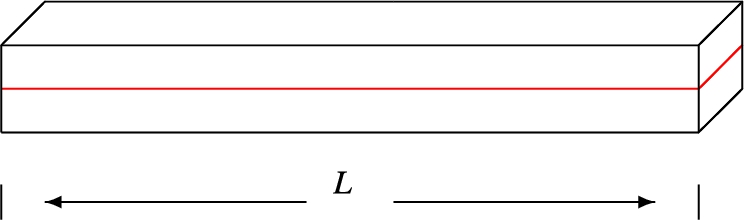
In this paper, we study the well-posedness and asymptotic stability to a thermoelastic laminated beam with nonlinear weights and time-varying delay. To the best of our knowledge, there are no results on the system and related Timoshenko systems with nonlinear weights. On suitable premises about the time delay and the hypothesis of equal-speed wave propagation, existence and uniqueness of solution is obtained by combining semigroup theory with Kato variable norm technique. The exponential stability is proved by energy method in two cases, with and without the structural damping, by using suitably sophisticated estimates for multipliers to construct an appropriated Lyapunov functional.
The one dimensional thermoelastic system is given by
In this model, ρ denotes the mass density, a the elasticity coefficient, b the stress-temperature and k the heat conductivity. The functions u and θ are the displacement of the solid elastic material and the temperature difference.
Thermoelasticity has aroused great interest since the publication of the pioneering article of Dafermos (1968) [9] where he wrote “There is a belief that thermoelasticity is the appropriate way for the explanation of the decay of the amplitude of free vibrations of some elastic bodies”. For a justification of the above statement, Dafermos proved that the solutions of the thermoelastic equations with homogeneous boundary conditions are asymptotically stable, however, he did not establish any stabilization rate. Several efforts have shown asymptotic stability, for instance, see [28,29] and reference therein. In these studies, the authors proved that the total thermoelastic energy decays to zero exponentially as time goes to infinity for material subject to Dirichlet, Neumann and also mixed boundary conditions. Timoshenko [40] in his theory, also assumed that the plane cross-sections u is perpendicular to the beam centerline and remain plane. Then an additional kinematics variable represented the rotation angle of a filament of the beam φ is added in the displacement assumptions. The pioneer linear model is given by two coupled partial differential equations
The coefficients and K are the mass per unit length, the polar moment of inertia of a cross section, Young’s modulus of elasticity, the moment of inertia of a cross section and the shear modulus respectively.
Rivera and Racke [38] considered the Timoshenko system with thermoelastic dissipation Fourier thermal law. More precisely, they took into account the following thermoelastic Timoshenko system
The authors showed that this system is exponentially stable if and only if the wave speeds are equal, i.e.,
A new coupling to the thermoelastic Timoshenko beam with the constitutive laws
was considered in [1] and is given by
The authors showed that this system is exponentially stable if and only if the wave speeds are equal. On the contrary, the authors obtained the polynomially stability depending on the different boundary conditions.
In the last years, several studies have been made in the context of stabilization of Timoshenko systems considering the minimum possible of dissipative mechanism. In fact, Soufyane [39] was the first to prove the exponential decay of the Timoshenko system with a locally distributed frictional damping effective only in one equation if and only if the waves speed are equal. For another way, the full damped Timoshenko system is exponentially stable without any restriction see [36].
In 1994 under the assumptions of Timoshenko beam theory, S. Hansen [15] introduced a mathematical model (1.5) for two-layered beams in which a slip can occur at the interface of contact
where denotes the transverse displacement, represents the rotation angle, is proportional to the amount of slip along the interface and denotes the effective rotation angle at time t and longitudinal spatial variable x, respectively.
In this model there is a “glue” layer of negligible thickness that bonds the two adjoining surfaces and produce the restoring force . The parameters are the density of the beams, the shear stiffness, mass moment of inertia, flexural rigidity, adhesive stiffness adhesive damping parameter of the beams, respectively. If , the third equation in (1.5) describes the coupled laminated beams without structural damping at the interface. If , the adhesion at the interface supplies a restoring force proportion to the interfacial slip. When , system (1.5) reduces to the well-known Timoshenko system (1.2), which have been widely studied.
From then, results was obtained in several context, which are mainly concerned with global existence and stability of the related system. Now, we recall some works on the laminated beam. In [42], the authors proved that the frictional damping created by the interfacial slip alone is not enough to stabilize this system exponentially to its equilibrium state. Naturally the question arises of studying the action of additional stabilizing mechanisms on this model.
Raposo [35] made the following change of variables , , , , , , and established the exponential stability for (1.5)
The importance of this result is in the proof that full damped laminated beam has a same behaviour of the full damped Timoshenko system. Feng et al. [13] condiered (1.6) with nonlinear damping terms and nonlinear source terms, they proved the existence of global attractors. Alves and Monteiro [2] considered the stabilization of (1.6) with , assuming and α are dependent on the point x. Apalara et al. [5] considered the laminated beam without frictional damping on the transverse displacement. They proved that a single control in form of a frictional damping just in the second equation on the rotation angle is strong enough to stabilize exponentially the system and improved the result obtained in [36]. We also refer the reader to [8,14,20,24–26] and so on for some stability results of laminated beams with structural memory.
For thermoelastic laminated beams, we first recall the work of Apalara [4] in which he considered a thermoelastic laminated beam with thermal effect given by Fourier’s law on the equation that describe the dynamic of the slip,
and established an exponential decay result without any additional damping (internal or boundary) term, since the wave speeds are equal. Liu and Zhao [23] studied a thermoelastic laminated beam system with history memory and thermal effect given by Fourier’s law on the second equation. They proved the well-posedness and obtained that the system with structural damping is exponentially stable, but the system without structural damping is exponentially stable if and only if the so-called equal wave speeds assumption
Furthermore, they showed that the system without structural damping is lack of exponential stability provided that (1.8) does not holds. Raposo et al., [34] considered a fully damped thermoelastic Timoshenko laminated system with a damping in each dynamic equation of the system. More precisely, they studied a system, where the dissipative action of the temperature on the transverse displacement generates a coupling term given by the stress tensor , and established the exponential stability of the system solution by the energetic method without (1.8). For results on thermoelastic laminated beams given by some other thermal law, we can refer to [3,12,21,22,41] and so on.
In recent years, the control of Partial Differential Equations with time delay effects has become an attractive area of research. In fact, time delays so often arise in many physical, chemical, biological and economical phenomena. Whenever energy is physically transmitted from one place to another, there is a delay associated with the transmission. Time delay is the property of a physical system by which the response to an applied force is delayed in its effect, and the central question is that delays source can destabilize a system that is asymptotically stable in the absence of delays, see [10]. Problem with delay as internal feedback was considered in [30], where was proved the exponential decay of solution by energy method. By semigroup approach in [37] was proved the well-posedness and exponential stability for a wave equation with frictional damping and nonlocal time-delayed condition. In [6] was proved the global existence and energy decay of solutions for a wave equation with non-constant delay and nonlinear weights.
For laminated Timoshenko beams with time delay, Feng [11] considered the laminated Timoshenko beams with time delay terms and boundary feedbacks:
Assuming that the weights of the delay are small, he established the exponential decay of energy to the system (1.9) by using an appropriate Lyapunov functional.
Motivated by the above results, in this paper, we study the well-posedness and asymptotic stability of a laminated beam with Fourier thermal and non-constant delay and nonlinear weights. The system is written as
We consider the following boundary conditions
and initial conditions
where the initial datum belongs to a suitable Sobolev space. Here is the time-varying delay and and are nonlinear weights acting on the frictional damping.
The main features of this work are threefold:
(i) Although there are some existing works on laminated beam with delay and on Timoshenko system with delay, all of the works are considered that the weights are constants, i.e., and are constants. To the best of our knowledge, there is no result on these systems with nonlinear weights. The motivation for choosing weights and as functions varying over time comes from the work of Benaissa et al. [7], where the authors considered a delayed wave eqaution with nonlinear weights.
(ii) Since the weights are nonlinear, there is a difficulty, which the operator is nonautonomous, by using semigroup theory to prove well-posedness. To overcome it, we use the Kato variable norm technique together with semigroup theory to show the system is well-posed.
(iii) It is well-known that the presence of delay can be a source of instability. But we obtain that, whether the structural damping exists or not, the term is strong enough to get exponential decay of the system if the weight of delay term is small under the assumption of equal wave-speed condition.
This manuscript is written as follows. In Section 2, we introduce some notations and preliminary results. In Section 3, using the Kato variable norm technique, and under some restriction on the nonlinear weights and on the time-varying delay, the system is showed to be well-posed for both problems. In Section 4, we present the result of exponential stability. We consider suitable premises about the delay and the hypothesis of equal-speed wave propagation. The result of exponential stability are proved by energy method either with or without structural damping, using suitably sophisticated estimates for multipliers to construct an appropriated Lyapunov functional.
Preliminaries
We will need the following hypotheses:
(H1) is a non-increasing function of class satisfying
where is a constant.
(H2) is a function of class ,which is not necessarily positives or monotones, such that
and
for some and .
As in [31], we assume that the time-varying delay satisfies
(H3) is a function such that
and
where and d are positive constants.
As in Nicaise et al. [32] we introduce the new variable
It is easily verified that the new variable satisfies
We denote the effective rotation angle by ξ, following the idea of [42], that is, we set and then rewrite (1.10) in the following form
The above system subjected to the following initial and boundary conditions
The well-posedness
In this section, we give the existence, uniqueness and smoothness of solution of problem (2.8)–(2.9) using the semigroup theory.
We begin by introducing the vector function with , and . The system (2.8)–(2.9) can be written as
where the operator is defined by
We consider the following spaces
Let
be the Hilbert space equipped with the following inner product
for and , where
is a non-increasing function of class and be a positive constant such that
The domain of is defined by
where
Notice that the domain of the operator does not dependent on time t, i.e.,
A general theory for nonautonomous operators given by equations of type (3.1) has been developed using semigroup theory, see [16,17] and [33]. The simplest way to prove existence and uniqueness results is to show that the triplet , with , for some fixed and , forms a CD-systems (or constant domain system, see [16] and [17]). More precisely, the following theorem, which is due to Tosio Kato (Theorem 1.9 of [16]) gives the existence and uniqueness results and is proved in Theorem 1.9 of [16] (see also Theorem 2.13 of [17] or [27]). For convenience let states Kato’s result here.
for all,generates a strongly continuous semigroup onand the familyis stable with stability constants C and m independent of t (i.e., the semigroupgenerated bysatisfies, for alland),
belongs to, which is the space of equivalent classes of essentially bounded, strongly measurable functions frominto the setof bounded operators from Y into.
Then, problem (
3.1
) has a unique solutionfor any initial datum in Y.
Using the time-dependent inner product (3.3) and the Theorem 3.1 we get the following result of existence and uniqueness of global solutions to the problem (3.1).
[Global solution] For any initial datumthere exists a unique solution U satisfyingfor problem (
3.1
). Moreover, if, then
Our goal is then to check the above assumptions for problem (3.1). First, we show that is dense in . The proof follows closely the proof in [19] and in [32] with the necessary modification imposed by the nature of our problem. Let be orthogonal to all elements of , namely
for .
We first take and . As and therefore, from (3.8), we deduce that
Since is dense in , then, it follows then that . Similarly, let , then , which implies from (3.8) that
So, as above, it follows that . Similarly, we take and we can show that .
Next, let then we obtain from (3.8) that
It is obvious that if and only if . Since is dense in with respect to the inner product , we get . By the same ideas as above, we can also show that . Finally for , we get from (3.8)
respectively. By density of in , we obtain .
We consequently have
Now, we show that the operator generates a -semigroup in for a fixed t.
We calculate for a fixed t. Take . Then
Since
we have
Whereupon
Therefore, from Young’s inequality, we deduce
Then, from (H2) and (3.4), we have that
where
From (H3) and (3.5), we have that
Therefore we conclude that
which means that operator is dissipative.
Now, we prove the surjectivity of the operator for fixed . For this purpose, let , we seek which is solution of
that is, the entries of U satisfy the system of equations
Suppose that we have found u, ξ and S with the appropriated regularity. Therefore, the first, third and firth equations in (3.11) give
It is clear that and . Furthermore, by (3.6) we can find z as
Following the same approach as in [32], we obtain, by using the last equation in (3.11),
if , where , and
otherwise, where .
In particular, by (3.13) and (3.14), we have
where
and
By using (3.11) and (3.12), we see that the functions u, ξ, S and θ satisfy the following system
with
Solving the system (3.16) is equivalent to finding
such that
for all .
Now we observe that solving the system (3.17) is equivalent to solve the problem
where the bilinear form
and the linear form
are defined by
and
Now, we introduce the Hilbert space equipped with the norm
It is clear that Υ and are bounded. Furthermore, using integration by parts, we can obtain that there exists a positive constant m such that
which implies that Υ is coercive.
Hence, we assert that Υ is continuous and coercive form on , and is continuous form on V. So applying the Lax–Milgram Theorem, we deduce that for all
the problem (3.18) admits a unique solution
Applying the classical elliptic regularity, it follows from (3.17) that
On the other hand, also holds true for any with , then
which, using integration by parts, implies
Hence
Similarly, we can get
Therefore, the operator is surjective for all . Again as , this prove that
for all .
To complete the proof of (iii), it suffices to show that
where , c is a positive constant and is the norm associated the inner product (3.3). For all , we have
It is clear that . Now we will prove for some . In order to do this, first observe that
for some . Since ξ is a non increasing function and , we get
which implies
Using (2.4) and that is bounded, we deduce that
which proves (3.20) and therefore (iii) follows.
Moreover, as is bounded on for all (by (2.4) and (3.5)) we have
with bounded on by (2.4) and (3.5). Thus
where is the space of equivalence classes of essentially bounded, strongly measurable functions from into .
Then, (3.10), (3.19) and (3.20) imply that the family is a stable family of generators in with stability constants independent of t, by Proposition 1.1 from [16]. Therefore, the assumptions (i)–(iv) of Theorem 3.1 are verified by (3.7), (3.9), (3.10), (3.19), (3.20) and (3.21). Thus, the problem
has a unique solution for . The requested solution of (3.1) is then given by
because
which concludes the proof. □
Exponential stability
This section is dedicated to study of the asymptotic behavior. We show that the solution of problem (2.8)–(2.9) is exponentially stable using the multiplier technique. Our effort consists in building a suitable Lyapunov functional by the energy method. The main goal in this section is to prove the following stability result.
Let. Assume that the hypotheses (H1)–(H3),andhold. Then the problem (
2.8
)–(
2.9
) admits a unique solutionMoreover, for some positive constants C, α, we obtain the following decay property
For the proof of Theorem 4.1 we need several lemmas.
We define the energy associated to the solution of problem (2.8) by the following formula
Our first result states that the energy is a non-increasing function and uniformly bounded above by .
Letbe a solution to the system (
2.8
)–(
2.9
). Then the energy functional defined by (
4.3
) satisfies
Multiplying the first four equations of (2.8) by , , and θ, respectively, integrating on and using integration by parts, we get
Now multiplying the fifth equation of (2.8) by and integrating on , we obtain
Consequently,
From (4.5)–(4.9), we know that
Due to Young’s inequality, we have
Hence, the proof is complete. □
In the previous result we observe that the energy functional restores some energy terms with a negative sign. We are interested in building a Lyapunov functional that restores the full energy of the system with negative sign, and for this goal, we consider the following lemmas.
Ifis a solution of (
2.8
)–(
2.9
), then the functional, defined bysatisfies the estimativefor any constant.
Differentiating , using (2.8) and integration by parts, we arrive at
Estimate (4.12) follows from Young’s and Poincaré’s inequalities. □
Ifis a solution of (
2.8
)–(
2.9
), then the functional, defined bysatisfies the estimativefor any constants.
By differentiating , using (2.8) together with integration by parts, we obtain
We then use Young’s inequality to obtain (4.14). □
Ifis a solution of (
2.8
)–(
2.9
), then the functional, defined assatisfies the estimativefor any constantsand.
We differentiate , use (2.8) and integrating by parts, yield
Exploiting Young’s, Poincaré’s and Cauchy–Schawrz inequalities, we have the estimates (4.16) and conclude the prove. □
Ifis a solution of (
2.8
)–(
2.9
), then the functional, defined bysatisfies the estimativefor any constantsand.
Derivative of , using (2.8) and integrating by parts, yields
From (H1) and (H2), we know that
By using (4.1) and the fact that , we have that
Estimate (4.18) follows from Young’s inequality. □
As in [18], taking into account the last lemma, we introduce the functional
For this functional we have the following estimate.
Letis a solution of (
2.8
)–(
2.9
). Then the functionalsatisfies
Now we are in position to prove our principal result.
We will divide the prove into two cases: and .
Case 1: .
We will to construct a suitable Lyapunov functional satisfying the following equivalence relation
for some and the prove that
which implies that
for some .
Let us define the Lyapunov functional
where , are positive real numbers which will be chosen later. By the Lemma 4.2, there exists a positive constant K such that
We have that
It follows from (4.3), Young’s, Poincaré’s, Cauchy–Schwarz inequalities, coupled with the fact that and for all , we deduce that
for some constant .
So, we can choose N large enough that and , then
holds true.
Now, differentiate , substitute the estimates (4.12), (4.14), (4.16), (4.18), (4.20), (4.22) and setting
we obtain
First, we take large enough such that
For fixed , let us choose
Finally, since non-negative and limited, applying Poincaré’s inequality and choosing N large enough that (4.24) is taken into the following estimate
for a certain positive constant .
Hence from (4.3) we have
In view of (4.23) and (4.25), we note that
which leads to
The desired result (4.2) follows by using estimates (4.23) and (4.26).
Case 2: .
In this case, we prove the exponential decay result (4.2) for problem (2.8)–(2.9) without structural damping. To build the Lyapunov functional, we need one more theorem.
Ifis a solution of (
2.8
)–(
2.9
), then the functional, defined bysatisfies the estimativefor any constantsand.
As in the proof of Lemma 4.3, we obtain
Using Young’s, Poincaré’s inequalities with and by (4.1), we establish (4.28). □
Note that of Lemmas 4.3-4.7, only Lemma 4.4 involves the third equation of (2.8). Making the appropriate changes, the result remains the same.
Now, we define the following Lyapunov functional
where , are positive real numbers which will be chosen later.
Using (4.3), Young’s, Poincaré’s, Cauchy–Schwarz inequalities, coupled with the fact that and for all , we can easily see that
for some constant .
Choosing N large enough, we obtain that there exist positive constants and such that
From estimates (4.12), (4.14), (4.16), (4.18), (4.20), (4.22), (4.28) and setting
we have
First, we select large enough so that
Next, we select large enough so that
And then we take large enough such that
Finally, since non-negative and limited, applying Poincaré’s inequality, choosing N large enough and from (4.3) we obtain the following estimate
where .
In view of (4.30) and (4.32), we observe that
which leads to
By estimates (4.30) and (4.33), we conclude the result (4.2). Then, the proof of theorem 4.1 is complete. □
Footnotes
Acknowledgement
The authors express sincere thanks to the anonymous referees for their constructive comments and suggestions that helped to improve the paper. Baowei Feng is supported by the National Natural Science Foundation of China, grant #11701465.
References
1.
D.S.AlmeidaJr., M.L.Santos and J.E.Muñoz Rivera, Stability to 1-D thermoelastic Timoshenko beam acting on shear force, Z. Angew. Math. Phys.65 (2014), 1233–1249. doi:10.1007/s00033-013-0387-0.
2.
M.S.Alves and R.N.Monteiro, Stabilization for partially dissipative laminated beams with non-constant coefficients, Z. Angew. Math. Phys.71 (2020), 165, 15pp.
3.
T.A.Apalara, Uniform stability of a laminated beam with structural damping and second sound, Z. Angew. Math. Phys.68(68) (2017), 41. doi:10.1007/s00033-017-0784-x.
4.
T.A.Apalara, On the stability of a thermoelastic laminated beam, Acta Math Sci.39 (2019), 1517–1524. doi:10.1007/s10473-019-0604-9.
5.
T.A.Apalara, C.A.Raposo and C.A.S.Nonato, Exponential stability for laminated beams with a frictional damping, Arch. Math.114 (2020), 471–480. doi:10.1007/s00013-019-01427-1.
6.
V.Barros, C.Nonato and C.Raposo, Global existence and energy decay of solutions for a wave equation with non-constant delay and nonlinear weights, Electronic Research Archive28 (2020), 205–220. doi:10.3934/era.2020014.
7.
A.Benaissa, A.Benguessoum and S.A.Messaoudi, Energy decay of solutions for a wave equation with a constant weak delay and a weak internal feedback, Electron. J. Qual. Theory Differ. Equ.11 (2014), 13pp.
8.
Z.Chen, W.J.Liu and D.Chen, General decay rates for a laminated beam with memory, Taiwan. J. Math.23 (2019), 1227–1252. doi:10.11650/tjm/181109.
9.
C.M.Dafermos, On the existence and the asymptotic stability of solutions to the equations of linear thermoelasticity, Arch Rational Mech Anal.29 (1968), 241–271. doi:10.1007/BF00276727.
10.
R.Datko, J.Lagnese and M.P.Polis, An example on the effect of time delays in boundary feedback stabilization of wave equations, SIAM J. Control Optim.24 (1986), 152–156. doi:10.1137/0324007.
11.
B.Feng, Wellposedness and exponential decay for laminated Timoshenko beams with time delays and boundary feedbacks, Math. Method Appl Sci.41 (2018), 1162–1174. doi:10.1002/mma.4655.
12.
B.Feng, On a thermoelastic laminated Timoshenko beam: Well posedness and stability, Complexity2020 (2020), Article ID 5139419.
13.
B.Feng, T.F.Ma, R.N.Monteiro and C.A.Raposo, Dynamics of laminated Timoshenko beams, J. Dyn. Diff. Equat.30 (2018), 1489–1507. doi:10.1007/s10884-017-9604-4.
14.
B.Feng and A.Soufyane, Memory-type boundary control of a laminated Timoshenko beam, Math. Mech. Solids25 (2020), 1568–1588. doi:10.1177/1081286520911078.
15.
S.W.Hansen, Control and estimation of distributed parameter systems: Non-linear phenomena, International Series of Numerical Analysis118 (1994), 143–170.
16.
T.Kato, Linear and quasilinear equations of evolution of hyperbolic type, C.I.M.E., II ciclo, 1976, 125–191.
17.
T.Kato, Abstract Differential Equations and Nonlinear Mixed Problems Lezioni Fermiane, [Fermi Lectures], Scuola Normale Superiore, Pisa, 1985.
18.
M.Kirane, B.Said-Houari and M.N.Anwar, Stability result for the Timoshenko system with a time-varying delay term in the internal feedbacks, Commun. Pure Appl. Anal.10 (2011), 667–686. doi:10.3934/cpaa.2011.10.667.
19.
W.J.Liu and M.Chen, Well-posedness and exponential decay for a porous thermoelastic system with second sound and a time-varying delay term in the internal feedback, Continuum Mech. Thermodyn.29 (2017), 731–746. doi:10.1007/s00161-017-0556-z.
20.
W.J.Liu, X.Kong and G.Li, Asymptotic stability for a laminated beam with structural damping and infinite memory, Math. Mech. Solids25 (2020), 1979–2004. doi:10.1177/1081286520917440.
21.
W.J.Liu, X.Kong and G.Li, Lack of exponential decay for a laminated beam with structural damping and second sound, Annales Polonici Mathematici124 (2020), 281–289. doi:10.4064/ap181224-17-9.
22.
W.J.Liu, Y.Luan, Y.Liu and G.Li, Well-posedness and asymptotic stability to a laminated beam in thermoelasticity of type III, Math. Methods Appl. Sci.43 (2020), 3148–3166. doi:10.1002/mma.6108.
23.
W.J.Liu and W.Zhao, Stabilization of a thermoelastic laminated beam with past history, Appl. Math. Optim.80 (2019), 103–133. doi:10.1007/s00245-017-9460-y.
24.
A.Lo and N.-E.Tatar, Stabilization of a laminated beam with interfacial slip, Electron. J. Differ. Equations2015 (2015), 169.
25.
A.Lo and N.-E.Tatar, Uniform stability of a laminated beam with structural memory, Qual. Theory Dyn. Syst.15 (2016), 517–540. doi:10.1007/s12346-015-0147-y.
26.
A.Lo and N.-E.Tatar, Exponential stabilization of a structure with interfacial slip, Discrete Continuous Dyn Syst.36 (2016), 6285–6306. doi:10.3934/dcds.2016073.
J.E.Muñoz Rivera, Energy decay rates in linear thermoelasticity, Funkcial Ekvac.35 (1992), 19–30.
29.
J.E.Muñoz Rivera, Asymptotic behaviour in inhomogeneous linear thermoelasticity, Appl Anal.53 (1994), 55–65. doi:10.1080/00036819408840243.
30.
S.Nicaise and C.Pignotti, Stabilization of the wave equation with boundary or internal distributed delay, Differential Integral Equations21 (2008), 935–958.
31.
S.Nicaise and C.Pignotti, Interior feedback stabilization of wave equations with time dependence delay, Electronic J. Differ. Equations41 (2011), 1–20.
32.
S.Nicaise, C.Pignotti and J.Valein, Exponential stability of the wave equation with boundary time-varying delay, Discrete Contin. Dyn. Syst.4 (2011), 693–722. doi:10.3934/dcdss.2011.4.693.
33.
A.Pazy, Semigroups of Linear Operators and Applications to Partial Differential Equations, Applied Math. Sciences, Vol. 44, Springer-Verlag, New York, 1983.
34.
C.Raposo, C.Nonato, O.Villagran and J.Chiquipoma, Global solution and exponential stability for a laminated beam with Fourier thermal law, Journal of Partial Differential Equations33 (2020), 143–157. doi:10.4208/jpde.v33.n2.4.
35.
C.A.Raposo, Exponential stability for a structure with interfacial slip and frictional damping, Appl. Math. Lett.53 (2016), 85–91. doi:10.1016/j.aml.2015.10.005.
36.
C.A.Raposo, J.Ferreira, M.L.Santos and N.N.O.Castro, Exponential stability for the Timoshenko system with two weak dampings, Applied Mathematics Letters18 (2005), 535–541. doi:10.1016/j.aml.2004.03.017.
37.
C.A.Raposo, H.Nguyen, J.O.Ribeiro and V.Barros, Well-posedness and exponential stability for a wave equation with nonlocal time-delay condition, Electron J Differ Eq.279 (2017), 1–11.
38.
J.E.M.Rivera and R.Racke, Mildly dissipative nonlinear Timoshenko systems global existence and exponential stability, J. Math. Anal. Appl.276 (2002), 248–278. doi:10.1016/S0022-247X(02)00436-5.
39.
A.Soufyane, Stabilisation de la poutre de Timoshenko, C. R. Acad. Sci. Paris, Série I-Mathematique328 (1999), 731–734. doi:10.1016/S0764-4442(99)80244-4.
40.
S.P.Timoshenko, On the correction for shear of the differential equation for transverse vibrations of prismatic bars, Philisophical Magazine41 (1921), 744–746.
41.
D.Wang and W.J.Liu, Lack of exponential decay for a thermoelastic laminated beam under Cattaneo’s law of heat conduction, Ricerche di Matematica (2020), 9pp. doi:10.1007/s11587-020-00527-3.
42.
J.M.Wang, G.Q.Xu and S.P.Yung, Exponential stabilization of laminated beams with structural damping and boundary feedback controls, SIAM J. Control Optim.44 (2005), 1575–1597. doi:10.1137/040610003.