We consider a boundary value problem in a bounded domain involving a degenerate operator of the form
and a suitable nonlinearity f. The function a vanishes on smooth 1-codimensional submanifolds of Ω where it is not allowed to be . By using weighted Sobolev spaces we are still able to find existence of solutions which vanish, in the trace sense, on the set where a vanishes.
In this paper we are interested in the existence of “suitable” solutions for a degenerate nonlinear elliptic equation of second order in a bounded and smooth domain Ω in with homogeneous Dirichlet boundary condition. More specifically the equation under study is driven by the operator
where, , among other assumptions, is a continuous function such that in the whole Ω except for suitable 1-codimensional submanifolds contained in Ω where it vanishes. Hence the ellipticity of L is broken somewhere in . This kind of operator is also called degenerate due to the fact that is unbounded.
Degenerate operators appear in many situations. Indeed it is known that many physical phenomena are described by degenerate evolution equations, where the degeneracy can be due to the vanishing of the time derivative coefficient or to the vanishing of the diffusion coefficient. In this context there is a strong connexion between degenerate 2nd order differential operators and Markov processes: roughly speaking these operators describe a diffusion phenomena of Markovian particle which moves until it reaches the set where the absorption takes place and here the particle “dies”. Because of this fact, degenerate equations are appropriate to describe fluid diffusion in nonhomogeneous porous media taking into account saturation and porosity of the medium. For more applications and problems involving degenerate operators one can see e.g [1–4,16] and the references therein.
Mathematically speaking, for degenerate partial differential equations, i.e., equations with various types of singularities in the coefficients, it is natural to look for solutions in weighted Sobolev spaces. A class of weights, which is particularly well understood, is the class of -weights (or Muckenhoupt class) that was introduced by B. Muckenhoupt. The importance of this class is that powers of distance to submanifolds of often belong to (see [12]) and these weights have found many useful applications also in harmonic analysis (see [19]). However there are also many other interesting examples of weights (see [9] for p-admissible weights). For some references on this subject see also [5–7,10], and for other applications of weighted Sobolev spaces see also [18].
To motivate the choice of the problem under study let us see the following example. Suppose additionally that is a continuous function such that if and only if . Let , be a smooth and bounded domain and assume that is a non-negative function with which is a regular connected submanifold compactly contained in Ω and such that for any . Consider the problem
Following [17] we say that is a solution if and the equation is satisfied in the sense of distribution, i.e.
But then from (1.1) it follows, that
and since and are continuous functions, so is (note that a vanishes on a null set) and we obtain
From this identity we deduce
In other words, for such a problem, the solution is zero whenever a is zero.
Motivated by this fact we study in this paper the existence of weak solutions for a degenerate elliptic operator in a bounded domain with homogeneous Dirichlet boundary condition and with the additional condition that our solutions are zero (in the sense of trace) on the set where a vanishes.
More specifically the problem under study is the following.
Denoted with the standard Muckenhoupt class for (see Section 2 for the definition of ), let , be a smooth and bounded domain, , and be functions satisfying:
is the disjoint union of a finite number k of compact, connected, without boundary and 1-codimensional smooth submanifolds of ,
and , for some ,
and
f has a strict local minimum in with , and there exists such that and in ,
there exists and , where is the first eigenvalue of the Dirichlet Laplacian in and stands for any connected component of .
Consider the problem
The requirement that u vanishes also on the set is motivated by the previous example.
A weak solution of (
P
) is a function such that
Note that, since and , the above identity makes sense. The choice of the space in place of the more common space is due to the fact that we do not know if the gradient of the solution we find is in .
Before we continue, let us make a few comments on the assumptions. First of all, note that we are just assuming the continuity of a and, in contrast to our motivating problem (1.1), the function f is also allowed to vanish in many points (assumption (f1)); however there is a relation of its first right derivative in zero with the function a (assumption (f2)).
Finally it is worth saying that assumption (a1) appeared also in [14] where the authors study an operator of type , for a suitable matrix A which can vanish. They are interested actually in establishing Poincaré type inequalities for such a degenerate operator.
It is easy to exhibits example of functions satisfying our assumptions. Letbe the ball centered at 0 in, of radius 2.
Take a radial function whose profile in the radial variable has zeroes of order less than one, for exampleThen it is easy to check that,for anyand then (
a2
) holds. The function is of course not of classwhere it vanishes.
Similarly, consider a function which is strictly positive in the center of the ball Ω and whose radial profile is, with null derivative in the origin, and of typeIt is easy to check that,for anyand then (
a2
) holds. Such a function isin all Ω, andin Ω except where it vanishes.
Note however that functions that arewhere they vanish are not allowed by our hypothesis. Indeed, if a were positive and of classin a neighbourhood ofwhere, then by the Taylor expansion,It followsthenand hence (
a2
) cannot be satisfied.
To state our main result let us fix some notations.
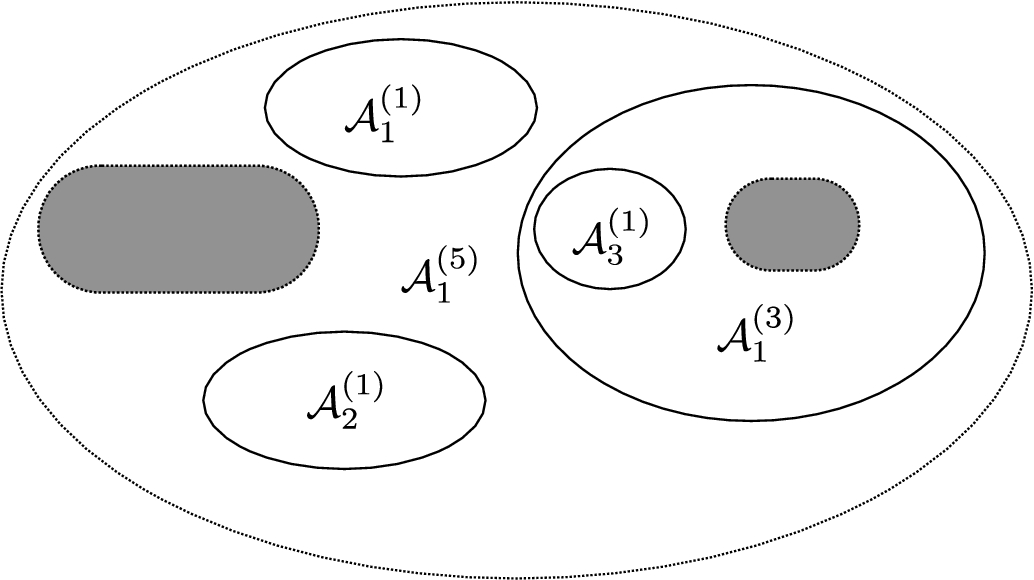
Denote . Let be the usual quotient space of under the equivalence relation which identifies points that can be joint with a continuous arch. Then gives the number of connected components of . Let us write
where stands for the number of subdomains of whose boundary is made exactly by i connected 1-codimensional submanifolds of . These domains are denoted with . See the Fig. 1 and Fig. 2 for two examples in dimension two.
Example of a domain (with one grey hole) where . In this case , , , .
Example of a domain (with two grey holes) where . In this case , , , , , .
Our result states that the number of solutions of (P) is related to χ.
Suppose that (
a1
), (
a2
), (
f1
), (
f2
) hold. Then, problem (
P
) has at leastnonnegative (and nontrivial) weak solutions. More specifically, the number of positive solutions with n bumps,, is given by the binomial coefficient.
We point out that we will use variational methods to prove our result and we will work in the weighted Sobolev space ; so the solutions we find actually will belong to this space.
The paper is organised as follows. In the next Section 2 we recall some basic facts on weighted Sobolev spaces to establish the framework of our problem. In Section 3 a suitable problem is solved which will be the main ingredient to prove our main result in the last Section 4.
Notations
As a matter of notations, in all the paper we denote with the usual Sobolev spaces. Whenever we use the notation . Finally is the closure of the test functions with respect to the norm in . Other notations will be introduced whenever we need.
Some well known facts
In this section we will give some preliminary facts on suitable weighted Sobolev spaces we will use later. For more details and applications of weighted Sobolev spaces, which is the right context to study degenerate elliptic operators, we refer the reader to [6,8,11–13,15], for instance.
Along this section
is a smooth and bounded domain, and
satisfies
where the supremum is taken over all the balls . In other words, h belongs to the so called Muckenhoupt class (see [15]). The right hand side of the inequality above is known as the -constant of h.
For each , is the Banach space of all measurable functions , for which
Whenever h is in the class, and then it makes sense to speak about weak derivatives and Sobolev spaces. By definition, the weighted Sobolev space is the set of functions such that the (weak) derivatives of first order are all in . The (squared) norm in is
It can be proved that is the closure of with respect to the previous norm. As usual, is the closure of with respect to the norm defined by
Both and are Hilbert spaces containing the positive and negative parts of each of their elements (see [6, Corollary 2.1]). Since h may vanish somewhere on , the weighted Sobolev spaces are not isomorphic the “usual” ones.
(The weighted Sobolev inequality).
There exist positive constantsand δ, such that for alland,
See [6, Theorem 1.3] for a proof. In particular from this result it holds that the quantity defined in (2.1) gives a norm on equivalent to .
The next result is also well known (see [12, Theorem 2.8.1]).
Ifin, then there exists a subsequenceand a functionsuch that
,;
.
Finally, we will enunciate a compact embedding type result for the weighted Sobolev spaces . See e.g. [8] for the details.
(Compact embeddings).
Let,andThen, the spaceis compactly embedded in.
Preliminaries: A problem (possibly) degenerate on the boundary
In this section, for future reference, we consider the following elliptic problem
where is a smooth, open and bounded domain, and b and f satisfying
, for , and , ,
f has a strict local minimum in with , and there exists such that and in ,
there exists and , where is the first eigenvalue of the Dirichlet Laplacian in D.
The operator is called also b-elliptic.
A weak solution for (
P
D
) is a function such that
Observe that b may eventually be zero somewhere on the boundary .
We will find the solution of (
P
D
) working in the space . Note that such a space is contained into , where is given in (a2), and then . Indeed, for we have, by the Hölder inequality,
and hence . As it follows by the next proof, the solution will be also bounded.
The main result of this section is as follows.
Under the previous assumptions, problem (
P
D
) has at least a nonnegative and nontrivial weak solution.
Due to the possibly degenerate structure of the problem, the suitable functional setting to treat (
P
D
) is the weighted Sobolev space . Let be the functional
where is the primitive of
for some such that in .
Observe that J is well defined in . In fact, since is bounded, we have
for some positive constant C. On the other hand, by Hölder inequality and being
for all . Moreover, since is continuous, .
Observe that J is coercive. Indeed, from (3.2) and (3.3) we deduce
To prove that J is weakly lower semicontinuous, we begin to note that by and , , and being the number in Theorem 2.3 is finite if we choose
Therefore, if in , by the compact embedding we deduce that (up to a subsequence)
From Theorem 2.2, up to a subsequence, there exists such that
Since b is positive in D, we obtain
Consequently,
and
On the other hand, from (a2)
showing that . Then by using the Lebesgue dominated convergence theorem, we conclude that
Thus, ψ is weakly continuous and, consequently, J is weakly lower semicontinuous in the Hilbert space . Let be a minimum point of J. Since J is ,
showing that is a weak solution of (
P
D
).
Now we are going to prove that is nontrivial. For that, it is enough to realise that J takes negatives values. Indeed let be a positive eigenfunction associated to the first eigenvalue of Laplacian operator in D with homogeneous Dirichlet boundary condition and consider
for each . By (f2), de L’Hospital rule and Lebesgue dominated convergence theorem, by passing to the limit as , we obtain
Thus, for small enough, we have , showing that is nontrivial.
It follows from (f1) and the definition of that by choosing in (3.1), we have
Since , we conclude that a.e. in D. Therefore a.e. in D, for some . Finally, from , we have that and . To conclude that , it is enough to choose in (3.4) and reasoning in a similar way. Therefore , concluding the proof. □
Finally we are ready to treat the problem
and prove Theorem 1.1.
To take advantage of the degeneracy of a in order to prove existence of multiple solutions to problem (P), we will divide the proof in two steps. In the first one will be considered a suitable class of problems (
P
i
,
l
) with diffusion operator involving coefficients degenerating on the boundary of the domain where the problem is settled, that is, for each and , we will look for weak solutions of the problem
In the second one, the solutions obtained for (
P
i
,
l
) will be used to construct solutions to (P), which have different numbers of positive bumps.
Step I: Existence of χ one-bump weak solutions to (
P
i
,
l
).
It follows from (a1) that each set is a bounded domain of with a smooth boundary, on which function a can be zero. Consequently, Step I is a straightforward consequence of hypotheses (a2), (f1), (f2) and Theorem 3.1 in previous Section. Let us call the one-bump weak solution obtained to (
P
i
,
l
).
Step II: Existence of nonnegative (and nontrivial) weak solutions to (P).
Let us consider the extensions of to Ω, that is,
Since , and
where in the last inequality we have used the Holder inequality. It is clear that . Moreover, since and , if then . Thus, since is a weak solution of (
P
i
,
l
), for all :
where the summation runs over all the possible combinations of indexes i, l, so as to include all the connected components of , showing that is a nonnegative and nontrivial weak solution of (P) for each and . Since the sum of n of the previous weak solutions () is still a solution of (P) (by (a1)), the result follows. Observe finally that, arguing as in Section 3, the solutions found are in .
Footnotes
Acknowledgements
João R. Santos was partially supported by CNPq 306503/2018-7, Brazil. Gaetano Siciliano was partially supported by Fapesp 2019/27491-0, Capes and CNPq 304660/2018-3, Brazil.
F.S.Cîrstea and V.Rǎdulescu, Multiple solutions of degenerate perturbed elliptic problems involving a subcritical Sobolev exponent, Topological Methods in Nonlinear Analysis15 (2000), 283–300. doi:10.12775/TMNA.2000.021.
3.
C.L.Epstein and R.Mazzeo, Degenerate Diffusion Operators Arising in Population Biology, Annals of Mathematics Studies, Vol. 185, Princeton University Press, Princeton, NJ, 2013.
4.
C.L.Epstein and R.Mazzeo, The geometric microlocal analysis of generalized Kimura and Heston diffusions, in: Analysis and Topology in Nonlinear Differential Equations, D.G.de Figueiredo, J.M.do Ó and C.Tomei, eds, Progress in Nonlinear Differential Equations and Their Applications, Vol. 85, Springer International Publishing AG, New York, NY, 2014, pp. 241–266. doi:10.1007/978-3-319-04214-5_14.
5.
E.Fabes, D.Jerison and C.Kenig, The Wiener test for degenerate elliptic equations, Ann. Inst. Fourier (Grenoble)32 (1982), 151–182.
6.
E.G.Fabes, C.E.Kenig and R.P.Serapioni, The local regularity of solutions of degenerate elliptic equations, Commun. Part. Diff. Eq.7(1) (1982), 77–116. doi:10.1080/03605308208820218.
7.
B.Franchi and R.Serapioni, Pointwise estimates for a class of strongly degenerate elliptic operators: A geometrical approach, Ann. Scuola Norm. Sup. Pisa Cl. Sci. (4)14(4) (1987), 527–568.
8.
V.Gol’dshtein and A.Ukhlov, Weighted Sobolev spaces and embedding theorems, Trans. Amer. Math. Soc.361(7) (2009), 3829–3850. doi:10.1090/S0002-9947-09-04615-7.
9.
J.Heinonen, T.Kilpelaïnen and O.Martio, Nonlinear Potential Theory of Degenerate Elliptic Equations, Oxford Mathematical Monographs. Oxford Science Publications., The Clarendon Press, Oxford University Press, New York, 1993.
10.
M.Kimura, Diffusion models in population genetics, Journal of Applied Probability1 (1964), 177–232. doi:10.2307/3211856.
A.Kufner, O.John and S.Fučik, Function Spaces. Monographs and Textbooks on Mechanics of Solids and Fluids; Mechanics: Analysis, Noordhoff International Publishing, Leyden; Academia, Prague, 1977.
13.
A.Kufner and B.Opic, How to define reasonably weighted Sobolev spaces, Commentationes Mathematicae Universitatis Carolinae25(3) (1984), 537–554.
14.
D.Monticelli, K.R.Payne and F.Punzo, Poincaré inequalities for Sobolev spaces with matrix-valued weights and applications to degenerate partial differential equations, Proc. Roy. Soc. Edinburgh Sect. A149(1) (2019), 61–100. doi:10.1017/S0308210517000427.
15.
B.Muckenhoupt, Weighted norm inequalities for the Hardy maximal function, Trans. Amer. Math. Soc.165 (1972), 207–226. doi:10.1090/S0002-9947-1972-0293384-6.
16.
M.K.V.Murthy and G.Stampacchia, Boundary problems for some degenerate elliptic operators, Ann. Mat. Pura Appl4(80) (1968), 1–122. doi:10.1007/BF02413623.
17.
P.Pucci and J.Serrin, Dead cores and bursts for quasilinear singular elliptic equations, Siam J. Math. Anal.38(1) (2006), 259–278. doi:10.1137/050630027.
18.
A.-M.Sändig and A.Kufner, Some applications of weighted Sobolev spaces, in: Teubner-Texte zur Mathematik, Vol. 100, Vieweg Teubner Verlag, 1987.
19.
A.Torchinsky, Real-Variable Methods in Harmonic Analysis, Pure and Applied Mathematics, Vol. 123, Academic Press, Inc., Orlando, FL, 1986.