In this paper, we analyze a model composed by coupled local and nonlocal diffusion equations acting in different subdomains. We consider the limit case when one of the subdomains is thin in one direction (it is concentrated to a domain of smaller dimension) and as a limit problem we obtain coupling between local and nonlocal equations acting in domains of different dimension. We find existence and uniqueness of solutions and we prove several qualitative properties (like conservation of mass and convergence to the mean value of the initial condition as time goes to infinity).
In this paper we combine a local diffusion equation, the classical heat equation,
in a higher dimensional domain , with a nonlocal diffusion equation, given by an integrable kernel
in R a different subset of . Associated with these two domains, Ω and R, in [24] and [18] the following kind of energy functional was introduced
Here we distinguish two cases according to the choice of the set : first, we consider (and we will refer to the resulting model as having a coupling in the source terms, see the next subsection) and next, A is a part of the boundary (we refer to this case as coupling at the boundary).
Observe that, the kernels J and G do not need to be equal. We will assume that J and also G satisfy the following hypotheses that will be assumed along the whole paper without further mention,
We can also consider kernels that are not in convolution form, that is, and with nonnegative, with , symmetric and integrable, and nonnegative, nontrivial and integrable. To simplify the presentation we will deal with convolution type kernels in the proofs.
Observe that it is common to assume that the integral of J and G is equal to one. This assumption is related to the probabilistic interpretation of the model given in [24] and [18]. For example, in this interpretation, is the probability of a particle (or an individual of a biological species) that is at jumps to y in a time step). So, in this case, we have
To obtain our results we only need the integrability of the kernels, hence we do not assume that they are normalized to have integral equal to one.
Associated with the energy (1.3) we have the evolution problem given by its gradient flow (with respect to ). This gives rise to an diffusion problem. Take as the solution of the abstract problem
with , and, the subdifferential of E. Then, it turns out (see [24] and [18]) that solves a system composed by a heat equation (local diffusion) of the form (1.1) in Ω and a nonlocal diffusion equation in R, (1.2), coupled via source terms in the equations (when in (1.2)) or via a boundary flux on (when in (1.2)). See Sections 1.1 and 1.2 below.
Also from [24] and [18] we know that the associated evolution problem is well-posed in the sense that there are existence and uniqueness of solutions. There are two alternative proofs of this fact. The first one uses a fixed point argument while the second relies on semigroup theory. Besides, a comparison principle holds. Also, the total mass of the initial condition is preserved along the evolution and the solutions converge exponentially fast to the mean value of the initial condition. Notice that, according to [24] and [18], we do not impose any continuity of the densities throughout the interface between the local and nonlocal domain, but we can guarantee continuity of the densities u and v inside the local and nonlocal subdomains Ω and R, respectively, by assuming continuity of the initial conditions. Also there is a probabilistic interpretation of this model (we refer one more time to [24] and [18]). In this interpretation individuals cannot diffuse neither jump from the exterior into Ω or the other way around (the integrals accounting for jumps do not consider the complement of Ω). There is no interchange of mass between and its complement. Therefore, the total mass is preserved and we can call our problem as being of Neumann type.
The study of nonlocal problems with smooth kernels has been widely considered recently, see [6,8–10,12,14,21–23] and the book [1]. This kind of equation is getting attention due to its potential applications in ecology, physics, and engineering, and to its flexibility to accurately capture effects that are not easily obtained from classical local models. Biological mobility models of animals and plants are examples of how distinct patterns of mobility can affect the success of invasions [8,34]. In epidemiology, the effects of long-range interactions are responsible for the spreading of diseases around the world [35]. Nonlocal patterns also play an important role in molecular interactions in dissimilar interfaces, continuum mechanics, [25,30], and peridynamics (a model of elasticity and mechanics), [32,33].
There are different strategies for couplings between local and nonlocal models. Let us briefly summarize previous results in [16,18,19,23,24,27], see also the review [15]. In [16], local and nonlocal problems are coupled trough a prescribed solid region in which both kinds of equations overlap (the value of the solution in the nonlocal part of the domain is used as a Dirichlet boundary condition for the local part and vice-versa). This kind of coupling gives continuity of the solution in the overlapping region but does not preserve the total mass. Here we follow [24] and [18] (see also [23,27]). In probabilistic terms, in the model described in [24], particles may jump across the interface between the two regions but can not pass coming from the local side unless they jump. Finally, in [18], the authors studied local and nonlocal diffusion models in different zones coupled via the fluxes across the surface that separates the two regions.
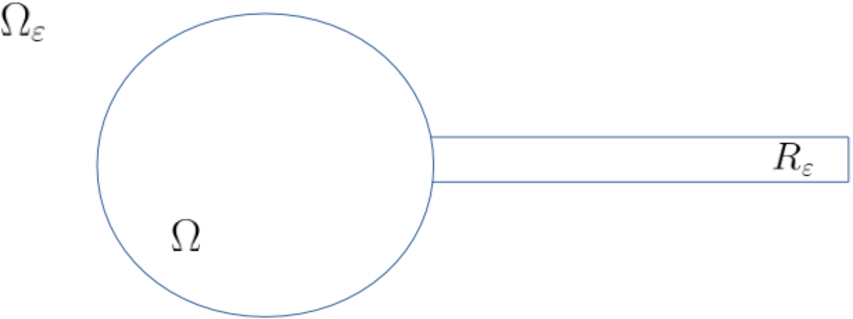
Here, we take as the nonlocal region a thin domain, that is, we consider ( is assumed to be open and bounded), depending on a small parameter that will go to zero and that measures the thickness of the domain. Therefore, in our model problem we have two full dimensional domains, the local domain (that is fixed) and the nonlocal domain . We denote a point in . The domain is assumed to be a general thin domain defined as
with . Notice that is a domain that is thin in the -variable. See Fig. 1.
Perturbed domain.
Here we want to pass to the limit as in the previous setting and obtain a nontrivial diffusion model in which we couple local and nonlocal diffusion equations, (1.1) and (1.2) that take place in domains of different dimension (we deal here with local diffusion in the full-dimensional domain and nonlocal diffusion in the lower-dimensional one).
For simplicity, we will concentrate in the product case and take as
Our results are valid in a more general setting (see Remark 2 below) but we prefer to avoid extra notations and simplify the changes of variables that are needed in the proofs. The typical configuration under study is depicted in Fig. 1.
Instead of a thin domain like , we could have a more complex domain, which could be described by some function g related to the geometry of the channel , more exactly, on the way the channel collapses to a general manifold . If we want to construct a more general geometry of the channel we could, for instance, in two dimensions, consider the channel , although more general and complicated geometries are allowed, see [2].
Limit domain.
Main goal. Let and consider a local/nonlocal coupling in this domain (see Sections 1.1 and 1.2 for a precise statement of the involved equations and the obtained results). As we have mentioned, our main goal is to study the limit as the nonlocal region, , gets thinner, that is, to study the limit as . When passing the limit as , the “limit” domain, (see Fig. 2) will be the union of Ω and the lower dimensional domain . In the limit of the solutions to our coupled models, we will obtain solutions to a local equation in the domain Ω (with a nonlocal source) and a nonlocal equation in a domain of smaller dimension, . After obtaining the limit equations, we will also prove some qualitative properties of this limit problem (like conservation of the total mass and study the asymptotic behaviour of the solutions).
Concerning references for equations in thin domains we refer to [2–5,28,31] that develop some techniques and methods to understand the effects of the geometry of the thin domain on the solutions of elliptic and parabolic singular problems. We can find some applications in elastic beam theories (as torsion and warping functions) [29], lubrification [7], fluid flows as ocean dynamics, geophysical fluid dynamics, and fluid flows in cell membranes, see for instance [26].
Our results can be viewed as an extension of [2] and [28]. In [2], the authors investigate the dynamics of a local reaction-diffusion equation with homogeneous boundary condition in a dumbbell domain. The dumbbell domain is composed by two disconnected regions joined by a thin channel, that depends on a thickness parameter ε and degenerates to a line segment as the parameter . As part of a series of articles (see [3,4]) the authors also prove some properties about the continuity of the set of equilibria. On the other hand, in [28] the authors deal with nonlocal evolution problems with non singular kernels in thin domains obtaining a limit problem when the thickness of the domain goes to zero, but without considering any coupling with a local part of the problem. Passing to the limit in these coupling terms is the main contribution of this work.
Coupling using source terms
We need to compare the solutions of the problem posed in the perturbed domain and the solutions to the limit problem in the limit domain . Since the solutions live in different spaces, to obtain convergence we need some care, not only in the choice of the functional space, but also with the metric chosen in this space. Decomposing a function as , with and , we define the metric in as
Remark that we multiply the norm of the involved functions in the thin part of the domain by a factor . Now, we can define the energy functional
which is finite in
Notice that in this energy functional we have two terms,
that are naturally associated with the equations (1.1) and (1.2) plus a coupling term given by
Now, let us consider the evolution problem obtained as the gradient flow associated with this energy with respect to the norm previously defined in (1.4), that is, will be the solution of the abstract problem
with initial data , . Here denotes the subdifferential of E at the point . To see what kind of equations we are solving here, let us compute the derivative of E at in the direction of ,
Since , we can derive the local/nonlocal problem associated to this gradient flow that is given by the following system of equations:
To clarify, let us state precisely what we will understand by a solution to (1.6): and is a solution to (1.6) if it solves the weak form of the gradient flow integrated for , that is,
for every test function φ such that and . Existence and uniqueness of such solutions were proved in [24].
As we have mentioned previously, our aim is to pass to the limit as in this evolution problem (1.6). To introduce a candidate to be a limit problem for (1.6), defined in the domain (see Fig. 2) we will perform a change of variables (as described in [28]) in the thin domain, , in order to fix it. The change of variables is given by
That is, we take and . One remark concerning notation is needed, we choose to call and then we have that .
With these variables we can fix the domain which allows us to analyze the asymptotic behavior as in a fixed space of functions. To fix the initial condition for v after the change of variables, we take for some fixed function . The problem (1.6) becomes after this change of variables the following equations in the fixed domain :
where
Notice that the problem (1.8) is similar to the ones obtained previously in thin domains (see for instance [2,28]).
Now, we are ready to state our main result for this coupling.
Letbe a family of solutions of (
1.8
) (they verify (
1.7
)). Then, there exists a unique pair,and, such thatThe pairis characterized as being the unique solution to the following limit problem in,where the limit kernelsandare given by
We also include here some properties of the limit problem (1.9). The problem is well posed, the total mass remains constant in time, that is,
and solutions converge exponentially to the mean value of the initial condition as , i.e.,
for some and (we also obtain that can be chosen independent of the initial data).
Coupling at the boundary
Now we want to impose that an individual to pass from the nonlocal domain to the local domain, it necessarily needs to cross the boundary to then get in the local domain. As we did before, first we will define the problem in the perturbed domain (see Fig. 1) and then derive the limit problem defined in the limit domain (see Fig. 2). Let us, as before, consider the domain , with and , with a small parameter ε.
Let us consider the metric (1.4) and derive the evolution problem as the flux associated with the energy
with Γ a fixed part of the boundary of Ω with (then we have a well defined trace operator from into ). Notice that the coupling term
involve the values of u on instead of the values of u inside Ω (compare with the previous functional ).
Now, the evolution problem associated to the energy functional is given by the following system:
Notice that the nonlocal part contributes with the normal derivative of u on Γ and the local part of the problem appears as before in the source term of the equation for the nonlocal part. The coupling is balanced in such a way that the problem preserves the total mass, see [18].
Let us state precisely what we will call a solution to (1.12): and is a solution to (1.6) if it solves the weak form of the gradient flow integrated for . In this case this reads as
for every test function φ such that and . For existence and uniqueness of such solutions we refer to [18].
After the same change of variables that we used before, and , we fix the domain and then pass to the limit and obtain the limit problem. Again here we take for some fixed function as the initial condition. Notice that, as we did in the previous subsection, there exists an equivalence between the coupled local/nonlocal problem (1.12) with the following coupled local/nonlocal thin domain problem defined in , with Γ a fixed part of the boundary of Ω,
with
Now we can enunciate a convergence result analogous to Theorem 1.1. It says that there is a limit as of the solutions to the problem (1.14) in the limit domain (see Fig. 2).
Letbe a family of solutions for the problem (
1.14
) in the sense of (
1.13
). Then, there exists a pair,and, such thatThe pairis characterized as the unique solution to the following limit problem in,where the limit kernelsandare given by
For this limit problem we also have that it is well posed, the total mass remains constant in time and solutions converge exponentially to the mean value of the initial condition as .
The local part in a thin domain
We can also consider the case in which the local part of the problem takes place in a thin domain (fixing the nonlocal domain). That is, we consider , , and can take as our reference domain. In this case the associated energy takes the form
We can also consider the limit as of solutions to the associated gradient flow in this case. In this case we obtain a limit problem in which the equation for u involves only the Laplacian in the first -variables and the coupling kernel is given by
(the kernel J remains unchanged since we are fixing the nonlocal domain R). The proof of this limit can be obtained following [2–4] (notice that here we are taking the limit in the local part of the problem) and hence we don’t include the details in this paper.
The paper is organized as follows: in Section 2 we deal with the problem with coupling via source terms and we prove Theorem 1.1 and in Section 3 we consider the coupling on the boundary and prove of Theorem 1.2.
First, we introduce a result that will be important to study the large time behavior and the limit problems described in the previous Section. We state the lemma for the first problem (coupling via source terms) but the same proof can be adapted for the other evolution problem (coupling on the boundary).
Let us denote by the fixed domain after the change of variables and by E the functional (1.5) after the change of variables, that is,
with
Letbe a family of first nontrivial eigenvalues of our evolution problem that are given byThen, there exists a constant, that does not depends on ε such thatand hence we have,for everysolution to (
1.8
), such that.
Let us argue by contradiction. Suppose that (2.1) is not hold, that means that, for every there exists a subsequence and such that
and
Taking the limit as we obtain
and
We have that , that is, is bounded in . Moreover, we get that is bounded in . Taking a subsequence, also denoted by , such that we have
Thanks to the Fatou’s lemma we know that
Hence, the limit is constant in Ω.
Also is bounded in . Define . From the bound in of we obtain that there exists a constant C such that and, moreover, we can take a subsequence which weakly converges in to some limit as and such that also converges to a limit that we call . Consider . We have that , therefore, see [11] and [1], there exists a constant independent of ε such that
In fact, since J is continuous, from our hypothesis on J, we get that there exists constants such that
Then, it follows that
for every ε small enough. Hence, the inequality (2.2) follows from Lemma 3.1 in [11] and the constant C only depends on and R but not on ε.
Note that we have
as , which yields
From here we conclude that in , which leads to strongly in . Finally, as in and in , we can take the limit as and obtain
From where it follows that , that is, . From
it follows that
and since we have we get
Now, from
and the strong convergence in we obtain
which yields a contradiction. The proof is complete. □
With this lemma, following [24] (see also [18]), we can provide an estimate for the asymptotic behavior of the solutions of the problem (1.8), that is, the solutions converges to the mean value of the initial condition
with finite positive constants, independent of ε, and also independent of the initial condition. Hence, we have that the -norm of is bounded (independently of ε). Here
To obtain this asymptotic behaviour one can use as a test function φ in our gradient flow , to obtain
Now, the uniform bound for the first nontrivial eigenvalue gives us
Then, we have
from where (2.3) follows. We refer to [24] for more details.
Now we are ready to proceed with the proof of Theorem 1.1.
First, we observe that, since J and G are continuous functions, we have
as , uniformly in .
Notice that after the change of variables we have that the pair has bounded energy (for some constant independent of ε), recall that the gradient flow aims to decrease the energy along the evolution. Then, from Lemma 2.1, since is bounded in , we can take a subsequence, also denoted by , such that
On the other hand, from , we have that
are also bounded in (uniformly in ). Hence, along a subsequence if necessary,
Now we consider the weak form of (1.8) (see (1.7)), that is, using the symmetry of the kernel J we have the following identities,
for every .
Now, let us take a test function that depends only on the first variable, for , that is, and us analyze the limit as of each term in the previous equations. We have
Now, note that
Notice that the measure in Ω is the product measure and hence when we integrate we have .
Since
goes to zero uniformly and and are bounded in , the first term goes to zero as and therefore we concentrate in the second. To analyze the limit of the second term, we observe that does not depend on and hence we can rewrite this term as follows,
Let
Observe that, since is bounded in , then is also bounded in so, taking a subsequence if necessary
Using (2.4) we obtain
Therefore, we can take the limit as and obtain
The same idea can be applied for the second integral in the weak form of the problem using the properties of the kernel G and Fubini’s theorem, which leads to
Concerning the terms that involve time derivatives, from the convergence we obtain
and
Finally, we will deal with the pure nonlocal integral. By Fubini’s theorem and (2.4) we get
Now, we can take the limit as , it follows that
Hence, since this procedure can be carry over for every , the limit equation, defined in the domain , (see Fig. 2) is given by the system (1.9),
where and .
To finish the proof we show existence and uniqueness of a solution of the solution to the limit problem (1.9) (notice that up to this point we have convergence along subsequences , proving uniqueness of the limit we obtain the existence of the full limit as ).
Thanks to the limit along subsequences we ensure the existence of a solution for the limit problem. To show the uniqueness let us suppose that there exists two solutions and of (1.9). Define and . The pair of satisfies the following equations
Multiplying the first equation of the problem (2.6) by and integrating over Ω and, the second equation by and integrating over , we get
Hence, if we let
we have
Now, from Lemma 2.1, we obtain
which implies and then we get
Hence, Gronwall’s inequality gives that
where . Since and we have that
that is
and hence
which means and . This guarantee the uniqueness of the solution for the problem (1.9) as we wanted to show. □
Now, we include several remarks.
From our previous arguments, we also conclude that the limit problem (1.9) is well-posed in (we have existence, uniqueness and continuous dependence with respect to the initial data of the solutions).
We only prove weak convergence of the solution of the problem (1.6) to the solution of the problem (1.9) (we do not prove strong convergence in the -norm). Moreover, we only guarantee the uniqueness of and this is not enough to ensure the uniqueness of .
Observe that, instead of the usual metric in we choose to work with the metric (1.4). This choice was made to obtain a nontrivial limit. In fact, using this metric we can observe the coupling of the local part of the problem in the domain Ω with the nonlocal part in the lower dimensional domain .
Now, if we consider the usual metric in and the energy functional
the associated evolution problem (after the change of variables) is given by
where , and . Observe that taking the limit as the nonlocal term that appears in the equation for goes to zero and hence we will lose the coupling term in the limit (the equation for will be independent of ). Also in this case, the limit problem will be well-posed, in the sense that we can ensure existence and uniqueness of the solution, but it is less interesting.
As we expected, the limit problem (1.9) preserves the total mass of the solution. This follows from the limit procedure and the fact that the problem (1.8) preserves the total mass for every . We include below a direct proof of this fact for completeness.
The solutionof the problem (
1.9
), with initial dataandsatisfies
Differentiating (2.9) with respect to t we obtain
Indeed, after a change of variables, due to the symmetry of G and Fubini’s theorem, the second and the fourth integral cancel each other. Also, by the symmetry of J and Fubini’s theorem, the second integral is zero. Finally, the first integral is zero since we have a Neumann type boundary condition for the local part.
This ends the proof. □
Finally, we include the study of the asymptotic behavior of the solutions for the limit problem (1.9).
Notice that from the fact that the constants in (2.3) do not depend on ε we obtain that the solutions for the limit problem (1.9) converge exponentially to the mean value of the initial condition. We have that
However, we can obtain a better control of the constant and obtain an exponential decay in terms of the first nontrivial eigenvalue associated to the limit problem. To this end, we use the -norm
We can define the energy functional associated to the limit problem (1.9) by
Indeed, the gradient flow associated with (2.12), is given by
Hence, using that
we obtain the limit problem (1.9).
With this energy at hand we can obtain the first nontrivial eigenvalue for our limit problem. Let us take as
where is given by (2.12) and
Letgiven by (
2.13
), thenand therefore,for everysolution of (
1.9
), such that.
The proof is similar to the one of Lemma 2.1 but we include the details for completeness. Let us suppose that . This implies that there exists a subsequence and such that
and
Taking the limit as we obtain
and
Recalling that we have
it follows that , that is, is bounded in . Moreover, is also bounded in . Then, we can extract a subsequence which weakly converges to a limit . From the weak convergence in we obtain strong convergence in . Then, we have that
Hence, the limit is constant in Ω.
Also, it follows that is bounded in . Since
we let , and obtain that . Then, we can take a subsequence which converges in , to some limit as . Consider , this function is such that . By Lemma 3.1, in [11], there exists a constant such that
From this inequality we have
which yields
We conclude that strongly in , which leads to strongly . Finally, as in and in , we can take the limit as and obtain
Then, we have that , that is . Hence, it follows that , but this is a contradiction with the fact that
since we have strong convergence in . The proof is complete. □
Thanks to Lemma 2.3 we can show that solutions to the limit problem converge exponentially fast to the mean value of their initial condition.
Givenand, the solution to (
1.9
), with initial data, converges to its mean value as, with an exponential rate(given by (
2.13
)),
We know that , with k constant, is also a solution of the problem (1.9). Hence, the pair
is also a solution of (1.9). If we choose
then, using that the mass is preserved in time, we get that h and z satisfy
Let
Differentiating f with respect to t we obtain
From Lemma 2.3 we get
Hence, we obtain
so, by Gronwall’s lemma we have that
with . From this it follows that
as . In particular, it means that in and in , with k given by the mean value of the initial condition. □
Let us first note that the existence and uniqueness of the solutions , of the problem (1.14), for each , was obtained in [18]. The arguments used to prove the conservation of mass and comparison principle also apply for the problem (1.14) following the ideas presented in [18].
Notice that we have an energy functional for the problem (1.14) given by (1.11),
If we change variables as before we get
with, as before,
Now, we just observe that Lemma 2.1 also works here. One can define what is the analogous to the first non-zero eigenvalue for the problem (1.14) as follows:
with
For the positivity of we refer to [1]. A uniform lower bound independent of ε can be proved as in Lemma 2.1. The large time behavior for the solutions of (1.14) can be obtained following the ideas developed in [18]. As we find in [18], the solutions of (1.14) converge exponentially to the mean value of the initial data as t goes to ∞, for each ε.
Now, we prove Theorem 1.2 taking the limit as ε goes to zero in the weak form of (1.14).
We proceed as in the proof of Theorem 1.1. First, we obtain convergence along subsequences. Since, after the change of variables the energy is bounded uniformly in ε (recall that the gradient flow aims to decrease the energy along the evolution), from Lemma 2.1, we get that
is bounded in , then we can take a subsequence, also denoted by , such that
On the other hand, we have that
are also bounded, and hence is bounded in . Hence, along a subsequence if necessary,
Let us consider the weak form of the problem (1.14) using for the equation for the variable (the second equation of (1.14)) a test function that depends only on the first variable, that is . We have,
Now we can take the limit for in each integral on the right side of the previous equations as we did in Theorem 1.1. The only difference appears when we analyze the term
In this case, we need the fact that we have a well defined and compact trace operator , see [20], therefore from the weak convergence
we obtain that, along a subsequence,
As before, since is bounded in , then is also bounded in so, taking a subsequence if necessary
Using (2.4) we obtain
Now we can take the limit as to obtain
The rest of the terms can be handled as in Theorem 1.1 to obtain the weak form of the equations of the limit problem (1.15).
Uniqueness of solutions to the limit problem can be obtained as in Theorem 1.1 using the energy
This completes the proof. □
Now, we gather some properties of the limit problem, (1.15).
The existence and uniqueness of the limit problem (1.15) can be obtained using a fixed point argument as it was done in [18].
The mass conservation in time follows as in the previous section (see also [18]).
To deal with the large time behavior we can be proceed as we did before, since the solutions of the problem (1.15) also converges to the mean value of its initial condition as t goes to zero. Notice that from (1.15) we can define the associated eigenvalue problem. Let us consider given by
where E is given by (3.1) and
One can show that is strictly positive and then, the computations of the previous rection can be adapted to prove that the solution of the limit problem (1.15) converges exponentially fast for the mean value of the initial datum as t goes to ∞.
Footnotes
Acknowledgements
BCS was financed by the Coordenação de Aperfeiçoamento de Pessoal de Nível Superior – Brasil (Capes) – No 88887369814/2019-00.
JDR is partially supported by CONICET grant PIP GI No 11220150100036CO (Argentina), by UBACyT grant 20020160100155BA (Argentina) and by the Spanish project MTM2015-70227-P.
References
1.
F.Andreu-Vaillo, J.Toledo-Melero, J.M.Mazon and J.D.Rossi, Nonlocal diffusion problems, in: Number, Vol. 165, American Mathematical Soc., 2010.
2.
J.M.Arrieta, A.N.Carvalho and G.Lozada-Cruz, Dynamics in dumbbell domains I. Continuity of the set of equilibria, Journal of Differential Equations231(2) (2006), 551–597. doi:10.1016/j.jde.2006.06.002.
3.
J.M.Arrieta, A.N.Carvalho and G.Lozada-Cruz, Dynamics in dumbbell domains II. The limiting problem, Journal of Differential Equations247(1) (2009), 174–202. doi:10.1016/j.jde.2009.03.014.
4.
J.M.Arrieta, A.N.Carvalho and G.Lozada-Cruz, Dynamics in dumbbell domains III. Continuity of attractors, Journal of Differential Equations247(1) (2009), 225–259. doi:10.1016/j.jde.2008.12.014.
5.
J.M.Arrieta and M.C.Pereira, Homogenization in a thin domain with an oscillatory boundary, Jour. Math Pures Appl.96(1) (2011), 29–57. doi:10.1016/j.matpur.2011.02.003.
6.
P.Bates and A.Chmaj, An integrodifferential model for phase transitions: Stationary solutions in higher dimensions, J. Statist. Phys.95(5–6) (1999), 1119–1139. doi:10.1023/A:1004514803625.
7.
G.Bayada, L.Chupin and S.Martin, Viscoelastic fluids in a thin domain, Quart. Appl. Math.65(4) (2007), 625–651. doi:10.1090/S0033-569X-07-01062-X.
8.
H.Berestycki, A.-Ch.Coulon, J.-M.Roquejoffre and L.Rossi, The effect of a line with nonlocal diffusion on Fisher-KPP propagation, Math. Models Meth. Appl. Sciences25(13) (2015), 2519–2562. doi:10.1142/S0218202515400175.
9.
C.Carrillo and P.Fife, Spatial effects in discrete generation population models, J. Math. Biol.50(2) (2005), 161–188. doi:10.1007/s00285-004-0284-4.
10.
E.Chasseigne, M.Chaves and J.D.Rossi, Asymptotic behavior for nonlocal diffusion equations, J. Math. Pures Appl. (9)86(3) (2006), 271–291. doi:10.1016/j.matpur.2006.04.005.
11.
C.Cortázar, M.Elgueta, J.D.Rossi and N.Wolanski, Boundary fluxes for non-local diffusion, J. Differential Equations234(2) (2007), 360–390. doi:10.1016/j.jde.2006.12.002.
12.
C.Cortázar, M.Elgueta, J.D.Rossi and N.Wolanski, How to approximate the heat equation with Neumann boundary conditions by nonlocal diffusion problems, Arch. Ration. Mech. Anal.187(1) (2008), 137–156. doi:10.1007/s00205-007-0062-8.
13.
M.D’Elia and P.Bochev, Formulation, analysis and computation of an optimization-based local-to-nonlocal coupling method, 2019, preprint, available at: arXiv:1910.11214.
14.
M.D’Elia, Q.Du, M.Gunzburger and R.Lehoucq, Nonlocal convection-diffusion problems on bounded domains and finite-range jump processes, Comput. Methods Appl. Math.17(4) (2017), 707–722. doi:10.1515/cmam-2017-0029.
15.
M.D’Elia, X.Li, P.Seleson, X.Tian and Y.Yu, A review of Local-to-Nonlocal coupling methods in nonlocal diffusion and nonlocal mechanics, Jour. Peridynamics Nonlocal Modeling (2020), to appear.
16.
M.D’Elia, M.Perego, P.Bochev and D.Littlewood, A coupling strategy for nonlocal and local diffusion models with mixed volume constraints and boundary conditions, Comput. Math. Appl.71(11) (2016), 2218–2230. doi:10.1016/j.camwa.2015.12.006.
17.
M.D’Elia, D.Ridzal, K.J.Peterson, P.Bochev and M.Shashkov, Optimization-based mesh correction with volume and convexity constraints, J. Comput. Phys.313 (2016), 455–477. doi:10.1016/j.jcp.2016.02.050.
18.
B.C.dos Santos, S.M.Oliva and J.D.Rossi, A local/nonlocal diffusion model, Applicable Analysis, to appear, 2020, available at: arXiv:2003.02015.
19.
Q.Du, X.H.Li, J.Lu and X.Tian, A quasi-nonlocal coupling method for nonlocal and local diffusion models, SIAM J. Numer. Anal.56(3) (2018), 1386–1404. doi:10.1137/17M1124012.
20.
L.C.Evans, Partial Differential Equations, 2nd edn, Graduate Studies in Mathematics, Vol. 19, American Mathematical Society, Providence, RI, 2010.
21.
P.Fife, Some nonclassical trends in parabolic and parabolic-like evolutions, in: Trends in Nonlinear Analysis, Springer, Berlin, 2003, pp. 153–191. doi:10.1007/978-3-662-05281-5_3.
22.
P.Fife and X.Wang, A convolution model for interfacial motion: The generation and propagation of internal layers in higher space dimensions, Adv. Differential Equations3(1) (1998), 85–110.
23.
C.G.Gal and M.Warma, Nonlocal transmission problems with fractional diffusion and boundary conditions on non-smooth interfaces, Communications in Partial Differential Equations42(4) (2017), 579–625. doi:10.1080/03605302.2017.1295060.
24.
A.Gárriz, F.Quirós and J.D.Rossi, Coupling local and nonlocal evolution equations, Calc. Var. PDE59(4) (2020), art. 112. doi:10.1007/s00526-020-01771-z.
25.
F.Han and L.Gilles, Coupling of nonlocal and local continuum models by the Arlequin approach, Inter. Journal Numerical Meth. Engineering89(6) (2012), 671–685. doi:10.1002/nme.3255.
26.
D.Iftimie, G.Raugel and G.R.Sell, Navier-Stokes equations in thin 3D domains with Navier boundary conditions, Indiana Univ. Math. Jour. (2007), 1083–1156. doi:10.1512/iumj.2007.56.2834.
27.
D.Kriventsov, Regularity for a local-nonlocal transmission problem, Arch. Ration. Mech. Anal.217 (2015), 1103–1195. doi:10.1007/s00205-015-0851-4.
28.
M.C.Pereira and J.D.Rossi, Nonlocal evolution problems in thin domains, Appl. Anal.97(12) (2018), 2059–2070. doi:10.1080/00036811.2017.1350850.
29.
J.M.Rodríguez and J.M.Viaño, Asymptotic analysis of Poisson’sequation in a thin domain and its application to thin-walled elastic beams and tubes, Mathematical methods in the applied sciences21(3) (1998), 187–226. doi:10.1002/(SICI)1099-1476(199802)21:3<187::AID-MMA941>3.0.CO;2-H.
30.
P.Seleson, B.Samir and P.Serge, A force-based coupling scheme for peridynamics and classical elasticity, Computational Materials Science66 (2013), 34–49. doi:10.1016/j.commatsci.2012.05.016.
31.
J.Shuichi and M.Yoshihisa, Remarks on the behavior of certain eigenvalues on a singularly perturbed domain with several thin channels, Comm. Partial Differential Equations17(3–4) (1992), 189–226. doi:10.1080/03605309208820852.
32.
S.A.Silling, Reformulation of elasticity theory for discontinuities and long-range forces, Jour. Mech. Physics Solids48(1) (2000), 175–209. doi:10.1016/S0022-5096(99)00029-0.
33.
S.A.Silling and R.B.Lehoucq, Peridynamic theory of solid mechanics, in: Advances in Applied Mechanics, Vol. 44, Elsevier, 2010, pp. 73–168.
34.
C.Strickland, D.Gerhard and D.S.Patrick, Modeling the presence probability of invasive plant species with nonlocal dispersal, Jour. Math. Biology69(2) (2014), 267–294. doi:10.1007/s00285-013-0693-3.
35.
W.Wang and Z.Xiao-Qiang, A nonlocal and time-delayed reaction-diffusion model of Dengue transmission, SIAM Jour. Appl. Math.71(1) (2011), 147–168. doi:10.1137/090775890.
36.
X.Wang, Metastability and stability of patterns in a convolution model for phase transitions, J. Differential Equations183(2) (2002), 434–461. doi:10.1006/jdeq.2001.4129.
37.
L.Zhang, Existence, uniqueness and exponential stability of traveling wave solutions of some integral differential equations arising from neuronal networks, J. Differential Equations197(1) (2004), 162–196. doi:10.1016/S0022-0396(03)00170-0.