This paper deals with the homogenization of a quasilinear elliptic problem having a singular lower order term and posed in a two-component domain with an ε-periodic imperfect interface. We prescribe a Dirichlet condition on the exterior boundary, while we assume that the continuous heat flux is proportional to the jump of the solution on the interface via a function of order .
We prove an homogenization result for by means of the periodic unfolding method (see SIAM J. Math. Anal.40 (2008) 1585–1620 and The Periodic Unfolding Method (2018) Springer), adapted to two-component domains in (J. Math. Sci.176 (2011) 891–927).
One of the main tools in the homogenization process is a convergence result for a suitable auxiliary linear problem, associated with the weak limit of the sequence of the solutions, as . More precisely, our result shows that the gradient of behaves like that of the solution of the auxiliary problem, which allows us to pass to the limit in the quasilinear term, and to study the singular term near its singularity, via an accurate a priori estimate.
In this paper we study the asymptotic behavior of a class of quasilinear elliptic problems presenting singular lower order terms and posed in two-component domains.
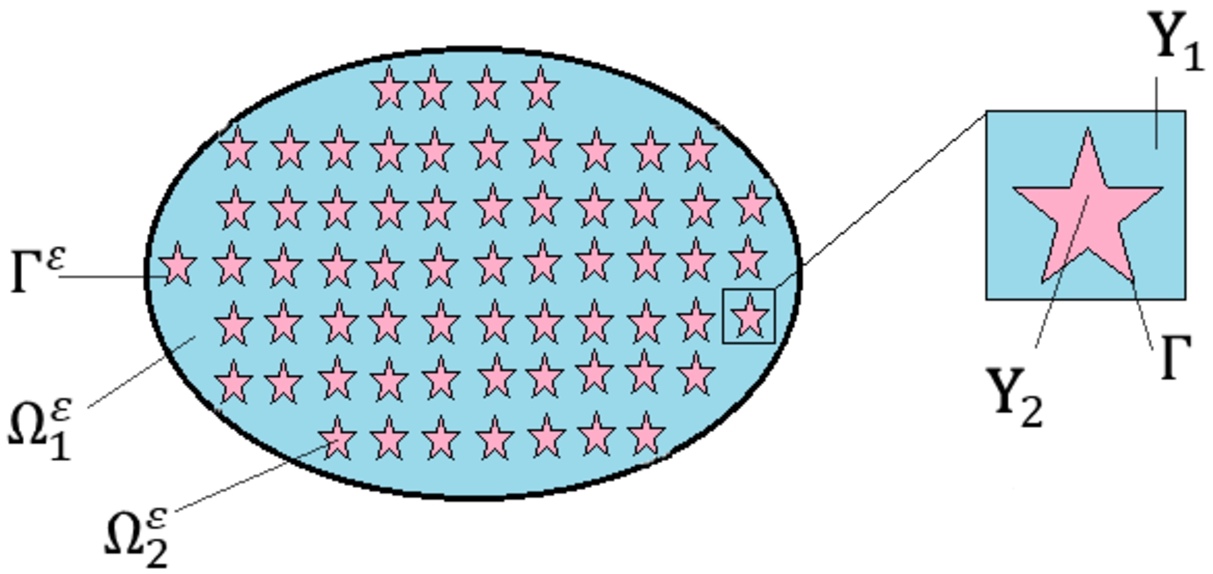
More precisely, the two-component domain Ω is a bounded open subset of which is the union of two disjoint open subsets, and , and their common boundary . The disconnected component is the union of the ε-periodic translated sets of , where is well contained in the reference cell Y and . The connected component is obtained by removing from Ω the closure of such that the interface .
We deal with the homogenization, as ε goes to zero, of the following problem:
where is the unit external normal vector to . We prescribe a Dirichlet condition on the exterior boundary, while we assume that the continuous heat flux is proportional to the jump of the solution on the interface by means of a function of order .
The quasilinear diffusion matrix field is defined by , where the matrix field A is uniformly elliptic, bounded, periodic in the first variable and Carathéodory. The nonlinear real function is nonnegative and singular at , while f is a nonnegative datum whose summability depends on the growth of ζ near its singularity. Concerning the boundary condition, where h is assumed to be a periodic, nonnegative and bounded function, and .
This problem describes the stationary heat diffusion in a two-component composite with an ε-periodic imperfect interface. In particular, quasilinear diffusion terms describe the behavior of materials like glass or wood, in which the heat diffusion depends on the range of the temperature (see for instance [6]). We refer to [20, Section 3] for more details about source terms depending on the solution itself and becoming infinite when the solutions vanish. These kind of source terms can model, for instance, electrical conductors where each point becomes a source of heat as a current flows inside. The boundary condition on models a jump of the solution through a rough interface and we refer to [9] for a physical justification of this model (see also [29]).
In view of a counterexample suggested by H.C. Hummel in [28], one cannot expect bounded a priori estimates for the solution when . For this case we refer to [23] where different a priori estimates needed. As for our problem, existence and uniqueness results has been proved in [25,26] for .
Here we prove an homogenization result for by means of the periodic unfolding method. This method was originally introduced by D. Cioranescu, A. Damlamian and G. Griso in [13] and [14] for fixed domains and extended to perforated ones in [16] and [17]. Then, it has been adapted to two-component domains by P. Donato, K.H. Le Nguyen and R. Tardieu in [22] (see also [21]).
This work has been partially inspired by the works [20] and [24]. Let us point out the main differences with respect to them and the additional difficulties. In [20] the authors treat the same singularity when A is linear and in a different geometrical framework where the domain has two connected components separated by an oscillating interface. This interface tends to a flat one, so that the integral on goes to the one on Γ, roughly speaking. But here is the union of disconnected sets (of order ) so that its measures goes to inifnity, whence the integral on needs particular care.
Let us mention that in [24] the authors consider the same singular problem with A quasilinear but posed in a periodically perforated domain. Here the holes are replaced by a second material so that we have to treat in addition all the integrals on the second component and the boundary term with jump.
In Section 2 we present the setting of the problem and we state the main results.
In Section 3 we give a short presentation of the periodic unfolding method, adapted to two-component domains.
In Section 4 we prove two a priori estimates uniform with respect to ε and we give an estimate of the integral of the singular term close to the singular set , in terms of the quasilinear one (cf. Proposition 4.3).
In Section 5 we prove a crucial convergence result, Theorem 5.4. It is one of the main tools when proving our homogenization result and it shows that the gradient of is equivalent to the gradient of the solution of a suitable auxiliary linear problem, associated with a weak cluster point of the sequence , as . This idea was originally introduced in [4] (see also [5]) where some nonlinear problems with quadratic growth are considered. We refer to [10] and [22] for the study of the auxiliary problem, while for the proof of the convergence result we adapt some techniques from [20] and [24].
Section 6 is devoted to the proofs of Proposition 2.5 and the homogenization theorem. For these results Theorem 5.4 plays an important rule not only in the study of the quasilinear term but also in that of the singular one. Actually, as done in [20] and [24], we split the integral of the singular term into the sum of two integrals: one on the set where the solution is close to the singularity and one where is it far from it, which results not singular. Near the singularity, making use of the estimate given in Proposition 4.3, we shift the study of the singular term to that of the quasilinear one, for which we can use Theorem 5.4.
Finally, let us point out that the homogenization result we prove here shows that the conductivity of the first material is the same obtained when there is no material occupying . On the other hand, since in the limit problem it appears f instead of (being the proportion of the material occupying ), one has anyway to take into account even the source term in the second component.
The first paper on this subject is due to [3] for the linear (nonsingular) case by multiple scale method. In [23] and [29] the authors also studied the linear case by using the Tartar method. For similar homogenization elliptic problems we refer to [8,20,24,28] and [30]. In [21,22] the authors study the linear case in presence of linear and nonlinear boundary conditions, respectively.
Setting of the problem and main results
Throughout the paper, we use the same notation as in [21,22] for the periodic unfolding method in two-component domains.
The domain. For , , let Ω be a bounded open set in with a Lipschitz-continuous boundary . Also let be a reference cell, with , . We suppose that and are two disjoint connected open subsets of Y such that , and , with a common boundary Lipschitz-continuous.
Let be a positive parameter taking values in a sequence converging to zero and set:
for any , and
and
By construction, Ω results the union of the two disjoint components and their common boundary, i.e. (see Fig. 1).
Also we introduce the following sets:
and
Also,
Let us note that here, for the sake of simplicity, we do not allow the second component to meet the boundary of the domain and also we suppose connected. Actually the cases where the holes meet the boundary of Ω and has a finite number of connected components can be treated as done in [21] and [22], respectively.
The two-component domain Ω and the reference cell Y.
In the sequel we denote by
the average of any function , for any open set ω of ,
the characteristic function of any open set ω of ,
∼ the zero extension to the whole of Ω of functions defined on or ,
, ,
c different positive constants independent on ε,
the set of matrix fields such that
with , ,
the canonical basis of ,
the restriction to of functions v defined in Ω, .
Moreover let us recall the classical decomposition for every real function v
where and are both nonnegative. In particular, one has
The problem. The aim of the paper is to study the asymptotic behavior, as ε goes to zero, of the following problem:
where is the unit external normal vector to , and we prescribe a Dirichlet condition on the exterior boundary and a jump of the solution on the interface , in the case .
Assumptions on the data.
The real matrix field satisfies the following conditions:
The functions ζ and f verify
, and h is a Y-periodic function in such that
Under the above assumptions we set, for every ,
The functional framework. We now introduce the functional spaces used in the literature to handle (2.4)-type problems.
Let endowed with the norm
It is known (see for instance [18, Lemma 1], [19]) that a Poincaré inequality in holds with a constant independent on ε, that is
Consequently, the norm in is equivalent to that in via a constant independent on ε.
For every , let be the space defined by
which, after the identification , is equipped by the norm
Let. There exist some positive constants,and C, independent of ε, such thatIn addition, ifis a bounded sequence in, then
The variational formulation associated with problem (2.4) reads
In [25,26] it is proved that, under assumptions H1)–H3), problem (2.7) admits a unique solution.
Let us introduce here the homogenized matrix , , corresponding to our case . It is defined by
where, for every , are unique solutions of the cell problems
The homogenized matrix is actually the one obtained in the framework of perforated domains. It has been originally introduced in [18] for linear problems with Neumann conditions in perforated domain, successively extended to quasilinear ones in [1] and [2].
We recall (see [7] and [18]) that the matrix satisfies the following properties:
Observe that assumptions H1)ii and H2)ii are only needed for the uniqueness of the solution of problem (2.7). If they do not hold true, the homogenized problem is still the same but all the convergences remain valid only for a subsequence.
The main results. We now state the main results of this work, which will be proved in Section 6.
Under assumptions H1)–H3), letbe the unique solution of problem (
2.7
). Then, there exist a subsequence (still denoted by ε),,withfor almost everyandwithfor almost everysuch thatandMoreover, the pairis the unique solution of the unfolded limit equation
Under assumptions H1)–H3), letbe given by Theorem
2.4
. Thenwhere,are the solutions of the cell problems (
2.9
), written for.
Then the homogenization result for problem (2.7) is
Under assumptions H1)–H3), letbe the unique solution of problem (
2.7
) andgiven by Theorem
2.4
. Thenalmost everywhere in Ω andis the unique solution of the following singular limit problem:where the homogenized matrixis given by (
2.8
) and verifiesConsequently, convergences (
2.11
) (with) hold for the whole sequence.
The periodic unfolding method
In this section we give a short presentation of the periodic unfolding method adapted to two-component domains by P. Donato, K.H. Le Nguyen and R. Tardieu in [22]. This method was originally introduced by D. Cioranescu, A. Damlamian and G. Griso in [13] and [14] for fixed domains and extended to perforated ones in [16] and [17].
To this aim, we recall the unfolding operators and and the boundary unfolding operator : and are exactly those ones introduced in [17] for perforated domains, while has been introduced for the two-component domain in [22].
Let , we denote by its integer part such that belongs to Y and set . Then, for every positive ε,
For any Lebesgue-measurable function ϕ on , the unfolding operators , , are defined as follows:
For any Lebesgue-measurable function ϕ on , the boundary unfolding operator is defined as follows:
If ϕ is defined in Ω, we simply write instead of , , for the sake of semplicity. Also we define as follows:
We now recall the main properties of the unfolding operators.
We state below the main propositions proved in [12] and [22] concerning the jump on the interface and some convergence results, under the same notations as in [21].
[
17
,
21
,
22
]Letandbe a bounded sequence in. Then,and there exist a subsequence (still denoted by ε),andwithfor almost everysuch thatMoreover, if, there exist a subsequence (still denoted by ε),andwithfor almost everysuch thatFurthermore, if, thenand also
A priori estimates
In this section we prove two uniform a priori estimates (with respect to ε) for a solution of problem (2.7). In addition, we recall Proposition 4.3 which gives a bound to the integral of the singular term close to the singularity.
These estimates allow us to prove the first part of Theorem 2.4 at the end of this section.
Under assumptions H1)–H3), letbe the solution of problem (
2.7
). The following a priori estimate holds true:wheredepends on α,and.
Alsowheredepends on α,,,.
Let be the solution of problem (2.7) and let us choose as test function. By H1)-H3) and applying the Young inequality with exponents and , we get for every
In view of Remark 2.1, the above inequality leads to
Thanks to Proposition 2.2 we get
So that,
Whence, choosing η sufficiently small so that and , we deduce the result from the previous estimate. □
Under assumptions H1)-H3), letbe the solution of problem (
2.7
). Thenfor every nonnegativewith c depending on α, β,,,and.
Let be the solution of problem (2.7) and let us choose a nonnegative as test function. Since φ has no jump on , the boundary term vanishes. Hence, by using the Hölder inequality and nonnegativity of f, ζ and φ, we have
which implies the result for , via the estimate (4.1). If now is nonnegative, since is Lipschitz continuous, there exist nonnegative and in such that . Then
□
We also recall the following result from [26] (written for and ). It gives an estimate of the integral of the singular term close to the singular set .
([26]).
Under assumptions H1)-H3), letbe the solution of problem (
2.7
) and δ a fixed positive real number. Thenfor every,, whereis an auxiliary function defined by
Under assumptions H1)–H3), letbe the unique solution of problem (
2.7
). Then, there exist a subsequence (still denoted by ε),,withfor almost everyandwithfor almost everysuch that (
2.11
) and (
2.12
) hold.
Let be the solution of problem (2.7). Proposition 4.1 allows us to apply Theorem 3.5. It provides the existence of , with for almost every and with for almost every such that, up to a subsequence, one has convergences (2.11)i,iv,v, since .
Now observe that, by construction, for every there exists such that
Also, by defintion of unfolding one has, for
Consequently, for almost every , there exists such that
On the other hand, using the continuity of ζ and (2.11)i, we have
This, together with (4.5), gives the convergence (2.11)ii.
Also, from Proposition 2.2 and convergence (2.11)i, Proposition 3.310 gives
which reads as (2.11)iii being independent on y.
To show that is nonnegative almost everywhere in Ω, we note that every solution is positive almost everywhere in Ω. Then, the definition of the unfolding operator implies almost everywhere in so that, in view of (2.11)i,
It remains to prove the second condition in (2.12). Let us choose first a nonnegative . Propositions 3.32,4 and 4.2, for the subsequence mentioned before, lead to
Now, from Proposition 3.38, and converge to f and φ, respectively, almost everywhere in , up to a subsequence. Thus, by (2.11)ii,
Since , and are nonnegative functions, we can use Fatou’s lemma and (4.7) to obtain
Being the functions f and independent on y, this implies in particular that
and ends the proof for . For φ with any sign, it suffices to decompose φ as . □
A convergence result for an auxiliary problem
This section is devoted to the study of a suitable auxiliary problem and a crucial convergence result, which is one of the main tools needed for proving Theorem 2.6. In the same spirit of what we have done in [24] in the case of a periodically perforated domain, we first consider the auxiliary linear problem (5.2) below and state existence and homogenization results for it. Then, we prove the convergence result given in Theorem 5.4. It shows that the gradient of is equivalent to the gradient of the solution of the auxiliary linear problem, associated with a weak cluster point of the sequence , as .
We refer to [10] and [22] for the study of the auxiliary problem. For the proof of the convergence result we adapt some techniques from [20] and [24], which inspired this work.
First of all, as in [10] we introduce a linear operator from to verifying the following assumption:
H4) If is a sequence such that
then
Let us point out that assumption H4) is satisfied, for example, by the adjoint of the linear operator introduced by Cioranescu and Saint Jean Paulin in [18]. Then, see [11, Remark 3.1], if H4) holds, one has .
The auxiliary problem
The suitable auxiliary problem we are interested in is the following one:
under assumptions H1), H3)–H4), and .
The variational formulation of problem (5.2) is
The existence and the uniqueness of a solution of problem (5.3) is a straightforward consequence of the Lax-Milgram theorem.
Observe now that in view of Proposition 4.1 and (2.11)iii, the sequence satisfies conditions (5.1), i.e.
The homogenization result below extends Theorem 3.3 of [22] to the case where the matrix field depends on x. We omit its proof, which follows along the line of [22, Theorem 3.3]. The terms containing the functional Z and the quasilinearity of A can be treated as in [10] and [7], respectively.
Under assumptions H1), H3)-H4) and, letbe the unique solution of problem (
5.3
). Then, there existandwithsuch thatand the pairis the unique solution of the limit equationFinally,is the unique solution of the following limit problem:where the homogenized matrixis given by (
2.8
).
Let us consider problem (5.2) for . Its variational formulation is
which admits a unique solution . Theorem 5.1 (written for ) gives
Thanks to the assumptions on A, the uniqueness of this problem ensures that
Moreover, the same arguments used to prove (2.11)iii give
As in [20] we define now the following auxiliary functions :
where is the usual truncation function at level m, so that
Then, we denote the solution of the following problem:
Its variational formulation is
Again, the existence and the uniqueness of a solution of problem (5.11) is straightforward proved by using the Lax-Milgram theorem.
Let us notice that , and consequently on , for every ε.
Thus, in particular, Theorem 5.1 applies to this case with no jump (for ) and, again by uniqueness, we obtain
Also the following convergence holds true:
Moreover, by classical results from [31], we have that for every fixed m
The sequence satisfies conditions (5.1). Indeed, in view of the estimate in (5.12) and convergence (5.13), one has
and
since by construction. Also, by using Proposition 3.310, one has
Let us also point out that, from (5.13), one has even
This is needed in the next subsection.
A convergence result
We are now able to prove the main result of this section. Here we adapt the arguments we used in [24] for the quasilinear singular case in periodically perforated domains to the two-component case, where the holes are replaced by the second component. This is why we analize in detail only the terms differing from the previous work, namely the boundary term and the quasilinear diffusion term in the second component.
The proof follows the same steps introduced in that of [20, Theorem 8.5], which concerns the singular case when A is linear and the domain is made up of two connected components separated by an oscillating interface.
Under assumptions H1)- H4), letandbe solutions of problems (
2.7
) and (
5.7
), respectively. Then, up to a subsequence,
The proof is done in 3 steps.
Step 1. Let us prove that
Let us choose as test function in (5.11). From the ellipticity of A, taking into account that , and (2.3) we get
From Remark 5.3 and H4), we obtain
which concludes the first step.
Step 2. In this step we show that
To do that, let us choose as test function in (2.7) and (5.11). By subtraction, H1)i and the nonnegativity of the boundary term, one has
Let us prove that, as , we have
so that we obtain the result (5.16) as , via convergence (5.10) and the Lebesgue theorem.
Concerning the second term in the right-hand side of the previous inequality, let us observe that satisfies (5.1), in view of (5.4) and (5.12). So that, by H4)
Let . We split the integral of the singular term in (5.17) in two terms as follows:
where, for ,
The terms corresponding to are exactly the ones considered in [24, Theorem 5.5] for the case of periodically perforated domains. It is easy to check that the additional terms and can be treated exactly in the same way. Indeed, all the convergences used there for the first component hold true also here in the second component, thanks to (2.1) and convergence (3.6).
Hence,
On the contrary, the term needs to be treated specifically, since its computation gives rise to a different boundary term. To this aim, let us observe that
for every , where D is a countable set of values (see for instance [20,27] and [24]).
Hence, for , we can write
From Proposition 4.3 written with we get
The first term in the right-hand side of the previous inequality goes to zero as ε goes to zero, because of H1)i, the Hölder inequality, (4.1) and (5.15). On the other hand, since , also belongs to , so that on and, since is nonincreasing (see definition (4.3)), we have
Thus we deduce that
As done for the previous terms, in order to handle we split it as follows:
The same arguments used to prove that in the proof of [24, Theorem 5.5] apply also to the second component. So, using again (2.1) and convergence (3.6), we get
This implies, together with (5.22)–(5.23),
By collecting (5.17), (5.19), (5.20), (5.21), (5.24), we finally obtain the validity of (5.18).
Step 3. In this last step, we show that
We take as test function in the variational formulations (5.11) and (5.7). By subtraction, we have
In view of Remark 5.2, it results
Consequently, by passing to the limit on ε, for H1) and H4)(whose assumptions are satisfied both by and thanks to (5.9) and (5.12)), we get
This together with (5.10) gives
At last, coupling (5.16) and (5.25) we obtain the desired result. □
Proof of the homogenization result
In this last section we prove the second part of Theorem 2.4, Proposition 2.5 and Theorem 2.6.
First, we treat Proposition 2.5 which is a consequence of the convergence result given in Theorem 5.4.
Let be the solution of problem (5.7). The homogenization result given in Theorem 5.1 (written for and , see (5.8)) gives, for the subsequence verifying (2.4),
where is a function in with , such that
Now let us observe that, from Theorem 5.4 and Proposition 3.39, we get
This, together with (2.11)iv,v and (6.1), leads to
which implies , for some function w only depending on x.
Since and
we derive and
Whence we obtain the convergence
and the claimed expression of . □
We are now able to prove the homogenization theorems.
Let us first remark that, under our assumptions, Proposition 4.4 holds true. In particular, by collecting (2.11)iv and (6.2)ii, one gets
Notice that the function is nonnegative due to (2.12). Moreover, conditions (5.4) ensures the validity of H4) and, as a consequence, Theorem 5.4 holds true.
Now, to identify the limit problem satisfied by , we take and , and use
as test function in (2.7). We obtain
Let us consider the solution of problem (5.3) and write
By using assumption H1), the Hölder inequality and Theorem 5.4, one has
taking into account that the norm of is bounded in .
By Theorem 5.1 (written for ), we obtain
in view of (6.3).
Concerning the boundary term in (6.5), by unfolding, using Lemma 3.4 and (3.3) we get
Since , passing to the limit as , we obtain
In order to pass to the limit in the singular term of (6.5), we define
Then one has
and
From now on, without loss of generality we assume and in (6.10). Indeed we can decompose these functions in their positive and negative parts as in (2.2). Now let us split the singular integral into two terms: one near the singularity and one far from it. For every positive δ we write
In view of Proposition 4.3 written for we have
Let us first show that
so that it results
Taking into account the decomposition given in (6.10), and the fact that since then and on , we have
where we used H3), and the growth condition of .
From the properties of the unfolding operators (Lemma 3.4 and estimate (3.3)), the fact that by definition and , we get
which implies (6.14).
Now, we write
The arguments used in Theorem 2.8 of [24] to handle the term related to the first component apply also to the second one. So that, in view of (6.4) and (6.15), we obtain
since, due to the expression of given by Proposition 2.5, the functions and vanish where is equal to 0.
In order to study the limit behavior of (defined in (6.12)), once again we split it as follows:
The integral on the first component is the same considered in the proof of [24, Theorem 2.8]. By using those same computations also on the second component, we get
Then, when passing to the limit in (6.5), we combine (6.6)–(6.9), (6.12), (6.16), (6.17) and have
for every and . By density we obtain
for every and . □
From the expression of given in Proposition 2.5, a standard computation shows that is a solution of the following problem:
Also, since the conditions given in (2.10) are satisfied by , Theorem 6 from [25] shows that is the unique solution of this problem. This implies the uniqueness of under the condition , in view of Proposition 2.5. Hence convergence (2.11) holds for the whole sequence, as well as (6.4).
We lastly prove that almost everywhere in Ω. From the strong maximum principle, by contradiction, we derive in Ω. This imply for every . This means on Ω which contradicts assumption H2)iii. Consequently almost everywhere in Ω and . Then satisfies the limit equation (2.14). □
Footnotes
Acknowledgements
The author wishes to express her deep gratitude to Patrizia Donato for helpful discussions and valuable suggestions.
References
1.
M.Artola and G.Duvaut, Homogénéisation d’une classe de problèmes non linéaires, C R Math Acad Sci Paris Ser A288 (1979), 775–778.
2.
M.Artola and G.Duvaut, Un résultat d’homogénéisation pour une classe de problèmes de diffusion non linéaires stationnaires, Ann Fac Sci Toulouse Math4 (1982), 1–28. doi:10.5802/afst.572.
3.
J.L.Auriault and H.Ene, Macroscopic modelling of heat transfer in composites with interfacial thermal barrier, Heat Mass Tranf37 (1994), 2885–2892. doi:10.1016/0017-9310(94)90342-5.
4.
A.Bensoussan, L.Boccardo and F.Murat, H-convergence for quasi-linear elliptic equations with quadratic growth, Appl Math Optim26 (1992), 253–272. doi:10.1007/BF01371084.
5.
A.Bensoussan, L.Boccardo and F.Murat, H-Convergence for Quasilinear Elliptic Equations Under Natural Hypotheses on the Correctors, Composite Media and Homogenization Theory, World Scientific, Singapore, 1995.
6.
M.B.Bever, Encyclopedia of Material Science and Engineering, Pergamon Press, New York, 1985.
7.
B.Cabarrubias and P.Donato, Homogenization of a quasilinear elliptic problem with nonlinear Robin boundary comditions, Appl Anal91 (2012), 1111–1127. doi:10.1080/00036811.2011.619982.
8.
E.Canon and J.N.Pernin, Homogenization of diffusion in composite media with interfacial barrier, Rev Roumaine Math Pures Appl44 (1999), 23–36.
9.
H.S.Carslaw and J.C.Jaeger, Conduction of Heat in Solids, Clarendon Press, Oxford, 1947.
10.
I.Chourabi and P.Donato, Homogenization and correctors of a class of elliptic problems in perforated domains, Asymptot Anal92 (2015), 1–43.
11.
I.Chourabi and P.Donato, Homogenization of elliptic problems with quadratic growth and nonhomogenous Robin conditions in perforated domains, Chin Ann Math Ser B37 (2016), 833–852. doi:10.1007/s11401-016-1008-y.
12.
D.Cioranescu, A.Damlamian, P.Donato, G.Griso and R.Zaki, The periodic unfolding method in domains with holes, SIAM J Math Anal44 (2012), 718–760. doi:10.1137/100817942.
13.
D.Cioranescu, A.Damlamian and G.Griso, Periodic unfolding and homogenization, C R Math Acad Sci Paris Ser I335 (2002), 99–104. doi:10.1016/S1631-073X(02)02429-9.
14.
D.Cioranescu, A.Damlamian and G.Griso, The periodic unfolding method in homogenization, SIAM J Math Anal40 (2008), 1585–1620. doi:10.1137/080713148.
15.
D.Cioranescu, A.Damlamian and G.Griso, The Periodic Unfolding Method, Series in Contemporary Mathematics, Vol. 3, Springer, Singapore, 2018.
16.
D.Cioranescu, P.Donato and R.Zaki, Periodic unfolding and Robin problems in perforated domains, C R Math Acad Sci Paris342 (2006), 467–474.
17.
D.Cioranescu, P.Donato and R.Zaki, The periodic unfolding method in perforated domains, Port Math63 (2006), 476–496.
18.
D.Cioranescu and J.Saint Jean Paulin, Homogenization in open sets with holes, J Math Anal Appl71 (1979), 590–607. doi:10.1016/0022-247X(79)90211-7.
19.
D.Cioranescu and J.Saint Jean Paulin, Homogenization of Reticulated Structures, Springer-Verlag, New York, 1999.
20.
P.Donato and D.Giachetti, Existence and homogenization for a singular problem through rough surfaces, SIAM J Math Anal48 (2016), 4047–4086. doi:10.1137/15M1032107.
21.
P.Donato and K.H.Le Nguyen, Homogenization of diffusion problems with a nonlinear interfacial resistance, NoDEA Nonlinear Differential Equations Appl22 (2015), 1345–1380. doi:10.1007/s00030-015-0325-2.
22.
P.Donato, K.H.Le Nguyen and R.Tardieu, The periodic unfolding method for a class of imperfect transmission problems, J Math Sci176 (2011), 891–927. doi:10.1007/s10958-011-0443-2.
23.
P.Donato and S.Monsurrò, Homogenization of two heat conductors with an interfacial contact resistance, Anal Appl3 (2004), 247–273. doi:10.1142/S0219530504000345.
24.
P.Donato, S.Monsurrò and F.Raimondi, Homogenization of a class of singular elliptic problems in perforated domains, Nonlinear Anal173 (2018), 180–208. doi:10.1016/j.na.2018.04.005.
25.
P.Donato and F.Raimondi, Uniqueness result for a class of singular elliptic problems in two-component domains, J Elliptic Parabol Equ2 (2019), 349–358. doi:10.1007/s41808-019-00044-x.
26.
P.Donato and F.Raimondi, Existence and uniqueness results for a class of singular elliptic problems in two-component domains, in: Integral Methods in Science and Engineering, Constandaet al., eds, Vol. 1, Birkhäuser, 2017, pp. 83–93.
27.
D.Giachetti and F.Murat, An elliptic problem with a lower order term having singular behaviour, Boll Unione Mat Ital2 (2009), 349–370.
28.
H.C.Hummel, Homogenization for heat transfer in polycristals with interfacial resistances, Appl Anal75 (2000), 403–424. doi:10.1080/00036810008840857.
29.
S.Monsurrò, Homogenization of a two-component composite with interfacial thermal barrier, Adv Math Sci Appl13 (2003), 43–63.
30.
J.N.Pernin, Homogénéisation d’un problème de diffusion en milieu composite à deux composantes, C R Acad Sci Paris Ser I321 (1985), 949–952.
31.
G.Stampacchia, Le problème de Dirichlet pour les équations elliptiques du second ordre à coefficients discontinus, Ann Inst Fourier (Grenoble) (1965), 189–258.