This paper is focused on the asymptotic behavior of sequences of functions, whose partial derivatives estimates in one or more directions are highly contrasted with respect to the periodic parameter ε. In particular, a direct application for the homogenization of a homogeneous Dirichlet problem defined on an anisotropic structure is presented. In general, the obtained results can be applied to thin structures where the behavior is different according to the observed direction.
The periodic unfolding method has been presented the first time by D. Cioranescu and al. in [2], with further development in [3,4,7,8] and extensively in [5]. Such method, as an equivalent to the two-scale convergence, has largely found application in the homogenization of periodically perforated domains (see e.g. [1,6,9–12,23]) and of thin structures with periodic pattern, like periodically perforated shells (see [15]), textiles made of long woven beams in strong contact (see [21,22]) and 3D lattice structures made of either beams or segments (see [13,17,18]) in a stable configuration.
In all these cases, the classical unfolding theory can be directly applied: given a bounded domain with Lipschitz boundary and periodically paved with cells of size ε, a small parameter, the structures models (and the displacements over them) can be represented by sequences such that either
whose asymptotic behavior is investigated in detail in [5, Section 1.4].
However, recent application of the unfolding method to a wider set of structure models that involve more complex setting in order to describe more phenomena and thus be closer to reality, finds its limitation in the investigation by the classical unfolding theorems. One of the encountered limitations concerns the anisotropic behavior of the sequences describing the structure model, i.e. the fact that these sequences present better estimates in some privileged directions with respect to others.
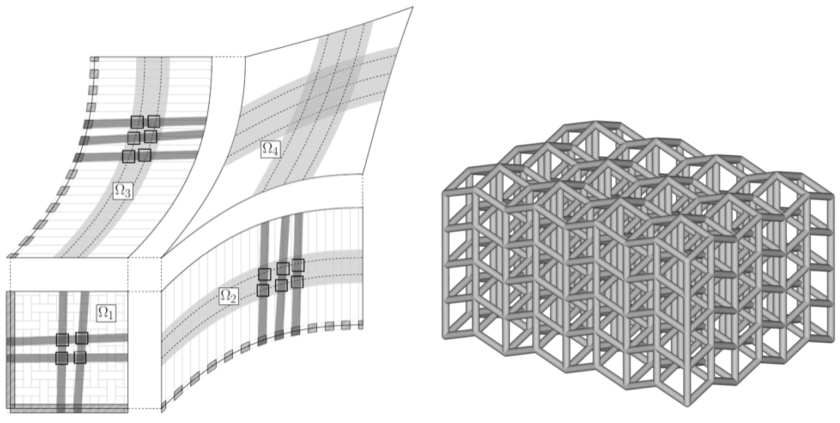
We can mention two representative examples: in the continuation of the work made in [22], the lack of strong contact between fibers and the partial clamp on a textile made of long beams leads to different gradient estimates for the displacement fields with respect to the observed direction (see Fig. 1 left), while in the extension of the works made in [18] to unstable lattice configurations, the same contrast on the gradient estimates appear on the unstable oscillating thin straits (see Fig. 1 right).
On the left, a sketch of the textile analyzed in [14]: as one can notice, in the unsupported part in the yarns in direction and behave differently. On the right, an unstable lattice structure analyzed in [16]: in many of these structures, the sequences describing the displacement have privileged directions.
In this context, an extension of the know unfolding theorems already developed in [2,4,5] to this new classes of functions, so-called “anisotropically bounded”, was needed to furnish the rigorous mathematical tools in order to apply the periodic unfolding to these types of structures. This is exactly the motivation and part of the purpose of this paper.
Following closely the classical results achieved in [5, Section 1.4], after presenting some standard notation for the periodic unfolding method in Section 2, in Section 3 we consider a decomposition of the Euclidean space by setting , where the variable corresponds to the first directions and from [5, Chap. 7], we recall the unfolding with parameters and prove the main properties. The core of our work is contained in Section 4, where we show the asymptotic behavior of these anisoptropically bounded sequences in the following cases:
;
;
;
.
These results will later be used in Section 5 to extend some more complex lemmas concerning the periodic unfolding (see for an instance [5, Lemma 11.11]) to this new classes of functions, showing that different anisotropic assumptions arise different regularity of the limit fields. In the last Section 6, a direct application of the developed tools for the homogenization via unfolding of the following homogeneous Dirichlet problem
whose nature is anisotropic. Existence and uniqueness of the limit problem are proven, the cell problems and the macroscopic limit problem are found.
The tools presented in this paper serves of multiple purposes.
In first place, the are the breakthrough for the investigation of above mentioned structures: in [14], the results are largely employed in [14, Section 6], where we deal with asymptotic behavior of sequences belonging to subspaces of and need an equivalent anisotropic formulation of [5, Lemma 11.11] (already applied in the same fashion of [15,22]). In [16], further adaptation of the results made in this paper to lattices (rigorously made in [13]) provided the sufficient ingredients to find the asymptotic behavior of sequences that model such unstable structures (one can look at problem [16, Eq. (5.1)] for structures of type ).
A second important result is given by the investigated problem. It is a representative example of which results can be expected by the homogenization of anisotropic structures (one can also find its similar formulation in for the stretching fields in [16, Eq. (13.1)]) and it can be applied to partial differential equations on domains involving periodic grids, lattices, thin frames and fiber structures.
Moreover, even though the presented formulation assumes an isotropy of the material and anisotropy of the displacement, the variational problem (1.1) can be reformulated by shifting the anisotropy to the material law:
In this sense, the investigation of such problem applies even by starting by a different design, especially related to layered composites with contrast in the coefficients, e.g. made of stiff and soft materials. Among them, we would like to mention [20], where this effect is reached by a layer of thin vertical beams, and [19], where the same peculiarity is obtained by a composite weak layer, i.e., the layer of the stiffness of bulk domains, scaled by ε.
Preliminaries and notation
We start by introducing the standard notation for the periodic unfolding method already used in [5, Section 1.4].
Let be the Euclidean space with usual basis and the open unit parallelotope associated with this basis. For a.e. , we set the unique decomposition such that
Let be a sequence of strictly positive parameters going to 0. We scale our paving by ε writing
Let now Ω be a bounded domain in with Lipschitz boundary. We consider the covering
and set
We recall the definitions of classical unfolding operator and mean value operator.
For every measurable function on , the mean value operator is defined as follows:
Let . From [5, Propositions 1.8 and 1.11], we recall the properties of these operators:
Since we will deal with Sobolev spaces, we give hereafter some definitions:
The unfolding with parameters
In this section we prepare the ground for the investigation of the asymptotically bounded functions.
In order to show the contrast in behavior of the anisotropically bounded sequences, we find convenient to set a decomposition of the Euclidean space. Let be in and such that . Denote
and
One has
For every and , we write
From now on, however, we find easier to refer to such decomposition with the vectorial notation
Similarly to (2.1), we apply the paving to a.e. and setting
We give now the definition of partial mean value operators.
For every , the partial mean value operators are defined as follows:
Denote
We endow these spaces with the respective norms:
We recall the unfolding with parameters tools already developed in [5, Chap. 7] and we define two partial unfolding operators. These operators are built in order to apply the unfolding only to their respective half of the domain and such that the composition of both gives the unfolding on the whole domain. As we will see, this “two-steps unfolding” proves to be the winning strategy to deal with anisotropically bounded sequences.
For every measurable function ϕ on Ω, the unfolding operator is defined as follows:
For every measurable function ψ on , the unfolding operator is defined as follows:
Note that in the partial unfolding operator the variable plays the role of a parameter, while in the role of parameters is played by the variables .
One hasMoreover, for everyone has
Let ϕ be measurable on Ω. We have that
For the result is obvious.
Let be in . We have
Let now ϕ be in . We have
□
Asymptotic behavior of anisotropically bounded sequences
In this section all the tools are ready to investigate the asymptotic behavior of anisotropically bounded sequences. Since the definition of “anisotropic behavior” only denotes a contrast in the estimates with respect to the direction observed, the different amount of information we have on the sequences arises a different asymptotic behavior.
We start with sequences bounded in , , whose gradient is bounded with order in in the first directions.
Letbe a sequence in,, satisfyingwhere the constant does not depend on ε.
Then, there exist a subsequence of, still denoted, and a functionin the spacesuch thatwhere.
The same results hold forwith weak topology replaced by weak-* topology in the corresponding spaces.
An analogous result holds for sequences uniformly bounded in , .
Letbe a sequence in,, such thatThen, there exist a subsequence of, still denoted, and,such thatwhereand.
The same results hold forwith weak topology replaced by weak-* topology in the corresponding spaces.
The proof is similar to [5, Corollary 1.37] and [5, Theorem 1.41]. □
Now, we consider the sequences in , , whose gradient is estimated with different order according to the considered direction.
Letbe a sequence in,, satisfyingwhere the constant does not depend on ε.
Then, there exist a subsequence of, still denoted, and functionssuch thatwhereand.
The same results hold forwith weak topology replaced by weak-* topology in the corresponding spaces.
From (4.1), up to a subsequence of , still denoted , one has the existence of such that (4.2)1 holds.
Set . This sequence belongs to and from estimate (4.1) and equality (3.2), it satisfies
where the constant does not depend on ε.
Up to a subsequence of , still denoted , there exists and (the periodicity of is proved as in [5, Theorem 1.36]) such that
where denotes the characteristic function of the domain .
Let g be in . For ε sufficiently small such that , we have
Then, passing to the limit yields
This means that a.e. in , thus and therefore .
Now, we transform the sequence using the unfolding operator , being a set of parameters.
From the above convergence and estimate (4.3), up to a subsequence of , still denoted , [5, Corollary 1.37] and [5, Theorem 1.41] give such that (using the rule (3.1)1)
This proves convergences (4.2)2,3,5. Moreover, from convergence (4.2)2 and the unfolding properties of we get that
which proves convergence (4.2)4. □
As the lemma below shows, an analogous asymptotic behavior is achieved starting from sequences uniformly bounded in , , with some assumptions on the gradient derivatives.
Letbe a sequence in,, satisfyingwhere the constant does not depend on ε.
Then, there exist a subsequence of, still denoted, functionssuch thata.e. in,and we havewhere.
The same results hold forwith weak topology replaced by weak-* topology in the corresponding spaces.
By estimate (4.4)1 and Lemma 4.2, there exists a subsequence of , still denoted , and functions , such that
Set . By estimate (4.4), this sequence satisfies
where the constant does not depend on ε.
Hence, applying Lemma 4.1 to the above sequence (but swapping and ), there exists a function such that
This, together with convergence (4.6)3 implies that the quantity belongs to . Since does not depend on and is periodic with respect to , we have that
thus and therefore .
Moreover, the quantity belongs to and thus Lemma A.2 implies that there exists with such that (4.5)3 hold. The proof follows by replacing by the function , which belongs to the space and satisfies a.e. in . □
Other unfolding results for anisotropically bounded sequences
In this section we use the achieved results for the unfolding of sequences in the anisotropic case to prove a more complex lemma involving multiple sequences. Even if it might seem a specific task, this lemma has proven to be a key component in the homogenization via unfolding of perforated structures (see [15]) and textiles (see [22]) and its extension can be applied to anisotropically structures, such as the textiles with loose contact investigated in [14].
Letbe a sequence converging weakly toin,. Moreover, assume that there existandsuch thatThen, u belongs to. Moreover, there exist a subsequence of, still denoted, andsuch that
As an immediate consequence, one has the following.
Letbe an open set in,. Letbe a sequence converging weakly toin,. Moreover, assume that there existandsuch thatThen, u belongs to. Furthermore, there exist a subsequence of, still denoted, andsuch that:
Define the spaces
where denotes the first entries of the Hessian matrix of ϕ.
We endow such spaces with the respective norms:
We are ready to extend Lemma 5.1 to the class of anisotropically bounded sequences.
Letbe a sequence in the space,, satisfyingwhere the constant does not depend on ε.
Moreover, assume that there existsuch thatThen, there exist a subsequence of, still denoted, andwith,,and a functionsuch that
We first apply the unfolding operator to both sequences and . By Lemma 4.2 and estimates (5.1), there exist a subsequence of , still denoted , , , , such that
By convergence (5.2), there exist a subsequence of , still denoted , and functions with such that
From convergences (5.4)2,3 and (5.5) we get
Applying to the above equality and since , while , , we get that a.e. in . Hence, and thus because it belongs to . As a consequence, one has
Set , . Again by convergence (5.2), there exist a subsequence of , still denoted , and such that
Then, due to convergence (5.5) we have .
Now, let and be two open sets such that
First, observe that
By the above convergence and (5.4)4, one has
Lemma 5.2 claims that up to a subsequence, there exists , which belongs to , such that the following convergence holds:
Taking into account convergence (5.5) we get
Since one can cover Ω by a countable family of open subsets satisfying (5.6), there exists in such that . This completes the proof of (5.3). □
With some more assumptions, we can improve the regularity of the limit functions.
Letbe a sequence in, with, satisfying the assumptions in Lemma
5.3
. Moreover, assume thatwhere the constant does not depend on ε.
Then, there exist a subsequence of, still denoted,,,andsuch that
From Lemma 5.3, there exist a subsequence of , still denoted , and , , and a function such that
By hypothesis (5.7), Lemma 4.1 (swapping and ) and the proof of Lemma 4.4 one has
with , and satisfying a.e. in .
Since, satisfies a.e. in and a.e. in by periodicity of , we obtain
Hence lies in . Lemma A.2 in the Appendix gives a function such that . The proof is complete. □
Application: Homogenization of an anisotropic diffusion problem
In this last section we want to give a direct application of the periodic unfolding for anisotropically bounded sequences to a diffusion problem.
Let be an open subset of and let with . Denote the set of matrices with coefficients in such that for every and for a.e. , the following inequalities hold:
;
.
Let A be in and let be the sequence of matrices belonging to defined by
From (2.2) for , we recall the definition of the Hilbert spaces
Let f be a function in .
Consider the following Dirichlet problem in variational formulation (see also (1.1) and (1.2) where it is written differently):
where · denotes the dot product by the column vectors and .
By the Poincaré inequality and the fact that , we have that
Thus, problem (6.2) admits a unique solution by the Lax–Milgram theorem and the following inequality holds:
Hence
where the constant does not depend on ε.
Set
Denote (resp. ) the closure of (resp. of ) in (resp. ) for the norm of (resp. ), see Section 3).
Below, we give the periodic homogenization via unfolding.
There existandsuch thatThe coupleis the unique solution of problem
Step 1. We show (6.5) and the weak convergences (6.4).
First, since , by definition (6.1) and the unfolding operator properties we immediately get that for a.e. .
Now, note that the solution of (6.2) satisfies (6.3). Hence, up to a subsequence of , still denoted , Lemma 4.3 gives and such that
Now, we choose the test functions
in , in ,
Φ in ,
in .
Set for a.e. .
Applying the unfolding operator to the sequence , we get that
Taking as test function in (6.2), then transforming by unfolding and passing to the limit give (6.5) with . By density argumentation, we extend such results for all and all . Since the solution is unique the whole sequences converge to their limit.
Step 2. We prove that convergences (6.4)3,4 are strong.
First, setting in (6.2), then transforming by unfolding and using the weak lower semicontinuity yield
from which it follows that all the above inequalities are in fact equalities. Hence
and
Since the map is a norm equivalent to the usual norm of , we get
This, together with the fact that (6.6)3,4 already converge weakly, ensures the strong convergences (6.4)3,4. The proof is therefore complete. □
Now, consider the following partition of A into blocks
where
is a matrix with entries in ,
is a matrix with entries in ,
is a matrix with entries in ,
is a matrix with entries in .
We define the correctors , , as the unique solutions in the space of the cell problems
By the Lax–Milgram theorem applied in Hilbert space , we obtain the existence and uniqueness of the solution of (6.7) for every .
Since A belongs to we get for every :
As a consequence 1
One can prove that also belongs to .
for every and
We can finally give the form of the homogenized problem.
The functionis the unique solution of the following homogenized problem:The homogenizing operatoris the matrix defined bywhereand thusis thematrix
Note, that in such a formulation the problem mixes the macroscopic and microscopic variables that correspond to . Nevertheless, the homogenization is considered to be concluded since all the involved functions depend on such variables.
Before proceeding to the proof, we find convenient to clarify the boundary conditions for the solutions of problem (6.8) in a simplified case.
Assume that . Then, the function of belongs to the space
Equation (6.5) with leads to:
from which the form of the cell problems (6.7) follows.
By (6.10), we can write as
Replacing by the above equality in (6.5) (note that is set to be zero since the correctors have been found) we first get
Concerning the second term, straightforward calculations lead to
where we denoted the matrix partitioned into the upper block and the lower block with zero entrances. Hence, we get that
Gathering all the dependent terms, we get the form (6.9) of the homogenizing operator .
Since and the ’s are in , it is clear that belongs to .
We prove now that is coercive. Let be a vector with fixed entries in . By the construction of the homogenizing operator, straightforward calculation imply that
where . Observe that by the cell problems (6.7), the second term in the last equality is equal to zero.
Now, the coercivity of the matrix A and the fact that imply that
which proves that is coercive.
Replacing the form of on the original problem (6.5), we get (6.8). By the boundedness and coercivity of and by the fact that the function belongs to , the above problem admits a unique solution by the Poincaré inequality and the Lax–Milgram theorem. □
Footnotes
Appendix
References
1.
B.Cabarrubias and P.Donato, Homogenization of some evolution problems in domains with small holes, Electron. J. Diff. Equ.169 (2016), 1–26.
2.
D.Cioranescu, A.Damlamian and G.Griso, Periodic unfolding and homogenization, Comptes Rendus Mathématique335(1) (2002), 99–104. doi:10.1016/S1631-073X(02)02429-9.
3.
D.Cioranescu, A.Damlamian and G.Griso, The Stokes problem in perforated domains by the periodic unfolding method, in: Proceedings Conference New Trends in Continuum Mechanics, M.Suliciu, ed., Theta, Bucarest, 2005, pp. 67–80.
4.
D.Cioranescu, A.Damlamian and G.Griso, The periodic unfolding method in homogenization, SIAM J. Math. Anal.40(4) (2008), 1585–1620. doi:10.1137/080713148.
5.
D.Cioranescu, A.Damlamian and G.Griso, The Periodic Unfolding Method. Theory and Applications to Partial Differential Problems, Springer, Singapore, 2018. doi:10.1007/978-981-13-3032-2.
6.
D.Cioranescu, A.Damlamian and J.Orlik, Homogenization via unfolding in periodic elasticity with contact on closed and open cracks, Asymptotic Analysis82 (2013), 201–232. doi:10.3233/ASY-2012-1141.
7.
D.Cioranescu, P.Donato and R.Zaki, The periodic unfolding method in perforated domains, Portugaliae Mathematica4 (2006), 467–496.
8.
A.Damlamian, An elementary introduction to periodic unfolding, in: Proc. of the Narvik Conference 2004, A.Damlamian, D.Lukkassen, A.Meidell and A.Piatnitski, eds, Gakuto Int. Series, Math. Sci. Appl., Vol. 24, Gakkotosho, 2006, pp. 119–136.
9.
A.Damlamian and N.Meunier, The “strange term” in the periodic homogenization for multivalued Leray–Lions operators in perforated domains, Ricerche mat.59 (2010), 281–312. doi:10.1007/s11587-010-0087-4.
10.
A.Damlamian, N.Meunier and J.Van Schaftingen, Periodic homogenization for monotone multivalued operators, Nonlinear Analysis67 (2007), 3217–3239. doi:10.1016/j.na.2006.10.007.
11.
P.Donato, H.Le Nguyen and R.Tardieu, The periodic unfolding method for a class of imperfect transmission problems, Journal of Math. Sci.176(6) (2011), 891–927. doi:10.1007/s10958-011-0443-2.
12.
P.Donato and Z.Yang, The periodic unfolding method for the heat equation in perforated domains, Sci. China Math59 (2016), 891–906. doi:10.1007/s11425-015-5103-4.
13.
R.Falconi, G.Griso and J.Orlik, Periodic unfolding for lattice structures (submitted). Preprint at HAL, https://hal.archives-ouvertes.fr/hal-03532516.
14.
R.Falconi, G.Griso, J.Orlik and S.Wackerle, Asymptotic behavior for textiles with loose contact (submitted).
15.
G.Griso, M.Hauck and J.Orlik, Asymptotic analysis for periodic perforated shells, ESAIM: M2AN55(1) (2021), 1–36. doi:10.1051/m2an/2020067.
16.
G.Griso, L.Khilkova and J.Orlik, Asymptotic behavior of unstable structures made of beams (submitted).
17.
G.Griso, L.Khilkova, J.Orlik and O.Sivak, Homogenization of perforated elastic structures, J. Elast.141 (2020), 181–225. doi:10.1007/s10659-020-09781.
18.
G.Griso, L.Khilkova, J.Orlik and O.Sivak, Asymptotic behavior of stable structures made of beams, J. Elast (2021). doi:10.1007/s10659-021-09816-w.
19.
G.Griso, A.Migunova and J.Orlik, Homogenization via unfolding in periodic layer with contact, Asymptotic Analysis99(1–2) (2016), 23–52. doi:10.3233/ASY-161374.
20.
G.Griso, A.Migunova and J.Orlik, Asymptotic analysis for domains separated by a thin layer made of periodic vertical beams, J. Elast.128(2) (2017), 291–331. doi:10.1007/s10659-017-9628-3.
21.
G.Griso, J.Orlik and S.Wackerle, Asymptotic behavior for textiles in von-Kármán regime, J. Math. Pures Appl144 (2020), 164–193. doi:10.1016/j.matpur.2020.10.002.
22.
G.Griso, J.Orlik and S.Wackerle, Homogenization of textiles, SIAM J. Math. Anal.52(2) (2020), 1639–1689. doi:10.1137/19M1288693.
23.
A.Ould Hammouda, Homogenization of a class of Neumann problems in perforated domains, Asymptotic Analysis71(1–2) (2011), 33–57. doi:10.3233/ASY-2010-1010.