We consider a Dirichlet problem for the Poisson equation in a periodically perforated domain. The geometry of the domain is controlled by two parameters: a real number , proportional to the radius of the holes, and a map ϕ, which models the shape of the holes. So, if g denotes the Dirichlet boundary datum and f the Poisson datum, we have a solution for each quadruple . Our aim is to study how the solution depends on , especially when ϵ is very small and the holes narrow to points. In contrast with previous works, we do not introduce the assumption that f has zero integral on the fundamental periodicity cell. This brings in a certain singular behavior for ϵ close to 0. We show that, when the dimension n of the ambient space is greater than or equal to 3, a suitable restriction of the solution can be represented with an analytic map of the quadruple multiplied by the factor . In case of dimension , we have to add times the integral of .
The object of this paper is to study a singular perturbation of a Dirichlet–Poisson problem in a periodically perforated domain. The aim is to show that the solution can be written as a combination of real analytic maps and – possibly singular but completely known – elementary functions of the perturbation parameters. The geometry of the problem is controlled by two parameters: a positive real number ϵ that determines the size of the holes and a shape function ϕ that deforms the boundary of a certain reference domain Ω into the shape of the holes. To wit, the holes are shifted copies of and thus, for ϵ that tends to zero, they shrink down to points. Next, we take a Dirichlet datum g and a Poisson datum f in such a way that the problem has a unique solution for each choice of the four variables ϵ, ϕ, g, and f. So it makes sense to ask ourselves what we can say of the map that takes a quadruple to the corresponding solution. In particular, we want to see what happens when ϵ is close to zero and the holes are shrinking to points.
The interest for periodic problems for the Laplace equations is (in part) motivated by their relevance in the applications. For instance, problems of this kind arise in the study of effective properties of composite materials. The reader may find some examples in the works of Ammari, Kang, and Lim [2], Ammari, Kang, and Touibi [3], Drygaś, Gluzman, Mityushev, and Nawalaniec [10], Gluzman, Mityushev, and Nawalaniec [14], and Kapanadze, Mishuris, and Pesetskaya [15,16].
Indeed, we have ourselves already written on this topic. In particular, the problem of this paper is very similar to those of [34] and [35]. There is a critical difference though: in [34] we take the Poisson datum f equal to 0 and in [35] the function f is required to have zero integral on the periodicity cell, whereas here we abandon this assumption. As a consequence, we have to deal with a specific singular behavior that appears for ϵ close to zero: If the ambient space has dimension , the solution shows a singularity of the order of , and, for , a -singularity. Also, in the previous works [34,35] the number ϵ was solely responsible for the geometric deformation of the problem, and thus only homothetic transformations of the holes were allowed. Here, instead, the holes can change shape according to the function ϕ and we analyze the joint dependence on the set of variables .
We now describe our problem in detail. We fix once for all
where denotes the set of natural numbers including 0. We set
The set Q is the fundamental periodicity cell and the diagonal matrix q is the periodicity matrix associated with the cell Q.
We consider a set satisfying the following assumption:
In (1), as well as in the rest of the paper, α is a fixed number in the open interval and the symbol denotes the closure of a set. For the definition of sets and functions of the Schauder class () we refer, e.g., to Gilbarg and Trudinger [13].
The boundary of Ω plays the role of a reference set and the boundary of the holes is obtained rescaling and shifting the image of under a suitable map ϕ. The set of the functions ϕ that we allow is denoted by and consists of the functions of that are injective and have injective differential at all points of . We can verify that is open in (see, e.g., Lanza de Cristoforis and Rossi [26, Lem. 2.2, p. 197] and [25, Lem. 2.5, p. 143]). Moreover, if , then the Jordan–Leray separation theorem (see, e.g, Deimling [9, Thm. 5.2, p. 26]) ensures that splits into exactly two open connected components. We denote by the bounded one and we can verify that is a set of class (cf. [25, Lem. 2.6, p. 144]). To put it simple, the modified set keeps the same regularity of the reference set Ω. Incidentally, we observe that this might not be the case with sets of a lower regularity. For example, a bi-Lipshitz image of the boundary of a Lipshitz set might not be the boundary of a Lipschitz set (cf., e.g., McLean [33, Fig. 2(iii)]).
Next we fix a point
which is the point where the hole in the reference periodicity cell shrinks to. It will be convenient to consider perturbations around a fixed
There is no loss of generality in this choice, because can be any function of . The advantage is that there exist a real number and an open neighborhood of in such that
Then, for these ϵ’s and ϕ’s we can define the hole
which is contained in Q, has size proportional to ϵ, and shape determined by ϕ. When ϵ tends to 0, the hole shrinks toward the point p while its shape changes according to ϕ (see Fig. 1).
A 2-dimensional example of perforated reference periodicity cell. The hole shrinks toward the point p when ϵ tends to 0.
The periodic set of holes is given by
and the periodic domain where we define the Poisson equation is
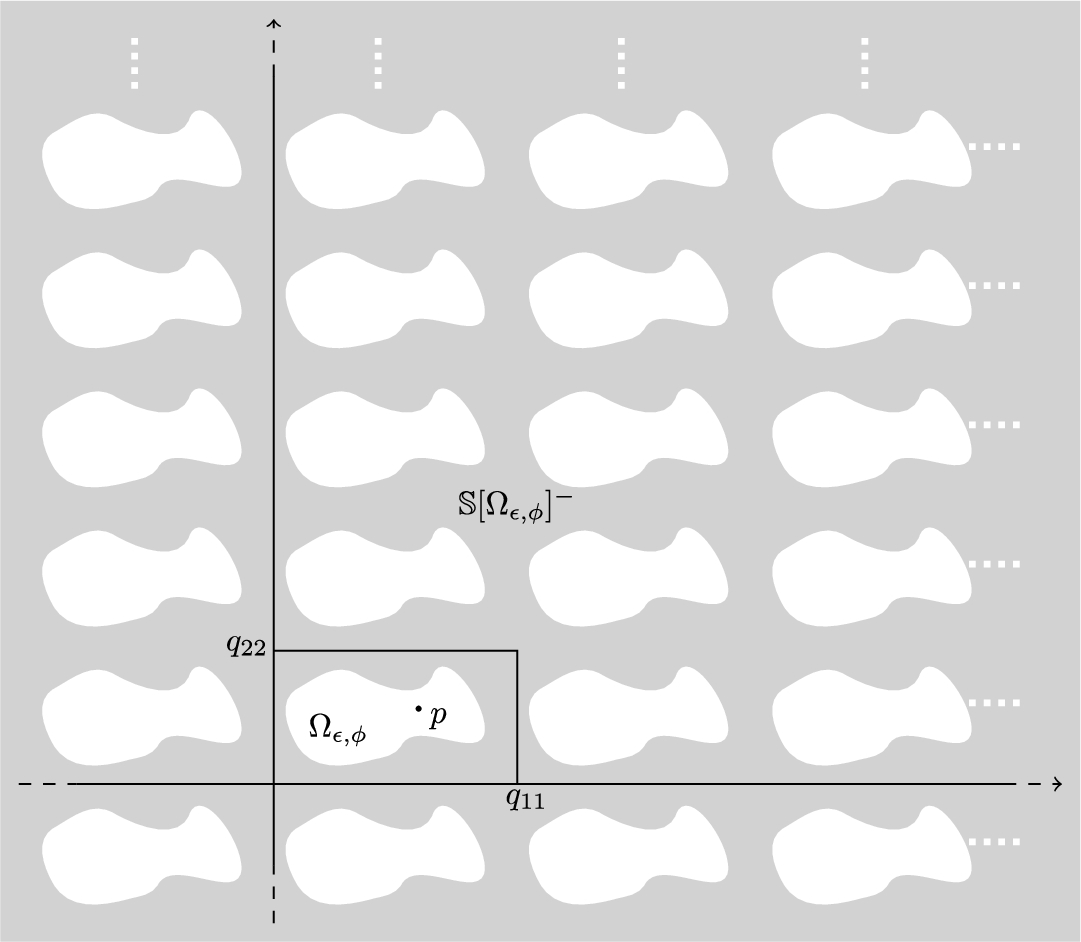
In other words, the domain is obtained removing from the periodic set of holes (see Fig. 2). When ϵ approaches zero, the hole in the cell shrinks toward .
A 2-dimensional example of periodically perforeted set .
We now introduce suitable spaces for the functional data of the problem. For the right-hand side of the Dirichlet boundary condition we take a function
which we properly transplant to be defined on . As for the Poisson datum, regularity has to be chosen more carefully. Lanza de Cristoforis in [19] and Preciso in [38,39] shown that Roumieu analytic functions produce analytic composition operators and analytic Newtonian potentials, a feature that will come handy later on in our analysis. Moreover, since we are dealing with a periodic problem, we have to take periodicity into account. So, the right-hand side of the Poisson equation will be a function
where is fixed and denotes the Roumieu class of q-periodic analytic functions (see (5) for the exact definition of , see also [35]).
All the ingredients are now introduced and we can state our Dirichlet–Poisson problem. For a quadruple , we look at
It is well known that problem (3) has a unique solution in the space (see Theorem 3.1, see also [35, Prop. 2.2]). To emphasize the dependence on , we denote it by
Then our goal is to describe the map
We observe, however, that the space in the right-hand side depends on ϵ, and so it is not suited to be the codomain of a function that depends on ϵ itself. To fix this inconvenience, we take an open bounded set V compactly contained in and for ϵ sufficiently small we consider the restriction of to . In this way belongs to , a space that does not depend on ϵ.
In our main Theorem 4.1 we show that, up to taking a smaller and a smaller open neighborhood of , the map that takes to is described by the formula
where is the Kronecker delta symbol and where
is real analytic (here could be replaced with for any ). The formula above makes evident that for the singular behavior of the solution only appears as soon as f has non-zero integral over Q. The same is true for , as we can deduce comparing this result with those in [35].
With the regularity chosen for f and g we can solve the problem in the framework of Schauder spaces. It would be possible to use Sobolev spaces instead of Schauder spaces (as in [4], for example, where we studied a perturbation near a vertex point). Doing so we might relax the regularity assumption on g and–with a straightforward modification of the analysis that we will present–obtain results similar to those in described above. It seems more difficult, instead, to relax the assumptions on f.
Usually, boundary value problems in singularly perturbed domains are studied with the methods of Asymptotic Analysis, as we can find in the works of Kozlov, Maz’ya and Movchan [17], Maz’ya, Movchan, and Nieves [30], Mazya, Nazarov and Plamenewskii [31,32], Novotny and Sokołowski [37], and so on. In this paper we adopt a different approach, named Functional Analytic Approach, which is more suited to obtain representation formulas in terms of analytic functions (see [6] for a detailed introduction). For this specific problem we will employ some periodic potential theory and we will exploit the idea of [36] (later developed in [24] and [29]) of using the periodic Newtonian potential corrected with a suitable multiple of the periodic fundamental solution of the Laplace equation. The singular behavior that arises when f has non-zero integral over Q is related to the fact that, in that case, the problem
has no solution (as one can check applying the Divergence Theorem to u in Q). Problem (4) may be seen as the limit of (3) as ϵ goes to 0. Indeed, in a recent paper Feppon and Ammari [11] have related the appearance of singular behaviors to the failure of similar compatibility conditions. The problems studied in [11] are not too far from the one that we analyze in this paper, but involve some specific generalized periodicity conditions. We also mention that the result that we present here is, in a sense, a periodic counterpart of a result obtained by Lanza de Cristoforis [20,21] for a bounded domain with a single small hole.
Incidentally, we point out that the application of the Functional Analytic Approach to perturbations of parabolic equations is still an open problem (to us). The potential theoretic tools to deal with periodic and non-periodic problems for the heat equations have been developed in [22,27,28]. Nevertheless, the anisotropy between space and time prevents from a direct extension of the method. It is a future goal of the authors and collaborators to extend the methods of the present paper to parabolic problems, starting from regular perturbation and then passing to singular ones.
The paper is organized as follows: In Section 2 we list some preliminary results of periodic potential theory that are used in Section 3 to transform problem (3) into an equivalent system of integral equations. In Section 4 we prove our main Theorem 4.1.
Preliminaries of potential theory
As mentioned in the introduction, we use periodic potential theory to transform problem (3) into an equivalent system of integral equations. More precisely, we use the periodic double layer potential, whose definition differs from that of the classical double layer potential because we replace the fundamental solution of the Laplace operator with a periodic analog. This will be a q-periodic tempered distribution such that
where denotes the Dirac distribution with mass in and where denotes the n-dimensional measure of a set. To define we can take
where the series converges in the sense of distributions on (cf., e.g., Ammari and Kang [1, p. 53], [6, §2.1]). It can be shown that is real analytic in and is locally integrable in (cf., e.g., [6, Thms. 12.3, 12.4]).
We will also find useful to write as the sum of the classical fundamental solution of the Laplacian
and a remainder which is regular around the origin. Here above is the -dimensional measure of the boundary of the unit ball in . We note that has an analytic extension to , which we still denote by , and that
in the sense of distributions (see, e.g., [6, Thm. 12.4]).
We now recall the definition of the classical (non-periodic) double layer potential. We introduce another set , which we use as a dummy for our definitions: is a bounded open connected subset of of class such that is connected. The classical double layer potential supported on and with density is defined by
where denotes the outward unit normal to and the symbol “·” denotes the scalar product in . As is well known, the restriction extends to a function in and the restriction extends to a function in . Moreover, on the boundary we have the jump formula:
(cf. Folland [12, Ch. 3], [6, §4.5]).
To define the periodic double layer potential we need some more notation about periodic domains. If is an arbitrary subset of such that (another dummy set), we define
Then a function u from or from to is q-periodic if for all x in the domain of definition of u and for all . For and , we denote by and the spaces of q-periodic functions of class in and in , respectively (cf. [6, p. 491]).
If is of class , then the periodic double layer potential with density is defined by
and we see that the expression in the right-hand side differs from that in the definition of because we replace with .
It is well known that the restriction extends to a function of and the restriction extends to a function of . Moreover, on the boundary of we have the jump formula
(cf., e.g., [6, Thm. 12.10]).
As mentioned in the introduction, we will use Roumieu analytic functions. The advantage is that the composition operator
is real analytic in the pair of if u is taken in a Roumieu class and v in a Schauder space (see Proposition 2.2 below). Also, Roumieu analytic functions produce Roumieu analytic Newtonian potentials (see Theorem 2.1). So, for all bounded open subsets of and , we set
and
where is the length of the multi-index . As is well known, the Roumieu class is a Banach space.
If , then we set
and
Similarly, if , we set
and
We can see that the periodic Roumieu class is a Banach space.
It is common to use Newtonian potentials to convert boundary value problems for the Poisson equation into boundary value problems for the Laplace equation. To keep this tradition alive we need to introduce a periodic analog of the Newtonian potential: if , then we set
Some of the properties of the periodic Newtonian potential are listed in the following theorem (we refer to [5] for an exhaustive overview).
The following statements hold.
Let. Thenand
Let. Then there existssuch thatfor alland such thatis linear and continuous fromto.
Then we introduce a slight variant of Preciso [38, Prop. 4.2.16, p. 51] and [39, Prop. 1.1, p. 101] on the real analyticity of a composition operator (see also Lanza de Cristoforis [18, Prop. 2.17, Rem. 2.19] and [20, Prop. 9, p. 214]).
Let m, h,, h,. Let,. Let,be bounded open connected subsets of,, respectively. Letbe of class. Then the operator T defined byfor allis real analytic from the open subsetofto.
Finally, we need a last technical lemma about the real analytic dependence of certain maps related to the change of variables in integrals and to the pullback of the outer normal field. For a proof we refer to Lanza de Cristoforis and Rossi [25, p. 166] and to Lanza de Cristoforis [20, Prop. 1].
Let α, Ω be as in (
1
). Then the following statements hold.
For each, there exists a uniquesuch thatandMoreover, the mapfromtois real analytic.
The map fromtothat takes ψ tois real analytic.
Formulation of problem (3) in terms of integral equations
First we convert problem (3) into a Dirichlet problem for the Laplace equation. In order to do so, we would like to use a function whose Laplacian equals the right-hand side of the first equation in problem (3). The natural candidate would be the periodic Newtonian potential . However, we have
So we need to get rid of the term in equation (6): We note that the function from to that takes x to is q-periodic and analytic, and that
As a consequence,
and we can use the corrected Newtonian potential
to transform problem (3) into a Dirichlet problem for the Laplace equation, that in turn we can analyze using the periodic double layer potential.
This is what we do to prove the following Theorem 3.1: first we transform the Dirichlet–Poisson problem into a Dirichlet–Laplace problem, and then we represent the solution as the sum of a constant and a double layer potential with a density that satisfies a certain boundary integral equation pulled-back to .
Let. Let. Let. Let Ω be as in (
1
). Let. Let,be as in (
2
). Let. Then problem (
3
) has a unique solutionin, which is delivered by the formulawhereand whereis the unique solution inof the system of integral equations
By (7) we can see that a function solves problem (3) if and only if the function
is a solution of the following boundary value problem
By [6, Prop. 12.24] the solution of problem (11) exists, is unique, belongs to , and can be written as
where is the unique pair in such that and
By a change of variable, the last equation can be rewritten as
Then we note that
and, since
(cf., e.g., Lanza de Cristoforis [21, Lem. 3.1]), equation (12) can be rewritten as
which is easily seen to be equivalent to (9). □
We denote by the unique solution of (9)–(10). We would like, however, to have integral equations that are defined also for , and system (9)–(10) is not. So we rescale and take
for all . We see that coincides with the unique pair such that
and (13)–(14) makes sense also for .
Using the pair instead of we obtain from Theorem 3.1 the following alternative representation formula for .
Let. Let. Let. Let Ω be as in (
1
). Let. Let,be as in (
2
). Let. Then the unique solutioninof problem (
3
) (which is also given by (
8
)) can be written aswhereis the unique solution inof system (
13
)–(
14
).
For that tends to system (13)–(14) turns into the following “limiting system of integral equations,”
In the following Theorem 3.3 we prove that (15)–(16) has a solution and that such solution is unique. As we shall see, system (15)–(16) is related to a specific boundary value problem, which we call the “limiting boundary value problem.” The proof of Theorem 3.3 follows the guidelines of the proof of [34, Lem. 3.4].
Let. Let. Let. Let Ω be as in (
1
). Let. Letbe the unique solution inofThen the following statements hold.
The limiting system (
15
)–(
16
) has one and only one solutionin. Moreover,where, for allwe have
The limiting boundary value problemhas one and only one solutionin. Moreover,
By classical potential theory (cf., e.g., Folland [12, Ch. 3 ], [6, Lem. 6.34]) and by the theorem of change of variable in integrals, we can see that problem (17) has a unique solution . Then the validity of statement (i) follows by [6, Thm. 6.37(i)] and, once more, by the theorem of change of variable in integrals.
To prove statement (ii) we first observe that problem (18) has at most one continuous solution (this follows by a classical argument based on the Maximum Principle). Then, by the properties of the classical double layer potentials and exploiting the fact that is a solution of (15)–(16), we can see that the function in (19) is harmonic and satisfies the second and the third conditions in (18) (cf. [6, §4.5]). Thus it coincides with the unique solution of (18). □
We might be curious to know what is the constant that appears in Theorem 3.3. In the following remark we attempt an explanation.
By the computations of [8, Lem. 7.2], we can verify that if , then coincides with the unique solution of
and that
If, instead, , then an extension of the 2-dimensional argument of [8, Lem. 7.2] to the -dimensional case shows that
where is the unique function of such that
and where we can see that the limit
exists and belongs to (see, e.g., Folland [12, Chap. 2, Prop. 2.74]). In particular, we have
In the following Theorem 3.5 we consider the map that takes to the pair and prove that it has a real analytic continuation in a neighborhood of . The proof of Theorem 3.5 exploits the Implicit Function Theorem for real analytic maps in Banach spaces (cf., e.g., Deimling [9, Thm. 15.3]).
Let. Let. Let. Let Ω be as in (
1
). Let. Let,be as in (
2
). Then there exist, an open neighborhoodofin, an open neighborhoodofin, and a real analytic mapsuch that
Let be the map from to defined by
for all .
We first note that equation in the unknown is equivalent to the limiting system (15)–(16), which has one and only one solution in . Similarly, if , then equation in the unknown is equivalent to the system (13)–(14) and has one and only one solution belonging to .
Then we observe that is real analytic in a neighborhood of . Namely, it is real analytic from to . This follows by the real analyticity results for the double layer potential of Lanza de Cristoforis and Rossi [26, Thm. 4.11(iii)], by real analyticity results for integral operators with real analytic kernel (cf. [23]), by the regularity result for volume potentials of Theorem 2.1, by the analyticity results for the composition operator of Valent [40, Thm. 5.2, p. 44], by Proposition 2.2, by Lemma 2.3, and by standard calculus in Banach spaces.
Since we plan to use the Implicit Function Theorem, we now consider the partial differential of at with respect to the variable . By standard calculus in Banach spaces we have
for all . By arguing as in the proofs of Theorem 3.3(i) and of [6, Prop. 13.10], we can see that is a bijection. Then by the Open Mapping Theorem, the operator is also a homeomorphism from to itself.
We can invoke the Implicit Function Theorem for real analytic maps in Banach spaces (cf., e.g., Deimling [9, Thm. 15.3]) and deduce the existence of , , , and as in the statement. □
A functional analytic representation theorem for the solution
We are ready to prove our main Theorem 4.1. As mentioned in the introduction, we will write the map as a combination of real analytic maps of and–possibly singular but completely known–elementary functions of ϵ. In particular, we will focus on the case where is close to a quadruple with the size parameter ϵ equal to 0, which is interesting also because of the singular behavior that appears when . Theorem 4.1 is a consequence of Theorem 3.5 on the analytic continuation of and of the representation formula for of Corollary 3.2.
Let. Let. Let. Let Ω be as in (
1
). Let. Let,,be as in Theorem
3.5
. Let V be a bounded open subset of. Then there exist, an open neighborhoodofincontained in, and a real analytic mapfromtosuch thatandMoreover,
Clearly, (20) holds true for and small enough. Then we note that
for all and all and we set
for all and all . By Theorem 2.1, by Lemma 2.3, by real analyticity results for integral operators with real analytic kernel (cf. [23]), and by standard calculus in Banach spaces, we deduce that is a real analytic map from to such that equality (21) holds. Since , we also deduce the validity of (22). □
If we fix with
then formula (21) shows that for the function displays a singular behavior of order as ϵ tends to 0. Under the same assumptions on the triple , we can see that, for , has a singularity of order as ϵ tends to 0. This can be deduced from (21) and (22) and remembering that (cf. Remark 3.4).
Also, the fact that is real analytic means that we can expand into a power series that converges (in norm) for in a neighborhood of . The approach presented in this paper can be used to compute the corresponding coefficients (see, e.g., [6–8]).
Footnotes
Acknowledgement
The authors are members of the “Gruppo Nazionale per l’Analisi Matematica, la Probabilità e le loro Applicazioni” (GNAMPA) of the “Istituto Nazionale di Alta Matematica” (INdAM). P.M. acknowledges the support from EU through the H2020-MSCA-RISE-2020 project EffectFact, Grant agreement ID: 101008140 and the support of the SPIN Project “DOMain perturbation problems and INteractions Of scales – DOMINO” of Ca’ Foscari University of Venice.
References
1.
H.Ammari and H.Kang, Polarization and Moment Tensors. With Applications to Inverse Problems and Effective Medium Theory, Applied Mathematical Sciences, Vol. 162, Springer, New York, 2007.
2.
H.Ammari, H.Kang and M.Lim, Effective parameters of elastic composites, Indiana Univ. Math. J.55(3) (2006), 903–922. doi:10.1512/iumj.2006.55.2681.
3.
H.Ammari, H.Kang and K.Touibi, Boundary layer techniques for deriving the effective properties of composite materials, Asymptot. Anal.41(2) (2005), 119–140.
4.
M.Costabel, M.Dalla Riva, M.Dauge and P.Musolino, Converging expansions for Lipschitz self-similar perforations of a plane sector, Integral Equations Oper. Theory88(3) (2017), 401–449. doi:10.1007/s00020-017-2377-7.
5.
M.Dalla Riva, M.Lanza de Cristoforis and P.Musolino, Mapping properties of weakly singular periodic volume potentials in Roumieu classes, J. Integral Equations Appl.32(2) (2020), 129–149.
6.
M.Dalla Riva, M.Lanza de Cristoforis and P.Musolino, Singularly Perturbed Boundary Value Problems – A Functional Analytic Approach, Springer, Cham, 2021.
7.
M.Dalla Riva, P.Musolino and R.Pukhtaievych, Series expansion for the effective conductivity of a periodic dilute composite with thermal resistance at the two-phase interface, Asymptot. Anal.111(3–4) (2019), 217–250.
8.
M.Dalla Riva, P.Musolino and S.V.Rogosin, Series expansions for the solution of the Dirichlet problem in a planar domain with a small hole, Asymptot. Anal.92(3–4) (2015), 339–361.
P.Drygaś, S.Gluzman, V.Mityushev and W.Nawalaniec, Applied Analysis of Composite Media – Analytical and Computational Results for Materials Scientists and Engineers, Woodhead Publishing Series in Composites Science and Engineering., Elsevier/Woodhead Publishing, Cambridge, MA, 2020.
11.
F.Feppon and H.Ammari, High order topological asymptotics: Reconciling layer potentials and compound asymptotic expansions, Multiscale Model. Simul.20(3) (2022), 957–1001. doi:10.1137/21M1461277.
12.
G.B.Folland, Introduction to Partial Differential Equations, 2nd edn, Princeton University Press, Princeton, NJ, 1995.
13.
D.Gilbarg and N.S.Trudinger, Elliptic Partial Differential Equations of Second Order, Classics in Mathematics, Springer-Verlag, Berlin, 2001, Reprint of the 1998 edition.
14.
S.Gluzman, V.Mityushev and W.Nawalaniec, Computational Analysis of Structured Media, Mathematical Analysis and Its Applications, Academic Press, London, 2018.
15.
D.Kapanadze, G.Mishuris and E.Pesetskaya, Improved algorithm for analytical solution of the heat conduction problem in doubly periodic 2D composite materials, Complex Var. Elliptic Equ.60(1) (2015), 1–23. doi:10.1080/17476933.2013.876418.
16.
D.Kapanadze, G.Mishuris and E.Pesetskaya, Exact solution of a nonlinear heat conduction problem in a doubly periodic 2D composite material, Arch. Mech. (Arch. Mech. Stos.)67(2) (2015), 157–178.
17.
V.Kozlov, V.Maz’ya and A.Movchan, Asymptotic Analysis of Fields in Multi-Structures, Oxford Mathematical Monographs, Oxford Science Publications, The Clarendon Press, Oxford University Press, New York, 1999.
18.
M.Lanza de Cristoforis, Differentiability properties of a composition operator, Rend. Circ. Mat. Palermo (2) Suppl.56 (1998), 157–165.
19.
M.Lanza de Cristoforis, A domain perturbation problem for the Poisson equation, Complex Var. Theory Appl.50(7–11) (2005), 851–867.
20.
M.Lanza de Cristoforis, Perturbation problems in potential theory, a functional analytic approach, J. Appl. Funct. Anal.2(3) (2007), 197–222.
21.
M.Lanza de Cristoforis, Asymptotic behavior of the solutions of the Dirichlet problem for the Laplace operator in a domain with a small hole. A functional analytic approach, Analysis (Munich)28(1) (2008), 63–93.
22.
M.Lanza de Cristoforis and P.Luzzini, Tangential derivatives and higher-order regularizing properties of the double layer heat potential, Analysis (Berlin)38(4) (2018), 167–193. doi:10.1515/anly-2018-0012.
23.
M.Lanza de Cristoforis and P.Musolino, A real analyticity result for a nonlinear integral operator, J. Integral Equations Appl.25(1) (2013), 21–46.
24.
M.Lanza de Cristoforis and P.Musolino, A singularly perturbed Neumann problem for the Poisson equation in a periodically perforated domain. A functional analytic approach, ZAMM Z. Angew. Math. Mech.96(2) (2016), 253–272. doi:10.1002/zamm.201400035.
25.
M.Lanza de Cristoforis and L.Rossi, Real analytic dependence of simple and double layer potentials upon perturbation of the support and of the density, J. Integral Equations Appl.16(2) (2004), 137–174.
26.
M.Lanza de Cristoforis and L.Rossi, Real analytic dependence of simple and double layer potentials for the Helmholtz equation upon perturbation of the support and of the density, in: Analytic Methods of Analysis and Differential Equations: AMADE 2006, Camb. Sci. Publ., Cambridge, 2008, pp. 193–220.
27.
P.Luzzini, Regularizing properties of space-periodic layer heat potentials and applications to boundary value problems in periodic domains, Math. Methods Appl. Sci.43(8) (2020), 5273–5294. doi:10.1002/mma.6269.
28.
P.Luzzini and P.Musolino, Periodic transmission problems for the heat equation, in: Integral Methods in Science and Engineering, Birkhäuser/Springer, Cham, 2019, pp. 211–223. doi:10.1007/978-3-030-16077-7_17.
29.
P.Luzzini, P.Musolino and R.Pukhtaievych, Shape analysis of the longitudinal flow along a periodic array of cylinders, J. Math. Anal. Appl.477(2) (2019), 1369–1395. doi:10.1016/j.jmaa.2019.05.017.
30.
V.Maz’ya, A.Movchan and M.Nieves, Green’s Kernels and Meso-Scale Approximations in Perforated Domains, Lecture Notes in Mathematics, Vol. 2077, Springer, Heidelberg, 2013.
31.
V.Maz’ya, S.Nazarov and B.Plamenevskij, Asymptotic Theory of Elliptic Boundary Value Problems in Singularly Perturbed Domains. Vol. I, Translated from the German by Georg Heinig and Christian Posthoff, Operator Theory: Advances and Applications, Vol. 111, Birkhäuser Verlag, Basel, 2000.
32.
V.Maz’ya, S.Nazarov and B.Plamenevskij, Asymptotic Theory of Elliptic Boundary Value Problems in Singularly Perturbed Domains. Vol. II, Translated from the German by Plamenevskij, Operator Theory: Advances and Applications, Vol. 112, Birkhäuser Verlag, Basel, 2000.
33.
W.McLean, Strongly Elliptic Systems and Boundary Integral Equations, Cambridge University Press, Cambridge, 2000.
34.
P.Musolino, A singularly perturbed Dirichlet problem for the Laplace operator in a periodically perforated domain. A functional analytic approach, Math. Methods Appl. Sci.35(3) (2012), 334–349. doi:10.1002/mma.1575.
35.
P.Musolino, A singularly perturbed Dirichlet problem for the Poisson equation in a periodically perforated domain. A functional analytic approach, in: Advances in Harmonic Analysis and Operator Theory, Oper. Theory Adv. Appl., Vol. 229, Birkhäuser/Springer, Basel AG, Basel, 2013, pp. 269–289. doi:10.1007/978-3-0348-0516-2_15.
36.
P.Musolino and V.Mityushev, Asymptotic behavior of the longitudinal permeability of a periodic array of thin cylinders, Electron. J. Differential Equations2015 (2015), 290, 20 pp.
37.
A.A.Novotny and J.Sokołowski, Topological Derivatives in Shape Optimization, Interaction of Mechanics and Mathematics, Springer, Heidelberg, 2013.
38.
L.Preciso, Perturbation analysis of the conformal sewing problem and related problems, PhD Dissertation, University of Padova, 1998. https://www.research.unipd.it/handle/11577/3425905.
39.
L.Preciso, Regularity of the composition and of the inversion operator and perturbation analysis of the conformal sewing problem in Roumieu type spaces, Tr. Inst. Mat. Minsk5 (2000), 99–104.
40.
T.Valent, Boundary Value Problems of Finite Elasticity. Local Theorems on Existence, Uniqueness, and Analytic Dependence on Data, Springer Tracts in Natural Philosophy, Vol. 31, Springer-Verlag, New York, 1988.