In this paper, we investigate the Laplace’s equation for the electrical potential of charge drops on exterior domain, and overdetermined boundary conditions are prescribed. We determine the local bifurcation structure with respect to the surface tension coefficient as bifurcation parameter. Furthermore, we establish the stability and the instability near the bifurcation point.
The raindrop disintegration in electric field plays an important role in the formation of thunderstorms, and the related research results are widely applied in producing microscopic, uniformly sized particles and capsules, such as manufacturing pharmaceuticals and printing inks.
The research on the symmetry-breaking bifurcation and the stability of charged drops has been one of the key issues in meteorology [18], aerosol science [21], nuclear fission [2] and spray technologies [12]. Let γ be the surface tension coefficient, Q be the quantity of electric charge, be the dielectric constant, be the radius of spherical and
Lord Rayleigh [17] asserted that the spherical fluid drop may become unstable if X is larger than some fixed constant, provided Q is large enough or γ is small enough.
Geoffrey Taylor [19] obtained the relationship between the major axis and the minor axis of the critical state about the droplet stability by experiment. The major axis and the minor axis were calculated by finding the pole, the point of maximum curvature and the point of minimum curvature. Miksis [11] computed the deformation of a dielectric drop in a uniform electric field numerically, his results showed that the drop remains stable, if and only if γ or does not less than some critical value. Tsamopoulos, Akylas and Brown [20] considered the evolution of axisymmetric, charged inviscid drops near the Rayleigh limit by a combination method of domain perturbation and multiple timescale, moreover, they showed there is a bifurcation point , such that charged drops are stable for and unstable for . Duft et al. [4] showed the evolution process of a levitating charged drop whose radius decreases with time through experiments. Other numerical results see [1,16] and references therein. In particular, by bifurcation method, Fontelos and Friedman [5] obtained a sequence of bifurcation curves and analyzed the stability of two-lobed form branch. They gave a positive answer to Rayleigh’s assertion. Muratov, Novaga and Ruffini studied a geometric variational problem modeling charged liquid drops in two space dimensions [14,15]. We also refer to the recent progress of changed drops in three dimensions space [7–9,13,15].
Since the drop is conductive, all the electric charges are distributed on the droplet surface. Outside Ω there is an electric field with a potential V vanishing at infinity, and there is a constant potential on the drop’s surface. The capillary force is proportional to the mean curvature and electrostatic repulsion of the charges. The electrostatic forces are proportional to the surface charge density and the normal component of the electric field. As in [10], the charge distributes on the surface of a conductor proportionally to the exterior normal derivative of the potential. According to all the conditions above, Fontelos and Friedman [5] obtained the following problem
where ν is the exterior normal unit to the , κ is the mean curvature of the drop’s surface, is the pressure difference between the fluid inside Ω and the fluid outside Ω, and C is a constant.
Let Ω be , then is a solution of problem (1.1) with
and
The problem of (1.1) can be rewritten as follows
where we choose to guarantee that is the trivial solution.
In addition, we consider the case of the perturbed boundary
where with , . Define
Then for each , is the trivial solution of . To find nontrivial solutions of (1.2), Fontelos and Friedman [5] proved that there is a sequence of bifurcation branches with
and the free boundary
where is the spherical harmonics with and . In particular,
Moreover, they proved that , the aspheric drop is stable for and unstable for for small enough.
Since , the fluid drop obtained in [5] are axisymmetric. If , is increasing with respect to ε, otherwise is decreasing with respect to ε, which indicates that the fluid drop is oblate in the y-direction if . From now on, we call the fluid drop is oblate if it is oblate in the y-direction (or ), and prolate if it is prolate in the y-direction (or ).
We find that the proof of [5, Theorem 3] is insufficient. In the calculation of ν, the term in [5, Theorem 3] is not exactly presented, which leads to the opposite sign of . Precisely, is , not in [5, Theorem 3]. Furthermore, the correct sign of plays an essential role in determining the stability of charged drops. Our purposes is to fix the calculation gap in [5].
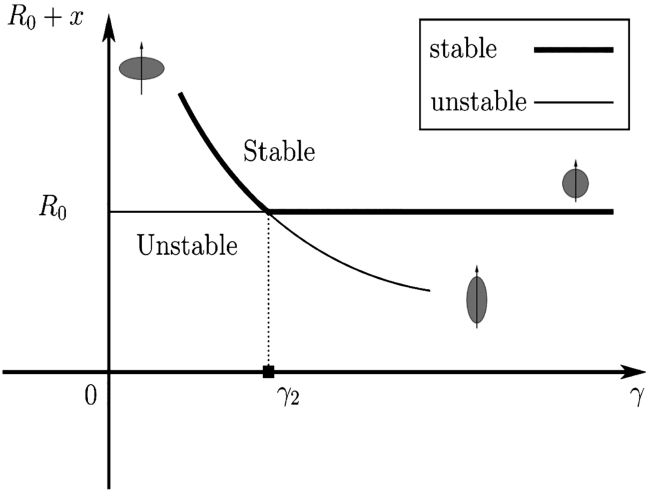
For the bifurcation branchemanating from,
Ifwithfor somesmall enough, then the oblate spheroids are linearly stable under small axially symmetric perturbation.
Ifand, then the prolate spheroids are linearly unstable under small axially symmetric perturbation.
The schematic diagram of Theorem 1.1 is shown in Fig. 1, where wee represent the axis of symmetry with an arrow.
Bifurcation and stability of charge drops.
The rest of this paper is organized as follows. In Section 2, we give the exact value of . There the key step is to obtain the exact expression of term in the exterior normal unit vector. In Section 3, we establish the stability and the instability near the bifurcation points by the Crandall–Rabinowitz principle of stability exchange.
Compute of
Now we compute the exact value of . We rewrite the free boundary as
which is the bifurcation branch emanating from . It has been proved in [5] that
Our task is to derive . This contains the second Fréchet derivative of and the mean curvature acting on .
Set
According to the boundary condition on , from [5] we have known that
and
In [5], Fontelos and Friedman used the formula of
to get . It contains a clerical error in this formula. The formula should be
It follows from [6] that
and
where . Direct computation implies
By some elementary computations, we have that
and
By (2.5), we get that
where
We now deduce which is different from [5]. The original computation in [5] contains a crucial gap. Notice that
is an exterior normal vector on . Observe that
where . So the exterior normal unit vector is
By the Taylor expansion again, we find that
In [5], the term is not exactly presented, which leads to some terms missing in the computation of . Moreover, the normal vector is not normalized in [5], which also leads to missing some terms. These terms eventually lead to the opposite sign of . Here we have all these terms exactly. This is the key to obtain the correct value of .
Furthermore, ν can be written as
and
Firstly, we show that
By (2.2)–(2.4), one has that
On the other hand, it holds that
Then, (2.2), together with (2.3) and (2.4), implies that
Therefore, it follows that
Further, one has that
which is different from the corresponding one of [5]. We further obtain that
with the fact that
where
Furthermore, it holds that
which is still different from [5, equality (5.4)]. We further obtain that
which is different from the corresponding one of [5, equality (5.5)]. From [5, Theorem 3], it yields
which is identical to the corresponding one of [5, Theorem 3]. It follows from (2.1) that
so
Thus,
With the fact of being orthogonal to , together with (2.6) and (2.7), one has
Then we have that
Since the value is different from the corresponding [5] (having opposite signs), the stability of charged drops may be affected.
Let and denote the null space and the range of any operator T, respectively.
Let T, K: be two bounded linear operators from a real Banach space X to another one Y. A complex number β is called a K-simple eigenvalue of T if
and
We will complete the proof of Theorem 1.1 with the Crandall–Rabinowitz principle of stability exchange [3] as follows.
Let X and Y be two real Banach spaces and letbe two bounded linear operators. Assumeisnearwithforsufficiently small. Letbe the linearization operator of F with respect to the second variable at. Ifis a K-simple eigenvalue of operator T with eigenfunction, then there exists locally a curvesuch thatMoreover, ifwithandnear, thenFurthermore, there are eigenvalues,with eigenvectors,, such thatwithThe bifurcation curve isif F is, with
We now complete the proof of Theorem 1.1 by showing the stability of charge drops.
According to [5, Theorem 2], 0 is a simple eigenvalue of and
Taking , the above transversality conclusion implies that 0 is a K simple eigenvalue of T. With the aid of Theorem 3.1, there are eigenvalues , with eigenvectors , , such that
with
and
Setting , then
where
With (3.1) and (3.2), one has and
Therefore, this yields
and
Thus
It follows that
In particular, for , we have
Therefore, we obtain that if and if for sufficiently small.
As that of [5], we define
Setting , then the solutions bifurcating from are linearly stable if , and linearly unstable if . By the values of and we obtain
Therefore, the solutions bifurcating from are linearly stable if , and linearly unstable if . Since and , near the bifurcation point, it holds that the solutions bifurcating from are linearly stable if , and linearly unstable if . □
Since is different from [5], the values of and ρ are different from [5]. Then the monotonicity of graph about bifurcation branch is reversed.
Data availability statements
There is not any conflict of interest. Data sharing not applicable to this article as no datasets were generated or analysed during the current study.
Footnotes
Acknowledgements
The research of Guowei Dai was supported in part by NSFC 11871129. The research of Ben Duan was supported in part by NSFC 12271205 and 12171498.
References
1.
O.A.Basaran and L.E.Scriven, Axisymmetric shapes and stability of charged drops in an external electric field, Phys. Fluids A1 (1989), 799–809. doi:10.1063/1.857377.
2.
N.Bohr and J.A.Wheeler, The mechanism of nuclear fission, Phys. Rev.56 (1939), 426–450. doi:10.1103/PhysRev.56.426.
3.
M.G.Crandall and P.H.Rabinowitz, Bifurcation, perturbation of simple eigenvalues and linearized stability, Arch. Ration. Mech. Anal.52 (1973), 161–180. doi:10.1007/BF00282325.
4.
D.Duft, T.Achtzehn, R.Müller, B.A.Huber and T.Leisner, Rayleigh jets from levitated microdroplets, Nature421 (2003), 128. doi:10.1038/421128a.
5.
M.A.Fontelos and A.Friedman, Symmetry-breaking bifurcations of charged drops, Arch. Ration. Mech. Anal.172 (2004), 267–294. doi:10.1007/s00205-003-0298-x.
6.
A.Friedman and F.Reitich, Quasi-static motion of a capillary drop, II: The three-dimensional case, J. Differential Equations186 (2002), 509–557. doi:10.1016/S0022-0396(02)00034-7.
7.
M.Garzon, L.J.Gray and J.A.Sethian, Numerical simulations of electrostatically driven jets from nonviscous droplets, Phys. Rev. E89 (2014), 033011. doi:10.1103/PhysRevE.89.033011.
8.
M.Goldman, M.Novaga and B.Ruffini, Existence and stability for a non-local isoperimetric model of charged liquid drops, Arch. Ration. Mech. Anal.217 (2015), 1–36. doi:10.1007/s00205-014-0827-9.
9.
M.Goldman, M.Novaga and B.Ruffini, On minimizers of an isoperimetric problem with long-range interactions and convexity constraint, Anal. PDE11 (2018), 1113–1142. doi:10.2140/apde.2018.11.1113.
10.
J.D.Jackson, Classical Electrodynamics, 3rd edn, John Wiley & Sons, New York, 1999.
11.
M.J.Miksis, Shape of a drop in an electric field, Phys. Fluids24 (1981), 1967–1972. doi:10.1063/1.863293.
12.
E.P.Miller, Electrostatics and Its Applications, A.D.Moore, ed., Wiley, New York, 1973.
13.
C.Muratov and M.Novaga, On well-posedness of variational models of charged drops, Proc. R. Soc. Lond. A472 (2016), 20150808.
14.
C.Muratov, M.Novaga and B.Ruffini, On equilibrium shapes of charged flat drops, Commun. Pure Appl. Math.71 (2018), 1049–1073. doi:10.1002/cpa.21739.
15.
C.Muratov, M.Novaga and B.Ruffini, Conducting flat drops in a confining potential, Arch. Ration. Mech. Anal.243 (2022), 1773–1810. doi:10.1007/s00205-021-01738-0.
16.
V.V.Pashkevich, H.J.Krappe and J.Wehner, Global potential-energy surface for surface-charged clusters, Zeitschrift für Physik D40 (1997), 338–340. doi:10.1007/s004600050222.
17.
L.Rayleigh, On the equilibrium of liquid conducting masses charged with electricity, Phil. Mag.14 (1882), 184–186. doi:10.1080/14786448208628425.
18.
C.P.R.Saunders, in: Proceedings of the International Colloquium on Drops and Bubbles, D.J.Collins, M.S.Plesset and M.M.Saffren, eds, Jet Propulsion Laboratory, Pasadena, CA, 1974.
19.
G.Taylor, Disintegration of water drops in an electric field, Proc. R. Soc. Lond. A280 (1964), 383–397. doi:10.1098/rspa.1964.0151.
20.
J.A.Tsamopoulos, T.R.Akylas and R.A.Brown, Dynamics of charged drop break-up, Proc. R. Soc. Lond. A401 (1985).
21.
K.T.Whitby and B.Y.U.Liu, in: Aerosol Science, C.N.Davies, ed., Academic, New York, 1966.