



Abstract
This paper focuses on the simultaneous homogenization and dimension reduction of periodic composite plates within the framework of non-linear elasticity. The composite plate in its reference (undeformed) configuration consists of a periodic perforated plate made of stiff material with holes filled by a soft matrix material. The structure is clamped on a cylindrical part. Two cases of asymptotic analysis are considered: one without pre-strain and the other with matrix pre-strain. In both cases, the total elastic energy is in the von-Kármán (vK) regime (
Keywords
Introduction
Nowadays, the use of 3D printing technology allows for the deployment or folding of pre-stretched membranes into desired shapes (e.g., see [28] and [1]). In this manufacturing process, the membrane is initially extended in specific directions, and then a pattern is printed on it. An interesting technological challenge is to determine the optimal pre-strain of the membrane to achieve the desired shape of the homogenized composite shell. The key aspect of this challenge is the transfer of pre-strain from the soft membrane to the stiff part of the homogenized composite shell. This motivation serves as the basis for studying this type of problem.
In practical applications, the material of the membrane is typically softer than the printed plastics. However, the findings of this paper indicate that a soft membrane alone does not transfer sufficient stress to the stiff part of the homogenized composite shell. This transfer of stress is necessary for folding the shell, particularly when the printed pattern consists of thick beams. In the second case presented in the paper, it is assumed that there is pre-strain in the soft membrane part of the periodic plate, which provide the desired effect.
This paper presents a theoretical study of homogenization and dimension reduction of composite structures in the framework of non-linear elasticity. The structure under consideration consists of a periodic perforated plate made of thick straight beams that intersect each other in the two in-plane directions creating a periodic structural frame (
When the thickness r and periodicity ε are of the same order, it is referred to as thick beams, however, when r is of a smaller order than ε, it is called thin beams.
Domain
For the purpose of analysis, it is assumed that the composite structure in the undeformed configuration is made of an elastic material. To simplify the analysis, it is assumed that the composite plate is made of a heterogeneous elastic material, with the matrix part
The limit behavior of the composite structure depend on the order of the infimum of the elastic energy with respect to the parameter ε, which in our case is in von-Kármán (vK) regime. In this paper, two cases are handled:
The applied forces are scaled in such a way that infimum of the total elastic energy is in vK regime, i.e.
It is assumed that, there is pre-strain in the soft matrix part (
As far as a minimizing sequence of deformations
The limit homogenized model for the composite structure is described by the vK plate model. This model emerges as the Γ-convergence limit in terms of displacements (see Remark 7 for more details) from non-linear problems stated in terms of deformations, highlighting the importance of considering initially deformations (see Remark 1 for more details) in studying the limit behavior. Despite the non-linear nature of the initial and homogenized problems, the cell problems associated with the vK plate are linear. In the Case 1, the homogenized limit energy has energy only from the stiff material part i.e. the limit energy terms from the matrix part vanishes due to the linear elastic cell problems. For Case 2, the homogenized energy has additional term due to the presence of pre-strain in the matrix part. With these cell problems and using the symmetry of the structure it is shown that the homogenized vK plate is orthotropic for isotropic homogeneous materials, which is consistent with the vK energy and linear elasticity formulations. This orthotropic plate model provides a valuable simplification for analyzing many mechanical behavior of the vK plate under matrix pre-strain.
The tool used for simultaneous homogenization and dimension reduction is the re-scaling unfolding operator, which is a variation of the periodic unfolding operator introduced in [14] and further developed in [15]. The unfolding operator is very suited for periodic homogenization problems set on a domain which depends on the parameter ε. For more information on homogenization techniques see [3,17,34,38], and [2]. Additionally, for more literature on dimension reduction see [20,37].
To ensure the existence of at least one minimizer for the limit energy problem, Γ-convergence techniques are used, for more details on homogenization using Γ-convergence see [10,22,32] and [21]. For general references on the theory of elasticity, see [11–13] and for non-linear plate theory, the authors recommend the seminal work presented in [20–22] and [18]. Moreover, for more literature on junction between plates and rods see [4] and [5]. The approach presented in this paper of homogenization and dimension reduction by re-scaling unfolding operator is similar to the one given in [16, Chapter 11] and [8].
Previous works have explored the topic of Γ-convergence (homogenization and dimension reduction) for plates under different non-linear (von-Kármán and bending) regimes with or without pre-strain, the authors mention a few here [9,33], and [39]. In these works the pre-strain is modeled by a multiplicative decomposition
In this context, it is worth mentioning that when the pre-strain is assumed to be in the form of
An extensive series of studies on homogenization and dimension reduction problems in structures composed of beams and plates has been conducted. Specifically, the behavior of structures involving curved rods with various contact conditions has been investigated, as documented in the works [26] and [36]. Furthermore, structures made of perforated plates have been the focus of attention, and for a comprehensive understanding of this topic, reference to the studies presented in [24] and [25] is recommended.
Moreover, in [27], consideration was given to a woven canvas with a fixed junction between the beams. This setup is a special consequence of Case 1 with the periodic structural frame as the domain in the current study. However, due to the presence of the soft matrix in the holes, additional terms are introduced in the limit energy. Nevertheless, the limit homogenized energy remains unchanged. The cell problems in the region
The paper is structured as follows: In the beginning, general notations are introduced in Section 2. Following that, the composite structure and boundary conditions are defined in Sections 3. The subsequent sections, namely Sections 4–5, focus on deriving Korn-type inequalities for deformations. These sections provide estimates in terms of ε for the linearized strain tensor corresponding to the displacement in the regions
Section 7 delves into Case 1, discussing the asymptotic behavior of the composite plate without pre-strain. This case examines the re-scaling of forces and its impact. Similarly, Section 8 focuses on Case 2, which explores the asymptotic behavior of the composite plate under matrix pre-strain. Finally, the paper concludes by extending the results to a more general periodic composite plate in Section 9.
Throughout the paper, the following notation will be used:
the mapping for a.e. for every displacement for every deformation for every
In this paper, the Einstein convention of summation over repeated indices is employed, and a generic constant denoted as C is used, which is independent of ε. These represent some of the general notations utilized in this paper. Notations that are not explicitly defined here can be found in the main content of the paper.
Description of the structure and natural assumption
In this section, the structure is defined as an elastic body that occupies a slender three-dimensional domain in its undeformed configuration. This domain is denoted by
It is assumed that the elastic body consists of a composite material distributed as a periodic perforated plate with holes filled with a relatively softer heterogeneous material. The composite plate is fixed in a cylindrical part.
The section concludes by presenting the sets of admissible deformations and displacements.
Structure of the stiff connected part
The structure is made of yarns orthogonal to each other. Then, the straight reference beams in the two directions are defined by
Let us denote
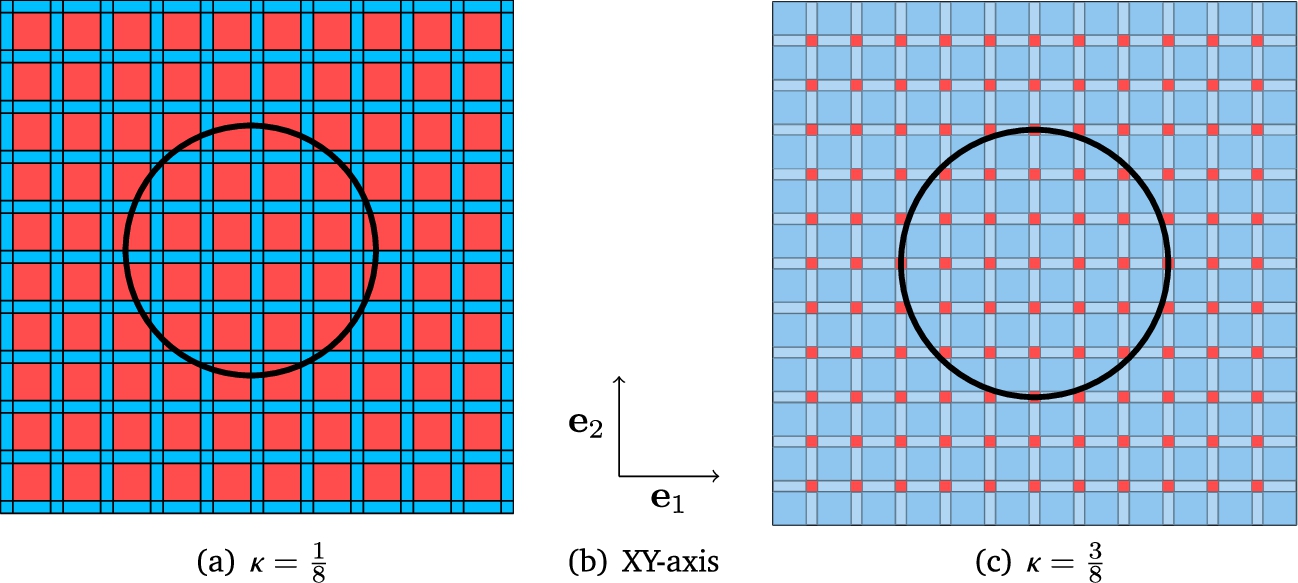
The periodic structural frame
Here, it is important to note that κ belongs to the interval
The boundary condition
It is assumed that the cylindrical part The non-linear elasticity problems stated in Sections 7.1 and 8.1 are formulated in terms of deformations. Therefore, it is crucial to begin with a decomposition of deformation and derive Korn-type inequalities for v.
In this section, an extension result for deformation is first introduced. Subsequently, the results on plate deformations are reviewed, and our assumptions on the boundary conditions are simplified. Following this, the plate deformation is applied to the extended periodic structural frame, and a Korn-type inequality for it is derived. Finally, an estimate for the strain tensor
Extension result
An extension result from [27] is recalled. This extension depends on the fact that beams intersect each other.
For every deformation v in
Moreover, if
Henceforth, we use the extended deformation
Let
By convention, in estimates, it is commonly denoted as
Now, from the above decomposition we have for
The terms
Estimate (4.4)2, the boundary conditions and Poincaré inequality give
From the above inequalities, we attain the non-linear Korn-type inequality for the plate
One has
We also have
The linearized strain tensor of an admissible deformation satisfies
First, observe that
As a consequence of the estimates (4.6) and (4.7), together with the extension result 1, we obtain the following result:
For the corresponding displacement
In this section, a Korn-type inequality and an estimate for the strain tensor

The red and blue part represent
Recalling the following classical estimates of the traces
For every
Let
The maps
As a consequence of the above lemmas, we can derive the following result
Let v be a deformation in
Step 1. We show that
Step 2. We prove that
Step 3. We prove
Step 4. We prove (5.6)1.
From (4.5)1 and (4.1) we obtain
Step 5. We prove (5.6)2.
Using Poincaré inequality, we obtain
We end this section with a estimate for the strain tensor
The strain tensor of the displacement
First, observe that
Besides, from the estimates (5.9)2 and (5.10), we get
In this section, a new splitting of the displacements corresponding to the deformations defined on
New splitting of the displacement
Let the displacement
The displacement is denoted by
The displacements
The equalities (6.1)
Since
We prove (6.1)5 to do that, we first apply the 3D-Korn inequality in the fixed domain
Applying the change of variable, since
We are in a position to use the results of [23] and to decompose the displacement
In this subsection, the decomposition of every displacement of the plate
(Theorem 6.1 in [23]).
Every displacement belonging to
Since our plate
Using the above Lemma and Remark,
One has
Case 1: Asymptotic behavior of the composite plate due to re-scaling of forces
In this section, the main results of Case 1 are presented. The section begins with the definition of the non-linear elasticity problem and the imposition of necessary assumptions on the right-hand side forces. The focus then shifts to the analysis of the asymptotic behavior of the Green St. Venant’s strain tensor. To achieve this, two periodic unfolding method operators are introduced. The key result of Case 1 is proved in Theorem 1, which details the asymptotic behavior of the minimization sequence
The non-linear elasticity problem in Von-Kármán regime
In this section, the elasticity problem is introduced, and the initial setup is established. Let us denote
For later convenience, the term
From the above assumptions on the local energy, it can be observed that:
The Hooke’s tensor a satisfy the following
The local energy
As a consequence of (7.2)–(7.5) we have
Then the non-linear elasticity problem reads
As a classical example of local elastic energy satisfying the above assumptions, we mention the St. Venant–Kirchhoff’s material for which
The forces have to admit a certain scaling with respect to ε. For the composite plate the required forces are of the type
The scaling of the force gives rise to the order of the energy in the elasticity problem. We prove this in the lemma below.
Let
Using (7.6) gives rise to the estimate
Since, we have assumed that the deformations
As a consequence, there exists a constant c strictly negative, and independent of ε such that
It is still an open problem whether there is a minimizer of
In this subsection, we consider a sequence
Now, we give the estimates of
Preliminaries on the unfolding operators
The convergences are achieved through the utilization of the re-scaling unfolding operator
Below, the definition of the periodic re-scaling unfolding operator and the unfolding operator for functions defined in
For every measurable function ψ on
In what follows, we recall some of the properties and inequalities related to the re-scaling unfolding operator and the unfolding operator, for proofs and more details see [16].
The re-scaling unfolding operator
Here, we note that for functions defined in ω, we have
Moreover, for every
In this subsection, the asymptotic behavior of the unfolded sequences of deformations and displacements defined on the region
There exist a subsequence of
The convergences (7.22), (7.23)1 are the immediate consequences of the estimates (7.18), (7.21) and using the properties of the unfolding operator. We remind that
We prove the convergences (7.24). From Lemma 10 we have
We give the proof of convergence (7.25). For that we see
For any
For the same subsequence as in the previous Lemma, one has
We have from (7.26) that
We end this subsection with the limit of the Green St. Venant’s strain tensor
For the same subsequence as the previous Lemmas, one has
Note, that the anti-symmetric part is responsible for the non-linearity of the problem.
Replacing the
We remark the following from the above Lemmas
The limit of the previous subsection allows us to investigate the limit of the elastic problem. Therefore, we introduce below the limit re-scaled elastic energy for the elasticity problem
Even though the total energy, as stated in equation (7.1), is expressed in terms of deformation, the limit is derived in terms of displacement. This is a common practice when the total elastic energy is in the Von-Kármán regime, which is of order
Before showing the convergence of the problem with Γ-convergence, we first prove that the limit-functional
Let us equip the space
Step 1. We show that
Let
Step 2. Using contradiction method we show the result (7.33)1, which is enough since the other side is trivial.
Indeed, if there does not exist any
The functional
First, we observe from (7.3) and (7.33)1 that there exist a constant
Let us set
Step 1. We prove that
Due to the boundary conditions on
Step 2. We prove that m is a minimum.
Consider a minimizing sequence
Hence, there exists a subsequence of
The following theorem is the main result of this section. It characterizes the limit of the re-scaled infimum of the total energy
Under the assumption on the forces (
7.8
)–(
7.11
), we have
The following proof uses a form of Γ-convergence.
Step 1. In this step we show that
Let In In
We show that for fixed n, there exists a sequence
By construction, the deformations
Step 3. From Step 1 and 2 we have for every
Finally, we end this section with a convergence result for
Let
To obtain the cell problems, we consider the variational formulation for
Let us denote
The homogenized energy (7.57) unveils an intriguing observation: the limit energy stemming from the matrix part (7.48)2 remains absent. This intriguing phenomenon explains that the soft matrix exhibits a level of weakness that renders it incapable of exerting any discernible influence on the homogenized vK plate behavior. Consequently, the homogenized energy for this composite structure remains like that of a periodic perforated plate.
A common terminology in literature for the homogenized tensors coefficients
The minimizer of this homogenized energy functional (7.57) satisfies the variational problem:
The quadratic form associated to
The associated quadratic form of the homogenized energy (7.57) comes from the macroscopic problem (7.59), and is given by
We are ready to give the main result of this subsection.
Under the assumption on the forces (
7.8
) and (
7.11
), the problem
We remark the following
The existence of a minimizer of the limit homogenized energy (7.61) is given by the fact the associated quadratic form is coercive and lower semi-continuous. Note that the homogenized energy
In this section the effective elastic behavior of the composite plate under matrix pre-strain is derived, for that it is assumed that there exist pre-strain in the matrix part which is modeled by a multiplicative decomposition of the deformation gradient
Above way of decomposition has first been introduced in the context of finite strain plasticity [19] and [29], in which they decompose the deformation gradient into two parts one elastic and another inelastic which is written as
The non-linear elasticity problem in Von-Kármán regime
We consider the following energy functional
The local elastic energy
We suppose that for the small pre-strain, there exists a
Moreover, we assume that (see estimate (5.6)1)
Since the pre-strain is small, then we can simplify the decomposition since for
Similarly, like in Section 7.1, we have as a consequence of (7.2)–(7.5) we have
Since, we have not assumed
Proceeding as (7.2), we have the following estimates:
Let
Using (8.4) gives rise to the estimate
Furthermore, the estimate (7.10)1 can be employed to arrive at
As a consequence of the above Lemma, we have that there exists a strictly positive constants
So, our aim is to give the limit of the re-scaled sequence
We proceed similarly like in Section 7, so we have from (7.14) that
So, we now give the limit of the non-linear strain tensor with matrix pre-strain, which is present in the total elastic energy.
We recall the following classical result:
Let
Suppose
First, we recall the expressions of the Frobenius norm and the scalar product associated. For all A,
Using the above inequality, we obtain
We recall that for matrix function
For the same subsequence as in the Lemma
13
, we have
Step 1: The convergence (8.9)1 is a direct consequence of the Lemma 15. Here, we give the proof for the convergence (8.9)2. We have
Now, we show that
So, we got
Step 3: We show that
Hence, from the convergences (8.11), (8.16) and (8.15), we obtain the convergence (8.9)2. □
We are now in position to give the asymptotic behavior of the re-scaled sequence
The limit from the convergence (8.9) allows us to investigate the limit of the non-linear elasticity problem. So, we introduce the limit re-scaled elastic energy for the non-linear elasticity problem as
The functional
Only the triplets
It should be noted that
Let us set
The proof is in line of the proof of the Lemma 17. □
The following theorem is the main result of this section. It characterizes the limit of the re-scaled infimum of the total energy
Under the Assumptions
1
, we have
The proof is same like done for the Theorem 1. □
To obtain the cell problems, we consider the variational formulation for
We are ready to give the main result of this subsection.
Under the assumption on the forces (
7.8
) and (
7.11
), the problem
We remark the following
The existence of a minimizer of the limit homogenized energy (8.19) is given by the fact that the associated quadratic form is coercive and lower semi-continuous. Note that the homogenized energy (8.19) has an addition term due to the matrix pre-strain, which is absent on the homogenized energy (7.57), showing that for the soft matrix to have any effect in the homogenized model pre-strain is necessary. We have
We end this subsection by showing that our homogenized vK plate, obtained through the incorporation of small matrix pre-strain (Case 2), exhibits orthotropic behavior.7
We know that this is true for Von-Kármán and linear regime, since the homogenized coefficients depend only on the cell problems.
We know that for isotropic homogenized materials, we have from [35] that
Let us assume that the plate is made from isotropic and homogeneous material, then we have
The proof is in line with Lemma 6.9 of [27].
In this section, the extension of our results to a more general periodic composite plate is undertaken. The key concept to emphasize is that our results can be extended to any periodic perforated plate with holes filled by a soft matrix. This extension yields similar results as presented in Lemma 1, with the holes being bounded domains featuring Lipschitz boundaries, thereby allowing for the attainment of the estimates (5.3).
In the following discussion, we explore cases where the general holes take the form of (9.1) (refer to Fig. 3).
General periodic composite plate
Our general domain is a periodic composite plate in which the part filled with the soft matrix is connected. We set the following:
Here, we have The domain filled with the soft matrix This structure is (like the one in Fig. 3a) is 3-dimensional and only periodic in two directions, in the third direction it is thin that is, its thickness is of same order
We assume that the domain
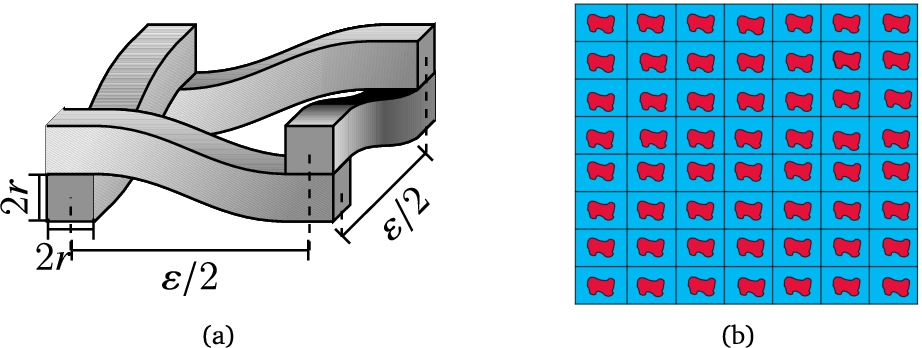
(a) The domain is a quarter of the periodicity cell of the full structure. (b) 2D periodic composite plate: Blue part is with stiff material and red part is with the soft matrix.
For every deformation
Note that
Our results are also valid for composite plate Let
Using
The periodic perforated plate
This paper focuses on the asymptotic analysis of a periodic composite plate with matrix pre-strain within the framework of non-linear elasticity. Two cases are considered: one without pre-strain and one with pre-strain. In both cases, the total elastic energy follows the von-Kármán (vK) regime. The re-scaling unfolding operator is utilized to derive the asymptotic behavior of the Green St. Venant’s strain tensor. The existence of a minimizer for the limit energy is shown through Γ-convergence. The discussion of both cases aims to demonstrate that the soft matrix only has an impact on the homogenized plate when pre-strain is present. This behavior is attributed to the relative weakness of the matrix compared to the stiff part, as well as the stability of the structure (due to similar orders of thickness r and periodicity ε). Furthermore, it is shown that the cell problems are linear elastic and the homogenized von-Kármán plate exhibits orthotropic behavior for isotropic homogenized material. The findings of this study have practical applications in the fields of 3D printing, textiles, and aerospace industries.
Footnotes
Acknowledgement
The research was funded by DFG, German Research Foundation, project number OR 190/10-1 and AIF project OptiDrape, both in the collaboration with the textile institute ITA in Aachen, Germany.