In this article, our objective is to explore a Cahn–Hilliard system with a proliferation term, particularly relevant in biological contexts, with Neumann boundary conditions. We commence our investigation by establishing the boundedness of the average values of the local cell density u and the temperature H. This observation suggests that the solution either persists globally in time or experiences finite-time blow-up. Subsequently, we prove the convergence of u to 1 and H to 0 as time approaches infinity. Finally, we bolster our theoretical findings with numerical simulations.
In [5,7] (also see [6]), G. Calginalp introduced the following phase-field system:
The system consists of the order parameter u, the temperature H, and the derivative of a double-well potential F, denoted as f. The typical choice for F is , which results in the usual cubic nonlinear term . It is important to note that all physical parameters in this system have been set equal to one. This model is commonly used to describe phase transition phenomena, such as melting-solidification processes, in certain types of materials (see, [1,2,4]).
The Caginalp system can be derived as follows: frist, we introduce the free energy
where Ω represents the domain occupied by the material. We then define the enthalpy as
For the evolution of the order parameter, we assume the relaxation dynamics with the relaxation parameter set to one, resulting in:
where represents the variational derivative with respect to u, leading to (1.1). Next, we derive the energy equation as follows:
where q denotes the heat flux. Finally, we make the assumption of the usual Fourier law for heat conduction, which can be expressed as
We recover (1.2) from the previous derivations. In equation (1.2), the term represents short-ranged interactions. It is worth noting that such a term is obtained by truncating higher-order terms (see, [8]), and it can also be viewed as a first-order approximation of a nonlocal term that accounts for long-ranged interactions (see, [13]).
Consequently, our focus shifts to the system where the convective Cahn–Hilliard equation is substituted with the convective Cahn–Hilliard equation with a proliferation term. Instead of (1.1), we contemplate the following:
Therefore, we are concerned with
We assume that Ω is a bounded and regular domain in , where .
Moreover, we define a proliferation term g as follows:
Furthermore, we take the cubic function:
It is noteworthy that the motivation for this article originates from the recent work of L. Cherfils, A. Miranville, and S. Zelik (referenced as [9]), where the authors investigated the asymptotic behavior of a generalized form of the Cahn–Hilliard equation with a proliferation term and subject to Neumann boundary conditions. Their findings indicated that either the average of the local cell density remains bounded, leading to the existence of a global-in-time solution, or the solution experiences finite-time blow-up. Moreover, they illustrated that biologically significant solutions converge to 1 as time approaches infinity. Additionally, they provided numerical simulations to corroborate their theoretical results. Building upon this groundwork, our contribution focuses on examining a Cahn–Hilliard system with a proliferation term.
The structure of this article unfolds as follows: In Section 2, we introduce the notation, function spaces, and key assumptions, Section 3 is dedicated to establishing a priori estimates. In Section 4, we prove the existence and uniqueness of the solution, Section 5 demonstrates that the problem generates a continuous semigroup on a suitable phase space, Section 6 investigates the phenomenon of blow-up in finite time of the solution. Finally, in Section 7, we present numerical simulations to validate the theoretical results.
Preliminaries
Notations and function spaces
We denote by the usual inner product in , with the associated norm . We define , where denotes the negative Laplace operator associated with Neumann boundary conditions and acting on functions with null spatial mean. is a norm on that is equivalent to the standard norm. More generally, denotes the norm in the Banach space X, while will denote the dual space. We define, for
where represents the Lebesgue measure of Ω and . Furthermore, for ,
We note that
is a norm on that is equivalent to the standard norm. Similarly,
and
are the norms on , , and , respectively, that are equivalent to their usual norms.
We also introduce the following phase space
which is a complete metric space with respect to the metric associated with the norm
Main assumptions
We state the following assumptions:
Throughout this article, the same letter c, , and represent constants that can vary from line to line, or even within the same line.
A priori estimates
Our objective in this section is to establish dissipative estimates. These estimates play a crucial role in demonstrating the existence and uniqueness of solutions, as well as the regularity of the solution. To initiate this process, we will introduce the following lemmas:
Letconstitute a solution to (
1.9
)–(
1.12
). Then,is bounded from above, andis bounded from below.
We integrate (1.9) over Ω, and we find
Note that
Furthermore, it follows that
Therefore,
Applying the Gronwall’s lemma to (3.4), we obtain
i.e, is bounded from above.
Next, we integrate (1.10) over Ω, and we have
which implies
Now, thanks to (3.5) and (3.7), we have
i.e. is bounded from below. Thus, the lemma is exhaustive. □
Letbe a solution of (
1.9
)–(
1.12
) and ifand, for all(and, in particular, we assumeand), thenandand, ifexists globally in timeand
Notice that, thanks to (3.4), we conclude
which gives
Furthermore, if
we have
Using (3.7) and (3.10), we get
and, if and , we obtain
Now, if exists globally in time,
and
Hence the lemma. □
Now, we assume that
for fixed positive constants and .
Consequently, we have, owing to (3.5) and (3.7)
Next, we state the following theorem:
Assuming that the given hypotheses are satisfied, ifis a global solution of (
1.9
)–(
1.12
) with, then the following estimate holds:whereand Q the monotonic function.
Setting and , we rewrite (1.9)–(1.12) as follows:
We multiply (3.16) by and integrate over Ω, we find
We remark that (see, [9])
and
Hence, we have
which leads to
We now multiply (3.16) by and (3.17) by , integrate over Ω, and summing the two results, we obtain
Note also that
and, thanks to (2.3)
Then, we get
where
satisfies
Now, summing (3.22) and (3.24), where is chosen sufficiently small such that , , and , we arrive at
where
satisfies
Additionally, we multiply (3.17) by and integrate over Ω. Employing Young’s inequality, we infer that
Summing (3.26) and (3.28), where is chosen sufficiently small such that , we find
where
verifies
In the subsequent steps, we multiply (3.16) by and integrate over Ω, we get
Note that, thanks to (2.3) and an appropriate interpolation inequality, we have
Proceeding as above, we obtain
Therefore,
Now, summing (3.29) and (3.34), where is chosen sufficiently small such that , we observe that the energy functional
satisfies the differential inequality of the form
and verifies
Now, applying Gronwall’s lemma to (3.35) (see, [14,16,18]), we obtain, thanks (3.36) the following dissipative estimate
which implies thanks to (3.14)
Thus, the proof. □
Existence and uniqueness of the solution
The theorem referenced as 3.1 plays an essential role in proving the existence of a solution to (1.9)–(1.12). To do so, it suffices to apply the standard Faedo Galerkin scheme, as explained in [3]. Once the existence of a solution to (1.9)–(1.12) is established, proving uniqueness is not a difficult task. Hence, the theorem
Under the assumptions of Theorem
3.1
hold, then a corresponding solutionof (
1.9
)–(
1.12
) with initial data,, satisfies the following estimate:
We define and . Then, the solution satisfies the following problem:
We integrate (4.2) over Ω, we find
Integrating also (4.3) over Ω, we obtain
Now, taking into account (4.6) and (4.7), we rewrite (4.2)–(4.5) as follows
Using now (4.6), the Hölder inequality, and the Young’s inequality, we have
Also, thanks to (4.6), (4.7), and following the same procedure as above, we conclude that
We now multiply (4.8) by and (4.9) by and integrate over Ω. Summing the two results, we obtain the following estimate
Note that
Setting
with Λ defined as
we have
Besides
Then (4.15) implies alors
Furthermore,
Finally, owing to (4.12), (4.13), (4.16) and (4.17) we obtain the following differential inequality
where
and
In particular, we deduce that
Thanks to the Theorem 3.1, we get
Thus, using the appropriate version of Gronwall’s inequality (see, [18]), we obtain
Using estimates (4.19), (4.20) and the above estimates, we find
The uniqueness of the solution for the system (1.9)–(1.12) is immediately established by the estimate (4.21), thus confirming the validity of the theorem. □
Thanks to Theorem 4.1, we are able to state the following theorem:
Under the assumptions of Theorem
4.1
, the problem (
1.9
)–(
1.12
) defines a continuous semi-group.by the expressionwhereis the unique solution of (
1.9
)–(
1.12
).
A direct consequence of the Theorem 3.1 is the following corollary:
Under the above assumptions, the semi-group, generated by (
1.9
)–(
1.12
), has on Ψ a bounded absorbing set, which can be denoted bywhereis the constant in (
3.38
). Moreover,, there exists, for which
Regularity of the solution
To establish additional regularity properties of the solution of (1.9)–(1.12), we state the following theorem
Under the above assumptions hold. Then there exists a positive constant c such that for any fixed bounded set, there exists a positive timesuch that, for any, the solutionsatisfies the following estimate:
Multiplying (3.17) by and (3.16) by , we obtain, adding the two results
Setting
we deduce from (5.2) that
Using Theorem 3.1, there exist positive constants , , and (independent of time and initial data) such that
Based on (5.2) and (5.3) and employing the uniform Gronwall lemma (see, [18]), we can conclude that
which gives, for every ,
which implies, owing to (3.14)
Hence, the proof is complete. □
We can also prove the following lemma:
Let the assumptions of the Theorem
5.1
hold. Then, the following estimate is satisfied
Integrating (3.35) and (5.2) between 0 and , we obtain
Hence, the proof. □
According to (4.23) and (5.5), we have the following corollary:
Under the above assumptions, the semigroupgenerated by (
1.9
)–(
1.12
) has a bounded absorbing set on, denoted bywhere c is a positive constant in (
5.5
). Furthermore, for any, there existssuch that
Blow up in finite time of the solution
Having established the additional regularity on the solution of (1.9)–(1.12), we demonstrate that the solution of (1.9)–(1.12) blows up in finite time. Hence, the following theorem:
We assume thatandfor some(and in particular, we assumeand). Then, u and H blow up in finite time. Furthermore, the blow up timesatisfiesand, owing to (
3.7
)
We rewrite (3.1) in the following form:
Note that
we find an equation of the form:
where and is non-positive and uniformly (in time) bounded.
So, the solution of the Riccati ODE (see, [9] and [11]) is written as
Using (3.7), where , we get
which implies, owing to (6.2)
So, we conclude the proof based on the principle of comparison. □
As a consequence of Theorem 6.1 and the estimates (3.5) and (3.8) (see, for example, [9] and [11]), we have the following corollary:
Letbe a solution of (
1.9
)–(
1.12
). Then, either u and H blow up in finite time, orexists globally in time, andandfor all
Letbe a solution of (
1.9
)–(
1.12
), whereis a global-in-time solution. Then,is dissipative in.
We see in ([9], Remark 2.2.2) that u can become negative even if is positive, which yields that H can become positive, if . Analogously, we can prouve that can become negative (and thus blows up) even if is nonnegative, which implies that can be positive (and thus blows up) if .
Indeed, we assume that
Then, if follows from (6.1), that at ,
meaning that , for and blows up in finite time. Furthermore
then , for and blows in finite time. The interesting question here is to see, if can becomes negative even if is positive, which leads to can be positive (and thus blows up) if . We consider the following Riccati ODE (see, [9])
When , the solution of (6.5) reads
where .
Then, when , u blows up in finite time and becomes negative.
Moreover, when the solution to (6.5) reads
and the same holds, for . Finally, when , then
which implies
Due to (6.3) and (6.8), we find
Hence, thanks to (6.8) and (6.9), we conclude that can becomes negative for every is positive, which implies can be positive for every .
Eventually, we have the following theorem:
Letbe a nonvanishing solution to (
1.9
)–(
1.12
) such thatand,. Then, u tends to 1 inand H tends to 0 inas.
We frist note that if , then . We thus assume that .
Setting again , we have
Then, since , , we note that
hence
We can deduce from (6.10) that, α is monotone increasing. Since it is bounded from above (by 1), it follows that α tends to some limit as .
Let now , , be such that tends to 0 as (indeed, note that ), for some . Then, and (and also , and ), are bounded, indepently of n, so that, at least for subsequence which we do not relabel,
Thus, passing to the limit in (6.10), we obtain
and
hence
which implies that (indeed, is monotone increasing and cannot tend to 0). Finally, we see that α tends to 1 as .
Now, noting that the trajectory is asymptotically compact in , the w-limit set of is nonempty and compact in . Then, if belongs to this set, necessarily , whence .
Furthermore, we note that , which implies for all . It follows from (5.5) that is bounded. Therefore, at least for a subsequence that we do not rename,
and consequently,
Since , we have
which implies
Finally, tends to 0 in as , which completes the proof. □
Numerical results
In this section, we provide some simulations that confirm our results. These numerical simulations are conducted using the FreeFem software (see, [12]). To do this, we rewrite the problem in the following form:
what is advantageous is that we have split the fourth-order equation (1.9) into two second-order equations (7.1) and (7.2) (see, [10,15] and [17]). Furthermore, the variational formulation associated with this problem is:
for all .
For spatial discretization, we consider a quasi-uniform family of decompositions of Ω into d-simplices, such that forms a triangulation of . The triangulation of induces a triangulation of . The triangulation of naturally induces a triangulation of Γ into d-1 simplices. For a given triangulation , we define as the usual conforming finite element space.
The semi-discrete spatial version of (7.1)–(7.5) is written as: Find such that
for all .
Now, concerning the temporal discretization of our problem, we consider here the semi-implicit Euler scheme applied to the semi-discrete spatial scheme. The time step is chosen as .
The scheme is then written as , for , find such that
for all .
In the numerical results presented below, Ω is a rectangle. The triangulation is obtained by dividing Ω into rectangles and subdividing each rectangle along the same diagonal. The time step is set to . Furthermore, we consider .
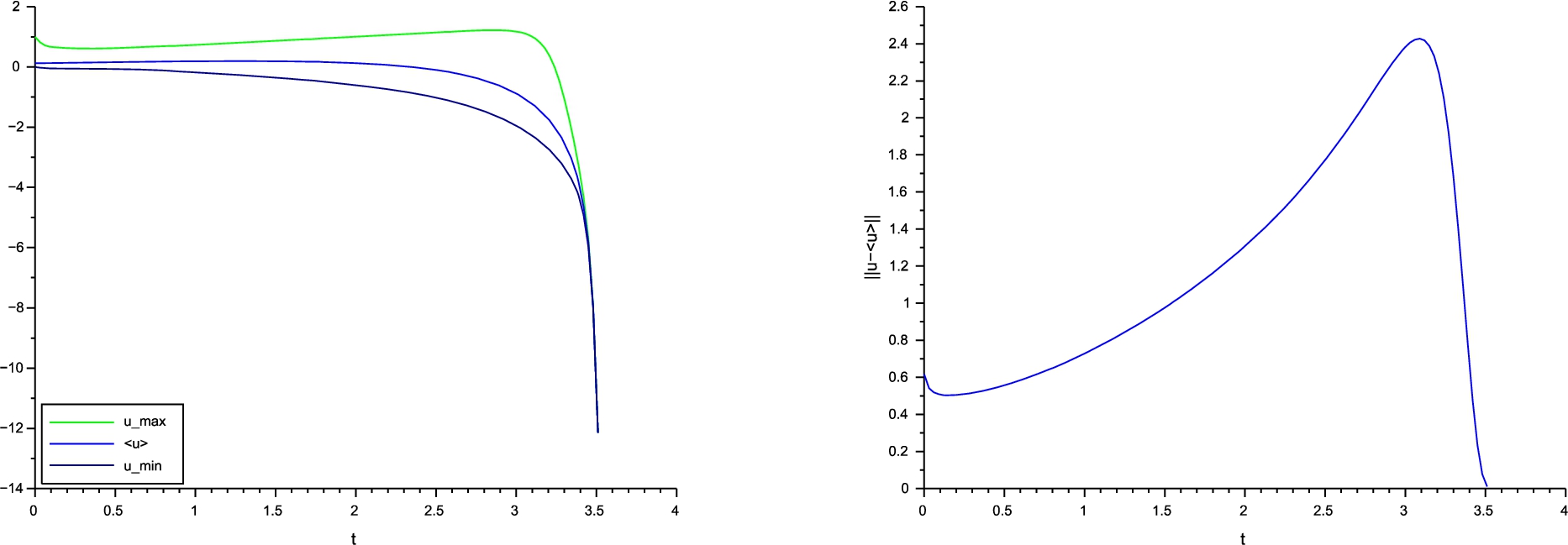
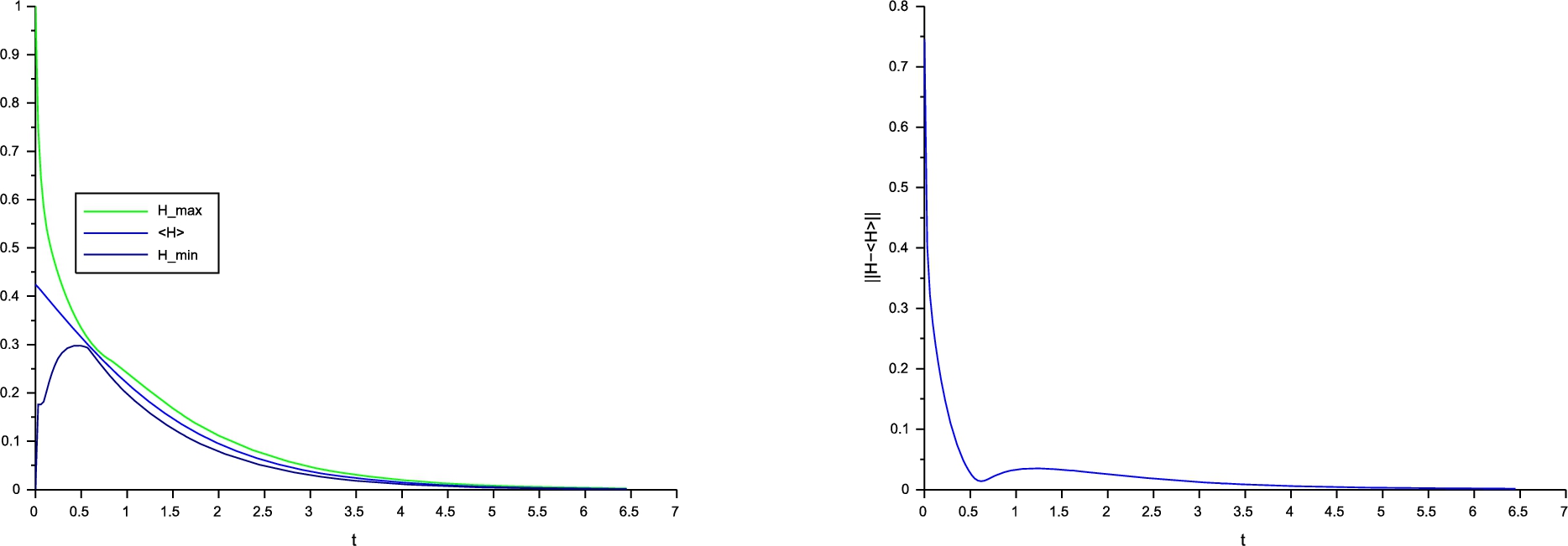
The left-hand images below depict the evolution of , , and with respect to time, and , , and with respect to time, where is the numerical solution of (7.1)–(7.5). The right-hand images depict the evolution of and with respect to t, for different choices of initial data and .
and , then u tends to 1.
and , u blows up and tends to 0.
In Fig.
1
, we take , , and , leading to and . In this case, u remains in the interval for all and converges to .
Fig.
2
corresponds to the function and the initial data and , resulting in . In this case, u blows up in finite time, while converges to 0, in accordance with the theoretical results.
In Fig.
3
, we still take with the initial data and , belonging to , and . Here, H remains in the interval for all and converges to , confirming the theoretical results.
In Fig.
4
blows up in finite time, while converges to 0. Here, we take and the initial data , which leads to .
and , then H tends to 0.
and , H blows up and tends to 0.
References
1.
S.Aizicovici and E.Feireisl, Long-time stabilization of solutions to a phase-field model with memory, Journal of Evolution Equations1 (2001), 69–84. doi:10.1007/PL00001365.
2.
S.Aizicovici, E.Feireisl and F.Issard-Roch, Long-time convergence of solutions to a phase-field system, Mathematical Methods in the Applied Sciences24 (2001), 277–287. doi:10.1002/mma.215.
3.
F.Boyer, Mathematical study of multi-phase flow under shear through order parameter formulation, Asymptot. Anal.20 (1999), 175–212.
4.
D.Brochet, X.Chen and D.Hilhorst, Finite dimensional exponential attractors for the phase-field model, Applied Analysis49 (1993), 197–212.
5.
G.Cagilnalp, Conserved-phase field system; implication for kinetic undercooling, Appl. Rev-B38 (1988), 789–791. doi:10.1103/PhysRevB.38.789.
6.
G.Caginalp, An analysis of a phase field model of a free boundary, Arch. Ration. Mech. Anal.92 (1986), 205–245. doi:10.1007/BF00254827.
7.
G.Caginalp and E.Esenturk, Anisotropic phase field equations of arbitrary order, Discrete Contin. Dyn. Systems S4 (2011), 311–350. doi:10.3934/dcdss.2011.4.311.
8.
J.Cahn and J.Hilliard, Free energy of a nonunifor system I. Interfacial free energy, J. Chem. Phys.28 (1958), 258–267. doi:10.1063/1.1744102.
9.
L.Cherfils, A.Miranville and S.Zelik, One a generalized Cahn–Hilliard equation with biological applications, disrete and continuous, Dynamical systems series B19 (2014), 2013–2026.
10.
L.Cherfils, M.Petcu and M.Pierre, A numerical analysis of the Cahn–Hilliard equation with dynamic boundary conditions, Discrete Cont. Dyn. Systems27 (2010), 1511–1533. doi:10.3934/dcds.2010.27.1511.
11.
H.Fakih, A Cahn–Hilliard equation with a proliferation term for biological and chemical applications, Asymptotic94 (2015), 71–104. doi:10.3233/ASY-151306.
12.
FreeFem is freely available at http://www.freefem.org/ff.
13.
G.Giacomin and J.L.Lebowitz, Phase segregation dynamics in particle systems with long range interaction I. Macroscopic limits, J. Statist. Phys.87 (1997), 37–61. doi:10.1007/BF02181479.
14.
C.Giorgi, M.Grasseli and V.Pata, Uniform attractors for a phase-field model with memory and quadratic nonlinearity, Indiana Univ. Math. J48 (1999), 1395–1446. doi:10.1512/iumj.1999.48.1793.
15.
M.Grasselli and M.Pierre, A splitting method for the Cahn–Hilliard equation with inertial term, Math. Models Methods Appl. Sci.20 (2010), 1363–1390. doi:10.1142/S0218202510004635.
16.
E.Gurtin, D.Polignone and J.Vinãls, Two-phase binary fluids and immiscible fluids described by an order parameter, Math. Models Methods Appli. Sci.6 (1996), 815–831. doi:10.1142/S0218202596000341.
17.
S.Injrou and M.Pierre, Stable discretizations of the Cahn–Hilliard–Gurtin equations, Discrete Cont. Dyn. Systems22 (2008), 1065–1080. doi:10.3934/dcds.2008.22.1065.
18.
A.Nimi, F.Langaet al., Robust exponential attractors for the Cahn–Hilliard–Oono–Navier–Stokes system, Discrete Cont. Dyn. Systems – Series S9 (2023), 2426–2451.