The wave propagation in dilatant granular materials is described by a nonlinear evolution equation of the fifth order deduced by Giovine–Oliveri in (Meccanica30(4) (1995) 341–357). In this paper, we study the well-posedness of the classical solutions for the Cauchy problem, associated with this equation.
In this study, we investigate the well-posedness of the following Cauchy problem:
with , such that
If
on the initial datum, we assume
On the other hand, if
we assume
Equation (1.1) was deduced in [28] in order to describe the wave propagation in dilatant granular materials. The variable u is the bulk density, δ, α, γ are macro- and microlevel dispersion parameters, while β is a parameter involving the ratio of the grain size and the wavelength.
In [46], Equation (1.1) with was deduced to model the evolution of the non-linear wave propagation compatible with the non-diffusive version of the model of bubbly liquids introduced by Drumheller and Bedford [26].
The existence of the solitons for (1.1) is proven in [29,48], while numerical solutions are analyzed in [30].
that was derived by Kawahara [37] to describe small-amplitude gravity capillary waves on water of a finite depth when the Weber number is close to (see [45]). Moreover, in [37], the author deduced (1.7) to describe one-dimensional propagation of small-amplitude long waves in various problems of fluid dynamics and plasma physics. (1.7) is also known as the fifth-order Korteweg–de Vries equation or generalized Benney–Lin equation [7,41].
Mathematical properties of (1.7) were studied recently in many detail, including the local and global well-posedness in the Bourgain space [20,21,34,35,52], the local and global well-posedness in energy space [25,27,31,51,56,57], the existence of solitary wave solution [9,32], the stability of periodic traveling wave solutions see [1,2,44,50,58], the well-posedness of the initial-boundary value problem on a bounded domain [10,13,24,38], the initial-boundary value problem on the half-line [11,12], periodic solutions (see [8,47]), and numerical solutions see [5,6,23,33,42,53]. In particular, [25] shows that the Cauchy problem of (1.7) is ill-posed in some energy spaces.
To obtain the exact solutions for (1.7), a number of methods have been proposed in the literature. In particular, the Lie group analysis method is used in [4,36], the exp-function method is used in [3,39,43], the polygonal method is used in [22,54], the generalized F-expansion method is used in [55].
In [18], the well-posedness of the Cauchy problem for (1.7) is proven, assuming on the initial datum (1.4). Finally, following [14,15,40,49], the convergence of the solution of (1.7) as is studied in [16,17].
The main result of this paper are the following theorems.
Assume (1.2), (1.3) and (1.4). Given κ, δ, β, α, γ, T, there exists an unique solution u of (1.1) such that
Moreover, ifandare two solutions of (1.1) in correspondence of the initial dataand, we have that
for some suitable, and every,, where
Assume (1.2), (1.5) and (1.6) with. Given κ, δ, β, α, T, there exists a solution u of (1.1) such that
Assume (1.2), (1.5) and (1.6) with. Given κ, δ, β, α, T, there exists an unique solution u of (1.1) such that
Moreover, (1.9) holds.
Using the Sobolev Immersion Theorem, Theorems 1.1, 1.2, 1.3 give the existence of a solution of (1.1), without additional assumption on the constants. Moreover, in Theorems 1.1 and 1.3 we have also the uniqueness and stability of the solution of (1.1).
The paper is organized as follows. In Sections 2, 3, 4, we prove Theorems 1.1, 1.2, 1.3, respectively.
Our existence argument is based on passing to the limit in a vanishing viscosity approximation of (1.1).
Fix a small number and let be the unique classical solution of the following problem:
where is a approximation of , such that
where an a positive constant independent of .
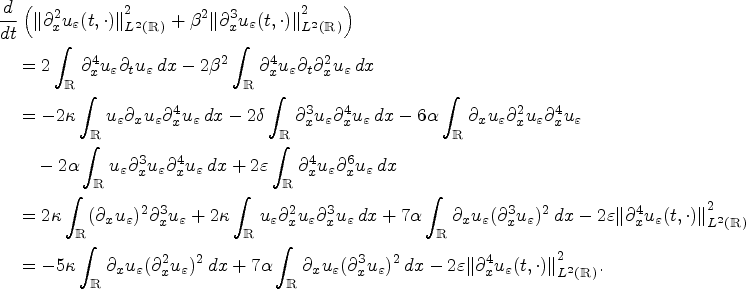
Let us prove some a priori estimates on , denoting with constants which depend only on the initial data, and with , the constants which depend also on T.
Following [19, Lemma 2.2], we prove the following lemma
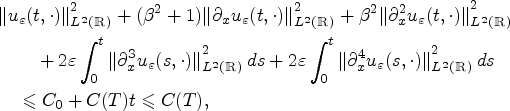
Given κ, δ, β, α, γ, T, there exists a constant, independent of , such that
for every.
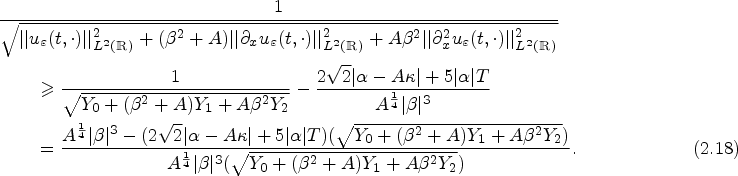
We begin by proving the following inequality:
for every , where A is an arbitrary positive constant.
We begin by observing that
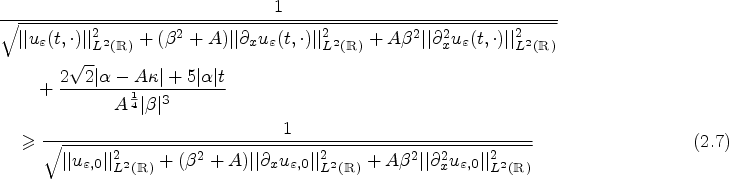
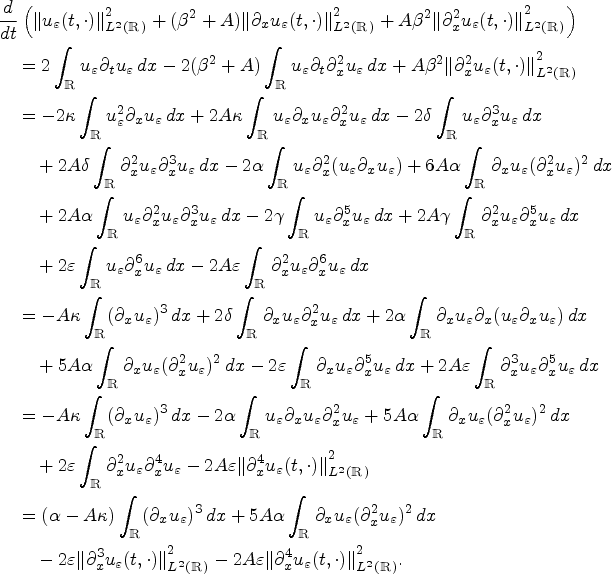
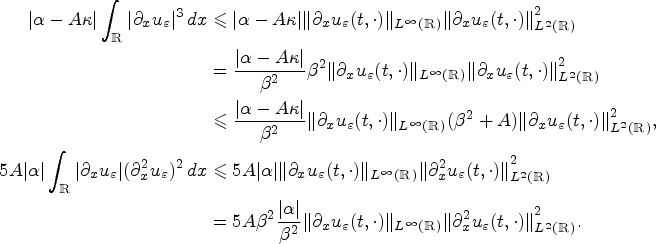
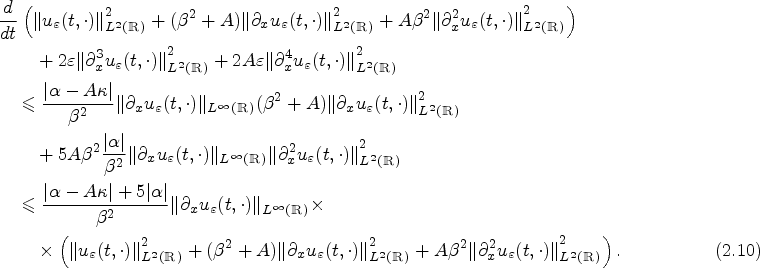
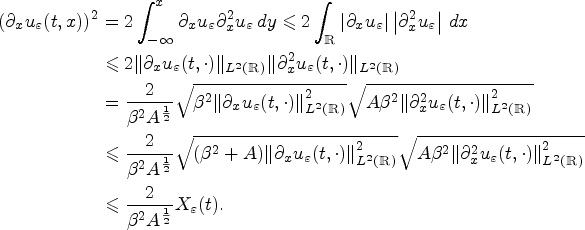
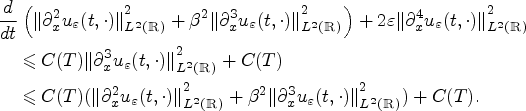
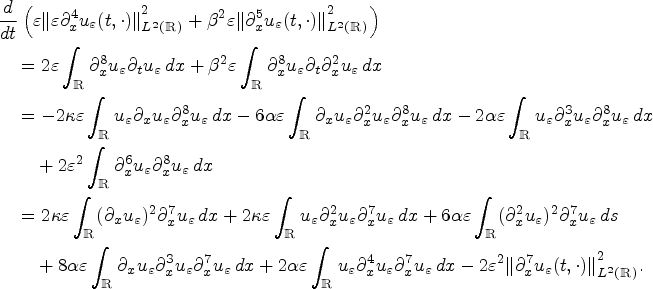
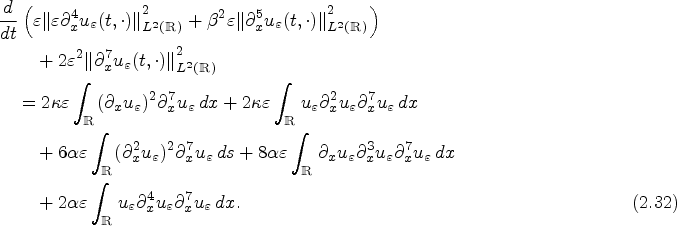
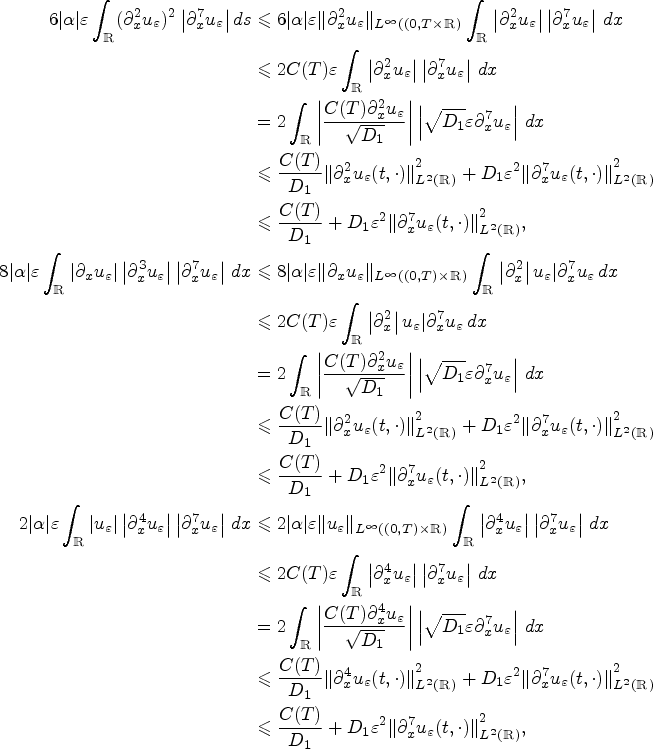
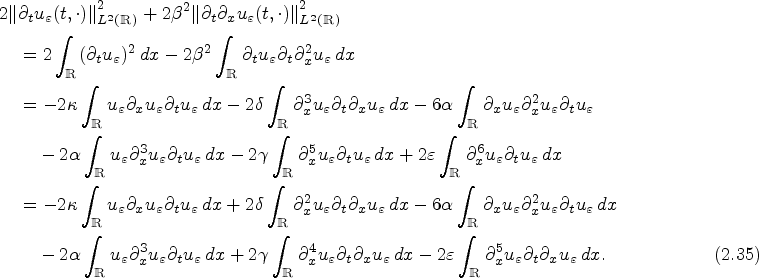
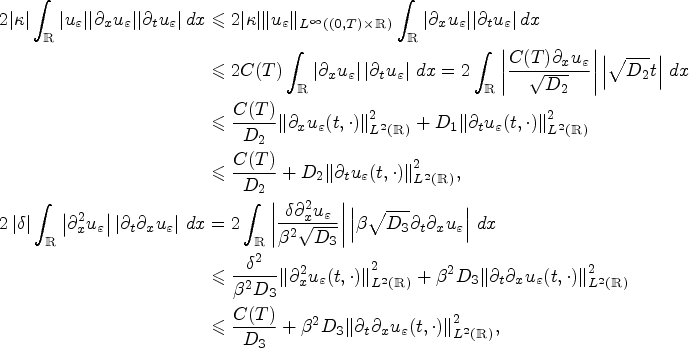
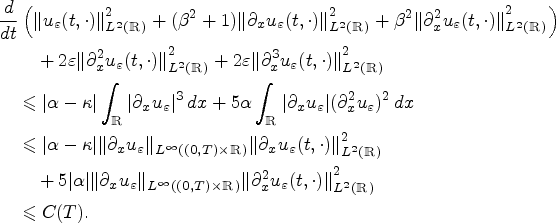
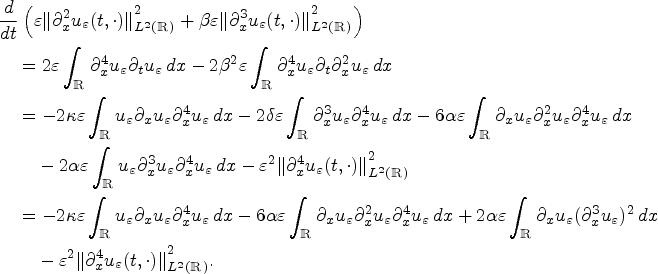
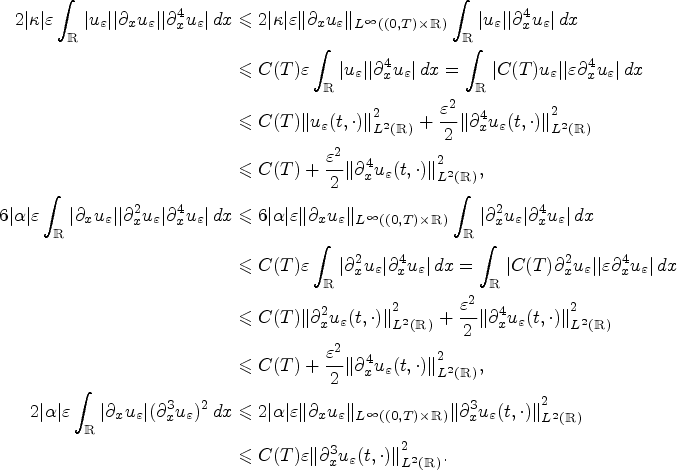
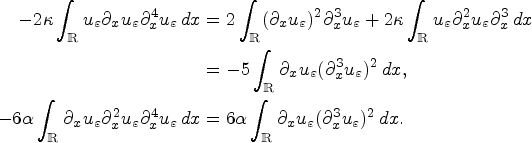
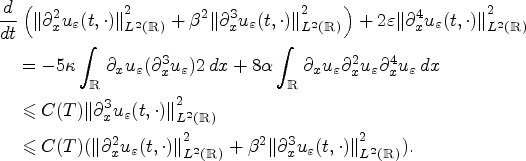
Consider A a positive constant. Multiplying (2.1) by , thanks to (2.8), an integration on gives
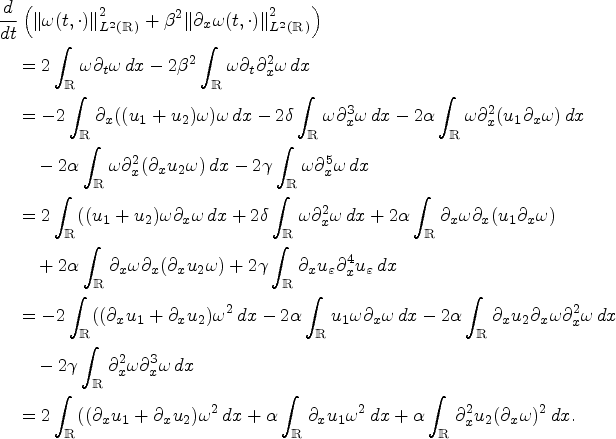
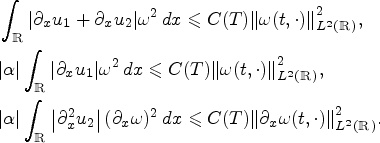
Arguing as in Lemma 2.6, we have that u is solution of (3.1), such that (1.12). Since , arguing as in Theorem 1.1, we have (1.9).
Footnotes
Acknowledgements
G. M. Coclite has been partially supported by the Project funded under the National Recovery and Resilience Plan (NRRP), Mission 4 Component 2 Investment 1.4—Call for tender No. 3138 of 16/12/2021 of Italian Ministry of University and Research funded by the European Union–NextGenerationEUoAward (Number CN000023), Concession Decree No. 1033 of 17/06/2022 adopted by the Italian Ministry of University and Research, CUP: D93C22000410001, Centro Nazionale per la Mobilitá Sostenibile, the Italian Ministry of Education, University and Research under the Programme Department of Excellence, Legge 232/2016 (Grant No. CUP D93C23000100001), and the Research Project of National Relevance “Evolution problems involving interacting scales” granted by the Italian Ministry of Education, University and Research (MIUR Prin 2022, project code 2022M9BKBC, Grant No. CUP D53D23005880006).
GMC expresses its gratitude to the HIAS – Hamburg Institute for Advanced Study for their warm hospitality.
The authors declare that they do not have any conflict of interest.
References
1.
AdamsR.MancasS.C., Stability of solitary and cnoidal traveling wave solutions for a fifth order Korteweg–de Vries equation, Appl. Math. Comput.321 (2018), 745–751. doi:10.1016/j.amc.2017.11.005.
2.
Al-AliE.M., Traveling wave solutions for a generalized Kawahara and Hunter–Saxton equations, Int. J. Math. Anal., Ruse7(33–36) (2013), 1647–1666. doi:10.12988/ijma.2013.3483.
3.
AssasL.M.B., New exact solutions for the Kawahara equation using exp-function method, J. Comput. Appl. Math.233(2) (2009), 97–102. doi:10.1016/j.cam.2009.07.016.
BagherzadehA.S., B-spline collocation method for numerical solution of nonlinear Kawahara and modified Kawahara equations, TWMS J. Appl. Eng. Math.7(2) (2017), 188–199.
6.
BaşhanA., An efficient approximation to numerical solutions for the Kawahara equation via modified cubic B-spline differential quadrature method, Mediterr. J. Math.16(1) (2019), 14. doi:10.1007/s00009-018-1283-9.
7.
BenneyD.J., Long waves on liquid films, J. Math. Phys., Mass. Inst. Techn.45 (1966), 150–155.
8.
BerloffN.G.HowardL.N., Solitary and periodic solutions of nonlinear nonintegrable equations, Stud. Appl. Math.99(1) (1997), 1–24. doi:10.1111/1467-9590.00054.
9.
BiswasA., Solitary wave solution for the generalized Kawahara equation, Appl. Math. Lett.22(2) (2009), 208–210. doi:10.1016/j.aml.2008.03.011.
10.
Capistrano-FilhoR.d.A.GomesM.M.d.S., Well-posedness and controllability of Kawahara equation in weighted Sobolev spaces, Nonlinear Anal., Theory Methods Appl., Ser. A, Theory Methods207(24) (2021), 112267. doi:10.1016/j.na.2021.112267.
11.
CavalcanteM.KwakC., Local well-posedness of the fifth-order KdV-type equations on the half-line, Commun. Pure Appl. Anal.18(5) (2019), 2607–2661. doi:10.3934/cpaa.2019117.
12.
CavalcanteM.KwakC., The initial-boundary value problem for the Kawahara equation on the half-line, NoDEA, Nonlinear Differ. Equ. Appl.27(5) (2020), 45. doi:10.1007/s00030-020-00648-6.
13.
CeballosJ.C.SepúlvedaM.VillagránO.P.V., The Korteweg–de Vries–Kawahara equation in a bounded domain and some numerical results, Appl. Math. Comput.190(1) (2007), 912–936. doi:10.1016/j.amc.2007.01.107.
14.
CocliteG.M.di RuvoL., Convergence of the Ostrovsky equation to the Ostrovsky–Hunter one, J. Differ. Equations256(9) (2014), 3245–3277. doi:10.1016/j.jde.2014.02.001.
15.
CocliteG.M.di RuvoL., Dispersive and diffusive limits for Ostrovsky–Hunter type equations, NoDEA, Nonlinear Differ. Equ. Appl.22(6) (2015), 1733–1763. doi:10.1007/s00030-015-0342-1.
16.
CocliteG.M.di RuvoL., A singular limit problem for conservation laws related to the Kawahara equation, Bull. Sci. Math.140(3) (2016), 303–338. doi:10.1016/j.bulsci.2015.12.003.
17.
CocliteG.M.di RuvoL., A singular limit problem for conservation laws related to the Kawahara–Korteweg–de Vries equation, Netw. Heterog. Media11(2) (2016), 281–300. doi:10.3934/nhm.2016.11.281.
18.
CocliteG.M.di RuvoL., Well-posedness of the classical solutions for a Kawahara–Korteweg–de Vries-type equation, J. Evol. Equ.21(1) (2021), 625–651. doi:10.1007/s00028-020-00594-x.
19.
CocliteG.M.di RuvoL., solutions for a Kuramoto–Velarde type equation, Mediterr. J. Math.20(3) (2023), 110.
20.
CuiS.TaoS., Strichartz estimates for dispersive equations and solvability of the Kawahara equation, J. Math. Anal. Appl.304(2) (2005), 683–702. doi:10.1016/j.jmaa.2004.09.049.
21.
CuiS.B.DengD.G.TaoS.P., Global existence of solutions for the Cauchy problem of the Kawahara equation with l 2 initial data, Acta Mathematica Sinica, English Series22(5) (2006), 1457–1466. doi:10.1007/s10114-005-0710-6.
22.
DeminaM.V.KudryashovN.A.Sinel’shchikovD.I., The polygonal method for constructing exact solutions to certain nonlinear differential equations describing water waves, Computational Mathematics and Mathematical Physics48(12) (2008), 2182–2193. doi:10.1134/S0965542508120087.
23.
DereliY.DağI., Numerical solutions of the Kawahara type equations using radial basis functions, Numer. Methods Partial Differ. Equations28(2) (2012), 542–553. doi:10.1002/num.20633.
24.
DoroninG.G.LarkinN.A., Kawahara equation in a bounded domain, Discrete Contin. Dyn. Syst., Ser. B10(4) (2008), 783–799.
25.
DoroninG.G.LarkinN.A., Well and ill-posed problems for the KdV and Kawahara equations, Boletim da Sociedade Paranaense de Matematica26(1–2) (2008), 133–137.
26.
DrumhellerD.S.BedfordA., A theory of bubbly liquids, The Journal of the Acoustical Society of America66(1) (1979), 197–208. doi:10.1121/1.383071.
27.
FaminskiiA.V.OpritovaM.A., On the initial-value problem for the Kawahara equation, J. Math. Sci., New York201(5) (2014), 614–633. doi:10.1007/s10958-014-2015-8.
28.
GiovineP.OliveriF., Dynamics and wave propagation in dilatant granular materials, Meccanica30(4) (1995), 341–357. doi:10.1007/BF00993418.
29.
IlisonL.SalupereA., Solitons in hierarchical Korteweg–de Vries type systems, Proc. Est. Acad. Sci., Phys. Math.52(1) (2003), 125–134.
30.
IlisonL.SalupereA., Propagation of -type solitary waves in hierarchical KdV-type systems, Math. Comput. Simul.79(11) (2009), 3314–3327. doi:10.1016/j.matcom.2009.05.003.
31.
JiaY.HuoZ., Well-posedness for the fifth-order shallow water equations, J. Differ. Equations246(6) (2009), 2448–2467. doi:10.1016/j.jde.2008.10.027.
32.
KabakoualaA.MolinetL., On the stability of the solitary waves to the (generalized) Kawahara equation, J. Math. Anal. Appl.457(1) (2018), 478–497. doi:10.1016/j.jmaa.2017.08.021.
33.
KarakocB.G.ZeybekH.AkT., Numerical solutions of the kawahara equation by the septic b-spline collocation method, Statistics, Optimization & Information Computing2(3) (2014).
34.
KatoT., Local well-posedness for Kawahara equation, Adv. Differ. Equ.16(3–4) (2011), 257–287.
35.
KatoT., Global well-posedness for the Kawahara equation with low regularity, Communications on Pure & Applied Analysis12(3) (2013), 1321–1339. doi:10.3934/cpaa.2013.12.1321.
36.
KaurL.GuptaR.K., Kawahara equation and modified Kawahara equation with time dependent coefficients: Symmetry analysis and generalized -expansion method, Math. Methods Appl. Sci.36(5) (2013), 584–600. doi:10.1002/mma.2617.
37.
KawaharaT., Oscillatory solitary waves in dispersive media, Journal of the Physical Society of Japan33(1) (1972), 260–264. doi:10.1143/JPSJ.33.260.
38.
KhanalN.WuJ.YuanJ.-M., The Kawahara equation in weighted Sobolev spaces, Nonlinearity21(7) (2008), 1489–1505. doi:10.1088/0951-7715/21/7/007.
39.
KudryashovN.A., A note on new exact solutions for the Kawahara equation using Exp-function method, J. Comput. Appl. Math.234(12) (2010), 3511–3512. doi:10.1016/j.cam.2010.04.034.
40.
LeFlochP.G.NataliniR., Conservation laws with vanishing nonlinear diffusion and dispersion, Nonlinear Anal., Theory Methods Appl.36(2) (1999), 213–230. doi:10.1016/S0362-546X(98)00012-1.
41.
LinS.P., Finite amplitude side-band stability of a viscous film, J. Fluid Mech.63 (1974), 417–429. doi:10.1017/S0022112074001704.
42.
LuJ., Analytical approach to Kawahara equation using variational iteration method and homotopy perturbation method, Topol. Methods Nonlinear Anal.31(2) (2008), 287–293.
43.
MahdaviE., Exp-function method for finding some exact solutions of Rosenau Kawahara and Rosenau Korteweg–De Vries equations, 2014.
44.
MancasS.C., Traveling wave solutions to Kawahara and related equations, Differ. Equ. Dyn. Syst.27(1–3) (2019), 19–37. doi:10.1007/s12591-017-0367-5.
45.
NataliF., A note on the stability for Kawahara-KdV type equations, Appl. Math. Lett.23(5) (2010), 591–596. doi:10.1016/j.aml.2010.01.017.
46.
OliveriF., Nonlinear wave propagation in a non-diffusive model of bubbly liquids, Acta Mech.83(3–4) (1990), 135–148. doi:10.1007/BF01172975.
47.
PınarZ.ÖzişT., The periodic solutions to Kawahara equation by means of the auxiliary equation with a sixth-degree nonlinear term, J. Math.2013 (2013), 106349.
48.
SalupereA.EngelbrechtJ.IlisonO.IlisonL., On solitons in microstructured solids and granular materials, Math. Comput. Simul.69(5–6) (2005), 502–513. doi:10.1016/j.matcom.2005.03.015.
49.
SchonbekM.E., Convergence of solutions to nonlinear dispersive equations, Commun. Partial Differ. Equations7 (1982), 959–1000. doi:10.1080/03605308208820242.
50.
TrichtchenkoO.DeconinckB.KollárR., Stability of periodic traveling wave solutions to the Kawahara equation, SIAM Journal on Applied Dynamical Systems17(4) (2018), 2761–2783. doi:10.1137/18M1196121.
51.
WangH.CuiS.DengD., Global existence of solutions for the Kawahara equation in Sobolev spaces of negative indices, Acta Math. Sin., Engl. Ser.23(8) (2007), 1435–1446. doi:10.1007/s10114-007-0959-z.
52.
YanW.LiY., The Cauchy problem for Kawahara equation in Sobolev spaces with low regularity, Math. Methods Appl. Sci.33(14) (2010), 1647–1660. doi:10.1002/mma.1273.
53.
YuanJ.-M.ShenJ.WuJ., A dual-Petrov–Galerkin method for the Kawahara-type equations, Journal of Scientific Computing34(1) (2007), 48–63. doi:10.1007/s10915-007-9158-4.
54.
Yuan-XiX., New explicit and exact solutions of the Benney–Kawahara–Lin equation, Chinese Physics B18(10) (2009), 4094–4099. doi:10.1088/1674-1056/18/10/005.
55.
ZhangS.XiaT., New exact solutions of the Kawahara equation using generalized F-expansion method, J. Math. Control Sci Appl. (JMCSA)1(1) (2007), 189–201.
56.
ZhangZ.LiuZ.SunM.LiS., Well-posedness and unique continuation property for the solutions to the generalized Kawahara equation below the energy space, Appl. Anal.97(15) (2018), 2655–2685. doi:10.1080/00036811.2017.1385064.
57.
ZhangZ.LiuZ.SunM.LiS., Low regularity for the higher order nonlinear dispersive equation in Sobolev spaces of negative index, J. Dyn. Differ. Equations31(1) (2019), 419–433. doi:10.1007/s10884-018-9669-8.
58.
ZhouY.LiuQ., Series solutions and bifurcation of traveling waves in the Benney–Kawahara–Lin equation, Nonlinear Dyn.96(3) (2019), 2055–2067. doi:10.1007/s11071-019-04905-x.