The wave equation with stochastic rapidly oscillating coefficients can be classically homogenized on bounded time intervals; solutions converge in the homogenization limit to solutions of a wave equation with constant coefficients. This is no longer true on large time scales: Even in the periodic case with periodicity , classical homogenization fails for times of the order . We consider the one-dimensional wave equation with random rapidly oscillation coefficients on scale and are interested in the critical time scale from where on classical homogenization fails. In the general setting, we derive upper and lower bounds for β in terms of the growth rate of correctors. In the specific setting of i.i.d. coefficients with matched impedance, we show that the critical time scale is .
We are interested in homogenization limits for the wave equation with two x-dependent coefficients, the density ρ and the stiffness a. We focus on the case where these coefficients are random and consider, for a length scale parameter , the scaled functions and . The wave equation with unknown then reads
where is given and the equation is completed with initial conditions for and . The fundamental question of classical homogenization theory is to determine effective coefficients and such that solutions of (1.1) converge, in some appropriate sense, to a solution of the wave equation with the effective x-independent coefficients and .
In the setting of periodic homogenization, one assumes that ρ and a are periodic functions. Classical homogenization on bounded time intervals was investigated in [9]. It is worth mentioning that the homogenization of the wave equation is more involved than the homogenization of the corresponding parabolic problem; the difference is that the energy of high frequency contributions of solutions is not dissipated and may contribute error terms for the entire time of interest.
The seminal work [18] treated the question of larger time spans in periodic media. It was shown that a dispersive version of the wave equation must be considered in order to treat longer time spans. The effect was also clearly demonstrated in [13]. The first rigorous convergence result was given in [16] for one space dimension and in [10,11] for arbitrary space dimension. All these approaches show that dispersive effects are relevant on time intervals , for additional analysis see also [1,4], and, for the same effect in lattice equations, [20]. In particular, classical homogenization cannot hold on this time scale. In [3], the authors show that, in the periodic case, is indeed the critical scale and classical homogenization holds on every scale for . Regarding methods we would like to mention that Bloch Analysis was used in [10,11,18], while more direct energy methods are the basis of [1,3,16], and the later stochastic contributions. For general results regarding the two methods we mention [2].
Let us now turn to stochastic models, given by maps
for some probability space and some . We emphasize that positive upper and lower bounds for the coefficients are used. Suppressing, as usual, the stochastic parameter , we write rescaled coefficients as
For the wave equation (1.1) with stochastic coefficients, there are several positive homogenization results available. In [7], convergence to the solution of a dispersive limit equation is shown in dimension . It is even shown that arbitrary orders of convergence can be achieved by introducing a cascade of corrections in the equation in sufficiently large dimensions. This was recently put in a new perspective in [12]. For a quite general approach see [17]. For a detailed analysis of one-dimensional wave equations with stochastic coefficients on fixed time intervals we refer to [14]. The recently published book [8] gives an introduction to homogenization techniques; it covers various stochastic settings and provides examples of interesting effects even for one space dimension and for the stationary (elliptic) equation.
An important difference between random and periodic homogenization is the growth of correctors. In the periodic case, there exist bounded correctors to all orders, which is not true in a general random setting. Even under the best possible mixing assumptions, in general, there are only bounded correctors of order (see, e.g., [7, Appendix C]). In particular, in the one-dimensional case, even the first order corrector is not bounded. The long-time homogenization results mentioned above rely either on periodic Bloch wave analysis or on expansions involving bounded higher order correctors. The fact that these correctors are only bounded if the dimension is sufficiently large leads to the dimensional restriction mentioned earlier. In particular, we are not aware of a stochastic homogenization result valid until the dispersive time-scale in dimension .
In this contribution, we consider the one-dimensional case (where even first order correctors are unbounded). We are not concerned with possible dispersive limit equations, but rather with critical time scale for classical homogenization (non-dispersive constant coefficients limit model). We are interested in the following question for stochastic media:
For which parameters is the constant coefficient wave equation a good replacement for (1.1) on time intervals ?
The critical number β will depend on the properties of the stochastic medium. In this contribution, we obtain two results related to this question: In the first result, we consider very general random media. These are characterised by a parameter , which is essentially the growth rate of correctors. We provide a lower critical value and an upper critical value with the following properties: For parameters , homogenization with classical limits works on for all models of class γ. For parameters , stochastic homogenization with classical limits is not valid for all models of class γ on time intervals . The precise formulation of this result and the formulas for and are given in Theorem 2.6. Unfortunately, the two critical values do not coincide. The most standard stochastic medium (using i.i.d. coefficients) has the model parameter , the two critical parameters are and . In this sense, we have bounds for the critical time scale, but we cannot determine the exact value of the critical time scale at which stochastic homogenization fails. In our second main result, we consider the case of i.i.d. coefficients with matched impedance, i.e., is a constant function. In this setting, we show that (corresponding to ) is the critical time-scale until which classical homogenization works, see Theorem 5.1.
To the best of our knowledge, we provide the first negative results on stochastic homogenization for the wave equation. The negative results in Theorem 2.6 and Theorem 5.1 rely on the same mechanism: the speed of wave packages in the random medium and in the corresponding (constant coefficient) homogenized equation is different on large time-scales. As mentioned above, we show that in the case of i.i.d. coefficients with matched impedance, homogenization works until that time-scale. This result relies on explicit formulas for solutions of the wave equations with matched impedance. In the general case, the situation is not clear and our analysis leaves open the following question: Consider the elementary i.i.d. stochastic medium with , and . What is the “real” critical value with the property that homogenization holds for and homogenization fails for ? We tried to find this value at least with numerical experiments, but we did not succeed to determine .
Our arguments for counter-examples are one-dimensional. We give some remarks on higher dimension in Section 2.4.
Notation and main result
Homogenized coefficients and correctors
In the one-dimensional case, the homogenized coefficients are given by simple formulas. Essentially, the effective density is the arithmetic mean of ρ and the effective permeability is the harmonic mean of a. Since we also consider non-ergodic media, we have a very general dependence on the spatial variable ; this requires slightly more involved definitions. In any case, the stochastic setting allows to take expectations: In the probability space we denote the expected value of a random variable with brackets and set .
Since we do not impose stationarity or ergodicity of the medium, our definition of effective coefficients involves several averages. In one space dimension, we use the following concept.
(Effective coefficients in the sense of averages)
For , we define the effective coefficients in the sense of averages as
demanding on the model functions ρ and a that the two limits of (2.1) exist. Note that we use a special sign convention for integrals, see (2.2) below.
In (2.1) and similar expressions in the subsequent text, we are interested in averages of the integrand. This means that, when we write for negative y, we are indeed interested in the value of . In other words, we want that integrals of positive functions are positive, even when the limits of the integrand are not ordered in the usual way. We therefore set, for ,
For periodic and, more generally, for stationary media, (2.1) can be replaced by simpler expressions. For stationary media, expectations are independent of y, hence and for arbitrary . When the stochastic medium is ergodic, then spatial averages converge to expected values, hence, in this case, it is not necessary to take expectations in (2.1). For periodic media, the formula is even simpler: One can omit the expectation and integrate only over one periodicity cell.
In the one-dimensional setting, we can write the two wave equations of interest as follows. For coefficients ρ, a given by (1.2) and rescaled coefficients , given by (1.3) and a source , we consider the sequence of solutions of the -problem
and the solution of the limit problem
We use here trivial initial data for notational convenience.
We turn to the construction of correctors and harmonic coordinates. The one-dimensional corrector equation reads for . For a given coefficient field a, one seeks a solution of this equation. In one space dimension, the solution is given by an integral: Since the argument in the squared brackets must be independent of y, the squared bracket coincides with some constant. The constant value is indeed the effective coefficient, for every . Dividing by and integrating over y, this formula can be used to define Φ. The procedure for the corrector for ρ is similar.
(Correctors)
Let be stochastic coefficients and let and be two positive numbers. We define corresponding correctors as
where we suppressed the argument ω also in ρ and a.
Dependence on coefficients. We note that the correctors depend on the coefficients ρ and a and on the effective coefficients and . Indeed, one can regard and as being chosen in such a way that the correctors have minimal growth.
Rescaling. Rescaled coefficients are defined by and . The correctors are rescaled as and . We note that satisfies, for every ,
and
Harmonic coordinates. Related to the correctors are harmonic coordinates. Later on we use the function to perform a change of coordinates that simplifies the equation. The rescaling for the function F is given by .
In this article, we study the question whether or not the homogenized solution is a good approximation for the heterogeneous media solution . The answer depends on the time span of interest and on the “quality” of the stochastic medium. We will measure the latter in terms of growth rates of the correctors.
Model classes and first main result
Let be a probability space, let ρ and a be stochastic coefficients, and let the space dimension be .
(Model class parameter γ)
For fixed we consider maps . Given ρ and a and two positive numbers and , we denote the corresponding correctors as and Φ, see Definition 2.2. We define the set of supercritical parameters as
The model class parameter γ is set to be
With this definition, we associate to a model (given by random fields a and ρ) a model class parameter .
Remarks. 1.) The class is a number. We recall that we always assume boundedness of a and ρ. Under this assumption, the functions Φ and have at most linear growth, which implies and hence . By definition, there always holds .
2.) Interpretation and periodic media. With defined as above, we say that defines a model of class γ. The quantity γ quantifies the sublinearity of the correctors. We recall the periodic coefficients have bounded correctors, hence the model parameter for periodic coefficients is .
3.) Effective coefficients in the sense of optimal correctors. The definition can also be used to define effective coefficients: The numbers and for which the optimal growth rate in (2.7) is obtained are the effective coefficients in the sense of optimal correctors.
We emphasize that the two possible definitions of effective coefficients are closely related. We will show in Lemma 4.4 the following: When the growth of (2.7) holds for and and for a number , then and are the effective coefficients in the sense of averages of Definition 2.1.
(The simplest stochastic medium)
Let and be i.i.d. random variables, chosen with a uniform distribution in . We define a and ρ by setting and for , and we set and . This defines a stochastic model. The model class parameter of this model is .
Let us sketch how to calculate the model parameter γ. For large , the quantities and of (2.5) are sums of y i.i.d. random variables with vanishing expected value, in particular we have for , with ,
(for holds an analogous estimate with ). We conclude that the expressions in (2.7) behave like (we write the formulas for Φ and ):
The above estimate, together with the analogous estimate for , yield .
For media with growth parameter , we refer to Appendix C.
We have to make precise what we mean with the sloppy expression “homogenization works”. The subsequent gives a definition. On the one hand, we have to introduce the parameter β that measures the time span under consideration. On the other hand, we have to choose a notion of convergence. Regarding the latter, it seems natural to work with the norms that are suggested by energy estimates, i.e., we use an -norm in time, and measure first derivatives with the norm in the spatial coordinate. We actually leave out first spatial derivatives, since one expects oscillations of , but no oscillations of . To compare only time derivatives turns out to be the more robust concept.
(Homogenization time parameter β)
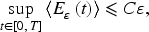
Let be stochastic coefficients and let be a positive parameter. We say that classical homogenization works with parameter β if the following holds: For any with compact support and any , the solutions of (2.3) and of (2.4) satisfy
Loosely speaking: is the parameter such that classical stochastic homogenization works on time intervals .
We can now formulate our first main result.
Critical parameters
Letbe a number such that a model of that class exists. With the critical parameters
there holds:
For: For all coefficientsof class γ, classical homogenization works with parameter β.
For: There exist coefficientsof class γ such that classical homogenization does not work with parameter β.
The main novelty of Theorem 2.6 is Part (2), while Part (1) follows by well established computations.
(The class of models with i.i.d. coefficients)
We described the case of i.i.d. coefficients in Example 2.4 and noted that it corresponds to . In this case, we have and . Accordingly, Theorem 2.6 implies that, for all , classical homogenization is valid. This matches previous findings, e.g. [12, Theorem 3 and Eq. (1.13)].
We emphasize that Part (2) of Theorem 2.6 does not imply that there exists i.i.d. coefficients such that for homogenization fails. It only ensures that there exist a model of class such that homogenization fails.
However, as mentioned above, Theorem 5.1 provides a sharp threshold for i.i.d. coefficients with matched impedance, for all . The threshold is .
Section 3 is devoted to the first claim of the theorem, the positive homogenization result. Section 4 is devoted to the second claim of the theorem, the negative result.
The case of matched impedance
The main novelty of Theorem 2.6 is Part (2), which concerns the failure of classical homogenization on sufficiently large time spans. In the special class of media with matched impedance one can understand well the mechanism of this failure. It is related to a large likelihood of a wrong averaged wave speed on a considerable time span. We would like to mention that we learned the techniques for matched impedance media from [14]. Below we provide an informal (but detailed) discussion of the failure of homogenization in media with matched impedance; rigorous results in this setting can be found in Section 5.
A medium has matched impedance if the product is a constant function. Here, we assume that holds for all and for -almost every .
In this section, we sketch the idea leading to negative results on homogenization in the case of matched impedance. For precise statements and rigorous proofs, we refer to Theorem 5.1 in Section 5. In addition, we provide in Theorem 5.1 a positive homogenization results which is significantly stronger than Part (1) of Theorem 2.6.
A stochastic medium with matched impedance. We consider coefficients that are piecewise constant in the intervals, for every . The numbers are chosen as i.i.d. random variables. A possible choice is to pick according to a uniform distribution on the interval . We set for every j and for all . This construction guarantees a constant impedance, on .
Solutions of the wave equation. In this setting, there is an explicit formula for solutions. Let of class be an arbitrary function with compact support in . We define a function u as follows: For every and , we set
using the convention that empty sums are zero, . We extend trivially by setting for . We claim that u solves the wave equation.
Before we verify the claim, let us calculate the initial values of u. For , there holds . For , there holds for some and . In particular, g does not coincide with the initial values of u.
Let us now show that, independent of initial data, u solves the wave equation. In the interior of the interval , we can calculate classically
It remains to show continuity of u and of the fluxes at the interfaces, i.e., at . Regarding continuity of u we calculate
We now verify the continuity of fluxes at
where we exploited . We have verified that u is a solution of the wave equation with coefficients a and ρ (see Appendix A for a integral representation of solutions of the Cauchy–Problem in the case of matched impedance).
Homogenization. Let us now consider the rescaled coefficients and . A solution of the wave equation is given by formula (2.11), which is modified to
We note that one can also express j in terms of x as in order to have a single formula for all .
The effective parameter is the harmonic average of , with our choices it is given by a simple expectation, for any . The effective parameter is the arithmetic average of , in our setting . We see that the impedance of the effective medium is again 1 and that the effective speed is . The effective wave equation is
A solution to this equation is given, for , by
We claim that stochastic homogenization fails in this setting on time intervals when we choose . To see this, it suffices to compare of (2.12) and of (2.14). This is sufficient since, for t in bounded time intervals, there holds for small (and recall that rigorous results are presented in Section 5).
Calculating the difference. Let us assume that the support of g is contained in , that the maximal value of g is 1 and that this maximum is attained in the point . The solution is a shift of the initial values, in this sense it is a wave that travels with speed to the right. For every observation point , the peak of the wave arrives at the time at which the argument of g in (2.14) is 1, i.e., . In more mathematical terms: For , the function has its maximum at , the value in this maximum is 1.
We want to calculate the time instance at which the function is maximal. The maximum of is at the point for which the argument of g in (2.12) is 1, hence
where j is such that holds, that is, .
We are interested in the mismatch of the arrival times for the -solution and the homogenized solution,
Let us consider a fixed grid point . At this point, the expected value of the mismatch is
This agrees with intuition, we expect that the wave arrives at the time that is suggested by the homogenized equation.
For our analysis, it is not sufficient to calculate the averaged arrival time. Homogenization fails when, with a positive probability, we observe a wrong arrival time in the stochastic medium. Let us therefore calculate the typical size of the random variable . For the calculation we use the quantity , defined by the expectation for any i. The number is the variance of the single entry in the sum. The independence of the random variables allows to calculate, again for ,
For and , we consider and . Clearly, we have , , and the arrival times of the pulse and the pulse typically differ by the order
For , this deviation is not small. We therefore expect that, typically, the two waves arrive at x with an order 1 mismatch, which leads also to an order 1 mismatch between the two solutions of the wave equation. The calculation strongly suggests that homogenization fails on the time scale for . Note that, in the above discussion, and (see (2.12) and (2.13)) do not satisfy the same initial conditions. We recall that rigorous result – positive and negative – are given in Section 5.
Remarks on higher dimensions
In Theorem 2.6, we provide two critical parameters, and . The lower critical parameter, , is related to positive homogenization results. It is derived in Section 3. The techniques of that section are well-established and independent of the dimension. It is possible to define a growth rate of correctors also in higher dimensions and to derive, with similar methods as in Section 3, positive homogenization results until time-scales , where depends on the growth rate. We mentioned that recent advances in quantitative stochastic homogenization yield optimal estimates on the growth of the correctors for large classes of random media, see e.g. [5,15] and the references therein.
The upper critical parameter is based on the construction of counter-examples. The counter-examples use either media with matched impedance or media-adapted domain transformations. In any case: If one considers layered media in dimension , then the one-dimensional counter-examples still provide examples where homogenization does not hold. We mention that a restriction to initial values with compact support would still require some work, but we would not expect severe difficulties to the construction of counter-examples.
On the other hand, for stochastic media that exploit the full liberty of media in higher dimension, we do not have any counter-examples and they cannot be constructed easily following the ideas that are used in this contribution.
The lower critical parameter
In this section we derive estimates for the homogenization error and prove Part (1) of Theorem 2.6: when t is not too large.
Following a standard approach, we first compare the solution of (2.3) with the two-scale expansion of the solution of (2.4). This comparison is the aim of the subsequent lemma.
Energy estimate for the error
Letbe a model of classwith bounds given by. Then, for everyand every, there existssuch that the following is true: Letbe supported in, forletandbe the unique solutions to (2.3) and (2.4), respectively, and letbe defined as
For everyholds
where
The following argument closely follows [19, Lemma 3.3]. Clearly, it suffices to prove the claim for . We therefore fix with support in .
Step 1: Equation for. We claim that of (3.1) satisfies
where is defined in (2.3) and the error functions are
With the help of (2.3), (2.4) and (2.6) we compute
The first term on the right-hand side in (3.6) can be expressed with the help of , defined in (2.5):
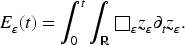
The derivation of (3.7) follows with a standard procedure of the theory of the linear wave equation: We multiply (3.4) with and integrate, for arbitrary , over . Since satisfies homogeneous initial conditions, an integration by parts allows to write the energy expression of (3.3) in the form
Taking expectations and using , we estimate the first term on the right hand side, for arbitrary :
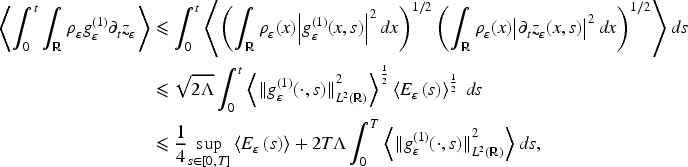
where we use Young’s inequality in the last inequality. A similar calculation allows to estimate the expectation of the second term on the right hand side of (3.8):
Regarding the last term in (3.8), we find, for every ,
Combining the last three displayed formulas with (3.8), we obtain (3.7).
Step 3: Estimatingand. The solution of (2.4) can be expressed by the following d’Alembert type representation formula with :
This representation of allows to estimate the error functions. We claim that there exists such that, for every ,
where the domain of integration is, with as above,
To show (3.10), we exploit formula (3.9). In combination with the assumption , the formula implies . Additionally, for a constant , it yields bounds for :
where we use the shorthand notation .
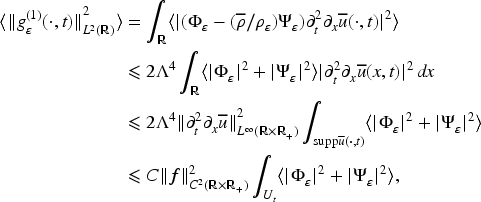
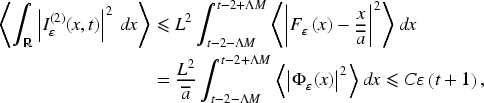
Let us estimate the first term of . Combining Fubini’s theorem with the facts that is deterministic and , we obtain
where . The terms involving and can be estimated analogously, and the claimed estimate (3.10) follows.
Step 4: Conclusion. Combining (3.7) and (3.10), we obtain with
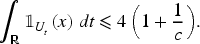
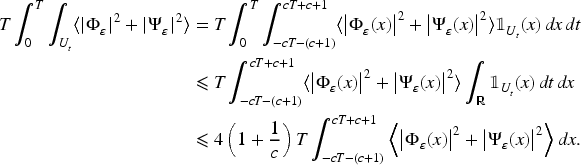
We begin by estimating the first term on the right-hand side of (3.13). For the set we use the characteristic function , defined as if and otherwise. The definition of implies, for every ,
We can therefore calculate
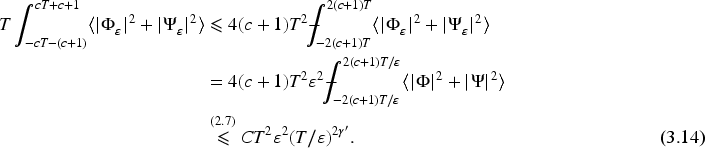
At this point we exploit the growth conditions (2.7). For every there exists such that, for and ,
To estimate the second term on the right-hand side in (3.13), we use for all and thus for
where . Inserting in (3.13) yields the claim (3.2).
Lemma 3.1 allows to prove Part (1) of Theorem 2.6. We repeat the desired statement in the subsequent lemma.
Letbe a model of class. Then, for all, classical homogenization works with parameter β in the sense of Definition 2.5.
Because of for , it suffices to consider . Let be given and let be supported in . Let and be the solutions of (2.3) and (2.4). We want to show that, for every , there holds
By continuity, we find such that . The triangle inequality together with the definition (see (3.1)) and yields
where is defined in (3.3). We estimate the two terms on the right-hand side separately. For the first term we use Lemma 3.1 with and find a constant such that, for every ,
Hence, follows from .
It remains to find bounds for the term . We use computations that are similar to those of Step 3 and Step 4 in the proof of Lemma 3.1. In particular, we use that by the explicit expression (3.9) of the homogenized solution in terms of f, which provides
where and the set is defined in (3.11). For every we have and thus
where . Hence, for every and ,
The right-hand side converges to zero as provided that , which is satisfied by the assumption .
The upper critical parameter
In this section, we prove Part (2) of Theorem 2.6. We show that model-independent homogenization fails on large time intervals. In this result, the length of the time interval depends on the growth properties of the correctors.
The construction will be based on coordinate transformations that are given by diffeomorphisms . We compare the wave equation in the original and in the new coordinates. We show that, when the original model defines a model of class γ, also the coefficients in the new coordinates define a model of class γ.
In Section 4.2 we use diffeomorphisms F that are based on the correctors. A relevant choice of F is given by harmonic coordinates. We stick with a more general description, since we also use a diffeomorphism F that is related to the oscillatory density coefficient. The growth properties of F imply that homogenization cannot take place for both models, the original model and the transformed model.
The wave equation in new coordinates
In this section, we use a general diffeomorphism to define new coordinates. We always assume that F is of class and strictly monotonically increasing with a positive lower bound for the derivative.
Given F, we construct also a rescaled map: We set such that . The coordinate transformation is equivalent to and hence equivalent to .
Coefficients are always scaled without any multiplication with . For coefficients in new coordinates we have, e.g.,
We next calculate the wave equation in the new coordinates .
Transformed wave equation
Letbe a diffeomorphism. We consider new spatial coordinates in the form. Letbe a solution of the wave equation (2.3) with coefficientsand. In the coordinateswe consider the new function. We can this as
We use the transformed coefficients
which provides after -dilation the formulasand. Regarding the right hand side, we define. Then the equation forreads
where we suppressed the argument t.
We have to transform the terms of (2.3). In the subsequent calculations, we always omit the argument t. The spatial arguments are always related by . For the first term of (2.3) we find
The right hand side of (2.3) is f. When we divide the rewritten equation (2.3) by , we obtain (4.2).
(Two problem adapted diffeomorphisms)
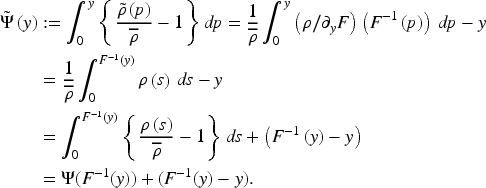
For two particular choices of F, the transformation yields a wave equation (4.2) that has one constant coefficient. We use the correctors Φ and of (2.5).
Harmonic coordinates: Let the transformation be given by . We observe that . With this choice of F, we obtain . The transformed system then has the coefficients and for all .
Coordinates for the density: With the choice we have . We find . The transformed system has the coefficients and for all .
Let us now evaluate the homogenized coefficients in the new coordinates. Interestingly, independently of the choice of the transformation F, the homogenized coefficients remain unchanged.
The subsequent lemma yields this fact, and it contains additionally a result about the order of the transformed system. When F satisfies certain assumptions regarding its distance from the identity and when the original system has the order γ, then the system in the new coordinates has also the order γ.
Properties of the transformed model
Letbe a stochastic model of class. Letbe a family of diffeomorphisms. We assume thatholds for two constants, for alland all y with. We furthermore assume that, for every, there exists C such that
for all. We consider the transformed coefficientsand. Then there holds:
The transformed modelis again of class γ.
The effective coefficients in the sense of optimal correctors are identical for the original and for the transformed model.
In the case, the effective coefficients in the sense of averages are unchanged in the sense that
Step 1:-norm in transformed coordinates. The upper and lower bounds and on the growth of F imply that -norms in transformed coordinates are equivalent to -norms in original coordinates. More precisely, for any -function and any integration bounds , there holds, with the substitution ,
A similar calculation can be performed for a lower bound and for the inverse transformation.
Step 2: Assertions 1. and 2. The main point is that the transformed system is of class γ, but the subsequent calculation provides also that the effective coefficients are not changed. We fix . We define the corrector with the transformed coefficient and the same number . We calculate, with the change of coordinates in the second line,
We now exploit that, for some and all , the growth estimate holds for the original model: . Evaluating the corresponding expression for the first term of , we get
Regarding the second term we obtain with the Cauchy–Schwarz inequality
where we used (4.3) in the last inequality. We conclude that there exists such that
and thus the claim for . The same calculation can be performed for Φ. Since was arbitrary, we conclude that the transformed model has an order not greater than γ.
Since the argument can be also used in the opposite direction, we also know that the class γ of the original problem is less than or equal to the class of the transformed system. This shows that the two classes actually coincide. Since we have used the numbers and of the original model in the calculation, we have obtained also the second assertion.
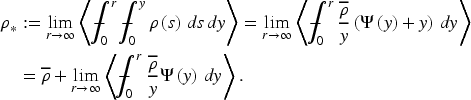
Step 3: Effective coefficients in the sense of averages. The subsequent lemma provides Assertion 3. Loosely speaking, the lemma shows that, for , the effective coefficients in the sense of averages coincide with the effective coefficients in the sense of optimal correctors.
On the two definitions of effective coefficients
Letbe a stochastic model of class. Letbe such that the corresponding correctors have the following property: For everythere issuch that, for all,
Then the effective coefficients in the sense of averages are well-defined and coincide withand.
We perform all calculations for ρ and , the calculations for a and Φ are analogous. Furthermore, we can restrict ourselves to , the calculations for negative r are identical. Because of we can furthermore assume . Our goal is to study the expression
The lemma is proven when we show that the limit in the last line exists and that it vanishes.
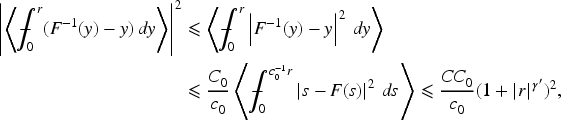
With this aim, we use a dyadic decomposition of the integral. For a large number r, we select the natural number K with . With constants C that depend only on the upper bound of ρ, we calculate for the squared absolute value with the Cauchy–Schwarz inequality
Using estimate (4.8) with we find, with the constant C changing in the last inequality,
Inserting above we obtain
For , this tends obviously to zero for . For , the second expression can be estimated by
which tends to zero because of . This shows and hence the claim.
Failure of stochastic homogenization
We claim that stochastic homogenization must fail on large time scales. The principal approach to the proof can be described as follows. We fix a model class parameter γ and fix a parameter β beyond the critical threshold . Let us assume that homogenization works with the parameter β. We consider a model of class γ. Then, for any , a change of coordinates provides a new model that satisfies the corrector estimates with parameter , hence the new model is again of class γ. Then both models, the old one, , and the new one, , allow homogenization. On the other hand, the coordinate transformation has a growth that is essentially γ, and this fact yields a contradiction to the fact that the -solutions of both models are close to the homogenized solution (and hence close to each other).
Upper critical parameter
Letbe such that a model with this model class parameter exists. Then
is an upper critical parameter in the sense of Theorem 2.6: For anythere are coefficientsof class γ such that classical homogenization does not work with parameter β.
Step 0: Preparation. We perform a proof by contradiction. We assume that, for some , classical homogenization works with parameter β for all coefficients of class γ. From now on we consider γ and as fixed and wish to derive a contradiction. Because of we can choose a number such that .
We furthermore choose a model of class γ. The contradiction will be derived from the fact that homogenization cannot work simultaneously for and the transformed model .
In the proof, we fix some function f, consider rescaled stochastic coefficients and , and study the solution of the wave equation (1.1) for with trivial initial data. Another object is the solution of the effective wave equation
with trivial initial data. Since, by assumption, classical homogenization works for the parameter β, we know that holds in the sense of (2.9): For every , as ,
Step 1: The limit solution. Let us first make a choice for the right hand side f. We choose a smooth non-negative function f with support in which satisfies on . The generalized d’Alembert representation formula in one space dimension allows to write the solution with the help of integrals over f. With and initial data , the limit solution reads
The formula implies that, for every time instance , the function has its support in . The function is positive in the point , and non-negative everywhere. Loosely speaking, is a combination of two wave pulses, both positive, one located at and the other located at .
Step 2: Model class γ. Since is of class γ, the parameter is below the infimum over admissible growth rates, ; this implies that, considering the constants ,
Because of (4.12), we can choose a subsequence such that
In the following, we suppose that there exists a sequence such that
(the case in which (4.13) holds with replaced by Φ can be treated analogously). For large k, there must hold , so we always assume this lower bound in the following. We claim that, for every with it holds
Indeed, assuming that (4.14) fails to hold, we have
We choose the transformation . Inequality (4.14) reads
In this sense, the coordinate transformation produces large errors at some points.
Let us now exploit in another way that the model class is γ. For every there exists a constant C such that
for all . Property (4.16) corresponds to one of the assumptions on F in Lemma 4.3. The other assumption reads and follows from the fact that
and similarly in the case that .
Step 3: Transformation of the equation. We recall that the model and the coordinate change F are fixed. We use the transformation of Lemma 4.1. The function is defined by , the new coefficients are and , the new sources are . The transformed equation is given by (4.2),
and satisfies trivial initial conditions. Because of (4.16) with arbitrary , Lemma 4.3 yields that and define again a model of class γ and that the homogenized system is again given by and . By our assumption, classical homogenization works with parameter β also for the coefficients . This implies that the solutions of
Step 4: Only a small error is introduced by changing fromto f. This step is slightly technical. Let and be as in Step 3. We consider the difference and claim that
We will exploit this property in the next step of the proof.
To derive (4.20), we start from the equation for ,
In view of Lemma B.1, it suffices to show for the space integrals the convergence
as . We compute for and omit the argument t after the first equality,
We consider the case . Equation (4.17) together with imply the deterministic lower bound for all and . Hence, implies that
We therefore obtain with ,
as . In the convergence of the last line we exploited the sublinear growth of (compare, e.g., (4.16), and note that we can choose ). The time derivative of in (4.22) is treated with the same calculation, replacing f by .
Step 5: Derivation of a contradiction. The remainder of this proof uses the following observation: By the error estimates (4.10) and (4.21), and are close to each other. This is in contradiction with the definition of through and the large deviation (4.15) of the transformation at the points .
Let us turn to the details of the argument. In Step 2 of this proof, we have constructed a sequence of points such that , see (4.15). Since F remains bounded on bounded sets by the upper bound on , we know that necessarily . Given the sequence , we choose the sequence . The choice is made such that , and hence . Upon choosing a subsequence, we can assume that all points have the same sign; without loss of generality we assume that the sign is positive. We consider the rescaled points and the time instances with as introduced above.
The overall picture is that the functions must all have a pulse at position at time . Let us quantify this statement. Writing short , the triangle inequality and yield
The second term on the right hand side was introduced to make the calculation clear; it vanishes identically. Taking expectations, (4.10) provides convergence to 0 as for the first term on the right hand side. In the third term we can exploit the upper and lower bounds and on the growth of F. Such bounds imply that the -norm in transformed coordinates is equivalent to the original coordinates in the sense of (4.6). This allows to estimate the third term by , which vanishes after taking expectations in the limit by (4.21). Altogether, we obtain from (4.23) for the expected value
We want to lead (4.24) to a contradiction with the fact that the function has non-trivial values in a neighborhood of , but vanishing values at positive points that are more than away from .
The transformation satisfies by (4.15). Given this lower bound for the expected value, there necessarily exists a subset of events with positive measure, such that for all .
We calculate the mismatch in -rescaled variables, writing again short instead of . Because of , , and , we find, for ,
We had chosen in Step 0 such that . Because of this choice, the exponent in the last expression of (4.25) is negative, which means that the mismatch is arbitrarily large.
This provides a contradiction with (4.24). For every , the function has its support (on the positive axis) around the point . On the other hand, vanishes around the point because of (4.25). Being a fixed positive quantity on a set with positive measure, and being non-negative everywhere, the expectation of the norm in (4.24) cannot vanish in the limit. We have found the desired contradiction.
Sharp homogenization results for matched impedance
Let us introduce a stochastic medium with matched impedance. As in Section 2.3, we focus on the situations of i.i.d. coefficients. Extensions to correlated coefficients are possible, see Remark 5.2 below. Fix and let be such that the random variables with are i.i.d.. We define the random coefficients by
The rescaled coefficients are and .
Critical parameter for media with matched impedance
Let the stochastic mediumbe as described above. Thenis the critical time horizon for classical homogenization in the following sense:
Letandbe two numbers. Letbe supported onwith the property that the corresponding homogenized solution does not have compact support. Then the solutionof (2.3) and the solutionof (2.4) satisfy
Letandbe two numbers. Letbe smooth and supported on. Then the solutionsandsatisfy
Proof of Part (1) of Theorem 5.1.
The underlying idea of the proof is to use the exact solutions to the homogeneous wave equation with piecewise constant coefficients of (2.12). We recall that a matched impedance is needed in order to have explicit solution in that form.
We allow here not only a right-going wave (with shape function g), but additionally a left-going wave (with shape function h). For times , the function solves a wave equation with vanishing right hand side. This allows to express with g and h. Writing instead of for times , and allowing that g and h depend also on , an adaption of formula (2.12) reads
for . On the other hand, a comparable solution of the homogenized equation with and reads, compare (2.14):
When we include also left-going waves, we do not only have that and are solutions to the corresponding homogeneous wave equations, but, moreover, every solution of the one-dimensional wave equation can be written with appropriate , , , and in the above form.
Our proof relies on two observations. (i) For appropriate g- and h-functions, there holds, for : and with and . (ii) For large times, solutions and have their main wave pulses at very distant points. This implies (5.1).
Step 0: Preparation. We fix the right hand side f with support on as in the Theorem and . We perform a proof with a contradiction argument and assume that convergence holds in (5.1), i.e., as ,
Step 1: Representation ofand. The function is a solution of the homogeneous wave equation for . We can therefore, for appropriate functions and , write in the form of (5.4): for for as in (5.4). This defines and . Indeed, by Lemma A.1, we have for
where g and h are given by and . The above representation formula can be rewritten as a sum of two pulses as in (5.4) by setting
Note that or holds by assumption on f. For fixed , we can also use a representation formula for . As a solution of a homogeneous wave equation with coefficients and for , there exist functions and such that has the form of (5.3), for for as in (5.3). This defines and . This fact and precise expressions for and can be derived as above for and appealing to the d’Alambert-type representation formula for solutions of the wave equation with matched impedance given in Lemma A.1. We skip the details here.
By finite speed of propagation, all functions g and h have support in some interval , where M depends on the support of f and the bounds for the coefficients in the equations.
Omitting the arguments of the functions, which are as in (5.3) and (5.4), the limit (5.6) is equivalent to
For a sufficiently large time instance t, the functions and are non-vanishing only for , and the functions and are non-vanishing only for . We therefore conclude the convergence
Step 2: Two solutions to inhomogeneous problems. From now on, we consider only large times , where the lower bound is determined by M. Additionally, we consider only positive positions . If is chosen large enough, only the contributions of and appear in the representation formulas.
We introduce a new function, . The function is defined as in the rule (5.3), but with the shape function :
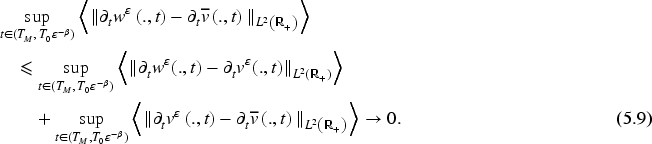
The subsequent calculation uses first a triangle inequality and then the convergence (5.7) for the first term and the convergence (5.5) for the second term:
Step 3: Deviation ofand. We will now verify that (5.9) leads to a contradiction. We can assume that is satisfied, otherwise we switch to and consider h instead of g. Since has support in , the functions and have support in .
Fix an arbitrary and consider the sequence of time instances . We claim that there exists an event with , such that
for every . Loosely speaking: With a positive probability, the pulse of is not approximately moving with speed .
Using the claim, we can conclude the proof: Since the is a positive quantity for every , (5.10) yields a contradiction to (5.9). This contradiction implies that (5.1) is true.
Step 4: Verification of the claim. The corresponding calculation was performed before, see (2.18) with the resulting mismatch of arrival times (2.19). When the mismatch exceeds for sufficiently large , then (5.10) holds.
Proof of Part (2) of Theorem 5.1.
Let f be as in the statement and let and be corresponding solutions. It suffices to show the statement (5.2) with and replaced by and . Indeed, since f is smooth and are independent of time, the time derivatives and are again solutions for a wave equation with trivial initial data and the result for values can be applied to derivatives.
Step 1: Homogenization for finite time. For every fixed , we find with
The statement is classical and we display a proof relying on Lemma 3.2 for completeness. Setting and , we deduce from , the definitions of Φ and of (2.5), and the scaled correctors and that
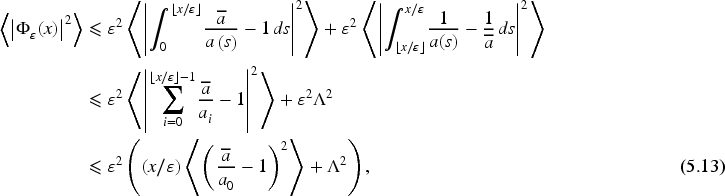
We claim that there exists such that
In order to show the claim, we consider in the following, without loss of generality, only points . We estimate
where . We used in the last inequality the fact that the are i.i.d., in particular,
This shows the claim, estimate (5.12) for and, hence, also for .
where and is given in (3.3). Inserting the above estimate and (5.12) into (3.15), we deduce
for some . The remaining estimate for follows by integrating in time, exploiting that and have trivial initial conditions.
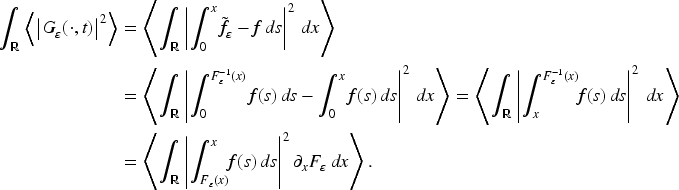
Step 2: Representation formula of solutions for times. We use the function , which defines harmonic coordinates (note that we use our particular sign convention for integrals when x is negative). Lemma A.1 allows, for , to represent the solutions:
where and are given by the relations
and
We will later use several properties of the functions and the representing functions and . The smoothness of f implies that there exists such that
Moreover, there exists such that
where we use for the last term on the right-hand side .
Finally, we note that the explicit expressions for and yield for
where
In the following two steps, we estimate and separately.
Step 3: Estimates for the error termsand. We claim that, for all and , there holds
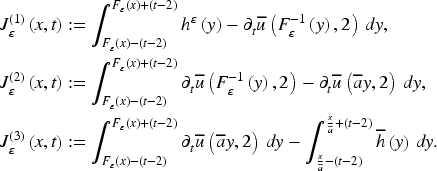
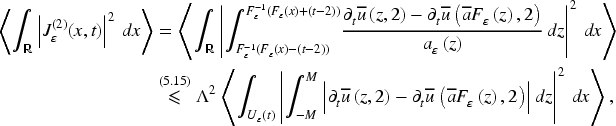
We will show the claim related to , the term can be treated similarly. We use the triangle inequality to split into two other terms and write
with
We begin with the term . Using that has support in , the estimates and , we obtain
where we used (5.12) in the last step and a constant .
We now estimate the term involving . A change of variables with and, accordingly, with pre-factor allows to calculate
where we use triangle inequality and the definition of and in the second inequality.
We can now combine (5.22) and (5.11) (with ). We obtain, for some and arbitrary :
With this estimate, we have shown the claim of (5.20).
Step 4: Estimate for the error term. We claim that defined in (5.19) satisfies
We start the proof by writing
with
Recalling for , we obtain, using the corresponding substitution in the first equality,
where the outer domain of integration is
and where we used .
Because of and , we obtain for some deterministic satisfying for some . We therefore find such that, changing the constant from one line to the next,
In order to estimate the term involving , we substitute again with and obtain
where with are as above. The Cauchy–Schwarz inequality implies
where (recall ). We use the equality to conclude from (5.12) and , that
for some . It remains to estimate the term involving . We observe that and thus
for all . Furthermore, holds unless
Arguing similar to the case of we deduce with help of (5.12)
for some . Combining (5.25)–(5.27), we obtain (5.24), and have therefore shown the claim for .
Step 6: Conclusion. The decomposition (5.16) combined with (5.20) and (5.24) imply the claim.
(Extensions to correlated coefficients)
Theorem 5.1 can be extended to certain correlated media. Indeed, the fact that the coefficients are i.i.d. is used, in the proof of Theorem 5.1, essentially only for the calculation
The upper bound is used in all applications of estimate (5.13) and the lower bound in (2.18) and (2.19) (note that with ). In Section C below, we construct, for every a random medium where the corrector satisfies bounds of the form
Next, we briefly sketch that the corrector estimates (5.28) yield results that are analogous to those of Theorem 5.1, where the critical time is replaced by . Indeed, if we replace (5.13) with the upper bound in (5.28), we obtain that (5.23) and (5.25)–(5.27) hold with
Clearly, this implies (5.20) and (5.24) with replaced by . Similarly, we obtain that the lower bound of (5.28) implies that (2.19) is replaced by
and the right-hand side diverges when .
Footnotes
Representation of matched impedance solutions
We state and prove a d’Alambert-type representation formula for solutions of the initial-value problem with matched impedance. We use this formula in the proof of Theorem 5.1.
For, letbe coefficients such thatholds almost everywhere. We use the function(with the standard sign convention for integrals). Then, for arbitrarywith compact support, the unique solution u of the wave equation
is given by
Uniqueness of the solution is known, the attainment of the initial values is easily checked. We only have to show that the expression in (A.1) solves the wave equation. We compute
Using , we obtain for the first spatial derivative of u
Taking another spatial derivative, the chain rule yields
Because of , we have found that u solves the wave equation.
A small right hand side in the wave equation
In this section, we formulate and prove a technical lemma which is used in the proof of Proposition 4.5.
Letbe a bound for the support of functions. We consider, for every, a functionsuch thatis supported infor every. We furthermore assume that the quantitysatisfies
Then, for everyand every sequence of coefficientssatisfyingfor all, the sequence of solutionsof
satisfies
Throughout the proof we denote by the energy of that is
The definition of imply that solves the equation
Now we can apply the same (standard) testing procedure as in Step 2 of the proof of Lemma 3.1. By multiplying the above equation with and integrating, we obtain (with help of integration by parts)
As in Step 2 of the proof of Lemma 3.1, we deduce from the above identity that
where . Recall that and thus is supported in time in and thus we obtain by sending
which completes the proof.
Media with γ ∈ ( 1 / 2,1 )
Our standard random medium has identically distributed independent values of ρ and a, which results in a model parameter (growth of correctors). When the values of ρ (or a) are not independent in the different cells, but have a positive correlation, then every value of γ in the interval can occur. This is what we show in this section with a construction from [6].
For simplicity, we consider media with constant ρ, say , and random a. An extension to more general models, in particular models of class with matched impedance () is straightforward. Let us emphasize that the following construction and computations are essentially contained in [6], where precise elliptic homogenization results in correlated media are proven.
For a given probability space let be a stationary Gaussian process. We suppose that, for every , the random variable has zero mean and variance one, and for every x. Moreover, we suppose that the autocorrelation function
satisfies, for some exponent and some factor ,
Our aim is to define coefficients that satisfy uniform bounds. We will define them by truncating the Gaussian variable . We fix a nonlinear map satisfying and for all . Possible choices are or . We consider the random field
The following properties of φ are proven in [6, Proposition 2.2]:
We are now in a position to construct, for every , a model of class γ.
Let γ be a number in the interval. We choose the parameterand consider g and φ as in Lemma C.1. Thenwithandgiven by
defines a model of class γ.
By construction, we have and thus on . Moreover, we have
and thus , see (2.1). Accordingly, the corrector Φ of (2.5) is given by
The choice yields and . In order to show that defines a model of class it suffices to show the following two statements (compare (2.7)):
and
We show (C.3), the computations for (C.4) are similar. As a preparation, we rewrite a double integral with the substitution rule:
Using this formula and the autocorrelation function , we find
Combining (C.2) and (which follows from ), we obtain the existence of a constant such that on and on . This allows to calculate the expression of (C.3):
As noted above, the computations for (C.4) are analogous. This shows that the model class is indeed γ.
Acknowledgements
This work was partially funded by Deutsche Forschungsgemeinschaft (DFG, German Research Foundation) under grant SCHW 639/11-1, “Strahlungsbedingungen für Wellen in periodischen und stochastischen Medien”.
References
1.
AbdulleA.PouchonT., Effective models and numerical homogenization for wave propagation in heterogeneous media on arbitrary timescales, Found. Comput. Math.20(6) (2020), 1505–1547. doi:10.1007/s10208-020-09456-x.
2.
AllaireG.BrianeM.VanninathanM., A comparison between two-scale asymptotic expansions and Bloch wave expansions for the homogenization of periodic structures, SeMA J.73(3) (2016), 237–259. doi:10.1007/s40324-016-0067-z.
3.
AllaireG.Lamacz-KeymlingA.RauchJ., Crime pays; homogenized wave equations for long times, Asymptot. Anal.128(3) (2022), 295–336.
4.
AllaireG.YamadaT., Optimization of dispersive coefficients in the homogenization of the wave equation in periodic structures, Numer. Math.140(2) (2018), 265–326. doi:10.1007/s00211-018-0972-4.
5.
ArmstrongS.KuusiT.MourratJ.-C., Quantitative Stochastic Homogenization and Large-Scale Regularity, Grundlehren der Mathematischen Wissenschaften [Fundamental Principles of Mathematical Sciences], Vol. 352, Springer, Cham, 2019.
6.
BalG.GarnierJ.MotschS.PerrierV., Random integrals and correctors in homogenization, Asymptot. Anal.59(1–2) (2008), 1–26.
7.
BenoitA.GloriaA., Long-time homogenization and asymptotic ballistic transport of classical waves, Ann. Sci. Éc. Norm. Supér. (4)52(3) (2019), 703–759. doi:10.24033/asens.2395.
8.
BlancX.Le BrisC., Homogenization Theory for Multiscale Problems, MS&A Vol. 21, Springer, Cham, 2023.
9.
Brahim-OtsmaneS.FrancfortG.A.MuratF., Correctors for the homogenization of the wave and heat equations, J. Math. Pures Appl. (9)71(3) (1992), 197–231.
10.
DohnalT.LamaczA.SchweizerB., Bloch-wave homogenization on large time scales and dispersive effective wave equations, Multiscale Model. Simul.12(2) (2014), 488–513. doi:10.1137/130935033.
11.
DohnalT.LamaczA.SchweizerB., Dispersive homogenized models and coefficient formulas for waves in general periodic media, Asymptot. Anal.93(1–2) (2015), 21–49.
12.
DuerinckxM.GloriaA.RufM., A spectral ansatz for the long-time homogenization of the wave equation, 2023.
13.
FishJ.ChenW., Space-time multiscale model for wave propagation in heterogeneous media, Comput. Methods Appl. Mech. Engrg.193(45–47) (2004), 4837–4856. doi:10.1016/j.cma.2004.05.006.
14.
FouqueJ.-P.GarnierJ.PapanicolaouG.SølnaK., Wave Propagation and Time Reversal in Randomly Layered Media, Stochastic Modelling and Applied Probability, Vol. 56, Springer, New York, 2007.
15.
GloriaA.NeukammS.OttoF., Quantitative estimates in stochastic homogenization for correlated coefficient fields, Anal. PDE14(8) (2021), 2497–2537. doi:10.2140/apde.2021.14.2497.
16.
LamaczA., Dispersive effective models for waves in heterogeneous media, Math. Models Methods Appl. Sci.21(9) (2011), 1871–1899. doi:10.1142/S021820251100557X.
17.
NeukammS.VargaM.WaurickM., Two-scale homogenization of abstract linear time-dependent PDEs, Asymptot. Anal.125(3–4) (2021), 247–287.
18.
SantosaF.SymesW.W., A dispersive effective medium for wave propagation in periodic composites, SIAM J. Appl. Math.51(4) (1991), 984–1005. doi:10.1137/0151049.
19.
SchäffnerM.SchweizerB.TjandrawidjajaY., Domain truncation methods for the wave equation in a homogenization limit, Appl. Anal.101(12) (2022), 4149–4170. doi:10.1080/00036811.2022.2054416.
20.
SchweizerB.TheilF., Lattice dynamics on large time scales and dispersive effective equations, SIAM J. Appl. Math.78(6) (2018), 3060–3086. doi:10.1137/17M1162184.