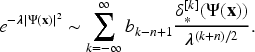
In this article we continue our research in (Yang and Estrada in Asymptot. Anal.95(1–2) (2015) 1–19), about the asymptotic expansion of thick distributions. We compute more examples of asymptotic expansion of integral transforms using the techniques developed in (Yang and Estrada in Asymptot. Anal.95(1–2) (2015) 1–19). Besides, we derive a new “Laplace Formula” for the situation in which a point singularity is allowed.
The theory of asymptotic expansions of generalized functions finds its usefulness in many areas in mathematics. The theory itself as well as its applications in number theory, geometry, and mathematical physics has been studied by several research groups in recent years [4,9–11,14].
The theory of thick distributions is a generalization of the classical theory of Schwartz distributions, in which it allows a singular point on the test functions [2,12,13].
In a previous paper [14], we have found some results in asymptotic expansion of thick distributions, mainly on the so called “moment asymptotic expansion”. We also calculated several examples of asymptotic expansion of thick distributions as illustrations of our theorems.
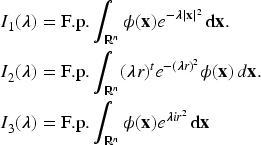
This article will present some follow-up research about asymptotic expansion of thick distributions. It can be viewed as a second part of [14]. This article has two main parts: in Section 3, we will compute more examples of asymptotic expansion of certain integral transforms, using the method developed in [14]. These integral transforms all allow a singular point, which is the main characteristic of thick distributions. To be more precise, we will compute asymptotic expansions of the following integral transforms:
as , and . Here we assume that , i.e., it is a thick test function and allows a singularity at the origin.
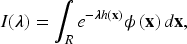
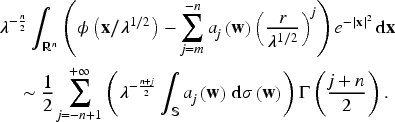
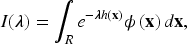
A second main part of this article is devoted to develop a new “Laplace Formula”. We consider the asymptotic evaluation of multidimensional integrals of the type
where is a real function and where R is a region of , . Under these conditions we find a new Laplace Formula:
We will give a detailed explanation and derivation of this formula in Section 4.
Some reviews
Let us first quote some theorems and propositions from [14].
Let, with moment functions, then
where, given by, is the surface area of the unit sphere. This means that, for some m.
This means that for any test function , ,
where m is the degree of the starting term of the asymptotic expansion of ϕ with respect to the radius r when . Namely, when .
The above two propositions are also from [14]. Of course they can be applied to a more broad situation where the finite part integral exists. For a more complete explanation of finite part integrals we refer to [14] and [3,4,8].
Computation of some examples
In this section, we want to compute some examples of asymptotic expansions of certain integrals with a parameter. In this section, we assume that , and as .
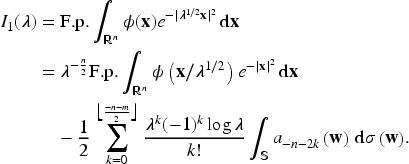
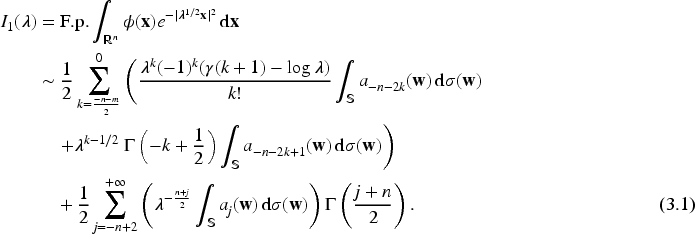
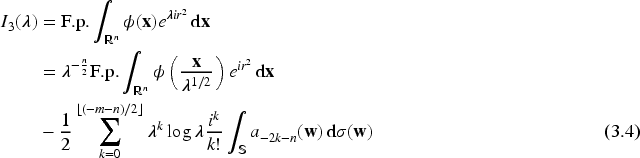
. We want to compute the asymptotic expansion of the integral
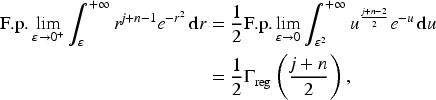
Notice that as , then using Proposition 2.2, we have
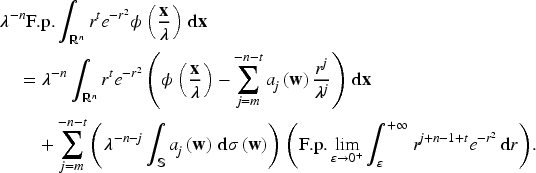
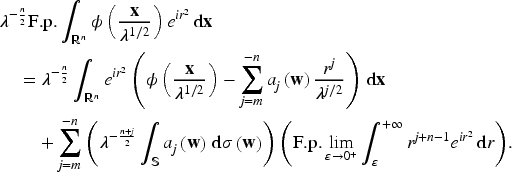
On the other hand,
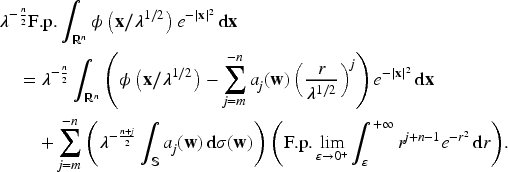
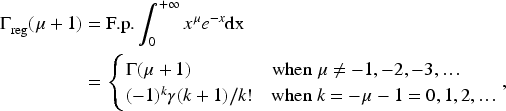
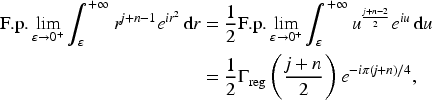
Observe that
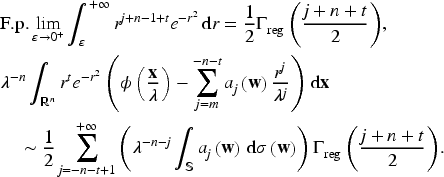
where
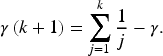
where is the logarithmic derivative of the gamma function [7], so that [4]
For a detailed computation of , please see [14], equations (6.16)–(6.21).
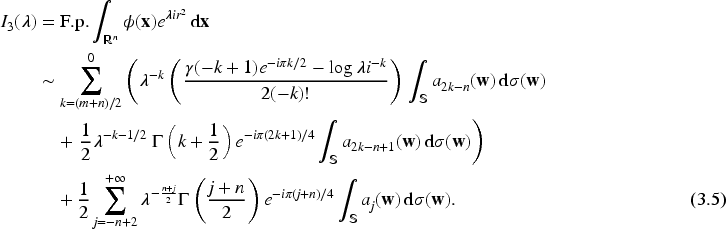
Hence
On the other hand, it is easy to compute that
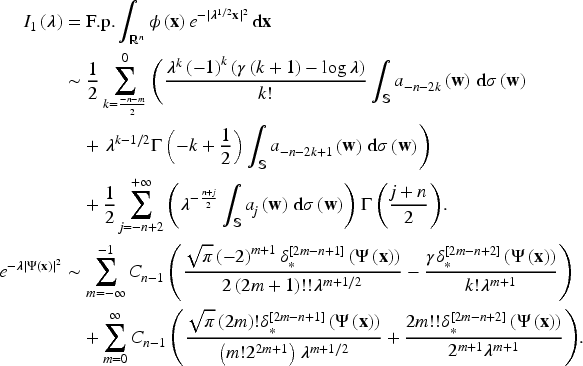
In summary, we have, if is even,
And the situation when is odd is similar with just a few index change.
Notice that this expansion was also computed in [1]. Here we summarize the details in [14] and [1].
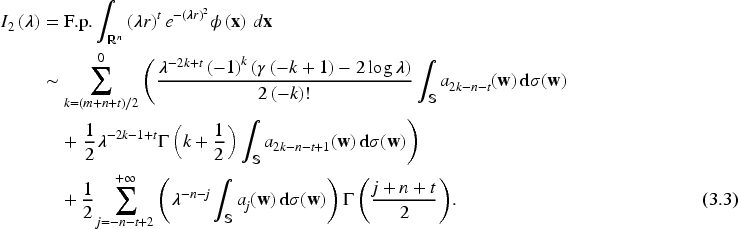
We want to compute the asymptotic expansion of the finite part integral
Obviously, the asymptotic expansion of at the origin is
Hence by Proposition 2.2, we have
On the other hand, we compute that
And
In summary, we have, if is even,
And when is odd the result is similar with just a few index change.
Clearly, the asymptotic expansion of at the origin is
We can compute that
And
Now let , we can compute
when we view as the finite part of the Fourier transform of with the transform variable equal to . And this result can be found in [6], for example.
On the other hand, when , the Fourier transform of , with the transform variable equal to , is . That is, there is no singularity. Hence we have, for even,
Again, the case when is odd is easy to get.
Laplace formula
Let us consider the asymptotic evaluation of multidimensional integrals of the type
where is a real function and where R is a region of . We assume that is smooth in a region containing the closure of the region R. It was shown by Focke [5] that the main contribution to for comes from the vicinity of the minima of in . The isolated critical points of h where minima occur are classified into three types according to their location: the interior critical points; the critical points of the smooth parts of the boundary; the critical points situated on the non-smooth parts of the boundary. The asymptotic expansion takes a different form for each type of critical points. In this section we want to discuss the asymptotic expansion of when R contains a first type critical point , i.e., when it contains an interior critical point.
We also assume that is smooth except for at the point . In fact, we assume that . That is, it is tempered when and, it admits an asymptotic expansion on when .
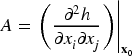
By assumption, is an interior minimum of h, non-degenerate. Namely, and its Hessian matrix
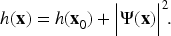
is positive definite. Thus, we can find , with , with positive Jacobian near , and such that,
Thus
By the computation we did in Example 3.1 above,
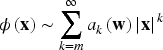
Now, let us consider the leading term of this expansion. Let us pick up a test function . We know that it admits an asymptotic expansion
with some integer m. In the following context let us use to denote the constant coefficients of the expansion of for simplicity. i.e.
Before discussing the expansion, let us present the following fact:
Let, then
Recall, if , it admits an asymptotic expansion when as , and acts on as
The statement follows if one observes that is to move the coordinate system towards .
Now, in order to discuss the leading term of the expansion, let us consider the following
where denotes the Hessian matrix at . Note , if we write , then . We know that admits an asymptotic expansion as when . One can see that
Since , there is an matrix B such that
With
In fact, , it is just the derivative of at .
Hence
Namely, the leading term of the expansion can be viewed as a linear change of variable.
Observe, if we denote ,
Thus in conclusion,
where and
Footnotes
Acknowledgements
Thanks to National Natural Science Foundation of China to support this research. The grant number is 12001150.
Thanks to Hefei University of Technology to support this research. The grant number from Hefei University of Technology is 407-0371000086.
References
1.
BarbosaA.deO.N., The asymptotic expansion of some integral transformation containing a singular point, Master’s thesis, Hefei University of Technology, 2022. Available at https://d-wanfangdata-com-cn-s.web.bisu.edu.cn/thesis/D02944055.
2.
EstradaR.FullingS.A., Functions and distributions in spaces with thick points, Int. J. Appl. Math. Stat.10(S07) (2007), 25–37, ISSN 0973-1377.
3.
EstradaR.KanwalR.P., Regularization, pseudofunction, and Hadamard finite part, J. Math. Anal. Appl.141(1) (1989), 195–207, ISSN 0022-247X. doi:https://doi.org/10.1016/0022-247X(89)90216-3.
4.
EstradaR.KanwalR.P., A Distributional Approach to Asymptotics: Theory and Applications, 2nd edn, Birkhäuser Advanced Texts: Basler Lehrbücher. [Birkhäuser Advanced Texts: Basel Textbooks], Birkhäuser Boston Inc., Boston, MA, 2002, p. 451. ISBN 0-8176-4142-4. doi:https://doi.org/10.1007/978-0-8176-8130-2.
5.
FockeJ., Asymptotische Entwicklungen Mittels der Methode der Stationären Phase(Berichte Über die Verhandlungen der Sächsischen Akademie der Wissenschaften zu Leipzig / Philologisc), De Gruyter, 1957.
6.
KanwalR.P., Theory and Applications, 3rd edn, Generalized Functions, Birkhäuser Boston Inc., Boston, MA, 2004, p. 476. ISBN 0-8176-4343-5. doi:https://doi.org/10.1007/978-0-8176-8174-6.
7.
LebedevN.N., Special Functions and Their Applications, Dover Publications, Inc., New York, 1972, p. 308, Revised edition, translated from the Russian and edited by Richard A. Silverman, Unabridged and corrected republication.
8.
PaychaS., Regularised Integrals, Sums and Traces: An Analytic Point of View, University Lecture Series, Vol. 59, American Mathematical Society, Providence, RI, 2012, p. 190. ISBN 978-0-8218-5367-2. doi:https://doi.org/10.1090/ulect/059.
9.
PilipovićS.StankovićB.TakačiA., Asymptotic Behaviour and Stieltjes Transformation of Distributions, Teubner-Texte zur Mathematik [Teubner Texts in Mathematics], Vol. 116, BSB B. G. Teubner Verlagsgesellschaft, Leipzig, 1990, p. 200, With German, French and Russian summaries. ISBN 3-322-00772-3.
10.
PilipovićS.StankovićB.VindasJ., Asymptotic Behavior of Generalized Functions, Series on Analysis, Applications and Computation, Vol. 5, World Scientific Publishing Co. Pte. Ltd., Hackensack, NJ, 2012, p. 294. ISBN 978-981-4366-84-7; 981-4366-84-6.
11.
VladimirovV.S.DrozzinovY.N.ZavialovB.I., Tauberian theorems for distributions, in: International Symposium in Memory of Hua Loo Keng, Vol. II, Beijing, 1988, Springer, Berlin, 1991, pp. 301–311.
12.
YangY., Reconstruction of the one-dimensional thick distribution theory, J. Math. Anal. Appl.488(1) (2020), 124034. 17, ISSN 0022-247X. doi:https://doi.org/10.1016/j.jmaa.2020.124034.