In this paper, we establish the results about spread relation to holomorphic curve intersecting hypersurfaces. Using the spread relation for holomorphic curve and Second Main Theorem, we prove some results for uniqueness problem of holomorphic curve by inverse image of hypersurfaces on angular domain. In my knowledge, it is the first time that uniqueness problem for holomorphic curves on angular domain into projective space intersecting with hypersurfaces is studied. Furthermore, we also study the growth of holomorphic curves with radially distributed hypersurfaces.
We denote by the angle on complex plane and by its closure, where . Then, is called an angular domain on complex plane. In 1998, by using potential method, Fedorov and Grishin studied the Second Main Theorem for holomorphic curve on half plane intersecting with hyperplanes in general position. In 2015, Zheng [19] established the value distribution of holomorphic curves on an angular domain intersecting with hyperplanes from the point of view of potential theory and established the first and second fundamental theorems corresponding to those theorems of Ahlfors–Shimizu, Nevanlinna, and Tsuji on meromorphic functions in an angular domain. We refer readers to [3,5,14,18,19] for comments on the results of the value distribution of holomorphic curves and meromorphic functions on an angular domain. In 2023, Quang [13] established some Second Main Theorems for holomorphic mappings from angular domain into projective varieties for arbitrary families of moving hypersurfaces via distributive constant. However, the applications of Second Main Theorem is not studied in [13]. The value distribution of holomorphic curve with lower order studied by some authors and has long history. We refer the readers to [2,7,9,10,12,15,17] for more details. In this paper, we will study the applications of Second Main Theorem on angular domain for holomorphic mappings intersecting with hypersurfaces in subgeneral position. In the studing of value distribution of holomorphic curve on angular domain, the spread of holomorphic curves has many applications. We refer the readers to [6] and [16] for some estimations on speard of holomorphic curve. In [8], Lin, Mori and Kohge gave some uniquenes results of meromorphic functions by using spread relation. In this work, we first extend the result of Niino [11] about spread relation to holomorphic curve intersecting hypersurfaces. Using the spread relation for holomorphic curve and a version Second Main Theorem with good level of truncated function, we establish some results for uniqueness problem of holomorphic curve by inverse image of hypersurfaces on angular domain. In my knowledge, it is the first time that uniqueness problem for holomorphic curves on angular domain into projective space intersecting with hypersurfaces is studied. Furthermore, we also study the growth of holomorphic curves with radially distributed hypersurfaces.
Characteristics of holomorphic curve on angular domain
In this paper, we consider the holomorphic curve with reduced representation , where are holomorphic functions and without common zeros in . The characteristic function of f is given by
where . The above definition is independent, up to an additive constant, of the choice of the reduced representation of f. The order and lower order of f is defined by
respectively. The holomorphic curve f is called transcendental if
Let r be a real number satisfying . Set and
Let be a holomorphic curve with reduced representation , where are holomorphic functions and without common zeros in . The counting function of f with respect to D is defined as
where the are the zeros of in counting with multiplicity. For each zero of in with multiple m, then term is counted m times in .
Now let δ be a positive integer, the truncated counting function of f is defined by
where any zero of multiplicity greater than δ of in is “truncated” and counted as if it only had multiplicity δ. This means that for each zero of in with multiple m, the terms is counted times in .
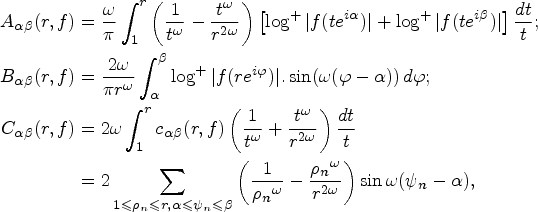
The angular proximity Nevanlinna of f with respect to D is defined as following:
and
where .
The angular Nevanlinna characteristic of f is defined by
Assume that and . Let be hypersurfaces in . The hypersurfaces are said to be in N-sugeneral position in if for any subset with , we have . When , we said that the hypersurfaces are said to be in general position in .
A map is said to be algebraically nondegenerate if the image of f is not contained in any proper subvarieties of .
In this paper, a notation “‖” in the inequality is mean that the inequality holds for outside a set with measure finite.
Our results are given as follows:
Let D be a hypersurface inandbe a holomorphic curve whose image is not contained D. Then we have for any,
Note that . By the definitions of , , and apply to Lemma 1 for , we have
Hence, we get
This is conclusion of Theorem 3.
Using Theorem 3, Lemma 1, Lemma 2, some steps in [13], and the methods in proving Theorem 1.2 [1], we can get the result as follows:
Assume that q, N, n are three natural numbers such that. Let f be an algebraically nondegenerate holomorphic curve frominto, andbe hypersurfaces in N-subgeneral position onwith,. Setand. If
then we have
where
Growth of holmorphic curves with radially distributed hypersurfaces
Let be a holomorphic curve and be a reduced representation of f. Let D be a hypersurface with degree d which is defined by polynomial homogeneous Q with degree d. Define
which is called a deficiency with respective D, and if , then D is called a deficient hypersurface of f. Under the existence of a deficient hypersurface of f, we consider the estimation of growth of the holomorphic curve f in view of some radially distributed hypersurfaces. Since the Cartan characteristic describes the growth of holomorphic curve, then we will first give an estimate for Cartan characteristic, and the estimate can be controlled in view of the counting functions of argument distribution of preimages of some hypersurfaces, so that we obtain the estimate of growth order of a holomorphic curve in view of some radially distributed hypersurfaces.
Because the Cartan characteristic of a holomorphic curve is increasing and logarithmic convex, we can consider its Pólya peak sequence. A positive increasing unbounded sequence is a sequence of Pólya peak order σ of if there exist sequences , , and such that
, , , and as .
, .
The sequence is called a strong Pólya peak sequence if, in addition, we have
, , for a sequence as and a positive constant K.
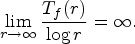
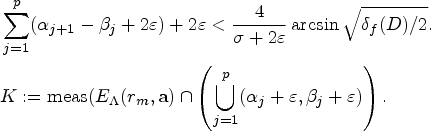
From (iii), we have . If has the lower order and order , then for a finite positive number σ with and a set E of positive numbers with finite logarithmic measure, there must be a sequence of strong Pólya peak of order σ of outside E (see Theorem 1.1.3 in [18]). Consider p pairs of real numbers such that
and we denote by the corresponding ray system , . For the system , define
and .
With above notations, Zheng proved the results as follows:
Letbe an m-nondegenerate transcendental holomorphic curve onof finite lower order τ. Letwithbehyperplanes in general position, and. Assume that for a ray system, (3.2) holds withand
whereis counting function of f with respective toinfor. Then.
Note that Zheng [19] stated Theorem 5 and Theorem 6 for holomorphic curve. However in the proof of spread lemma, we need , then f must be a transcendental holomorphic curve. Motivate from the Theorem 5 and Theorem 6, we prove two following results:
Letbe a transcendental holomorphic curve onof lower orderand order. Let D be a small moving hypersurface with respect to f and. Assume that for awith,
Then for any sequence of Pólya peaksof order σ, we have
for some positiveonly depending onindependent of m, where.
Assume that q, N, n are three natural numbers such that, andbe a nondegenerate algebraically transcendental holomorphic curve of finite lower order τ. Letbehypersurfaces in N-subgeneral position in, and. Assume that for a ray system, (3.4) holds withand
whereis counting function of f with respective toinfor. Then.
Uniqueness of holomorphic curves in angular domain
The uniqueness of holomorphic curve on complex plane is investigated by many authors. So far, there is not any result about uniqueness theorem of holomorphic curve on angular domain by inverse image of hypersurfaces. In this section, using the spread relation for holomorphic curve (Theorem 11) and Theorem 4, we obtain the following results:
Let q, N, n be positive integers such that, and f and g be nondegenerate algebraically transcendental holomorphic curves fromintoand f has lower order. Letbe q (,, whereare degree ofrespectively) hypersurfaces in N-subgeneral position in, and D be a small moving hypersurface of f such that. Assume that for a ray system, (3.4) holds withand three following conditions hold:
,, where
for all;
and.
If, then.
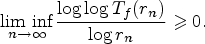
In the Theorem 9, the condition is a technique condition. About the uniqueness of meromorphic functions on an angular domain share sets, the authors [8] required that for Pólya peak sequence. However, it is not true, we only have
Let f be a holomorphic curve such that when , then and as .
Some preliminaries in angular Nevanlinna theory for meromorphic functions
First, we remind some definitions which is contained the book of A. A. Goldberg and I. V. Ostrovskii [4]. We consider the set
Let f be a meromorphic function on the angle , , . We recall that
where
and are poles of counted according with multiplicity. We denote by the angular Nevanlinna characteristics on and defined as following:
In order to prove theorems, we need the following lemmas.
Let k be a natural number and f be nonconstant meromorphic function on. Then we have the estimate
From Lemma 2, we have
for all r large enough outside a set of finite measure.
Proofs of Theorem 7 and Theorem 8
Let be a transcendental holomorphic curve of lower order and its reduced representation. Suppose that D is a moving hypersurface with degree d which is defined by the moving polynomial homogeneous with degree d as follows
such that are holomorphic function without common zero, where , for , . We denote by the holomorphic curve associated with D (or with Q), and denote by the reduced representation of a. The moving hypersurface D is called small with respective to f if as . We denote (or ) by the counting function of zeros of . Then the defect of f with respect the small moving hypersurface D is defined by
since as .
Let D be a small moving hypersurface with respect to f, we put
where and . We consider Pólya peak sequence of order σ of . It means that is positive sequence and there exist sequences , , and such that
, , , and as .
, .
Let be a positive function satisfying
Put
and let
Then we define
where the infimum is taken over all functions Λ satisfying (6.1). With above notations, we obtain the following result which extends the result due to Niino [11]:
Letbe a transcendental holomorphic curve of lower orderand order. Let D be a small moving hypersurface with degree d of f andis its associated holomorphic curve such thatand. Then for any sequenceof Pólya peaks of orderfor f and any positive functionwithas, we have
Here,.
From Theorem 11, we get .
The map f has the lower order and order , then for a finite positive number σ with and a set E of positive numbers with finite logarithmic measure, then there exists a sequence of strong Pólya peak of order σ of outside E (see Theorem 1.1.3 in [18]). The proof of Theorem 11 are the same the proof of Theorem 2 in [11]. We only recall some steps. Note that , . We may assume that and . We have
where . Define the entire function by , where k is a nonnegative integer, c is a nonzero constant, and . Then, we have
We put
and . Then we deduce that and as . Set . Since a is a small mapping of f, then we get
Therefore, in order to prove Theorem 11, it is sufficient to prove that
The remain proofs are the same in [11], pages 103 to 104, we omit it at here.
Proofs of Theorem 7.
Suppose that (3.5) does not hold. Then there exists a subsequence of , still denoted by such that . Set
and . Obiviously, as . For a positive function satisfying as , we denote
Taking an such that
Then we get
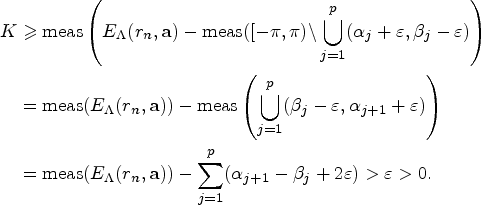
It is easy to see that there exists a such that for all m large enough, we have
which is a contradiction and we finish the proof of Theorem 7.
Now, we prove Theorem 8. First, we need some lemmas as follows:
Letbe an algebraically nondegenerate transcendental holomorphic curve andis a integer. Letbe hypersurfaces in N-subgeneral position in. Letbe degree ofrespectively and. Then we have
holds for all r large enough outside a set with finite measure.
Let f be holomorphic curve onand D be a hypersurfaces defined the zeros of homogeneous polynomial Q such that. Then we have
whereis the counting function the zeros ofin. The inequality also holds withandinstead ofand.
Proof of Theorem 8.
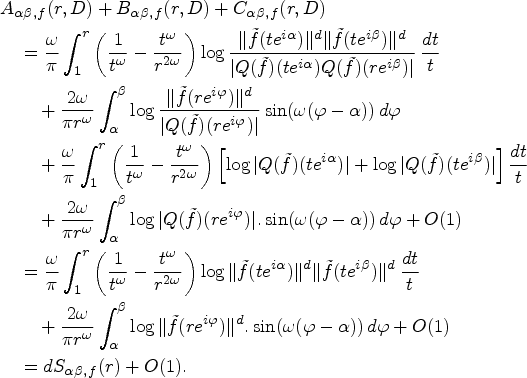
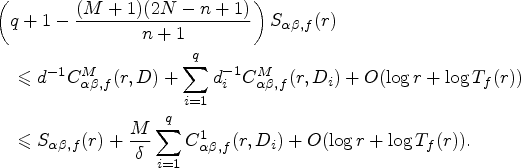
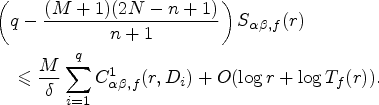
Using Lemma 3 and Lemma 4, we prove Theorem 8 as follows. Suppose that . Note that , then . Choose such that and (3.4) holds for . By Theorem 7, we see that (3.5) holds for some constant . Now we estimate . Combine Lemma 3 and Lemma 4, we get
where and is a suitable constant. By arguments as [18], from (3.5), we get
and we deduce
It is a contradiction and then .
Proofs of Theorem 9
Proof of Theorem 9.
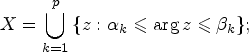
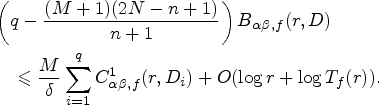
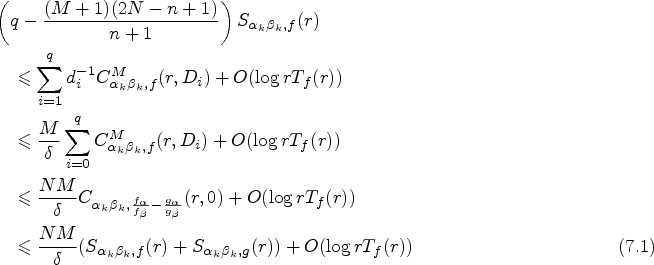
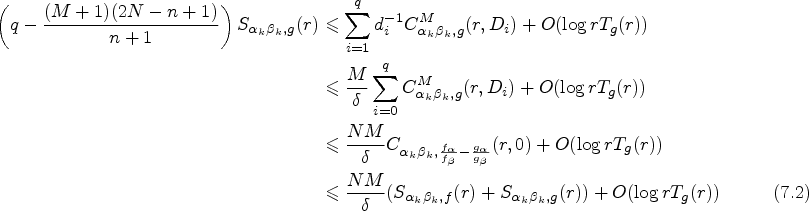
We suppose that , then there are two numbers , such that . Assume that is a zero of in X, from the condition when , we get . This implies is a zero of . Since are in N-subgeneral position, then there are at most N hypersurfaces intersecting at . Therefore, we have . Apply to Theorem 4 for some small enough, we obtain
for all . Similarly, we also have
for all , where . Since , combine (7.1) and (7.2), we deduce
Note that , we need to treat two cases as follows:
Case I. . Then . We can take such that
where . By Theorem 11 to f gives the existence of the Pólya peak sequence of order of f outside a set with finite measure. For n large enough, we have
For n large enough, set
Then we get
It is easy to see that there exists a such that for all n large enough, we have
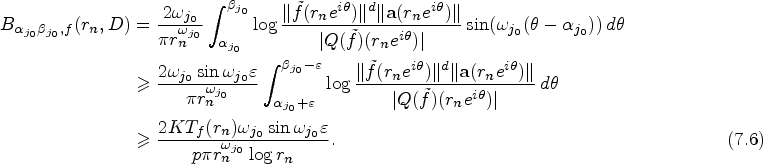
Set and in (6.2), choose with as . Then from (7.4), we get
By the definition of and (7.5), for small enough, we see
By the assumption , from (7.3) and (7.6), we obtain
Note that since as . By property of Pólya peak sequence and (7.7), we have
which is impossible. Hence .
Case II. . By the argument as Case I with all the is replaced by , we can derive
This is impossible. Hence .
Footnotes
Acknowledgements
The research results are supported by the Ministry of Education and Training of Vietnam under the project with the name The Nevanlinna Cartan’s second main theorem and some applications and grant number B2024-TNA-19.
Data sharing statements
Data sharing not applicable to this article as no datasets were generated or analysed during the current study.
References
1.
AnD.P.QuangS.D.ThaiD.D., The second main theorem for meromorphic mappings into a complex projective space, Acta Math VietNam.38 (2013), 187–205. doi:10.1007/s40306-013-0011-6.
2.
CiechanowiczE.MarchenkoI.I., On deviations and strong asymptotic functions of meromorphic functions of finite lower order, J. Math. Anal. Appl.382 (2011), 383–398. doi:10.1016/j.jmaa.2011.04.050.
3.
FedorovM.A.GrishinA.F., Some questions of Nevanlinna theory for the complex half plane, Math. Phys. Anal. Geom.1 (1998), 223–271.
4.
GoldbergA.A.OstroskiiV., Value Distribution of Meromorphic Functions, Translations of Mathematical Monographs, Vol. 236, 2008.
5.
HaymanW.YangL., Growth and values of functiona regular in an angle, Proc. Lond. Math. Soc.44(3) (1982), 193–214. doi:10.1112/plms/s3-44.2.193.
6.
KowalshkiA.MarchenkoI., On deviations and spreads of entire curves, Ann. Polon. Math.123 (2019), 345–368.
7.
KrutinV.I., On the magnitudes of the positive deviations and the defects of entire curves of finite lower order, Math. USSR Izvestija.13(2) (1979), 307–334. doi:10.1070/IM1979v013n02ABEH002045.
8.
LinW.MoriS.TohgeK., Uniqueness theorems in an angular domain, Tohoku Math. J.58 (2006), 509–527.
9.
MarchenkoI.I., On the magnitudes of deviations and spreads of meromorphic functions of finite lower order, Sbornik: Mathematics.186(3) (1995), 391–408. doi:10.1070/SM1995v186n03ABEH000023.
10.
MarchenkoI.I., Baernstein’s star-function, maximum modulus points and a problem of Erdös, Annales Fennici Mathematici.47 (2022), 181–202. doi:10.54330/afm.112881.
11.
NiinoK., General defect relations of holomorphic curves, Trans. Amer. Math. Soc.289(1) (1985), 99–113. doi:10.1090/S0002-9947-1985-0779054-5.
12.
PetrenkoV.P., The growth of integral curves of finite order, Math. USSR Sbornik.26(4) (1975), 427–448. doi:10.1070/SM1975v026n04ABEH002489.
13.
QuangS.D., Value distribution theory on angular domains for homolorphic mappings and arbitrary families of moving hypersurfaces, Bull. Math. Science.13(2) (2023), 2250008, 27 pages. doi:10.1142/S1664360722500084.
14.
TsujiM., Potential Theory in Modern Function Theory, Maruzen Co. LTD, Tokyo, 1959.
15.
WangY.WangX., The evolution of immersed locally convex plane curves driven by anisotropic curvature flow, Adv. Nonlinear Anal.12(1) (2023), 117–131. doi:10.1515/anona-2022-0245.
16.
WuN., Deviations and spreads of holomorphic curves of finite lower order, Houston. J. Math.45 (2019), 395–411.
17.
WuN.XuanZ., On the growth of holomorphic curve, Kodai Math J.37 (2014), 285–302.
18.
ZhengJ., Value Distribution of Meromorphic Functions, Springer-Verlag, Berlin Heidelberg, 2011.
19.
ZhengJ., Value distribution of holomorphic curves on an angular domain, Michigan Math. J.64 (2015), 849–879. doi:10.1307/mmj/1447878034.