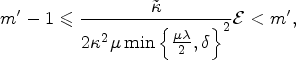
In this work, we consider the two-dimensional Oldroyd model for the non-Newtonian fluid flows (viscoelastic fluid) in Poincaré domains (bounded or unbounded) and study their asymptotic behavior. We establish the existence of a global attractor in Poincaré domains using asymptotic compactness property. Since the high regularity of solutions is not easy to establish, we prove the asymptotic compactness of the solution operator by applying Kuratowski’s measure of noncompactness, which relies on uniform-tail estimates and the flattening property of the solution. Finally, the estimates for the Hausdorff as well as fractal dimensions of global attractors are also obtained.
In this paper, we consider the following hypothesis on the domain Ω:
Let Ω be an open and connected subset of, the boundary of which is uniformly of class(see [
18
]). In addition, there exists a positive constant λ such that the following Poincaré inequality holds:
A typical example of unbounded Poincaré domains in is with , see [48, p.306] and [40, p.117].
Let us denote by , the velocity of the fluid, , the pressure of the fluid and , an external forcing. We consider the following system of equations of motion arising in the Oldroyd fluids of order one for the viscoelastic fluid flows:
One can impose the condition , , to ensure the uniqueness of pressure p. Let be the coefficient of kinematic viscosity. In (1.2), for , we take
If we take (that is, ), then we obtain Newton’s model of incompressible viscous fluid or the well known Navier–Stokes equations. The relaxation time is characterized by the fact that after instantaneous cessation of motion, the stresses in the fluid do not vanish instantaneously, but die out like . Moreover, the velocities of the flow, after instantaneous removal of the stresses, die out like , where κ is the retardation time. Note that the system (1.2) is non-autonomous even if the external forcing is independent of t, due to the presence of memory. As the system (1.2) is non-autonomous, in order to apply the asymptotic theory available for the autonomous systems, we need to transform the system (1.2) into an equivalent autonomous system. If we introduce
The mathematical analysis of the 2D Oldroyd system (1.2) started with Kotsiolis and Oskolkov [26,37] based on the solvability results available for the Navier–Stokes equations due to Ladyzhenskaya (see [30]). Oskolkov established the global existence of a unique “almost” classical solution in a finite time interval for the initial and boundary value problem for such systems. The questions regarding the existence, uniqueness and continuous dependence of the solutions upon the initial data were investigated by many authors, for instance, see [3–5,9,10,36,37], etc.
For an extensive literature on the existence of global attractors for 2D Navier–Stokes equations, the interested readers are referred to see [1,2,6–8,13–15,17,19,31,41,42,45,48] etc., and references therein. The works [12,16,35,38,43,44,49], etc. discuss attractors and stability for abstract equations and viscoelastic equations with memory. Asymptotic analysis of Navier–Stokes equations with delays has been carried out in [11,33], etc., and references therein. The existence of the global attractor and estimates for its dimensions for the initial-boundary value problem (1.2) with in a bounded domain with smooth boundary is obtained in [20–23,26–28], etc., using the method developed by Ladyzhenskaya in [31]. Attractor theory of the initial-boundary value problems for equation of motion of Jeffreys–Oldroyd fluids in domains with smooth and nonsmooth boundary is developed in [25].
Difficulties and approaches
It appears that the transformation provided in (1.4), which transforms the system (1.2) into the autonomous one (1.5), is ineffective. The problem is that, in order for the autonomous attractor theory to work, a semigroup (solution operator) must map from a phase space into itself; in other words, the phase space as a whole must include the permitted space of initial data. In this case, the allowable initial data is the space , the evolution under the flow will produce a solution that no longer lies in the space . Therefore, we consider the phase space for the initial data as and show the existence of global attractors for the system (3.2) below. This will imply the existence of global attractors for the system (1.5) (or (3.1) below).
In most of these works mentioned above, the authors applied the theory of global attractors for the system (1.2) (non-autonomous) rather than (1.5) (autonomous), which is not applicable due to the presence of memory term. In this work, we show the existence of global attractors in Poincaré domains for the system (1.5) and obtain estimates for the Hausdorff and fractal dimensions of such attractors. Since the high regularity of solutions for the system (1.5) is not easy establish, we demonstrate the asymptotic compactness of the solution operator by an application of Kuratowski’s measure of noncompactness, which relies on uniform-tail estimates and flattening property of the solution.
Organization of the paper
The rest of the paper is organized as follows: In the next section, we provide necessary function spaces needed to explain the global solvability results for the system (1.2). As the system (1.2) is non-autonomous due to the presence of memory, using the transformation (1.4), we change the system (1.2) into (1.5), which is autonomous. In Section 3, for , we show that the system (1.5) in Poincaré domains possesses a global attractor, using asymptotic compactness property of the solution operator (Theorem 3.8). Finally, the estimates for the Hausdorff as well as fractal dimensions of the global attractor for the system (1.5) in Poincaré domains is obtained in Section 4 (Theorem 4.2).
Mathematical formulation
In this section, we provide the necessary function spaces needed to obtain the global solvability results of the system (1.2) (equivalently (1.5)). We also discuss the well-posedness of the system (1.2).
Functional setting
Let be the equivalence class of all real valued square integrable functions on with the norm defined by . Let denotes the Sobolev space with the norm defined by , . We define the space
where is the space of all infinitely differentiable functions with compact support in Ω. Let and denote the completion of in and norms, respectively. The norm in is defined by , and the norm in is given by due to the Poincaré inequality (1.1). The inner product in the Hilbert space is denoted by and the induced duality between the spaces and its dual by . Note that is densely and continuously embedded into and can be identified with its dual and we have the Gelfand triple: . In the rest of the paper, we also use the notation for the second order Sobolev spaces.
Linear operator
Let be the Helmholtz–Hodge orthogonal projection. Let us define
Remember that the operator A is a non-negative, self-adjoint operator in and
Nonlinear operator
We define the trilinear form by
If , are such that the linear map is continuous on , the corresponding element of is denoted by . We denote . Using integration by parts, it is immediate that
By an application of Hölder’s and Ladyzhenskaya’s inequalities ([30, Lemma 1, p. 8]), it can be easily seen that B maps (and so ) into
for all , so that
using the Poincaré inequality. For more details on the linear and nonlinear operators, the interested readers are referred to see [17,46,47], etc.
Properties of the kernel
Let us define
A function is called positive kernel if the operator L is positive on , that is, for all T
. Clearly is a positive kernel, so that
Abstract formulation and weak solution
Taking in (1.2), we write the abstract formulation of the system (1.2) as:
Let us now provide the definition of weak solution for the system (2.5).
The function with , is called a weak solution to the system (2.5), if for , and , satisfies for a.e.
Let us now state the existence and uniqueness theorem for the system (2.5). A proof of the following theorem can be obtained from [34, Theorem 3.4]. A local monotonicity property of the linear and nolinear operators and a generalization of the Minty–Browder technique is exploited in the proof of [34, Theorem 3.4].
There exists a unique weak solutionto the system (2.5) in the sense of Definition2.1satisfying the following energy equality:
for a.e..
Kuratowski’s measure of noncompactness
The first result on measure of noncompactness was defined and studied by Kuratowski in [29]. With the help of some vital implications of Kuratowski’s measure of noncompactness, one can show the existence of a convergent subsequence for some arbitrary sequences. Therefore, such results are helpful to obtain the asymptotic compactness of semigroup without using the compact embedding, cf. [24,50,51] etc., and references therein.
Let be a metric space and E a bounded subset of . Then the Kuratowski measure of noncompactness (the set-measure of noncompactness) of E, , is defined by
The function κ is called Kuratowski’s measure of noncompactness.
Note that if and only if is compact (see [39, Lemma 1.2]). The following lemma is an application of Kuratowski’s measure of noncompactness which is helpful in proving the asymptotic compactness of the solution operator.
Letbe a Banach space andbe an arbitrary sequence in. Thenhas a convergent subsequence if.
Global attractor
In this section, we discuss the existence of a global attractor for 2D Oldroyd model of fluid flow equations of order one. We assume that is independent of t in (2.5). Since the system (2.5) depends on memory (non-autonomous), the solution cannot be represented as a one parameter family of semigroups and hence we cannot use the usual theory used in [42] for the autonomous 2D Navier–Stokes equations, to obtain the global attractors. Thus, as we discussed earlier, we use the transformation, and transform the system (2.5) to
Note that whenever a Cauchy problem on a Banach space is well posed in the sense of Hadamard (for proper notion of weak solution) for all initial data , then the corresponding (forward) solutions can be written in the form , where the semigroup is uniquely determined by the dynamical system.
The transformation which converts the original equation (1.2) (or (2.5)) into the autonomous one (1.5) (or (3.1)) does not seem to work. The issue is that all the autonomous attractor theory requires the semigroup , in other words, the allowable space of initial data must be the whole of the phase space. The proof of invariance of the attractor, for example, relies on the fact that is a semigroup, so that . In this case, the allowable initial data is the space , the evolution under the flow will produce a solution that no longer lies in the space . Therefore, we consider the following system in our further analysis:
where and . Note that the system (3.1) is a particular case of (3.2).
Let us define , so that satisfies:
where
By a standard Galerkin approximation technique, it can be shown that the system (3.2) has a unique weak solution in (see Lemma 3.2 and Proposition 3.4 below). In the sequel, we use the notation, with the norm , that is, . It can be easily seen that
and hence the norms and are equivalent on .
Let , be the unique weak solution of the system (3.2). Thanks to the existence and uniqueness of weak solution for the system (3.3), we can define a continuous semigroup in by
It should be noted that the system (3.2) is autonomous and hence we can develop a similar theory available in [42] for the system (3.2). We prove the existence of a global attractor for the system (3.2) in Poincaré domains satisfying Hypothesis 1.1. This follows from the following general result:
Letbe a complete metric space and letbe a semigroup of continuous (nonlinear) operators in. If (and only if)possesses an absorbing setbounded inand is asymptotically compact in, thenpossesses a (compact) global attractor. Furthermore, ifis continuous fromintoandis connected in, thenis connected in.
Let us next prove the existence of a global attractor for the semigroup defined on for the 2D Oldroyd system (3.2) in Poincaré domains. Our first aim is to establish the existence of an absorbing ball in for . Next lemma provides an estimate satisfied by which will be useful in the sequel.
Letbe the unique weak solution of the system (3.2). Then, we have for all
Let us take the inner product with to the first equation in (3.2) to get
for a.e. , where we have used . Taking the inner product with to the second equation in (2.5), we obtain
Furthermore, it follows from (3.22) and (3.25) that the set (3.20) is absorbing in for the semigroup . Hence, the following uniform estimate is valid:
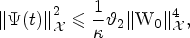
for t large enough ( or ) depending on the initial data.
Asymptotic compactness
In this subsection, we establish the asymptotic compactness of the semigroup associated with the system (3.2). We show the asymptotic compactness with the help of uniform-tail estimate, flattening property and an application of Kuratowski’s measure of noncompactness (see Lemma 2.4). In the following lemma, we obtain the uniform-tail estimates for the solutions of the system (3.2).
Let ρ be a smooth function such that for and
Then, there exists a positive constant C such that and for all .
Suppose that. Then for every, there existssuch that the solutionof system (1.5) satisfies
for alland for all, whereand.
Taking the divergence of the first equation of (1.5), we obtain
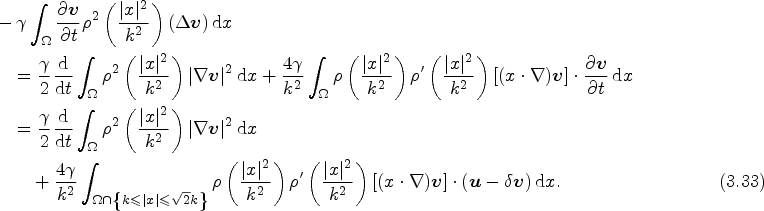
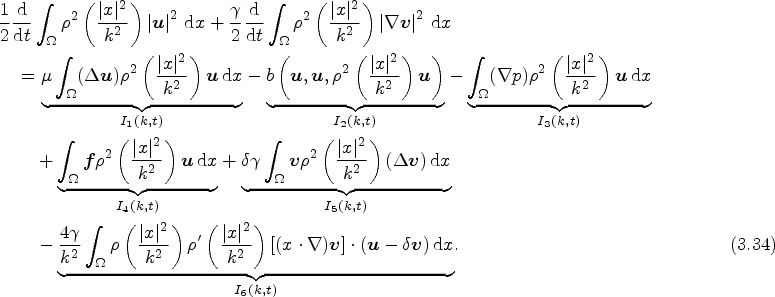
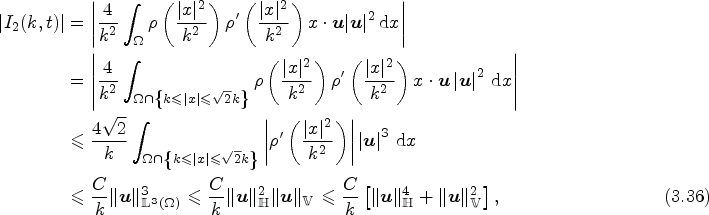
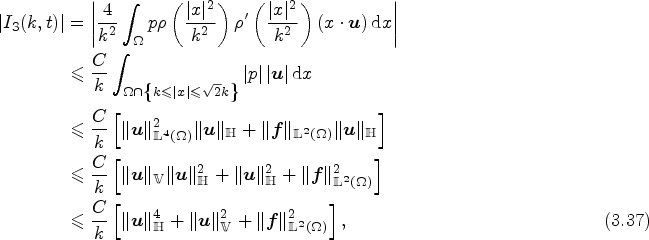
where, in the second and third steps, we have used the elliptic regularity for Poincaré domains with uniformly smooth boundary of class (cf. [18, Lemma 1]). Taking the inner product of the first equation of (1.5) with and the second equation of (1.5) with in , we have
For , an application of variation of constants formula yields
where we have used the bound obtained in (3.24). Hence, from (3.42), we conclude that for any , there exists a such that
for all and . This completes the proof.
The following lemma provides the flattening estimates for the solution of the system (3.2). For each , we set
Let for . Then , which has the orthogonal decomposition:
where is a canonical projection and is a family of eigenfunctions of the Dirichlet Laplacian in with the corresponding eigenvalues as . We also have that
Furthermore, for , we have
Suppose that. Then for everyand for each, there existssuch that the solutionof the system (1.5) satisfies
for alland for all.
Multiplying the first and second equations of (1.5) by , we find
and
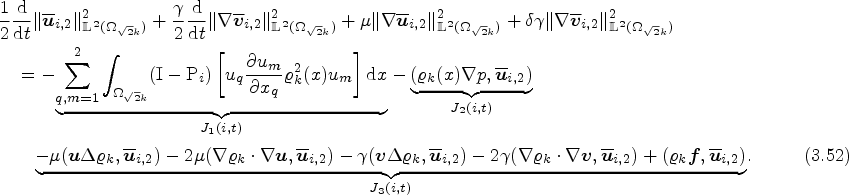
Applying to the equations (3.48)–(3.49) and then taking the inner product of the resulting equations with and in , respectively, we get
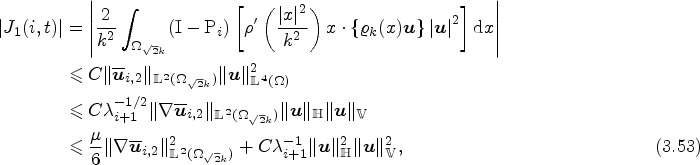
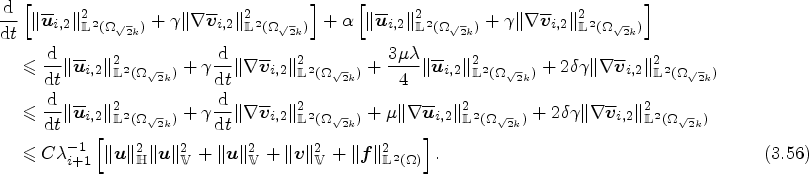
Next, we estimate each term of (3.52) as follows: Using integration by parts, divergence free condition of , (3.46) (assuming ), Hölder’s, Ladyzhenskaya’s and Young’s inequalities, we find
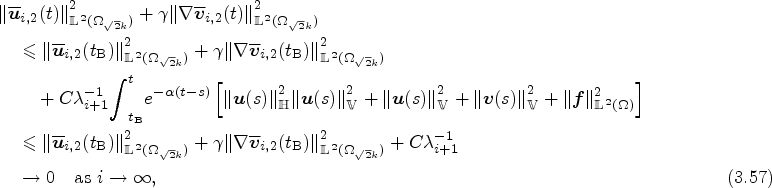
Applying variation of constants formula to (3.56), we find
for , where we have used (3.24). Hence, from (3.57), we conclude that for any , there exists a such that
for all and . This completes the proof.
In the following proposition, we demonstrate the asymptotic compactness of the semigroup associated with the system (3.2) using the results obtained in Lemmas 3.5 and 3.6.
The semigroupis asymptotically compact in.
It is enough to show that for arbitrary sequences and , the sequence
is pre-compact in . Let , . In order to prove the pre-compactness of the sequence , we need to show that the Kuratowski measure and , (cf. Lemma 2.4).
Since, , there exists such that for all . For each , by Lemma 3.5, there exists such that
for all and for all . Let us fix . By Lemma 3.6, there exists such that
for all and for all .
Now, the inequality (3.24) provides us that the set is bounded in which further implies that the set is bounded in . Hence, by the finite-dimensional range of , is pre-compact in , from which we conclude that
It follows from (3.60)–(3.61) and [39, Theorem 1.4] that
which shows that is asymptotically compact in . This completes the proof.
Using the existence of absorbing set, the asymptotic compactness of the semigroup and Theorem 3.1, we have the following result immediately:
Let Ω satisfy Hypothesis1.1. Assume thatand. Then the semigroupassociated with the system (3.2) possesses a global attractorin, that is, a compact invariant set in, which attracts all bounded sets in. Moreover,is connected inand is maximal for the inclusion relation among all the functional invariant sets bounded in.
Since the system (2.5) is equivalent to the system (3.1) which is a particular case of the system (3.2) with , we provide the following result on the existence of global attractors for the system (2.5).
Let Ω satisfy Hypothesis1.1. Assume thatand. Then the semigroupassociated with the Oldroyd system (2.5) possesses a global attractorin.
Dimension of the attractor
In this section, we analyze the dimension of the global attractor obtained in Section 3. We estimate the bounds for the Hausdorff as well as fractal dimensions of the global attractor .
Let and , for be the unique weak solution of the system (3.2). The linearized flow around is given by the following system:
As in the case of nonlinear problem, one can show that there exists a unique solution , for all . Furthermore, and , for all . We define a map by setting , where . In the next lemma, we show that the map is bounded and the semigroup is uniformly differentiable on , that is,
Letandbe two members of. Then there exists a constantsuch that
where the linear operator, foris the solution operator of the problem (4.1) with. In other words, for every, the map, as a mapis Fréchet differentiable with respect to the initial data, and its Fréchet derivative. Moreover, (4.2) is satisfied.
For and , let us define
and . Then satisfies:
where . Let us take the inner product with to the first equation in (4.4) to obtain
for a.e. . Next we take the inner product with to the second equation in (4.4) to get
An application of Gronwall’s inequality in (4.13) yields
that is,
where and . Thus, by the definition of , it is immediate that
and hence the differentiability of with respect to the initial data as well as (4.2) and (4.3) follows.
In the next theorem, we show that the global attractor obtained in Theorem 3.8 has finite Hausdorff and fractal dimensions, and we find their bounds also.
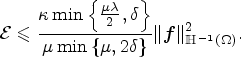
The global attractor obtained in Theorem3.8has finite Hausdorff and fractal dimensions, which can be estimated as
where is the orthogonal projector of onto the space spanned by . From [48, Section V.3.4] (see Proposition V.2.1 and Theorem V.3.3), we infer that if , for some , then the global attractor has finite Hausdorff and fractal dimensions estimated respectively as
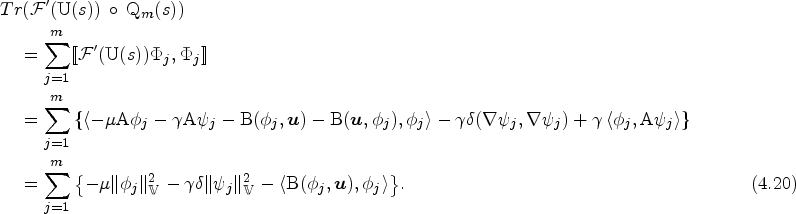
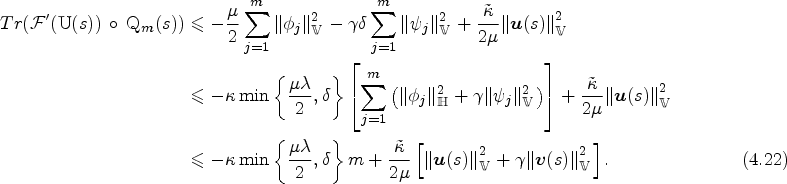
Our next aim is to estimate the number . Let , and set and , and . Let us consider as an orthonormal basis in for . Note that , for all . Since , we know that , a.e. . By the Gram–Schmidt orthogonalization process, we can assume that . Then, one can see that
The authors would like to thank the Department of Science and Technology (DST) Science & Engineering Research Board (SERB), India for a MATRICS grant (MTR/2021/000066). In December 2023, the first author visited the Indian Institute of Technology Roorkee in Roorkee, India, and was greatly assisted by their gracious hospitality in completing this work.
Conflict of interest
The authors have declared no conflict of interest.
Declaration of interests
The authors declare that they have no known competing financial interests or personal relationships that could have appeared to influence the work reported in this paper.
References
1.
AbergelF., Attractor for a Navier–Stokes flow in an unbounded domain, Math. Mod. Num. Anal.23 (1989), 359–370. doi:10.1051/m2an/1989230303591.
2.
AbergelF., Existence and finite dimensionality of the global attractor for evolution equations on unbounded domains, J. Diff. Equ.83 (1990), 85–108. doi:10.1016/0022-0396(90)90070-6.
BabinA.V., The attractor of a Navier–Stokes system in an unbounded channel-like domain, J. Dyn. Differ. Equ.4 (1992), 555–584. doi:10.1007/BF01048260.
7.
BabinA.V.VishikM.I., Attractors of partial differential equations in an unbounded domain, Proc. R. Soc. Edin. A116 (1990), 221–243. doi:10.1017/S0308210500031498.
8.
BallJ.M., Continuity properties of global attractors of generalized semiflows and the Navier–Stokes equations, J. Nonlin. Sci.7 (1997), 475–502. doi:10.1007/s003329900037.
9.
BarbuV.SritharanS.S., Navier–Stokes equation with hereditary viscosity, Zeitschrift für angewandte Mathematik und Physik54 (2003), 1–13. doi:10.1007/PL00012626.
10.
CannonJ.R.EwingR.E.HeY.LinY., A modified nonlinear Galerkin method for the viscoelastic fluid motion equations, International Journal of Engineering Science37 (1999), 1643–1662. doi:10.1016/S0020-7225(98)00142-6.
11.
CaraballoT.RealJ., Attractors for 2D-Navier–Stokes models with delays, J. Differential Equations205 (2004), 271–297. doi:10.1016/j.jde.2004.04.012.
12.
ChepyzhovV.V.ContiM.PataV., Averaging of equations of viscoelasticity with singularly oscillating external forces, Journal de Mathématiques Pures et Appliquées108 (2017), 841–868. doi:10.1016/j.matpur.2017.05.007.
13.
ConstantinP.FoiasC., Global Lyapunov exponents, Kaplan–Yorke formulas and the dimension of the attractors for 2D Navier–Stokes equations, Commun. Pure Appl. Math.38 (1985), 1–27. doi:10.1002/cpa.3160380102.
14.
ConstantinP.FoiasC., Navier–Stokes Equations, Chicago Lectures in Mathematical Series, 1989.
15.
ConstantinP.FoiasC.TemamR., Attractors Representing Turbulent Flows, Memoirs of the American Mathematical Society, Vol. 53, 1985.
FoiasC.ManleyO.RosaR.TemamR., Navier–Stokes Equations and Turbulence, Cambridge University Press, 2001.
18.
HeywoodJ.G., The Navier–Stokes equations: On the existence, regularity and decay of solutions, Ind. Univ. Math. J.29 (1980), 639–681. doi:10.1512/iumj.1980.29.29048.
19.
JuN., The -compact global attractor for the solutions to the Navier–Stokes equations in two-dimensional unbounded domains, Nonlinearity13 (2000), 1227–1238. doi:10.1088/0951-7715/13/4/313.
20.
KarazeevaN.A., Initial boundary value problems for linear viscoelastic flows generated by integro-differential equations, Journal of Mathematical Sciences127 (2005), 1869–1874. doi:10.1007/s10958-005-0147-6.
21.
KarazeevaN.A., Asymptotic behavior and attractor of systems governing two-dimensional viscoelastic flows, Journal of Mathematical Sciences242 (2019), 1–14. doi:10.1007/s10958-019-04463-y.
22.
KarazeevaN.A.KotsiolisA.A.OskolkovA.P., Dynamic system and attractors generated b.y the initial boundary value problems for equations of motion of linear viscoelaztic fluids, Trudy Mat. Inst., Steklov188 (1990), 60–87.
23.
KarazeevaN.A.KotsiolisA.A.OskolkovA.P., Dynamical systems generated by initial-boundary value problems for equations of motion of linear viscoelastic fluids, Proc. Steklov Inst. Math.3 (1991), 73–108.
24.
KinraK.MohanM.T.WangR., Asymptotically autonomous robustness of non-autonomous random attractors for stochastic convective Brinkman–Forchheimer equations on , Int. Math. Res. Not. IMRN2024 (2024), 5850–5893. doi:10.1093/imrn/rnad279.
25.
KotsiolisA.A., Attractors of initial-boundary value problems for equations of motion of Jeffreys–Oldroyd fluids in domains with nonsmooth and smooth boundaries, Zap. Nauchn. Sem. S.-Peterburg. Otdel. Mat. Inst. Steklov. (POMI)208 (1993), 186–199.
26.
KotsiolisA.A.OskolkovA.P., On the solvability of fundamental initial-boundary value problem for the motion equations of Oldroyd’s fluid and the behavior of solutions, when , Notes of Scientifics of LOMI150 (1986), 48–52.
27.
KotsiolisA.A.OskolkovA.P., On a dynamic system generated by equations of motion of the Oldroyd fluids, Zap. Nauchn. Semin. POMI155 (1986), 119–125.
28.
KotsiolisA.A.OskolkovA.P., On limit states and attractors for equations of motion of the Oldroyd fluids, Zap. Nauchn. Semin. POMI152 (1986), 97–100.
29.
KuratowskiK., Sur les espaces complets, Fund. Math.1 (1930), 301–309. doi:10.4064/fm-15-1-301-309.
30.
LadyzhenskayaO.A., The Mathematical Theory of Viscous Incompressible Flow, Gordon and Breach, New York, 1969.
31.
LadyzhenskayaO.A., Attractors for Semigroups and Evolution Equations, Lezioni Lincee, Cambridge University Press, Cambridge, 1991.
32.
LiY.GuA.LiJ., Existence and continuity of bi-spatial random attractors and application to stochastic semilinear Laplacian equations, J. Differential Equations258 (2015), 504–534. doi:10.1016/j.jde.2014.09.021.
33.
Marín-RubioP.RealJ., Attractors for 2D-Navier–Stokes equations with delays on some unbounded domains, Nonlinear Anal.67 (2007), 2784–2799. doi:10.1016/j.na.2006.09.035.
34.
MohanM.T., Deterministic and stochastic equations of motion arising in Oldroyd fluids of order one: Existence, uniqueness, exponential stability and invariant measures, Stoch. Anal. Appl.38 (2020), 1–61. doi:10.1080/07362994.2019.1646138.
35.
MohanM.T., Global attractors, exponential attractors and determining modes for the three dimensional Kelvin–Voigt fluids, Evol. Equ. Control Theory11 (2022), 125–167. doi:10.3934/eect.2020105.
36.
OrtovV.P.SobolevskiiP.E., On mathematical models of a viscoelastic with a memory, Differential and Integral Equations4 (1991), 103–115.
37.
OskolkovA.P., Initial boundary value problems for the equations of motion of Kelvin–Voigt fluids and Oldroyd fluids, Proceedings of Steklov Institute of Mathematics2 (1989), 137–182.
38.
PataV.ZucchiA., Attractors for a damped hyperbolic equation with linear memory, Adv. Math. Sci. Appl.11 (2001), 505–529.
39.
RakočevićV., Measures of noncompactness and some applications, Filomat12 (1998), 87–120.
40.
RobinsonJ.C., Infinite-Dimensional Dynamical Systems: An Introduction to Dissipative Parabolic PDEs and the Theory of Global Attractors, Cambridge University Press, 2001.
41.
RobinsonJ.C., Attractors and finite-dimensional behavior in the 2D Navier–Stokes equations, ISRN Mathematical Analysis2013, 291823, 29 pages.
42.
RosaR., The global attractor for the 2D Navier–Stokes flow on some unbounded domains, Nonlinear Analysis: Theory, Methods & Applications32 (1998), 71–85. doi:10.1016/S0362-546X(97)00453-7.
43.
SobolevskiiP.E., Stabilization of viscoelastic fluid motion, Oldroyd’s mathematical model, Differential and Integral Equations7 (1994), 1579–1621.
SritharanS.S., Invariant Manifold Theory of Hydrodynamic Transition, Pitman Research Notes in Mathematics Series, Vol. 241, Longman Scientific and Technical, Harlow, 1990.
46.
TemamR., Navier–Stokes Equations, Theory and Numerical Analysis, North-Holland, Amsterdam, 1984.
47.
TemamR., Navier–Stokes Equations and Nonlinear Functional Analysis, 2nd edn, CBMS-NSF Regional Conference Series in Applied Mathematics, 1995.
48.
TemamR., Infinite-Dimensional Dynamical Systems in Mechanics and Physics, Springer, New York, 1997.
49.
VorotnikovD.A.ZvyaginV.G., Uniform attractors for non-autonomous motion equations of viscoelastic medium, J. Math. Anal. Appl.325 (2007), 438–458. doi:10.1016/j.jmaa.2006.01.078.
50.
WangB.FussnerD.W.BiC., Existence of global attractors for the Benjamin–Bona–Mahony equation in unbounded domains, J. Phys. A40 (2007), 10491–10504. doi:10.1088/1751-8113/40/34/007.
51.
WangR.KinraK.MohanM.T., Asymptotically autonomous robustness in probability of random attractors for stochastic Navier–Stokes equations on unbounded Poincaré domains, SIAM J. Math. Anal.55 (2023), 2644–2676. doi:10.1137/22M1517111.