This paper is concerned with the well-posedness and long-time dynamics of a class of beam/plate equations with rotational inertia and nonlinear energy damping. The model is derived from nonlocal dissipative energy models for flight structures, as proposed by Balakrishnan-Taylor (Proceedings Damping 89, Flight Dynamics Lab and Air Force Wright Aeronautical Labs, WPAFB, 1989). Our main results address the existence of compact global attractors. The work complements the degenerate coefficient case left open by Sun and Yang (J. Math. Anal. Appl., Volume 512, Issue 2, 2022).
In this work we study well-posedness and long-time dynamics of the following nonlinear beam/plate with nonlocal damping and rotational inertia
where is a bounded domain with smooth boundary , , κ is a nonnegative constant, q is a positive exponent, is the norm in weak phase space given by
is a nonlinear source, h is an external force, and stands for the norm in . Corresponding to the displacement we consider the hinged boundary condition, described by
and initial condition
We concentrate on the case when . The limiting case (without the presence of rotational forces) and with null external force was recently studied by Jorge Silva et al. [16]
where the clamped boundary condition was considered. Existence, uniqueness, and polynomial decay rates have been established for regular solutions. The main purpose in the present paper is to study the well-posedness and asymptotic behavior of solutions for (1.1)–(1.3). More specifically, we prove that the dynamical systems generated by the problem (1.1)–(1.3) has a compact global attractor . This work complements the recent work of Sun and Yang [18] who consider the case with non degenerate nolocal coefficient.
In current literature, there are many works in the context of beams/plates whose dissipation coefficient is given by a nonlocal function. In this work we will only focus on beam/plate models whose nonlocal damping intensity is determined by the energy of the system.
Physical motivation
Balakrishnan in [2] studied the damping phenomena in flight structures with free response. The model of Ordinary Differential Equations (ODE) proposed in terms of the basic second-order dynamics for the displacement variable is described by
where ω is the mode frequency, is a (small) damping coefficient, and is a nonlinear damping that can be given by functions like
Later, Balakrishnan and Taylor in [3], using approximation of Krylov-Bogoliubov, suggested a new class of damping models called energy models based on the instantaneous total energy of the system with
where and is the instantaneous energy associated with system (1.5). Here, it is important to mention that the class of ODEs (1.5) with degenerate damping coefficient (1.6) is associated with the following model proposed by Krasovskii [13] (1963)
with damping coefficient given by a function possessing appropriate conditions. ODE models (1.5) (with D given by (1.6)) and (1.7) are identified in the case .
In [3], Balakrishnan and Taylor also propose several models for the beam torsion as well as beam bending modes for a uniform Bernoulli beam. In particular, to yield the model (1.5) with for the single mode response, they suggest for beam bending for a beam of length the following model
where represents the transversal deflection of a beam in the rest position, is a damping coefficient, ζ is a constant appearing in the approximation of Krylov-Bogoliubov and with w being the mode frequency and the spectral density of a Gaussian external force. We refer to [3, Section 4] for the modeling of (1.8) (see Eq. (4.2)).
Recent works
As mentioned at the end of Section 1.1 the first n-dimensional version of model (1.8) in the presence of a nonlinear sourcing term was considered in [16] (Eq. (1.4)). Polynomial decay rates were obtained for regular initial data. Recently, Gomes Tavares et al. [11] consider model (1.4) in the context of frictional damping and without the presence of the force term . The authors prove that the corresponding energy functional is squeezed by polynomial-like functions involving the power of the damping coefficient.
Sun and Yang in [17] considered the following model associated with (1.4)
with hinged boundary condition, where ϕ, M are functions of class , with for all , and h is an external force. The authors proved the existence of strong global attractors and their robustness on the perturbed parameter κ, where “strong” means that the compactness, the attractiveness and the finiteness of the fractal dimension of the attractors are all in the topology of a more regular space where the attractors belong. Very recently, Li et al. [14] complemented the results of [17] by proving the existence of a compact global attractor for problem (1.9) in the degenerate case and with the dynamical system in the weak phase space topology. Later, Sun and Yang in [18] treated model (1.9) considering the presence of rotational forces
The existence of strong attractors has been established. The results obtained by Sun and Yang [17,18] are important works in the context of energy models, but they left open the degenerate case that corresponds to the natural and intrinsic form of the Balakrishnan-Taylor damping coefficient given by .
Recently, Gomes Tavares et al. [10] treated model (1.4) considering frictional damping with a nonlocal fractional coefficient
The authors prove the existence of a compact global attractor for the restriction of . The case was considered with a Krasovskii’s dissipation given by , where is a bounded Lipschitz function on such that on and is strictly increasing for . The existence of a non-compact attractor has been established. More recently, Gomes Tavares et al. [9], through the use of new nonlinear multipliers, proved the property of asymptotic compactness in the case , and consequently, the existence of a compact global attractor was established for . Also, recently, considering the damping energy in problem (1.4) of the form
Zhou and Sun [20] showed the well-posedness of weak solutions and the energy goes to zero as t goes to infinity when . When , , due to the degeneracy of the damping coefficient, the authors only proved the well-posedness of strong solutions to the problem. In the case , one can also refer to [6]. Also, more recently, Bezerra et al. [4,5] considered the context of energy damping for a class of plate models with non-constant material density. Results of stability and existence of global attractor were obtained.
Motivated by the aforementioned works, we propose to complement the work of Sun and Yang [18] in the open point left by the authors. We consider the degenerate case . To overcome the difficulty generated by the degenerate coefficient, a new class of nonlinear multipliers as set in [9] were used to establish the asymptotic compactness of the dynamic system associated with problem (1.1)-(1.3).
Organization of work
Our paper is organized as follows: in Section 2 we introduce the main assumptions and discuss the well-posedness to the problem (1.1)–(1.3). In Section 3 we establish our main result, Theorem 3.4, which guarantees the existence of a compact global attractor for (1.1)–(1.3).
Well-posedness
Functional spaces and assumptions
Let us begin by introducing some notation that will be used throughout this work. We denote , , and
Here the notation stands for -inner product and denotes -norm. For simplicity for , . Thus, and represent the norms in and , respectively. Let’s denote
The dynamics of the system generated by problem (1.1)–(1.3) will be studied on the following weak phase space with inner product and norm defined by
and
Note that , for and in the limiting case .
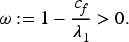
Denoting by the first eigenvalue of the bi-harmonic operator with hinged boundary condition, then
Let . The energy related to problem (1.1)–(1.3) is given by
where .
With respect to the forcing terms h and f we assume that , , and
for some constants , and growth exponent for .
Generation of a semigroup
Setting with , we then rewrite the original problem (1.1)–(1.3) as the following equivalent first order problem
where is a linear operator defined by
and is the nonlinear operator
Thus, the well-posedness result for (2.4), and consequently for the system (1.1)–(1.3), reads as follows:
Well-posedness
Let Assumption 2.1 be in force and. Then, we have:
If, then there existssuch that problem (2.4) has a unique mild solution, which is given by
If, then the above mild solution U is regular one.
In both cases, we have that.
The proof is based on four steps stated bellow. In Step 1 we will show that the operator given in (2.5) is an infinitesimal generator of a – semigroup of contractions on . This is proved by showing that A is dissipative and maximal, and application of the Lumer-Phillips Theorem ([15], Theorem 1.4.3). In Step 2 we show that the operator is locally lipschtz. Step 1 and Step 2 guarantee the existence of local solution ([15], Theorem 6.1.4). The existence of global solution is guaranteed in Step 3.
Step 1. The operator A defined in (2.5) is the infinitesimal generator of a -semigroup in . Indeed, we take arbitrary element . Then
Which shows that A is dissipative. To show that A is maximal we need to prove that , where is the range of . Indeed, let , and consider the equation which, written in components, reads
Substituting in the second equations of (2.8), we obtain
Since the corresponding weak formulation is
where
by the Lax–Milgram Theorem we can conclude that problem (2.9) admits a unique solution . Then we deduce from the second equation of (2.8) that . This implies that . Therefore, A is maximal monotone and due to Lummer-Phillips Theorem A is a infinitesimal generator of a – semigroup of contractions on .
Step 2. The operator given in (2.6) is locally Lipschitz. Indeed, let us take and , such that . Denoting , we have
Now, let’s estimate the terms on the right hand side of the above equality. First we have
Using that
we have
and, from Mean Value Theorem (MVT), there exists such that
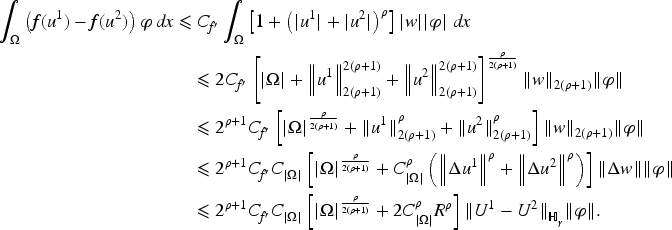
From MVT, (2.2), Hölder’s inequality with , and embedding with , we get
Returning to (2.10), there exists a constant such that
This proves items and of the Theorem 2.1.
Step 3. Remains to check that both mild and regular solutions are globally defined, that is, . Indeed, in order we define
Next, multiplying the Eq. (1.1) by and integrating over Ω we get
Estimate (2.17) implies that any (mild or strong) solution is globally bounded in time. Therefore, from Pazy [15, Theorem 1.4] we conclude that . This completes the proof of the Theorem 2.1.
Continuous dependence
Let Assumption 2.1 be in force,and. Ifandare two mild or strong solutions of problem (1.1)–(1.3) corresponding to initial data,, respectively. Then, there exists a positive constantsuch that
Then, from (2.19) and (2.11) there exists a constant such that
Therefore, applying Gronwall’s lemma we get (2.18).
Global attractor
The general theory of dissipative dynamic systems can be found in [1,7,8,12,19]. To study the long-time behavior of solutions of the system (1.1)–(1.3) we will use the theory presented by Chueshov and Lasiecka in [7,8]. More specifically, we will show the existence of a global attractor proving that the system is dissipative and asymptotically smooth.
The well-posedness of problem (1.1)–(1.3) given by Theorems 2.1 and 2.2 implies that the evolution operator defined by
where is the unique weak solution of the system (1.1)–(1.3), defines a nonlinear -semigroup which is locally Lipschitz continuous on the phase space . Therewith the dynamics of problem (1.1)–(1.3) can be studied through the continuous dynamical system .
A bounded set is an absorbing set for if for any bounded set , there exists such that
which characterizes as a dissipative dynamical system.
The dynamical system is asymptotically smooth if for any bounded positive invariant set , there exists a compact set , such that
A bounded closed set is a global attractor for if, it is positive invariant, that is, , , and uniformly attracting, that is, for any bounded set ,
Let be the set of stationary points of the dynamical system :
We define the unstable manifold emanating from set as a set of all such that there exists a full trajectory with the properties
The dynamical system is said to be gradient if there exists a strict Lyapunov function for on the whole phase space .
It is well known that the properties of dissipativity and asymptotic smoothness are critical for proving existence of global attractors. In fact, the following result is well known [7,8].
Let a dynamical systempossess a compact global attractor. Assume that there exists a strict Lyapunov function on. Then. Moreover, the global attractorconsists of full trajectorieswith the properties
Assume that the assumptions of Theorem 2.1 hold. Then,given by
is a strict Lyapunov functional for the dynamical system. Consequently,is a gradient dynamical system.
Let us define . From (2.12) one sees that the mapping
is non-increasing for every . We assume that u is sufficiently regular for multiplying the Eq. (1.1) by and integrating over and obtain
where is the set of stationary points of the dynamical system . Since we know that
then Φ is a strict Lyapunov functional for the dynamical system .
We are now in a position to state our main result of this work.
Global attractor
Let Assumptions of Theorem 2.2 be valid withand. Then, we have:
(Global attractor). The associate semigroupof problem (1.1)–(1.3) has a compact global attractorin.
(Characterization). The global attractoris precisely the unstable manifoldemanating from the set of stationary solution. In addition,consist of full trajectoriessuch that
The proof of item is based on two propositions stated below. Proposition 3.5 guarantees that is dissipative and Proposition 3.8 shows that has the asymptotic smoothness property. Then the existence of a global attractor follows from Theorem 3.1. The proof of item follows from Proposition 3.3 as a direct application of Theorem 3.2.
These results are detailed in the following three sections.
Dissipativity
Dissipativity
Under the hypotheses of Theorem 2.1, the dynamical systemis dissipative. Moreover, there exists a positively bounded absorbing set.
Let us begin by fixing an arbitrary bounded set and consider the solutions of problem (1.1)–(1.3) given by with .
is a absorbing set for in . Therefore the dynamical system is dissipative.
Polynomial decay rate
We assume the hypotheses of Theorem 2.1 withandin Assumption (2.3). Then there exists a positive constantssuch that the energydefinid in (2.1) has the following decay rates
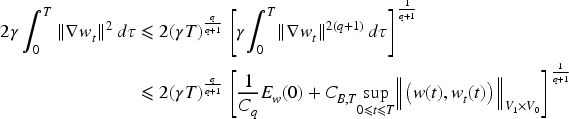
Let . Using that and , we have and . Thus, from the inequality (3.12), we obtain that
Therefore, (3.13) follows directly from the inequality above.
Asymptotic smoothness
The proof that the system is asymptotically smooth is set out in Proposition 3.8 below. The result is obtained by a direct application of the compactness criterion presented in [8, Theorem 7.1.11].
Letbe a dynamical system on a complete metric space X endowed with a metric d. Assume that for any bounded positively invariant set B in X and for anythere existssuch that
whereis a functional defined onsuch that
for every sequencefrom B. Thenis an asymptotically smooth dynamical system.
Asymptotic smoothness
Under assumptions of Theorem 2.2 with, then the dynamical systemgenerated by mild solutions to (1.1)–(1.3) is asymptotically smooth.
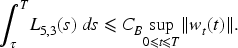
The proof is a direct application of the compactness criterion presented in [8, Theorem 7.1.11]. Let B a bounded set in and be two mild solutions of problem (1.1)-(1.3) with initial data , . Let and . The variable satisfies and
where
We set
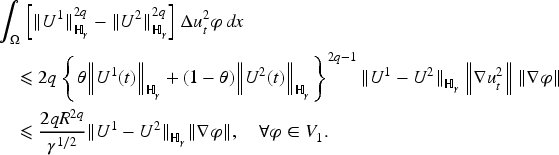
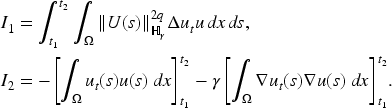
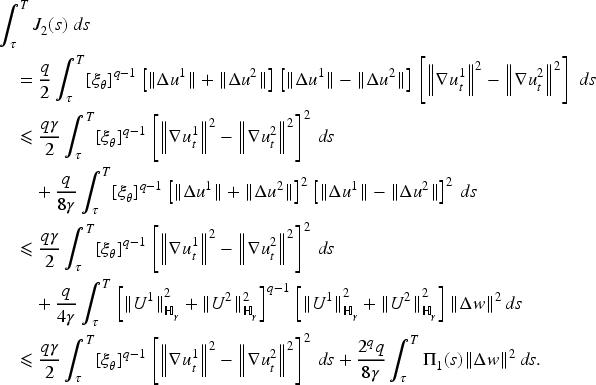
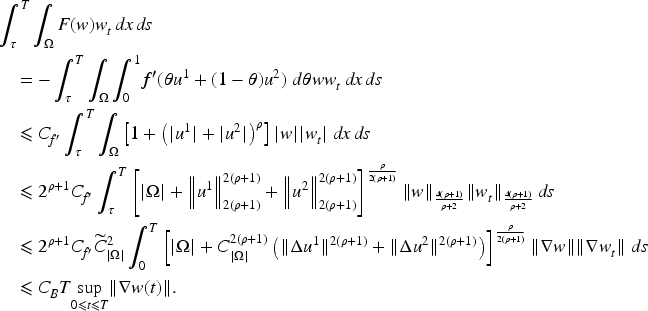
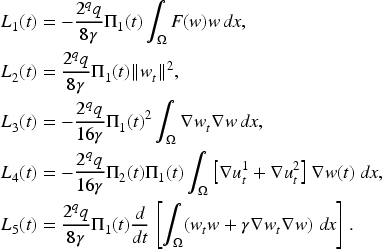
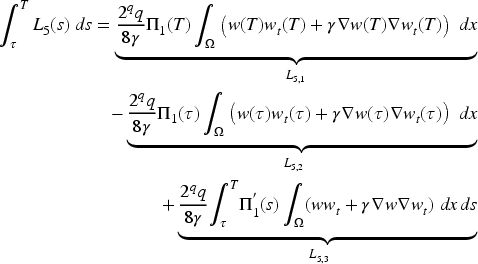
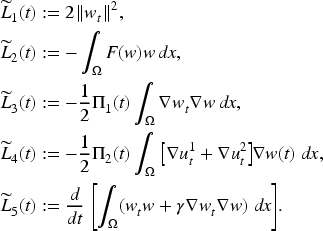
Multiplying the equation (3.14) by and integrating over , we get
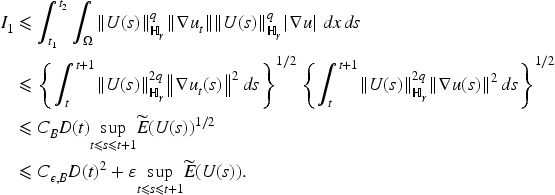
Now, given a sequence , since B is bounded and positive invariant, the corresponding solutions of problem (1.1)–(1.3) are uniformly bounded in . Hence
Thus, since compactly, there exists a subsequence which converge strongly in . Therefore
Therefore, from (3.27) and (3.28), applying [8, Theorem 7.1.11] this proves that is an asymptotically smooth dynamical system.
Footnotes
Acknowledgements
The authors would like to thank the anonymous referees for their constructive comments and suggestions which helped us to improve the original manuscript considerably.
Yanan Li is supported by the National Natural Science Foundation of China (No.12101155) and Heilongjiang Province Natural Science Foundation of China (No. LH2021A001). Vando Narciso is supported by the Fundect/CNPq Grant 15/2024.
References
1.
BabinA.V.VisikM.I., Attractors of Evolution Equations, Nauka, Moscow, 1989. English translation, North-Holland, 1992.
2.
BalakrishnanA.V., A theory of nonlinear damping in flexible structures, Stabilization of flexible structures (1988), 1–12.
3.
BalakrishnanA.V.TaylorL.W., Distributed parameter nonlinear damping models for flight structures, in: Proceedings Damping 89, Flight Dynamics Lab and Air Force Wright Aeronautical Labs, WPAFB, 1989.
4.
BezerraF.D.M.LinfangL.NarcisoV., Stability by polynomial squeezing for a class of energy damping plate models, Acta Appl. Math.188(8) (2023), 1–19.
5.
BezerraF.D.M.LinfangL.NarcisoV., Dynamics for a class of energy beam models with non-constant material density, Z. Angew. Math. Phys.75 (2024), 8. doi:https://doi.org/10.1007/s00033-023-02147-x.
6.
CavalcantiM.M.Domingos CavalcantiV.N.SilvaM.A.J.NarcisoV., Stability for extensible beams with a single degenerate nonlocal damping of Balakrishnan-Taylor type, J. Differential Equations290 (2021), 197–222. doi:https://doi.org/10.1016/j.jde.2021.04.028.
7.
ChueshovI.LasieckaI., Long-time behavior of second order evolution equations with nonlinear damping, Mem. Amer. Math. Soc.195(912) (2008).
8.
ChueshovI.LasieckaI., Von Karman Evolution Equations: Well-Posedness and Long-Time Dynamics, Springer Monographs in Mathematics, Springer, New York, 2010.
9.
Gomes TavaresE.H.SilvaM.A.J.LasieckaI.NarcisoV., Dynamics of extensible beams with nonlinear non-compact energy-level damping, Mathematische Annalen, Math. Ann. (2024). doi:https://doi.org/10.1007/s00208-023-02796-3.
10.
Gomes TavaresE.H.SilvaM.A.J.NarcisoV.VicenteA., Dynamics of a class of extensible beams with degenerate and non-degenerate nonlocal damping, Adv. Differ. Equ.28 (2023), 685–752.
11.
Gomes TavaresE.H.SilvaM.A.J.NarcisoV.VicenteA., Intrinsic polynomial squeezing forBalakrishnan-Taylor beam models, in: ISAAC 2021: Analysis, Applications, and Computations, 2023, pp. 621–633.
12.
HaleJ.K., Asymptotic Behavior of Dissipative Systems, Mathematical Surveys and Monographs, Vol. 25, American Mathematical Society, Providence, 1988.
13.
KrasovskiiN.N., Stability of Motion: Applications of Lyapunov’s Second Method to Differential Systems and Equations with Delay, Stanford University Press, 1963.
14.
LiY.NarcisoV.SunY., Attractors and asymptotic behavior for an energy-damped extensible beam model, Z. Angew. Math. Phys.75 (2024), 92. doi:10.1007/s00033-024-02241-8.
15.
PazyA., Semigroups of Linear Operators and Applications to Partial Differential Equations, Vol. 44, Springer-Verland, 1983.
16.
SilvaM.A.J.NarcisoV.VicenteA., On a beam model related to flight structures with nonlocal energy damping, Discrete Contin. Dyn. Syst. – Series B24(7) (2019), 3281–3298.
17.
SunY.YangZ., Strong attractors and their robustness for an extensible beam model with energy damping, Discrete Contin. Dyn. Syst. – Series B27(6) (2022), 3101–3129.
18.
SunY.YangZ., Attractors and their continuity for an extensible beam equation with rotational inertia and nonlocal energy damping, J. Math. Anal. Appl.512(2) (2022).
19.
TemamR., Infinite-Dimensional Dynamical Systems in Mechanics and Physics, Applied Mathematical Sciences, Vol. 68, Springer-Verlag, New York, 1988.
20.
ZhouC.SunC.Y., Stability for a class of extensible beams with degenerate nonlocal damping, The Journal of Geometric Analysis33 (2023), 295. doi:10.1007/s12220-023-01353-3.