Integrins are a group of heterodimeric transmembrane receptors that play essential roles in cell–cell and cell–matrix interaction. Integrins are important in many physiological processes and diseases. Integrins acquire affinity to their ligand by undergoing molecular conformational changes called activation. Here we review the molecular biomechanics during conformational changes of integrins, integrin functions in leukocyte biorheology (adhesive functions during rolling and arrest) and molecules involved in integrin activation.
Integrins are heterodimers that function as activation-dependent adhesion molecules at the interface between cells and immobilized ligands in the extracellular matrix or other cell surfaces [1–3]. The interactions of integrins with their ligands are broadly relevant to a multitude of physiological and disease situations, such as inflammation [4–7], immune responses [8–11], thrombosis and hemostasis [12–15], extracellular matrix assembly [1–3,16–18], tumor metastasis [15,19–22] and other cellular processes. This review is focused on the four integrins (Table 1) among the known 24 integrins [9,23]: (LFA-1, lymphocyte function-associated antigen 1), (Mac-1, macrophage-1 antigen), (p150,95), .
Excellent reviews cover the structures of integrins [9,78–81]. Both α and β subunits of integrins have large ectodomains, a single membrane-spanning helix (transmembrane, TM) and, usually, a short unstructured cytoplasmic tail (Fig. 1). Typically the α and β subunits contain around 1000 and 750 amino acids, respectively [78]. Specifically, human has 1170 amino acids, has 1152 amino acids, has 1163 amino acids, has 1161 amino acids and has 769 amino acids. All α chains of the integrins contain an I domain with homology to von Willebrand factor (VWF) A domain. The ectodomains are composed of several domains with flexible linkers between them. Each α ectodomain has (from C to N terminus) calf-1 and 2 domains, a thigh domain, a β propeller domain, and an α I domain. The ectodomains have a β-tail domain, integrin epidermal growth factor like repeat domains (I-EGF-1 to 4), a plexin-semaphorin-integrin (PSI) domain, a hybrid domain, and a β I-like domain. The ectodomains can be divided into headpiece and tailpiece as shown in Fig. 1. The α and β cytoplasmic tails of integrins are extended and flexible and can directly bind several adapter proteins with different functional effects [82–88] (Table 2).
Structural schematic of the extended integrin. α chain red, β chain blue. Subdomains and headpiece/tailpiece portions labeled.
integrins, also known as leukocyte integrins [4,27], are the most important molecules in recruiting leukocytes, especially neutrophils and naïve lymphocytes, from the blood stream to sites of immune responses and inflammation. integrins are involved in slowing down rolling [24,100,124–128], promoting arrest [100,129–137], supporting spreading and migration [128,136–143], homotypic and heterotypic cell–cell interactions [8,10,11,144–148] and phagocytosis [6,137,149–153]. Unlike other integrins, leukocyte integrins have few extracellular matrix ligands.
Conformational activation
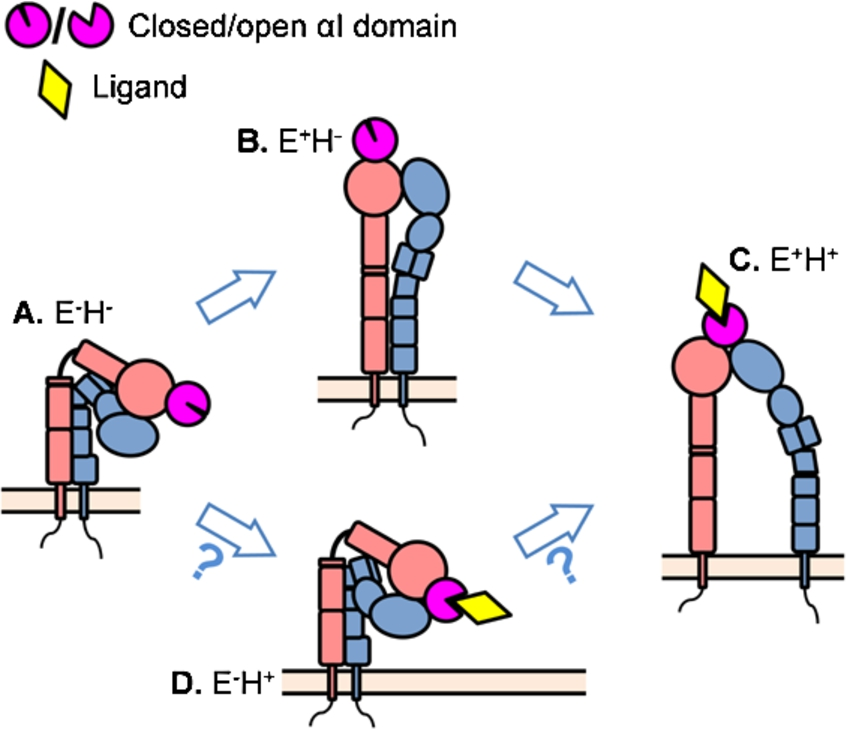
Integrins regulate their adhesiveness through changes in the conformation of their ectodomain [154], which can increase ligand affinity by ∼10,000 fold [155]. The first integrin structure was solved for integrin [156,157] starting a rich stream of publications with information about integrin ectodomain structures. It is widely accepted that integrins have at least three conformations with different ligand binding affinities [8,9,88,158–160] (Fig. 2(A)–(C)): bent ectodomain with closed headpiece (E−H−, resting state, low affinity), extended ectodomain with closed headpiece (E+H−, intermediate [88,100,135,161–163] or low [159] affinity), and extended ectodomain with open headpiece (E+H+, high affinity). Furthermore, a structure of bent ectodomain with open headpiece (E−H+, Fig. 2(D)), which can bind small soluble ligands [164,165], was found in structures of [164] (Electron Microscopy, EM) and [67] (X-ray crystallography), but it is not clear whether this structure exists on the cell surface and whether it has any function.
The existing conformations of the integrins and the proposed consequences of conformational changes. (A) The resting state of integrin has bent ectodomain with closed headpiece. (B) The resting integrin can extend its ectodomain. This conformation may have intermediate affinity to the ligand and mediate leukocyte slow rolling. (C) Further conformational changes can induce headpiece-opening and acquire fully activated integrin. This conformation has high affinity to the ligands and is thought to support arrest and leukocyte adhesion. (D) The structure of bent ectodomain with open headpiece was also crystallized in integrin.
Models of integrin activation
Most studies on conformational integrin activation are limited to the truncated ectodomains, often modified by site-directed mutagenesis to stabilize conformations. In these studies, amino acids thought to be in close proximity in one of the conformations are replaced by cysteines to form disulfide bonds. By necessity, such stabilized integrins must be studied outside their natural cellular context. These experiments suggested two different models of integrin conformational activation. The “switchblade” model proposes that integrin extension is required for headpiece opening and the bent integrin first undergoes extension followed by rearrangements in the metal ion-dependent adhesion site (MIDAS) motif leading to headpiece-opening and high affinity ligand binding [8,9,154,161,162,166,167] (Fig. 2, (A) to (B) to (C)). An alternative model is the “deadbolt” model, where interactions between the headpiece and the legs keep the integrin in the closed, bent conformation and extension can only occur after the “deadbolt” is released. Two studies have shown that E−H+ integrin can exist, suggesting that integrins can open their headpiece prior to extending their ectodomain (Fig. 2, (A) to (D) to (C)). It is not known whether this conformation exists on living cells. A third model is extension first, then force-facilitated headpiece opening [10,11,135].
Extension
The resting state of integrins shows a bent structure shaped like an inverted “V” with the low affinity headpiece closely approaching the plasma membrane [154,168], experimentally verified in live leukocytes by Förster resonance energy transfer (FRET) [169,170], in which FRET from α I domain (FITC-conjugated antibodies) to plasma membrane (Octadecyl rhodamine B, ORB) was observed in resting leukocytes and disappeared when the cells were activated. The bent ectodomain of integrins is about 11 nm above the plasma membrane, whereas the extended ectodomain is about 23 nm (with α I domain) [78]. To allow the headpiece to bind ligands on other cells or surfaces in trans, the ectodomain needs to be extended. Integrin extension is initiated by inside-out signaling [9]. EM and FRET studies show that the α and β feet of extended integrins are more separated than those of bent integrins [154,160]. This could be achieved by lateral displacement of the cytoplasmic tails or by a change of the angle between the α and β transmembrane domains, or both. Such molecular rearrangements could conceivably provide the force necessary to extend the ectodomain. There is good evidence that integrin extension is mediated by talin binding in the β cytoplasmic tail of integrin [88,100], thus causing the conformational changes of cytoplasmic tail and transmembrane domain [171].
Headpiece opening
The integrin headpiece includes the α I domain, the β propeller domain and the thigh domain of the α subunit and the β I-like domain, the hybrid domain, the PSI domain and the I-EGF-1 domain of the β subunit [9]. In integrins, the ligand-binding pocket is located in the α I domain. During integrin activation, the headpiece undergoes conformational changes allowing two ligand binding sites to be exposed, one for the external ligand like ICAM-1 and one for an internal ligand formed by the α I domain, binding to the β I-like domain. On or , the MIDAS is formed by the metal ion (such as Mg2+) and the residues T209, D242 and the D140XSXS motif of the I domain [9,172], or the residues T206, D239 and the D137XSXS motif of I domain [155], respectively. It has been demonstrated by introducing disulfide bonds that wild-type isolated I-domain has low affinity for ICAM-1, whereas pulling down the α7 helix of the I-domain partially or completely will include the stabilized intermediate or high affinity I-domain [155,173]. The α I-domain sits on top of the β propeller domain, in close proximity to the β I-like domain. In natural integrin without disulfide bonds, it is thought that upon integrin activation, the β I-like domain binds an internal ligand (amino acid residue G310) of the I domain. This binding pulls down the α7 helix and stabilizes the high affinity conformation of α I [9,67,154,174]. The internal ligand binding requires that the MIDAS in the β I-like domain is open, which is thought to be induced by hybrid domain swing-out [175,176]. In the “switchblade” model, it is suggested that integrin extension enables hybrid domain swing-out [175,176], thus inducing further conformational changes of the α and β I and I-like domains and acquiring high affinity for ligand [9,174]. However, in cell-free systems it has also been observed that bent integrin can have swung-out hybrid domain and open headpiece [154,174]. This bent conformation with open headpiece [67,164,177] (E−H+) can bind (small) soluble ligands [164,165,177] prior to extension, suggesting that integrin extension is not necessary for headpiece-opening. These observations are difficult to reconcile with the switchblade model. Kindlin-3 (another important adapter protein) deficient murine neutrophils or kindlin-3 knock down HL-60 cells show a defect in headpiece-opening as reported by conformation-specific antibodies [100]. A mutant talin-1 (L325R) [178] was also demonstrated to prevent headpiece-opening of integrin on neutrophils, which exhibit a similar phenotype as kindlin-3 knock out neutrophils [100]: both show normal slow rolling but deficient arrest.
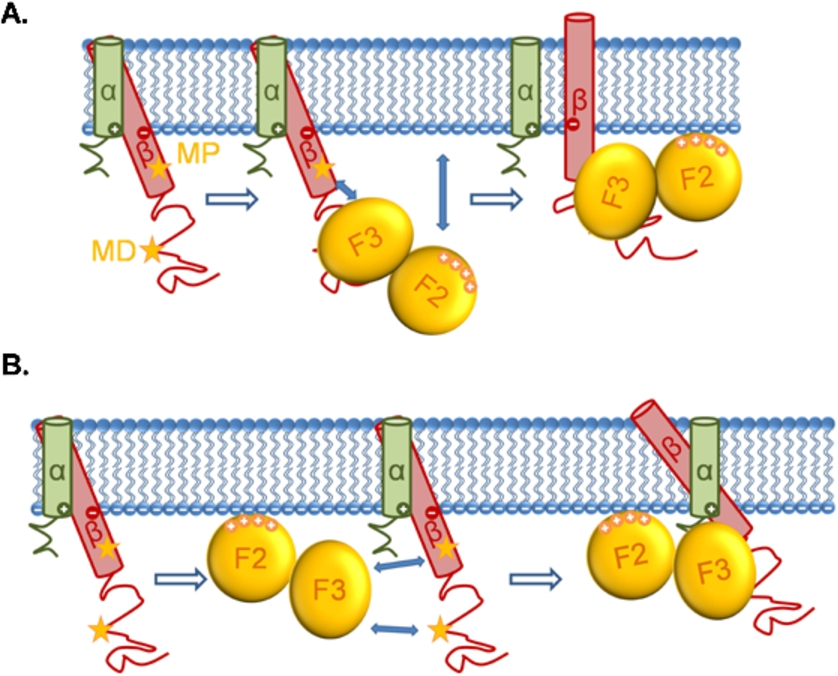
The movements of integrins’ TMD induced by talin binding. The α and β TMDs of integrins cross at an angle at rest. The two stars indicate the talin binding sites (MP and MD) of the β cytoplasmic domain. (A) Upon binding to the talin F3 domain through the MD binding site of the β cytoplasmic domain, the attractions between talin F3 domain and the MP binding site of β cytoplasmic domain, as well as the attractions between the talin F2 domain and the plasma membrane, force the β TMD to move, resulting in an angle change between α and β TMDs, along with the pistoning of β TMD and the dissociation of α and β TMDs. (B) A more recent study suggested that talin first interacts with the plasma membrane through its F2 domain, then the attractions between talin F3 domain and the two β cytoplasmic binding sites force the β TMD to move and change their crossing angle, along with the pistoning of β TMD and the dissociation of α and β TMDs.
Cytoplasmic tail separation
In live cells, the cytoplasmic domains of the integrin α and β subunits are close to one another [171] in the resting (bent) state, close enough so FRET occurs between fluorescent proteins fused to the α and β cytoplasmic domains [171]. Replacement of the α and β cytoplasmic domains with acidic and basic amino acids that form a heterodimeric α-helical coiled-coil forces the two cytoplasmic domain together and stabilizes integrins in their inactive state [179]. The natural integrin cytoplasmic tails have flexible structures and several binding sites for different regulatory adaptor proteins (Table 2). Important regions of the cytoplasmic tails are the NPxY motifs in the tail, which bind talin (membrane-proximal NPxY) [83,101] and kindlin (membrane-distal NPxY) [109,110], respectively. The integrin “off” state is stabilized by binding of filamin or other phosphotyrosine-binding (PTB) domain-containing proteins. It is thought that filamin competes with talin. Tyrosine phosphorylation of the β-tail by some Src family kinases (SFK) has also been suggested to be involved in stabilizing the bent conformation through inhibiting talin binding [180]. β tail phosphorylation promotes the binding of PTB-containing proteins such as Dok1 (docking protein 1), thus preventing the binding of talin. The binding of other PTB-containing talin competitors, such as ICAP1 (integrin cytoplasmic domain associated protein 1), is not dependent on integrin tyrosine phosphorylation [84]. Upon talin binding, cytoplasmic tails separation occurred, resulting in diminished FRET between fluorescent proteins fused to the α and β cytoplasmic domains [171]. This separation of α and β cytoplasmic tails is thought to be critical for integrin extension and, in the switchblade model, also for headpiece opening [179].
Transmembrane domain (TMD) structure changes
The TMD of α and β are both α helices. The α and β helices cross at specific angles relative to the plane of the plasma membrane. This is stabilized by in-register alignment of side-chain arrays (Fig. 3) [181]. Nuclear magnetic resonance (NMR) spectroscopy showed the structures of the TMD complex – the TMD helix is roughly perpendicular to the membrane while the TMD helix is tilted [182,183]. A specific α-helical interface (salt-bridge) between the α and β transmembrane domains stabilizes integrin in the resting state [181,184,185]. Three models have been proposed for the movement of the transmembrane domains during integrin activation: moving apart [184], pistoning up and down [181], or an angle change [181] between α and β. The pistoning model is related to the angle change model, because it suggests that intracellular activating signals could shorten the portion of helix which is buried within the lipid bilayer, thereby changing membrane tilt angle and register with the neighboring helix to avoid hydrophobic mismatch with the fixed width of the membrane bilayer. This change in tilt angle could be the critical event in disrupting transmembrane interactions that stabilize the low-affinity conformation, leading to integrin activation [181,186]. Structural studies of a complex between talin and the integrin cytoplasmic domain [102] suggested two talin binding sites on the cytoplasmic domain – membrane-proximal (MP) and membrane-distal (MD) sites. Talin binding to the MD part of the β cytoplasmic domain subsequently engages the MP binding site, resulting in reorientation of the TMD (Fig. 3(A)). The interaction of the MP part with talin results in the position and angle change of MP part, thus leading to the pistoning [102] and moving apart [187] of the transmembrane helices. A recent study showed that phosphatidylinositol 4,5-bisphosphate (PIP2) can interact with residue Arg995 within the TMD and break the salt-bridge when talin is bound, thus helping integrin activation [188].
Adaptor proteins and integrin activation
The main adaptor molecules regulating integrin activation include talin, Rap1-GTP interacting adapter molecule (RIAM) and kindlin (kindlin-3 in leukocytes). Talin and kindlin are reported to bind the integrin β cytoplasmic tail directly, whereas RIAM is thought to bind and recruit talin to integrin.
Talin
Talin is a high-molecular-weight cytoskeletal protein concentrated at regions of cell-substratum contact [189]. There are two genes, talin-1 and talin-2. Talin-1 contains an N-terminal 47-kD head domain and a ∼220-kD C-terminal flexible rod domain [190]. Talin-1 interacts with both actin and integrin [103]. The head domain consists of an N-terminal FERM domain (protein 4.1, ezrin, radixin and moesin) with three subdomains (F1, F2, F3) and an F0 subdomain with no homology to known domains [191]. It is suggested that the talin head domain has a unique extended structure different from the typical cloverleaf structure seen in other FERM domains [192]. The F3 subdomain contains a PTB domain that binds the integrin β subunit tail at the membrane-proximal NxxY site and promotes integrin activation [101–104]. The talin rod domain is composed of a series of helical bundles (R1 to 13) and a C-terminal single helix dimerization domain (DD). The rod domain contains multiple binding sites for RIAM [193–195], vinculin [195,196], deleted in liver cancer 1 (DLC1) [197], synemin [198], a second binding site for integrin [199,200], binding sites for actin [87,201,202] and internal binding sites for the talin F3 subdomain [203]. It is not clear whether and how all these binding sites are occupied when the attendant integrins are resting or activated.
Talin binding to integrin β cytoplasmic tail leads to spatial changes of the tail and TMD. Two models have been proposed for these changes: the “moving apart” model, in which talin binding leads to the moving apart of the α/β “legs” as demonstrated by FRET assay [171]; and the “piston and angle change” model, in which talin binding leads to angle change, pistoning up and down along with moving apart of the α and β TMDs (Fig. 3), supported by NMR structure studies using short peptides including the TMDs [102,181,187,204,205]. It is thought that the change of the position of the α and β chains relative to each other induces the conformation changes in the ectodomain, but it is not known how the forces are transduced.
The interaction of the talin F3 subdomain with the cytoplasmic tail is necessary but not sufficient for integrin activation. The interaction of talin and the membrane is also important [87]. Some basic residues in the F2 subdomain (Fig. 3), which is located close to the plasma membrane during talin-integrin binding, can bind acidic phospholipids in the plasma membrane [187]. This interaction is also thought to be necessary for integrin activation [204], because mutations of the membrane binding residues on F2 domain significantly decrease the binding of PAC-1 antibody, which is specific for activated integrin. A recent molecular dynamics study using atomistic molecular stimulation demonstrated that PIP2 and 1,2-dioleoyl-sn-glycero-3-phosphocholine (DOPC) are important for talin-mediated salt bridge breaking, which leads to spatial changes of the β TMD and leads to integrin activation [188].
RIAM
RIAM is a broadly expressed adapter protein that contains an RA (Ras association)-like domain, a pleckstrin homology (PH) domain, and several proline-rich sequences. RIAM is important for talin recruitment and integrin activation in leukocytes [206,207], but not platelets [208]. A short amphipathic helix (residues 6–30) in the N-terminal region of RIAM binds talin. A fusion protein containing this helix fused to the membrane-targeting sequence of Rap1A mimics recruitment of talin to the plasma membrane by the RIAM-Rap1 complex and supports integrin activation [193]. This result shows that RIAM is sufficient to recruit talin, but does not address the question whether it is required. RIAM and vinculin compete for the same binding site on talin-1 and their binding to talin is mutually exclusive [194]. RIAM is located in the newly formed protrusions of adherent cells, whereas vinculin is located in mature focal adhesions [194]. This suggests a model where RIAM binding to talin initializes the talin recruitment and integrin activation, then RIAM is replaced by vinculin to further stabilize the activated state of integrin. Interestingly, RIAM was also shown to immunoprecipitate with kindlin-3, even before it immunoprecipitates with talin [209]. However, whether RIAM directly interact with kindlin-3 is unknown.
Kindlin-3
Kindlin is a family of focal adhesion proteins including three subtypes – kindlin-1, 2, and 3, which are also known as fermitin family homolog 1, 2 and 3 (FERMT1, FERMT2, FERMT3) respectively [210]. Kindlin-3 is expressed in leukocytes and platelets and is another essential player that binds to the integrin subunit tail at the membrane-distal NxxY site [109,110]. Kindlin binding to does not compete with talin binding. Kindlin shows high levels of sequence similarity to talin FERM domain [211]. The main difference is that kindlin contains a PH domain that may be involved in membrane recruitment by phosphoinositide binding [190]. The subdomain 3 in kindlin binds the distal NPxY motif of integrin β tails [109,212,213]. Kindlin-3 is expressed exclusively in cells of haematopoietic origin. Mutations in kindlin-3 are found in leukocyte adhesion deficiency III (LAD-III) patients, which have severe bleeding and immune deficiency caused by defective integrin activation in leukocytes and platelets [109,214–217]. These findings demonstrate a critical role for kindlin-3 in leukocyte integrin activation, but the specific mechanisms remain controversial. Kindlin-3 knockout mice show a defect in neutrophil arrest but not slow rolling, which suggests that kindlin-3 is required for headpiece-opening but not extension of integrin [100]. Kindlin-3 knockdown in the HL-60 promyeloid cell line results in a binding defect of mAb24 [218–221], which is specific for open headpiece, but not KIM127 [222,223], which reports integrin extension. These results suggest essential roles of kindlin-3 in headpiece-opening of integrin [100]. An alternative hypothesis suggests that kindlin can promote talin binding to integrin cytoplasmic tail [224]. However, although kindlin, talin and integrin cytoplasmic tail can form a ternary complex, the binding of kindlin to integrins neither enhances talin–integrin binding nor increases talin targeting to the membrane [225,226], and no direct talin–kindlin interaction has been reported. Another hypothesis suggests that kindlin-binding may induce integrin clustering to enhance binding of multivalent ligands via increased avidity, rather than through conformational changes that lead to increased affinity for monovalent ligand [190,227], which is experimentally supported [228].
Leukocyte arrest and signaling of integrin activation
During infection or inflammation, leukocytes in blood, including granulocytes, monocytes and lymphocytes are recruited to the site of immune responses in a cascade-like fashion [17,27,136,229–234] that includes rolling, arrest, crawling, transendothelial migration and migration in tissues. Integrins play vital roles in all these processes. From rolling to arrest, leukocytes need to adhere with sufficient force to balance the force imposed by the drag and torque exerted by the flowing blood. Arrest is thought to be triggered by rapid changes in integrin conformation through inside-out signaling, which may be triggered from surface receptors P-selectin glycoprotein ligand-1 (PSGL-1) or chemokine receptors. This requires regulation of several kinases and assembly and disassembly of multiprotein complexes that form around the cytoplasmic tails of integrins.
Rolling
The dominant molecules involved in leukocyte rolling are selectins and their ligands, whose biomechanics has been reviewed before [24,25,125,127,235–238]. The interaction of endothelial selectins with leukocyte PSGL-1 primes integrin activation, specifically promoting extension of integrins [24,88,125,126,239]. Assays using conformation-specific antibodies have confirmed that rolling on P- or E-selectins can induce integrin extension on leukocytes within human blood [24]. Thus, integrins also serve as “rolling receptors” [27]: they transiently engage their ligand ICAM-1, thereby reducing rolling velocity (slow rolling). Slow rolling has been proposed to be mediated by extended integrin with intermediate affinity [24,100,125–127,135,161–163,240]. This mechanism of integrin-dependent slow rolling was confirmed by using an allosteric inhibitor [125,163] that allows integrin to assume the extended, but not high affinity conformation, and by using kindlin-3 knocked out mice, in which integrin can be extended but the headpiece cannot be opened [100].
Schematics of the inside-out signaling of integrin activation. The integrin activation through inside-out signaling can be divided into PSGL-1 signaling (green) and chemokine receptor (GPCR) signaling (blue). Molecules involved in both two signaling pathway are shown in both colors. The signaling source of kindlin-3 (black) is unknown.
During leukocyte rolling, interactions of endothelial E- and P-selectins with PSGL-1 activate a key signaling pathway. PSGL-1 is the major ligand for P-selectin [239,241,242] and also binds E-selectin [236,243] and L-selectin [237] under flow conditions. PSGL-1 is preferentially located on the tips of leukocyte microvilli [25,244], which enables interactions with selectins during rolling. Granulocytes rolling on P- or E-selectin partially activate integrin through PSGL-1 induced inside-out signaling, which was demonstrated by observation of slow rolling on ICAM-1 [24,125,126] accompanied by increased staining with the extension reporter antibody KIM127 [24]. A mutational study of PSGL-1 showed that the cytoplasmic tail was crucial for this signal transduction, whereas the extracellular domain is responsible for leukocyte rolling [238].
Under no-flow conditions, soluble P-selectin-Fc chimeric protein was shown to induce SFK-dependent phosphorylation of Naf-1, followed by recruitment of the phosphoinositide-3-OH kinase (PI3K) p85-p110δ (PI3Kδ) heterodimer and priming of integrin activation [245]. This pathway may be important when leukocytes bind platelets, which have much higher density of P-selectin than endothelial cells. This pathway is not operative in rolling leukocytes, because PI3Kδ deficient leukocytes showed normal slow rolling on P-selectin and ICAM-1 under flow conditions [246].
On the neutrophil surface, PSGL-1 is closely associated with L-selectin and this does not require interaction of the L-selectin lectin domain with the known selectin-binding domain of PSGL-1 [127]. Engagement of P- or E-selectin with PSGL-1 triggers signaling through lateral interaction with L-selectin [127], followed by phosphorylation of the SFKs Fgr, Hck and Lyn [126,127,246,247]. Further studies indicated that Fgr is the main SFK required for slow rolling [126]. The phosphorylation of Fgr induces phosphorylation of the ITAM-containing adaptor proteins DAP12 or FcRγ [126], which subsequently interact with and phosphorylate the tyrosine kinase Syk [126,246]. Bruton tyrosine kinase (Btk) [246,248], which is one of Tec family kinase, acts downstream from Syk, where the signaling appears to divide into two pathways: one through phospholipase C-γ2 (PLCγ2); the other through PI3Kγ [248]. The downstream molecules of PLCγ2 are CalDAG-GEFI and p38 MAPK, which are known to activate the small GTPase Rap1a [240]. Rap-1a activation is associated with LFA-1 activation, but the details are unknown. Rap-1 has been proposed to bring talin-1 to the subunit, or it may be involved in kindlin-3 recruitment. In the PI3Kγ pathway, Akt is phosphorylated [127,248], which was reported to inhibit the integrin negative regulator GSK3α/β in platelets [249]. Again, the details are unknown. The PI3Kγ pathway could also be involved in integrin clustering.
Although PSGL-1 signaling can prime integrin activation by promoting integrin extension and cause slow rolling of leukocytes [24,100,125,126,250], chemokine receptor signaling is thought to be required for full integrin activation (probably associated with headpiece opening) and leukocyte arrest [125,130,135,251]. Chemokine receptors are G-protein coupled receptors (GPCRs), which are seven-transmembrane proteins that are identified by the coupling with the heterotrimeric G protein containing a particular α-subunit () paired with a -complex () [252]. Several chemokine receptors are expressed on leukocytes, and many of them can trigger arrest [253]. The best-studied chemokine receptor in this context is the C-X-C chemokine receptor type 2 (CXCR2), which binds the chemokine (C-X-C motif) ligands (CXCL) 1, 2, 3, 5, 6 and 7.
The chemokine receptor signaling pathway triggering integrin activation is incompletely understood [88,234]. In neutrophils, the most relevant chemokine receptor responsible for arrest is CXCR2 [254]. In vitro flow chamber assays show that immobilized CXCL1 stimulating CXCR2 leads to LFA-1 activation and neutrophil arrest on an E-selectin/intercellular adhesion molecule 1 (ICAM-1) substrate through depended signaling [125]. Specifically, but not is required. -dependent Ras activation leads to the activation of phosphoinositide 3-kinase (PI3K) by binding to its catalytic subunit [255]. The dissociated subunit has been shown to interact with a number of molecules, including PI3K isoforms [256,257], PDZ proteins [258], guanine nucleotide exchange factors (GEFs) such as PIP3-dependent Rac exchanger (P-Rex) [259] and protein kinase D [260]. A recent study showed that the β subunits 1, 2, 4, and 5 in are indispensable for GPCR-mediated integrin activation and leukocyte recruitment, in which Ras-related C3 botulinum toxin substrate 1 (Rac-1) and phosphoinositide phospholipase C (PLC) and are involved in downstream signaling pathway [261]. In vivo, PI3Kγ [262,263] and protein kinase C (PKC) θ [264] deficient neutrophils show no defect in arrest, but they revert to rolling again, suggesting that there is a defect in integrin bond maturation. Blockade of p44/42 and p38 mitogen-activated protein kinases (MAPK), PI3K, or PKC signaling does not affect chemokine triggered integrin activation on monocytes. The role of inositol triphosphate (IP3) and intracellular free calcium (Ca2+), the calcium-binding messenger protein calmodulin, and inositol-1,4,5-triphosphate receptors as downstream events of PLC activation is controversial [265,266]. Ca2+/diacylglycerol (DAG)-regulated guanine nucleotide exchange factor I (CalDAG-GEFI) is required for activation of Ras-related protein 1 (Rap1) and integrin in neutrophils [267]. In contrast, when the neutrophils were stimulated by fMLP, integrins were activated by activation of Rac through proto-oncogene vav (Vav1) and P-Rex1 [268]. Two (incomplete) chemokine receptor pathways leading to activation of different integrins were demonstrated in T-lymphocytes stimulated by CXCL12 or PMA: PLCγ → Ca2+/DAG → CalDAG-GEFI → Rap1 → LFA-1 and PLCγ → Ca2+/diacylglycerol → PKC → very late antigen-4 (VLA-4) [269] respectively. Another GTPase, cell division control protein 42 (Cdc42), may be a negative regulator of integrin activation upon chemokine stimulation [270]. Phospholipase D1 (PLD-1) was demonstrated as the downstream of Rac1 and RhoA [270]. Phosphatidylinositol-4-phosphate 5-kinase type I gamma (PIP5KC) is downstream of PLD-1 and found to specifically control the transition of LFA-1 from an extended low-intermediate state to a high-affinity state [270]. In a recent study [271] CXCL12 was shown to induce Janus kinase (JAK) 2 and 3 activation in a -independent manner. JAK2 and 3 were upstream of Vav1, which then activates Ras homolog gene family member A (RhoA) and Rac-1. Blockade of RhoA and PLD-1 inhibits the activation of Rap1a. Another study on suggests that Rap1 is downstream of PKC [272].
In conclusion, the proximal (GPCR to to PLCβ) and distal (GALDAG-GEFI to Rap1 to talin-1 to integrin) parts of the pathway are clear, but the middle parts are not clear. It is also unknown whether integrin activation is local, i.e. in the microvillus where the leukocyte is in touch with chemokine, or global (whole cell).
Rap-1
As reviewed, the pathways of PSGL-1 signaling and chemokine receptor signaling may converge on Rap1. However, PSGL-1 ligation triggers only extension and chemokine receptor ligation triggers high affinity (open headpiece). This discrepancy requires that molecules other than Rap-1 are involved. During integrin activation, activated Rap1 needs to be recruited to the plasma membrane by a signaling module comprising the cytosolic adapter proteins ADAP (adhesion and degranulation promoting adapter protein) and SKAP55 (src kinase-associated protein of 55 kDa) [273]. RapL is one of the Rap1 downstream effectors, which was identified by a yeast two-hybrid screen [89,274]. RapL binds to a site consisting of two lysine residues (K1097/K1099) following the GFFKR motif, which is found only in the [90] subunit. RapL forms a complex with the serine/threonine kinase Mst1. Rap1 activation recruits both RapL and Mst1 to LFA-1 and actives Mst1 kinase activity. RapL-deficiency impairs Mst1 activation in cells. Knocking down Mst1 expression reduces integrin activation in response to chemokine stimulation [91], but it is not known how Mst1 is involved in extension or high affinity.
RIAM is another important Rap1 binding protein, which is very important in integrin activation [275]. RIAM has been reported to interact with SKAP-55 and play key roles in the recruitment of Rap1/RIAM complex to the plasma membrane [276]. The ability of Rap1 to activate integrins depends on talin binding to integrin cytoplasmic tail [272]. Rap1 induces the formation of an integrin-activation complex containing talin in combination with RIAM [272,277]. RIAM deficient mice have no defect in platelet arrest [206,208], but a severe defect in neutrophil arrest [207], macrophage adhesion [207], and lymphocyte adhesion [206,207]. A recent study shows that SLAT (SWAP-70-like adaptor of T cells) can interact with Rap-1 through its PH domain and promotes TCR-mediated, Rap1-dependent LFA-1 activation and adhesion [278]. Since SLAT is activated by T cell receptor engagement, this mechanism is unlikely to be involved in triggering arrest.
Conclusions and open questions
integrins are fascinating molecular machines that translate intracellular adaptor binding (kindlin-3, talin-1, RIAM) into conformation changes of the ectodomains. This may be transmitted through moving the cytoplasmic and transmembrane domains apart, or changing their crossing angle. The molecular mechanics by which these movements are translated to ectodomain changes are unknown. integrin activation is triggered by PSGL-1 ligation or chemokine receptor ligation or both. Under physiologic conditions, PSGL-1 ligation alone reduces the rolling velocity in a integrin-dependent fashion. When (soluble or immobilized) chemokines are available, full integrin activation (E+H+) ensues and leads to arrest of the rolling cell. Both the PSGL-1and the chemokine receptor signaling pathways to integrins are only partially understood. The initial hypothesis that all integrins are activated in the same way was refuted: not only are different integrins activated in different ways, but activation mechanisms even appear to be cell type-specific. The methods used to study integrin activation include crystallography of conformationally stabilized integrins, rotary shadowing EM, NMR, reporter antibodies, and functional studies of rolling and arrest. It is very challenging to integrate findings obtained with these fundamentally different and mutually exclusive methods.
Footnotes
Acknowledgements
This research was supported by funding from National Institutes of Health, USA (NIH, HL078784).
RuoslahtiE. Integrins. The Journal of Clinical Investigation. 1991;87(1):1–5. PubMed PMID: 1985087. PubMed Central PMCID: 294975.
3.
SchwartzMA. Transmembrane signalling by integrins. Trends in Cell Biology. 1992;2(10):304–308. PubMed PMID: 14731926.
4.
GahmbergCGValmuLFagerholmSKotovuoriPIhanusETianL, et al. Leukocyte integrins and inflammation. Cellular and Molecular Life Sciences: CMLS. 1998;54(6):549–555. PubMed PMID: 9676574.
5.
SavinkoTSMorrisonVLUotilaLMWolffCHAleniusHTFagerholmSC. Functional Beta2-integrins restrict skin inflammation in vivo. The Journal of Investigative Dermatology. 2015;135(9):2249–2257. PubMed PMID: 25918984.
6.
El KebirDFilepJG. Modulation of neutrophil apoptosis and the resolution of inflammation through integrins. Frontiers in Immunology. 2013;4:60. PubMed PMID: 23508943. PubMed Central PMCID: 3589696.
7.
ZarbockAKempfTWollertKCVestweberD. Leukocyte integrin activation and deactivation: Novel mechanisms of balancing inflammation. Journal of Molecular Medicine. 2012;90(4):353–359. PubMed PMID: 22101734.
8.
SpringerTADustinML. Integrin inside-out signaling and the immunological synapse. Current Opinion in Cell Biology. 2012;24(1):107–115. PubMed PMID: 22129583. PubMed Central PMCID: 3294052.
9.
LuoBHCarmanCVSpringerTA. Structural basis of integrin regulation and signaling. Annual Review of Immunology. 2007;25:619–647. PubMed PMID: 17201681. PubMed Central PMCID: 1952532.
10.
ComrieWABabichABurkhardtJK. F-actin flow drives affinity maturation and spatial organization of LFA-1 at the immunological synapse. The Journal of Cell Biology. 2015;208(4):475–491. PubMed PMID: 25666810. PubMed Central PMCID: 4332248.
11.
ComrieWALiSBoyleSBurkhardtJK. The dendritic cell cytoskeleton promotes T cell adhesion and activation by constraining ICAM-1 mobility. The Journal of Cell Biology. 2015;208(4):457–473. PubMed PMID: 25666808.
12.
ShattilSJNewmanPJ. Integrins: Dynamic scaffolds for adhesion and signaling in platelets. Blood. 2004;104(6):1606–1615. PubMed PMID: 15205259.
13.
CollerBSShattilSJ. The GPIIb/IIIa (integrin ) odyssey: A technology-driven saga of a receptor with twists, turns, and even a bend. Blood. 2008;112(8):3011–3025. PubMed PMID: 18840725. PubMed Central PMCID: 2569161.
14.
ChicoTJChamberlainJGunnJArnoldNBullensSLGadekTR, et al. Effect of selective or combined inhibition of integrins and on thrombosis and neointima after oversized porcine coronary angioplasty. Circulation. 2001;103(8):1135–1141. PubMed PMID: 11222478.
15.
ChereshDA. Integrins in thrombosis, wound healing and cancer. Biochemical Society Transactions. 1991;19(4):835–838. PubMed PMID: 1794568.
16.
PhillipsonMKubesP. The neutrophil in vascular inflammation. Nature Medicine. 2011;17(11):1381–1390. PubMed PMID: 22064428.
17.
KolaczkowskaEKubesP. Neutrophil recruitment and function in health and inflammation. Nature Reviews Immunology. 2013;13(3):159–175. PubMed PMID: 23435331.
18.
VecinoEHellerJPVeiga-CrespoPMartinKRFawcettJW. Influence of extracellular matrix components on the expression of integrins and regeneration of adult retinal ganglion cells. PLoS ONE. 2015;10(5):e0125250. PubMed PMID: 26018803.
19.
FoubertPVarnerJA. Integrins in tumor angiogenesis and lymphangiogenesis. Methods in Molecular Biology. 2012;757:471–486. PubMed PMID: 21909928.
RantalaJKPouwelsJPellinenTVeltelSLaasolaPMattilaE, et al. SHARPIN is an endogenous inhibitor of -integrin activation. Nature Cell Biology. 2011;13(11):1315–1324. PubMed PMID: 21947080. PubMed Central PMCID: 3257806.
22.
DesgrosellierJSChereshDA. Integrins in cancer: Biological implications and therapeutic opportunities. Nature Reviews Cancer. 2010;10(1):9–22. PubMed PMID: 20029421. PubMed Central PMCID: 4383089.
23.
ByronAHumphriesJDAskariJACraigSEMouldAPHumphriesMJ. Anti-integrin monoclonal antibodies. Journal of Cell Science. 2009;122(22):4009–4011.
24.
KuwanoYSpeltenOZhangHLeyKZarbockA. Rolling on E- or P-selectin induces the extended but not high-affinity conformation of LFA-1 in neutrophils. Blood. 2010;116(4):617–624. PubMed PMID: 20445017. PubMed Central PMCID: 3324292.
25.
SunddPGutierrezEKoltsovaEKKuwanoYFukudaSPospieszalskaMK, et al. ‘Slings’ enable neutrophil rolling at high shear. Nature. 2012;488(7411):399–403. PubMed PMID: 22763437. PubMed Central PMCID: 3433404.
26.
SumaginRPrizantHLomakinaEWaughRESareliusIH. LFA-1 and Mac-1 define characteristically different intralumenal crawling and emigration patterns for monocytes and neutrophils in situ. Journal of Immunology. 2010;185(11):7057–7066. PubMed PMID: 21037096. PubMed Central PMCID: 3004223.
27.
HoggNLaschingerMGilesKMcDowallA. T-cell integrins: More than just sticking points. J Cell Sci. 2003;116(Pt 23):4695–4705. PubMed PMID: 14600256.
28.
MakgobaMWSandersMEGinther LuceGEDustinMLSpringerTAClarkEA, et al. ICAM-1 a ligand for LFA-1-dependent adhesion of B, T and myeloid cells. Nature. 1988;331(6151):86–88. PubMed PMID: 3277059.
29.
AranaEHarwoodNEBatistaFD. Regulation of integrin activation through the B-cell receptor. Journal of Cell Science. 2008;121(14):2279–2286.
30.
ShrivastavaAShishodiaSSodhiA. Expression of LFA-1 adhesion molecules on cisplatin-treated macrophages. Biochimica et Biophysica Acta (BBA) – Molecular Cell Research. 1998;1402(3):269–276.
31.
BalkowSHeinzSSchmidbauerPKolanusWHolzmannBGrabbeS, et al. LFA-1 activity state on dendritic cells regulates contact duration with T cells and promotes T-cell priming. Blood. 2010;116(11):1885–1894. PubMed PMID: 20530790.
32.
MorrisMALeyK. Trafficking of natural killer cells. Current Molecular Medicine. 2004;4(4):431–438. PubMed PMID: 15354873.
33.
FisherKLLuJRiddleLKimKJPrestaLGBodarySC. Identification of the binding site in intercellular adhesion molecule 1 for its receptor, leukocyte function-associated antigen 1. Molecular Biology of the Cell. 1997;8(3):501–515. PubMed PMID: 9188101. PubMed Central PMCID: 276100.
34.
LahtiMHeinoJKapylaJ. Leukocyte integrins , and as collagen receptors–receptor activation and recognition of GFOGER motif. The International Journal of Biochemistry & Cell Biology. 2013;45(7):1204–1211. PubMed PMID: 23542015.
35.
RothleinRDustinMLMarlinSDSpringerTA. A human intercellular adhesion molecule (ICAM-1) distinct from LFA-1. Journal of Immunology. 1986;137(4):1270–1274. PubMed PMID: 3525675.
36.
StanleyPHoggN. The I domain of integrin LFA-1 interacts with ICAM-1 domain 1 at residue Glu-34 but not Gln-73. Journal of Biological Chemistry. 1998;273(6):3358–3362.
37.
StauntonDEDustinMLSpringerTA. Functional cloning of ICAM-2, a cell adhesion ligand for LFA-1 homologous to ICAM-1. Nature. 1989;339(6219):61–64. PubMed PMID: 2497351.
38.
KlicksteinLBYorkMRFougerollesARSpringerTA. Localization of the binding site on intercellular adhesion molecule-3 (ICAM-3) for lymphocyte function-associated antigen 1 (LFA-1). The Journal of Biological Chemistry. 1996;271(39):23920–23927. PubMed PMID: 8798624.
39.
IhanusEUotilaLToivanenAStefanidakisMBaillyPCartronJP, et al. Characterization of ICAM-4 binding to the I domains of the CD11a/CD18 and CD11b/CD18 leukocyte integrins. European Journal of Biochemistry/FEBS. 2003;270(8):1710–1723. PubMed PMID: 12694184.
40.
BaillyPTonttiEHermandPCartronJ-PGahmbergCG. The red cell LW blood group protein is an intercellular adhesion molecule which binds to CD11/CD18 leukocyte integrins. European Journal of Immunology. 1995;25(12):3316–3320.
41.
TianLKilgannonPYoshiharaYMoriKGallatinWMCarpénO, et al. Binding of T lymphocytes to hippocampal neurons through ICAM-5 (telencephalin) and characterization of its interaction with the leukocyte integrin CD11a/CD18. European Journal of Immunology. 2000;30(3):810–818.
KimHYSkokosEAMyerDJAgabaPGonzalezAL. integrin regulation of respiratory burst in fibrinogen adherent human neutrophils. Cellular and Molecular Bioengineering. 2014;7(2):231–242. PubMed PMID: 25632307. PubMed Central PMCID: 4306468.
44.
DingCMaYChenXLiuMCaiYHuX, et al. Integrin CD11b negatively regulates BCR signalling to maintain autoreactive B cell tolerance. Nature Communications. 2013;4:2813. PubMed PMID: 24264377.
45.
AltieriDCBaderRMannucciPMEdgingtonTS. Oligospecificity of the cellular adhesion receptor Mac-1 encompasses an inducible recognition specificity for fibrinogen. The Journal of Cell Biology. 1988;107(5):1893–1900. PubMed PMID: 3053736. PubMed Central PMCID: 2115324.
46.
MetlayJPWitmer-PackMDAggerRCrowleyMTLawlessDSteinmanRM. The distinct leukocyte integrins of mouse spleen dendritic cells as identified with new hamster monoclonal antibodies. The Journal of Experimental Medicine. 1990;171(5):1753–1771.
47.
VargaGBalkowSWildMKStadtbaeumerAKrummenMRothoeftT, et al. Active MAC-1 (CD11b/CD18) on DCs inhibits full T-cell activation. Blood. 2007;109(2):661–669.
48.
ParkosCAColganSPDiamondMSNusratALiangTWSpringerTA, et al. Expression and polarization of intercellular adhesion molecule-1 on human intestinal epithelia: Consequences for CD11b/CD18-mediated interactions with neutrophils. Molecular Medicine. 1996;2(4):489–505. PubMed PMID: 8827719. PubMed Central PMCID: 2230166.
49.
DiamondMSStauntonDEde FougerollesARStackerSAGarcia-AguilarJHibbsML, et al. ICAM-1 (CD54): A counter-receptor for Mac-1 (CD11b/CD18). The Journal of Cell Biology. 1990;111(6 Pt 2):3129–3139. PubMed PMID: 1980124. PubMed Central PMCID: 2116396.
50.
DiamondMSStauntonDEMarlinSDSpringerTA. Binding of the integrin Mac-1 (CD11b/CD18) to the third immunoglobulin-like domain of ICAM-1 (CD54) and its regulation by glycosylation. Cell. 1991;65(6):961–971. PubMed PMID: 1675157.
51.
XieJLiRKotovuoriPVermot-DesrochesCWijdenesJArnaoutMA, et al. Intercellular adhesion molecule-2 (CD102) binds to the leukocyte integrin CD11b/CD18 through the A domain. Journal of Immunology. 1995;155(7):3619–3628. PubMed PMID: 7561061.
52.
WrightSDWeitzJIHuangAJLevinSMSilversteinSCLoikeJD. Complement receptor type three (CD11b/CD18) of human polymorphonuclear leukocytes recognizes fibrinogen. Proceedings of the National Academy of Sciences of the United States of America. 1988;85(20):7734–7738. PubMed PMID: 2971974. PubMed Central PMCID: 282267.
53.
BellerDISpringerTASchreiberRD. Anti-Mac-1 selectively inhibits the mouse and human type three complement receptor. The Journal of Experimental Medicine. 1982;156(4):1000–1009. PubMed PMID: 7153706. PubMed Central PMCID: 2186827.
54.
DiamondMSAlonRParkosCAQuinnMTSpringerTA. Heparin is an adhesive ligand for the leukocyte integrin Mac-1 (CD11b/CD18). The Journal of Cell Biology. 1995;130(6):1473–1482. PubMed PMID: 7559767. PubMed Central PMCID: 2120570.
55.
SimonDIChenZXuHLiCQDongJMcIntireLV, et al. Platelet glycoprotein ibα is a counterreceptor for the leukocyte integrin Mac-1 (CD11b/CD18). The Journal of Experimental Medicine. 2000;192(2):193–204. PubMed PMID: 10899906. PubMed Central PMCID: 2193258.
56.
SantosoSSachsUJKrollHLinderMRufAPreissnerKT, et al. The junctional adhesion molecule 3 (JAM-3) on human platelets is a counterreceptor for the leukocyte integrin Mac-1. The Journal of Experimental Medicine. 2002;196(5):679–691. PubMed PMID: 12208882. PubMed Central PMCID: 2194005.
57.
WetzelAChavakisTPreissnerKTSticherlingMHausteinUFAndereggU, et al. Human Thy-1 (CD90) on activated endothelial cells is a counterreceptor for the leukocyte integrin Mac-1 (CD11b/CD18). Journal of Immunology. 2004;172(6):3850–3859. PubMed PMID: 15004192.
58.
LishkoVKNovokhatnyVVYakubenkoVPSkomorovska-ProkvolitHVUgarovaTP. Characterization of plasminogen as an adhesive ligand for integrins (Mac-1) and (VLA-5). Blood. 2004;104(3):719–726.
59.
MyonesBLDalzellJGHoggNRossGD. Neutrophil and monocyte cell surface p150,95 has iC3b-receptor (CR4) activity resembling CR3. The Journal of Clinical Investigation. 1988;82(2):640–651.
60.
LoikeJDSodeikBCaoLLeuconaSWeitzJIDetmersPA, et al. CD11c/CD18 on neutrophils recognizes a domain at the N terminus of the Aα chain of fibrinogen. Proceedings of the National Academy of Sciences. 1991;88(3):1044–1048.
61.
RubtsovAVRubtsovaKFischerAMeehanRTGillisJZKapplerJW, et al. Toll-like receptor 7 (TLR7)-driven accumulation of a novel CD11c+ B-cell population is important for the development of autoimmunity. Blood. 2011;118(5):1305–1315.
62.
PostigoAACorbíALSánchez-MadridFde LandázuriMO. Regulated expression and function of CD11c/CD18 integrin on human B lymphocytes. Relation between attachment to fibrinogen and triggering of proliferation through CD11c/CD18. The Journal of Experimental Medicine. 1991;174(6):1313–1322.
63.
SadhuCTingHJLipskyBHensleyKGarcia-MartinezLFSimonSI, et al. CD11c/CD18: Novel ligands and a role in delayed-type hypersensitivity. Journal of Leukocyte Biology. 2007;81(6):1395–1403. PubMed PMID: 17389580.
64.
FrickCOdermattAZenKMandellKJEdensHPortmannR, et al. Interaction of ICAM-1 with -integrin CD11c/CD18: Characterization of a peptide ligand that mimics a putative binding site on domain D4 of ICAM-1. European Journal of Immunology. 2005;35(12):3610–3621.
65.
ChoiJChoiJNhamS-U. Characterization of the residues of I-domain and ICAM-1 mediating their interactions. Mol Cells. 2010;30(3):227–234(in English).
66.
IhanusEUotilaLMToivanenAVarisMGahmbergCG. Red-cell ICAM-4 is a ligand for the monocyte/macrophage integrin CD11c/CD18: Characterization of the binding sites on ICAM-4. Blood. 2007;109(2):802–810.
67.
SenMYukiKSpringerTA. An internal ligand-bound, metastable state of a leukocyte integrin, . The Journal of Cell Biology. 2013;203(4):629–642. PubMed PMID: 24385486. PubMed Central PMCID: 3840939.
68.
Vorup-JensenTChiLGjelstrupLCJensenUBJewettCAXieC, et al. Binding between the integrin (CD11c/CD18) and heparin. Journal of Biological Chemistry. 2007;282(42):30869–30877.
69.
YakubenkoVPUstinovVPluskotaELópezJAWangYSimonDI. Platelet-leukocyte conjugation mediated by GPIbα– (CD11c/CD18) interaction. Blood. 2013;122(21):1029.
70.
ChoiJLeytonLNhamS-U. Characterization of I-domain binding to Thy-1. Biochemical and Biophysical Research Communications. 2005;331(2):557–561.
71.
JongyunGJeongsukCJoo HeeLSang-UkN. Identification of critical residues for plasminogen binding by the I-domain of the integrin, . Mol Cells. 2007;24(2):240–246.
72.
Van der VierenMLe TrongHWoodCLMoorePFJohnTSStauntonDE, et al. A novel leukointegrin, , binds preferentially to ICAM-3. Immunity. 1995;3(6):683–690.
73.
MiyazakiYVieira-de-AbreuAHarrisESShahAMWeyrichASCastro-Faria-NetoHC, et al. Integrin (CD11d/CD18) is expressed by human circulating and tissue myeloid leukocytes and mediates inflammatory signaling. PLoS ONE. 2014;9(11):e112770.
74.
MiyazakiYBuntingMStafforiniDMHarrisESMcIntyreTMPrescottSM, et al. Integrin is dynamically expressed by inflamed macrophages and alters the natural history of lethal systemic infections. Journal of Immunology. 2008;180(1):590–600. PubMed PMID: 18097061. PubMed Central PMCID: 2275910.
75.
GraysonMHVan der VierenMSterbinskySAMichael GallatinWHoffmanPAStauntonDE, et al. integrin is expressed on human eosinophils and functions as an alternative ligand for vascular cell adhesion molecule 1 (VCAM-1). The Journal of Experimental Medicine. 1998;188(11):2187–2191. PubMed PMID: 9841932. PubMed Central PMCID: 2212388.
76.
Van der VierenMCroweDTHoekstraDVazeuxRHoffmanPAGraysonMH, et al. The leukocyte integrin binds VCAM-1: Evidence for a binding interface between I domain and VCAM-1. Journal of Immunology. 1999;163(4):1984–1990. PubMed PMID: 10438935.
77.
YakubenkoVPYadavSPUgarovaTP. Integrin , an adhesion receptor up-regulated on macrophage foam cells, exhibits multiligand-binding properties. Blood. 2006;107(4):1643–1650. PubMed PMID: 16239428. PubMed Central PMCID: 1367263.
78.
CampbellIDHumphriesMJ. Integrin structure, activation, and interactions. Cold Spring Harbor Perspectives in Biology. 2011;3(3):a004994. PubMed PMID: 21421922. PubMed Central PMCID: 3039929.
79.
ArnaoutMAGoodmanSLXiongJP. Structure and mechanics of integrin-based cell adhesion. Current Opinion in Cell Biology. 2007;19(5):495–507. PubMed PMID: 17928215. PubMed Central PMCID: 2443699.
80.
AskariJABuckleyPAMouldAPHumphriesMJ. Linking integrin conformation to function. J Cell Sci. 2009;122(Pt 2):165–170. PubMed PMID: 19118208. PubMed Central PMCID: 2714414.
81.
BennettJSBergerBWBillingsPC. The structure and function of platelet integrins. Journal of Thrombosis and Haemostasis: JTH. 2009;7(Suppl 1):200–205. PubMed PMID: 19630800.
LegateKRFässlerR. Mechanisms that regulate adaptor binding to β-integrin cytoplasmic tails. Journal of Cell Science. 2009;122(2):187–198.
84.
AnthisNJCampbellID. The tail of integrin activation. Trends in Biochemical Sciences. 2011;36(4):191–198. PubMed PMID: 21216149. PubMed Central PMCID: 3078336.
85.
AbramCLLowellCA. The ins and outs of leukocyte integrin signaling. Annual Review of Immunology. 2009;27:339–362. PubMed PMID: 19302044. PubMed Central PMCID: 3248397.
CalderwoodDACampbellIDCritchleyDR. Talins and kindlins: Partners in integrin-mediated adhesion. Nature Reviews Molecular Cell Biology. 2013;14(8):503–517. PubMed PMID: 23860236. PubMed Central PMCID: 4116690.
88.
LefortCTLeyK. Neutrophil arrest by LFA-1 activation. Frontiers in Immunology. 2012;3:157. PubMed PMID: 22701459. PubMed Central PMCID: 3373145.
89.
KatagiriKMaedaAShimonakaMKinashiT. RAPL, a Rap1-binding molecule that mediates Rap1-induced adhesion through spatial regulation of LFA-1. Nature Immunology. 2003;4(8):741–748. PubMed PMID: 12845325.
90.
TohyamaYKatagiriKPardiRLuCSpringerTAKinashiT. The critical cytoplasmic regions of the / integrin in Rap1-induced adhesion and migration. Molecular Biology of the Cell. 2003;14(6):2570–2582. PubMed PMID: 12808052. PubMed Central PMCID: 194904.
91.
KatagiriKImamuraMKinashiT. Spatiotemporal regulation of the kinase Mst1 by binding protein RAPL is critical for lymphocyte polarity and adhesion. Nature Immunology. 2006;7(9):919–928. PubMed PMID: 16892067.
92.
KatagiriKOhnishiNKabashimaKIyodaTTakedaNShinkaiY, et al. Crucial functions of the Rap1 effector molecule RAPL in lymphocyte and dendritic cell trafficking. Nature Immunology. 2004;5(10):1045–1051. PubMed PMID: 15361866.
93.
NhoRSKahmJ. -integrin-collagen interaction suppresses FoxO3a by the coordination of Akt and PP2A. The Journal of Biological Chemistry. 2010;285(19):14195–14209. PubMed PMID: 20223831. PubMed Central PMCID: 2863165.
94.
MaiAVeltelSPellinenTPadzikACoffeyEMarjomakiV, et al. Competitive binding of Rab21 and p120RasGAP to integrins regulates receptor traffic and migration. The Journal of Cell Biology. 2011;194(2):291–306. PubMed PMID: 21768288. PubMed Central PMCID: 3144408.
95.
AlahariSKReddigPJJulianoRL. The integrin-binding protein Nischarin regulates cell migration by inhibiting PAK. The EMBO Journal. 2004;23(14):2777–2788. PubMed PMID: 15229651. PubMed Central PMCID: 514951.
96.
AlahariSKLeeJWJulianoRL. Nischarin, a novel protein that interacts with the integrin subunit and inhibits cell migration. The Journal of Cell Biology. 2000;151(6):1141–1154. PubMed PMID: 11121431. PubMed Central PMCID: 2190593.
97.
NevoJMaiATuomiSPellinenTPentikainenOTHeikkilaP, et al. Mammary-derived growth inhibitor (MDGI) interacts with integrin α-subunits and suppresses integrin activity and invasion. Oncogene. 2010;29(49):6452–6463. PubMed PMID: 20802519.
98.
HanJRoseDMWoodsideDGGoldfingerLEGinsbergMH. Integrin -dependent T cell migration requires both phosphorylation and dephosphorylation of the cytoplasmic domain to regulate the reversible binding of paxillin. The Journal of Biological Chemistry. 2003;278(37):34845–34853. PubMed PMID: 12837751.
99.
FeralCCRoseDMHanJFoxNSilvermanGJKaushanskyK, et al. Blocking the integrin-paxillin interaction selectively impairs mononuclear leukocyte recruitment to an inflammatory site. The Journal of Clinical Investigation. 2006;116(3):715–723. PubMed PMID: 16470243. PubMed Central PMCID: 1361348.
100.
LefortCTRossaintJMoserMPetrichBGZarbockAMonkleySJ, et al. Distinct roles for talin-1 and kindlin-3 in LFA-1 extension and affinity regulation. Blood. 2012;119(18):4275–4282. PubMed PMID: 22431571. PubMed Central PMCID: 3359742.
101.
CalderwoodDAZentRGrantRReesDJHynesROGinsbergMH. The talin head domain binds to integrin β subunit cytoplasmic tails and regulates integrin activation. The Journal of Biological Chemistry. 1999;274(40):28071–28074. PubMed PMID: 10497155.
102.
WegenerKLPartridgeAWHanJPickfordARLiddingtonRCGinsbergMH, et al. Structural basis of integrin activation by talin. Cell. 2007;128(1):171–182. PubMed PMID: 17218263.
103.
SampathRGallagherPJPavalkoFM. Cytoskeletal interactions with the leukocyte integrin cytoplasmic tail. Activation-dependent regulation of associations with talin and α-actinin. The Journal of Biological Chemistry. 1998;273(50):33588–33594. PubMed PMID: 9837942. PubMed Central PMCID: 2823626.
104.
Garcia-AlvarezBde PeredaJMCalderwoodDAUlmerTSCritchleyDCampbellID, et al. Structural determinants of integrin recognition by talin. Molecular Cell. 2003;11(1):49–58. PubMed PMID: 12535520.
105.
GeierFFengosGIberD. A computational analysis of the dynamic roles of talin, Dok1, and PIPKI for integrin activation. PLoS ONE. 2011;6(11):e24808. PubMed PMID: 22110576. PubMed Central PMCID: 3217926.
106.
GuptaSChitJC-YFengCBhuniaATanS-MBhattacharjyaS. An alternative phosphorylation switch in integrin (CD18) tail for Dok1 binding. Scientific Reports. 2015;5:11630.
107.
StanleyPSmithAMcDowallANicolAZichaDHoggN. Intermediate-affinity LFA-1 binds α-actinin-1 to control migration at the leading edge of the T cell. The EMBO Journal. 2008;27(1):62–75. PubMed PMID: 18079697. PubMed Central PMCID: 2147999.
108.
BogdanovicODelfino-MachinMNicolas-PerezMGavilanMPGago-RodriguesIFernandez-MinanA, et al. Numb/Numbl-Opo antagonism controls retinal epithelium morphogenesis by regulating integrin endocytosis. Developmental Cell. 2012;23(4):782–795. PubMed PMID: 23041384.
109.
MoserMNieswandtBUssarSPozgajovaMFasslerR. Kindlin-3 is essential for integrin activation and platelet aggregation. Nature Medicine. 2008;14(3):325–330. PubMed PMID: 18278053.
110.
MontanezEUssarSSchiffererMBoslMZentRMoserM, et al. Kindlin-2 controls bidirectional signaling of integrins. Genes & Development. 2008;22(10):1325–1330. PubMed PMID: 18483218. PubMed Central PMCID: 2377186.
111.
MaYQQinJWuCPlowEF. Kindlin-2 (Mig-2): A co-activator of integrins. The Journal of Cell Biology. 2008;181(3):439–446. PubMed PMID: 18458155. PubMed Central PMCID: 2364684.
112.
LiuJDasMYangJIthychandaSSYakubenkoVPPlowEF, et al. Structural mechanism of integrin inactivation by filamin. Nature Structural & Molecular Biology. 2015;22(5):383–389. PubMed PMID: 25849143. PubMed Central PMCID: 4424056.
113.
TruongTShamsHMofradMR. Mechanisms of integrin and filamin binding and their interplay with talin during early focal adhesion formation. Integrative Biology. 2015;7(10):1285–1296. PubMed PMID: 26156744.
114.
SharmaCPEzzellRMArnaoutMA. Direct interaction of filamin (ABP-280) with the beta 2-integrin subunit CD18. Journal of Immunology. 1995;154(7):3461–3470. PubMed PMID: 7534799.
115.
BonetRVakonakisICampbellID. Characterization of 14-3-3-zeta interactions with integrin tails. Journal of Molecular Biology. 2013;425(17):3060–3072. PubMed PMID: 23763993. PubMed Central PMCID: 4068353.
116.
BottcherRTStremmelCMevesAMeyerHWidmaierMTsengHY, et al. Sorting nexin 17 prevents lysosomal degradation of integrins by binding to the -integrin tail. Nature Cell Biology. 2012;14(6):584–592. PubMed PMID: 22561348.
117.
GeigerCNagelWBoehmTvan KooykYFigdorCGKremmerE, et al. Cytohesin-1 regulates β-2 integrin-mediated adhesion through both ARF-GEF function and interaction with LFA-1. The EMBO Journal. 2000;19(11):2525–2536. PubMed PMID: 10835351. PubMed Central PMCID: 212768.
118.
KolanusWNagelWSchillerBZeitlmannLGodarSStockingerH, et al. integrin/LFA-1 binding to ICAM-1 induced by cytohesin-1, a cytoplasmic regulatory molecule. Cell. 1996;86(2):233–242. PubMed PMID: 8706128.
119.
ChangDDHoangBQLiuJSpringerTA. Molecular basis for interaction between Icap1α PTB domain and integrin. The Journal of Biological Chemistry. 2002;277(10):8140–8145. PubMed PMID: 11741908.
120.
SimpsonMABradleyWDHarburgerDParsonsMCalderwoodDAKoleskeAJ. Direct interactions with the integrin cytoplasmic tail activate the Abl2/Arg kinase. The Journal of Biological Chemistry. 2015;290(13):8360–8372. PubMed PMID: 25694433. PubMed Central PMCID: 4375489.
121.
TeckchandaniAMulkearnsEERandolphTWToidaNCooperJA. The clathrin adaptor Dab2 recruits EH domain scaffold proteins to regulate integrin endocytosis. Molecular Biology of the Cell. 2012;23(15):2905–2916. PubMed PMID: 22648170. PubMed Central PMCID: 3408417.
122.
Arias-SalgadoEGLizanoSSarkarSBruggeJSGinsbergMHShattilSJ. Src kinase activation by direct interaction with the integrin β cytoplasmic domain. Proceedings of the National Academy of Sciences of the United States of America. 2003;100(23):13298–13302. PubMed PMID: 14593208. PubMed Central PMCID: 263791.
123.
KlinghofferRASachsenmaierCCooperJASorianoP. Src family kinases are required for integrin but not PDGFR signal transduction. The EMBO Journal. 1999;18(9):2459–2471. PubMed PMID: 10228160. PubMed Central PMCID: 1171328.
124.
DunneJLBallantyneCMBeaudetALLeyK. Control of leukocyte rolling velocity in TNF-α-induced inflammation by LFA-1 and Mac-1. Blood. 2002;99(1):336–341. PubMed PMID: 11756189.
125.
ZarbockALowellCALeyK. Spleen tyrosine kinase Syk is necessary for E-selectin-induced integrin-mediated rolling on intercellular adhesion molecule-1. Immunity. 2007;26(6):773–783. PubMed PMID: 17543554. PubMed Central PMCID: 2600878.
126.
ZarbockAAbramCLHundtMAltmanALowellCALeyK. PSGL-1 engagement by E-selectin signals through Src kinase Fgr and ITAM adapters DAP12 and FcRγ to induce slow leukocyte rolling. The Journal of Experimental Medicine. 2008;205(10):2339–2347. PubMed PMID: 18794338. PubMed Central PMCID: 2556779.
127.
StadtmannAGermenaGBlockHBorasMRossaintJSunddP, et al. The PSGL-1-L-selectin signaling complex regulates neutrophil adhesion under flow. The Journal of Experimental Medicine. 2013;210(11):2171–2180. PubMed PMID: 24127491. PubMed Central PMCID: 3804951.
128.
HerterJMRossaintJBlockHWelchHZarbockA. Integrin activation by P-Rex1 is required for selectin-mediated slow leukocyte rolling and intravascular crawling. Blood. 2013;121(12):2301–2310. PubMed PMID: 23343834.
129.
GiagulliCScarpiniEOttoboniLNarumiyaSButcherECConstantinG, et al. RhoA and zeta PKC control distinct modalities of LFA-1 activation by chemokines: Critical role of LFA-1 affinity triggering in lymphocyte in vivo homing. Immunity. 2004;20(1):25–35. PubMed PMID: 14738762.
130.
LumAFGreenCELeeGRStauntonDESimonSI. Dynamic regulation of LFA-1 activation and neutrophil arrest on intercellular adhesion molecule 1 (ICAM-1) in shear flow. The Journal of Biological Chemistry. 2002;277(23):20660–20670. PubMed PMID: 11929876.
D’AmbrosioDAlbanesiCLangRGirolomoniGSinigagliaFLaudannaC. Quantitative differences in chemokine receptor engagement generate diversity in integrin-dependent lymphocyte adhesion. Journal of Immunology. 2002;169(5):2303–2312. PubMed PMID: 12193695.
133.
ConstantinGMajeedMGiagulliCPiccioLKimJYButcherEC, et al. Chemokines trigger immediate integrin affinity and mobility changes: Differential regulation and roles in lymphocyte arrest under flow. Immunity. 2000;13(6):759–769. PubMed PMID: 11163192.
134.
DiVietroJASmithMJSmithBRPetruzzelliLLarsonRSLawrenceMB. Immobilized IL-8 triggers progressive activation of neutrophils rolling in vitro on P-selectin and intercellular adhesion molecule-1. Journal of Immunology. 2001;167(7):4017–4025. PubMed PMID: 11564821.
135.
AlonRFeigelsonSW. Chemokine-triggered leukocyte arrest: Force-regulated bi-directional integrin activation in quantal adhesive contacts. Current Opinion in Cell Biology. 2012;24(5):670–676. PubMed PMID: 22770729.
136.
GreenCESchaffUYSarantosMRLumAFStauntonDESimonSI. Dynamic shifts in LFA-1 affinity regulate neutrophil rolling, arrest, and transmigration on inflamed endothelium. Blood. 2006;107(5):2101–2111. PubMed PMID: 16269618. PubMed Central PMCID: 1895714.
137.
LiuDQLiLMGuoYLBaiRWangCBianZ, et al. Signal regulatory protein α negatively regulates integrin-mediated monocyte adhesion, transendothelial migration and phagocytosis. PLoS ONE. 2008;3(9):e3291. PubMed PMID: 18820737. PubMed Central PMCID: 2553263.
138.
MorrisonVLMacPhersonMSavinkoTSan LekHPrescottAFagerholmSC. The integrin-kindlin-3 interaction is essential for T-cell homing but dispensable for T-cell activation in vivo. Blood. 2013;122(8):1428–1436.
139.
ConstantinGLaudannaC. A deadly migration. Immunity. 2010;32(2):147–149.
140.
SchneiderTIssekutzTBIssekutzAC. The role of (CD49d) and (CD18) integrins in eosinophil and neutrophil migration to allergic lung inflammation in the Brown Norway rat. American Journal of Respiratory Cell and Molecular Biology. 1999;20(3):448–457. PubMed PMID: 10030843.
141.
ThatteJDabakVWilliamsMBBracialeTJLeyK. LFA-1 is required for retention of effector CD8 T cells in mouse lungs. Blood. 2003;101(12):4916–4922. PubMed PMID: 12623847.
142.
KimCH. Crawling of effector T cells on extracellular matrix: Role of integrins in interstitial migration in inflamed tissues. Cellular & Molecular Immunology. 2014;11(1):1–4. PubMed PMID: 24056781. PubMed Central PMCID: 4002148.
143.
XuXJaegerERWangXLagler-FerrezEBatalovSMathisNL, et al. Mst1 directs Myosin IIa partitioning of low and higher affinity integrins during T cell migration. PLoS ONE. 2014;9(8):e105561. PubMed PMID: 25133611. PubMed Central PMCID: 4136924.
144.
DustinMLShawAS. Costimulation: Building an immunological synapse. Science. 1999;283(5402):649–650. PubMed PMID: 9988658.
145.
LinWFanZSuoYDengYZhangMWangJ, et al. The bullseye synapse formed between CD4+ T-cell and staphylococcal enterotoxin B-pulsed dendritic cell is a suppressive synapse in T-cell response. Immunology and Cell Biology. 2015;93(1):99–110. PubMed PMID: 25287444.
146.
LinWSuoYDengYFanZZhengYWeiX, et al. Morphological change of CD4+ T cell during contact with DC modulates T-cell activation by accumulation of F-actin in the immunology synapse. BMC Immunology. 2015;16(1):49. PubMed PMID: 26306899. PubMed Central PMCID: 4549951.
147.
NolzJCMedeirosRBMitchellJSZhuPFreedmanBDShimizuY, et al. WAVE2 regulates high-affinity integrin binding by recruiting vinculin and talin to the immunological synapse. Molecular and Cellular Biology. 2007;27(17):5986–6000. PubMed PMID: 17591693. PubMed Central PMCID: 1952166.
148.
SumenCDustinMLDavisMM. T cell receptor antagonism interferes with MHC clustering and integrin patterning during immunological synapse formation. The Journal of Cell Biology. 2004;166(4):579–590. PubMed PMID: 15314068. PubMed Central PMCID: 2172210.
149.
SchnitzlerNHaaseGPodbielskiALuttickenRSchweizerKG. A co-stimulatory signal through ICAM- integrin-binding potentiates neutrophil phagocytosis. Nature Medicine. 1999;5(2):231–235. PubMed PMID: 9930874.
150.
Jongstra-BilenJHarrisonRGrinsteinS. Fcγ-receptors induce Mac-1 (CD11b/CD18) mobilization and accumulation in the phagocytic cup for optimal phagocytosis. The Journal of Biological Chemistry. 2003;278(46):45720–45729. PubMed PMID: 12941957.
151.
DewittSLaffafianIHallettMB. Phagosomal oxidative activity during integrin (CR3)-mediated phagocytosis by neutrophils is triggered by a non-restricted Ca2+ signal: Ca2+ controls time not space. J Cell Sci. 2003;116(Pt 14):2857–2865. PubMed PMID: 12771186.
152.
WiedemannAPatelJCLimJTsunAvan KooykYCaronE. Two distinct cytoplasmic regions of the integrin chain regulate RhoA function during phagocytosis. The Journal of Cell Biology. 2006;172(7):1069–1079. PubMed PMID: 16567504. PubMed Central PMCID: 2063764.
153.
MacPhersonMLekHSPrescottAFagerholmSC. A systemic lupus erythematosus-associated R77H substitution in the CD11b chain of the Mac-1 integrin compromises leukocyte adhesion and phagocytosis. The Journal of Biological Chemistry. 2011;286(19):17303–17310. PubMed PMID: 21454473. PubMed Central PMCID: 3089572.
154.
NishidaNXieCShimaokaMChengYWalzTSpringerTA. Activation of leukocyte integrins by conversion from bent to extended conformations. Immunity. 2006;25(4):583–594. PubMed PMID: 17045822.
155.
ShimaokaMXiaoTLiuJ-HYangYDongYJunC-D, et al. Structures of the I domain and its complex with ICAM-1 reveal a shape-shifting pathway for integrin regulation. Cell. 2003;112(1):99–111.
156.
XiongJPStehleTDiefenbachBZhangRDunkerRScottDL, et al. Crystal structure of the extracellular segment of integrin . Science. 2001;294(5541):339–345. PubMed PMID: 11546839. PubMed Central PMCID: 2885948.
157.
XiongJPStehleTZhangRJoachimiakAFrechMGoodmanSL, et al. Crystal structure of the extracellular segment of integrin in complex with an Arg-Gly-Asp ligand. Science. 2002;296(5565):151–155. PubMed PMID: 11884718.
158.
ChenWLouJZhuC. Forcing switch from short- to intermediate- and long-lived states of the αA domain generates LFA-1/ICAM-1 catch bonds. The Journal of Biological Chemistry. 2010;285(46):35967–35978. PubMed PMID: 20819952. PubMed Central PMCID: 2975219.
159.
ChenXXieCNishidaNLiZWalzTSpringerTA. Requirement of open headpiece conformation for activation of leukocyte integrin . Proceedings of the National Academy of Sciences of the United States of America. 2010;107(33):14727–14732. PubMed PMID: 20679211. PubMed Central PMCID: 2930457.
160.
TakagiJPetreBMWalzTSpringerTA. Global conformational rearrangements in integrin extracellular domains in outside-in and inside-out signaling. Cell. 2002;110(5):599–611.
161.
SchurpfTSpringerTA. Regulation of integrin affinity on cell surfaces. The EMBO Journal. 2011;30(23):4712–4727. PubMed PMID: 21946563. PubMed Central PMCID: 3243613.
162.
ZhuJLuoBHXiaoTZhangCNishidaNSpringerTA. Structure of a complete integrin ectodomain in a physiologic resting state and activation and deactivation by applied forces. Molecular Cell. 2008;32(6):849–861. PubMed PMID: 19111664. PubMed Central PMCID: 2758073.
163.
SalasAShimaokaMKoganANHarwoodCvon AndrianUHSpringerTA. Rolling adhesion through an extended conformation of integrin and relation to α I and β I-like domain interaction. Immunity. 2004;20(4):393–406. PubMed PMID: 15084269.
164.
AdairBDXiongJPMaddockCGoodmanSLArnaoutMAYeagerM. Three-dimensional EM structure of the ectodomain of integrin in a complex with fibronectin. The Journal of Cell Biology. 2005;168(7):1109–1118. PubMed PMID: 15795319. PubMed Central PMCID: 2171847.
165.
ZhuJBoylanBLuoBHNewmanPJSpringerTA. Tests of the extension and deadbolt models of integrin activation. The Journal of Biological Chemistry. 2007;282(16):11914–11920. PubMed PMID: 17301049. PubMed Central PMCID: 1952534.
166.
ShimaokaMTakagiJSpringerTA. Conformational regulation of integrin structure and function. Annual Review of Biophysics and Biomolecular Structure. 2002;31:485–516. PubMed PMID: 11988479.
167.
YeFKimCGinsbergMH. Molecular mechanism of inside-out integrin regulation. Journal of Thrombosis and Haemostasis: JTH. 2011;9(Suppl 1):20–25. PubMed PMID: 21781238. PubMed Central PMCID: 3979599.
168.
LarsonRSDavisTBologaCSemenukGVijayanSLiY, et al. Dissociation of I domain and global conformational changes in LFA-1: Refinement of small molecule-I domain structure-activity relationships. Biochemistry. 2005;44(11):4322–4331. PubMed PMID: 15766261.
169.
LefortCTHyunYMKimM. Monitoring integrin activation by fluorescence resonance energy transfer. Methods in Molecular Biology. 2012;757:205–214. PubMed PMID: 21909915.
170.
LefortCTHyunY-MSchultzJBLawF-YWaughREKnaufPA, et al. Outside-in signal transmission by conformational changes in integrin Mac-1. The Journal of Immunology. 2009;183(10):6460–6468.
171.
KimMCarmanCVSpringerTA. Bidirectional transmembrane signaling by cytoplasmic domain separation in integrins. Science. 2003;301(5640):1720–1725. PubMed PMID: 14500982.
172.
ArnaoutMAMahalingamBXiongJP. Integrin structure, allostery, and bidirectional signaling. Annual Review of Cell and Developmental Biology. 2005;21:381–410. PubMed PMID: 16212500.
173.
ShimaokaMLuCPalframanRTvon AndrianUHMcCormackATakagiJ, et al. Reversibly locking a protein fold in an active conformation with a disulfide bond: Integrin I domains with high affinity and antagonist activity in vivo. Proceedings of the National Academy of Sciences of the United States of America. 2001;98(11):6009–6014. PubMed PMID: 11353828. PubMed Central PMCID: 33413.
174.
XieCZhuJChenXMiLNishidaNSpringerTA. Structure of an integrin with an α I domain, complement receptor type 4. The EMBO Journal. 2010;29(3):666–679. PubMed PMID: 20033057. PubMed Central PMCID: 2830704.
175.
TakagiJStrokovichKSpringerTAWalzT. Structure of integrin in complex with fibronectin. The EMBO Journal. 2003;22(18):4607–4615. PubMed PMID: 12970173. PubMed Central PMCID: 212714.
176.
XiaoTTakagiJCollerBSWangJ-HSpringerTA. Structural basis for allostery in integrins and binding to fibrinogen-mimetic therapeutics. Nature. 2004;432(7013):59–67.
177.
GuptaVGyllingAAlonsoJLSugimoriTIanakievPXiongJP, et al. The β-tail domain (βTD) regulates physiologic ligand binding to integrin CD11b/CD18. Blood. 2007;109(8):3513–3520. PubMed PMID: 17170130. PubMed Central PMCID: 1852245.
178.
YagoTPetrichBGZhangNLiuZShaoBGinsbergMH, et al. Blocking neutrophil integrin activation prevents ischemia-reperfusion injury. The Journal of Experimental Medicine. 2015;212(8):1267–1281. PubMed PMID: 26169939. PubMed Central PMCID: 4516797.
179.
LuCTakagiJSpringerTA. Association of the membrane proximal regions of the α and β subunit cytoplasmic domains constrains an integrin in the inactive state. The Journal of Biological Chemistry. 2001;276(18):14642–14648. PubMed PMID: 11279101.
180.
AnthisNJHalingJROxleyCLMemoMWegenerKLLimCJ, et al. β integrin tyrosine phosphorylation is a conserved mechanism for regulating talin-induced integrin activation. The Journal of Biological Chemistry. 2009;284(52):36700–36710. PubMed PMID: 19843520. PubMed Central PMCID: 2794784.
181.
PartridgeAWLiuSKimSBowieJUGinsbergMH. Transmembrane domain helix packing stabilizes integrin in the low affinity state. The Journal of Biological Chemistry. 2005;280(8):7294–7300. PubMed PMID: 15591321.
182.
LauTLKimCGinsbergMHUlmerTS. The structure of the integrin transmembrane complex explains integrin transmembrane signalling. The EMBO Journal. 2009;28(9):1351–1361. PubMed PMID: 19279667. PubMed Central PMCID: 2683045.
183.
ZhuJLuoBHBarthPSchonbrunJBakerDSpringerTA. The structure of a receptor with two associating transmembrane domains on the cell surface: Integrin . Molecular Cell. 2009;34(2):234–249. PubMed PMID: 19394300. PubMed Central PMCID: 2694939.
184.
LuoBHSpringerTATakagiJ. A specific interface between integrin transmembrane helices and affinity for ligand. PLoS Biology. 2004;2(6):e153. PubMed PMID: 15208712. PubMed Central PMCID: 423134.
185.
LuoBHCarmanCVTakagiJSpringerTA. Disrupting integrin transmembrane domain heterodimerization increases ligand binding affinity, not valency or clustering. Proceedings of the National Academy of Sciences of the United States of America. 2005;102(10):3679–3684. PubMed PMID: 15738420. PubMed Central PMCID: 553322.
186.
LiddingtonRCGinsbergMH. Integrin activation takes shape. The Journal of Cell Biology. 2002;158(5):833–839. PubMed PMID: 12213832. PubMed Central PMCID: 2173150.
187.
KalliACCampbellIDSansomMS. Multiscale simulations suggest a mechanism for integrin inside-out activation. Proceedings of the National Academy of Sciences of the United States of America. 2011;108(29):11890–11895. PubMed PMID: 21730166. PubMed Central PMCID: 3141943.
188.
OrłowskiAKukkurainenSPöyryARissanenSVattulainenIHytönenVP, et al. PIP2 and talin join forces to activate integrin. The Journal of Physical Chemistry B. 2015;119(38):12381–12389. PubMed PMID: 26309152.
189.
BurridgeKConnellL. A new protein of adhesion plaques and ruffling membranes. The Journal of Cell Biology. 1983;97(2):359–367. PubMed PMID: 6684120. PubMed Central PMCID: 2112532.
190.
MoserMLegateKRZentRFasslerR. The tail of integrins, talin, and kindlins. Science. 2009;324(5929):895–899. PubMed PMID: 19443776.
191.
GoultBTBouaouinaMElliottPRBateNPatelBGingrasAR, et al. Structure of a double ubiquitin-like domain in the talin head: A role in integrin activation. The EMBO Journal. 2010;29(6):1069–1080. PubMed PMID: 20150896. PubMed Central PMCID: 2845276.
192.
ElliottPRGoultBTKoppPMBateNGrossmannJGRobertsGC, et al. The structure of the talin head reveals a novel extended conformation of the FERM domain. Structure. 2010;18(10):1289–1299. PubMed PMID: 20947018. PubMed Central PMCID: 2977851.
193.
LeeHSLimCJPuzon-McLaughlinWShattilSJGinsbergMH. RIAM activates integrins by linking talin to Ras GTPase membrane-targeting sequences. The Journal of Biological Chemistry. 2009;284(8):5119–5127. PubMed PMID: 19098287. PubMed Central PMCID: 2643525.
194.
LeeHSAnekalPLimCJLiuCCGinsbergMH. Two modes of integrin activation form a binary molecular switch in adhesion maturation. Molecular Biology of the Cell. 2013;24(9):1354–1362. PubMed PMID: 23468527. PubMed Central PMCID: 3639047.
195.
GoultBTZacharchenkoTBateNTsangRHeyFGingrasAR, et al. RIAM and vinculin binding to talin are mutually exclusive and regulate adhesion assembly and turnover. The Journal of Biological Chemistry. 2013;288(12):8238–8249. PubMed PMID: 23389036. PubMed Central PMCID: 3605642.
196.
GingrasARZieglerWHFrankRBarsukovILRobertsGCCritchleyDR, et al. Mapping and consensus sequence identification for multiple vinculin binding sites within the talin rod. The Journal of Biological Chemistry. 2005;280(44):37217–37224. PubMed PMID: 16135522.
197.
LiGDuXVassWCPapageorgeAGLowyDRQianX. Full activity of the deleted in liver cancer 1 (DLC1) tumor suppressor depends on an LD-like motif that binds talin and focal adhesion kinase (FAK). Proceedings of the National Academy of Sciences. 2011;108(41):17129–17134.
198.
SunNCritchleyDRPaulinDLiZRobsonRM. Identification of a repeated domain within mammalian α-synemin that interacts directly with talin. Exp Cell Res. 2008;314(8):1839–1849. PubMed PMID: 18342854.
199.
GingrasARZieglerWHBobkovAAJoyceMGFasciDHimmelM, et al. Structural determinants of integrin binding to the talin rod. The Journal of Biological Chemistry. 2009;284(13):8866–8876. PubMed PMID: 19176533. PubMed Central PMCID: 2659244.
200.
RodiusSChaloinOMoesMSchaffner-ReckingerELandrieuILippensG, et al. The talin rod IBS2 α-helix interacts with the integrin cytoplasmic tail membrane-proximal helix by establishing charge complementary salt bridges. Journal of Biological Chemistry. 2008;283(35):24212–24223.
201.
CritchleyDR. Biochemical and structural properties of the integrin-associated cytoskeletal protein talin. Annual Review of Biophysics. 2009;38:235–254. PubMed PMID: 19416068.
202.
GingrasARBateNGoultBTHazelwoodLCanestrelliIGrossmannJG, et al. The structure of the C-terminal actin-binding domain of talin. The EMBO Journal. 2008;27(2):458–469. PubMed PMID: 18157087. PubMed Central PMCID: 2168396.
203.
SongXYangJHirbawiJYeSPereraHDGoksoyE, et al. A novel membrane-dependent on/off switch mechanism of talin FERM domain at sites of cell adhesion. Cell Research. 2012;22(11):1533–1545.
204.
AnthisNJWegenerKLYeFKimCGoultBTLoweED, et al. The structure of an integrin/talin complex reveals the basis of inside-out signal transduction. The EMBO Journal. 2009;28(22):3623–3632. PubMed PMID: 19798053. PubMed Central PMCID: 2782098.
205.
WegenerKLCampbellID. Transmembrane and cytoplasmic domains in integrin activation and protein–protein interactions (review). Molecular Membrane Biology. 2008;25(5):376–387. PubMed PMID: 18654929. PubMed Central PMCID: 3000922.
206.
SuWWynneJPinheiroEMStrazzaMMorAMontenontE, et al. Rap1 and its effector RIAM are required for lymphocyte trafficking. Blood. 2015;126(25):2695–2703. PubMed PMID: 26324702. PubMed Central PMCID: 4683330.
207.
Sarah KlapprothMSKlapprothSSperandioMFässlerRMoserM. RIAM controls bidirectional signaling of leukocyte integrins. Blood. Forthcoming.
208.
StrittSWolfKLorenzVVogtleTGuptaSBoslMR, et al. Rap1-GTP-interacting adaptor molecule (RIAM) is dispensable for platelet integrin activation and function in mice. Blood. 2015;125(2):219–222. PubMed PMID: 25336629. PubMed Central PMCID: 4347307.
209.
KlicheSWorbsTWangXDegenJPatzakIMeinekeB, et al. CCR7-mediated LFA-1 functions in T cells are regulated by 2 independent ADAP/SKAP55 modules. Blood. 2012;119(3):777–785. PubMed PMID: 22117043.
210.
KarakoseESchillerHBFasslerR. The kindlins at a glance. J Cell Sci. 2010;123(Pt 14):2353–2356. PubMed PMID: 20592181.
211.
KloekerSMajorMBCalderwoodDAGinsbergMHJonesDABeckerleMC. The kindler syndrome protein is regulated by transforming growth factor-β and involved in integrin-mediated adhesion. Journal of Biological Chemistry. 2004;279(8):6824–6833.
212.
SchmidtSNakchbandiIRuppertRKawelkeNHessMWPfallerK, et al. Kindlin-3-mediated signaling from multiple integrin classes is required for osteoclast-mediated bone resorption. The Journal of Cell Biology. 2011;192(5):883–897. PubMed PMID: 21357746. PubMed Central PMCID: 3051823.
213.
MoserMBauerMSchmidSRuppertRSchmidtSSixtM, et al. Kindlin-3 is required for integrin-mediated leukocyte adhesion to endothelial cells. Nature Medicine. 2009;15(3):300–305.
214.
McDowallASvenssonLStanleyPPatzakIChakravartyPHowarthK, et al. Two mutations in the KINDLIN3 gene of a new leukocyte adhesion deficiency III patient reveal distinct effects on leukocyte function in vitro. Blood. 2010;115(23):4834–4842. PubMed PMID: 20357244.
215.
CrazzolaraRMaurerKSchulzeHZiegerBZustinJSchulzAS. A new mutation in the KINDLIN-3 gene ablates integrin-dependent leukocyte, platelet, and osteoclast function in a patient with leukocyte adhesion deficiency-III. Pediatric Blood & Cancer. 2015;62(9):1677–1679. PubMed PMID: 25854317.
216.
GrudaRBrownACGrabovskyVMizrahiSGurCFeigelsonSW, et al. Loss of kindlin-3 alters the threshold for NK cell activation in human leukocyte adhesion deficiency-III. Blood. 2012;120(19):3915–3924. PubMed PMID: 22983444.
217.
Manevich-MendelsonEFeigelsonSWPasvolskyRAkerMGrabovskyVShulmanZ, et al. Loss of Kindlin-3 in LAD-III eliminates LFA-1 but not VLA-4 adhesiveness developed under shear flow conditions. Blood. 2009;114(11):2344–2353. PubMed PMID: 19617577.
218.
KamataTTieuKKTaruiTPuzon-McLaughlinWHoggNTakadaY. The role of the CPNKEKEC sequence in the subunit I domain in regulation of integrin (LFA-1). Journal of Immunology. 2002;168(5):2296–2301. PubMed PMID: 11859118.
219.
LuCShimaokaMZangQTakagiJSpringerTA. Locking in alternate conformations of the integrin I domain with disulfide bonds reveals functional relationships among integrin domains. Proceedings of the National Academy of Sciences of the United States of America. 2001;98(5):2393–2398. PubMed PMID: 11226250. PubMed Central PMCID: 30149.
220.
YangWShimaokaMChenJSpringerTA. Activation of integrin β-subunit I-like domains by one-turn C-terminal α-helix deletions. Proceedings of the National Academy of Sciences of the United States of America. 2004;101(8):2333–2338. PubMed PMID: 14983010. PubMed Central PMCID: 356951.
221.
DransfieldIHoggN. Regulated expression of Mg2+ binding epitope on leukocyte integrin α subunits. The EMBO Journal. 1989;8(12):3759–3765. PubMed PMID: 2479549. PubMed Central PMCID: 402061.
222.
LuCFerzlyMTakagiJSpringerTA. Epitope mapping of antibodies to the C-terminal region of the integrin subunit reveals regions that become exposed upon receptor activation. Journal of Immunology. 2001;166(9):5629–5637. PubMed PMID: 11313403.
223.
RobinsonMKAndrewDRosenHBrownDOrtleppSStephensP, et al. Antibody against the Leu-CAM β-chain (CD18) promotes both LFA-1- and CR3-dependent adhesion events. Journal of Immunology. 1992;148(4):1080–1085. PubMed PMID: 1371129.
224.
ZhangYWangH. Integrin signalling and function in immune cells. Immunology. 2012;135(4):268–275. PubMed PMID: 22211918. PubMed Central PMCID: 3372743.
225.
BledzkaKLiuJXuZPereraHDYadavSPBialkowskaK, et al. Spatial coordination of kindlin-2 with talin head domain in interaction with integrin β cytoplasmic tails. The Journal of Biological Chemistry. 2012;287(29):24585–24594. PubMed PMID: 22648415. PubMed Central PMCID: 3397883.
226.
KahnerBNKatoHBannoAGinsbergMHShattilSJYeF. Kindlins, integrin activation and the regulation of talin recruitment to . PLoS ONE. 2012;7(3):e34056. PubMed PMID: 22457811. PubMed Central PMCID: 3311585.
227.
YeFSniderAKGinsbergMH. Talin and kindlin: The one-two punch in integrin activation. Frontiers of Medicine. 2014;8(1):6–16. PubMed PMID: 24477625.
228.
YeFPetrichBGAnekalPLefortCTKasirer-FriedeAShattilSJ, et al. The mechanism of kindlin-mediated activation of integrin . Current Biology: CB. 2013;23(22):2288–2295. PubMed PMID: 24210614. PubMed Central PMCID: 3912999.
229.
McEverRPMooreKLCummingsRD. Leukocyte trafficking mediated by selectin-carbohydrate interactions. The Journal of Biological Chemistry. 1995;270(19):11025–11028. PubMed PMID: 7538108.
230.
ButcherEC. Leukocyte-endothelial cell recognition: Three (or more) steps to specificity and diversity. Cell. 1991;67(6):1033–1036. PubMed PMID: 1760836.
231.
SpringerTA. Traffic signals for lymphocyte recirculation and leukocyte emigration: The multistep paradigm. Cell. 1994;76(2):301–314. PubMed PMID: 7507411.
232.
LeyK. Leukocyte adhesion to vascular endothelium. Journal of Reconstructive Microsurgery. 1992;8(6):495–503. PubMed PMID: 1453376.
233.
LeyKLaudannaCCybulskyMINoursharghS. Getting to the site of inflammation: The leukocyte adhesion cascade updated. Nature Reviews Immunology. 2007;7(9):678–689. PubMed PMID: 17717539.
234.
HerterJZarbockA. Integrin regulation during leukocyte recruitment. Journal of Immunology. 2013;190(9):4451–4457. PubMed PMID: 23606722.
235.
SunddPPospieszalskaMKCheungLSKonstantopoulosKLeyK. Biomechanics of leukocyte rolling. Biorheology. 2011;48(1):1–35. PubMed PMID: 21515934. PubMed Central PMCID: 3103268.
236.
XiaLSperandioMYagoTMcDanielJMCummingsRDPearson-WhiteS, et al. P-selectin glycoprotein ligand-1-deficient mice have impaired leukocyte tethering to E-selectin under flow. The Journal of Clinical Investigation. 2002;109(7):939–950. PubMed PMID: 11927621. PubMed Central PMCID: 150926.
237.
SperandioMSmithMLForlowSBOlsonTSXiaLMcEverRP, et al. P-selectin glycoprotein ligand-1 mediates L-selectin-dependent leukocyte rolling in venules. The Journal of Experimental Medicine. 2003;197(10):1355–1363. PubMed PMID: 12756271. PubMed Central PMCID: 2193782.
238.
MinerJJXiaLYagoTKappelmayerJLiuZKlopockiAG, et al. Separable requirements for cytoplasmic domain of PSGL-1 in leukocyte rolling and signaling under flow. Blood. 2008;112(5):2035–2045. PubMed PMID: 18550846. PubMed Central PMCID: 2518905.
239.
ZarbockALeyKMcEverRPHidalgoA. Leukocyte ligands for endothelial selectins: Specialized glycoconjugates that mediate rolling and signaling under flow. Blood. 2011;118(26):6743–6751. PubMed PMID: 22021370. PubMed Central PMCID: 3245201.
240.
StadtmannABrinkhausLMuellerHRossaintJBolomini-VittoriMBergmeierW, et al. Rap1a activation by CalDAG-GEFI and p38 MAPK is involved in E-selectin-dependent slow leukocyte rolling. European Journal of Immunology. 2011;41(7):2074–2085. PubMed PMID: 21480213. PubMed Central PMCID: 3124568.
241.
NormanKEMooreKLMcEverRPLeyK. Leukocyte rolling in vivo is mediated by P-selectin glycoprotein ligand-1. Blood. 1995;86(12):4417–4421. PubMed PMID: 8541529.
242.
XiaLRamachandranVMcDanielJMNguyenKNCummingsRDMcEverRP. N-terminal residues in murine P-selectin glycoprotein ligand-1 required for binding to murine P-selectin. Blood. 2003;101(2):552–559. PubMed PMID: 12393631.
243.
HirataTMerrill-SkoloffGAabMYangJFurieBCFurieB. P-selectin glycoprotein ligand 1 (PSGL-1) is a physiological ligand for E-selectin in mediating T helper 1 lymphocyte migration. The Journal of Experimental Medicine. 2000;192(11):1669–1676. PubMed PMID: 11104809. PubMed Central PMCID: 2193099.
244.
MooreKLPatelKDBruehlRELiFJohnsonDALichensteinHS, et al. P-selectin glycoprotein ligand-1 mediates rolling of human neutrophils on P-selectin. The Journal of Cell Biology. 1995;128(4):661–671. PubMed PMID: 7532174. PubMed Central PMCID: 2199883.
245.
WangHBWangJTZhangLGengZHXuWLXuT, et al. P-selectin primes leukocyte integrin activation during inflammation. Nature Immunology. 2007;8(8):882–892. PubMed PMID: 17632516.
246.
YagoTShaoBMinerJJYaoLKlopockiAGMaedaK, et al. E-selectin engages PSGL-1 and CD44 through a common signaling pathway to induce integrin -mediated slow leukocyte rolling. Blood. 2010;116(3):485–494. PubMed PMID: 20299514. PubMed Central PMCID: 2913455.
247.
PiccardoniPSideriRManariniSPiccoliAMartelliNde GaetanoG, et al. Platelet/polymorphonuclear leukocyte adhesion: A new role for SRC kinases in Mac-1 adhesive function triggered by P-selectin. Blood. 2001;98(1):108–116. PubMed PMID: 11418469.
248.
MuellerHStadtmannAVan AkenHHirschEWangDLeyK, et al. Tyrosine kinase Btk regulates E-selectin-mediated integrin activation and neutrophil recruitment by controlling phospholipase C (PLC) γ2 and PI3Kγ pathways. Blood. 2010;115(15):3118–3127. PubMed PMID: 20167705. PubMed Central PMCID: 2858472.
249.
MooreSFvan den BoschMTHunterRWSakamotoKPooleAWHersI. Dual regulation of glycogen synthase kinase 3 (GSK3)α/β by protein kinase C (PKC)α and Akt promotes thrombin-mediated integrin activation and granule secretion in platelets. The Journal of Biological Chemistry. 2013;288(6):3918–3928. PubMed PMID: 23239877. PubMed Central PMCID: 3567645.
250.
ChesnuttBCSmithDFRafflerNASmithMLWhiteEJLeyK. Induction of LFA-1-dependent neutrophil rolling on ICAM-1 by engagement of E-selectin. Microcirculation. 2006;13(2):99–109. PubMed PMID: 16459323.
251.
RaingerGEFisherACNashGB. Endothelial-borne platelet-activating factor and interleukin-8 rapidly immobilize rolling neutrophils. The American Journal of Physiology. 1997;272(1 Pt 2):H114–H122. PubMed PMID: 9038929.
252.
QinKDongCWuGLambertNA. Inactive-state preassembly of -coupled receptors and heterotrimers. Nature Chemical Biology. 2011;7(10):740–747. PubMed PMID: 21873996. PubMed Central PMCID: 3177959.
253.
LeyK. Arrest chemokines. Frontiers in Immunology. 2014;5:150. PubMed PMID: 24772112. PubMed Central PMCID: 3983478.
254.
SmithMLOlsonTSLeyK. CXCR2- and E-selectin-induced neutrophil arrest during inflammation in vivo. The Journal of Experimental Medicine. 2004;200(7):935–939. PubMed PMID: 15466624. PubMed Central PMCID: 2213284.
255.
Rodriguez-VicianaPWarnePHDhandRVanhaesebroeckBGoutIFryMJ, et al. Phosphatidylinositol-3-OH kinase as a direct target of Ras. Nature. 1994;370(6490):527–532. PubMed PMID: 8052307.
256.
KerchnerKRClayRLMcCleeryGWatsonNMcIntireWEMyungCS, et al. Differential sensitivity of phosphatidylinositol 3-kinase p110γ to isoforms of G protein dimers. The Journal of Biological Chemistry. 2004;279(43):44554–44562. PubMed PMID: 15322106.
257.
DboukHAVadasOShymanetsABurkeJESalamonRSKhalilBD, et al. G protein-coupled receptor-mediated activation of p110β by is required for cellular transformation and invasiveness. Science Signaling. 2012;5(253):ra89. PubMed PMID: 23211529. PubMed Central PMCID: 3979326.
258.
LiZBenardOMargolskeeRF. interacts with PDZ domain-containing proteins. The Journal of Biological Chemistry. 2006;281(16):11066–11073. PubMed PMID: 16473877.
259.
MayeenuddinLHGarrisonJC. Phosphorylation of P-Rex1 by the cyclic AMP-dependent protein kinase inhibits the phosphatidylinositiol (3,4,5)-trisphosphate and -mediated regulation of its activity. The Journal of Biological Chemistry. 2006;281(4):1921–1928. PubMed PMID: 16301320.
260.
JamoraCYamanouyeNVan LintJLaudenslagerJVandenheedeJRFaulknerDJ, et al. -mediated regulation of Golgi organization is through the direct activation of protein kinase D. Cell. 1999;98(1):59–68. PubMed PMID: 10412981.
261.
BlockHStadtmannARiadDRossaintJSohlbachCGermenaG, et al. Gnb isoforms orchestrate a signaling pathway comprising Rac1 and Plcβ2/3 leading to LFA-1 activation and neutrophil arrest in vivo. Blood. 2016;127(3):314–324. PubMed PMID: 26468229.
262.
SmithDFDeemTLBruceACReutershanJWuDLeyK. Leukocyte phosphoinositide-3 kinase {gamma} is required for chemokine-induced, sustained adhesion under flow in vivo. Journal of Leukocyte Biology. 2006;80(6):1491–1499. PubMed PMID: 16997858.
263.
LiuLPuriKDPenningerJMKubesP. Leukocyte PI3Kγ and PI3Kδ have temporally distinct roles for leukocyte recruitment in vivo. Blood. 2007;110(4):1191–1198. PubMed PMID: 17488877.
264.
BertramAZhangHvon VietinghoffSde PabloCHallerHShushakovaN, et al. Protein kinase C-theta is required for murine neutrophil recruitment and adhesion strengthening under flow. Journal of Immunology. 2012;188(8):4043–4051. PubMed PMID: 22403440.
265.
HydukSJChanJRDuffySTChenMPetersonMDWaddellTK, et al. Phospholipase C, calcium, and calmodulin are critical for integrin affinity up-regulation and monocyte arrest triggered by chemoattractants. Blood. 2007;109(1):176–184. PubMed PMID: 16960156.
266.
HuoYSchoberAForlowSBSmithDFHymanMCJungS, et al. Circulating activated platelets exacerbate atherosclerosis in mice deficient in apolipoprotein E. Nature Medicine. 2003;9(1):61–67. PubMed PMID: 12483207.
267.
BergmeierWGoergeTWangHWCrittendenJRBaldwinACCifuniSM, et al. Mice lacking the signaling molecule CalDAG-GEFI represent a model for leukocyte adhesion deficiency type III. The Journal of Clinical Investigation. 2007;117(6):1699–1707. PubMed PMID: 17492052. PubMed Central PMCID: 1865026.
268.
LawsonCDDonaldSAndersonKEPattonDTWelchHC. P-Rex1 and Vav1 cooperate in the regulation of formyl-methionyl-leucyl-phenylalanine-dependent neutrophil responses. Journal of Immunology. 2011;186(3):1467–1476. PubMed PMID: 21178006.
269.
GhandourHCullereXAlvarezALuscinskasFWMayadasTN. Essential role for Rap1 GTPase and its guanine exchange factor CalDAG-GEFI in LFA-1 but not VLA-4 integrin mediated human T-cell adhesion. Blood. 2007;110(10):3682–3690. PubMed PMID: 17702895. PubMed Central PMCID: 2077316.
270.
Bolomini-VittoriMMontresorAGiagulliCStauntonDRossiBMartinelloM, et al. Regulation of conformer-specific activation of the integrin LFA-1 by a chemokine-triggered Rho signaling module. Nature Immunology. 2009;10(2):185–194. PubMed PMID: 19136961.
271.
MontresorABolomini-VittoriMToffaliLRossiBConstantinGLaudannaC. JAK tyrosine kinases promote hierarchical activation of Rho and Rap modules of integrin activation. The Journal of Cell Biology. 2013;203(6):1003–1019. PubMed PMID: 24368807. PubMed Central PMCID: 3871442.
272.
HanJLimCJWatanabeNSorianiARatnikovBCalderwoodDA, et al. Reconstructing and deconstructing agonist-induced activation of integrin . Current Biology: CB. 2006;16(18):1796–1806. PubMed PMID: 16979556.
273.
KlicheSBreitlingDTogniMPuschRHeuerKWangX, et al. The ADAP/SKAP55 signaling module regulates T-cell receptor-mediated integrin activation through plasma membrane targeting of Rap1. Molecular and Cellular Biology. 2006;26(19):7130–7144. PubMed PMID: 16980616. PubMed Central PMCID: 1592884.
274.
CarmonaGGottigSOrlandiAScheeleJBauerleTJugoldM, et al. Role of the small GTPase Rap1 for integrin activity regulation in endothelial cells and angiogenesis. Blood. 2009;113(2):488–497. PubMed PMID: 18805968.
275.
LafuenteEMvan PuijenbroekAAKrauseMCarmanCVFreemanGJBerezovskayaA, et al. RIAM, an Ena/VASP and Profilin ligand, interacts with Rap1-GTP and mediates Rap1-induced adhesion. Developmental Cell. 2004;7(4):585–595. PubMed PMID: 15469846.
276.
MenascheGKlicheSChenEJStradalTESchravenBKoretzkyG. RIAM links the ADAP/SKAP-55 signaling module to Rap1, facilitating T-cell-receptor-mediated integrin activation. Molecular and Cellular Biology. 2007;27(11):4070–4081. PubMed PMID: 17403904. PubMed Central PMCID: 1900018.
277.
WatanabeNBodinLPandeyMKrauseMCoughlinSBoussiotisVA, et al. Mechanisms and consequences of agonist-induced talin recruitment to platelet integrin . The Journal of Cell Biology. 2008;181(7):1211–1222. PubMed PMID: 18573917. PubMed Central PMCID: 2442211.
278.
CôteMFosCCanonigo-BalancioAJLeyKBécartSAltmanA. SLAT promotes TCR-mediated, Rap1-dependent LFA-1 activation and adhesion through interaction of its PH domain with Rap1. Journal of Cell Science. 2015;128(23):4341–4352. PubMed PMID: 26483383.