In this paper, magneto-hydrodynamic blood flows through porous arteries are numerically simulated using a locally modified homogenous nanofluids model. Blood is taken into account as the third-grade non-Newtonian fluid containing nanoparticles. In the modified nanofluids model, the viscosity, density, and thermal conductivity of the solid-liquid mixture (nanofluids) which are commonly utilized as an effective value, are locally combined with the prevalent single-phase model. The modified governing equations are solved numerically using Newton’s method and a block tridiagonal matrix solver. The results are compared to the prevalent nanofluids single-phase model. In addition, the efficacies of important physical parameters such as pressure gradient, Brownian motion parameter, thermophoresis parameter, magnetic-field parameter, porosity parameter, and etc. on temperature, velocity and nanoparticles concentration profiles are examined.
In the last few years, the study and investigation on non-Newtonian nanofluids have been grown, and this is mostly due to their widespread range of applications. These types of fluids, are widely encountered in many industrial, bio-medical and technology applications, such as molten of polymers, paper production, biological solutions, drug delivery in blood, cardiovascular system, paints, plastic-sheet formation, glues, and etc. [1,2]. Blood is considered to be one of the most important multi-component mixtures in nature. Generally, blood is composed of plasma, red blood cells (RBCs), white blood cells (WBCs), platelets, and etc. It is widely accepted that, notwithstanding the plasma behaves as a Newtonian fluid, the hematocrit (The volume percentage of RBCs in blood. It is normally 45% for men and 40% for women.) exhibits shear-thinning behavior and therefore, must be modeled as a non-Newtonian fluid [3].
Some earlier works in blood flow simulation, such as Ogulu [4], Ogulu and Amose [5], and etc. have considered blood as a Newtonian fluid which is valid in large blood vessels, but when the diameter of the blood vessel is the same order of magnitude as the red blood cells and corpuscles, it is known that the non-Newtonian nature of blood has to be taken into account such as works of Majhi and Nair [6], Prakash and Ogulu [7], Moyers-Gonzalez et al. [8], and Massoudi and Phuoc [9]. The physical properties of the non-Newtonian blood have been introduced by many researches such as Fowkes et al. [10], Baieth [11], Ghasemi et al. [12] and to name but a few. In bio-medically viewpoint, some metallic nanoparticles in the blood such as synthetic gold, can be used in biomedical sciences (e.g. drug delivery, imaging, diagnosis and therapy applications). The studies of such applications are seen in researches of Huang [13], Kumar et al. [14], Fernandes et al. [15], and etc.
One of the approved approaches for simulating the blood flow is using the model of second or third grade non-Newtonian fluid. In 1994, Majhi and Nair [6] examined pulsatile blood flows subjected to externally-imposed periodic body acceleration by considering blood as a non-Newtonian third grade fluid. In 2008, Massoudi and Phuoc [9] studied the unsteady pulsatile flow of blood, including the effects of body acceleration in an artery. They modeled the blood, as a modified second-grade fluid where the viscosity and the normal stress coefficients depend on the shear rate. In 2011, Misra et al. [16] investigated the characteristics of hydro-magnetic flow and heat transfer of the second-grade blood in a channel with oscillatory stretching walls. During that year, Habibi and Ghasemi [17] investigated the effect of a magnetic field on the volume concentration of nanoparticles of a non-Newtonian blood as a drug carrier. Steady simulations of non-Newtonian blood flow through an axisymmetric stenosed artery in the presence of magnetic field were performed in 2013 by Alshare et al. [18]. Cherry and Eaton [19] presented a simulation of magnetic particles in non-Newtonian blood to model particle injection into an artery-shaped domain for magnetic drug targeting. In their study, magnetic forces, gravity, and random forcing due to collisions with blood cells were included. In 2014, Moawed et al. [20] investigated numerically, the convective heat transfer effect on the non-Newtonian nanofluid flows (containing and blood solution) in the horizontal tube with Constant heat flux. In the same year, Hatami et al. [2] studied the third grade non-Newtonian blood conveying gold nanoparticles in a porous and hollow vessel by two analytical methods. They took into account temperature dependency for blood and examined the effect of Brownian motion of nanoparticles and magnetic field on behavior of blood flow. Alimohamadi and Imani [21] presented the numerical solution (using COMSOL 4.3 Multiphysics software and with a free and porous media flow toolbox) of transient non-Newtonian blood flow patterns through an aneurysm artery with porous walls under the applied magnetic field. Recently in 2015, Ghasemi et al. [12] analyzed analytically and numerically third grade non-Newtonian blood flows containing nanoparticles in porous arteries in the presence of external magnetic field. For properties of nanofluids, such as thermal conductivity and viscosity in ambient condition, they considered constant effective values.
Generally, in order to analyze the behavior of nanoparticles suspended in a fluid (or nanofluids), two main numerical approaches have been adopted by researchers. The first approach is the two-phase model, which considers both the fluid and the solid-nanoparticles phases in the simulation. The second one is the single-phase (or homogenous-phase) model in which both phases (fluid and solid-nanoparticles) are in thermal and hydrodynamic equilibrium state. The latter approach is simpler and more computationally efficient. In a general manner, there are several factors that affect the thermal and hydrodynamic characteristics of nanofluids, such as Brownian motion (diffusion, sedimentation, and dispersion), layering at the solid/liquid interface, gravity, particles clustering, the friction between the fluid and the solid particles, and etc. Therefore, without any precise experimental data and comprehensive theoretical studies, the existing two-phase model has not enough accuracy for examining nanofluids. Consequently, modifying the single-phase model, is more convenient than the two-phase model [22]. Therefore, in order to enhance the results of the single-phase model for analyzing the nanofluids flow, several amendments are necessary.
In this paper, a new modified single-phase model for analyzing nanofluids flow is introduced for the first time. In this model, all properties of nanofluids such as, density, viscosity, and thermal conductivity which are normally used as effective constant values for the single-phase model, are incorporated locally with the governing equations (as no-constant values). This approach is used for examining the magneto-hydrodynamic blood flows through porous arteries. Blood is taken into account as the third-grade non-Newtonian fluid containing nanoparticles. Regarding to Refs [2] and [14] gold nanoparticles () are very important in biomedical science. For example, gold nanoparticles can be used to activate or inhibit the growth of blood vessels. And also, gold nanoparticles could solve some of the problems associated with administering angiogenic drugs. Gold nanoparticles are efficient drug-carrying and drug-delivery vehicles because they can encapsulate large quantities of therapeutic molecules. Therefore, in this paper, the gold nanoparticle () is considered in the blood and the results for nanoparticle are compared to the prevalent single-phase model. This comparison depicts that the prevalent single-phase model has a considerable deviation for predicting the behavior of nanofluids flow especially in dimensionless temperature and nanoparticle volume fraction. In addition the effect of the important governing parameters such as pressure gradient, Brownian motion parameter, thermophoresis parameter, magnetic field parameter, porosity parameter, and etc. on the velocity, temperature, and volume fraction distribution and the dimensionless heat and mass transfer rates is examined.
Mathematical governing equations
Schematic of magneto-hydrodynamic blood flows through a porous artery.
The fully-developed steady-state incompressible non-Newtonian nanofluid (blood) through a porous artery in the presence of magnetic field is considered. A schematic diagram of the problem, including the mechanical physic in the cylindrical coordinates () is shown in Fig. 1. In this problem, blood flows in the x-direction through a hollow porous vessel (or artery) with an axial velocity of . The flow is assumed to be axisymmetric with no radial and swirl components of velocity. To increase the generality of the problem, it is supposed that, there is an initial slip velocity () at the inner surface () and no-slip condition () at the outer wall (). For considering the effect of natural convection, the nanofluid’s density is defined as follows [2,23]: where, ρ is density, φ is the nanoparticle concentration (or volume fraction), T is the temperature, and is the volumetric coefficient of expansion. The subscripts f, p, and refer to the based fluid, nanoparticles, and nanofluid, respectively. The subscript ∞ refers to the reference condition. In keeping with the Oberbeck–Boussinesq approximation and an assumption that the nanoparticle concentration is only a few percent (), the following linearization can be considered [24,25]:
For the present problem and all given assumptions, the governing equations in the cylindrical coordinates including the conservation of momentum, thermal energy, and nanoparticles, are formulated as follows [1,2,12]: where, is the non-Newtonian stress tensor, subscript x refers to the axial direction, K is the permeability of porous medium, g is the gravitational acceleration, is the magnetic field strength, k is the thermal conductivity, c is the specific heat capacity, is the thermophoretic diffusion coefficient, and is the Brownian diffusion coefficient. Stress tensor in a third-grade fluid is given by where, , , and β are the material moduli, p is the pressure, and the kinematical tensors and (Rivlin–Ericksen tensors) for the present problem are defined by ():
In this study, a new locally Modified Single-Phase Model (here it is named as MSPM) for analyzing nanofluids flow and heat transfer is introduced. For this manner, the parameters and of the above governing equations may be introduced by the following two relations [23]:
Blood viscosity increases about 2% for each degree centigrade decrease in temperature. Normally, blood temperature does not change much in the body [26]. Therefore, in this study, it is assumed that the dynamic viscosity and the thermal conductivity of the base fluid (blood) are constant, i.e. and . Now, the following dimensionless parameters are introduced: where, R and denote the reference dimension and velocity, respectively and subscript w refers to the inner surface wall. Substituting Eqs (4) and (6) into Eq. (3), using the dimensionless quantities given in Eq. (6), and finally choosing a suitable reference pressure, the non-dimensional forms of the governing equations after dropping bars for simplicity, lead to the following coupled equations: where, and are two constant quantities, is the third-grade non-Newtonian parameter, is the porosity parameter, is the magnetic parameter, denotes the pressure gradient parameter with a chosen reference pressure, displays Brownian diffusion constant, demonstrates the Grashof number, denotes the Brownian motion number, and the last constant parameter is the thermophoresis parameter. In this study, for the boundary conditions, it is assumed that each variable, u, θ, and ψ, has an initial value in the inner radius , and reaches to zero in the outer radius . Therefore the boundary conditions in dimensionless form are as follows:
By introducing the surface heat flux in dimensionless form through , the surface mass flux in dimensionless form via , the nanofluid Nusselt number through , and the nanofluid Sherwood number by means of , the following relation can be established:
As mentioned before, in this paper, blood with gold nanoparticles are considered for non-Newtonian nanofluid which their properties are illustrated in Table 1. The data is given from Ref. [11].
Thermophysical properties of non-Newtonian fluid (blood) and gold nanoparticle
Properties
Fluid phase (blood)
c [J/kgK]
3617
129
ρ [kg/m3]
1050
19,300
k [W/mK]
0.52
318
–
18.381
–
0.655
–
611.54
–
319.04
–
−317.48
Algorithm of numerical solution
In this section, the set of non-linear ordinary differential equations (8)–(10) with boundary conditions (11) are solved using a combination of analytical and Newton’s numerical techniques. First of all, Eq. (10) is simplified as . By integrating twice, the following relation is obtained:
By considering the boundary conditions and , the constants a and b are achieved. Therefore, Eq. (13) can be expressed as: and
Substituting Eq. (14) into Eqs (8) and (9), leads to the following coupled governing equations:
It is clear from Table 1 that, which is considered as −1.0 in further calculations. Also, in a nanofluid, the nanoparticle concentration is generally only a few percent (), therefore the first and second brackets of Eq. (17) can be approximated and , respectively. Hence, by using Eqs (15) and (17) is simplified as bellows: where, the constant parameters in Eq. (18) are defined as , , and . It should be noted that by considering a thermal conductivity for nanofluids which is independent of the nanoparticle-concentration, Eq. (17) and the MSPM are reduced to a simpler relation and the prevalent nanofluids’ model such as those seen in Refs [1,2] and [12]. Here, the old Prevalent Single-Phase Model of nanofluids is named as PSPM. Therefore, in Eq. (18), when the model is MSPM and when the model is PSPM. Also, the same role for coefficient λ can be considered for Eq. (16). The algorithm of numerical calculation (computer programming procedure) of the non-linear differential Eqs (16) and (18) with boundary conditions (11) is given as follows:
Specify input data of base fluid and nanoparticles, i.e. , , , , P, Λ, , , , and ;
Calculate , and base on step (i);
Solve Eq. (18) to obtain by using Newton’s numerical method;
Solve Eq. (16) to obtain by using Newton’s numerical method.
Validation of numerical solution
In order to check the validity of the present computational programming code, the governing Eqs (10) and (18) subject to the boundary conditions (11) are solved numerically for some values of the governing parameters of the PSPM, i.e. , , , , , and . The results for the temperature profile, , and the nanoparticle concentration profile, , are compared with those obtained by Ghasemi et al. [12] in Table 2. It is evident from Table 2 that the present results are in very good agreement with those reported by other researchers. Therefore, it is concluded that the results obtained in this study are accurate.
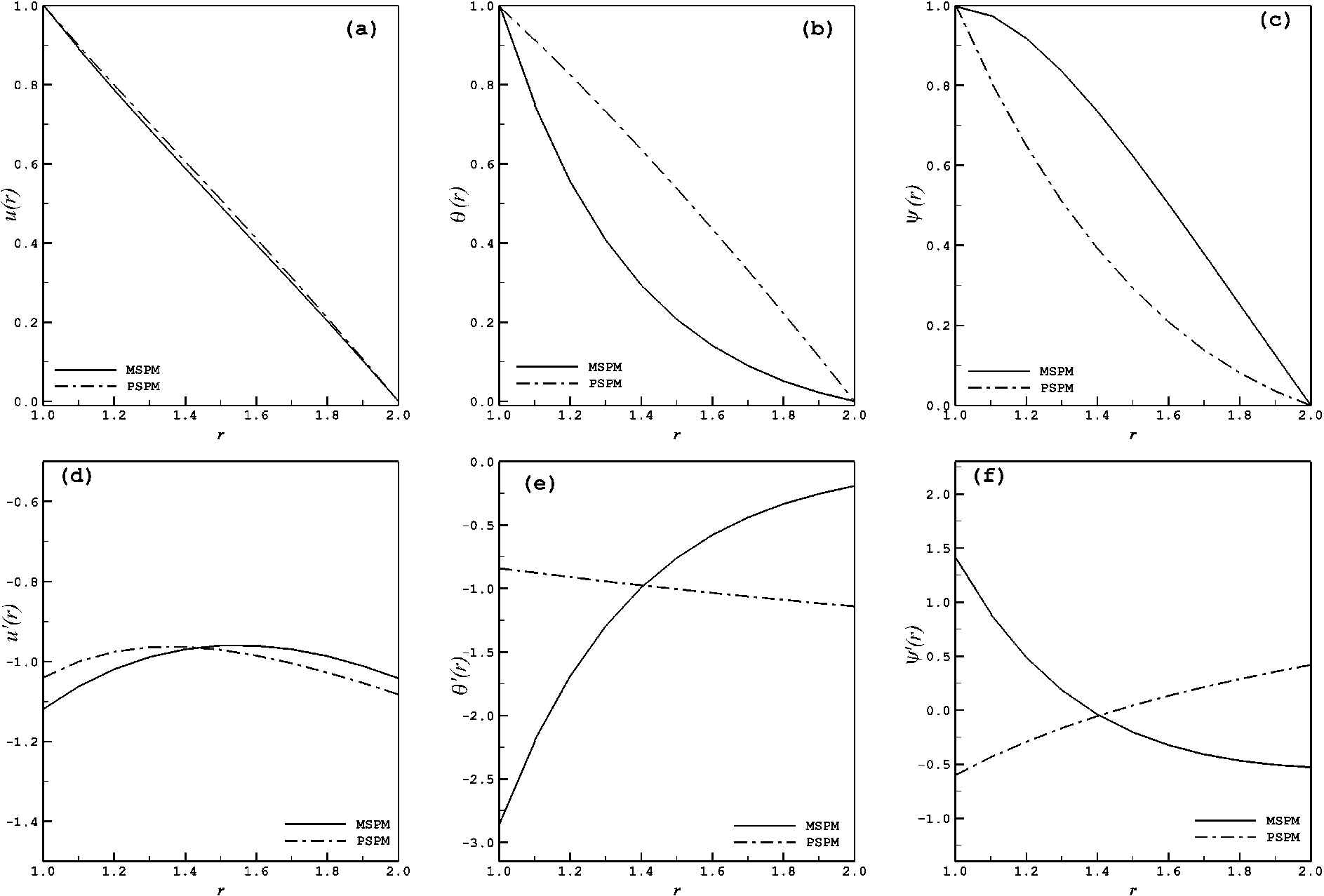
Effect of the MSPM and PSPM on the dimensionless profiles for the same governing parameters.
Results and discussion
In this section, the numerical results for dimensionless profiles of velocity, , temperature, , nanoparticle concentration, , and etc. are illustrated for different values of governing parameters. These results are plotted through graphs Figs 2–10. For all simulations and their corresponding figures, the values of governing parameters are listed in Table 3. In order to examine the effect of implementing MSPM and PSPM on the results, a comparison for six dimensionless profiles (i.e. u, , θ, , ψ and ) are presented in Figs 2 and 3. The displayed results in both Figs 2 and 3 confirm that the PSPM has a remarkable deviation for predicting the behavior of non-Newtonian nanofluids flow especially in dimensionless temperature (θ), nanoparticle concentration (ψ) and their gradient (i.e., and ). It should be noted that, discussions about the PSPM and its effect on the results of the magneto-hydrodynamic blood flows through porous arteries (or coaxial porous cylinder) have been published recently in many studies such as Refs [2,12,13,17] and [27]. Therefore, for the next simulations in this paper, the implementation of MSPM is only examined. It is evident from Eq. (18) that magnetic field (M), non-Newtonian parameter (Λ), pressure gradient parameter (γ), Brownian diffusion constant (), and Grashof number () have no influence on thermal characteristic and nanoparticle-concentration. Therefore, the effects of those governing parameters are assessed only on velocity profile.
Effect of the MSPM and PSPM on the dimensionless profiles for the same governing parameters.
Effect of magnetic field (M) on the dimensionless profiles of u and .
Effect of non-Newtonian parameter (Λ) on the dimensionless profiles of u and .
Effect of porosity parameter (P) on the dimensionless profiles of u and .
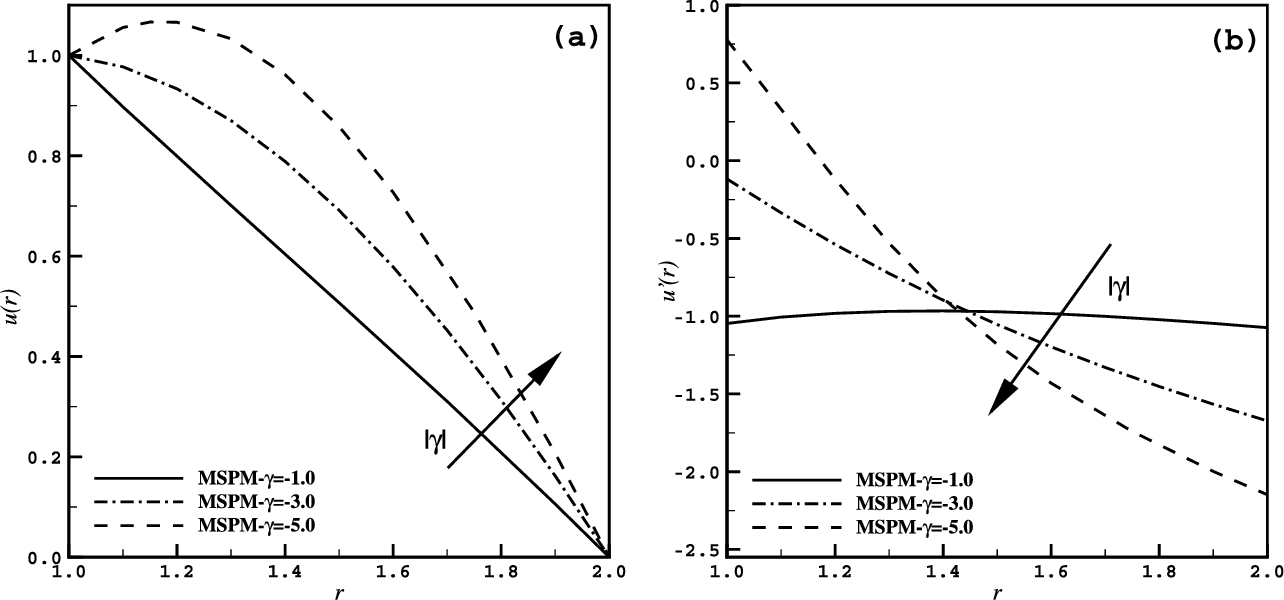
Effect of pressure gradient () on the dimensionless profiles of u and .
Effect of Brownian motion number () on the dimensionless profiles of u, θ and ψ.
Effect of thermophoresis parameter () on the dimensionless profiles of u, θ and ψ.
Effect of and on the dimensionless heat and mass transfer rates.
The first analysis in this section is related to the effects of magnetic field (M) on the flow characteristics (u and profiles). By applying a magnetic field, a Lorentz force is created, which results in a retarding force on the velocity of the flow [28]. Therefore, as M increases (and consequently increasing the retarding force) the velocity of the fluid decreases. This issue can be observed in the results plotted in Fig. 4(a) (for , 2 and 4).
The second examination belongs to the effect of non-Newtonian parameter (Λ) on the flow specification (u and profiles). In order to remain in the admissible range, Λ is taken smaller than 2. It is clear from Fig. 5, when non-Newtonian effect increases (as Λ increases), velocity profile decreases slightly. This pattern and behavior can be seen in many references such as, Refs [2] and [12] for flows in hollow vessels and Ref. [29] for flows in pipe.
Figure 6 is depicted for showing the effect of porosity parameter (P) on velocity profile as the third analysis. As observed in this figure, by increasing the porosity parameter (P), velocity profile decreases. This is because for a constant pressure gradient, when porosity decreases, fluid can easily moves through the porous media and consequently velocity profile increases.
The next examination belongs to the effect of the pressure gradient (γ) on the flow characteristics (u and profiles). This is shown in Fig. 7. As seen in this figure, by increasing the pressure gradient (), velocity profile increases. The reason of this behavior is very clear. When minus pressure gradient (favorable pressure gradient) increases, the flow is accelerated and it makes higher velocity in the artery.
The governing parameters for non-Newtonian nanofluid flow simulations
Fig. no.
M
P
Λ
2
0
0.02
2.0
2.0
0.5
0.1
0.1
0.1
0.1
1.0
1
2
3
0
0.02
0.5
0.5
0.5
0.1
0.1
0.1
0.1
1.0
1
2
4
0
0.02
2.0
2.0
0.5
0.0–4.0
0.1
0.1
0.1
1.0
1
2
5
0
0.02
2.0
2.0
0.5
0.1
0.1
0.1
0.1–2.0
1.0
1
2
6
0
0.02
2.0
2.0
0.5
0.1
0.1
0.1–1.0
0.1
1.0
1
2
7
0
0.02
2.0
2.0
0.5
0.1
0.1
0.1
0.1
1.0–5.0
1
2
8
0
0.02
1.0–5.0
0.5
0.5
0.1
0.1
0.1
0.1
1.0
1
2
9
0
0.02
0.5
1.0–3.0
0.5
0.1
0.1
0.1
0.1
1.0
1
2
10a
0
0.02
1.0–5.0
0.5
0.5
0.1
0.1
0.1
0.1
1.0
1
2
10b
0
0.02
0.5
1.0–4.0
0.5
0.1
0.1
0.1
0.1
1.0
1
2
Nanoparticle concentration (or volume fraction of nanoparticles) is a key parameter for studying the effect of nanoparticles on flow fields and temperature distributions. It is worth noting that Brownian motion of nanoparticles at the molecular and Nano-scale levels plays an important role in heat transfer and thermal behavior. In nanofluid flows, due to the size of the nanoparticles Brownian motion takes place which can enhance the heat transfer properties. Thus Fig. 8 is prepared to present the effect of Brownian motion () on the velocity, temperature, and nanoparticle concentration profiles as the fifth investigation. Figure 8(a) confirms that increasing has no significant effect on velocity profile. However, as it is shown in Fig. 8(b), when Brownian motion parameter increases, the temperature values in whole domain increase (because of heat transfer enhancement). Also, Fig. 5(c) verifies that when Brownian motion parameter increases, nanoparticles concentration decreases near the inner wall which is due to effective movement of nanoparticles.
Figure 9 displays the effect of thermophoretic parameter () on velocity, temperature and nanoparticle volume fraction profiles. It is clear from the figure that the temperature of the fluid increases whereas the nanoparticle concentration decreases with increase of . And, the figure confirms that increasing has no significant effect on velocity profile. It should be noted that, positive indicates that the inner surface is hotter than the outer surface. In addition, for hot surface, thermophoresis tends to blow the nanoparticle volume fraction boundary layer away from the surface since a hot surface repels the Nano-sized particles from it. As a consequence, when thermophoretic parameter increases, nanoparticles concentration reduces near the inner wall and the temperature increases due to effective movement of nanoparticles.
The last simulation belongs to the effect of Brownian motion number () and thermophoretic parameter () on the dimensionless heat and mass transfer rates on the inner wall (). The results are presented in Fig. 10. Figure 10 illustrates that heat transfer flux on the inner wall decreases with the increase in Brownian motion number () or in thermophoretic parameter (). In fact, effective movement of nanoparticles due to increment of or , increases the temperature of fluid layer near the wall. Hence, heat flux reduces on the inner surface. For mass transfer rate (mass flux), Fig. 10 depicts that increasing or , enhances the mass flux on the inner surface. This is due to effective movement of nanoparticles.
Conclusion
In this paper, magneto-hydrodynamic blood flows through porous arteries are numerically simulated using a locally modified homogenous nanofluids model. Blood is considered as the third-grade non-Newtonian fluid containing nanoparticles. In the modified nanofluids model, the viscosity, density, and thermal conductivity of the solid-liquid mixture (nanofluids) which are commonly utilized as an effective value, are locally combined with the prevalent single-phase model. The modified governing equations are solved numerically using Newton’s method and a block tridiagonal matrix solver. The results are compared to the prevalent nanofluids single-phase model. The comparison shows that, the prevalent single-phase model has a remarkable deviation for predicting the behavior of non-Newtonian nanofluids flow especially in dimensionless temperature (θ), nanoparticle concentration (ψ) and their gradient (i.e., and ). In addition, the efficacies of the some important physical parameters such as pressure gradient, Brownian motion parameter, thermophoresis parameter, magnetic field parameter, porosity parameter, and etc. on temperature, velocity and nanoparticles concentration profiles are examined.
Footnotes
Acknowledgement
The author would like to acknowledge the Shahrood University of Technology, which supported this project.
Conflict of interest
The author has no conflict of interest to declare.
References
1.
EllahiR.RazaM. and VafaiK., Series solutions of non-Newtonian nanofluids with Reynolds’ model and Vogel’s model by means of the homotopy analysis method, Mathematical and Computer Modelling55 (2012), 1876–1891.
2.
HatamiM.HatamiJ. and GanjiD.D., Computer simulation of MHD blood conveying gold nanoparticles as a third grade non-Newtonian nanofluid in a hollow porous vessel, Computer Methods and Programs in Biomedicine113 (2014), 632–641.
3.
HronJ.MalekJ. and TurekS., A numerical investigation of flows of shear-thinning fluids with applications to blood rheology, International Journal of Numerical Methods in Fluids32 (2000), 863–879.
4.
OguluA., Deep heat muscle treatment – A mathematical model 1, Acta Physica Hungarica73(1) (1993), 3–16.
5.
OguluA. and AmoseE., Modeling pulsatile blood flow within a homogeneous porous bed in the presence of a uniform magnetic field and time-dependent suction, International Communications in Heat and Mass Transfer34 (2007), 989–995.
6.
MajhiS.N. and NairV.R., Pulsatile flow of third grade fluids under body acceleration-modelling blood flow, International Journal of Engineering Science32(5) (1994), 839–846.
7.
PrakashJ. and OguluA., A study of pulsatile blood flow model as a power law fluid in a constricted tube, International Communications in Heat and Mass Transfer34(6) (2007), 762–768.
8.
Moyers-GonzalezM.A.OwensR.G. and FangJ., A non-homogeneous constitutive model for human blood. Part III: Oscillatory flow, Journal of Non-Newtonian Fluid Mechanics155 (2008), 161–173.
9.
MassoudiM. and PhuocT.X., Pulsatile flow of blood using a modified second-grade fluid model, Computers & Mathematics with Applications56(1) (2008), 199–211.
10.
FowkesF.G.LoweG.D.RumleyA.LennieS.E.SmithF.B. and DonnanP.T., The relationship between blood viscosity and blood pressure in a random sample of the population aged 55 to 74 years, European Heart Journal14(5) (1993), 597–601.
11.
BaiethH.E.A., Physical parameters of blood as a non-Newtonian fluid, International Journal of Biomedical Science4(4) (2008), 323–329.
12.
GhasemiS.E.HatamiM.Kalani SarokolaieA. and GanjiD.D., Study on blood flow containing nanoparticles through porous arteries in presence of magnetic field using analytical methods, Physica E70 (2015), 146–156.
13.
HuangS.H., Gold nanoparticle-based immunochromatographic test for identification of Staphylococcus aureus from clinical specimens, Clinica Chimica Acta373 (2006), 139–143.
14.
KumarK.P.PaulW. and SharmaC.P., Green synthesis of gold nanoparticles with Zingiber officinale extract: Characterization and blood compatibility, Process Biochemistry46 (2011), 2007–2013.
15.
FernandesR.SmythN.R.MuskensO.L.NittiS.Heuer-JungemannA.Ardern-JonesM.R. and KanarasA.G., Interactions of skin with gold nanoparticles of different surface charge, shape, and functionality, Nano Small Micro11(6) (2015), 713–721.
16.
MisraJ.C.ShitG.C.ChandraS. and KunduP.K., Hydromagnetic flow and heat transfer of a second-grade viscoelastic fluid in a channel with oscillatory stretching walls: Application to the dynamics of blood flow, Journal of Engineering Mathematics69(1) (2011), 91–100.
17.
HabibiM.R. and GhasemiM., Numerical study of magnetic nanoparticles concentration in biofluid (blood) under influence of high gradient magnetic field, Journal of Magnetism and Magnetic Materials323(1) (2011), 32–38.
18.
AlshareA.TashtoushB. and El-KhalilH.H., Computational modeling of non-Newtonian blood flow through stenosed arteries in the presence of magnetic field, Journal of Biomechanical Engineering135(11) (2013), 114503.
19.
CherryE.M. and EatonJ.K., Simulation of magnetic particles in the bloodstream for magnetic drug targeting applications, in: 8th International Conference on Multiphase Flow, ICMF 2013, Jeju, Korea, 2013, pp. 26–31.
20.
MoawedM.El-MaghlanyW.AliR.K. and HamedM., Forced convection heat transfer inside tube for non-Newtonian fluid flow utilizing nanofluid, International Journal of Applied Sciences and Engineering Research3(4) (2014), 889–898.
21.
AlimohamadiH. and ImaniM., Transient non-Newtonian blood flow under magnetic targeting drug delivery in an aneurysm blood vessel with porous walls, International Journal for Computational Methods in Engineering Science and Mechanics15(6) (2014), 522–533.
22.
KhanaferK.VafaiK. and LightstoneM., Buoyancy-driven heat transfer enhancement in a two-dimensional enclosure utilizing nanofluids, International Journal of Heat and Mass Transfer46 (2003), 3639–3653.
23.
OztopH.F. and Abu-NadaE., Numerical study of natural convection in partially heated rectangular enclosures filled with nanofluids, International Journal of Heat and Fluid Flow29 (2008), 1326–1336.
24.
KuznetsovA.V. and NieldD.A., The Cheng–Minkowycz problem for natural convective boundary-layer flow in a porous medium saturated by a nanofluid, International Journal of Heat and Mass Transfer52 (2009), 5792–5795.
25.
TzouD.Y., Thermal instability of nanofluids in natural convection, International Journal of Heat and Mass Transfer51 (2008), 2967–2979.
26.
CinarY.SenyolA.M. and DumanK., Blood viscosity and blood pressure: Role of temperature and hyperglycemia, American Journal of Hypertension14(5) (2001), 433–438.
27.
EllahiR.ZeeshanA.VafaiK. and RahmanH.U., Series solutions for magnetohydrodynamic flow of non-Newtonian nanofluid and heat transfer in coaxial porous cylinder with slip conditions, Journal of Nanoengineering and Nanosystems225(3) (2011), 123–132.
28.
IbrahimW. and ShankerB., Magnetohydrodynamic boundary layer flow and heat transfer of a nanofluid over non-isothermal stretching sheet, ASME Journal of Heat Transfer136 (2014), 051701.
29.
YurusoyM. and PakdemirliM., Approximate analytical solutions for the flow of a third-grade fluid in a pipe, International Journal of Non-Linear Mechanics37 (2002), 187–195.