



Abstract
Corrosion of surgical instruments provides a seat for contamination and prevents proper sterilisation, placing both patients and medical staff at risk of infection. Corrosion can also compromise the structural integrity of instruments and lead to mechanical failure in use. It is essential to understand the various factors affecting corrosion resistance of surgical instruments and how it can be minimised.
This paper investigates the effect on corrosion resistance from the clinical washing decontamination (WD) process, specifically by studying the changes in surface roughness and Cr/Fe ratio. Results indicate that the WD process provides a positive effect on smooth polished samples, while a lesser positive effect was observed on rough reflection reduced samples.
Introduction
Surgical instruments were defined as critical items by Earle H. Spaulding [1] in 1968 due to their high risk of disease transmission between patients. Both decontamination and sterilization are critical for surgical instrument reprocessing between each use [1–3]. Corrosion on surgical instruments provides a seat for contamination, allows entrapment of debris and prevents proper sterilisation. It will place both patients and medical staff at risk of infection. Corrosion can also compromise the structural integrity of instruments and lead to mechanical failure in use [4].
Good quality surgical instruments, with proper care, are expected to have a lifespan of more than 10 years [4,5]. It is widely believed that incidents are under reported, yet we have still received several complaints regarding corrosion of surgical instruments, some shortly after purchase. Many factors can contribute to instruments’ lifespan, including material selection, surface roughness, passivation, handling (before, during and after surgery), transportation, storage, decontamination and sterilization procedure. After purchase, the most important factors are then narrowed down to handling and the decontamination process [4].
There is increasing concern regarding alkaline detergent used in Sterile Service Departments (SSD). According to Spry [4], strongly alkaline detergents are not recommended for routine processing as “they can destroy the passivation layer and promote corrosion”. However, alkaline detergents have been proven to be effective in minimizing prion transmission risks [6] and this is a primary reason alkaline detergents are widely used in SSDs across the UK.
Surface treatment applied by suppliers varies greatly and results in a difference in surface roughness and surface topography. It is believed by some that a polished surface can cope with the decontamination cycle better as a mirror-like surface does not hold moisture, while others prefer reflection-reduced instruments due to their better feel and reduced light reflection.
Literature indicates that smooth surface provides better corrosion resistance by leaving less liquid residue, requiring higher pitting potential and resisting corrosion propagation than a rough surface [7–10]. However, most experiments reported were performed under aggressive environments, such as NaCl solution, and surface finishes studied were for other applications, such as food industry and construction. Therefore, these results cannot simply be assumed to apply to SSD circumstances, as there is no proof of alkaline detergent corroding instruments.
Although an oxide layer which tightly adheres to the metal and separates the metal from electrolyte solution can be provided by passivation, it remains invisible to naked eyes (usually 1–3 nanometers in thickness) [11]. Since passivation cannot be tested or assured, our samples are not passivated amounting to a worst-case scenario.
In this study, effects of the WD process are discussed and the alkaline detergent is considered as part of the procedure. Roughness (Ra) changes and Chromium/Iron (Cr/Fe) ratio were used as critical factors to determine the sample corrosion resistance.
The primary aim of this study is to investigate the effect of standard WD processes on surgical instruments and whether the passivation layer is enhanced or there is an increased risk of corrosion. The secondary aim is to investigate how the effect varies with different surface finished and hence what finish is most corrosion resistant.
Methods
Samples were prepared from commercial AISI 420 stainless steel in sheet form. This is one of the most widely used grades for surgical instruments, particularly for such as scissors, due to a good combination of corrosion resistance and mechanical strength [5]. Sample sheets had a thickness of 6.5 mm and were cut into the dimension of 20 × 40 mm. Chemical composition is given in Table 1.
Chemical composition (wt%) of sample material (AISI420)
Chemical composition (wt%) of sample material (AISI420)
Four different surface finishes were prepared:
Hand polished with 320 grit silicon carbide abrasive sheet (P320);
Hand polished with 600 grit silicon carbide abrasive sheet (P600);
Hand polished with 1200 grit silicon carbide abrasive sheet (P1200); and
Reflection-reduced/Bead blasted with glass bead grade 10, particle size 180–300 micron (B10).
Samples were degreased in an acetone bath for 5 minutes, rinsed in deionised water for 5 minutes and dried in air.
Experiments were carried out in SSD of Ninewells Hospital, Dundee. 150 cycles were processed, mimicking one year of use. The applied decontamination procedure is described below.
Samples were aligned in a stainless steel washing basket (manufacture and material unknown due to long service period) prior to washing cycles. Each cycle includes
Pre-washed in cold water of a maximum 35°C for 6 min;
Washed in 70°C water for 15 min, with detergent added;
Rinsed in 65°C water for 3 min;
Rinsed in 65°C water for 3 min;
Final rinsed in 90°C RO water for 2 min; and
Hot air dried for 20 min at 120°C.
The detergent used in WD cycles is Maximum pH Plus (Serchem: Telford, UK), with a pH value of 13–14 and diluted to about pH 10.5 at point of use.
A Jeol JSM-4700F scanning electron microscope (SEM) (Jeol: Tokyo, Japan) was used at 10 kV to determine the characteristic appearance of the surface finishes at 100×, 300×, 500× and 1000×.
Roughness of the samples was measured by a Dektak 3ST profilometer (Veeco: Plainview, USA) at a random direction across the surface, and a mean of 10 readings taken. Surface roughness measurements were carried out both before and after corrosion experiments.
To analyse the relationship between the concentration of chemical composition and depth from surface, depth profile analyses were performed on samples before and after corrosion experiments by a glow discharge optical emission spectroscopy (GD-OES) (Horiba Jobin Yvon: Kyoto, Japan). The power applied was 50 W and the pressure 850 Pa. The sampling diameter was 15 mm for each measurement.
SEM images taken of different polished surface finishes (Fig. 1) indicated similar morphological features among all three polished samples except fewer and shallower scratches with the finer polishing grade. The bead blasted sample surface was not characterised by scratches but indentations left after blasting.

SEM pictures of different surface finishes (A) P320; (B) P600; (C) P1200; (D) B10.

(Continued.)
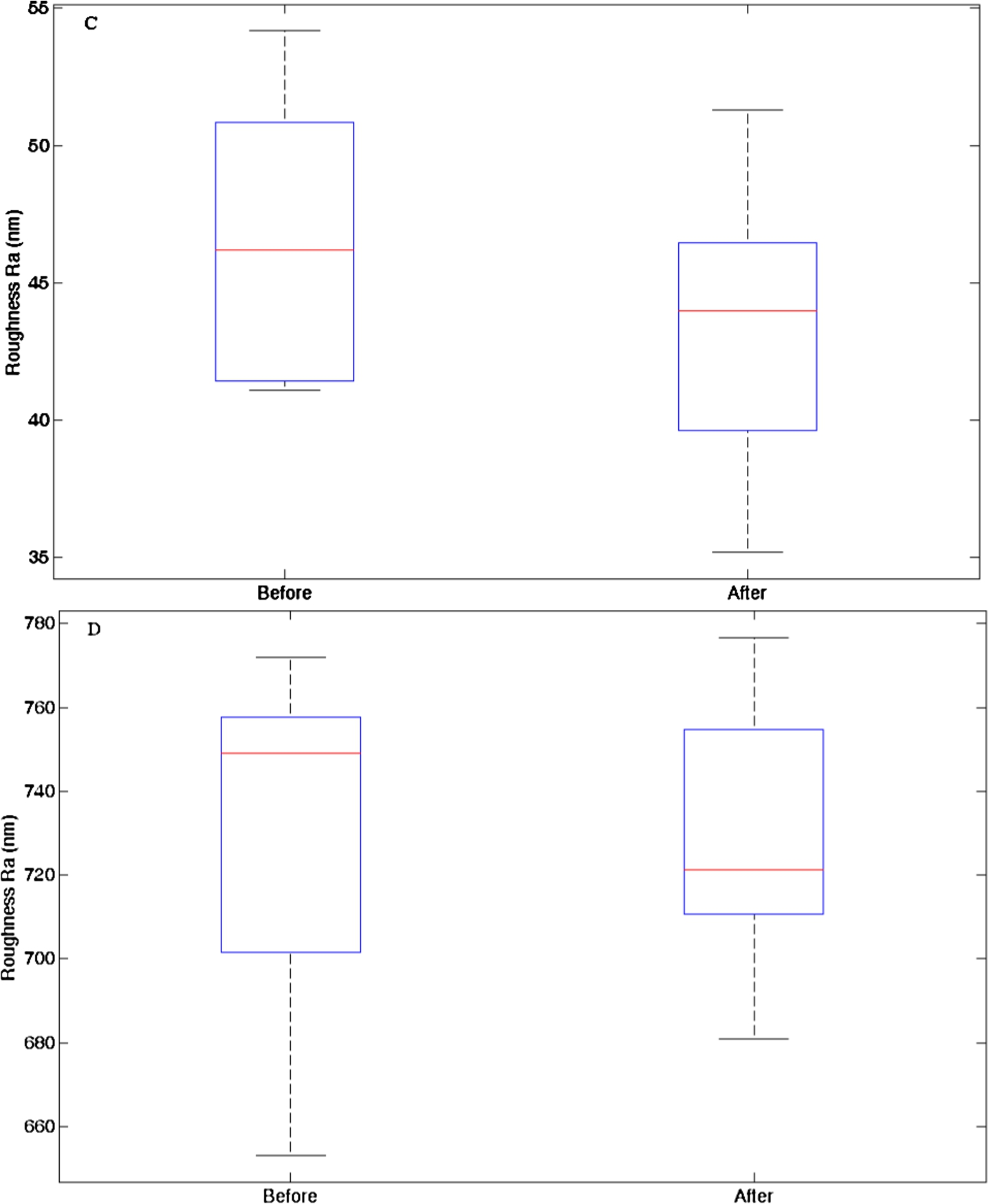
Roughness of the sample surfaces was determined by Ra values before and after processing through the WD cycles (Table 2). Although mean values of polished samples decreased slightly, both maximum and minimum values decreased significantly (Fig. 2). Comparing measurements before and after WD cycles, both P600 and P1200 displayed a smaller standard deviation, indicating a more uniform surface. Compared to polished samples, B10 has a minimal change in roughness as the value of Ra decreased for only 0.6% and its standard deviation covers a similar range.
Roughness value of samples and changes after WD cycles
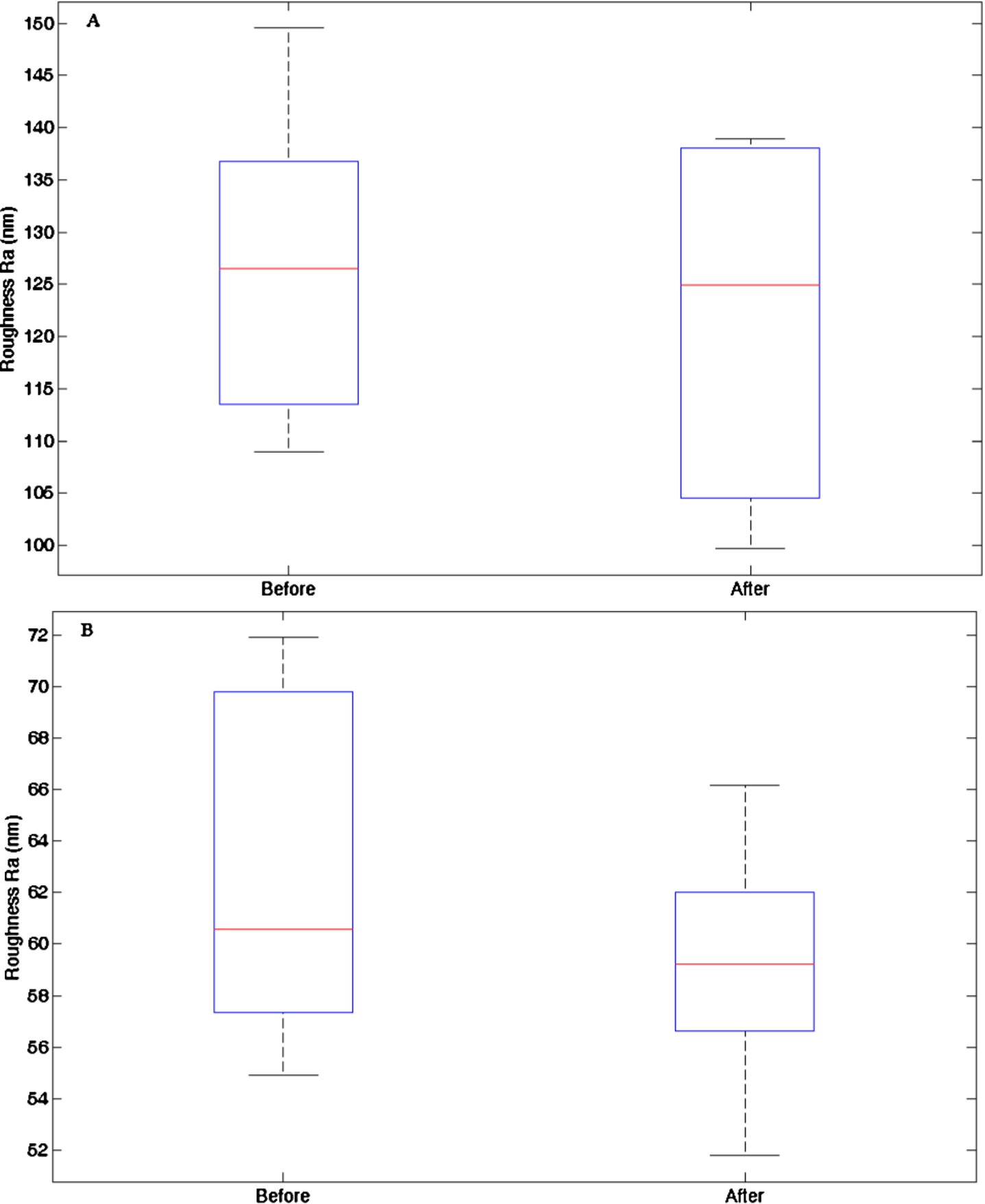
Roughness value of different surface finishes (A) P320; (B) P600; (C) P1200; (D) B10.
It appears that the WD procedure used can smooth surgical instrument surface over time. Comparing three polished samples, it is noted that the smoother the original surface, the greater is the effect. Although the mean roughness of the sample B10 decreased the most among all four groups, it is based on a much rougher original surface.
(Continued.)
After 150 WD cycles, all samples retained the same appearance except B10. Corrosion was observed on bead blasted samples (Fig. 3). However, it remains curious that only one side, that touching the washing basket during experiment, was corroded. It is suspected to be caused by the microenvironment formed between two materials (stainless steel sample and washing basket) because the corrosion occurred is galvanic corrosion instead of pitting corrosion.

Corrosion observed on bead blasted sample after WD cycles (A) overview; (B) ×100.
Chromium enrichment at the surface is a critical factor for corrosion resistance. The passivation layer is mainly composed of Fe2O3 and Cr2O3 and Cr oxides are more stable and dense than Fe oxides. Hence, high chromium concentration at the material surface provides better corrosion resistance [12]. Cr/Fe ratio is often used to indicate corrosion resistance [13,14].
The time taken to sputter gives a measure of distance from the surface. The concentration of elements was detected before and after experiments and the Cr/Fe ratio was calculated to indicate the passivity of sample surface (Fig. 4). The non-corroded area of sample B10 (Fig. 4(D)) was used in this experiment.
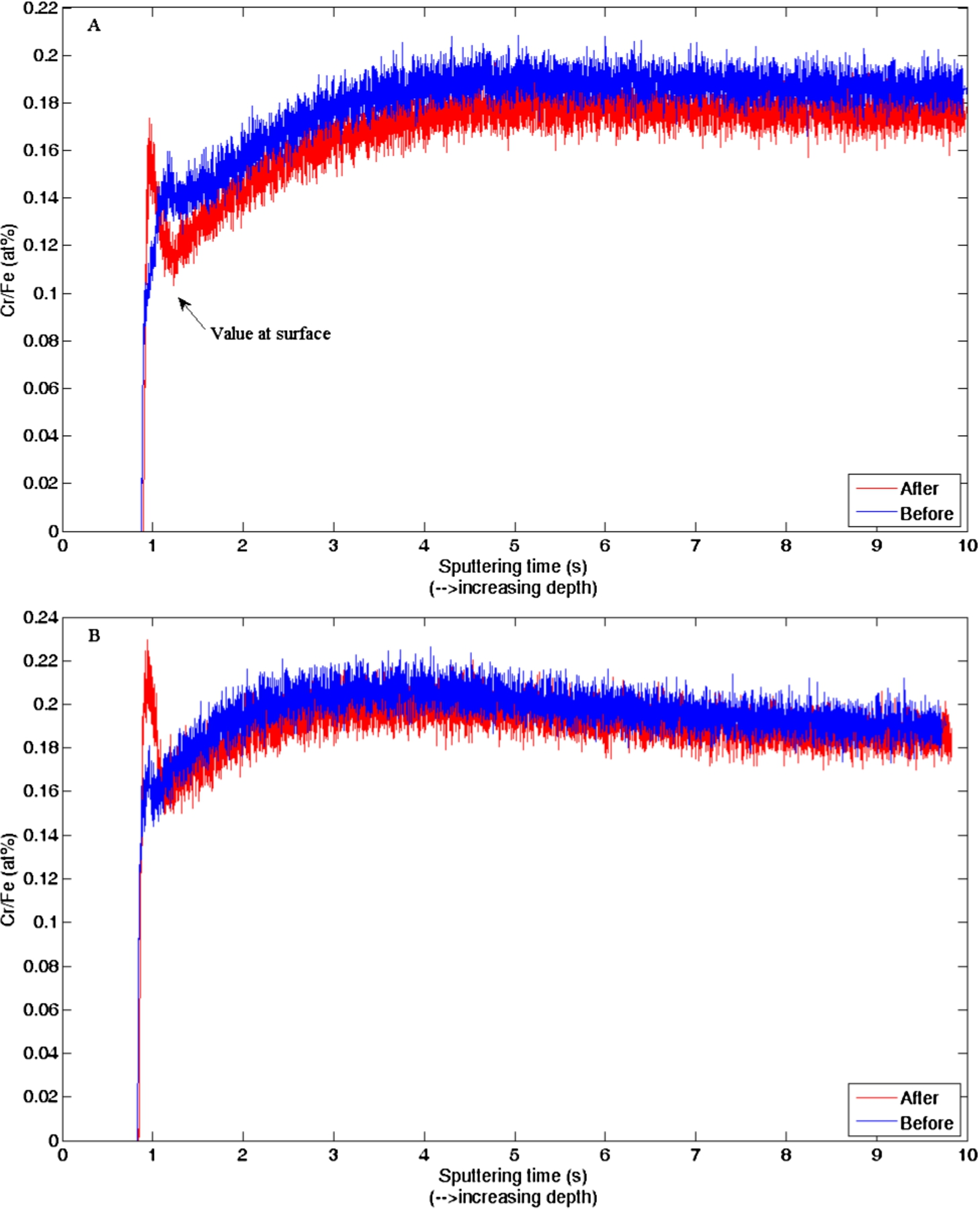
Cr/Fe value by sputtering time (A) P320; (B) P600; (C) P1200; (D) B10.

(Continued.)
Among all samples, P1200 showed the most significant effect in Cr/Fe ratio increasing from 0.24 to 0.32, followed by P600, whose Cr/Fe ratio changed from 0.18 to 0.23. P320 displayed the least increase of the three polished samples with just more than 0.01. B10 has a minimal change in Cr/Fe ratio. Changes of Cr/Fe ratio caused by WD process only have an effect within a few microns of the surface (displayed on figures from 0.8 s to about 1.2 s), before the Cr/Fe ratio of the material reaches back to its bulk compositional ratio.
All samples showed an increase of Cr/Fe ratio at the sample surfaces, indicating that WD cycle using alkaline detergent have a positive effect on corrosion resistance of polished stainless steel type 420. The effect ranks as
By combining roughness results and depth profile of the samples, it may be concluded:
Currently used washing decontamination process with alkaline detergent has a positive effect on stainless steel type 420;
It would be helpful in extending surgical instrument life time to reduce roughness and increase the Chromium concentration at the surface;
The effect increases as roughness is reduced.
Inter-material reaction with stainless steel basket tray will be studied in the future, as one factor of surgical instrument corrosion problem appears galvanic corrosion.
More grades of stainless steel used to manufacturer surgical instruments, such as AISI 410 (forceps and retractors), AISI 303 (chisels and bone curettes) and AISI 316L (medical implants) will be included in future experiments. Work will also be carried in collaboration with several manufacturers using commercial surface finish grades including polishing, sand and bead blasting.
Footnotes
Acknowledgements
This work was funded through support from the University of Dundee, Northern Research Partnership (NRP) and Scottish Funding Council (SFC).
Conflict of interest
The authors have no conflict of interest to report.