



Abstract
Objective:
The purpose of this study was to evaluate the effect of double-application coats and times on microtensile bond strength (μTBS) and adhesive-dentin interfaces created by dentin adhesive systems after 6 months of storage in water.
Materials and methods:
Two-hundred sixteen extracted non-carious human third molars were selected for the study. Single-Bond Universal (SU) and All-Bond Universal (AU), Adper Easy One (Eo) Self-Etch adhesive and Adper Single-Bond 2 (Sb) etch-and-rinse adhesive were applied to a flat dentin surface using three methods (1): dentin adhesives were applied as recommended by the manufacturers; (2): two consecutive coats of dentin adhesives were applied before photo-polymerization; and (3): a single coat of adhesive was applied but with twice the manufacturers recommended application time. Microtensile bond strength was determined either immediately or after 6 months of water storage. Data were analyzed using one-way analysis of variance and Tukey’s post-hoc tests.
Results:
At 24 h, groups 1, 2, and 3 exhibited statistically similar results for all dentin adhesive systems. For AU-Er, group 3 showed significantly higher bond strength than all group of AU-Se after 6 months.
Conclusion:
Universal adhesives seemed more stable against water degradation than traditional two-step etch-and-rinse and all-in-one systems within the 6-month period.
Introduction
Current adhesive technology tends to simplify bonding procedures by decreasing application steps, shortening clinical application time, and reducing technique sensitivity [1]. In addition to the number of application steps, which may involve three, two, or single application steps, adhesives can be classified based on their functional mechanism as etch-and-rinse and self-etch adhesives [1]. Recently, a new type of adhesive has been introduced. These types of self-etch adhesive are classified as ‘universal’ or ‘multi-mode’ because they can be used with the etch-and-rinse, selective enamel etching, or self-etch techniques [2,3]. However, adhesives still face the challenge of combining the improvements made in adhesion performance, adhesive reliability, and simplified application protocols [2].
Gaps between teeth and restoratives are caused by weakened adhesives; therefore, the durability of bonds is paramount for restorative longevity [4]. Resin degradation is directly related to water sorption [5]. Hydrolytic degradation of resin may also induce dentin bond strength decreases [6–8]. This decline is also linked with proteolytic changes in exposed collagen fibrils within dentin [6–8].
Increased bond strength may be achieved when multiple coats or prolonged adhesive application times are used on dentin, instead of those recommended by manufacturers [9–11]. The better performance of double-application coats and times of adhesives may be accounted for through several mechanisms. With longer resin application times, monomers are able to continue diffusing inward, and likewise solvents diffuse outwards [10]. With double coats, the first adhesive layer etches the dentin substrate and may quickly become buffered by the hydroxyapatite [12]; the additional layers of unpolymerized acidic monomers may subsequently improve etching by increasing the concentration of acidic reagents. Further impregnation of resin may simultaneously occur because of the additional supply of adhesive resin [13].
Bond strength and bond durability are affected by the extent of resin infiltration into the exposed collagen network [14,15]. Ideally, adhesive monomers should fill the interfibrillar spaces around exposed collagen fibrils [14,16]. Double-application coats or times could increase resin saturation into the collagen network. These methods can be used easily in clinical practice, thereby improving the quality of resin-dentin bonds [10]. However, there are no reports on the effects of double-application coats and times for universal adhesives after aging in water. Thus, the purpose of the study was to evaluate the effect of double-application coats and times on μTBS and adhesive-dentin interfaces created by dentin adhesive systems immediately and after 6 months of water storage. The null hypotheses tested were as follows: (1) there is no difference in bond strength following double manufacturer-recommended application coats and times of adhesives, and (2) bond degradation is not prevented by different application protocols of adhesives after 6 months of water storage.
Materials and methods
The study protocol was approved by the local ethics committee (Ethical Committee of Istanbul University, Ref No: 2013/654). A schematic illustration of the study design is shown in Fig. 1.
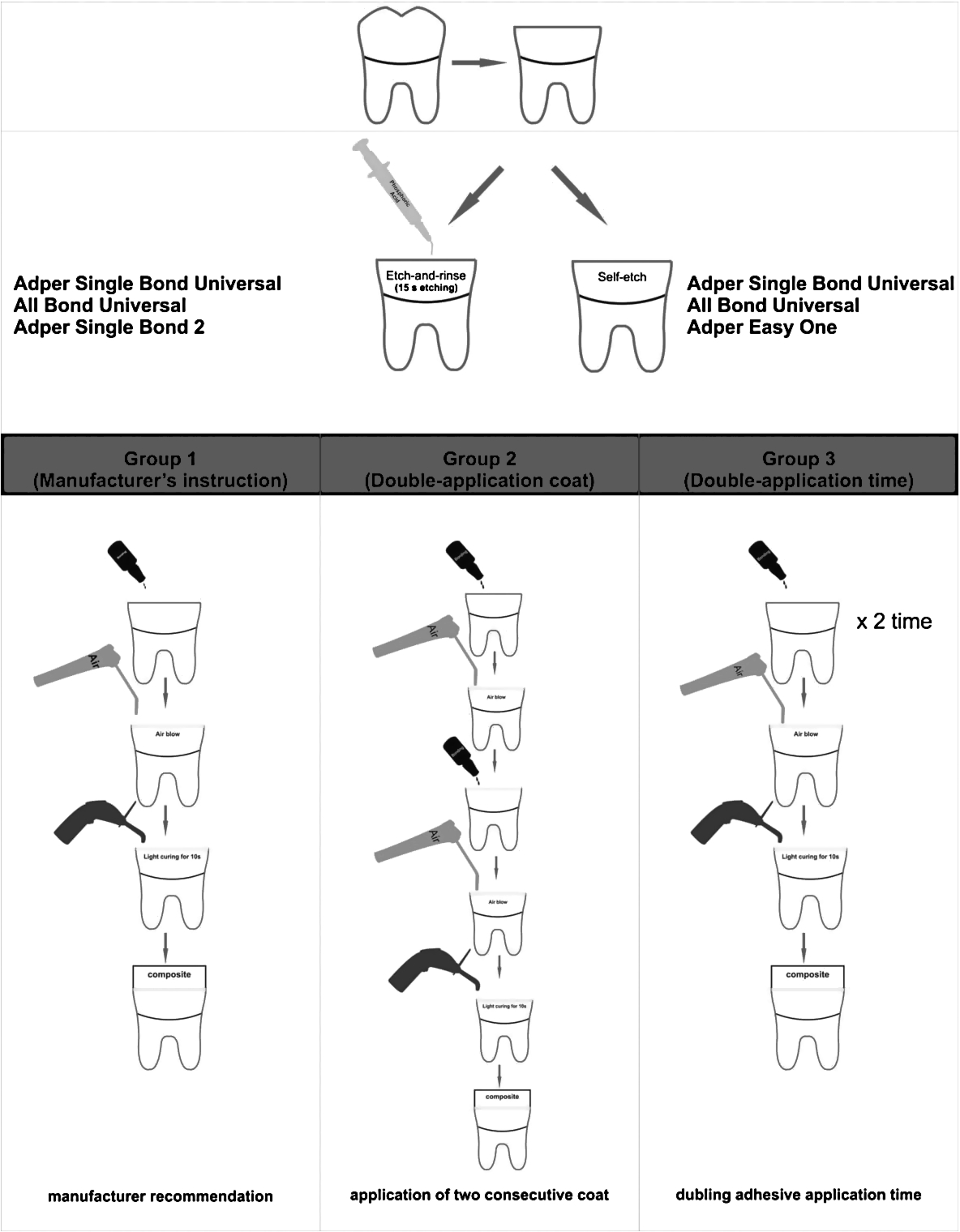
Schematic representation of the study design.
A total of 216 extracted non-carious human third molars were selected for the study. Of these, 180 were used for μTBS tests and 36 were used for scanning electron microscopy (SEM) examination. Teeth were stored for less than 1 month in 0.5% chloramine-T solution at 4°C. The occlusal enamel was sectioned using a slow-speed diamond saw (Isomet, Buehler; Lake, Bluff, Illinois, USA) under water lubrication to prepare a superficial dentin surface. The occlusal enamel was examined under a light microscope (Olympus SZ61, Munster, Germany) at ×30 magnification to ensure it had been accurately removed. The newly-exposed dentin surfaces were finished using 600-grit wet silicon carbide (SIC) abrasive for 15 seconds to standardize the smear layer.
Bonding procedures
After the flat dentin surfaces were prepared, 60 of 180 teeth were equally randomly assigned to the control adhesives materials (30 teeth). The remaining 120 teeth were randomly assigned to the two tests, the universal adhesive with etch-and-rinse (Er) and self-etch (Se) mode (60 teeth). Adper Single Bond 2 etch-and-rinse (Sb) (3M ESPE, St. Paul, MN, USA), and Adper Easy One Self-Etch Adhesive (Eo) (3M ESPE, St. Paul, MN, USA) were used as a control. Single-Bond Universal Adhesive (SU) (3M ESPE, St. Paul, MN, USA) (60 teeth) and All-Bond Universal (AU) (Bisco, Schaumburg, IL, USA) (60 teeth), (30 teeth) with both approaches of etch-and-rinse (Er) and self-etch (Se) were used as test materials. The ingredients of the dentin adhesives and manufacturer’s recommendations are listed in Table 1. The adhesives were applied with micro-brushes using one of the three following methods (Fig. 1):
The dentin adhesive system was used in accordance with the manufacturer’s instructions.
The dentin adhesives were applied in two consecutive coats prior to photo-polymerization. The first coat was applied in accordance with the manufacturer’s recommendations. A second coat was then similarly applied. Adhesive systems were then polymerized for 10 s using a halogen light unit (Optilux 501, Kerr Corp., Middleton, WI, USA) calibrated at 850 mW/cm2.
a single coat of dentin adhesive was applied but with twice the manufacturer’s recommended application time prior to photo-polymerization. The method of use for each dentin adhesive was in accordance with the manufacturer’s instructions but for double the amount of time. The adhesive systems were then polymerized for 10 s using a halogen light unit.
Dentin adhesives ingredients and manufacturer’s instructions
Dentin adhesives ingredients and manufacturer’s instructions
bis-GMA = bisphenol glycidyl methacrylate; MDP = methacryloyloxydecyl dihydrogen phosphate; HEMA = 2-hydroxyethyl methacrylate.
Five teeth (
After storage in distilled water at 37°C for 24 h, each tooth was longitudinally sectioned across the bonded interfaces in the mesio-distal and bucco-lingual directions using a slow-speed diamond saw to obtain resin-dentin beams with a cross-sectional area of approximately 1 mm2. A beam from each tooth was assigned to be tested immediately or after storage in distilled water at 37°C for 6 months. The beams were then attached to a modified device for μTBS testing using cyanoacrylate resin (Zapit Dental Ventures of North America, Corona, CA, USA) and were subjected to a tensile force in a universal testing machine (Micro Tensile Tester; Bisco Inc., Schaumburg, IL, USA) at a crosshead speed of 0.5 mm/min. The tensile load was applied until specimen failure. The failure load was divided by specimen cross-sectional area to express results in MPa. The mean μTBS of the beams from each tooth was used as the value for that tooth and the mean μTBS per tooth was used as the statistical unit. The fracture modes were evaluated at
SEM observations
For each dentin adhesive system, two teeth per group (
The specimens were vertically sectioned in a bucco-lingual plane through the center of the restoration and polished with 600-, 800-, and 1200-grit silicon carbide abrasive papers under running water. They were subsequently treated with 1-, 0.3-, and 0.05-
Statistical analysis
All statistical analyses were performed using IBM SPSS for Windows version 20.0 (SPSS, Chicago, IL, USA). Kolmogorov–Smirnov tests were used to test the normality of data distribution. Continuous variables were expressed as mean ± standard deviation. Comparisons of continuous variables between groups were performed using one-way analysis of variance and Tukey’s post hoc test. A two-sided P value < 0.05 was considered statistically significant.
Microtensile bond strength (means ± standard deviations) and statistically significance (number of intact sticks tested/ number of pre-test failured sticks) of tested adhesives for application groups. (AU: All Bond Universal, SU: Single Bond Universal, Sb:Adper Single Bond 2, Eo: Adper Easy One)
Microtensile bond strength (means ± standard deviations) and statistically significance (number of intact sticks tested/ number of pre-test failured sticks) of tested adhesives for application groups. (AU: All Bond Universal, SU: Single Bond Universal, Sb:Adper Single Bond 2, Eo: Adper Easy One)
Note. Identical capital letters in rows indicate no significant diffrence between groups for means of each adhesives with self etch and etch-and rinse mode after 24 hours Identical lower case letters show in rows show no significant diffrence between groups for means of each adhesives with self etch and etch-and-rinse mode after 6 months. Identical upper symbols in columns demonstrate no significant diffrence between means of adhesives with self etch and etch-and-rinse mode for each group after 24 hours and 6 months.
Number and percentage (%) of specimens according to fracture mode for each self etch experimental group. (A: adhesive, C: cohesive within dentin, D: cohesive within composite resin, M: mixed)
Number and percentage (%) of specimens according to fracture mode for each etch & rinse experimental group. (A: adhesive, C: cohesive within dentin, D: cohesive within composite resin, M: mixed)
Statistic comparison of the bond strength values between 24 hours 6 months for each dentin adhesive (AU: All Bond Universal, SU: Single Bond Universal, Sb: Adper Single Bond 2, Eo: Adper Easy One)
The mean μTBS values with standard deviations and fracture modes are summarized in Tables 2, 3 and 4. Table 5 demonstrates the statistical comparison of bond strength values of groups between 24 hours and 6 months for each dentin adhesive. The statistical comparisons between groups for each adhesive system and comparison between dentin adhesive systems for each group are shown in Table 2. One-way ANOVA revealed a significant influence of time, adhesives, and groups (
There was no statistically significant difference between Se and Er approaches for SU and AU in groups 1, 2, and 3 after 24 hours. At 24 h, there was no statistically significant difference between group 1 (manufacturer’s instructions), group 2 (double-coat), and group 3 (double-application time) for all adhesives. After 6 months of water storage for AU-Er, group 3 exhibited statistically higher μTBS values than each group of AU-Se (
When universal adhesives were used in the Se application mode, SU and AU exhibited similar μTBS values to each other and with Eo for groups 1 and 2 after 24 hours. For group 3, only SU showed significantly higher strength than Eo. When universal adhesives were used in the Er application mode, Sb (48.4 MPa) exhibited significantly higher strength than SU (37.9 MPa) and AU (32.8 MPa) in group 1. In group 2, Sb (42.4 MPa) only showed significantly higher strength than SU (33.3 MPa) (
After 6 months of water storage, μTBS values of SU and AU did not decrease significantly according to 24 h (
Fracture analyses
For each specimen, the most common failure was adhesive fracture at 24 h and after 6 months (Tables 3 and 4) of water storage (rate, 27.3–100%). The second most common type of failure was cohesive fracture within the dentin (rate, 0–56%). Cohesive fracture within composite and mix fracture was the least frequent pattern.
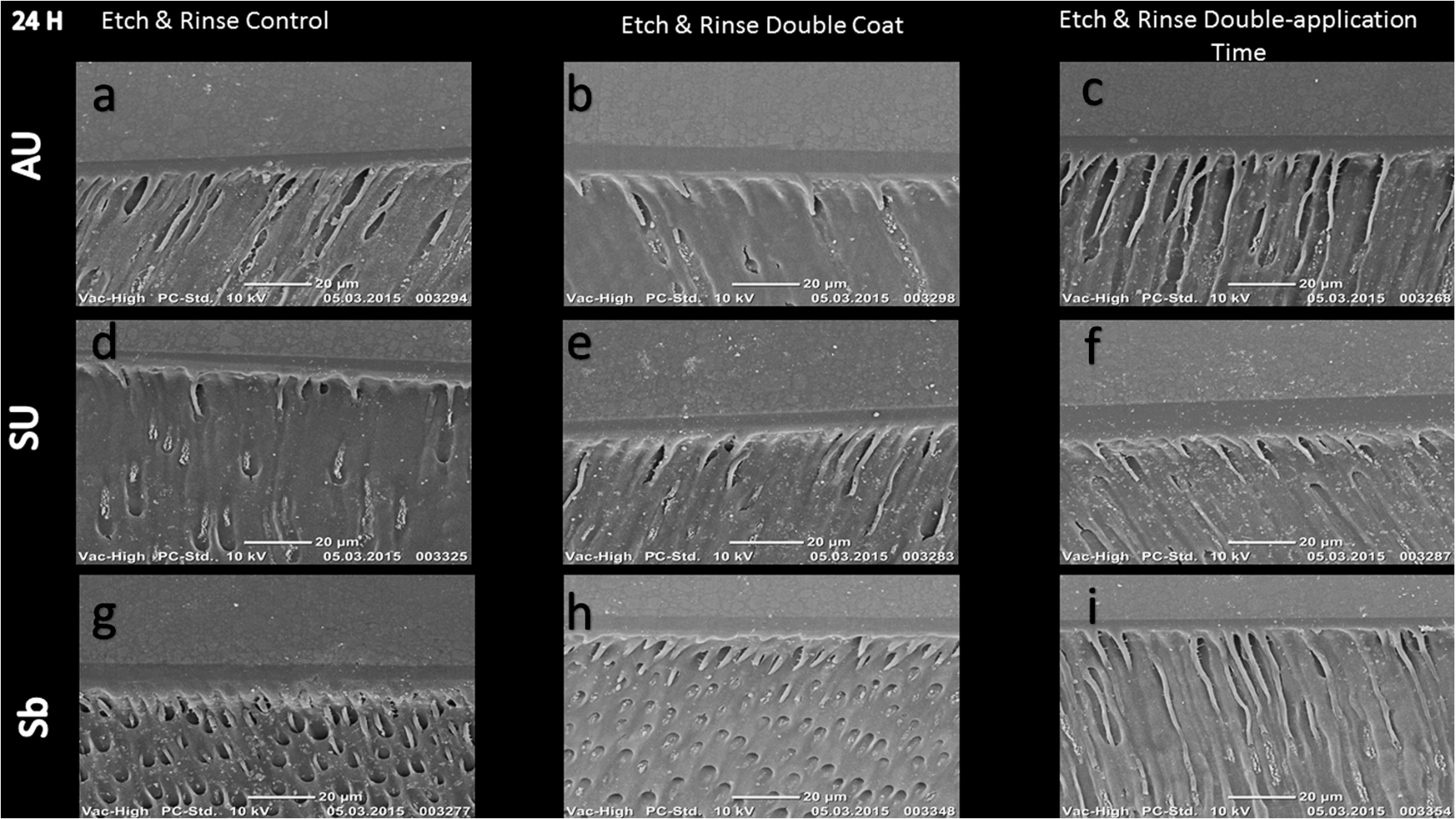
Representative SEM images of tested adhesives for etch&rinse application groups after 24 hours (AU: All Bond Universal, SU: Single Bond Universal, Sb: Adper Single Bond 2).
In Er mode and different application groups (AU, SU, and Sb), a thicker hybrid and adhesive layer and funnel-shaped resin tag formations were seen after 24 hours (Fig. 2). However, funnel-shaped resin tag formations and resin tags in the dentin tubules were thicker in group 2 than the other application groups (Fig. 2(b, e, h)). Also, these three adhesives showed deeper penetration into dentin with formation of long and regular resin tags (Fig. 2(c, i)). In Se mode, a thick adhesive layer and thin hybrid layer with a few short resin tags was detected for the three application groups (AU, SU and Eo) after 24 hours (Fig. 3). Also in this application mode (Se), some small gaps between the adhesive layer and composite were seen in SU group 1 (Fig. 3(d)). Moreover, a large gap as found in adhesive failure was detected in three application groups for Eo after 24 hours (Fig. 3(g–i)). After 6 months, similar to the 24-hour findings, thicker adhesive and hybrid layer and funnel-shaped resin tag formations were observed in the three application groups (AU, SU and Sb) in the Er mode. Funnel-shaped resin tag formations and resin tags in the dentin tubules were larger and longer. Moreover, deeper dentin penetration with regular and a high concentrations of dense resin tags were seen all application groups (AU, SU and Sb) (Fig. 4). In the SE mode and different application groups for AU, SU, and Eo, similar to the 24-hour results, a thick adhesive layer and thin hybrid layer with a few short resin tags was observed (Fig. 5). Small gaps between hybrid layer and dentin were seen in groups 1 and 2 of AU (Fig. 5(a, b)). Larger and more gaps between the hybrid layer and dentin were also observed in groups 1 and 2 of Eo (Fig. 5(g, h)).

Representative SEM images of tested adhesives for self-etch application groups after 24 hours (AU: All Bond Universal, SU: Single Bond Universal, Eo: Adper Easy One).
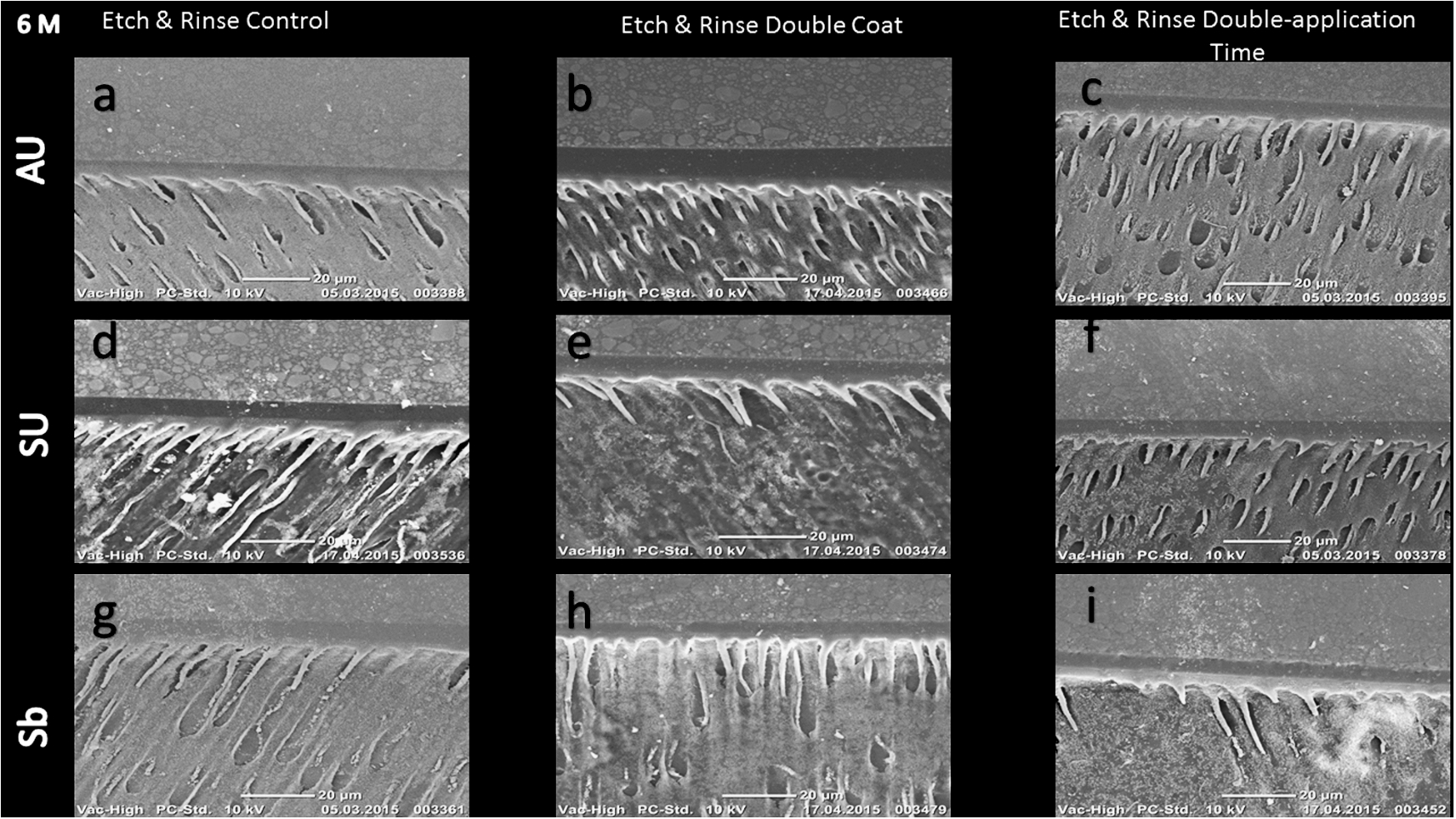
Fig. 4: Representative SEM images of tested adhesives for etch&rinse application groups after 6 months (AU: All Bond Universal, SU: Single Bond Universal, Sb: Adper Single Bond 2).
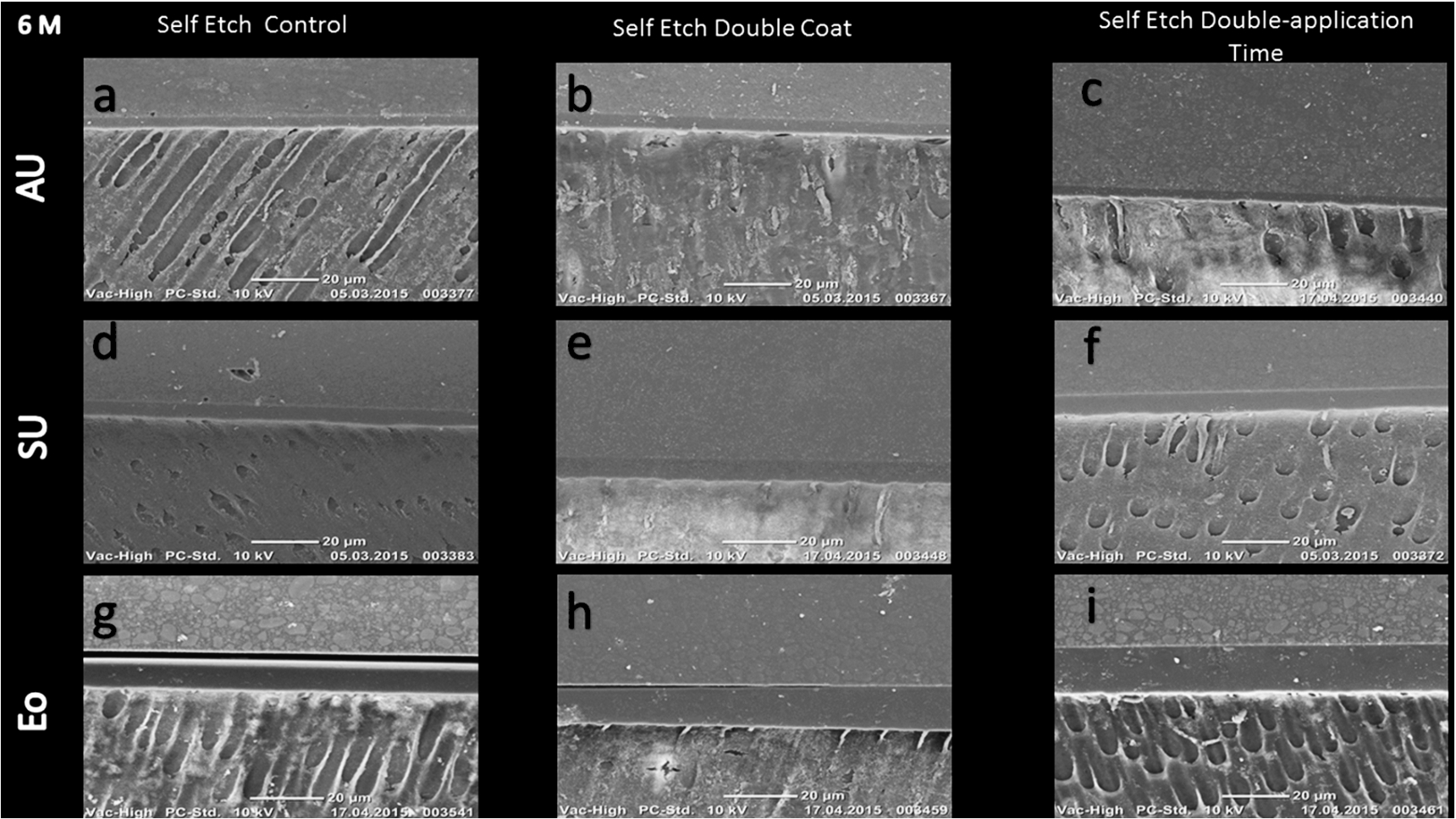
Representative SEM images of tested adhesives for self-etch application groups after 6 months (AU: All Bond Universal, SU: Single Bond Universal, Eo: Adper Easy One).
The study results showed that the double-application coat (group 2) and double-application time (group 3) of adhesives exhibited statistically similar μTBS values to those found with the manufacturer’s instructions (group 1) for SU with Se and Er, AU with Se and Er, and Eo and Sb after 24 hours. However, group 3 of SU adhesive with Se and AU with Er exhibited higher bond strength than groups 1 and 2. Thus, our first null hypothesis that “there is no difference in bond strength following double application coats or times compared with manufacturer’s recommended application times” for adhesives was partially accepted. Our second null hypothesis, “bond degradation cannot be prevented with different application protocols of adhesives after 6 months of water storage” was partially accepted, because bond degradation was not prevented by double-application coats or times for Eo and by double-application times for Sb, likewise in group 1. Two universal adhesive systems were quite stable over the 6-month period with both Se and Er for each group. In agreement with the findings of the present study, Scotch Bond Universal, which is the same as Single-Bond Universal, showed no difference between double-coat application and use of the manufacturer’s recommendations after 24 hours and 6 months. Also, it was reported that improvement in bond strength of one-step self-etch adhesives using double-coat applications were adhesive dependent [18]. One of the aims of this study was to improve bond strength using a double-application coat and double-application time. Pashley et al. showed that bonding of Prompt L-Pop to dentine may be improved by application of a second adhesive layer after light curing the first layer [19]. The authors stated that an additional application of adhesive system could seal the nonpolymerized oxygen inhibition layer, thus enabling it to be adequately polymerized [19]. Hashimoto et al. [10] reported that the method of multiple consecutive coating during dentin bonding improved the bond strength of Optibond Solo Plus and Single-Bond and reduced nanoleakage. Furthermore, it was reported that longer resin application times increased resin-dentin bond strength [20–22]. Reis et al. reported that prolonged application times could increase the immediate μTBS of two-step etch-and-rinse adhesive systems and make the adhesive layer more stable over time [11]. When the adhesive is left undisturbed for prolonged periods, more solvent can evaporate thus allowing the formation of a stronger polymer within the dentin and higher resin-dentin bond strength. Consistent with those described above, increased μTBS values were also observed in our study after double-application coats and times; however, the highest values for bond strengths were generally achieved following two double-application times for each adhesive. Different from our study, Silva et al. reported the μTBS values of Single Bond decreased when an additional adhesive layer was used and the second application of a Clearfil SE Bond and Adper Prompt layer did not alter μTBS values [23]. However, it was suggested that the ideal adhesive thickness was certainly variable and depended on the adhesive system used [24].
Munoz et al. reported that All Bond Universal and Scotch Bond Universal on dentin as either etch-and-rinse or self-etch strategies showed lower μTBS values compared with the control adhesives after 24 hours [25]. In agreement with Munoz et al. [25], Adper Single-Bond 2 exhibited higher μTBS values than both of Universal adhesives. Also, the lowest values were obtained from all-in-one Eo after 24 hours in the present study. This difference in values may be explained by the fact that Eo did not contain 10-methacryloyloxydecyldihydrogenphosphate (10-MDP) compared with AU and SU. It was reported that10-MDP interacted chemically with hydroxyapatite (HAp) most intensively and stably, and this was considered to be the platform for the superior bonding effectiveness of MDP-based self-etch adhesives to enamel/dentin [26]. On the other hand, in the present study there was no significant difference between either Universal adhesive system after 24 hours. This finding is agreement with Wagner et al.’s [27] study results. Partially consistent with the findings in the present study, Munoz et al. found the only difference between Single-Bond Universal and All Bond Universal was with self-etch after 24 hours [25,28]. Partially in agreement with the present study’s results, only with self-etch, AU showed less bond strength than SU [25,29] and the hydrophobic resin coating significantly increased bond strength of AU with Se after 6 months [29]. AU “ultra-mild” (pH ≈ 3.1) [30] adhesive produced superficial demineralization in dentin only partially and the residual hydroxyapatite was still attached to the collagen [1]. The low acidity of AU was assumed to be insufficient to etch the dentin surface effectively into which monomer infiltration occurs [31]. Incomplete resin infiltration of the demineralized dentin can leave exposed collagen at the dentin-adhesive interface [32]. These naked collagen fibrils have been reported to reduce bond strength over time, because they are not protected against exogenous substances [32–34]. A systemic review reported that ultra-mild universal adhesive evaluated (All Bond Universal) showed an improvement in the dentin bond strength with the etch-and-rinse strategy [30]. SU and Eo are two adhesives from the same manufacturer that have a concentration of the polyalkenoic acid copolymer known as Vitrebond copolymer (1–5%). This copolymer might also provide chemical bonding derived from its spontaneous bonding to hydroxyapatite [35,36]. For self-etch adhesives, it is well known that chemical bonding between polycarboxylic monomers and hydroxyapatite plays a crucial role in their bonding mechanism [36]. In addition, SU and AU are MDP-containing 1-step self-etch adhesives that can chemically interact with calcium in hydroxyapatite [37]. However, AU does not have a polyalkenoic acid copolymer such as Vitrebond copolymer in its composition. The lack of the additional chemical bonding provided by a Vitrebond copolymer may be the reason why the mean bond strength was significantly weaker for AU with Se than for SU with Se [38]. Therefore, double-coating or double-application time may increase resin infiltration, thus may improve chemical bonds in group 2 for AU with Er mode or in groups 2 and 3 for SU with Er.
Universal adhesives seemed more stable against water degradation than traditional two-step etch-and-rinse (Adper Single Bond 2) and all-in-one systems (Adper Easy One) over the 6-month period. In contrast to the results of the of present study, Scotchbond Universal applied with different mode exhibited significantly lower bond strength after 6 months compared with 24-hour values [39]. Consistent with our findings, it was reported that although Sb as a control group showed significantly lower bond strength after 6 months of water storage, Universal adhesives (SU with Er and Se, and AU with Se) that contain MDP exhibited stable bond strength [28]. In the present study, universal adhesives differed from Sb and Eo primarily with the incorporation of the 10-MDP monomer in the former, to provide acidity for its self-etching capability. Although to differing levels, MDP-containing adhesives form nano-layers at the adhesive interface, depending on the formulation of the adhesive. Stable MDP-Ca salt deposition together with these nano-layers may explain the high stability of MDP-based bonding [40].
Chen et al. reported that the use of universal adhesives in either etch-and-rinse or self-etch applications did not result in significantly different μTBS to dentin [41]. In agreement with Chen et al. [41], statistically similar μTBS values were obtained from self-etch and etch-and rinse-modes for three application groups of both universal adhesives after 24 hours. Several studies have reported that bond strength values were similar for etch-and-rinse and self-etch approaches for universal adhesives [25,27,42].
In agreement with SEM images of the present study, Wagner et al. [27] observed that when acid etching was applied prior to the adhesives (etch-and-rinse), all universal bonding showed deeper penetration into dentine with formation of long resin tags (up to 50 μm) and thicker hybrid layer (2–4 μm) [27].
Conclusion
Use of universal adhesives (AU and SU) as either Er or Se did not result in significantly different μTBS to dentin in three groups for either universal adhesive after 24 hours. Universal adhesives seemed more stable against water degradation than the traditional two-step etch-and-rinse and all-in-one systems over the 6-month period. In all groups, Sb exhibited the highest μTBS values at 24 hours, but after 6 months of water storage, both universal adhesives had the highest values. AU with ER showed significantly higher strength than SU with ER only in group 3 after 6 months. SU with SE demonstrated higher bond strength than AU with Se in groups 2 and 3. A numeric increase in bond strengths occurred for SU, AU, Sb, and Eo with double-application coats and times, but these increases were not statistically significant.
Footnotes
Acknowledgements
The current study is based on a thesis submitted to the graduate faculty, University of Istanbul, in partial fulfillment of the requirements for the degree of Doctor of Philosophy and was supported by Scientific Research Projects Coordination Unit of Istanbul University. Project number 29935.
Conflict of interest
The authors declare no conflicts of interest related to the materials tested in the present study.