



Abstract
Background:
The clinical magnetic resonance imaging (MRI) images may get corrupted due to the presence of the mixture of different types of noises such as Rician, Gaussian, impulse, etc. Most of the available filtering algorithms are noise specific, linear, and non-adaptive.
Objective:
There is a need to develop a nonlinear adaptive filter that adapts itself according to the requirement and effectively applied for suppression of mixed noise from different MRI images.
Methods:
In view of this, a novel nonlinear neural network based adaptive filter i.e. functional link artificial neural network (FLANN) whose weights are trained by a recently developed derivative free meta-heuristic technique i.e. teaching learning based optimization (TLBO) is proposed and implemented.
Results:
The performance of the proposed filter is compared with five other adaptive filters and analyzed by considering quantitative metrics and evaluating the nonparametric statistical test. The convergence curve and computational time are also included for investigating the efficiency of the proposed as well as competitive filters.
Conclusion:
The simulation outcomes of proposed filter outperform the other adaptive filters. The proposed filter can be hybridized with other evolutionary technique and utilized for removing different noise and artifacts from others medical images more competently.
Introduction
MRI is a one of the modern noninvasive imaging modality extensively used for soft tissue imaging, especially in the assessment of neurological, cardiovascular and musculoskeletal disorder. More importantly, it is free from dangerous ionic radiation and provides good resolution image in real-time. However, the noise which corrupts the MRI images may not be of a unique type. Apart from impulse noise produced by switching circuit and Gaussian noise super-imposed during transmission, Rician noise has the maximum contribution in MRI images. Rician causes random fluctuations and bias in acquired medical images [1]. Similarly, impulse and Gaussian noises generate a pimple and grain like effects respectively. When noises of multiple origins and characteristics are present in the image, denoising becomes non-effective because most of the available filters are suitable for the selected set of noise. For example, a median filter is suitable for impulse noise and a mean filter is preferable for Gaussian noise reduction [2]. Likewise, in the case of Rician noise, these two filters fail to give satisfactory result [3]. In fact, in a real scenario, the noise which corrupts the image may not be of a single type. Different types of noise are produced which depends upon various factor such as sensor temperature, environmental conditions, types of electrical circuitry etc. Also, different types of noise are introduced at the time acquisition, sampling, quantization, transmission, etc. Practically, it is not possible to recognize the source of noise and its type. Furthermore, the selection of the respective appropriate filter to suppress the corresponding noise is extremely challenging. Hence, to fulfill this limitation, adaptive filters are introduced that effectively performs irrespective of all these.
Adaptive filters achieve this by suitably tuning their parameters using different advanced techniques. These adaptive filters can be either linear or nonlinear. Wiener filter, Kalman filter, pseudo-inverse filter, etc. are examples of linear adaptive filters. The linear adaptive filters blur the edge of an image during smoothening [4]. However, unlike linear filters, nonlinear adaptive filters remove noise without degrading the edge information. Artificial neural network (ANN) based realizations of filters are one of the widely used nonlinear adaptive filters. The performance of the neural network based nonlinear adaptive filters is a well appreciated one on acoustic, images, electrocardiography, electroencephalogram, etc. [5–7].
An important feature of ANNs is that of generalization, whereby a trained ANN is capable of providing a correct set of matching output data from the previously unseen input. Typically, learning of ANN occurs by some sort of example through training, where the training algorithm iteratively adjusts the interconnected weights of input and output layers. Multilayer perceptron (MLP) network is an example of ANN filter and usually applied to eliminate noise from the images [8]. However, the complexity of MLP is high due to the presence of multiple layers, and consequently, it has a lower rate of convergence. A single layer neural network named as FLANN where the input is functionally expanded is introduced to improve the performance with higher convergence speed. Subsequently, FLANN has been employed in many engineering applications such as noise cancellation, classification, system identification, etc. [9–13]. There are already numerous neural networks available and each utilizing a different form of training scheme. The training of the neural network can be classified into the derivative (gradient) and derivative-free algorithms. Derivative based techniques such as least mean squares (LMS), backpropagation (BP), recursive least squares (RLS), etc. are applied to update the weights of a neural network. However, these algorithms are not preferable for nonlinear problems due to the reasons like learning rate dependency, stuck at local maximum or minimum point and making the network sluggish [14,15]. For a reason mentioned above, derivative free heuristic techniques such as genetic algorithm (GA), particle swarm optimization (PSO), artificial bees colony (ABC), cat swarm optimization (CSO), etc. are applying for the training of neural networks [16–19].These evolutionary algorithm based neural filters have been applied for removing noise from various images [20,21]. However, the efficiency of such filtering algorithms depends upon crossover, mutation, inertia, cognitive and social parameters. Thus, Rao et al. [22,23] have developed TLBO optimization technique which mimics the learning methodology between teacher and student. Unlike, other evolutionary methods it has only one controlling parameter. It helps in avoiding unnecessary concern about the values of different parameters making it less complex and improves convergence rate. Naik et al. [24] have applied TLBO for updating the weights of FLANN network and implemented in the classification task.
The principle objective of this paper is to propose TLBO based FLANN (TLBO-FLANN) adaptive filter to suppress noise such as Rician, Gaussian, impulse and their mixture from different MRI images. The TLBO is used as an optimization technique for selection of the best possible set of weights by taking the error as a cost function. To the best of author’s knowledge, the implementation of TLBO algorithm to update the weights of FLANN structure for removing rician noise from the MRI images has not been reported in the literature till yet. Along with TLBO, some other optimization techniques such as LMS, BP, PSO and CSO are also applied to train the variants of neural filters. The proposed approach along with other state-of-the art and their performance on the basis of qualitative as well as statistical analysis is detailed in the rest part of this article.
Proposed TLBO based FLANN (TLBO-FLANN) filter
The architecture of FLANN is very simple in design because of the absence of hidden layers and exploiting relevant functional (examples: exponential, power, trigonometric, etc.) expansion to solve any nonlinear task. It also provides superior or equivalent result compare to traditional MLP and other modern variants of ANN in many challenging applications [9–13]. In this article, the FLANN network has been trained with limited controlling parametric algorithm i.e. TLBO. The metaheuristic TLBO technique is inspired by teaching and learning methodology. Here, the teacher is delivering the lecture and knowledge transfer to all the students. All students also collect additional information from the surrounding resources such as self-studies, Internet, discussing with other students etc. If knowledge of any student exceeds the knowledge of the teacher, he/she will become a new teacher. This process repeats and knowledge of class enhanced. The proposed TLBO-FLANN filter is presented in Fig. 1. Here, nine pixels
Noisy pixels can be expanded exponentially in the following mathematical way,
The corresponding exponentially expanded nine noisy pixels from one kernel in an array are:
The restored intensity at nth iteration is,
Similarly, the estimated error at nth iteration is:
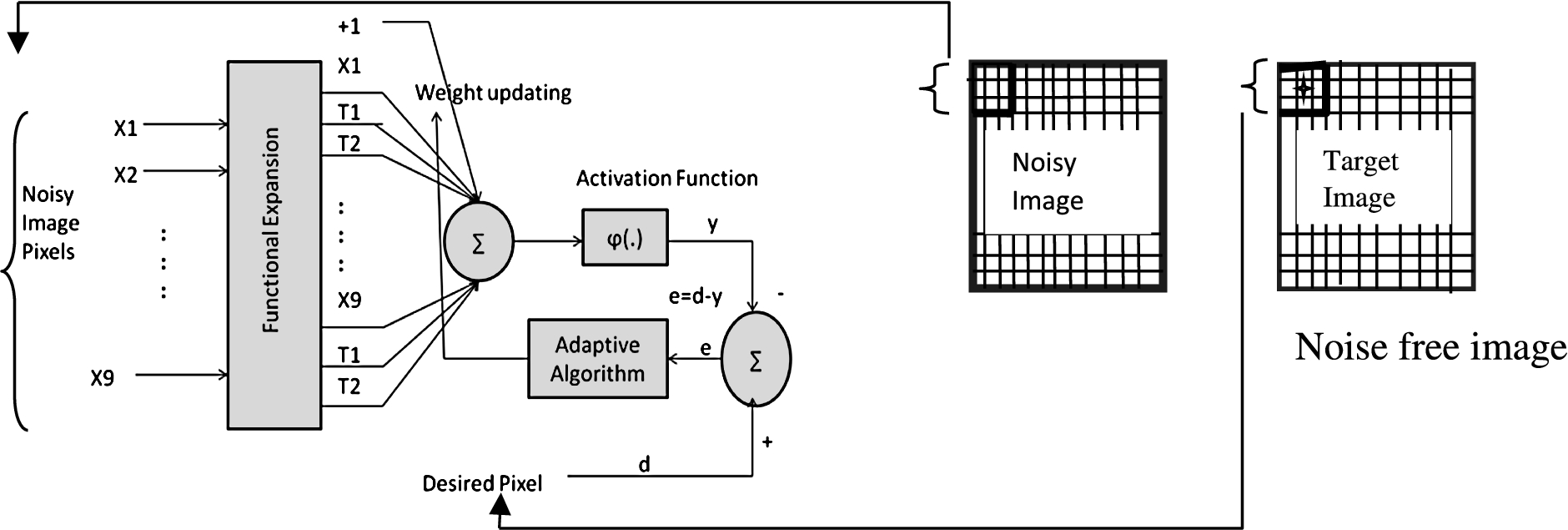
TLBO-FLANN Filter.
According to the error value in descending order, the respective 10 sets of weight are stored. The next ten sets of weight are generated by applying teaching and learning phases of TLBO algorithm. Once again, errors will be evaluated with new sets of weights and compared with the previous errors. The above procedure is applied to the whole image with the shifted kernel to successive rows as well as columns. These processes are continued until maximum iteration reached or by attaining sets of weights where the error is less than defined threshold.
Teaching Phase:
Learning Phase:
‘W’ and ‘
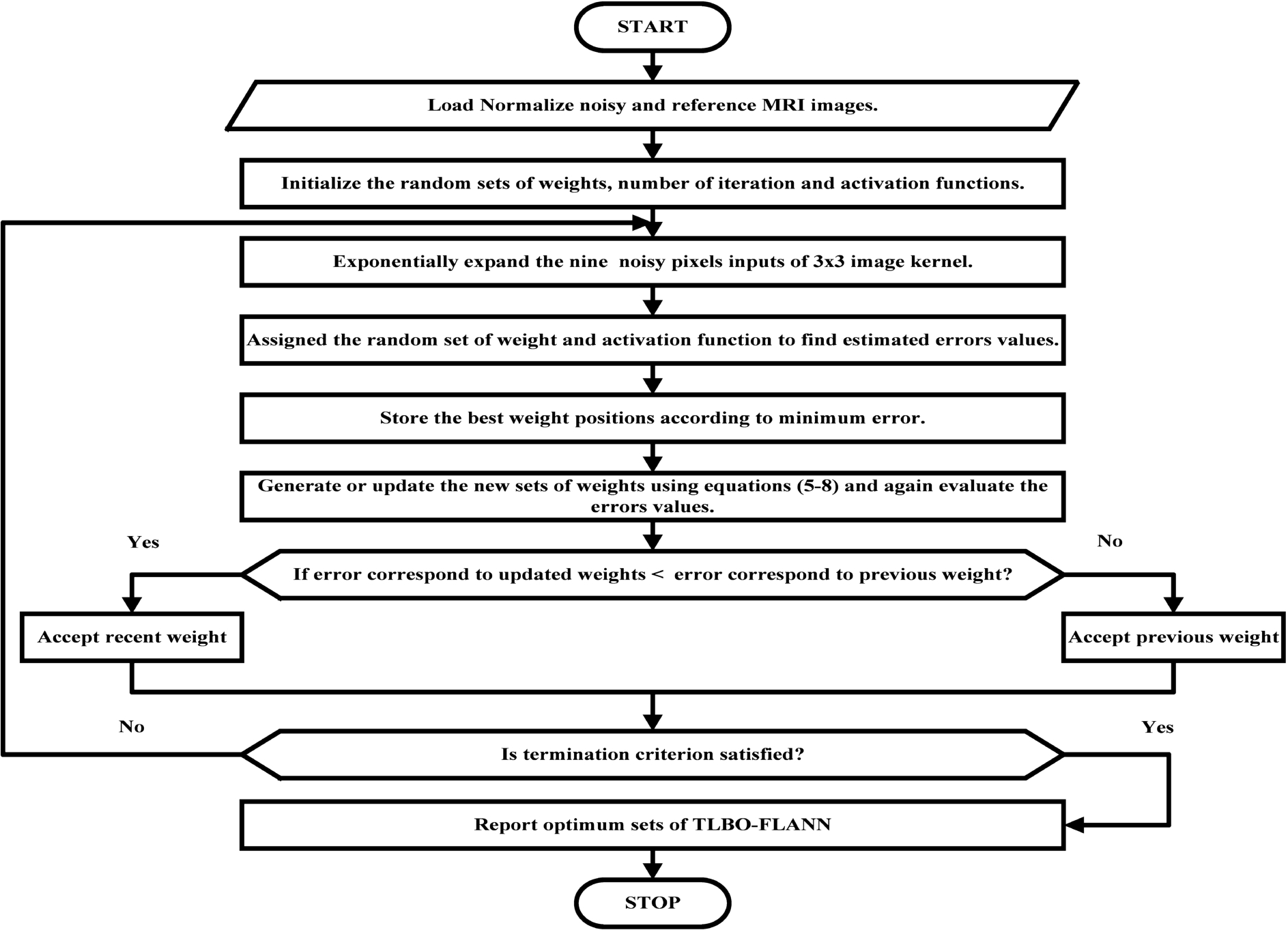
Flowchart of TLBO-FLANN filter.
The MATLAB software environment and computer with specification Intel® Core(TM) i3-2366M CPU@1.40 GHz, 4 GB installed random access memory (RAM) is used to perform all the experimental task. In this study, different synthetically corrupted MRI images are considered. All the MRI images are collected from department of radiology, Medanta Hospital, Ranchi, India. The MRI images are anonymous and patient identity is not disclosed anywhere. These images corrupted with noises such as Rician, Gaussian, impulse and their mixture are considered for simulation studies. The reference image (Fig. 3(b)) and the noisy image (Fig. 3(e)) are considered for the training of TLBO-FLANN network. In the Fig. 3(e), the densities of Rician and impulse noises are 0.08 and 0.02 respectively. Similarly, mean and variance of Gaussian noise are 0 and 0.02 respectively. After the completion of training, any other MRI image possessing any type of noise can be tested with the proposed filter. The Fig. 3(f)–(l) were depicted as filtered image after elimination of mixed as well as particular noise from the different MRI images. The size of all the MRI images is
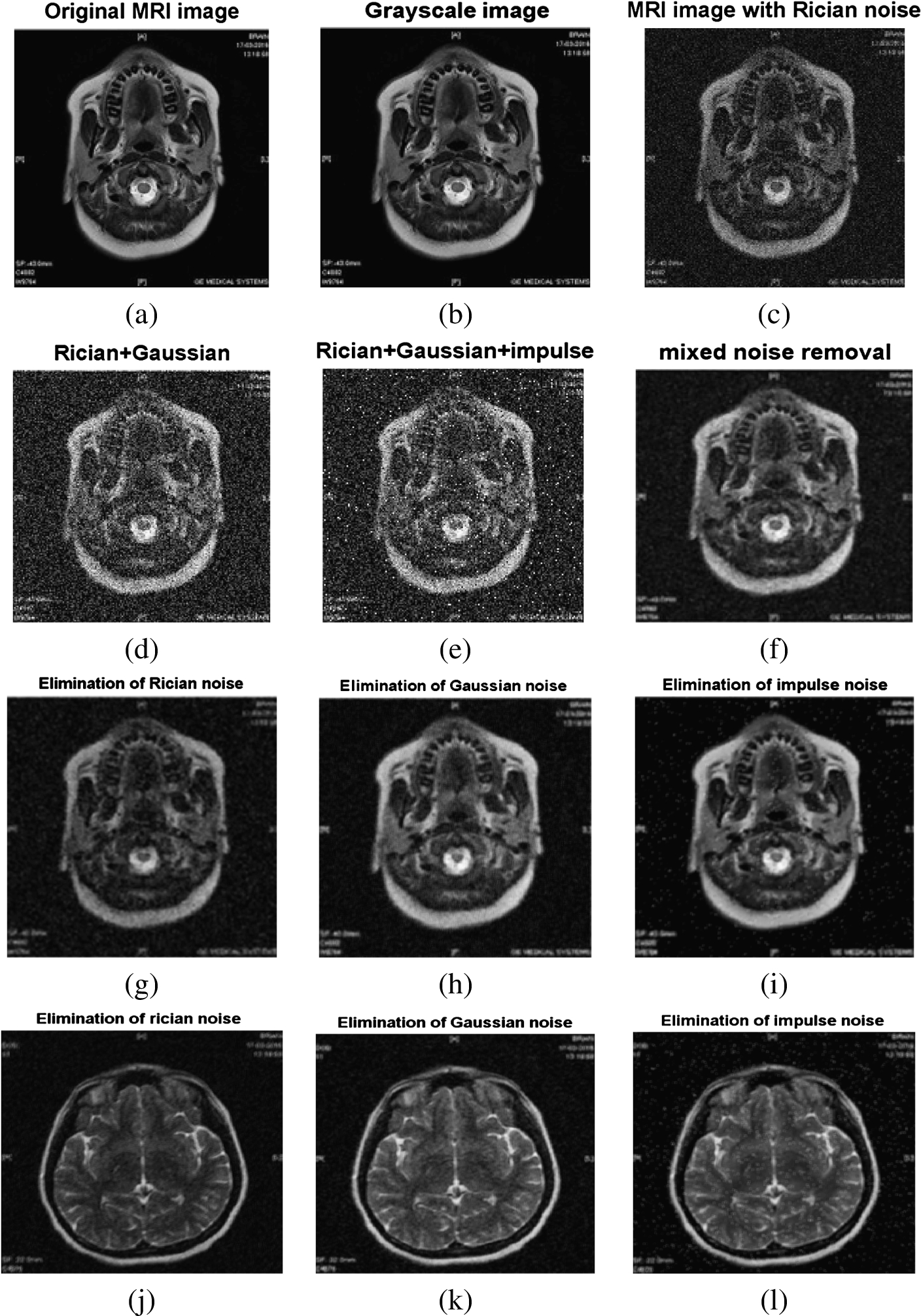
Removal of mixed and particular noise from different MRI images by using TLBO-FLANN filter. (Image Courtesy: Department of Radiology, Medanta Hospital, Ranchi, India).
The radiology ethical committee of Medanta has confirmed the improvement of medical image quality which is shown in Fig. 3. The performance of the proposed TLBO-FLANN filter is compared with five other filters, such as Wiener, BP-MLP, LMS-FLANN, CSO-FLANN and PSO-FLANN. The evaluation metrics such as structural similarity index (SSIM), peak signal to noise ratio (PSNR), normalized mean square error (NMSE) and noise reduction in decibels (NRDB) are calculated to measure the quality of filtered images. These performance indices are mathematically expressed as:
Parameters used in LMS-FLANN and TLBO FLANN filter
Image Quality Metrics values obtain from mixed noise filtering of MRI images
The values of PSNR and SSIM for different noisy MRI images and filtered image are depicted in Table 2. It is clear from the table that the PSNR and SSIM values of noisy MRI-1 are 23.006 and 0.667 respectively and these values are improving after applying different filtering techniques. The PSNR and SSIM value obtained from the TLBO-FLANN filter are 30.698 and 0.7684 respectively which is highest among the other competitive filters. The best values obtained by applying different filters are bold faced. The images of MRI-3 and MRI-4 are given in the appendix of this article. Figure 4(a) shows the convergence curves of BP-MLP, LMS-FLANN, PSO-FLANN, CSO-FLANN and TLBO-FLANN based on the NMSE in dB for above experiments over 1000 iteration. The Fig. 4(a) confirms that TLBO-FLANN network apparently has the best convergence rate among other ANNs filters as it reaches the minimum value with the faster rate. The Fig. 4(b) shows the average computational time taken for total training time of all the neural network based filters. The LMS-FLANN and BP-MLP have taken training time as 1222.071 sec. and 5356.098 sec. which is lowest and highest respectively among all. In the case of nature inspired filters, TLBO-FLANN takes the highest time of 3743.876 sec. as compare to CSO-FLANN and PSO-FLANN. However, the accuracy of TLBO-FLANN is more than any other applied competitive filters which is the foremost concern for clinical applications. In Table 2, the data obtained from MRI-3 shows that CSO-FLANN is performing better than the all other filters. Hence, to avoid the obscurity of filtering efficiency, a non-parametric statistical approach i.e. Friedman’s test is also carried out on the proposed and other competitive algorithms for computing the average ranking considering the PSNR metric for 20 individual experiments on each algorithm. This test provides the average ranking of proposed and other competitive filters. The Friedman’s test also provides critical value ‘p’ which decides the result is significant or not, and it is usually acceptable at less than 0.05 or 0.01 [26]. Tables 3–4 are obtained from the Friedman’s statistical test, the lower ranking of TLBO-FLANN i.e. 2.8 and the obtained p-values is
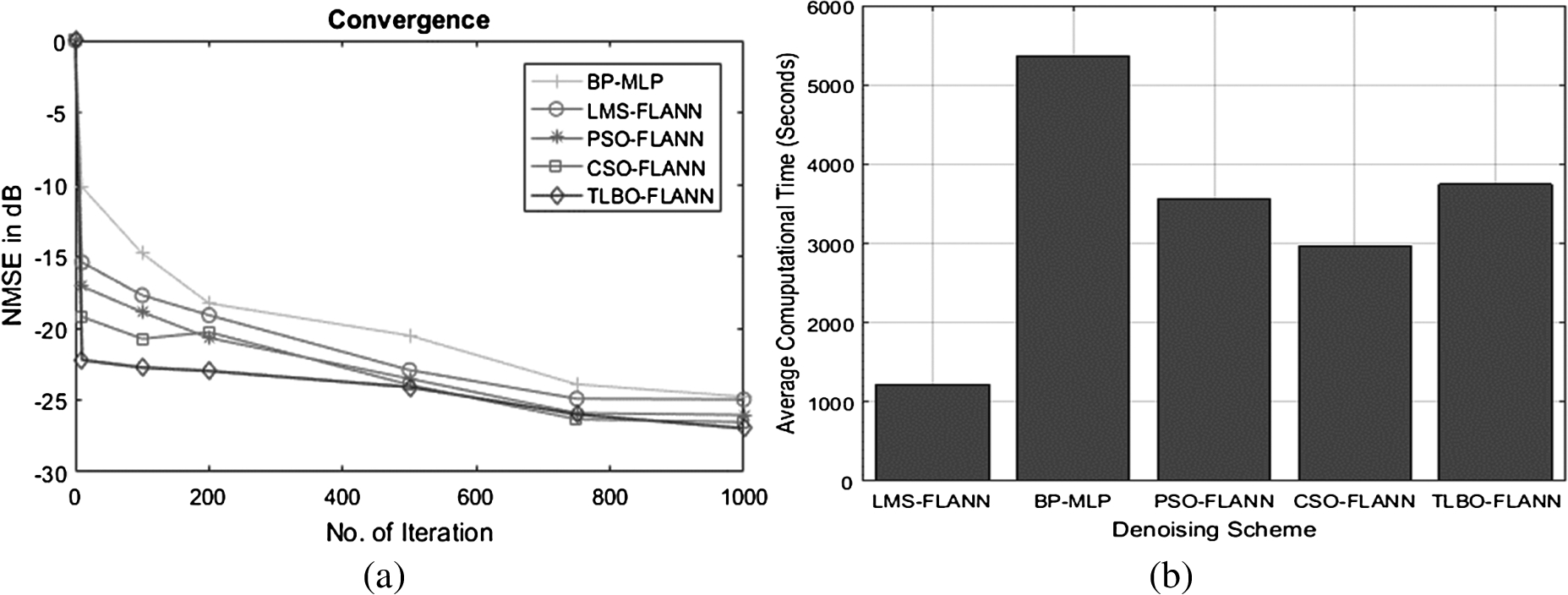
Convergence and average computational time graphs of various ANNs filters.
The proposed TLBO-FLANN filter is successfully applied to eliminate the noises such as Rician, Gaussian, impulse and their mixture from various MRI images and exhibit satisfactory performance in different noise conditions. The qualitative and quantitative investigations demonstrate the superiority of proposed approach over other five filters i.e. Wiener, LMS-FLANN, BP-MLP, PSO and CSO-FLANN. The comparison of performance includes computational time, quantitative metrics, such as PSNR, SSIM, NRDB, NMSE and convergence rate. The Friedman’s test is also performed to access the dominance of proposed TLBO-FLANN filter over others. The proposed TLBO-FLANN network can be further exploited in the elimination of the several artifacts which is generated during acquisition of MRI image. It can be utilized for denoising the medical images like Ultrasound, computed tomography (CT) and X-rays. This paper also paves the way for hybridizing TLBO with other evolutionary technique to train the FLANN for achieving the more precise result.
Average ranking of filtering algorithms on Friedman’s Test
Friedman statistical parameters
Footnotes
Acknowledgement
We would like to thank department of radiology, Medanta hospital, Ranchi, India and appreciate the effort of senior radiologist Dinesh Das in collection of digital image data and their valuable suggestion as well as time.
Conflict of interest
The authors declare that there are no conflicts of interest.