



Abstract
During the last two decades, biodegradable/absorbable materials which have many benefits over conventional implants are being sought in clinical practices. However, to date, it still remains obscure for us to perform full physic-chemical characterization and biological risk assessment for these materials and related devices due to their complex design and coherent processing. In this review, based on the art of knowledge for biodegradable/absorbable materials and biological risk assessment, we demonstrated some promising strategies to establish and improve the current biological evaluation systems for these biodegradable/absorbable materials and related medical devices.
In recent years, with the rapid development of biomedical materials and medical devices, accumulating new biomaterials and products with perfect properties are being applied in clinical scenarios. Among these, biodegradable/absorbable materials have been widely used due to their good performance and highly added value. So far, new biodegradable/absorbable materials which are typically with complex design and configuration, have been fully applied in medical sutures, drug delivery carriers, artery stents, regenerative biomaterials and so on, especially for those allocated “intelligent” polymer materials, partly because most of these materials could intently induce the regeneration and reconstruction of tissues in vivo. As is known, these implants will be degraded and absorbed prior to the new tissue formed and their physic-chemical properties and mechanical properties will also change accordingly, so how to maintain the balance between degradation and tissue regeneration is the key point to solve the safety and effectiveness of these products [1–5].
Biological evaluation is an important preclinical process to protect humans from potential biological risk arising from the use of biomaterials and medical devices. Especially for ISO10993 standard series, it has become one of the key technical bases for review and approve of biomaterials and medical devices. However, for the new biodegradable/absorbable materials, since it may have different physical, chemical and biological properties in material selection and structural design, which could lead to the inapplicable scenarios with respect to the traditional biological evaluation methods. Thus, how to fully understand the biocompatibility of biodegradable/absorbable materials and initiate the scientific and appropriate risk assessment so as to effectively control the quality and safety before clinical use have become worldwide issues. Herein, based on the current application of biodegradable/absorbable materials, we provide some potential strategy of biological evaluation and establish safety evaluation standard system for these materials and medical devices.
Definition and category for biodegradable/absorbable materials and devices
Definition for biodegradable/absorbable materials and devices
Biodegradable/absorbable materials and devices refer to those that physical, metabolic and/or chemical decomposition may occur during used in the intended human physiological environment. The chemical bond may break due to hydrolysis or oxidation as well as electrochemical based corrosion degradation and the degradation products may interact with body biological system which finally were absorbed and excreted by cells and tissues. Degradation does not mean absorption. Only when these biomaterials are degraded into appropriate size can they pass through or be assimilated by cells and/or tissue over time. In theory, any biomaterials and devices can be degraded as they were used in the human body regardless of the degradation rate. Whereas, the absorptive performance is closely related to their design and intended clinical application.
Category for biodegradable/absorbable materials and devices
Most biodegradable/absorbable devices are implantable which listed as high risk medical devices that must be strictly controlled. During the intended implantation, they can maintain proper mechanical property, and then be absorbed gradually and excluded or induce tissue growth to help the body achieve fully physiological repair. Biodegradable/absorbable devices are widely used in different kinds of clinical practices, involving wound repair, such as sutures, patches, anti-adhesive products, cardiovascular devices, such as vascular stents, orthopedic devices, such as screws and ligaments, tissue engineering products such as cell matrix scaffold etc. [6–10]. This kind of product is designed to reduce the disadvantages of ordinary inert material implants, such as local physical stimulation, chronic inflammation, thrombosis, endothelial dysfunction, inconsistent with the growth of the body, drug reliance, stress shielding, corrosion, local accumulation of metal ions and repeat surgery necessary, etc.
Biodegradable/absorbable materials from natural origin
These kinds of materials are usually macromolecular substances which derived from plants and animals. They can be used alone or as a combination of products, such as collagen, hyaluronic acid, sutures of animal origin etc. The degradation products can be absorbed by tissue or cell. They usually have sound biocompatibility, mature processing technology and the fast biodegradable rate, low mechanical properties, relatively poor stability, and short shelf life. Additionally, immunogenicity and bio-safety should be concerned since most of these materials are of animal origin.
Synthetic biodegradable/absorbable materials
There are varieties of synthetic biodegradable/absorbable materials, e.g. PLA and PGA. Hydrolysable alpha-hydroxy polyesters have been described as “absorbable” since the first polyglycolide based sutures were released in the United States. PLA, which could maintain their whole configuration during the intended period of the degradation process, has also been widely used as tissue engineering scaffold materials, vascular stents and so on. Most synthetic biodegradable/absorbable products may require complex modification and processing. During their intended application, these materials will experience hydrolysis or oxidation and break into pieces. Then the small molecular degradation products will be absorbed by the body and metabolized. Most of biodegradable/absorbable products may have sound biocompatibility. In addition, their surface characteristics, composition and physical and mechanical properties are easy to design and modify. Also, they usually have low friction coefficient, easy to fix surface loading drugs, cells and other biological molecules [11]. However, some polymers may cause local acidic environment after their degradation in the body and release toxic monomers, additives and catalysts, which may cause inflammation and other toxicity. Additionally, polymers usually have poor mechanical properties, relative short shelf life as well as the strict storage condition which may partly restrict their wide application in clinic [12]. Furthermore, for some synthetic biodegradable/absorbable materials, it is reported that the results of animal experiments are inconsistent with the clinical results [13].
Biodegradable/absorbable metallic materials
Most of biodegradable/absorbable metallic materials such as magnesium, zinc and iron have excellent mechanical properties in comparison with polymers [14]. Besides the metal ions formed by the degradation in vivo are essential elements, researches have reported that, for magnesium zinc alloy, the degradation rate can reach less than 0.02 mm per year [15], which shows superior prospects for cardiovascular and orthopedic applications [3,16,17]. In addition, high-purity magnesium is now becoming another promising discovery in orthopedic surgery, such as screws, splints and other fixed devices, due to its slower corrosion rate than magnesium based alloys and no toxic elements are also involved since the total magnesium presented in human tissues is about 30 g and the daily consumption of magnesium is about 400 mg [18]. However, to some metallic materials such as magnesium, the formation of hydrogen and the osmolality alteration may give rise to cytotoxicity and systemic toxicity as well as liver and kidney toxicity concerns due to its high oxidative corrosion rates [19]. Thus, how to develop the in vitro and in vivo animal models to investigate these absorbable metallic materials have now become prospective but with great challenge.
Biodegradable/absorbable bioactive materials
Generally speaking, bioactive materials are new type of composite materials with good biocompatibility. These kinds of materials can mimic natural tissue structure and induce tissue growth via their characteristics and surface topology, such as bioactive calcium phosphate ceramic, artificial bones with bone induction. They can induce new bone formation with or without the help of grow factors or living cells, which solve the technical problems involving cell proliferation, infection control and immunogenicity removal [20]. Also, most of these materials may have good biocompatibility in comparison to their complex preparation process as well as stringent specifications.
Current standards for biological evaluation of biodegradable/absorbable materials
So far, ISO10993 serials have been widely accepted for biological evaluation of biomaterials and medical devices. Meanwhile, most of these standards were originally developed for non-degradable materials. Among these standards, ISO10993.9, ISO10993.13, ISO10993.14 and ISO10993.15 are originally developed for evaluation of degradable materials in vitro. Therefore, it should be careful when they have been used for biodegradable/absorbable materials [21–24]. Fortunately, in the updated versions of other parts of ISO10993, more concerns have been taken for biodegradable/absorbable materials. ISO/TC194 is now developing specific international standards for absorbable implants and metallic implants. In addition, other organizations such as ISO/TC150, ASTM also issued some specifications for biodegradable/absorbable materials and medical devices, for instance ASTM F2902 Standard Guide for Assessment of Absorbable Polymeric Implants and ASTM F1983Standard Practice for Assessment of Compatibility of Absorbable/Resorbable Biomaterials for Implant Applications [25,26].
Biological evaluation strategies for biodegradable/absorbable materials
Biological evaluation for biodegradable/absorbable materials has long been a worldwide problem. Unlike pharmaceutical and chemical test, the degradation process of this kind of materials is relatively complicated. The degradation process can initiate prior to clinical application, for instance, in the process of hot extrusion or injection molding of synthetic biodegradable/absorbable materials or during their shelf lives as well as their clinic application duration. Furthermore, apart from the material itself, the influence of coating materials, process residues, additives, sterilization etc. should also been taken into consideration. Therefore, appropriate testing models should be established to investigate the degradation and absorption characteristics of these products on the basis of the physical and chemical characteristics in order to establish highly sensitive and specific methods. Then, combined with current standards and toxicological risk assessment data as well as the comparison with legally marketed devices, we can finally control the biological risk of these products. Based on the flow chart (see Fig. 1) given in ISO10993-1 [27], we should further consider the following systematic approaches (see Fig. 2).
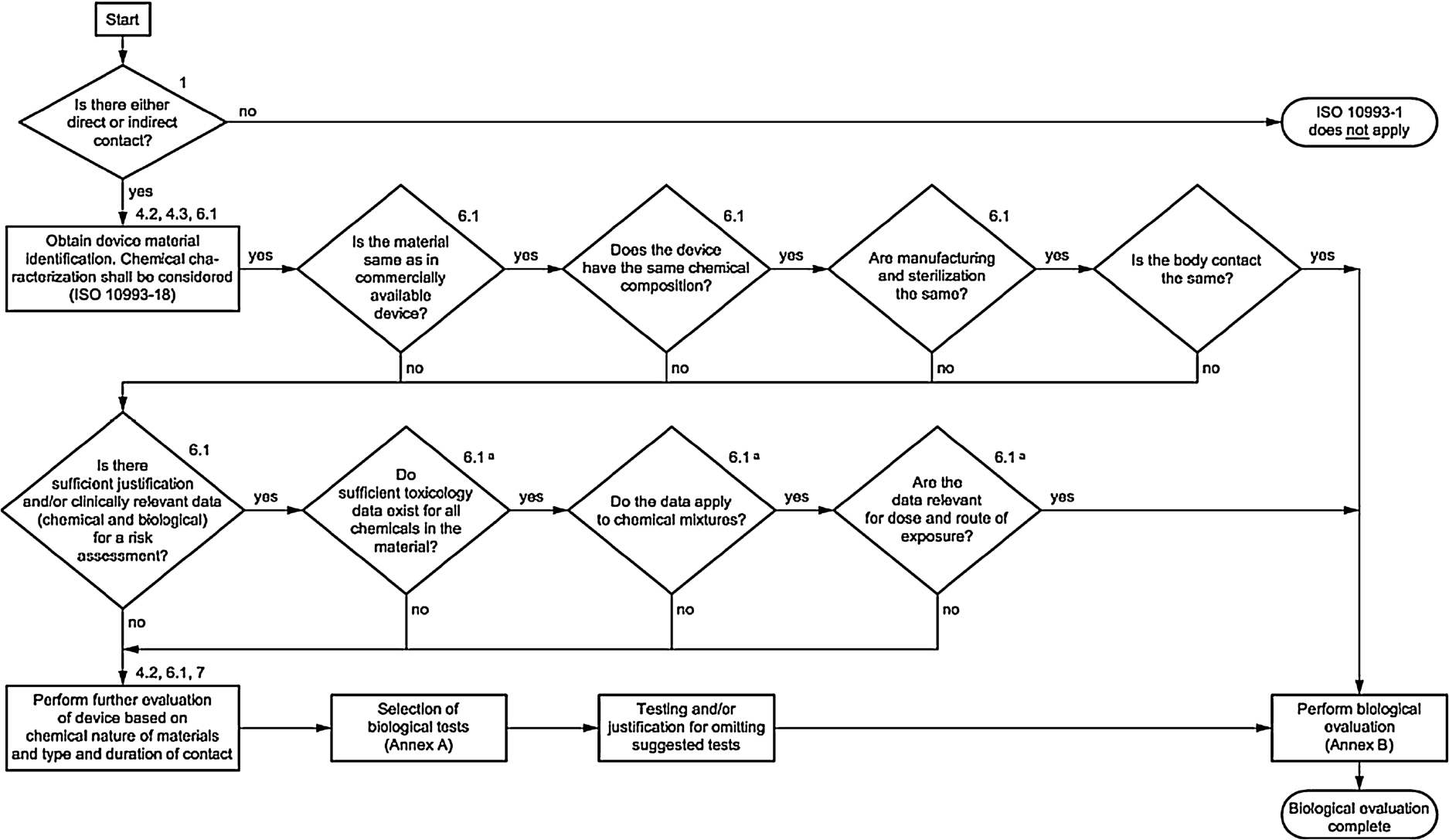
Summary of the systematic approach to a biological evaluation of medical devices as part of a risk management process (from ISO10993-1:2009).
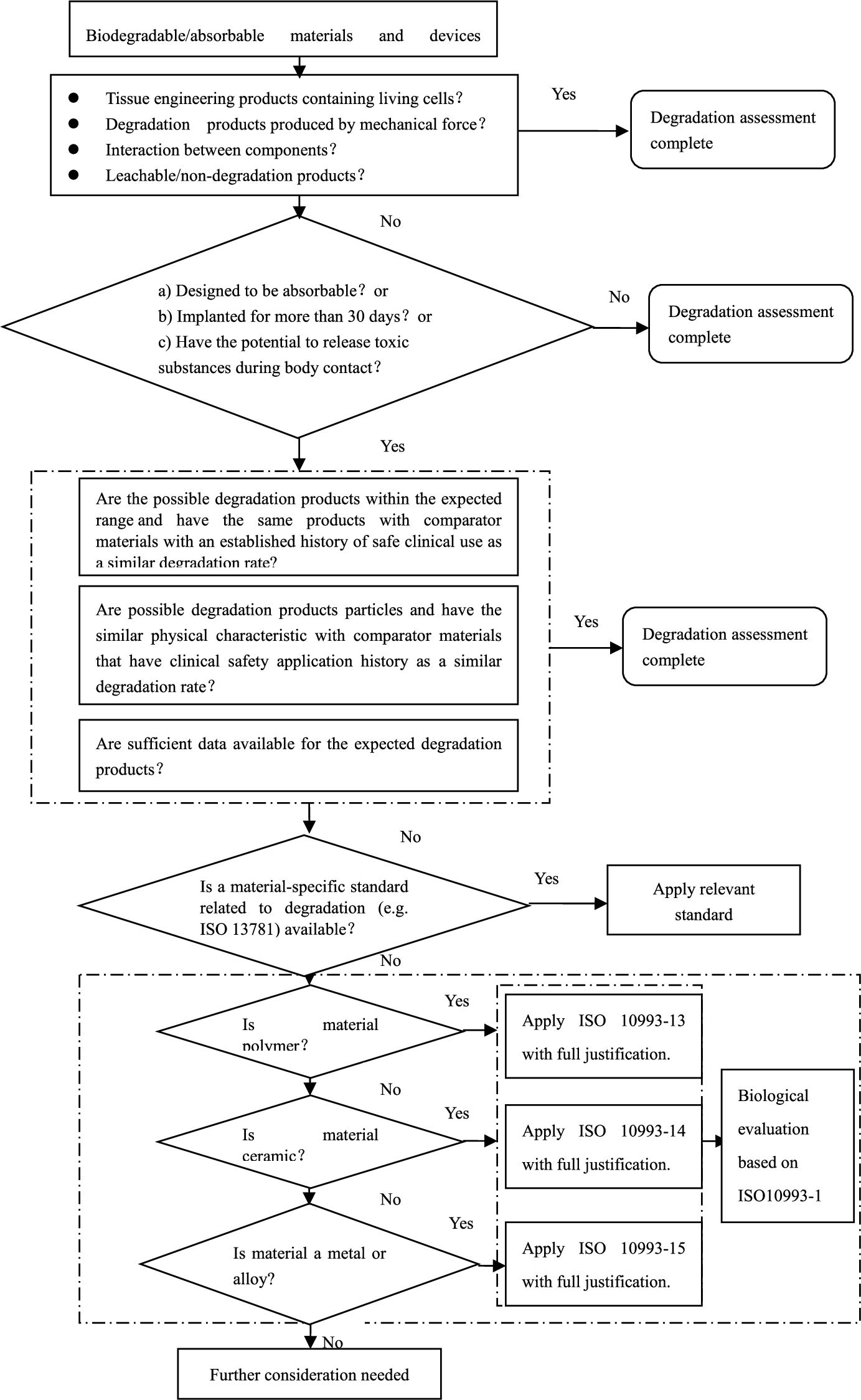
Flowchart for biological evaluation of biodegradable/absorbable materials and devices.
The updated FDA’s guidelines [28] for biological evaluation of biodegradable implant materials pointed out that, for biodegradable implants without an established history of safe clinical use of material formulations, their biocompatibility should be at least as good or as good as the legally marketed products and their degradable products and metabolic pathway should also be identified simultaneously. For degradation assessment in vivo, factors such as sample preparation, the species and quantity of animals, implantation site and duration, selection of endpoints and result evaluation should be considered according to the characteristics of the material. Care should be taken that appropriate time points should be selected per the degradation kinetics of the products. The selected study time points should be longer than most of the degradation duration and should include at least the following time points: (1) Early time points (no or minimal degradation), usually indicate the time point between one week and two weeks after implantation in order to evaluate early tissue reaction. (2) Medium time points (when degradation initiated). These time points should be established dependent on the characteristic of the targeted biodegradable/absorbable materials. It should be appropriate for the assessment of the overall intended tissue reaction (e.g. substantial structural disorders and/or have been broken). When comes to composite implants with different degradation rate, the selected time points should consider all components’ potential degradation time points. (3) Late time points (when most implants are absorbed). The purpose of this time point is to inspect the minimal residues of the targeted implants, which could leverage the data in vitro (e.g. weight loss 50% or mechanical strength loss 50%) in order to fully assess the late condition of the implants. However, this investigation cannot be used to totally replace the real degradation state in vivo. Meanwhile, if tissue reaction, material structure and function have indicate an acceptable stable condition and it is also difficult to identify the gross degradation products, the data collected can also be used to illustrate the local reaction on condition that the full absorption data are unavailable [29,30].
So far, the suitable endpoints for in vivo evaluation include but not limited: weight loss, surface morphology characterization, gross observation, histological observation and mechanical change if appropriate. The protocols for degradation in vivo should adapt to assess the potential risk to the patients, e.g. toxicity risk and mechanical loss risk along with recording the parameters that affect the evaluation of degradation rate. If adverse biological reactions have been observed, it is recommended to initiate the additional in vitro assessment to identify the sources of toxicity, e.g. characterization of chemicals.
There are usually two sorts of degradation tests in vitro, that is, accelerated test and real-time test. For accelerated test, the degradation mode could change due to high temperature. Therefore, for synthetic biodegradable/absorbable materials, more attention should be paid to the effect of glass transition temperature and melt temperature on the degradation action. For biodegradable/absorbable metallic materials, we need to care about the effect of high temperature on corrosion chemistry or model of implants (e.g. pitting and crevice etc.). In the degradation protocol in vitro, the mechanical behavior (fatigue tests, creep tests and wear tests etc.), chemical properties (oxidation, electrochemical corrosion and polymer degradation etc.) and surface characterization should be fully considered. For degradable polymers, Table 1 is recommended following ISO/TS10993-18 [31]. It should be noted that the methods given in Table 1 are usually for non-absorbable material. For intended absorbable materials and devices, it is necessary to justify the applicability of the analytical method, e.g. taking full account of the effects of crystallinity, sequence distribution of copolymer, purity of particle size and oxidation of cellulose derivatives on characterization of absorbable materials and devices. In addition, for biodegradable/absorbable materials and devices, pharmacokinetic data and degradation mechanism should also be fully investigated to fulfill biological evaluation.
Examples related to material characterization of the absorbable materials and devices
Based on the requirement of ISO10993-1, biodegradable/absorbable materials and devices have been categorized as implants when selecting the endpoints with regard to biocompatibility. In the new edition of ISO10993-1, biodegradation has been added in the framework for medical devices, components or materials that have the potential to degrade in the body environment shall provide the information involving biodegradation.
Thus, it is recommended that users should characterize all the degradation products which could be produced prior to use (e.g. the processing or shelf life) or during clinical application to identify the degradation products via chemical or theoretical analysis. Based on the equivalent processing, materials with an established history of safe clinical use and related literatures could help to identify the intended degradation products and potential toxicity. Use of the degradation product information obtained from both chemical analysis and literature review to perform toxicological risk assessment could effectively exempt some biocompatibility tests for the targeted materials and devices.
During degradation of biodegradable/absorbable materials and devices, some potential instantaneous particulates may be produced and released into the medium or local tissues, so it is necessary to characterize the potential clinical effects of these degradation products. If the particle is produced and absorbed as an identical rate as another material with an established history of safe clinical use, theoretically no more biocompatibility assessments are needed for the targeted particles. However, since the chemical composition and particle size may affect biological response, adequate information and/or tests should be established to support the exemption of the corresponding biocompatibility endpoints.
Selection and preparation of test samples for biodegradable/absorbable materials and devices
The selection and preparation of test samples is one of the key factors for biocompatibility tests. It is generally accepted that the final sterilized product or the representative parts should be selected as the test sample. If the final sterilized product is unavailable, the test sample selected should endure the same process and sterilization as the final sterilized product. Otherwise, it should be fully justified, which could contain all the differences between test samples and final sterilized products during their processing and these differences could not affect their chemical release or data from degradation kinetics. For an instance, whether or not the differences on surface characteristics or geometry could significantly affect their hemocompatibility. For biodegradable/absorbable materials and devices, data from exhausted extraction and physic-chemical, morphological and topographical characterization of materials are helpful for biological evaluation of final products. For products containing active pharmaceutical ingredients, since the drugs may cause false positive results, it is recommended that tests involving both final products and products only without drugs should be performed, respectively. During the test sample preparation, 37°C may usually have the high priority. For biodegradable/absorbable metallic materials and devices, temperature elevation is not recommended. For polymers, the test temperature elevation should not exceed its glass state temperature (Tg) and it is necessary to demonstrate that degradation products were the same as the degradation products under 37°C condition.
Special concerns with biocompatibility tests in vitro for biodegradable/absorbable materials and devices
During their applications in the body environment, biodegradable/absorbable materials and devices might produce degradation products with relative low molecular weight and the particle size, morphology and rate of degradation products may affect the results of biocompatibility tests. When performing in vitro biocompatibility tests for these products, if the degradation rate of the product is sufficiently rapid, elevated concentrations of the intended degradation products could alter the pH and/or osmolality of an in vitro test system and result in some abnormal outcomes. However, due to the effective perfusion and carbonate buffer system exist in vivo, it will not produce adverse reactions correspondingly. Therefore, it could be appropriate to adjust the in vitro test solution pH (using acid or base) and/or osmolality (via dilution) to a physiologic range. But it is necessary to demonstrate that pH and/or osmolality factors are the causations for the adverse results and the degradation products have not altered significantly and sound results can be achieved via this adjustment. Furthermore, any pH or osmolality adjustment shall be justified in the biocompatibility risk assessment. For an instance, it is reported that the adjustment of pH value of the culture medium to 7.35 could help to maintain the cell viability, when performing cytotoxicity tests for biodegradable/absorbable metallic materials and devices using DMEM supplemented with 10% serum [32,33]. Another report has also demonstrated that it may be necessary to adjust osmolality to +/−5% of normal physiological osmolality, when magnesium alloys was evaluated with a human osteoblast cell type in order to determine whether the osmolality of medium is the key factor for cytotoxicity [34]. It is recommended that pH or osmolality adjustment should be justified based on cell type, cell medium, culture conditions and degradation products etc., combined with the results obtained from the original extracts and some in vivo tests, such as implant tests.
Problems and prospects
With the development of medical device industry, biomedical engineering and material science, biodegradable/absorbable materials and devices have aroused wide concerns due to their distinguished clinical application value. Due to the complex of biodegradable/absorbable materials and devices, there are still significant differences in the requirements and methods for the evaluation of the biological evaluation by regulatory authorities in various countries and regions. The existing problems including but not limited: (1) Different designs of the same product may have different physical and chemical properties and degradation activity, so how to choose the appropriate test conditions (including degradation in vitro and in vivo) and biological evaluation endpoints? (2) For neo-type biodegradable/absorbable implants, which usually contain bioactive components such as protein and cytokines, the traditional methods of biocompatibility may not be applicable, so how to select methods available with sensitivity and specificity based on product characteristics? (3) During their degradation process in vivo, some biodegradable/absorbable materials and devices can produce new products, so how to evaluate the consistency of degradation behavior in vivo and in vitro and further extrapolate the data to humans? The solution of these problems will contribute to the development and application of biodegradable/absorbable materials and devices in the future.
Footnotes
Acknowledgements
The author(s) disclosed receipt of the following financial support for the research, authorship, and/or publication of this article: This work was funded, in part, by Shandong science and technology development plan project (2014GSF118151) and National key research and development project (2016YFC1103205) and (2016YFC1102503).
Conflict of interest
The author(s) declared no potential conflicts of interest with respect to the research, authorship, and/or publication of this article.