



Abstract
BACKGROUND/OBJECTIVE:
We present a description of an experiment in which the parameters describing the quality of the mandrel embedding an implant into a bone were determined. A method was developed that allows, from outside a living organism, the strength of the mandrel of the implant in the bone tissue to be determined. Using the proposed technique, we investigated how the mechanical properties of the bone affect the quality of the implant mandrel embedding in the bone tissue.
MATERIALS AND METHODS:
As part of the research work, we conducted 15 compression tests on previously prepared samples that reflected an uncemented endoprosthesis embedding in the proximal base of a femur bone.
RESULTS:
The results of the research showed that the load applied is dispersed between the mandrel and the bone tissue. The mechanical stability of the embedding affects the mechanical properties of the bone. The experiment revealed the nature of the mechanical stability of the embedding in relation to the increasing contact surface area.
CONCLUSIONS:
We observed a non-linear nature of dependences of bone density as the main parameter describing the properties of bone relative to the extent of loosening expressed in the form of the slip surface of the mandrel relative to the bone. The mechanical stability of the embedding is crucial in the initial phase of the implant healing because it eliminates the loosening of the mandrel embedding. It provides a guarantee that the specific geometry of the treated motion apparatus part will be preserved and lowers the risk of inflammatory conditions during the treatment process.
Keywords
Introduction
The biomechanical phenomena that arise in the course of the implantation of an implant and the associated regeneration of the joints are often overlooked in favour of case studies defining only the clinical diagnoses of the cases [1–3]. In the methods for treating injuries using artificial organs in the form of implants, information about the mechanics of the systems is crucial. Implant-bone mechanics is complex and the mechanical strength and stability immediately after deposition of the living tissue is dependent on many factors [4]. The main objective of this research was to focus on the mechanical phenomena that directly affect the strength and stability of the implant mandrel embedding in the tissue. The implementation of the research was planned in such a way as to allow the parameters which most affect the strength and stability of the embedding to be determined, while finding associations between specific parameters. Obtaining the research results was possible only with experimental research, which allowed for the measurement of physical quantities among other movements from the given load without invasive intervention in the living body of the patient while maintaining the biomechanical properties of the bone tissue.
A search of the parameters that most affect the strength and reliability of the mandrel implant embedding was experimentally performed by making any biomechanical measurements on pre-prepared samples. The research focussed on an investigation of the strength and stability of the embedding in the initial phase of the implant healing. This condition should be described as the phase that begins the healing before the regeneration phase starts the repair processes of the bone tissue. The embedding quality in the healing phase is important for the stability of the implant embedding, and for the elimination of all phenomena that contribute to the development of adverse inflammation in the healing process of the injury. In the literature, this condition is reported to be crucial for the end result of the treatment, i.e. maintaining the original geometry of the treated piece of the apparatus motion (kinematics mapping) and the adequate stimulation of growth factors in the bone defect [5–12]. Understanding the factors affecting the stability of the implant mandrel embedding in the early healing phase will eliminate a number of disorders in the treatment of the musculoskeletal system with the help of implants.
The main objective of the research was to show how the mechanical properties of the bone tissue affect the strength and stability of the embedding of the implant mandrel in the bone tissue.
Materials and methods
The main result of the research is the size of the slip surface of the implant mandrel (the change at the level 15 mm2) relative to the bone in relation to the size of the load (average value 132 N) increment for bone tissue of the selected bone density. The size of the slip surface of the mandrel, defined as the size of the increased contact area added to the load, is given by when the embedded mandrel lost stability in relation to the bone (skidded).
We developed a research tool that was made to copy the actual biomechanical conditions in the initial phase of the healing of the implant. The object of the research was the proximal base of the femoral bone after osteotomy where a piece of the mandrel implant was embedded without cement. The bones used as the objects of the research came from the base of the proximal femoral bones of year-old cattle. Adjusting the bone preparation was based on the removal of the surrounding soft tissue from the bone and giving it the appropriate geometry. For such prepared material, the mechanical properties of the tissue were determined by measuring the volume and weight of the individual preparations of bone. In this way, we calculated the apparent density of the spongy and cortical tissue used in the test objects.
The apparent density of spongy tissue should be understood as the ratio of the weight of dry spongy tissue to the total volume of the spongy part of the sample, including all its pores, expressed in g/cm3.
The apparent density of the cortical tissue should be understood as the ratio of the dry mass of the cortical tissue to the total volume of the cortical part of the sample expressed in g/cm3
For the research tool, we used a piece of the endoprosthesis mandrel which was used in the treatment of the implantation of a hip joint made of cobalt chrome surgical steel according to ISO 5832-2 (Fig. 1).

Procedure for creating a research tool (a piece of bone with an implant pin).
The proposed construction of the research object is reflected in the cementless connection of the implant with the bone in the hip and knee endoprosthesis in humans as well as in animals.
Fifteen independent test objects were prepared as described above by selecting them in subgroups depending on the density of the bone formulation. Research procedures of individual subgroups were subjected to static loading by compression.
The survey was based on experimental static compression tests of the research tools, where loads were applied to the mandrel of the test objects. A reaction of bone tissue in the form of displacement relative to the mandrel of the test facility was recorded. Also, displacement in the given load direction was recorded. Changing the size of the slip surface of the mandrel in relation to the increase in load was indirectly designated. Also, the visual condition of the research object was monitored (Fig. 2).

Structure of the test stand used for the research on the test objects.
Analyzing the nature of the operation of the implant spindle in the bone, it can be concluded that its load is of a complex nature, namely compressive, bending and torsional loads.
However, the analysis of loads shows that the most frequent loads are compressive loads and are considered to be dominant and critical.
Therefore, in experimental studies, the focus was on a standard compression test to find out the nature of the mechanical interaction of the implant on the bone for the most critical load.
The research was completed on 15 pre-prepared research objects by registering the movement of the mandrel piece with respect to the bones of the load given. Registration of movements took place at a frequency of 1 kHz, with an accuracy of 0.003 mm, and with the accuracy of a given load of 0.5 N. The parameter describing the bone tissue used in the production of the research objects was the apparent density of the spongy and cortical tissue of the proximal base of the femoral bone, determined with an accuracy of 0.065 g/cm3. The apparent density of the bone tissue is the ratio of its mass to the volume of bone including bone porosity. For individual measured values, standard deviations have been scaled. For a better interpretation of the mechanical properties of bone, the selected bone preparations were divided into three groups. The selection in the group consisted in assigning to the selected group of samples in which the apparent density of spongy and cortical bone were similar and the standard deviation did not exceed 10% of the mean value.
Such selection allowed to create three subgroups, each of them consisted of five samples.
The results of these independent subgroups were subjected to the Mann-Whitney U test, determining the absolute values of the parameters describing the quality of the mandrel implant embedding in the bone tissue. Tests were performed on the samples in which the bone tissue came from animals and the time it spent outside of a living organism did not exceed 24 h before the experiment was performed. The ambient conditions during this period correspond to an ambient temperature of 0–30 °C with a relative humidity of 40–60%.
The results show how bone density affects the size of mandrel slip with respect to the bone, contributing to the quality and stability of the mandrel embedding. The results obtained show directly how the percentage change in density affects the size of the slip surface at a constant load. The size of the registered slip surface greatly affects the stability and quality of the mandrel embedding.
The obtained values of the sizes of the slip surfaces were compared to the numerical values of the apparent tissue densities of the cortical and spongy bones in each of the selected subgroups (Table 1).
The results of the research for the 10 tests carried out for the selected subgroups
The results of the research for the 10 tests carried out for the selected subgroups
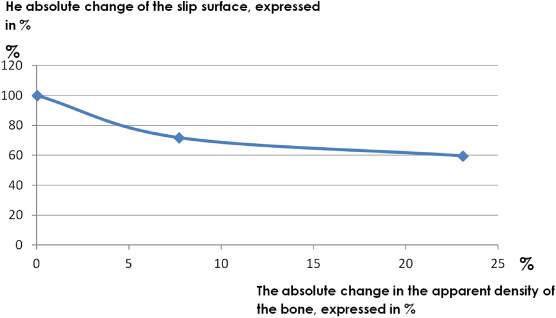
The results show that the size increment of the surface contact of the mandrel with the bone in correlation with the apparent density of the bone in the same ambient conditions (load restraint) is not a linear one. On the basis of the experiment and the results obtained from the size of the contact surface, it follows that the higher the apparent density of the bone, the smaller the increase of the slip surface. It gives better stability for embedding the implant mandrel in the bone (Fig. 3).
Structure of the test stand used for the research on the test objects.
At a constant value of the set load on the embedded stem in the bone, the deformations obtained are not proportional and show a non-linear trend.
The experience shows that the quality of the bone tissue (the quantity and size of the pores in the spongy bone) is decisive in the vicinity of the stem.
The result was obtained by determining the size of the slip surface increment in relation to the bone density in the vicinity of the stem for a quasi static load of constant value.
The absolute increase of slip surface was determined as the surface area by which the stem moved under the load in relation to the original surface.
For individual subgroups of samples, the average value of the primary surface and the average value of the increase in the form of mutual ratio were determined and expressed as a percentage.
The absolute change in apparent bone density should be understood as the increase/loss in bone density in relation to the original bone density (as part of the natural bone remodeling) in the form of mean value for samples from particular subgroups described as percent change in density relative to the original value.
Absolute increases of the slip surface against the absolute density changes are shown in the chart above.
Research on the biomechanical properties of bone is still ongoing. Further defining its attributes allows for a better description of the biomechanical properties of bone tissue. Designing a surgical junction or implant requires proper embedding in the bone so that it can be operated properly and reliably. According to a study by Hendrich et al., there is no perfect embedding of the implant in the bone tissue. A case study conducted by his team showed that the loosening of the implant mandrel has a negative effect for the patient as it can consequently lead to death [11,12,19–22].
The research carried out showed that the strength of the implant stem in the bone is affected not only by the geometry of the seating and embedment technique but also by the parameters describing the quality of the bone surrounding the stem, including bone density.
The conducted experimental research has shown that the structure (size and number of pores) and bone density also affect the strength and quality of the implant’s bone anchorage.
Experiments have shown that bone density has a non-linear nature of the impact on the strength of the implant-bone connection.
During the experiment, it was observed that in the case of the same implant spindle mounted in the same way in a bone which is characterized by a different bone density, the compressive strength of the implant-bone system is different.
The research has shown that the density of the bone in which the mandrel was placed has an impact on the quality of implant placement in the bone in a non-linear manner. The higher the bone density, the better the implant placement quality.
The observed phenomenon allows to conclude that the contact area of the implant with the bone with a high density is lower than with the bone with large pores and weak structure to ensure a certain stable settling.
For the same type and shape of implant mandrel, the strength of such embedding increased with the value of bone density, and hence knowing the actual bone density and the potential load of the system makes it possible to determine the size of the contact surface at which the loosening phenomenon of the mandrel will be eliminated. The graph in Fig. 3 shows how much the size of the mandrel surface should be increased (expressed as an absolute percentage) for the projected loss of bone density by the body, to minimise the risk of loosening of the implant in the bone tissue during the considered period of operation.
The results of this research are also confirmed by the statement of Olsen et al., whose research showed that a treatment technique using a short mandrel with uncemented embedding (used in the BMHR technique) does not provide good strength for mandrel embedding [13]. The performed research not only confirmed previously known research results, but allowed the strictly mechanical factors (compressive strength) determining the strength of embedding to be determined.
The health and metabolism of a person affects the condition and quality of bones and this changes due to internal (disease) and external factors (lifestyle, injuries).
Remodelig improves its quality or creates internal destruction of bone tissue. The results obtained in the experiment may be helpful in the selection of implants, because they show what size of contact surface of the implant stem with the bone must be ensured that the seating guarantees the transfer of loads resulting from the user’s weight.
The determined relation between bone density and the contact surface (Fig. 3) will allow to select and validate the size of the contact surface at which, in spite of bone remodeling (e.g. loss of density), the implant stem in the bone should give a secure fit.
The results obtained should be approached with a certain degree of uncertainty. Considered overall, the general health condition of the body has an impact on the strength and quality of the implant mandrel embedding [14–17,21–26].
Conclusion
We observed a non-linear nature of dependences of bone density as the main parameter describing the properties of bone relative to the extent of loosening expressed in the form of the slip surface of the mandrel relative to the bone. The mechanical stability of the embedding in the initial phase of the implant healing is crucial because it eliminates the loosening of mandrel embedding. It provides a guarantee of the specific geometry of the treated motion apparatus part being preserved and lowers the risk of inflammatory conditions during the treatment process.
Footnotes
Acknowledgements
The author would like to acknowledge the Laboratory of Biomechanics of the Warsaw University of Technology for kindly providing assistance.
Conflict of interest
The author declares that there is no conflict of interest regarding the publication of this paper.
Funding
The above-described experimental research was the work of the Institute of Micromechanics and Photonics, Warsaw University of Technology, performed in 2015–2018.