



Abstract
BACKGROUND:
Ceramic crown that fires the layering porcelain on zirconia corping is starting to be used due to aesthetic requirements. However, many ceramics are used, but wear characteristics are often unknown.
OBJECTIVE:
This study was performed to investigate the wear of human enamel by porcelains, and to determine the influence of porcelain hardness, surface roughness and crystal of porcelain on the enamel wear.
METHODS:
Enamel specimens were prepared from extracted human molar teeth. Porcelain specimens were prepared from Deguceram Gold, Vita Omega 900, and Cercon Ceram Kiss. Enamel wear volume was calculated and the porcelain wear depth, surface roughness and Vickers hardness was measured. Moreover, the observation of a crystal by scanning electron microscope and the crystal by X-ray diffraction were identified.
RESULTS:
Omega 900 showed the smallest enamel wear volume and porcelain wear depth. The Vickers hardnesses of Omega 900 and Cercon Ceram Kiss were almost identical. Leucite was detected from Deguceram Gold and Omega 900, and Silica and Silicon Nitride were detected from Cercon Ceram Kiss.
CONCLUSIONS:
The enamel wear is influenced not by the hardness of the porcelain but by the surface roughness, the size and shape of the crystal.
Introduction
Dental porcelain is widely used for metal-ceramic and all-ceramic restoration because of its excellent esthetic qualities and biocompatibility. There have been several reports on its abrasion of natural teeth [1–7]. Some researchers report that porcelain hardness affects enamel wear [2], while others conclude that hardness alone cannot account for differences in enamel wear [3]. In relation to porcelain surface finishing, some reports indicate that surface polishing can effectively reduce enamel wear [5]. It is generally agreed, however, that porcelain surface properties may be closely related to enamel wear, and that rough porcelain surfaces increase the coefficient of friction with enamel and thus tend to increase the amount of wear [6]. In clinical ceramic restoration, the porcelain surface tends to become roughened during occlusal adjustment, and subsequent polishing is important. In polishing with a dental handpiece following occlusal adjustment, it is difficult to obtain a glossy surface, therefore it has been reported that increased wear occurs in natural teeth [7].
In recent years, all-ceramic restoration in which layering porcelain is overlaid on a zirconia coping produced by CAD/CAM has come into general use. Layering porcelain on zirconia shows about the same mechanical strength as porcelain which is fused to metal crowns, however, the behavior of layering porcelain is unknown. Various uncertainties concerning its use and performance remain, as it is a relatively new material.
In the present study, we therefore investigated the influence of porcelain surface roughness, Vickers hardness, grain size and crystalline components on enamel wear by low-fusing hydrothermal porcelain, feldspathic porcelain, and layering porcelain for zirconia, and on the wear of the three porcelains themselves.
Materials and methods
Extracted human tooth preparation
The specimens’ teeth were extracted by the general practitioner and it was agreed that they would be used not only for disposal but also for experimental use. Each enamel test piece was prepared for mounting on the upper arm of the abrasion tester from a caries-free extracted human molar, by cutting the molar parallel to its axis with the top of the cusp at the center to obtain a rectangular cylinder with sides of 3 mm in length, and then grinding the cusp to a hemispherical shape with a diameter of 3 mm using a dental hand piece with electrodeposited diamond with a grain size number of 1,000-grit. Figure 1 shows a typical enamel test piece, in the form of a rectangular column topped by the hemispherical cusp portion.

Processing of deciduous human teeth. The tooth was cut into a rectangular cylinder with 3-mm-long sides and the top of the cusp was ground to a hemispherical shape with a 3-mm radius.
Dentin color porcelains of Deguceram Gold (Dentsply International Inc., PA, USA), Vita Omega 900 (Vita, Bad Säckingen, Germany) and Cercon Ceram Kiss (DeguDent GmbH, Hanau, Germany) were used in the present study.
Porcelain powder was mixed with distilled water and poured into a metal mold. Excess moisture was removed from the porcelain with tissue paper, and the specimens were then removed from the metal mold. A porcelain furnace (Austromat 3001, Dekema Dental-Keramiköfen GmbH, Freilassing, Germany) was used to fire the specimens. All specimens were fired twice according to manufacturers’ instructions. It has recently been found that there is no difference in the degree of enamel wear by porcelain surfaces finished by polishing [4]. In this study, we therefore finished all of the porcelain specimens by hand lapping with 2000-grit abrasive under running water. The final dimensions of the specimens were approximately 4 mm × 3 mm × 30 mm.
Abrasion test
As shown schematically in Fig. 2, the enamel test piece was mounted in the upper part of an abrasion tester (Toyo Seiki Seisaku-sho, Ltd., Tokyo, Japan) and the porcelain test piece was mounted below on the tester table. A vertical load (F) of 4.9 N was applied to the enamel test piece. One abrasion trial comprised 10,000 cycles, with each cycle consisting of linear reciprocating travel over a distance of 3 mm for 1 sec with water supplied to the region of contact between the enamel and porcelain specimens. The length of the enamel test piece was measured by a VH-5000 high-precision, high-speed optical microscope (Keyence Corporation, Osaka, Japan) before and after abrasion and the difference was calculated as the wear height h shown in Fig. 3, where r is the radius of wear surface area, H is hight of form of sphere lack that subtracted wear height h from the diameter of sphere (2R). Then volume of form of sphere lack was subtracted from volume of sphere and wear volume M was calculated by the following equation.
Porcelain wear was determined by the maximum depth measured in the porcelain test piece surface at the end of the abrasion trial by a surface roughness meter (Surftest SV-400, Mitutoyo Corporation, Kanagawa, Japan) with a scan speed of 0.1 mm/sec perpendicular to the wear track. The roughness of the bottom of abrasion surface was determined in a similar manner, as the arithmetic mean roughness (Ra) at the end of the abrasion trial. All measurements were performed in accordance with Japan Industrial Standard (JIS) B 0601, 1994. For each type of porcelain, five different enamel and porcelain specimens were used. Each test piece was measured ten times, and the average values of wear were calculated. The distribution of the resulting data was determined by one-way analysis of variance and statistical significance using Tukey’s multiple range test (Stat View; Abacus Concepts, Inc., Berkeley, CA, USA).
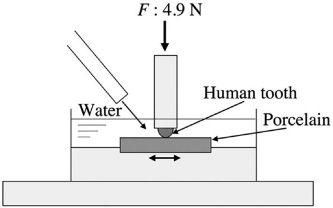
Schematic illustration of wear test. The abrasion cycle consisted of linear reciprocating movement over 3 mm for 1 sec.

Dimensions measured for calculation of wear volume. R: Radius of sample, r: Wear side radius, h: Amount of decrease in sample length.
The Vickers hardness (HV) of the enamel and porcelain specimens was measured by a HV tester (HM-125, Mitutoyo Corp., Kanagawa, Japan) with an applied load of 49.05 N maintained for 15 sec. The length of the diagonal indentation left by the Vickers indenter was measured, and the HV was calculated by the following equation, where F is the applied load (N) and d is the diagonal length of the indentation.
Scanning electron microscope (SEM) observation
A crystal morphology of three kinds of porcelains were observed by SEM (JSM-5600LV, Japan Electron Optics Laboratory Co. Ltd., Tokyo, Japan) with an accelerating potential of 15 kV that magnification of ×500 after 10% of hydrofluoric acid (Wako Pure Chemical Industries, Ltd. Osaka, Japan) processing for 1 minute.
Crystal structure analysis by X-ray diffraction
Crystalline components of three kinds of porcelain were analyzed with an X-ray diffractometry (XRD-6100, Shimadzu Corp., Tokyo, Japan) and scanned with Cu-Kα radiation at 40 kV tube voltage and 30 mA tube current, and then examined within a range of 2𝜃 = 10−50°.
Results
Enamel wear volume and porcelain wear depth
Figure 4 shows the wear volume of the enamel for the porcelains. The wear volume was 0.102 mm3 with Cercon Ceram Kiss and 0.094 mm3 with Deguceram Gold. Although the two values were similar, they were shown to be significantly different (p < 0.05) by Tukey’s multiple range test. The wear volume with Omega 900 was 0.061 mm3, which was substantially smaller than with the other two porcelains and significantly different (p < 0.05) from both.
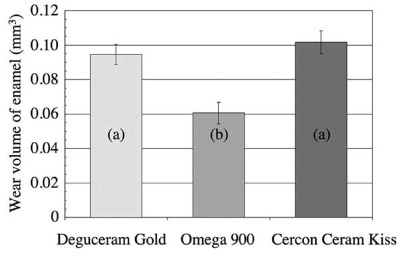
Wear volume of enamel for three kinds of porcelain. Between different alphabets statistically significant differences (p < 0.05) are indicated by Tukey’s multiple range test.
As shown in Fig. 5, the wear depth of the three porcelains by the enamel was 18.03 μm for Deguceram Gold, 15.96 μm for Cercon Ceram Kiss, and 12.38 μm for Omega 900. A statistical difference (p < 0.05) was found between the wear depths of all three porcelains. The results thus show a clear tendency for smaller enamel wear volume when the porcelain wear depth is small.
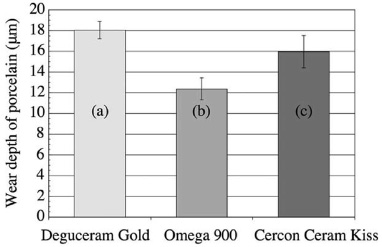
Wear-out depth of three kinds of porcelains. Between different alphabets statistically significant differences (p < 0.05) are indicated by Tukey’s multiple range test.
As shown in Fig. 6, the roughness (Ra) of the porcelain abrasion surface at the end of the abrasion test was 2.20 μm for Omega 900, 3.08 μm for Cercon Ceram Kiss, and 3.27 μm for Deguceram Gold. The results taken together indicate a clear tendency for a smaller enamel wear volume when the surface roughness of the opposing porcelain is low. A statistically significant difference (p < 0.05) was found between all three porcelains in abrasion surface roughness.
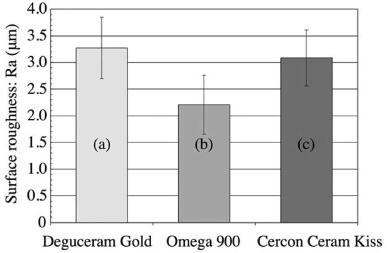
Arithmetic mean roughness (Ra) of three kinds of porcelains after wear test. Between different alphabets statistically significant differences (p < 0.05) are indicated by Tukey’s multiple range test.
Figure 7 shows the HV of the enamel and the three porcelains. Omega 900 had the highest value, at 581 HV. The hardness of Cercon Ceram Kiss was 578 HV, which was slightly lower than that of Omega 900 but not statistically different (p > 0.05). The hardness of 517 HV for Deguceram Gold was significantly lower (p < 0.05) than that of both other porcelains. All three porcelains had significantly higher (p < 0.05) Vickers hardness than the value of 332 HV found for enamel.

Vickers hardness of human enamel and three kinds of porcelains. Between different alphabets statistically significant differences (p < 0.05) are indicated by Tukey’s multiple range test.
Figure 8 shows the SEM image of three kinds of porcelain surfaces. Crystal polygonal of a large and small variety is observed in Deguceram Gold. Crystal of fine amorphous is observed in Omega 900. Spherical crystals were observed in Cercon Ceram Kiss.
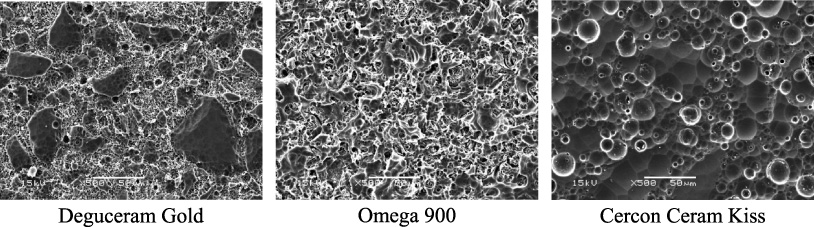
SEM images of the crystal structure of the three kinds of porcelains.
Figure 9 shows the X-ray diffraction patterns of three kinds of porcelains. The X-ray diffraction pattern of Deguceram Gold showed seven peaks of leucite (K2O ⋅ Al2O3 ⋅ 4SiO2) that 2𝜃 values of 16.44, 26.00, 27.21, 30.48, 31.61, 33.97 and 38.06 degrees. As for Omega 900, peak of 16.52, 26.12, 27.30, 30.57 and 31.63 5 degrees was similarly confirmed. On the other hand, a peak of silica (SiO2) of 26.69 degrees and silicon nitride (Si3N4) of 33.98 degrees were admitted though leucite was not able to be confirmed with Cercon Ceram Kiss.
Discussion
Enamel wear occurs naturally in healthy humans at a rate of 20–40μm per year in vertical measure [8]. Following tooth repair, however, the wear rate in the opposing teeth is influenced by the repair material [9] and its surface properties [10]. It has been reported that enamel wear is comparatively small when gold alloy is used as the repair material in the oral cavity [11], but it is not clear whether in vitro study data relates directly to clinical conditions [12].
It has been reported that higher values of surface roughness, load, and sliding speed lead to an increase in the coefficient of friction and the wear volume [13]. It has also been shown that, in the wear process, loose particles generated by wear tend to scratch and thus roughen the surface, as they form a slurry and increase both porcelain and enamel abrasion [9]. Furthermore, it was confirmed by SEM image that the crystal of silica and silicon nitride of Cercon Ceram Kiss has a spherical form. It is considered that the spherical form crystal is easier to detach than a polygon form, and three-body wear occurred. The crystal of a large polygon is confirmed by Deguceram Gold and it is guessed that wear is subject to this influence. On the other hand, Omega 900 exhibited an amorphous fine structure, and since the crystal desorption was a small amount and the surface roughness was kept small value, the wear amount was considered to be small.
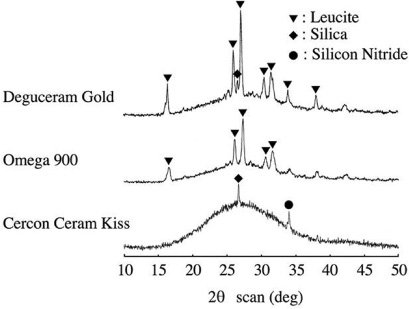
X-ray diffraction patterns of the three kinds of porcelains.
According to Seghi et al., microstructural differences between ceramics also influence enamel wear [3]. Cercon Ceram Kiss is an SiO2 glass-based material. It has been reported that, in the presence of water, crack propagation increases in silicate glasses with high alkaline oxide content [14]. The alkaline soda-lime glass content of Cercon Ceram Kiss is 15–25% in contrast to the 11% content generally found in soda-lime glasses [15]. In the present study, the enamel wear by this porcelain may in part be attributable to changes in the porcelain surface related to interaction between its alkaline oxides and water.
The Vickers hardness of Omega 900 was not significantly different from that of Cercon Ceram Kiss. It has been reported that a proportional relationship exists between ceramic hardness and enamel wear [16], but in the present study, enamel wear was smallest for Omega 900, thus indicating that it cannot be predicted solely on the basis of porcelain hardness [17].
Leucite is added to veneering porcelains for crowns with porcelain to metal fusing, in order to obtain a coefficient of thermal expansion close to that of metals [18]. Deguceram Gold is a hydrothermal ceramic with low melting, softening, and glass transition temperatures, and with a coefficient of thermal expansion adjusted by the large quantity of leucite added [19]. The large amount of enamel wear caused by this porcelain in the present study is thus in apparent accord with the reported rise in enamel wear by low-fusing ceramics [9]. It has also been reported that a leucite-free Si-hydroxyl layer can protect the ceramic surface from damage, and leucite-free ceramic has a homogeneous highly dense structure that contribute to its low abrasive against the tooth enamel [20]. According to another report, increased leucite content increases the enamel wear volume [3]. However, as for the evaluation, it is difficult with the leucite quantity because there is much quantity of enamel wear of Cercon Ceram Kiss where leucite was not detected in crystal structure analysis by X-ray diffraction of this study. The Vickers hardness of Deguceram Gold was found to be the lowest of the three porcelains. This is in line with the reports by Cesar et al. [21], Rasmussen et al. [14], and Kon et al. [22] that porcelains high in leucite content exhibit low Vickers hardness. The comparatively low hardness of Deguceram Gold may thus be due to the difference in its original frits composition. The enamel wear volume with this porcelain was nevertheless high. This again indicates that hardness alone is not a reliable predictor of wear in the opposing enamel, but rather that a comprehensive consideration of crystal size, surface properties, and other factors is necessary.
The enamel wear was lowest (0.061 mm3) with Omega 900, which is in agreement with reports by Al-Hiyasat et al. [20]. Omega 900 is a fine-grain porcelain as shown in the SEM image (Fig. 7). The decrease in wear exhibited by these fine grain porcelains may indicate that irregularities or fractures created under loading conditions cause defects of smaller and less abrasive dimensions [23], and it also influences smooth surface property. The wear depth of the Omega 900 surface was itself found to be small in the present study, presumably for much the same reasons. Moreover, Omega 900 exhibited the lowest post-abrasion surface roughness of the three porcelains, which indicates a low coefficient of friction against the enamel and is a further reason for the low wear found with this porcelain [24].
The Vickers hardness of Omega 900 was high, but, as described above, enamel wear was lowest with this porcelain. Other related factors include the porcelain surface condition [7,21], porosity [22,25], degree of crystallization and crystal size [26]. In the clinical context, moreover, it is necessary to consider pH [25], stress [27], and mode of occlusion [28], among other factors.
Omega 900 has a smooth surface property in fine grain porcelain, and there is little influence on enamel by loose particles of the wear. Therefore, there is little quantity of wear of enamel and Omega 900. In Deguceram Gold and Cercon Ceram Kiss, surface roughness grew large under the influence of loose particles considered that grain size was caused by this more greatly than Omega 900, and enamel and quantity of wear of the porcelain increased. In addition, the size and shape of the crystal and surface roughness of porcelain influence enamel wear and it is difficult to evaluate enamel wear only in Vickers hardness or leucite content.
Conflict of interest
None to report.