



Abstract
BACKGROUND:
Mechanical simulations for biological tissues are effective technology for development of medical equipment, because it can be used to evaluate mechanical influences on the tissues. For such simulations, mechanical properties of biological tissues are required. For most biological soft tissues, stress tends to increase monotonically as strain increases.
OBJECTIVE:
Proposal of a strain-energy function that can guarantee monotonically increasing trend of biological soft tissue stress-strain relationships and applicability confirmation of the proposed function for biological soft tissues.
METHOD:
Based on convexity of invariants, a polyconvex strain-energy function that can reproduce monotonically increasing trend was derived. In addition, to confirm its applicability, curve-fitting of the function to stress-strain relationships of several biological soft tissues was performed.
RESULTS:
A function depending on the first invariant alone was derived. The derived function does not provide such inappropriate negative stress in the tensile region provided by several conventional strain-energy functions.
CONCLUSIONS:
The derived function can reproduce the monotonically increasing trend and is proposed as an appropriate function for biological soft tissues. In addition, as is well-known for functions depending the first invariant alone, uniaxial-compression and equibiaxial-tension of several biological soft tissues can be approximated by curve-fitting to uniaxial-tension alone using the proposed function.
Keywords
Introduction
Biomechanical simulation—i.e. mechanical simulation for biological tissues—can be used to verify performances of medical equipment, and is thus an effective development tool. The biomechanical simulation requires material properties that numerically represent relationships between forces applied to biological tissues and their deformations. Material properties of biological soft tissues, e.g., skin, muscle, and adipose, must be based on the finite deformation theory because of their nonlinearity and their greater deformation than that of hard tissues, e.g., bone and tooth. Ideally, nonlinearity, anisotropy, and viscoelasticity should be taken into consideration when attempting to reproduce deformation behaviors of these soft tissues. Furthermore, a coupled structural and fluid analysis, e.g., an analysis of blood vessels, requires complicated model [1]. Therefore, in this study, we propose a strain-energy function that focuses on the nonlinearity of biological soft tissues. When applying biomechanical simulation to biological soft tissues, hyperelastic models assuming incompressibility and isotropy—particularly a polynomial strain-energy function formed by Rivlin [2]—have been widely used [3–5]. The polynomial strain-energy function is implemented in many of the finite element method (FEM) systems, e.g., Abaqus, ANSYS, and Marc, and thus can be easily utilized. Therefore, we focused on this incompressible isotropic polynomial strain-energy function.
In material tests on biological soft tissues, such as uniaxial-tension tests, we can see that stress increases monotonically with increasing strain [6,7]. However, from the study of Schröder and Neff [8] showing that the second invariant is non-convex, we judged that the conventionally used polynomial strain-energy function does not guarantee monotonically increasing stress–strain relationships. Additionally, ethical issues have restricted the implementation of tests on biological soft tissues in recent years. Even if they can be done, most of them involve uniaxial-tension. Therefore, a strain-energy function used for biological soft tissues is desirable to be one that can approximate other test modes, such as uniaxial-compression and equibiaxial-tension, from uniaxial-tension alone.
In this study, we proposed a polyconvex polynomial strain-energy function, of which stress increases monotonically with increasing strain. Furthermore, to confirm an applicability of our proposed function to biological soft tissues, we used the function for curve-fitting to uniaxial-tension/compression test of porcine-liver by Chui et al. [9] and uniaxial/equibiaxial-tension test of porcine-coronary-artery by Lally et al. [10]. Compatibility of the curve-fitting results with the experimental data from the original compression and equibiaxial tests was then evaluated.
Theoretical considerations
Strain-energy functions
Biological soft tissues deform greatly, like rubber materials. Therefore, in order to reproduce deformation behaviors of the biological soft tissues using FEM, the strain-energy function formed by Rivlin [2] shown in Eq. ((1)) have been frequently used:
The first Piola–Kirchhoff stress, i.e., the nominal stress, must be determined based on Eq. (7). The second Piola–Kirchhoff stress tensor
For biological soft tissues, a strain-energy function assuming incompressibility and isotropy is frequently used. Under these assumptions, the first Piola–Kirchhoff stress in the case of uniaxial-tension/compression is determined. When an incompressible isotropic object is subjected to uniaxial-tension/compression, the strain within it is uniform. The deformation gradient tensor
The first Piola–Kirchhoff stress of isotropic equibiaxial-tension is determined in the same manner as the uniaxial-tension/compression. When an incompressible isotropic object is subjected to equibiaxial-tension, the strain within it is uniform. In this case, the deformation gradient tensor
In uniaxial-tension behaviors reported by Yamada [6] and Abe et al. [7], stress of most biological soft tissues increases monotonically with increasing strain. Therefore, it is desirable for a strain-energy function to have a monotonically increasing stress–strain relationship. For a polyconvex function, a second derivative is positive. Because a second-order differential of a strain-energy function corresponds to a first-order differential of a stress–strain relationship, when a strain-energy function is polyconvex, stress increases monotonically with increasing strain.
Schröder and Neff [8] obtained the following findings with respect to polyconvexity of the reduced invariants J i in Eq. (10) and a term including them:
The first reduced invariant J
1 is polyconvex. Term (J
1 − 3)
n
is also polyconvex in the range of n ≥ 1. The second reduced invariant J
2 is not polyconvex.
From these characteristics, if a term having the second reduced invariant is included, the function is not polyconvex; therefore, Eqs ((10)) and ((11)) are not always polyconvex. For the polynomial strain-energy function to be always polyconvex, the coefficients of the terms including J
2 should be set to zero, i.e., c
ij
(j ≠ 0) = 0, to eliminate those terms. Additionally, the terms including J
1 should be further defined as a positive linear combination, i.e., c
ij
(j = 0) ≥ 0. That is, Eq. ((10)) is rewritten as in Eq. ((29)), namely a polyconvex strain-energy function, which is expressed as a reduced polynomial form with a coefficients constraint added. In addition, Eq. ((11)) is rewritten as in Eq. ((30)).
The polyconvex strain-energy function proposed in this study is a function based on the first (reduced) invariant alone. As is well-known, such functions can approximate other test modes from a uniaxial-tension test in rubber [20–23]. In order to verify applicability of the proposed function, it was examined whether other test modes such as uniaxial-compression and equibiaxial-tension can be approximated from uniaxial-tension alone. That is, curve-fitting only to the uniaxial-tension extracted from the data of Chui et al. [9] on experimental uniaxial-tension/compression of porcine-liver was performed with Eq. (30) via Eq. (21); the compression derived from the curve-fitting was then compared with the experimental finding. In addition, a similar comparison for equibiaxial-tension was performed by using the data of Lally et al. [10] on experimental uniaxial/equibiaxial-tension of porcine-coronary-artery. Since, for porcine-liver, Chui et al. [24] suggested that the nine-parameter polynomial strain-energy function, i.e., Eq. (11), can provide a good result, curve-fitting using it was also performed. Additionally, curve-fitting using Eqs (31) and (32) used for porcine-coronary-artery by Lally et al. [10] was then performed, and the results were compared with those of the proposed function:
The uniaxial-tension/compression of porcine-liver by Chui et al. [9] was converted to a numerical form by using UnGraph software (Biosoft, Cambridge, UK). The experimental tension/compression has five or six points in both the tension and compression sides. All points were converted to numerical data, and the data only on tension side were submitted to curve-fitting, using Eqs ((11)), ((30)), ((31)), and ((32)). Curve-fitting was performed by minimizing RMS in Eq. ((33)), using a solver function in Microsoft Excel 2013. The curve-fitting results are shown in Fig. 1, and the values of coefficients obtained and the RMS values derived for the tension region and the compression region are shown in Table 1.
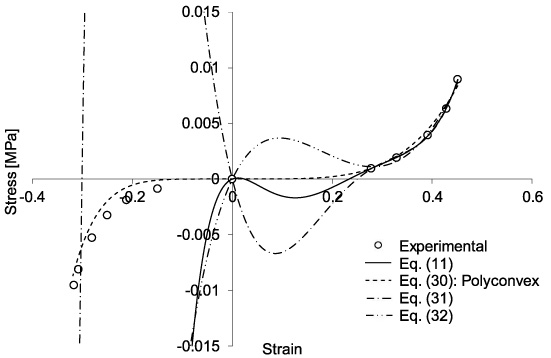
Results of curve-fitting to uniaxial-tension alone extracted from uniaxial-tension/compression data for porcine-liver.
Results of curve-fitting to uniaxial-tension alone of porcine-liver
[MPa]
The data of Lally et al. [10] on the uniaxial/equibiaxial-tension of porcine-coronary-artery were converted to a numerical form by using UnGraph software (Biosoft, Cambridge, UK). In the report by Lally et al. [10], the experimental uniaxial-tension was shown as a solid line. Therefore, the uniaxial-tension line was converted to points that were as densely located as possible. Using the numerical data only on tension, curve-fitting calculations were performed using Eqs ((11)), ((30)), ((31)), and ((32)), as described in Section 4.1. Figures 2, 3, and Table 2 show the curve-fitting results.
Results of curve-fitting to uniaxial-tension alone of porcine-coronary-artery
Results of curve-fitting to uniaxial-tension alone of porcine-coronary-artery
[MPa]
In accordance with the work of Hisada [25], if nonlinear problems in FEM use any strain-energy functions other than polyconvex ones, it is not guaranteed that the functions will have a unique solution for a given boundary condition. Multiple solutions for unique boundary conditions will possibly halt calculation in FEM, so that the use of such functions is not appropriate. When a strain-energy function is polyconvex, uniqueness and stability of solutions in FEM are guaranteed [25]. Therefore, because the proposed strain-energy function is polyconvex, stable execution of FEM can be expected.
The strain-energy function proposed here takes the same form as in the Yeoh model [20], which was proposed for carbon-black-filled rubber vulcanizates. Terms including I 2 were eliminated in the Yeoh model on the basis of the experiments by Kawabata and Kawai [26] and Seki et al. [27], who found that sensitivity of strain-energy functions to changes of I 2 was smaller than that to changes of I 1. On the other hand, we eliminated terms including J 2 on the basis of the polyconvexity of the reduced invariants and made the remaining terms positive linear combination. It is therefore interesting that the strain-energy functions having the same form were derived from completely different grounds. Yeoh showed that c 20 was definitely negative when evaluating its applicability to carbon-black-filled rubber vulcanizates [20]. This characteristic is probably associated with the deformation behavior of carbon-black-filled rubber vulcanizates. In contrast, in the proposed function, c 20 needs to be zero or positive. Thus, if the characteristic described above represents general deformation behaviors of rubber, it would be difficult to use our proposed function to reproduce them.
Next, we discuss the applicability of the proposed function to the uniaxial-tension/compression of porcine-liver shown in Fig. 1. According to the interpolation of the experimental points by Chui et al. [9], a stress–strain curve should be tangential to an abscissa in the vicinity of strain = 0, and stress should increase monotonically with increasing strain. However, for curve-fitting using Eqs ((11)), ((31)), and ((32)), no monotonic increase is found in the strain range from 0 to 0.28. In addition, in Eqs ((11)) and ((31)), there are inappropriate negative stress, despite in the tensile state. This is because there is no fitting object in the long interval of 0.28 in strain from zero up to the first data point, and the functions are not polyconvex. In contrast, our proposed function does not show inappropriate stress over the whole tension region and provides a monotonically increasing stress–strain relationship, because the function is polyconvex. Consideration of the compression region in Fig. 1 reveals that, because curve-fitting was performed only in the tension region, Eqs ((11)), ((31)), and ((32)) do not match the experimental compression at all, and Eq. ((31)) has inappropriate positive stress in the compression region. In contrast, the proposed function appropriately represents the experimental compression trend, i.e., monotonically increasing, and does not have inappropriate positive stress in the compression region. These results are consistent with the RMS values in Table 1. As in Yeoh’s report [20], the following equation is obtained by combining the equations for the first Piola–Kirchhoff stress in uniaxial-tension/compression, i.e., Eq. ((21)), and the proposed function, i.e., Eq. ((30)):
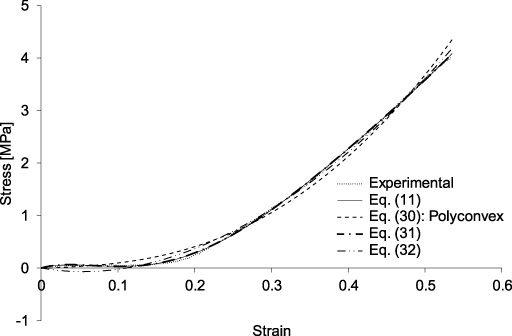
Approximation results for uniaxial-tension based on curve-fitting to uniaxial-tension alone extracted from experimental data on uniaxial/equibiaxial-tension of porcine-coronary-artery.
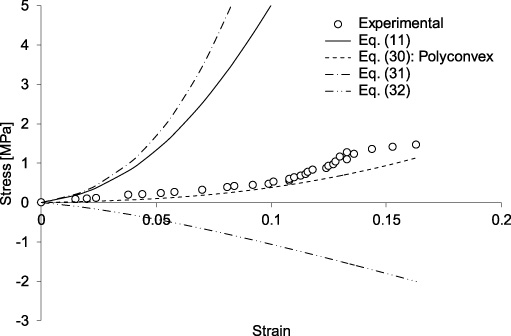
Approximation results for equibiaxial-tension based on curve-fitting to uniaxial-tension alone extracted from experimental data on uniaxial/equibiaxial-tension of porcine-coronary-artery.
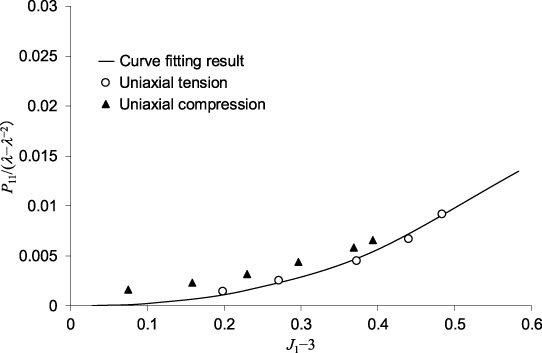
Relationships of P 11∕(𝜆 − 𝜆−2) to (J 1 − 1) for uniaxial-tension/compression in the experimental results and the fitting curve for tension alone with respect to Eq. ((34)).
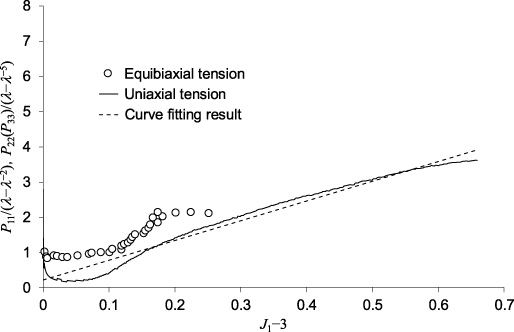
We then examine the applicability of the proposed function to the uniaxial/equibiaxial-tension behaviors of porcine-coronary-artery by Lally et al. [10]. According to the study of Lally et al. [10], the stress–strain relationships for both uniaxial-tension and equibiaxial-tension of porcine-coronary-artery show a monotonic increasing trend. As shown in Fig. 2, all the functions are similar in uniaxial-tension. However, for Eq. ((32)), there is inappropriate negative stress, despite in the tensile state. This is because Eq. ((32)) is not guaranteed its monotonic increase. In contrast, our proposed function does not show inappropriate stress over the whole tension region and provides a monotonically increasing stress–strain relationship. Although Eqs ((11)) and ((31)) are not guaranteed its monotonic increase, there are not inappropriate values. Here, further consideration is given to the equibiaxial-tension in Fig. 3. Because curve-fitting was performed only in the uniaxial-tension, Eqs ((11)), ((31)), and ((32)) do not match the experimental equibiaxial-tension at all, and Eq. ((32)) has inappropriate negative stress in the equibiaxial-tension. In contrast, the proposed function well represents the feature of the experimental equibiaxial-tension, i.e., monotonically increasing, and does not have inappropriate negative stress in the equibiaxial-tension. These results are consistent with the RMS values in Table 2. As is the case with the former examination for the tension and compression, the following equation is obtained by combining the equation for the first Piola–Kirchhoff stress in the case of equibiaxial-tension, i.e., Eq. ((28)), and the proposed function, i.e., Eq. ((30)):
From these, we judged that the proposed model can reproduce the deformation behavior of porcine-liver and porcine-coronary-artery more appropriately than the conventionally used strain-energy functions, i.e., Eqs (11), (31), and (32), from the viewpoints of monotonically increasing trend and uniaxial-compression/equibiaxial-tension obtained from the curve-fitting to uniaxial-tension alone.
The scope of application of our proposed function is the static deformation behavior of materials that can be assumed to be incompressible and have the monotonically increasing relationship between stress and strain, e.g., biological soft tissues. Also in consideration of the features as “stability of calculation based on the uniqueness of solution” and “reproducibility of other modes’ testing from uniaxial test alone” as described above, the proposed function can be effective used for biomechanical simulation involving various test modes, e.g., compression and equibiaxial-tension.
Many biomechanical simulations with various deformation to verify the effect of mattresses on the human body and the stress of intervertebral discs have been studied in recent years [28–44]. In such biomechanical simulation, the intervertebral discs are subjected to tension and compression with the deformation behavior of the waist bending. When only tensile tests are applied to the conventional strain-energy function, tensile stresses are calculated for compressive deformations, and appropriate solutions may not be derived. This is not the case with the proposed function, which shows compressive stress for compressive deformation. We believe that the proposed function will effectively provide the success of such static biomechanical simulations from uniaxial test alone.
In this study, we proposed a polyconvex strain-energy function. We evaluated the proposed function by applying it to uniaxial-tension/compression and uniaxial/equibiaxial-tension of biological soft tissues. The results obtained are summarized as follows:
The proposed function can reproduce a monotonically increasing trend of stress–strain relationships. The proposed function guarantees unique solutions in FEM. The uniaxial-compression behavior of porcine-liver can be approximated by curve-fitting to the uniaxial-tension alone using the proposed function. The equibiaxial-tension behavior of porcine-coronary-artery can be approximated by curve-fitting to the uniaxial-tension alone using the proposed function.
From these facts, the proposed function can provide stable static biomechanical simulations including multiple deformation behaviors, e.g., tension, compression, and equibiaxial-tension, from uniaxial test alone. For example, the proposed model can be used for stress analysis of the intervertebral discs due to the bending motion of the waist that occurs when a person sleeps on a mattress. Since the proposed function can be realized by the coefficient restriction to the function implemented in general-purpose FEM systems, we believe that the proposed function greatly contributes to implementation of biomechanical simulation for biological soft tissues.
Footnotes
Acknowledgements
T. Funai is grateful to Dr. Osamu Sugiyama of the Industrial Research Institute of Shizuoka Prefecture for his help in checking the grammar of this manuscript.
Conflict of interest
None to report.