



Abstract
BACKGROUND:
Our previous study found that spray-dried glutinous rice starch (sGRS) is larger in size, rounder in shape and better in flowability than native GRS. It has the potential to be used for direct compression hydrophilic matrix (HM) tablets.
OBJECTIVE:
This study aimed to investigate the factors that affect the propranolol release from directly compressed sGRS HM tablets.
METHODS:
The effects of the amount of sGRS, the compaction pressure and the amount of magnesium stearate on the drug release rate from sGRS directly compressed HM were investigated. In vitro drug releases were performed. The dilution potential of sGRS was investigated.
RESULTS:
The higher the sGRS content, the slower the release rate of propranolol. The compaction pressure and the amount of magnesium stearate did not significantly affect the release rate of the drug. The sGRS showed plastic deformation under compaction with a dilution potential of 46%.
CONCLUSIONS:
sGRS can be used as a direct compression HM. The amount of sGRS significantly affected the release rate of the drug from the matrix.
Introduction
Direct compression tablets are produced by mixing the drug with the excipients in a blender. The powder mixture is then directly compressed on a tabletting machine. Direct compression excipients should be free flowing, physiologically inert, tasteless and colourless. The excipients should also improve the compressibility of poorly compressible drugs, be relatively inexpensive and be capable of being reworked with no loss of flowability or compressibility [1]. The advantages of this process are obvious: very few stages are involved, with a consequent reduction in appliance and handling costs. Furthermore, as heat and water are not involved, stability is not affected.
Hydrophilic matrix (HM) tablets are most frequently used as controlled release dosage forms intended for oral administration [2,3]. Such matrices are commonly employed because of the advantages associated with their manufacturing, i.e., simple formulation and the use of existing tableting technologies. When this system is exposed to an aqueous medium, it does not disintegrate, but it develops a highly viscous, gelatinous surface barrier immediately after hydration which will further control the drug release and the liquid penetration into the centre of the system. The overall drug release rate is controlled by one or more of the following processes: transportation of the solvent into the system, swelling of the associated matrix, diffusion of the solute through the swollen matrix and erosion of the swollen matrix [4].
Our previous study found that pregelatinized glutinous rice starch (pGRS) was a potential HM forming agent. However, the tablets were prepared by a wet granulation method [5]. We also found the optimal condition for spray-dried GRS (sGRS) to get the product suitable for direct compression method [6]. The obtained product (sGRS) was larger in size, rounder in shape and better in flowability than native glutinous rice starch. It has a potential to be used for direct compression HM tablets. The objective of this study was to investigate the factors that affect the drug release from directly compressed sGRS HM tablets and compare its retarding ability with hydroxypropyl methyl cellulose (HPMC). The mechanism of drug release from sGRS HM tablet and the dilution potential of sGRS were also investigated.
Materials and methods
GRS was purchased from Cho Heng Rice Vermicelli Factory (Thailand). HPMC (Methocel® F4M) was purchased from Rama Production (USA). Acetaminophen (Iwaki Seiyaku, Japan) and propranolol hydrochloride (Changzhou Yabang Pharmaceutical, People Republic of China) were used as model drugs. All other chemicals used were of an analytical grade.
The preparation of sGRS
The sGRS was prepared as described in our previous paper [6]; briefly, the slurry of 6% w/w GRS was heated at 62 °C for 9 minutes to get 79% pregelatinized starch. The pGRS was spray-dried at the inlet temperature of 250 °C and 44% compressed air flow (GEA Niro A/S Gladsaxevej 305-DK-2860 Soeborg, Denmark) to obtain 97% gelatinized sGRS.
Preparation of sGRS HM tablets and factors that affect drug release
The experimental design
The effects of three factors, i.e., the amount of sGRS (X 1, 80–200 mg/tab), the compaction pressure (X 2, 100–250 MPa), and the amount of magnesium stearate (MgSt) (X 3, 1–2.5%), on the drug release rate were investigated. The central composite design (CCD) was used for this study, and the model drug was propranolol HCl (80 mg/tab). The compositions and the compaction pressures for all 17 experiments are shown in Table 1. The sGRS and propranolol HCl were blended in a mixer for 10 min. MgSt were added and further mixed for 5 min. The powder blends were compressed using a tableting process analyser (Model N-30EX, Tab All, Okada Seiko, Tokyo) equipped with flat-faced punches 8 mm in diameter.
The composition and condition for HM tablets preparation
The composition and condition for HM tablets preparation
The responses were the drug release rate (Y
1) and the hardness (Y
2). A second-order polynomial mathematical model (Eq. (1)) was selected to predict the response (Y
i
):
To prove the robustness of the obtained model, the model was used to generate the compositions of HM tablets, which have different drug release rates: maximum, medium and minimum. The HM tablets were then prepared according to those conditions, and the observed drug release rates were compared with the predicted values. The validated model was used to optimize the formulation that meet satisfactory requirements [8,9].
Dissolution test
A dissolution test of the propranolol HCl HM (n = 3) was conducted using the official monograph [8] for propranolol extended-release capsules, i.e., dissolution apparatus 1 (100 rpm) in 900 ml of 0.1 N hydrochloric acid at pH 1.2 for 1.5 h and phosphate buffer solution (pH 6.8) for 22.5 h at 37 ± 0.5 °C. Filtered media were analysed with an ultraviolet-visible spectrophotometer at a wavelength of 289 nm for the propranolol HCl content. The percentages of drug released per surface area of the tablet were plotted against the square root of time, the slope was a drug release rate (Eq. (2)) [10].
The weights of 20 tablets were individually measured. The average weight and SD were calculated. The uncoated tablets weighed between 80–250 mg or higher than 250 mg and could have 7.5 and 5% deviations, respectively [9].
Hardness
The hardness values of 10 tablets were individually determined by using a hardness tester (VanKel Industry, USA). The average hardness and SD values were calculated.
Uniformity of content
The individual propranolol HCl contents in 10 tablets were determined. The average percentage of the labelled amount was calculated. The tablets comply with the test if each individual content is between 85 and 115% [9].
Friability
The tablets (as close to 6.5 g as possible) were carefully dedusted, placed in the friabilator drum and rotated 100 times. Then, any loose dust from the tablets was removed, and the tablets were reweighed. The percentage of weight loss was calculated. A maximum mass loss should not be greater than 1% [9]. The tests were done in triplicate.
Drug retarding ability of the sGRS compared with HPMC
The tablets containing a variety of HM-forming agents (GRS, sGRS or HPMC) were produced by a direct compression technique at the optimal condition from the obtained data: 160 mg/tab of HM forming agent, 240 MPa of compression pressure, and 1% MgSt. The properties of the tablets, i.e., dimension, uniformity of weight, hardness, friability and uniformity of content and dissolution profile, of each formulation were investigated.
The drug release mechanism
The analysis of drug release from swellable matrices can properly be performed with a flexible model that can identify the different contribution to overall kinetics. The simple power law (Eq. (4)) was selected to describe the kinetics of drug release from swellable HM [11].
sGRS and acetaminophen (0, 10, 20, 30, 40, 50, 60, 70% w/w) were blended in a mixer for 10 min. Aerosil® (0.25%) and MgSt (1%) were added and mixed for a further 5 min. The blended powder was compressed by a tableting process analyser (Model N-30EX, Tab All, Okada Seiko, Tokyo, Japan) equipped with 8 mm flat-faced punches with a target weight of 240 mg at various compaction pressures (from 50 to 300 MPa). The data were recorded by the DAATSU II software (Okada Seiko, Tokyo, Japan). The tensile strength of each tablet was calculated from the hardness and thickness of the tablets (Eq. (5)) [12].
The AUC of each mixture divided by the AUC of the 0% acetaminophen mixture gave a ratio known as work potential or area ratio. This area ratio was plotted against the concentration of the drug. Linear regression and back extrapolation to a zero area ratio gave the values reflecting the dilution capacity [13].
Physical characteristics of GRS and sGRS
The GRS and sGRS appeared as white powder with average particle sizes of 10.73 ± 0.44 and 52.64 ± 2.51 μm, respectively. The microphotographs of the GRS and sGRS showed the differences in particle size, shape, and surface texture. The GRS was polygonal-shaped granules, non-porous and smooth surface, while sGRS was larger and concave spherical shaped with hollow regions [6]. These properties would promote the flowability of the modified starch, which is important when they are used as directly compressed excipients.
Preparation of sGRS HM tablets and factors that affect drug release
The release rate and physico-chemical characteristics of sGRS HM tablets are shown in Table 2. The uniformity of weight and the uniformity of content of every formulation met the requirement of BP [9]. These data implied that the mixtures did not have any flowability problem.
The release rates and physio-chemical properties of sGRS HM tablets
The release rates and physio-chemical properties of sGRS HM tablets
Only formulations 8 and 10 met both the monograph of drug release [8] (i.e., <30% at 1.5 h, between 35% and 60% at 4 h, between 55% and 80% at 8 h, between 70% and 95% at 14 h and between 81% and 110% at 24 h) and the friability test (<1%). The drug release rates of both formulations were 0.013% mm−2 min−1∕2. This rate was used to generate the composition of the HM tablets i.e., 160 mg of sGRS, 240 MPa of compaction pressure, and 1% MgSt and was considered as the optimal formulation.
The response surface graphs of drug release rate are shown in Figs 1a, b and c. The relationship between drug release rate and X
1, X
2 and X
3 was described by a quadratic model, as shown in Eq. (8).
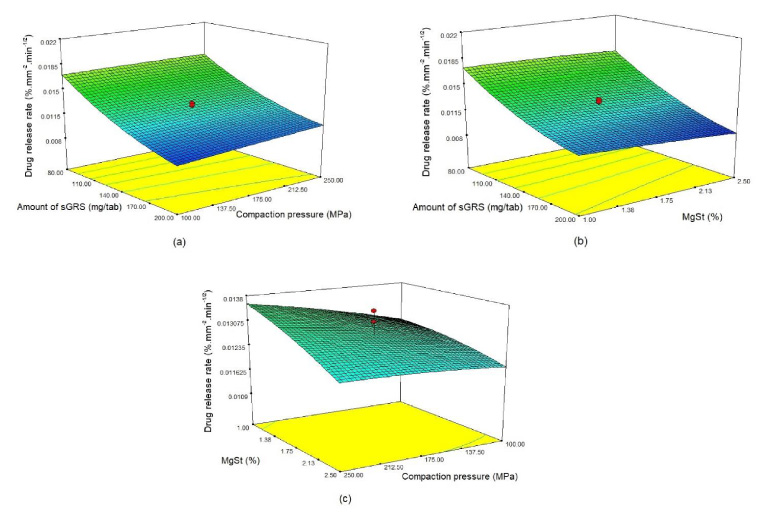
The response surface graph of drug release rate: (a) amount of sGRS vs. compaction pressure; (b) amount of sGRS and amount of MgSt; (c) compaction pressure and amount of MgSt.
The coefficient of determination (R 2) of this model was 0.9658. ANOVA showed that the model p-value was significant (p = 0.0003) and that the lack of fit p-value was not significant (p = 0.5325). This indicated that this model was well fitted. To validate the obtained model, Eq. (8) was used to generate the tablet composition with various drug release rates. The maximum drug release rate (0.020% mm−2 min−1∕2) was obtained with 40 mg of sGRS, 300 MPa of compaction pressure, and 0.5% of MgSt. The median drug release rate (0.015% mm−2 min−1∕2) was obtained with 120 mg of sGRS, 200 MPa of compaction pressure, and 0.8% of MgSt. The minimum drug release rate (0.009% mm−2 min−1∕2) was obtained with 240 mg of sGRS, 240 MPa of compaction pressure, and 1% of MgSt. The optimal drug release rate (0.013% mm−2 min−1∕2) was obtained with 160 mg of sGRS, 240 MPa of compaction pressure, and 1% MgSt. The HM tablets were prepared according to these conditions, and their drug release rates are shown in Table 3.
The drug release rates of HM tablets prepared according to the condition generated by the model (n = 5)
The uniformity of weight, uniformity of content and friability of all HM tablets met the requirements of BP [9] (data not shown). The hardness values of the sGRS HM tablets for maximum, medium and minimum release rate were 33.63 ± 0.24, 68.50 ± 0.22 and 116.37 ± 0.47 N, respectively (n = 10). The observed and predicted release rates (Table 3) were not significantly different (p > 0.05). This mathematical model is well fitted with experimental data and can be used to explain the drug release rate.
From the model (Eq. (8)), only the amount of sGRS (X
1) and the quadratic term of the amount of sGRS (
Further investigation found the relationship between hardness (Y
2) and X
1, X
2 and X
3 in a linear model, as shown in Eq. (9). The coefficient of determination (R
2) of this model was 0.8620. ANOVA showed that the model p-value was significant (p < 0.0001) and that the lack-of-fit p-value was also significant (p > 0.0094). This implied that this model was not a complete fit. Thus, the model was not further validated, but the information trend could be used for an explanation of the event. The amount of sGRS and compaction pressure had a positive effect, while the amount of MgSt had a negative effect on the hardness. However, only the amount of sGRS and the amount of MgSt significantly influenced the hardness of HM tablets.
A variety of HM-forming agents, i.e., GRS, sGRS and HPMC, were used to prepare tablets. The physical characteristics, i.e., the uniformity of weight, the uniformity of content and the friability, of all HM tablets met the BP requirements [9] (Table 4). The propranolol HCl release profiles of all matrices are shown in Fig. 2. HPMC could sustain the release of propranolol HCl better than sGRS and GRS. The release data were analysed according to the Eqs (3) and (4), and the parameters are listed in Table 5.
The physico-chemical properties of GRS, sGRS and HPMC HM tablets
The physico-chemical properties of GRS, sGRS and HPMC HM tablets
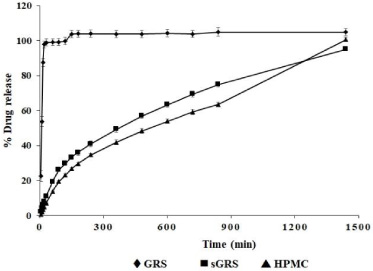
The dissolution profiles of GRS, sGRS, and HPMC HM tablets.
The drug release parameters (mean ± SD, n = 9) of GRS, sGRS and HPMC HM tablets
* is statistically significant (p-value < 0.005).
GRS tablets showed rapid drug release in acidic medium because of its fast disintegration (within 10 min). The low solubility and unswellable nature of GRS [6] allowed fast water penetration into the tablets and weakened the bond between the particles. The tablets disintegrated instead of hydrating, and no gel layer was formed to hinder drug release. The correlation coefficients (R 2) of the GRS tablets in both the power law and Higuchi’s equations were 0.6855 and 0.519 in acidic medium and 0.2878 and 0.3141 in phosphate buffer medium, respectively (Table 5). These results indicated a poor correlation between the drug release and time.
Both sGRS and HPMC matrix release profiles were well fitted to the power law model (Eq. (4)) and Higuchi’s equation (Eq. (3)). HPMC HM tablets released the drug slightly faster in an acidic medium than in a phosphate buffer medium but via a different mechanism (Table 5). In an acidic medium, the mechanism was super case II (n = 1.1732), and in a phosphate buffer medium, the mechanism was anomalous (n = 0.5492). The sGRS HM tablets also released the drug faster in acidic medium than in the phosphate buffer medium and followed the same mechanism, i.e., anomalous (n = 0.8780 and 0.4695, respectively). The release rates of the drug from sGRS HM tablets in acidic medium (0.0163% mm−2 min−1∕2) were faster than those from HPMC HM tablets (0.0126% mm−2 min−1∕2). The release rates of the drug from sGRS HM tablets in phosphate buffer medium (0.0118% mm−2 min−1∕2) were also faster than those from HPMC HM tablets (0.0106% mm−2 min−1∕2).
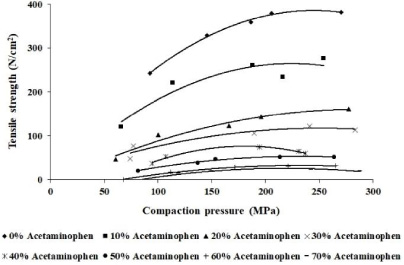
The compaction profiles of SGRS/acetaminophen tablets.

The plot of area ratio and % w/w of acetaminophen.
The dilution potential is the capacity of any excipient to be mixed with another ingredient while still obtaining tablets of acceptable quality. This value could be used as an index to evaluate the efficacy of direct compressible excipients. The higher the dilution potential, the better is the quality of excipient. Acetaminophen (a poorly compactable drug) was used as a model drug for this experiment. The compaction profiles of sGRS/acetaminophen mixtures are shown in Fig. 3. The tensile strength of the tablets decreased when the amount of acetaminophen increased at the same compaction pressure. Thus, the AUC of compaction pressure (in the range of 70–230 MPa) and tensile strength also decreased when the concentration of the drug increased. When the area ratios were plotted against the concentration of acetaminophen (Fig. 4), a linear relationship was observed. Linear regression and back extrapolation to a 0-area ratio yielded a dilution capacity value of 46%. This is a theoretical measure of the maximum ability of the sGRS to hold acetaminophen in a tablet mass that maintains its integrity upon release of pressure. These values truly reflect the decline in the compactibility of an excipient when exposed to a poorly compactible drug, as expressed in the decrease in the normalized area ratios as a function of the percentage of acetaminophen.
Discussion
The effect of the MgSt concentration, the most commonly used lubricant, on the tablet physio-chemical properties has been reported by several authors [14–16]. Usually, a lubricant is used at 0.2–2% of the total weight of tablet, but it exerts a very large effect on the pharmaceutical characteristics. Theoretically, MgSt forms a layer on the host particles, weakening the interparticle bonding [17–19] and simultaneously delaying the wettability of particles. This resulted in a decrease in the tablet hardness and a delay of tablet disintegration [20–22]. Furthermore, it could affect the bioavailability of the active ingredient [23]. The lubricant-sensitivity of sGRS was also investigated. The result showed that the amount of lubricant (X 3) in the common range of 1–2.5% [24] affected the hardness of the HM tablets. The higher the MgSt amount, the lower the tablet hardness. However, the MgSt amount did not significantly affect the drug release rate (Eq. (8)). This result could be from the fact that the sGRS quickly formed a highly viscous gel-layer. It could attenuate the lubricant influence and, therefore, reduce the differences found during drug release [25].
The amount of sGRS significantly affected the hardness. The higher the amount of sGRS, the higher the tablet hardness. The higher amount of sGRS caused an increase in the inter-particulate surface area available for bonding [26–28] and resulted in harder tablets.
Hydrophilic polymers normally have rapid gelification when in contact with water, becoming hydrated instead of disintegrating. This hydration leads to the formation of a zone in which the polymer passes from the “crystalline” state to a “rubbery” state known as a gel layer. Several transport phenomena take place through this gel layer: the entry of the aqueous medium, the exit of the drug to the outside of the system and the phenomena of matrix erosion. The thickness of the gel layer increases as more water enters the system. At the same time, the surface-most polymer chains, which become hydrated earlier than the others, gradually relax until they lose consistency, after which matrix erosion begins. Thus, penetration of the medium into the matrix is accompanied by the formation of a series of fronts, which later disappear during the process of matrix dissolution [29–32]. The release of a drug from HM tablets involved two release mechanisms, a Fickian diffusional release and Case-II relaxational release. Fickian diffusional release occurs by the usual molecular diffusion of drug due to a chemical potential gradient. Case-II relaxational release is the drug transport mechanism associated with stresses and state-transition in hydrophilic glassy polymers which swell in water or biological fluids. This term also includes polymer entanglement and erosion. For a cylindrical matrix (e.g., tablets), values of n = 0.45 indicate case I or Fickian diffusion, 0.45 < n < 0.89 indicate an anomalous (non-Fickian) release, values of n = 0.89 indicate case II transport kinetics, and values of n > 0.89 indicate super case II transport [29].
The water retention capacity of HPMC and sGRS was not different (1.05 ± 0.01), the swelling capacity of sGRS (6.88 ± 0.01) was higher than that of HPMC (1.44 ± 0.01) and the solubility of sGRS (10.73 ± 0.23%) was also higher than that of HPMC (0.34 ± 0.14%). In addition, there were reports that the medium pH (1 and 6.4) had no effect on the rheological characteristics of the HPMC gel [33,34]. Peerapattana et al. [5] also reported that the pH of the medium (from 1–8) hardly affected the viscosity of pGRS mucilage. Therefore, the difference in the release mechanisms (n-values) and release rates of HPMC and sGRS HM tablet in both media should be due to differences in swelling capacity and solubility.
The anomalous release of sGRS HM tablets in both media means propranolol HCl was released from the matrices via two competing mechanisms, i.e., drug diffusion and polymer relaxation (or erosion). The drug diffusion mechanism contributed largely in phosphate buffer medium (n value close to 0.45), while the matrix erosion contributed more in acidic medium (n value close to 0.89). When the matrix first came into contact with the acidic medium, the drug at the outer surface was dissolved and leached into the medium. When it was further contacted with the medium, the sGRS was hydrated, swelled and formed a gel layer for drug to diffuse. The diffusion mechanism contributed more as time progressed. Therefore, the n value and drug release rate gradually decreased in phosphate buffer medium. However, due to the lower swelling capacity and solubility of HMPC than sGRS, these resulted in the super case-II mechanism of drug release from HPMC HM tablets in acidic medium and the anomalous mechanism in phosphate buffer medium. As seen when comparing the drug release rate from sGRS with HPMC HM tablets in both media, after water absorption, sGRS swelled faster and became more soluble than HPMC. Hence, the drug was released faster from the sGRS HM tablets than from the HPMC HM tablets.
Curvature was observed in the compaction profiles of every acetamenophen concentration (Fig. 3). This could be explained by the fact that there are two components responsible for forming a compact: a constructive component, responsible for forming strong bonds, and a destructive component, mainly responsible for post-compression elastic recovery. The elastic recovery is exaggerated at a high compaction profile. This pattern of the compaction profile is similar to the result of Avicel® PH101, a plastic deformation material [13].
Conclusion
The response surface methodology and multiple response optimization could be applied to identify the factors that affect interested responses. This tool can help minimize the number of experiments and provide much information simultaneously. The sGRS was a potential candidate to be used as a direct compression HM-forming agent. The sGRS made the tablet preparation easier with less unit operation and more economical and could retard the release of the propranolol HCl. The amount of sGRS significantly affected the release rate of propranolol HCl from the matrix. The higher the sGRS content, the slower the release rate of the drug. While the compaction pressure and the amount of MgSt did not significantly affect the release rate of the drug. The sGRS showed plastic deformation under compaction with a dilution potential of 46%.
Footnotes
Acknowledgements
This work was supported by (1) the Postharvest Technology Innovation Center and Agricultural Machinery and Postharvest Technology Research Center, Khon Kaen University (KKU), and (2) KKU’s Graduate Research Fund and Financial Support for Graduate Research. The authors would like to thank the Research Institute of Pharmaceutical Sciences, Musashino University, Japan, for their technical support in the tableting process analysis.