



Abstract
BACKGROUND:
Drilling is a well-known mechanical operation performed for fixing fracture at required locations in bone. The process may produce mechanical and thermal alterations in the structure of the bone and surrounding tissues leading to irreversible damage known as osteonecrosis.
OBJECTIVE:
The main purpose of this study was to measure the level of biological damage in bone when a drill assisted by low and high levels of vibrations is penetrated into bone tissue.
METHODS:
Histopathology examination of sections of bones has been performed after drilling the bone using a range of vibrational frequency and rotational speed imposed on the drill with and without supply of saline for cooling.
RESULTS:
Cell damage in bone was caused by the combined effect of drill speed and frequency of vibrations. Histopathology examination revealed more damage to bone cells when a frequency higher than 20 kHz was used in the absence of cooling. Cooling the drilling region helped minimize cell damage more at a shallow depth of drilling compared to deep drilling in the cortex of cortical bone. The contribution of cooling in minimizing cell damage was higher with a lower drill speed and frequency compared to a higher drill speed and frequency.
CONCLUSION:
Vibrational drilling using a lower drill speed and frequency below 25 kHz in the presence of cooling was found to be favorable for safe and efficient drilling in bone.
Introduction
Drilling in bone is a frequent orthopedic surgical operation and has been widely discussed in the literature [1–6]. Control on force and temperature during bone drilling is essential for a safe and efficient surgical outcome. Drilling in bone may cause structural and biological damage to the living tissue which may led to loosening of fixative metallic components attached to the bone. Excessive drilling force and torque generated during the process may subject delicate bone tissue to unnecessary stress and can break the drill during surgical incision [2,7]. Excess heat generation in bone during surgical drilling seriously affects cell activity leading to necrotic bone (death of the cells) [3,8,9]. Necrosis is an inevitable and irreversible biological process that can be induced by drilling in bone.
Heat generation above the thermal threshold level during cutting of bone has been reported as a major cause of failure of fixative devices attached to the bone. Previous studies on bone drilling mainly focused on determination of optimized parameters such as drill speed and feed rate and drill geometry for minimizing biological damage in bone. One potential damage is the disappearance of cells (osteocytes) in the microstructure of bone which could minimize osteogenic potential of bone surrounding the implant. There is no consensus in published research on the determination of the thermal threshold level for inducing necrosis in bone during drilling operation [10,11]. Studies pertinent to the analysis of biological damage in bone in vibrational drilling (VD) are rare. Similar bone healing was found between piezosurgery and traditional bone drilling in the tibia of a rat [12]. Less biological damage to the bone was observed when VD with a fixed frequency of 20 kHz and an amplitude of 16 μm was used in bovine cortical bone [13].
Recent research on bone drilling mainly focusses on finding new cutting techniques for multifold decrease in mechanical and biological damage in bone. Despite several benefits VD can offer compared to conventional drilling (CD), the biological response of the bone to a range of vibrational frequencies has not yet been extensively investigated [13,14]. Besides exploring the effect of tool geometry and cutting parameters on the outcome of the bone cutting process, researchers have also tested established cutting techniques assisted by microvibrations imposed on the tools along the cutting direction. One of these techniques is VD or ultrasonically-assisted drilling (UAD) and has been widely used in several studies on bone drilling [13,15–17]. Research has shown several benefits of VD in metals [18], composites [19] and biological tissues [20–22]. VD under certain levels of vibrations imposed on the drill was found to control mechanical and thermal damage in bone. Some studies have found lower cutting force and elevated temperature when vibrational plane cutting and orthogonal elliptical vibration-assisted cutting were used for cutting the bone [23,24].
Studies evaluating damaged bone cells due to VD using a range of frequencies are rare. In addition, previous studies have investigated cell damage in bone only in dry drilling (without a supply of saline for cooling). The main aim of this study was therefore to explore possible benefits of ultrasonically assisted in bone by investigating mechanical and physiological defects in bone caused by VD. Experiments are performed to measure and compare the extent of cell damage around the hole with and without cooling the drilling region in VD.
Materials and methods
Specimen preparation for drilling
The middle part of the femoral bone of a young cow aged three to four years was used in the drilling experiments. Bovine bones have demonstrated properties similar to human bones and are widely used in studies related to bone surgical procedures. Cylindrical pieces of approximately 6 cm length were cut from the femoral shaft. Periosteum from the outer surface of specimens was cleaned using milling operation in the presence of cooling with saline. The thermocouple was placed approximately 1 mm to 1.5 mm from the drilling track for acquiring temperature data. Specimens waiting for drilling operations were kept refrigerated at −10 °C to preserve their physical properties.
Drilling experiments
A vertical drilling machine with ultrasonic transducer placed on the top the drill assembly was used in the experiments. A schematic of the experimental set up for VD is shown in Fig. 1. The ultrasonic transducer was able to generate a maximum frequency and amplitude of 40 kHz and 20 μm respectively. A two component transducer (9345B; Kistler, Switzerland) was used to measure the drilling thrust force. The transducer was placed just below the bath collecting bone swarf and saline solution. Thermocouples with a 1 mm wire diameter were used for temperature measurements. The estimated uncertainty in the temperature measurement system was 0.5 °C. The maximum and minimum spindle speed used was 1000 rpm and 2500 rpm while the feed rate was fixed at 40 mm/min. The frequency of vibrations varied between 15 kHz and 30 kHz and the amplitude of vibration was kept constant at 10 μm. Drilling was performed using a 4.8 mm surgical drill. Normal saline with a temperature of 10 °C was used as a coolant medium. The saline was supplied to the drilling region at volume flow rate of 0.4 l/min using a plastic hose of 4 mm diameter.
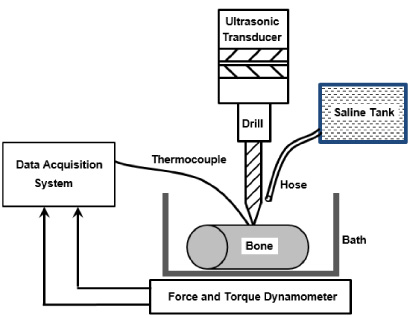
Schematic of the experimental set up for VD in bone.
Specimens with holes were cut from the main cylindrical piece and fixed in 10% formaldehyde solution for more than eight hours. Decalcification of specimens was performed for two days in a solution containing 40 ml 65 vol% nitric acid, 20 ml 10 vol% formaldehyde and 340 ml distilled water. Slices were prepared by cutting the bone near the location where the thermocouple was placed. Viable and dead osteocytes (basic unit cell lying in lacuna of bone microstructure) were visualized using the BX53 microscope (Olympus, Japan).
Results
The magnitude of drilling force and bone temperature were recorded at their peaks value during the drilling experiments. Each data set in the subsequent graphs represents the average of three consecutive tests using similar drilling parameters. Drilling thrust force and bone temperature were simultaneously measured during the drilling operation. At first, the drilling test was performed in a dry condition (no supply of coolant) using a range of drill speeds and with a constant frequency of 20 kHz followed by irrigating the drilling region with saline solution. Variation of drilling force and bone temperature in VD under dry and wet conditions is shown in Fig. 2. The drilling force was found to be slightly affected when saline was used. However, the drilling force was found to decrease with an increase in drill speed regardless of the supply of solution to the drilling region. Conversely, bone temperature was found to increase with an increase in drill speed. Obviously, bone temperature was significantly dropped for all values of drill speeds when saline was used.

Variation of force and temperature in bone with drill speed in VD (frequency – 20 kHz).
A representative set of images showing the microstructure of the sections of bone specimens after drilling with and without cooling is shown in Fig. 3. Viable osteocytes within the lacunae (dark spots indicated by the arrows) are indicated in histology images. An area covered by 400 μm distance away from the cut edge of the hole was examined for cell damage. Disappearance of the osteocytes from their chambers (lacunae) indicated the death of cells and was referred as “damage” in this study. The cell damage (in percent), representing the number of disappeared osteocytes from lacunae to the total number of osteocytes in the enclosed region, was calculated. The locations of viable osteocytes within the lacunae are shown with arrows and empty lacunae are highlighted with circles. Haversian canals, which are a series of microscopic tubes providing passage to the blood vessels and nerves, are enclosed with rectangles. A large arrow points out the cut surface and also represents the cutting direction along which cell damage away from the surface of the hole was calculated.

Histology images obtained after VD: (a) dry drilling, (b) wet drilling.
The effect of the frequency of vibration on the number of less lost (cell damage) for drilling with and without cooling with saline is shown in Fig. 4. The number of missing osteocytes (which correspond to damage or loss) within 400 μm distance from the edge of the hole was correlated with the frequency of vibration. The damage in the bone structure was found to significantly increase with an increase in frequency in dry drilling. In drilling performed with supplying saline solution, the damage was significantly decreased for each value of frequency used. The effect of saline on cell damage at a frequency of 30 kHz was lower compared to the damage induced in the bone using a frequency lower than 30 kHz. A possible reason for this was the ineffective cooling in the presence of strong vibrations.
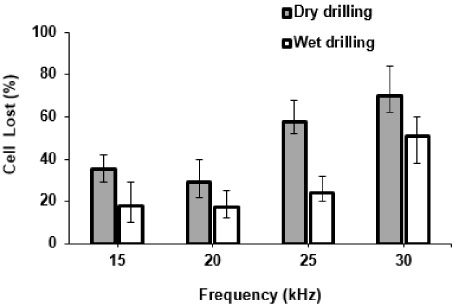
Effect of frequency on cell loss in dry and wet drilling (drill speed – 2000 rpm).
The next step was to find the effect of cooling on cell damage at two different levels of drilling depths (2 mm and 7 mm) measured from the top surface of the bone. The calculations were performed by changing the drill speed from 1000 rpm to 25000 rpm and using lower and higher levels of frequency (15 kHz and 30 kHz). The effect of drill speed on cell damage at 2 mm and 7 mm drilling depths using a fixed frequency of 15 kHz was calculated (see Fig. 5). Cooling the drilling region significantly reduced the amount of cell damage both in shallow and deep drilling. The reduction in cell damage was not significant when cooling was used in deep drilling using a high frequency (see Fig. 6). The cell damage was increased with an increase in drill speed regardless of the level of frequency and depth of drilling.
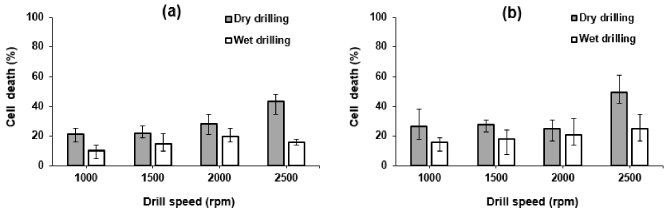
Effect of cooling on cell loss in dry and wet drilling: (a) drilling depth – 2 mm, (b) drilling depth – 7 mm (frequency – 15 kHz).

Effect of cooling on cell loss in dry and wet drilling: (a) drilling depth – 2 mm, (b) drilling depth – 7 mm (frequency – 30 kHz).
The drilling system used in this study mimics a handheld surgical drill used in real orthopaedic surgeries. The mechanics of chip separation and evacuation from the drilling region is the same regardless of the size of the drilling system. The surgical systems used in orthopaedic clinics do not have a mechanism for visualizing and measuring biological damage induced in the bone tissue by a hard metallic drill. Conventionally, the postoperative response is only jugged based on an infection near the cutting area or a loosening of fixation. In this study, the biological response of bone tissue was studied using a rage of ultrasonic frequencies imposed on the drill and a well-known range of drill speeds. One of the novel aspects of the current study was the evaluation of cell death surrounding the drill area in VD in the presence of cooling. The rise in bone temperature and slight drop in the drilling force during dry and wet drilling was a collective result of the drill speed and frequency.
Cooling the drilling region with saline takes away heat produced by shear deformation of bone material and also reduces friction between alternating contact of drill with bone. A significant decrease in cell damage was found using saline cooling even when a frequency of 30 kHz was imposed on the drill in shallow drilling (2 mm depth of drilling). The ineffectiveness of cooling in deeper drilling was caused by the limited access of cooling media to the tip of the drill due to strong alternating translational motion of the drill and rotations imposed on the drill which caused splashing of the cooling media. The effect of drill speed on the drilling force and temperature in CD in bone is unclear due to conflicting results published in previous studies [3,25,26]. A decrease in drilling force and rise in bone temperature with an increase in the drill speed observed in the current study was similar to the publish data on CD in bone [27,28].
A histology examination of specimens after cutting provides useful information on morphology alterations in bone tissue. The majority of published studies reported histopathology of bone during CD (with no vibrations imposed on the drill). Bone remodelling and osseointegration were found as indictors for successful osteotomies during cutting with a drill, piezosurgical piece and saws. Although necrotic cells have been shown to be the inevitable outcome of a temperature rise above a thermal threshold level in cutting, cell death was also found to be strongly influenced by the drilling force [29]. Cooling the cutting region with saline can minimize heat generation and cell damage surrounding the cut during the sawing and burring of hard bone [30]. Microcracks generated in the microstructure of bone as a result of large drilling force was suspected to absorb bone cells [31,32]. Drill speed is one of the influential factors for physiological alterations in bone tissue [13].
Reduced cell viability using a higher frequency imposed on the drill is attributed to an increase in temperature due to heat dissipation and alternating stress induced in bone tissue as a result of a vibrated drill. This led to significant thermal alteration in the bone tissue due to elevated temperature. VD in bone has been found to produce less damage in terms of osteonecrosis near the drill site [13]. Rotary ultrasonic drilling can also minimize thermal and mechanical damage in bone due to lower temperature and undue forces compared to CD [16]. On the other hand, piezotomes have been found to minimize bone loss and soft tissue protection [33]. Piezosurgery has been reported to have similar postoperative healing in bone compared to CD [12]. A complicated relationship among various drilling parameters such as drill speed, feed rate, frequency of vibration, drilling force, temperature and cell damage made the identification and selection of conducive drilling parameters in surgical bone drilling a difficult task until now.
Conclusions
Drilling experiments were performed on skeletally matured bone using a range of drill speeds and frequency of vibrations imposed on a surgical drill in the cutting direction. Increased alternating contact of the drill with bone caused by high levels of microvibrations was linked to the increased level of biological damage in bone. Lower damage to bone cells was calculated with a frequency of 20 kHz and below. Frequencies above 20 kHz possibly increased bone temperature above the thermal threshold level for living cells residing close to the drilling region when no coolant was supplied to the drilling region. This study hypothesized that a lower drill speed and frequency and constant supply of coolant medium are essential for risk-free vibrational drilling in bone. Investigating the effect of drill size and drill speed above 2500 rpm in the presence of vibrations on cell damage was beyond the scope of this study.
Footnotes
Acknowledgements
The authors are thankful to Mr. Bader Al-Sumri, Biomedical Scientist in the Pathology Department, Sultan Qaboos University for the preparation of specimens for histological examination.
Conflict of interest
None to report.
Funding
This research study was supported by the Deanship of Research Grant Scheme of Sultan Qaboos University, Sultanate of Oman (Grant no. RF/ENG/MIED/19/02).