



Abstract
BACKGROUND:
Knee proprioception is an integral component of neuromuscular control system that stabilizes the joints, reducing incidence of injury. Knee injuries’ incidences differ between genders. Knee rotation is a component of different knee injury mechanisms. Gender differences in knee proprioception in internal (IR) and external (ER) rotations are not sufficiently studied.
OBJECTIVE:
To check whether proprioceptive acuity in IR and ER directions of knee rotation is inherently lower in women compared to men. Moreover, to assess gender difference in ranges of knee rotation.
METHODS:
Thirty volunteers (15 women and 15 men) participated. Knee proprioception acuity and ranges of knee rotation were assessed using the knee rotatory kinesthetic device (KRKD). Proprioception was tested using absolute judgment task, subject’s ability to discriminate different rotation movements (stimuli) randomly presented, then just notable difference (JND) was calculated; least difference accurately discriminated in 75% of trials.
RESULTS:
Women had lower proprioception acuity in IR than men (1.70
CONCLUSION:
Gender difference in knee proprioception acuity was found in IR, which is the direction of rotation that anterior cruciate ligament (ACL) stabilize. Women’s ranges of knee rotation are greater than men in both IR and ER.
Abbreviations
Introduction
Injury prevention is receiving higher interest in present research [1], and reducing the incidence of knee injuries using different training programs are present in literature [2]. The prevention programs are multifaceted, however, they all concentrate in modifiable factors that can affect incidence of knee injury such as neuromuscular control and proprioception training [3].
Proprioception is one of the components of the sensorimotor regulation system. It plays the role of providing sensory information necessary for establishing neuromuscular control responses, thus enhancing joints stability [4]. Mechanoreceptors providing proprioceptive feedback are widespread in knee joint menisci, capsule, ligaments, tendons and muscles surrounding the knee joint [5]. Anterior cruciate ligament (ACL) in particular plays important proprioception role serving the feedback mechanisms regulating the neuromuscular control system [4, 5]. Rozzi et al. [6] suggested that innate high knee laxity in women may lead to lower proprioceptive acuity compared to men counterparts. This lower proprioceptive acuity may affect neuromuscular control in a negative way and render women at higher susceptibility to different knee injuries.
A particular sequence is proposed and applied in sports injury prevention researches involving identifying the sports injury problem, the risk factors and mechanisms that contributes to incidence of injury and strategies to modify these risk factors to reduce future incidence are main components in the sequence of injury prevention researches [1, 7]. Neuromuscular control and proprioceptive acuity are modifiable ACL injury risk factors [8]. Gender differences in the incidence of different knee injuries such as ACL injuries are reported as an identifiable injury problem [9]. Several risk factors of higher ACL injuries in women compared to men counterparts have been researched while proprioception acuity has been rarely considered in previous studies [10]. Thus in this research it is intended to check whether there exists a gender difference in proprioception as ACL injury risk factor.
Gender differences in proprioception acuity were investigated in some studies in the sagittal plane movements of the knee joint [6, 11, 12, 13]. Despite the rotation components in some significant knee injuries, such as ACL [14, 15] and meniscus injuries [16, 17] gender differences in proprioceptive acuity in the transverse plane movements was checked in a single previous study [10]. In that study, they tested proprioception using threshold to detection of passive movement (TTDPM), and results indicated poorer proprioceptive capacity in women compared to men in the internal rotation (IR) direction in healthy subjects.
The purpose of this study is to test gender differences in knee rotation proprioception acuity. Moreover, to assess knee active and passive range of motion of knee internal (IR) and external rotation (ER). Based on the higher incidence of ACL injuries in women compared to men it was hypothesized that women would report less proprioceptive acuity in knee rotation than men, and they would have higher active and passive range of motion compared to age and sports activity level matched men.
Methods
Design
A cross sectional study was conducted to compare knee rotatory proprioceptive acuity, and range of motion of active and passive knee rotation between healthy recreational sports active college-aged men and women.
Subjects
Thirty recreational sports active healthy subjects volunteered in this study (15 men and 15 women). Men and women volunteers were comparable in age and physical activity level. Physical activity level was determined according to sports activities rating scale [18]. Subjects were excluded from the study if they had previous lower limb injuries that require surgery, minor knee injuries or any source of knee pain for the last 3 months. Subjects had description of the procedures of the study and they provided signed consent form prior to data collection in consensus with the ethical approval from the University’s institutional review board (IRB). Data collection took place during the period between February and June 2015.
Procedures
Each subject visited the laboratories of department of physical therapy at University of Dammam for one time that extends for about 90 minutes. All subjects were tested for knee rotatory proprioceptive acuity and active and passive knee range of motion (ROM) using knee rotatory kinesthetic device (KRKD). Procedures are similar in all subjects and all procedures were carried out by the author.
Assessment of proprioceptive acuity
An example of one of the test positions. Panel A shows the starting position of knee rotation movement at 0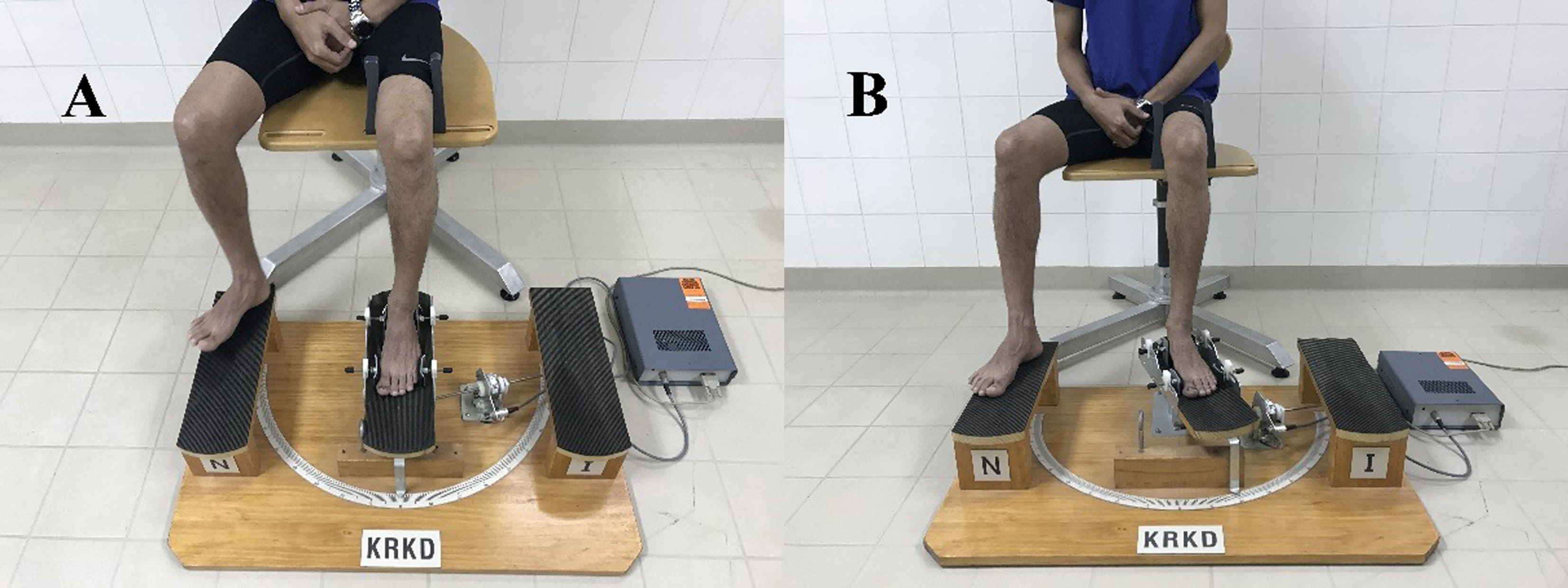
Software of the motor-derived KRKD provides a set of highly reproducible movement steps at random order which are difficult, but not impossible, to discriminate [19]. The outcome measure is just noticeable difference (JND). If two movements are too close to one another in range of motion a subject would perceive them as “the same movement”. To be perceived as different movements (be differentiated) they should be a separated by wide enough range of motion. In this case JND can be considered as the minimum difference between ranges of knee rotation movements that allow the subject to perceive them as different movements in 75% of trials [15]. Previous studies showed no significant difference in knee proprioceptive acuity between dominant and non-dominant legs in healthy non-athletes [19] and in athletes [20] using JND calculated based on measures by KRKD. Therefore, we arbitrary selected to examine the right knee of all subjects. Software of KRKD was set to present 4 movement steps (rotation ranges) in each of the knee rotation directions; IR and ER directions. In IR the movement stimuli were set to (13.5
Each direction of motion was tested separately. The order of testing IR and ER proprioceptive acuity was randomized. In each direction the 4 related movement steps were repeated 40 repetitions, 10 repetitions for each stimulus, at a randomized order that the software shuffled automatically for each volunteer and direction of motion [14].
Volunteer sat on the KRKD height adjustable chair in 90
At the beginning, each volunteer was enabled a familiarization trial on the direction of motion that was randomly selected to be tested first by a blind draw. The four movement steps in each rotation direction were given numbers from 1 to 4, from smaller to larger respectively. So that during familiarization the subject was trained to identify the movement stimuli in this way. After familiarization trial the test was carried out. During each test movement the subject was asked to move the movable platform from starting position (0
Volunteer assumed the same sitting position, and the same legs positions, and thighs and feet stabilization of the tested and non-tested sides as in assessment of proprioceptive acuity. Knee rotation ROM was assessed using a goniometer mounted at the base of the platforms. The order of testing of active and passive knee ROM and the direction of test were randomized for all subjects. For active range of motion the volunteer was asked to move to maximal degree of knee rotation in test designated direction maintaining even foot contact with the platform. For passive ROM testing the same procedure as active ROM assessment was followed by pressure by a handheld dynamometer in the same direction of rotation by a force equals 9 Nm applied at a fixed point of the movable platform using Microfet handheld dynamometer
Statistical analysis
Between subjects characteristics comparison were done using independent t-test. Probit analysis, a subroutine of SPSS 12 for windows, was used to analysis data for proprioceptive acuity and to calculate JND values for all subjects. To assess the significance of mean differences between and within the women and men groups, we applied a separate two way mixed ANOVA for each variable including JND, active, and passive ROM of knee rotation for groups (women, men), and direction of knee rotation (IR, ER). All tests level of significance were evaluated at alpha
Subjects’ characteristics (means
S.E)
Subjects’ characteristics (means
Women and men were compared for differences in mean age, weight, height, and BMI. No significant differences were found in comparing different characteristics between women and men subjects as shown in Table 1.
Comparisons of simple effects of gender on proprioceptive acuity showed significantly higher JND in women compared to men in IR direction of rotation. On the other hand there was no significant between women and men in JND means in ER. Results of proprioceptive acuity showed no significant difference comparing simple effects of direction of rotation (IR or ER) on proprioceptive acuity measure, JND, within women participants. Assessing interaction effects of gender and direction of rotation on JND showed no significant interaction effects (Table 2).
Mean
SD of the just noticeable difference (JND) for internal and external rotation movements of the women and men
Mean
Active and passive knee rotation ranges of motion were assessed. Comparing simple effects of gender on knee rotation active range of motion showed significantly larger IR range of motion in women compared to men. Likewise, for knee rotation passive range of motion there were significantly higher IR range in women compared to men.
Simple effects of direction of rotation (IR or ER) assessed for active range of motion showed significantly larger ER ranges compared to IR ranges within women subjects respectively. Similarly, simple effects of direction of rotation on passive range of motion showed significantly higher ER ranges compared to IR ranges in both women subjects respectively. There were no significant interaction effects between gender and direction of knee rotation active or passive ranges of motion (Table 3).
Mean
The current study was conducted to assess the gender differences in proprioceptive acuity, active and passive knee rotation ranges of motion.
The results of the study showed significantly higher JND in IR direction in women compared to men. Higher JND values indicate that women have lower proprioceptive acuity in IR direction than men. Few previous studies reported the gender difference in knee proprioception in different directions. Barrack et al. [22] and Rozzi et al. [6] evaluated proprioception during knee flexion and extension and reported a lower proprioception towards end range of extension in females. Nagai et al. [10] and Boerboom et al. [11] reported a lower performance in proprioceptive testing in females in IR direction. Current study and previous studies [6, 10, 11, 23]demonstrated a lower proprioception in females are present only in the direction where ACL can be loaded (End range of extension and IR) [24]. This can be a probable explanation of the role of proprioception in higher incidence of non-contact ACL injuries in women athletes; as women had lower capacity to perceive ACL injurious positions. Probably proprioceptors in the ACL may be still less stimulated in women at the same range where proprioceptors in the ACL in men subjects fire more readily. Likewise, the lower stiffness of the knee joint in women at low loading forces in transverse and frontal plane movements have been reported in previous studies, and may explain the higher susceptibility of women athletes to non-contact ACL injuries [25].
Another factor which determine the proprioception is the level of activity/exercise. It is confirmed from various studies that physical activity and exercises improves joint position sense [26, 27, 28]. There was a significant difference in the level of activity between the male and female subjects who participated in the current study which a higher level of activity in male participants.
An additional factor is the gender difference in ACL volume where a previous study reported lower ACL volume in women compared to men [29]. Although the same study mentioned that the volume difference were non-significant between gender when adjusting for subject heights, this adjustment will not negate the effect of ACL volume on mechanoreceptors density; the number of mechanoreceptors per unit volume. A lower ACL volume was reported in contralateral limbs of ACL-injured compared to control subjects irrelevant of gender, and confirmed in women by separately comparing ACL-injured and control women [30]. Assuming that women and men have similar numbers of proprioceptors in their ACL, then with lower ACL volume the density of proprioceptors should be higher in women. We found only one study that tried to check for association between ACL mechanoreceptors density and proprioceptive acuity, calculating density as number of mechanoreceptors per gram of specimen weight not ACL volume [31]. These authors reported weak negative correlation between ACL mechanoreceptors density and proprioceptive inaccuracy. Although the report was of relatively low correlation (
Three methods are used in psychophysical experiments; method of limits, method of constant stimuli, and method of adjustment. To test proprioception the methods of limits are used by testing for TTDPM, method of constant stimuli is used by applying JND and method of adjustment are used by testing joint position sense (JPS) through recording error in active or passive reproduction of different joint positions. Despite differences between methods there are no experimental comparisons between them and they are all in use to assess proprioception [1].
Higher knee active and passive rotation ranges of motion reported in this study conforms to the results reported earlier [21, 32]. However, previous studies reported higher women total range of rotation while in current study we reported higher women ranges than men in each of IR and ER in separately. Similar to explanation of higher JND in women, significantly higher active and passive ranges of knee IR and ER rotations in women compared to men may result from higher joint laxity in women compared to men, or less knee joint stiffness in valgus/varus-IR/ER movements’ directions [6, 25]. Moreover, the discrepancy in knee IR range of motion in women compared to men had been explained by the lower volitional activation of knee muscles that provides dynamic restraint to knee IR in women compared to men. This lesser dynamic restraint to IR motion leaves passive structures, including ACL, under a higher demand to restrain IR, thus more likely to sustain injuries [33].
Clinically, this study provided additional evidence of gender difference in knee rotatory proprioception. The finding of the study suggest that the knee proprioceptive training has to be considered in different ranges and different directions regardless of male or female. The ACL prevention and rehabilitation programs should stress proprioceptive training in rotatory directions and plyometrics that involves jumping, cutting, and pivoting activities
Study limitations
There were three main limitations of this study. First the forms of physical activities in which volunteers participate differ between men and women subjects in the current study. Although there was a comparable level of activity according to sports activities rating scale [18] with no significant difference between women and men, mostly women participated in activities that did not involve rotation or pivoting; like cycling and treadmill exercises. On the contrary, most male participants played football that requires pivoting and cutting maneuvers. It is likely that men proprioception is positively affected from this form of activities involving pivoting and cutting. Secondly, no joint laxity tests were performed among the subjects of the current study. However studies shows that increased joint laxity can be a contributing factor for lower proprioceptional acuity [34, 35]. As the current research does not evaluate the joint laxity it is not possible to determine whether it could have been a confounding variable.
Another limitation of the study is that knee rotation range of motion for women was not previously assessed using KRKD. So, we relied on previous studies on men subjects in KRKD to select test angles used as stimuli for testing proprioceptive acuity. Values of total IR and ER ranges in women using KRKD were relatively high compared to a previous studies comparing gender differences in total passive rotation at 90
Conclusion
The current study leads us to support that women have lower proprioceptive acuity than men in IR direction of knee motion. Moreover, women also have larger active and passive range of motion of knee rotation. Both findings are probably related to relative lower joint stiffness and higher laxity in IR direction, and less dynamic restraint from thigh muscles activation. These finds suggests that static restraints for knee IR, especially ACL, are at risk of injury. Prevention and rehabilitation programs should address the development of higher proprioceptive acuity and more rapid and efficient dynamic restraints of knee IR to provide better ACL injury protection for women.
Conflict of interest
None to report.
Footnotes
Acknowledgments
We would like to acknowledge Ms. Ibtihal A. Alhawaj, the technician at the Department of Physical Therapy, College of Applied Medical Sciences, University of Dammam, for her assistance during data collection of this study.