



Abstract
BACKGROUND:
Work-related musculoskeletal disorders are the most common health problems which affect millions of office workers.
OBJECTIVE:
The objective of this study is to determine scapular positioning at rest and different anatomical planes, the assessment of pain, postural changes and the functionality of upper extremity that is caused by the lack of ergonomic principles among office workers of civil servants in TRNC (Turkish Republic of Northern Cyprus).
METHODS:
183 individuals participated in the study and 2 groups were created by grand scores of Rapid Upper Limb Assessment (RULA) tool. Scapular dyskinesis, pain of upper extremity and back, physical functions and symptoms of upper extremity, the self-rated neck disability, cervical and upper thoracic posture of workers were assessed.
RESULTS:
The difference between pain situation and the results of upper extremity and neck disability scores of the participants among the groups was significant (
CONCLUSIONS:
Working environment and conditions cause the wrong of working posture and thus, lead individuals to spend more energy together with physical difficulty, and consequently affect general health.
Introduction
As humans, we have the ability to solve particular problems physically and mentally with new techniques. We can adapt to environmental stimuli and can work under excessive load. Even though the load is physical or mental, it happens as a result of one’s own will or due to the fear of losing a job. Individuals are not aware of the stress their body is exposed to when they are performing the work that is given as a result of over loading. Therefore, the effect of recurring loads become irreversible and can cause permanent health problems [1, 2].
Work-related musculoskeletal disorders (WR-MSD) are the most common health problems that affect millions of workers in Europe [3] and according to a report presented in 2005, its prevalence was stated to be as 38.1% [4]. Various individual, physical, psychosocial or ergonomic factors play a role in development of WR-MSD. They can occur as a result of ergonomic and physical factors such as the height and usage of the desk, chair, screen and mouse not being exclusive to the individual, having static body positions, having poor posture during the work and recurrent movements [5, 6, 7, 8].
Scapular dyskinesis, which is known as altered scapular motion and position, is a musculoskeletal disorder that affects upper extremity. It occurs primarily as a result of muscular, osseous, neurological problems or secondarily as a result of a pathology that is related with the shoulder [9].
The objective of this study is to test the hypothesis that whether ergonomic risk affects the positioning at rest and different anatomical planes, upper body pain, postural changes and functionality of the upper extremity among office workers of civil servants in TRNC.
Methods
Patient selection
The study was conducted among office workers in the public departments located in Famagusta, TRNC in November 2015–February 2016. The study was approved by Eastern Mediterranean University Health Subcommittee (No: ETK00-2016-0020). The participants were given written, verbal information about the purpose of the study and the assessments that will be applied. In addition, they signed an informed consent form. In order to determine the number of samples that will be included in the study, statistical power analysis was carried out. In total, 183 individuals participated in the study.
Criteria for inclusion
Individuals,
who work at public departments for at least 20 hours a week for at least a year, who have normal joint mobility in the upper extremity, who have signed the voluntary informed consent form, whose age range between 25–55.
Individuals,
who had neck and shoulder surgery, who have obesity ( who have had physiotherapy and rehabilitation within last 3 months, who have structural scoliosis, neurologic or systemic disease.
Participant were assessed with rapid upper limb assessment (RULA) tool for the worker. Two groups were created as a result of the assessment with the individuals having received 1, 2, 3, 4 points and individuals having received 5, 6, 7 points. Dominant upper extremity was taken as a reference in all of the assessments. Sociodemographic factors of the patients such as age, sex, body mass index (BMI) and participants’ duration of work were recorded.
Rapid Upper Limb Assessment
Ergonomic risk factors were determined through direct observation of employees’ postures by the dominant side in their workplace using the RULA tool. RULA assesses biomechanical and postural loading on the upper limbs. It is divided into two segments (A and B). Segment A includes steps regarding the assessment of upper arm, lower arm and wrist, whereas segment B is related with the assessment of neck, trunk and legs. Zero and 1 points were added to A and B scores by depending on the muscle use (static postures held for longer than one minute or repeated more than four times per minute) and force (total hours of work in a day) and consequently C and D scores were achieved. Then, C and D scores were combined in a table to obtain a Grand Score. The grand score ranges from 1 to 7 in which a score of 1 or 2 is acceptable, a score of 3 or 4 needs further investigation, 5 or 6 needs investigation and changes sooner and a score of 7 needs immediate investigation and change [10, 11].
Lateral Scapular Slide Test
Lateral Scapular Slide Test (LSST), which was designed by Kibler in 1991, was used for assessing scapular dyskinesis. The test involves three positions. Position 1 involves placement of the shoulder in glenohumeral joint neutral, in position 2, the humerus is placed in a position of medial rotation with 45 degrees of shoulder abduction in the coronal plane and in position 3, the upper extremity is placed in a position of maximal medial rotation with 90 degrees of shoulder abduction in the coronal plane (Fig. 1). The position of the scapula is detected by measuring the distance between the inferior angles of the scapula to the spinous process of the thoracic vertebra bilaterally in all 3 ways. When the bilateral difference is greater than 1.5 cm, it indicates that scapular asymmetry is abnormal [12, 13].
Assessment of scapular dyskinesis in three positions.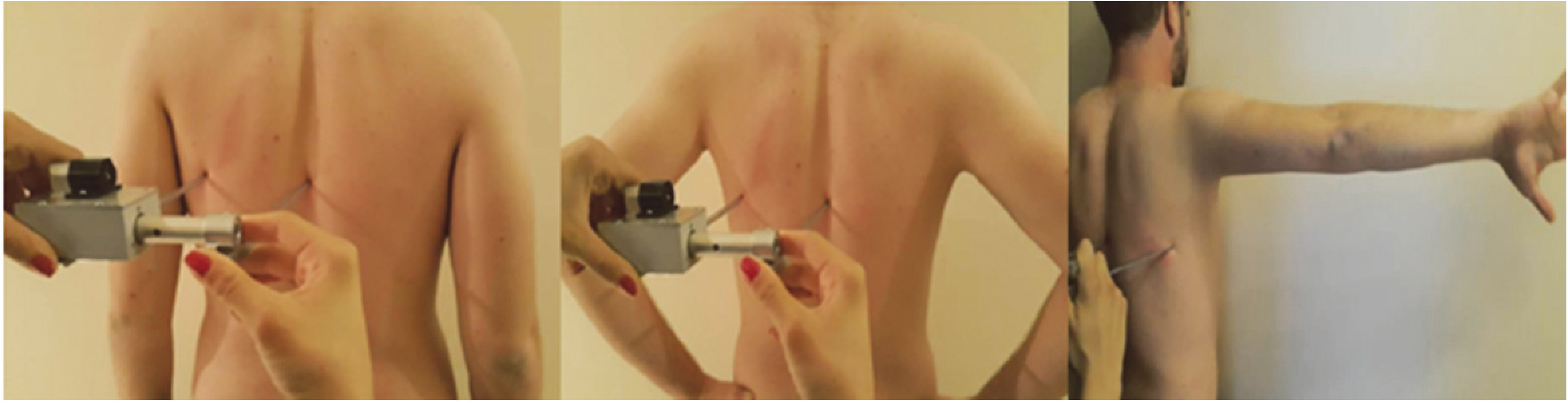
Cervical and upper thoracic posture assessment.
The short form McGill Pain Questionnaire (SF-MPQ) was used for the assessment of pain of upper extremity and back of the individuals. The questionnaire gives information on describing sensory, affective and total aspects of pain experience. Fifteen adjectives describing pain experience were used in its main section. Patients rate the adjectives (Pain Rating Index [PRI]) that best describes their current pain with a four-point scale, with end points of 0 (none) and 3 (severe). Patients also rate their present pain intensity on a visual analogue scale (VAS) and the overall intensity of their total pain experience on a numerical rating scale, with the end points 0 (no pain) and 5 (excruciating pain). The perceived intensity of the pain was assessed with numeric value scale (0
Quick-Disabilities of the Arm, Shoulder and Hand
Quick-Disabilities of the Arm, Shoulder and Hand (Q-DASH) was used for measuring physical functions and symptoms of upper extremity. At least 10 chapters of 11 must be replied in order to calculate the Q-DASH score. Each question was scored with 5-point scale. The total number was calculated with the following formula: [(n total of the replies)/n
A comparison of the age and physical characteristics of the participants
A comparison of the age and physical characteristics of the participants
BMI: Body mass index.
A comparison of the RULA scores of the participants
The self-rated disability of patients with neck pain was assessed with Neck Disability Index (NDI). The index was composed of 10 items that has 6 answer choices for each question. The score range was between 0–5; the highest score was 50 and the lowest was 0. The total points were classified as 0–4: no disability, 5–14: mild disability, 15–24: moderate disability, 25–34: severe disability and 34 and above: complete disability [17].
Cervical and upper thoracic posture assessment
Comparison of pain status of participants
Comparison of pain status of participants
Comparison of short form McGill Pain Questionnaire scores of participants
Comparison of disability scores of participants
Comparison of postural angle of participants
A comparison of the LSST values of participants
A comparison of the LSST results of participants
Cervical and upper thoracic postures were assessed with photography method [18, 19]. Tripod and camera (Canon EOS Rebel T5i, 18.0 megapixel) were located 0.8 meters away from the participant, at C7 alignment in a position, where the lens of the camera would be vertical to the individual’s sagittal level [20]. Reflective markers were placed on the lateral canthus of the eye, the tragus of the ear, the spinous process of C7 and the spinous process of T4. The head tilt angle between the vertical line aligned with tragus of the ear and the line connecting the canthus of eye to the tragus [21], the craniovertebral angle between the horizontal line passing through C7 and the line connecting C7 with tragus [22], the cervicothoracic angle between the line connecting tragus-spinous process of C7 and the line passing through spinous processes of C7-T4 [23] were measured with Markus Bader – MB Software Solutions, triangular screen ruler program (Fig. 2).
After the data had been obtained from the question form, Statistical Package for Social Science (SPSS) 21.0 was used for statistical analysis. Independent sample t test and chi-square test were used for the comparison of groups.
Results
A total of 183 individuals, of which 87 in the group I and 96 in the group II participated in the study. No significant difference was found according to the independent sample t test results with regard to the comparison of age and physical characteristics of the individuals who have participated in the study (
Discussion
As working hours and conditions get more difficult every day, the posture of office workers is affected which can cause WR-MSD. Defining risks that can be created regarding upper and lower extremity musculoskeletal disorders (MSD) is important in terms of public health and health related quality of life. Results supported our hypothesis that ergonomic risk factors can significantly affect scapular positioning at rest and different anatomic planes, upper body pain, functionality of the upper extremity except postural changes among office workers.
RULA is a valid and reliable measurement instrument for preventing MSD that can develop due to the manner of work and for determining risky body postures and it helps determine the statistically significant relationship among the risk scores of individuals and MSD complaints [11]. Ergonomic risk factors are affected by individual and psychosocial parameters and increase the pace of MSD formation. Studies revealed that poor working posture damages the body mechanic and can create such problems [24]. Two hundred and fifty dentists were questioned at their work place using RULA, DASH and NDI indexes in astudy carried out by Dabholkar et al. Significant relationship has been found among RULA and NDI as a result of the study. The neck problems that were detected in the study are considered to be caused by long term static neck flexion, abduction/flexion of shoulder joint of dentists and the irregularity of breaks at work [25]. The values of office workers we have obtained in this study have similar qualifications with the ones determined in other studies which have observed the occupational groups. In our study, it is possible to find a posture, in which neck and body flexion is dominant in general, and repetitive movements appear in shoulder joints. It can be stated that working posture is made by applying repetitive movements, static loading or strength at suitable movement gap for arm, hand and wrist regions and further assessment of this region may be required. Significant difference has been found in NDI, Q-DASH and pain parameters in the comparison between the groups in terms of RULA assessment. It can be stated that working posture that carries higher risk than upper extremity is not suitable for the expected normal joint movement. There are repetitive movements and static muscle activation. The strength applied should be reduced and the individual/work conditions should be measured in a short period by carrying out further ergonomic assessments. As the scores of neck and back parts are two times higher than upper extremity according to the values of pain section scores that were obtained from the study, we consider that they support the ergonomic risk assessment in working positions. Our study can be a reference for other studies conducted on the assessment of ergonomic differences of office workers and on planning ergonomic education accordingly
One of the factors that cause disability to take place in upper extremity on the neck of office workers is the damage of scapula movement. Movement disorder at lower section of M. Trapezius and functional disorder on axioscapular muscles are seen in the people who suffer from chronic neck pain. The control and movement of scapula is damaged as kinematics of the body segments is changed [26]. There are plenty of studies investigating the presence of scapular dyskinesis in the cases of sport injuries, thus comparing the overhead activities and sedentary cases as the after effects of injuries [12, 27, 28]. Kibler et al., have found out that 1.5 cm difference found between the measurement of LSST 2 and 3 and the assessment of scapular dyskinesis of individuals may be related to the decrease of pain and shoulder function [9]. While no significant difference has been found among the values taken at upper extremity resting position (0
Apart from individual and environmental factors, there are other factors leading to pain such as recurrent movements and the movements that require strength, non-ergonomic working spaces and wrong working postures, staying at the same position for a long time, the angle of computer screen, position of desk and chair, the height of keyboard and using the mouse more than 4 hours [34, 35]. In the study carried out by Janwantanakul et al., the relation of neck, back, low back MSD with psychosocial and work related physical risk factors were analysed and they have found that problems of head/neck region is related to working at a poor posture, problems at back are related with excessive body flexion during work and problems at low back are related to working 8 hours or more a day [36]. In a study carried out by Cho et al., the effect of risk factors on MSD formation and the prevalence of these symptoms in individuals who use computer for a long time was examined and it has been determined that the symptoms were mostly seen in shoulder, neck and back regions. Furthermore, psychological problems may cause shoulder and neck problems and high work load may cause low back problems. Poor posture can occur at neck, back, shoulder and elbow regions, whereas MSD can occur at forearm, wrist and finger regions due to recurrent movement [37]. 40.3% of the individuals in our study had pain problem on their neck, 40.3% on their back and 19.3% on their upper extremity regions. Therefore, the results show similarity with the literature. A great majority of the pain complaints of the workers might have occurred as a result of recurrent movements with usage of computer and keyboard for a long time and writing, not taking breaks during work time and lack of ergonomic arrangements in their work places without having any ergonomic training.
It is known that office workers mostly work at slump position. When the studies conducted on slump position are reviewed, it has been found that this position is related with head/neck flexion and forward head posture and it cause the formation of pain due to the increase of muscle activation on cervical and thoracic erector spine for supporting head/neck weight in anterior head position and due to the increase of stress on cervical vertebras and postural problems [38]. Slouch and erect positions’ effect on shoulder flexion movement gap and severity of pain was analysed in people who suffer from shoulder pain due to shoulder impingement syndrome by Bullock et al. No significant difference has been found in terms of the assessment of the severity of pain among two different postures and they have found that shoulder flexion movement gap was decreased 17
Disability was defined by Nagi [41] in 1965 as limitation in performing socially defined roles and tasks expected from an individual within a sociocultural and physical environment. According to the International Classification of Functioning (ICF) and its functions, disability is defined as problems that will prevent individuals from participating in daily life activities throughout their lives. When the relationship between individual and the characteristics of work place with neck pain and disability on office workers was analysed in the study carried out by Jonstona et al., it has been found that neck pain and disability that are assessed with NDI can be affected by using mouse for more than 6 hours, negative effects of emotional condition, increasing age and working space. It has been determined that the pain that occur as a result of poor working ergonomics, as certain sections of the body stay in poor and static position, when forearms are not parallel to the ground and using keyboard when the wrist is not in neutral position [42]. A significant difference has been found between the groups in terms of pain problems of the individuals who have ergonomic risk as well as neck disability problems (
Shoulder, arm and hand disability can be seen secondary to shoulder or neck pain. In the study conducted by Osborn and Jull on individuals suffering from shoulder pain, they have discovered that NDI index and results of Q-DASH questionnaire show medium level correlation and consequently, they set forth that function of upper extremity can be affected depending on neck pain [43].
Hunsaker et al. also used the Q-DASH questionnaire in their study as we used. When normative values gathered by orthopaedic surgeons in America are considered, 10.1
Posture is defined as the harmony of body segments with each other in certain time period and it is known as an important sign of health. Anterior head tilt position can develop and increase cervical sourced neck and back pain syndromes. There are studies which assess reliable an sustainable head and neck postures using the photographing method [45]. Head tilt angle that is used in determining postural problems gives information on the position of the head. This angle can be named differently with the calculation of different angle gaps according to same reference points in some resources [23, 46]. No significant difference has been found between the groups in craniohorizontal angle values in individuals who suffer and do not suffer from neck pain in the study of Silva et al. [47]. No significant difference has been found in our study between the two groups in terms of head tilt angle assessment. It is possible to consider that neck pains cannot only be caused and affected by posture but also by individual and ergonomic risk factors. In addition, the head tilt angle at the levels that can cause postural problems in both of the groups were compatible with the findings in the literature. However, as there are not normal value gaps regarding these angles, only the differences among the groups could be interpreted. Craniovertebral and cervicothoracic angles are other assessments that were used in determination of postural problems in our study. Information was given on neck flexion and extraction values at both angles and we were able to be informed on posture analysis. In the study conducted by Edmondston et al., they determined head tilt angle value as 64.4
The results highlight the need for office workers to receive advice specific to their needs, on ergonomic principles related to their workstations, computer, mouse and keyboard use and work time. The issue of adjustable furniture, anthropometric assessment of workstations and time of using workstation tools requires further investigation.
Conclusion
Working environment and conditions may cause damage in posture during work and thus, lead individuals to spend more energy and have physical difficulty, consequently affect general health. It is important to design work spaces that are compatible with anthropometric measurements of human body and it is necessary to make various modifications to decrease the risk of musculoskeletal disorders and to increase the quality of life, to prevent neck, shoulder, arm and hand pain and disability experienced by office workers. In conclusion, we recommend the implementation of the principles of ergonomics in workstations and health education to develop working posture among office workers (e.g. rest break, strecthing) and thus, to reduce morbidity caused by musculoskeletal disorders.
Footnotes
Acknowledgments
We would like to thank all the participants for their willingness to contribute to this study.
Conflict of interest
There are no known conflicts of interest.