



Abstract
BACKGROUND:
The effect of core training on dynamic balance and agility has yet to be established in literature, especially among junior athletes.
OBJECTIVE:
To investigate the effect of core training on dynamic balance and agility among Indian junior tennis players.
METHOD:
Thirty junior tennis players from various parts of Delhi and the national capital region participated in the study. The study featured a pre-test/post-test experimental design. The subjects were divided into the experimental group (mean age
RESULTS:
A significant difference was found in the post-test values of agility (t-test
CONCLUSION:
Core training programs can be incorporated safely with players’ regular training to improve their dynamic balance and agility, which can eventually lead to better performance.
Introduction
Tennis is one of the most popular sports in the world and is played by over 75 million people [1]. It is a racquet sport involving high levels of intermittent, repetitive physical activity within a competitive match, which may last between 1–4 hours [2]. The physical demand of the game varies, and it significantly depends on the type, level, and surface on which the game is played [3]. Tennis is a sport that demands speed, flexibility, agility, dynamic balance, explosive power, anaerobic and aerobic conditioning, and the ability to react and anticipate quickly. To ensure an efficient “footwork pattern” in tennis, players require good agility, flexibility, and balance combined with a good whole-body coordination [4]. Training in agility and balance enables players to move faster on the court and to change directions swiftly while maintaining control of their body.
A large number of junior players participate at school-, national-, and international level tennis competitions all over the world. Tennis, despite being a safe sport, has an increased risk of injury among junior players because of the high intensity of play, the increased duration of the game, and the physiological and biomechanical demand of the game. Pluim et al. conducted a systematic search on published data on tennis injuries and reported that most tennis injuries occur in the lower extremities, followed by the upper extremities and trunk [5].
The term “core stability” became popular in research after the 20
However it is defined, core stability training is a form of training meant to increase core musculature strength, endurance, and neuromuscular control. The goals of core stability training are improvement in the intersegmental control of the spine, control of intra-abdominal pressure, and global muscular control of trunk movement. The function of the core is to maintain body alignment and equilibrium both statically and dynamically, thus preventing serial distortion patterns [13]. Core training plays a significant role in improving performance. It also prevents injuries and acts as an integral part of the rehabilitation programs of lower limb and trunk injuries [14, 15, 16, 17, 18]. Sandrey and Mitzel [19] and Kahle and Gribble [20] reported a significant improvement in balance in a healthy population after six weeks of a core stabilization training program. However, Schilling et al. [16] reported no improvement in agility after six weeks of core training. Nesser and Lee [21] and Ozmen and Aydogmus [22] also did not establish a relationship between core training and agility in the athletic population. The effect of core training on dynamic balance and agility has yet to be established in the literature, especially among junior athletes. Thus, this study aimed to determine the effect of a core training program on dynamic balance and agility among Indian junior tennis players.
Methods
Subjects
A sample consisting of 30 junior tennis players (age: 15.3
Procedure
Written informed consent duly signed by a legal guardian was required from all subjects who met the inclusion criteria. A simple random sampling method was used to divide the subjects into two groups: Group A (experimental group) and Group B (control group). The study featured a pre-test/post-test experimental design. All the participants were tested for agility and dynamic balance before and after five weeks of intervention. The order of the tests for dynamic balance and agility was randomly assigned. To ensure recovery between measurements, the subjects were given rest periods between the tests. Each test was taken thrice, and the average was obtained for analysis.
Agility was evaluated using t-test, which is considered highly reliable for measuring agility by a number of researchers [23, 24, 25]. The athlete stands at the base of a T that is made of four cones (Fig. 1). Once the examiner gives the signal to start, the athlete runs to the middle cone (10 yards). From there, the athlete sidesteps to the right cone and touches it (5 yards). Then, the athlete sidesteps to the left to the distant cone (10 yards) and touches it. Again, the athlete sidesteps to the middle cone and touches it. In the final stage of the testing, the athlete runs backwards from the middle cone position and touches the base cone (10 yards), and the total time is noted by using a stopwatch [23, 26, 27]. Three trials of the test were performed, and the average of the three was taken for analysis. The subjects were instructed to run as quickly as possible, and a 2 min rest period was given between each trial to avoid fatigue.
Arrangement of cones for t-test.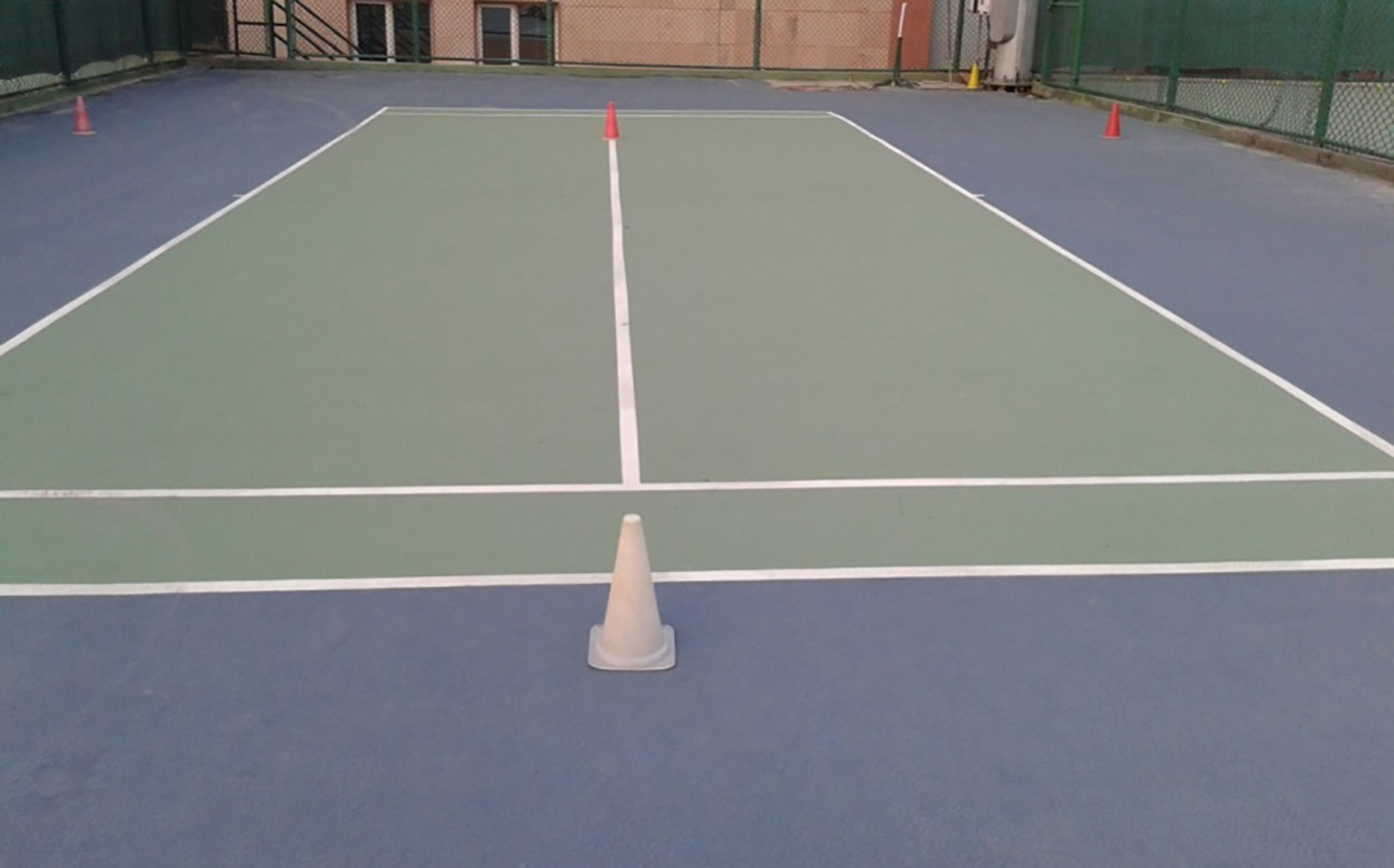
Star excursion balance test.
The Star Excursion Balance Test (SEBT) [28, 29] was used to evaluate the dynamic balance of all subjects. Previous research confirmed the high inter- and intra-tester reliability of the SEBT [30, 31]. The testing procedure starts with the athlete standing on his dominant leg at the center of a grid, which is formed by eight lines extending at an angle of 45
A: Anterior excursion AM: Anteromedial excursion M: Medial excursion PM: Posteromedial excursion P: Posterior excursion PL: Posterolateral excursion L: Lateral excursion AL: Anterolateral excursion
All the subjects were asked to perform three trials, and the average was taken for analysis. The trial would be considered invalid if the subjects 1) removed their hand from their hip, 2) were unable to maintain a single leg stance, 3) shifted their weight to the reach foot, and 4) were unable to return the reach foot to the starting position prior to reaching another direction. In case of an invalid trial, the data were discarded and the trial was repeated.
The experimental group performed a core training program [32] (Table 1) in addition to their regular training for five weeks, three times per week. The primary focus of the training program was on the abdominal, low back, and pelvic musculatures [32]. The control group continued with their regular training, and a post-test (t-test and SEBT) was conducted after five weeks of training for both groups.
Five-week core training program performed by the experimental group [31]
Statistical analysis was performed with SPSS (version 16.0 SPSS Inc.). The pre-test and post-test values of the dependent variables were analysed by the Shapiro-Wilk test to determine whether the distributions were normal. The pre-test and post-test data were compared using a paired sample t-test within each group. The independent t-test was used to compare the mean variations of the core training group (experimental) and the control group. The statistical significance was set to
Results
When both groups were compared using the independent sample test, no significant difference was found in the pre-test means for agility using t-test and SEBT in all excursions. A significant difference was observed in the post-test mean for agility (t-test
The experimnetal group demonstated a significantly better t-test scores and a higher SEBT scores except in anterior direction. Error bars are 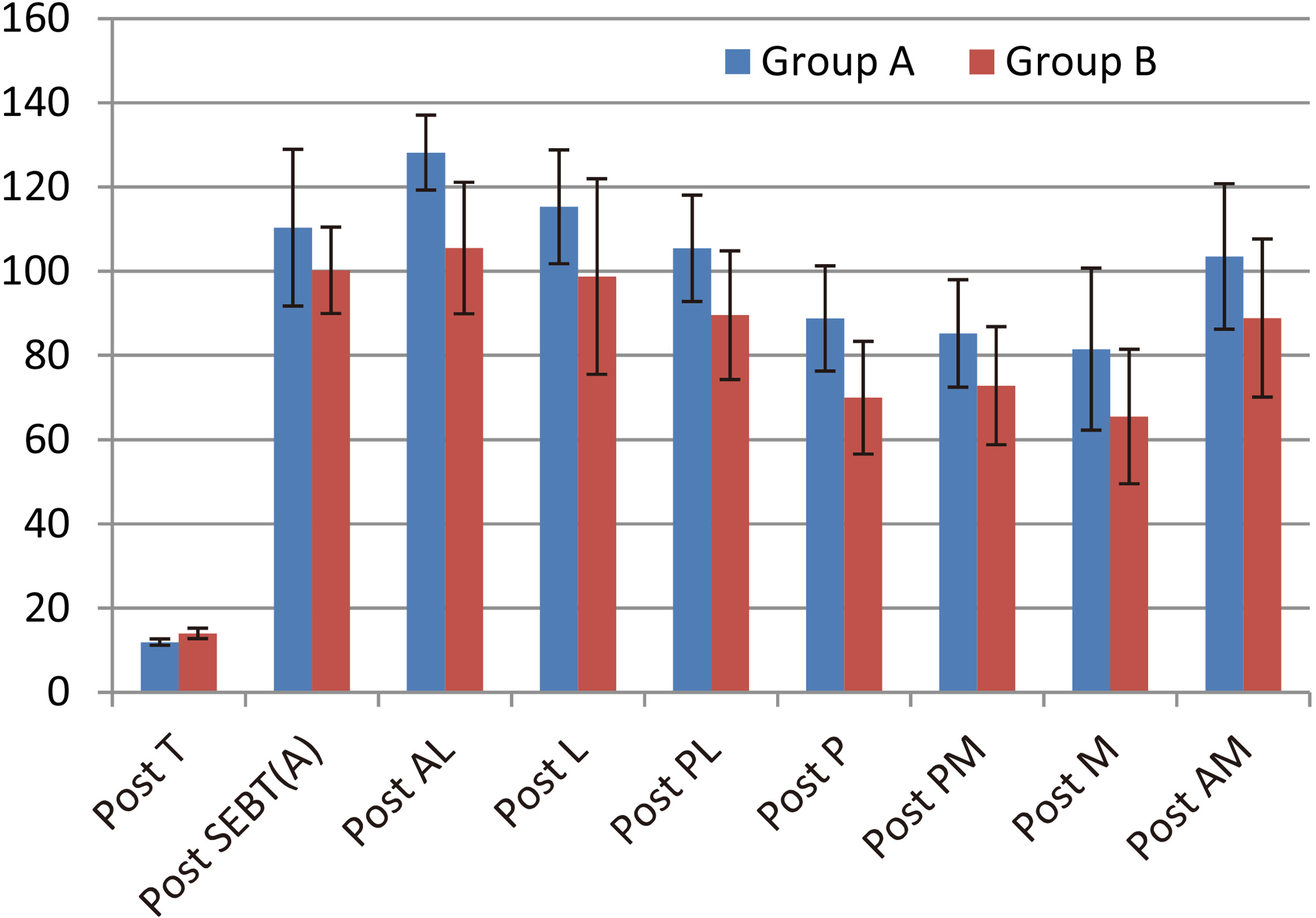
Within group analysis of experimental group showed a statistically significant difference between pre-test and post-test means for t-test and SEBT except in anterior direction. Error bars are 
Within group analysis of control group showed no statistically significant difference between pre-test and post-test means for t-test and SEBT. Error bars are 
This research aimed to determine the effect of a core training program on agility and dynamic balance among Indian junior tennis players. A group of 33 junior tennis players volunteered to participate, but three dropped out because they were not available at the time of the post-test. A significant difference in agility and dynamic balance was found after the five-week core training program. However, no significant difference was observed in dynamic balance in the anterior excursion using SEBT.
Core muscles provide a stable biomechanical efficient platform for peripheral muscles to act. Most assessments of segmental sequencing in throwing, striking, and hitting indicate proximal to the distal pattern [33]. Pelvic and abdominal muscles are segmental links of the kinetic chain between the lower and the upper body. They act as a fulcrum, and the upper and the lower body act as movable levers. Therefore, core stability is important in improving physical activity, balance, and thus performance. Core muscle weakness may lead to lower limb injuries and imbalance during performance. According to Faries and Greenwood, “balance comes from core; strong core equals good balance” [34].
A few studies have been conducted on specific excursions that are adaptable to sports, such as tennis having a positive correlation of the core with eight SEBT excursions. Earl and Hertel [35] found EMG activity of the lower extremity during SEBT and reported that SEBT is direction-dependent, with posterior, posterolateral (PL), and anterolateral (AL) excursions recruiting higher activity than other excursions. The McGill score showed that the more muscular endurance the core has, the faster an athlete will be. The quadratus lumborum muscle functions to resist shearing of the spine through activation in flexion, extension, and lateral flexion and to stabilise frontal flexion and extension [36]. Better performance in the t-test requires better ability to change directions [37].
The findings of our study are consistent with those of some studies that investigated the effect of core training on a healthy and athletic population. Sandrey and Mitzel [19] reported a significant improvement in three directions of SEBT after a six-week core training program among high school level athletes. Ozmen and Aydogmus [22] reported a significant gain in three directions of SEBT among adolescent badminton players after a six-week core training program. However, no improvement in agility was found after the core training. The training programs used by Sandrey and Mitzel and Ozmen and Aydogmus were identical to the exercise program given to the subjects in our study [19, 22]. Kahle and Gribble [20] also reported an improvement in SEBT scores among healthy individuals after a core stabilisation training program. The results of the study are also in agreement with those of the studies conducted by Lust et al. [38] and Basset and Leach [39], who reported an improvement in dynamic balance among baseball players and gymnasts after a progressive core training program. Granacher et al. [40] compared two different types of core training programs (stable vs. unstable surface) and found that both programs led to a significant improvement in balance.
The significant difference in agility indicated that core training improved agility because of better motor recruitment, better neural recruitment, or better neural adaptation. Improved agility is beneficial to players in certain games, such as tennis, basketball, and football, which require quick movements and sudden changes in direction and position. Sharrock et al. [41] used the t-test to measure agility and reported a positive correlation between core stability and athletic performance, including agility. Nesser et al. [42] also discovered a moderate correlation between core stability and agility along with other several sports-specific performance measures.
One of the possible limitations of the study is the failure to confirm the maturation level of the study population. The effect of puberty on the variables of the current study must be further investigated. Muscle tightness could also have affected the measurement of SEBT. Thus, muscle flexibility should have been checked before the intervention. Moreover, the study did not measure the motivational component of the participants, which could have influenced the training outcome and the testing.
For the prevention of musculoskeletal disorders, the rehabilitation of disorders of the lumbar spine, and the improvement of athletes’ performance, advocating for comprehensive strengthening or core muscle facilitation is necessary [43, 44, 45]. Lumbar stability requires passive stiffness (due to osseous and ligamentous structures) and active stiffness (due to muscle and neural control). Co-contraction through the abdominal fascial system connects lower extremity stability to upper extremity stability. This effect is significant in overhead athletes because of diagonally related muscles that act as a torque/counter-torque during throwing [46]. The capabilities of tennis players must encompass agility, quickness, balance, speed, and flexibility [47]. Core muscles play an important role in postural control and multiplanar movement in tennis players, as they are activated before the gross body. Postural control is necessary for a tennis player to move dynamically in a multiplanar direction. SEBT mimics the multiplanar direction a tennis player would use on the court during play. Therefore, the SEBT results indicate a significant difference in the seven excursions except for (A). They show that core stabilization exercises enhance multiplanar dynamic balance and agility, which eventually lead to the improved performance of tennis players.
Conclusion
The results of this study indicated an improvement in dynamic balance and agility in athletes who had undergone a core training program. Therefore, core training can be incorporated into other training programs to enhance tennis players’ dynamic balance and agility, which may eventually improve the performance outcome.
Footnotes
Acknowledgments
The authors would like to thank the participants involved in the study. They also would like to thank the faculty members of the Department of Rehabilitation at Jamia Hamdard for helping them complete the study.
Conflict of interest
None to report.