




Abstract
BACKGROUND:
One of the complications of obesity is low back pain, frequently associated with postural disorders. Body adiposity index (BAI) can be calculated without weighing, which may be rendered useful in settings where measuring accurate body weight is problematic.
OBJECTIVE:
The aim of this study was to compare two indices of somatic structure, i.e., BAI and BMI regarding their accuracy (specific and sensitive) in predicting postural aberrations.
METHODS:
The study group comprised of 1281 participants aged 20–22 years, who were students from universities in southern Poland. Anteroposterior spinal curvatures were measured using the Rippstein plurimeter. All subjects were measured for body height (BH) and mass, waist and hip circumference (WC and HC, respectively).
RESULTS:
In both male and female groups classified according to BAI cut-off points, a significant linear relationship was noted for the lumbar lordosis angle, i.e., the latter increased along with the BAI increase. The analysis of variance confirmed statistically significant differences in lordosis angles in both groups (women
CONCLUSIONS:
We concluded that, contrary to BAI, BMI value did not indicate a significant difference in lumbar lordosis angle between normal weight and obese participants (women and men).
Characteristics (mean
SD and range) of the study participants
Characteristics (mean
Over the past decades, a gradual increase has been observed in overweight and obesity. This phenomenon mainly concerns highly industrialised societies and is mostly related to disadvantageous changes in lifestyles. Unhealthy eating habits and low levels of physical activity have been indicated as the most common causes of obesity [1]. Obesity is a risk factor for a large number of diseases affecting both the quality and length of human life. One of the complications of obesity is low back pain, frequently associated with postural disorders. Back pain is a common condition which has been described as a serious public health problem [2]. Epidemiological evidence shows that low back pain is a multifactorial problem. Abnormal spinal curvatures and body mass index (BMI) over 25 were correlated to low back pain [3]. It has been estimated that over 80% of the population will report low back pain at some point in life [4]. Investigations in Poland and other countries showed that the main risk factors for the development of low back pain syndrome are body height (women over 170 cm and men over 180 cm), overweight and obesity, hip abduction and hamstrings flexibility, age from 40 to 59 years, inefficiency of abdominal and dorsal muscles, postural defects (scoliosis, hyperlordosis, unequal length of the extremities) [6, 7, 8]. It is therefore important to estimate the relationships between BMI, body adiposity index (BAI) and angle of lumbar lordosis and thoracic kyphosis in healthy Caucasians (men and women). However, BMI measurement is known to have limited accuracy, and it is different for males and females with similar % body adiposity. BMI is particularly inaccurate in subjects with elevated lean body mass, such as athletes, and cannot be generalized among different ethnic groups [9, 10, 11]. To address this limitation, Bergman et al. defined an alternative index, i.e., BAI, in samples of Mexican-Americans and African-Americans [12]. BAI can be calculated without weighing, which may render it useful in settings where measuring accurate body weight is problematic. As confirmed by recent studies, the BAI estimates % adiposity and cardiovascular risk [9, 10, 11, 12], but we aimed to assess the predictive value of this indicator with respect to the angles of lumbar lordosis and thoracic kyphosis.
The aim of this study was to verify whether there was a relationship between the physiological curvature of the thoracic and lumbar spine and BAI and BMI indices. We assumed that BAI might be a more sensitive predictor of lumbar hyperlordosis than BMI. An additional objective of our research was to determine the relationship of increased lumbar lordosis (LL) and thoracic kyphosis (ThK) with body height or body weight among young adults of the Caucasian population.
Materials and methods
Participants
The study was comprised of 742 women and 539 men (a total of 1281 participants) aged 18–22 years, who were students from universities in southern Poland and had a Caucasian background. Participants took part in different forms of obligatory physical activity classes. All subjects were healthy, and the majority (70%) of them were not aware of their postural deformities. During interviews, they did not report any cardiometabolic problems and 75.7% had BMI
All students provided written informed consent to participate in the study. Anthropometric measurements were taken in a separate room. The study was approved by the Ethics Committee and complied with the updated version of the Declaration of Helsinki. After having read and signed an informed consent form, the subjects were scheduled for a testing session at the University of Economics and Academy of Physical Education in Poland.
Procedures
This was a cross-sectional analytical study where the participants were measured only once. The examinations were carried out in the morning. Anteroposterior spinal curvatures were measured using the Rippstein plurimeter, a tool for quick, accurate and inexpensive assessment of children and adolescents’ posture in the sagittal and transverse planes, which can be used to complement physical examination (orthopedics, pediatrics) and rehabilitation. This apparatus enables quick and easy measurements and ensures the reproducibility of the results even when the examinations are carried out by different examiners. The results are read directly from the apparatus, yielding two values of angular deflection. The first value is the angle of thoracic kyphosis, measured between the kyphosis peak Th
Mean and standard deviation (
SD) of the anthropometric variables by BAI cut-off points (men and women)
Mean and standard deviation (
Measurement by Rippstein plurimeter.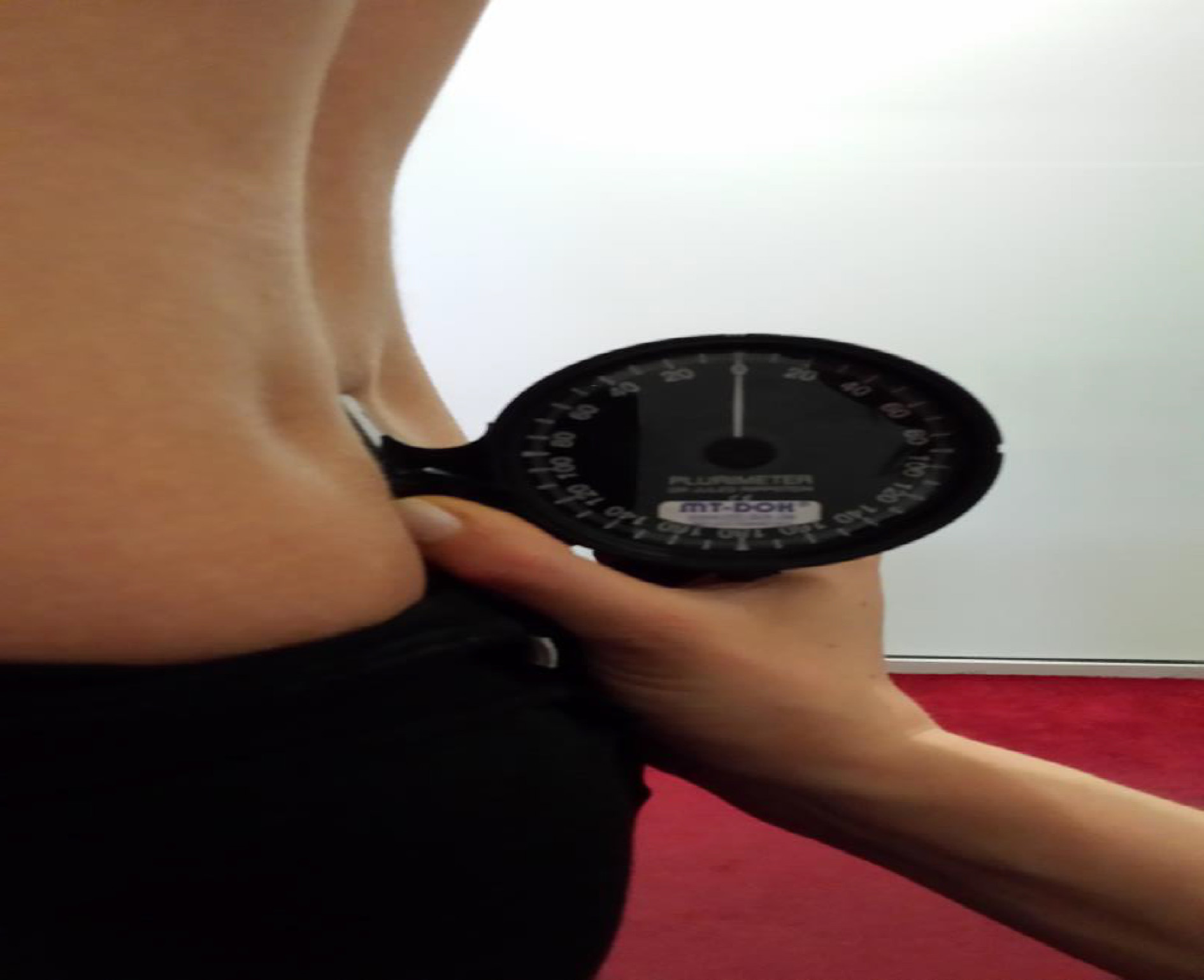
Measurements included body height (BH), waist and hip circumference (WC and HC) (cm). Body weight (kg) was determined using a stand-on bioimpedance analyzer (BIA) Tanita BC 420SMA (Tanita Corporation, Japan). The study was performed according to a standard protocol recommended by the manufacturer: in the fasted state, in light clothing, without shoes and socks with clean feet. The participants were instructed not to eat at least 2 hours before the measurement. The Analyzer samples periods of 5-second resistance values (Rx) and the reactance of their volume (Xc). This is the basis for calculating body composition by a computer program relative to age, sex and body height [16]. Body height was also used to estimate body fat percentage. BMI was calculated by the formula: BMI = body weight [kg]/body height [m
For the measurement of body height, a wall-mounted stadiometer with standard scales was used with the accuracy of 0.5 cm. Body height was measured to the nearest mm. WC (cm) and HC (cm) were measured with an anthropometric tape over light clothing. Waist circumference was measured at the minimum circumference between the iliac crest and the rib cage whereas hip girth was measured at the maximum width over the greater trochanters. Waist to hip ratio (WHR) and waist to height ratio (WHtR) were then calculated. A measurement of waist to hip ratio (WHR) is an appropriate method of identifying patients with abdominal fat accumulation. WHO recommends the use of the waist circumference measurement because it is closely correlated with BMI and WHR, and it is an approximate index of intra-abdominal fat mass and total body fat [15]. Standard BMI ranges (
Mean and standard deviation (


Footnotes
Acknowledgments
We are grateful to the participants for their time and effort. The study was supported by the statutory funding from the Academy of Physical Education.
Conflict of interest
The authors declare no conflict of interest.