



Abstract
BACKGROUND:
Chronic non-specific low back is the most common musculoskeletal complaint that significantly affects the general population. Exercises are advocated as the main part of treatment for chronic low back pain.
OBJECTIVE:
The purpose of this study was to compare the effects of workouts of the core musculature and routine physical therapy exercise training for the treatment of disability caused by chronic low back pain.
METHODS:
In this single-blinded, randomized, controlled trial, 120 patients with non-specific low back pain were examined in Lahore, Pakistan. They were randomly allocated into treatment groups A and B. Group A performed core stabilization workouts and Group B had routine physical therapy. The Oswestry Disability Index (ODI) was used to evaluate the outcome of each treatment. Statistical analysis was performed using SPSS v16.0 and a
RESULTS:
Significant reduction in disability was observed in both groups at the end of the second, fourth, and sixth week of treatment (
CONCLUSION:
A larger reduction in disability was observed for subjects treated with core stabilization exercises in comparison to those treated with routine physical therapy.
Introduction
Low back pain has become a massive global health problem, despite its apparently benign nature. It is now responsible for more years lived with disability than any other health condition [1]. Low back pain caused an estimated 72 million years lived with disability in 2013, 1.5 times that of major depression (ranked #2) and twice that of diabetes (ranked #7) [1]. In 2013, approximately 615 million people worldwide lived with disabling low back pain [2]. Low back pain affects all age groups and is the leading cause of disability in both low- and high-income countries [3]. Low back pain and the associated disability moreover have major economic consequences. Americans spent $35 billion on health services for low back pain in 2010, and this figure is increasing rapidly [4, 5].
Exercise is possibly the most advocated treatment option for chronic low back pain [6, 7]. Exercise has the potential to improve spinal mobility, muscle strength, motor coordination, spinal stabilization and general aerobic conditioning. Additionally, the costs of exercise therapy are reasonably low and exercise providers are readily available. A Cochrane review described randomized controlled trials that determined the effectiveness of exercises for chronic non-specific low back pain [8]. There was convincingly strong evidence that exercise is as effective as other interventions for treatment of chronic low back pain; however, there were also contradictions. Findings from different experimental trails and systematic reviews reported in the Cochrane Library have persuaded the available clinical practice guidelines that strongly prescribe exercise as a hallmark component for the treatment of low back pain [6, 7, 9].
Various exercises for chronic low back pain has been prescribed including intensive dynamic back extensor exercises [10], motor control exercises [11], yoga [12] and aerobic exercises [13]. Most of the studies have demonstrated the effectiveness of core stability exercise over general exercises [14, 15, 16]. These core stability exercises specifically engage the muscles that are attached to the lumbar spine, pelvis and hip area. The outcome measure of reduction in pain signifies only general effects of the exercises [14]. Studies by Hodges and Richardson on people with chronic recurrent low back pain found delayed activity of deep core muscles (transversus abdominis, multifidus) with limb movements therefore failing to prepare the spine for the perturbation resulting from limb movement [17]. Core stability programs are successful when advocated for the treatment of low back pain [18, 19, 20], but effectiveness of these exercises to achieve performance benefits is yet to be established [21, 22]. The outcome measure of reduction in pain signifies only general effects of the exercises [14, 23]. It is interesting to research how this pain reduction in chronic low back pain patients affects their daily functioning in social and personal sphere of life. Thus the aim of this study was to compare the effects of core stabilization exercises and routine physical therapy exercises in terms of mean reduction in disability due to chronic low back pain.
Methods
This was a randomized, controlled trial of subjects with chronic non-specific low back pain (pain not attributed to any specific cause and duration
The patients were blinded to the treatment, the clinicians were not. A research assistant obtained the data from each patient at the end of the second, fourth, and sixth week of treatment. Subjects in Group A were treated with core stabilization exercises while subjects in Group B (the control group) were treated with exercises targeting superficial muscles of the spine (Table 1). Both exercise regimens were supervised by a physical therapist once a week. Patients in both groups were advised to perform their respective exercises twice a week at home. Brochures with the description of exercises were provided to assist during practice at home. A baseline treatment of therapeutic ultrasound (3 MHZ for 10 minutes at 50% intensity) [25] and transcutaneous electrical nerve stimulation (continuous mode for 10 minutes) [26] was applied to the lumbar region for all patients (Fig. 1).
List of exercises performed under core stabilization and routine physical therapy exercise
List of exercises performed under core stabilization and routine physical therapy exercise
Flow sheet diagram of the research process.
Bar chart of change in ODI score across 2 groups.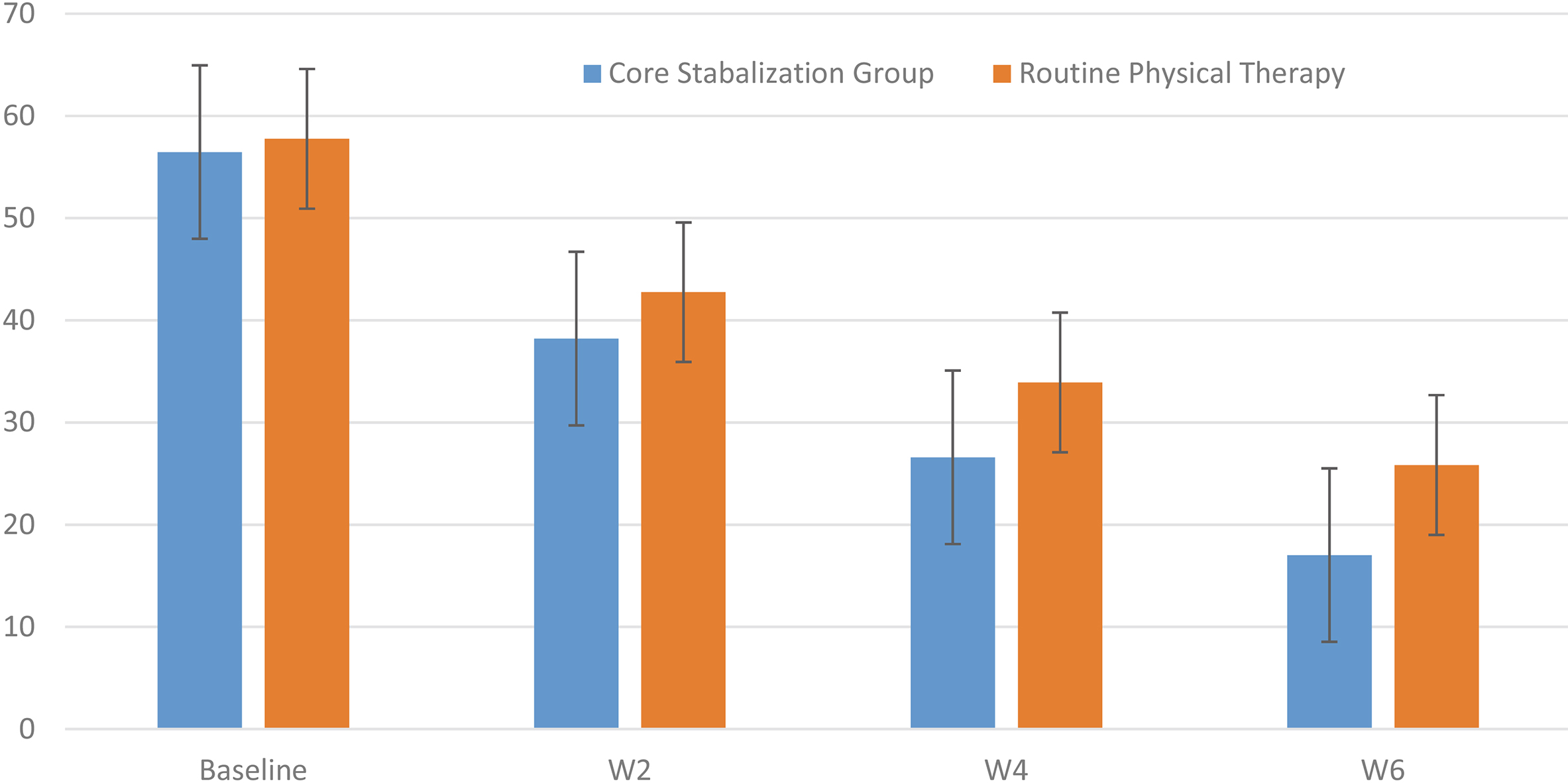
SPSS v 22.0 was used to analyze the data and a p-value
Comparison of age and weight and height between the two treatment groups
Between group comparison of disability score at the second, fourth, and sixth week of treatment
A total of 120 subjects were enrolled in this study, of which 12 subjects discontinued (7 in Group A and 5 in Group B). Therefore, 108 subjects were evaluated at the sixth (and final) week of treatment. Subjects in both groups were relatively similar in terms of sociodemographic variables (Table 2). Both groups had a statistically significant decrease in the ODI score at the end of the second, fourth, and sixth week of treatment (Table 3). There was a statistically significant difference in the change from the baseline pretreatment disability score to the post-treatment disability score (at the end of week 6) in both treatment groups. The reduction of the ODI score was larger for Group A (39.44
Discussion
The main objective of this study was to compare the effectiveness of core stabilization and routine physical therapy exercise in the reduction of disability in subjects with chronic low back pain. Statistically significant decreases were found in both groups in the change from baseline to the end of the second, fourth, and sixth week of treatment. There was a statistically significant decrease from the baseline pretreatment disability score and the post-treatment disability score (at the end of the sixth week) in both treatment groups.
The results of this study were moreover supported by other studies. In a similar study by Franca et al. [27] that compared spinal stabilization exercise with superficial strengthening exercises in subjects with low back pain, a greater reduction in the ODI score was observed with the spinal stabilization exercises in comparison to strengthening exercises. In addition, a three months randomized clinical trial by Inani and Selkar [28] compared core stabilization with routine physical therapy exercises to manage 30 patients with low back pain. Core stabilization exercises included the deep muscles of the spine (Group 1), while routine strengthening exercises of different superficial muscles were included in the general exercises (Group 2). Significantly greater improvements in disability (
A comparative study comparing the effects of lumbar spine stability exercises, dynamic strengthening exercises and Pilates on chronic low back pain reveled significant favorable outcome in terms of pain, disability and lumbar range of motion in the lumbar stabilization group at the 10
In-depth biomechanical analysis of the deep muscles of the trunk has indicated that there is delayed activation of these muscle in subjects with low back pain when spinal stability is required for different dynamic tasks [32, 33]. Decreases in thickness and high fat content were found in the multifidus muscles of low back pain patients as compared to normal healthy subjects [34]. To compensate for this delay, low back pain patients tend to escalate the activity of the superficial muscles to maintain spinal stability through increased spinal stiffness [35]. Other studies have also concluded that patients recovering from acute low back pain have an increased tendency to develop the same problem if not treated with exercises targeting the deep muscles of the spine [17, 36].
Limitations
There was no proof of patients’ compliance with exercises performed at home prescribed by the physical therapist. Furthermore, the type of job that the participants had was not accounted for, which might have mimicked the results of the study.
Conclusion
A prominent decrease in disability due to chronic non-specific low back pain was achieved with core stability exercises as compared to general physical therapy exercises.
Footnotes
Acknowledgments
This study is a part of the Degree of Philosophy in Physiotherapy at The University of Lahore, Pakistan. The authors are extremely grateful to all those who have helped and participated in this research.
Conflict of interest
None to report.