




Abstract
BACKGROUND:
Many studies have presented lower limb kinematics in Western countries, but few have concentrated on gender and age differences for Chinese populations.
OBJECTIVES:
The purpose of this study was to investigate three-dimensional hip and knee kinematics especially for elderly Chinese during walking and running, as well as to analyze age differences.
MATERIALS AND METHODS:
Sixty healthy volunteers, including 40 young and 20 elderly adults, were divided into two groups by gender and instructed to perform walking and running in a comfortable manner. The hip and knee kinematics were obtained with 3D Motion Capture System. Normalization was used to avoid the body size effect. Age differences were tested with independent
RESULTS:
In non-sagittal planes, the hip and knee ranges of motion of young males are larger during running, but smaller during walking than those of elderly males. Young females reveal smaller non-sagittal planes hip and knee ranges of motion than elderly females, regardless of whether they are walking or running. There are also significant age differences in the peak hip and knee angles especially in frontal plane during running. Young adults reveal greatly higher peak hip and knee adduction angles than elderly adults.
CONCLUSIONS:
Walking speed and the hip and knee ROM for Chinese are different from Westerners. These kinematic differences can be used for reference to design better joint prostheses to meet various Chinese people’s needs.
Introduction
Mean (SD) of the demographic data for young and elderly adults
Mean (SD) of the demographic data for young and elderly adults
Artificial joints have been widely used in the treatment of advanced arthritis and severe fractures. The main purpose of artificial joint replacement is to contact the joints for pain, maintain joint stability, improve joint function, and adjust the length of both lower limbs. Lower limb dynamics parameters are an important part of artificial joint design, processing and application. The kinematics of the hip and knee joints are essential not only for analyzing the factors associated with pathological gait, but also for providing detailed mechanical properties and a quantitative description of human movements [1]. Therefore, it is necessary to conduct an in-depth study on the dynamic parameters of the lower limbs. Although there is nearly 20% of the world population in China, few studies [2] have presented standardized data that characterize the Chinese lower limb kinematics. Normal western gait parameters are frequently used in clinical application for Chinese. However, ethnic differences exist in lower limb kinematics of Western and Chinese people, which may lead to the misdiagnosis of clinical problems and the improper evaluation of treatments [3]. For example, the Chinese knee joint activity can reach 146
Few manuscripts [9] have presented lower limb kinematics of elderly persons or analyzed age differences. Numerous studies have focused on significant gender differences, mainly in pelvis, hip and/or knee joints motions, during walking and running in healthy adults (for pelvis motion [11, 12], for hip motion [13, 14], for knee motion [13, 14]). The data presented by Youdas et al. [16] indicated that the sagittal angle of the pelvic tended to decrease with age, especially in the case of females. Kennis et al. [10] indicated that aging men and women experienced a decline in muscle mass and in muscle strength and muscle power. Judge et al. [17] showed that older person spent more time with both feet on the ground (double support), and less time with one foot on the ground (single support) than young person. However, these studies only investigated the gender differences in a relatively small age range. The gender differences in the gait reported in recent studies were not consistent across age group and a significant age-sex interaction was observed [15].
Therefore, the objectives of this study is to investigate three-dimensional kinematic data at the hip and knee joints for young and elderly Chinese adults during walking and running, and to clarify age differences in these kinematic parameters separately for males and females. The dynamic track system was employed to record the kinematics data for further analysis. The research in this paper clarifies whether the joint arthroplasty had enough motion capability to perform Chinese people activity, and was prepared for the establishment of a kinematics model suitable for Chinese lower limb parameters in the future.
Sixty healthy Chinese people, including 40 young (20 males and 20 females) and 20 elderly (10 males and 10 females) adults, were randomly recruited from the local university. Demographic data and spatiotemporal parameters for all subjects were measured (Table 1). None of the subjects suffered from any medical conditions reported to affect the kinematics of lower extremity. Prior to data collection, each subject was asked to fill out a questionnaire about their ethnicity background and the ability to perform these activities being studied. The study was approved by the ethics committee of the university, and all participants signed a consent form prior to participation.
In this study, the Optotrak
The overall arrangement of the measurements and the distribution of markers on human body.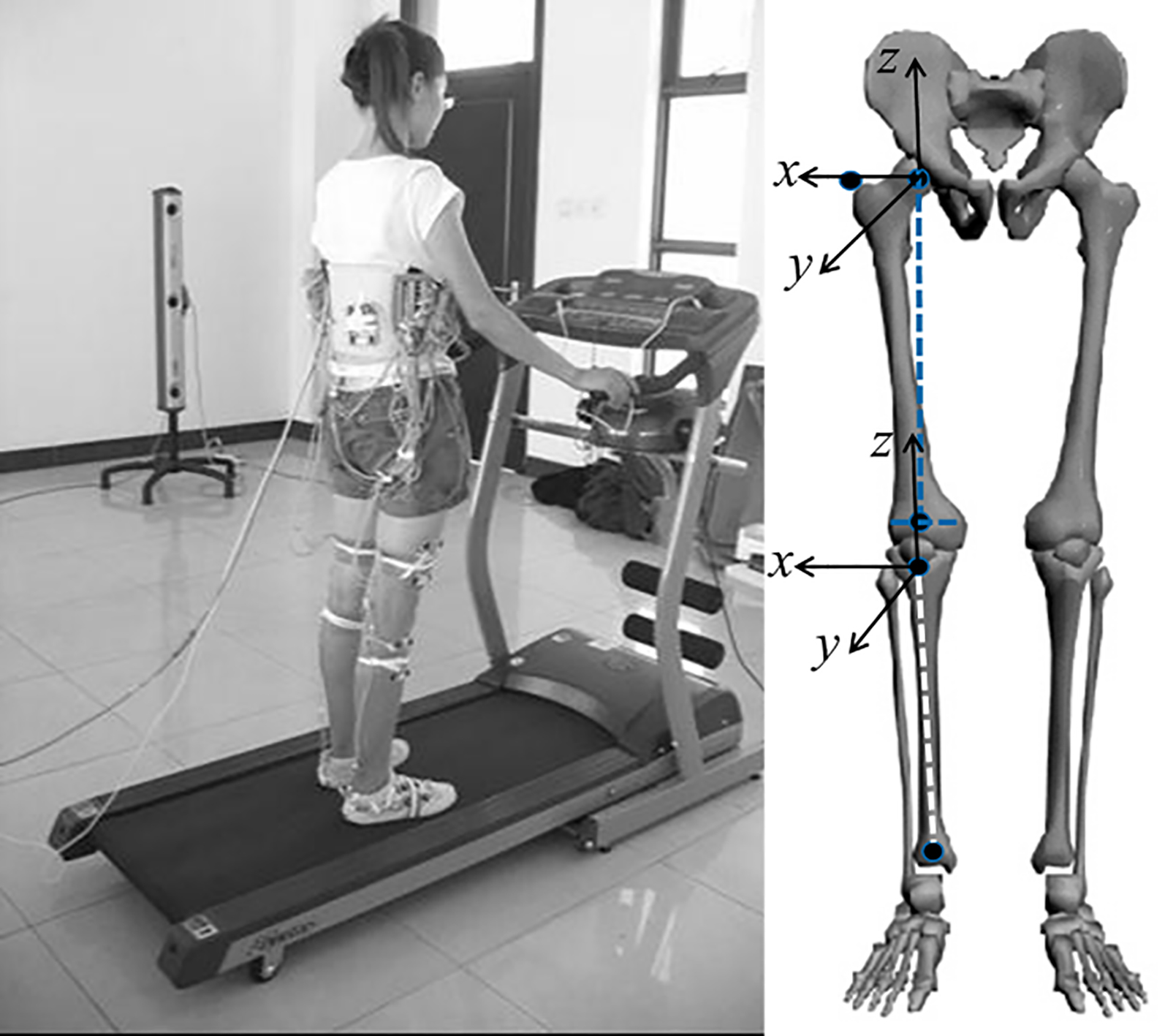
Mean (SD) of the spatiotemporal parameters for young and elderly adults during walking and running
Local coordinate systems were defined for the shank, thigh and pelvis segments through digitized palpated bony landmarks. The bony landmarks included left/ right ilium anterior superior, left/right prominence of the greater trochanter external surface, left/right femur lateral/medial epicondyle, left/right fibula apex of lateral malleolus, left/right tibia apex of medial malleolus. The local coordinate systems enabled the calculation of the floating axis angles at the hip and knee joints. The relative joint angles were defined by using an Euler/Cardan sequence (
Some previous studies [22] showed that 6 minutes of adaptive training on treadmills could effectively avoid the gait differences caused by treadmills. In order to avoid the unnatural and small-stepping gait, all subjects are required to familiarize to the treadmill for at least 6 minutes prior to data collection. Walking and running were performed on a treadmill at a comfortable (participant felt relaxed) speed. For each subject, six walking or running trials were recorded for each activity, three times of data were collected as a reference, and three more times were taken as experimental data. Each subject performed 10 minutes exercise for data acquisition.
The raw kinematic data were smoothed using an integrated digital filter with a cut-off frequency of 6 Hz in Visual 3D software (C-Motion Inc., USA). To generate ensemble graphs, data were normalized to 100%. For each subject, the average and standard deviation of joint angles were obtained from six trials. These individual data were then averaged for each group.
The kinematics data of the hip and knee joints were divided into four groups on the basis of different ages and genders, and the variables were averaged across the subjects. The normality of the variables was assessed by the Kolmogorov-Smirnoff test of normality. The variables for each group were statistically compared with independents
The spatiotemporal parameters for young and elderly adults during walking and running were measured (Table 2). The variance of each sample is calculated, which can be seen in parenthesis behind the mean value of this sample. On the other hand, the ANOVA test was also conducted in Table 2 to show the difference in mean between two samples, which are the samples of young and elderly adults specifically. No significant age differences existed in the spatiotemporal parameters during walking and running, except the speed for males group during running. In this study, elderly males had nearly identical speed (young males
Mean of the hip and knee angular motion for Chinese young (thick) and elderly (thin) people during walking (males, solid; females, dashed).
Mean of hip and knee angular motion for Chinese young (thick) and elderly (thin) people during running (males, solid; females, dashed).
Mean ROM (total values) of the hip and knee joints during walking and running
Mean (SD) peak hip and knee angles in three planes during walking and running
The mean curves of the hip and knee kinematics during walking and running are presented in sagittal, frontal and transverse planes, which can be seen from Figs 2 and 3. The mean ROM and peak joint angles of the hip and knee joints in all three planes are listed in Tables 3 and 4. The results demonstrate that the ROMs of hip and knee angles less than 20
Elderly and young people show different mean ROM and peak angles at the hip and knee joints in the experiment. In the frontal plane, the walking ROM of young males were 14.1
In transverse plane, the internal rotation angles of the knee during walking were 2.5
There are also some gender differences in the mean ROM and peak angles at the hip and knee joints. In sagittal plane, the peak knee flexion angles of the males and females during running were 62.0
Some lower limbs activities have been widely investigated in Western countries, whether joint arthroplasty is in support of oriental activities has caused more and more attention in the majority of oriental patients. The spatiotemporal parameters in this study are compared with previous results. We conclude that Caucasian generally walked more quickly than Chinese, especially in elderly population. Also, comparison of the hip and knee kinematics in this study throughout the gait cycle was made with respect to previous results. In general, the sagittal plane hip and knee ROM for Chinese are lower than those for Westerners, but similar with those for Korean. In non-sagittal plane, the joint motions varies a lot between different studies. Lifestyle affected by cultural and ethnic variations could contribute to these differences. Besides, the discrepancies can also be caused by the soft tissue artifact and the variation of calculation methods. These ethnic discrepancies demonstrated that it is very essential to establish a kinematic database for Chinese. A number of manuscripts have studied age-associated changes in muscle strength and body balance. For the above-mentioned reasons, some previous studies comparing kinematics between elderly and young adult subjects have reported age-associated reductions in ROM at the lower limb joints. However, some different results are obtained from this study. For the remained kinematics during the studied activities, there are gender-related differences between young and elderly participants.
In this study, we found that age differences in both males and females are not significant in sagittal plane at the knee joint during walking, as well as in transverse plane at the hip joint during walking and running. However, there are important age differences in sagittal plane at the hip joint during walking and running, the same as in frontal plane at the hip and knee joints during running, based on both genders. In non-sagittal planes, the hip and knee ROM of young males are smaller during walking, but larger during running than elderly males. However, young females tend to reveal smaller non-sagittal planes ROM at the hip and knee joints than elderly females, no matter they are walking or running. We attribute these discrepancies to different speed. Devita and Hortobagyi [23] indicated that elderly adults had a larger ROM at the hip joint throughout the gait cycle compared with young adults when the two groups walked at nearly identical speed. But those ROM at the lower limb joints decreased with advancing age were performed at significantly different walking speed [17, 24, 25]. In this study, elderly males have nearly identical speed during walking, but significantly slower speed during running compared to young males. In females group, no great difference is found in the speed during walking and running. We guessed that the stooped posture may cause larger ROM at the hip and knee joints of elderly adults in this study. Decreased ROM in males group during running is due to age-associated changes in gait-muscle weakness and impaired balance correlated with gait velocity and step length in older population [17]. In sagittal plane, young males reveal smaller ROM at the hip joint, but larger ROM at the knee joint during walking and running. It was quite different from those in frontal and transverse planes. Judge et al. [17] concluded similar results that young adults revealed smaller hip ROM (42
Meanwhile, it was also found in this research that elderly group reveal higher peak hip flexion during walking and running, but lower peak hip and knee adduction during running compared to young group. These age differences may result from more flexion and adduction posture of elderly group. Judge et al. [17] showed that the hip kinematics in older subjects were shifted 3
Finally, this study still remains to be improved further, which should be acknowledged. First, the quantity of recruited subjects is relatively small compared with the whole population in China, and the subjects’ age ranges lack middle-aged and old-aged groups. Second, walking and running are performed on a treadmill, rather than on a walkway. In order to avoid the unnatural, small-stepping gait, the subjects are asked to familiarize with the treadmill for at least 6 minutes prior to the measurement. Third, the kinetic and neuromuscular data, which are essential for understanding age differences, are not studied in this paper.
Conclusions
The results of this study can be used for providing a supplement to the database of the hip and knee mechanical properties during daily activities for elderly Chinese population. The conclusions are as follows:
In non-sagittal the hip and knee ROM of young males are smaller during walking, but larger during running than elderly males. However, young females tend to reveal smaller non-sagittal planes ROM at the hip and knee joints than elderly females, no matter they are walking or running. Both young males and females reveal significantly lower hip flexion angles during walking and running, and higher hip and knee adduction angles during running, compared to elderly adults. Compared to previous studies, it was found that walking speed and the sagittal plane hip and knee ROM for Chinese are different than for Westerners.
Footnotes
Acknowledgments
Financial support for this work, provided by the National Natural Science Foundation of China (Grant No. 91648105) and the Priority Academic Program Development of Jiangsu Higher Education Institutions (PAPD), are gratefully acknowledged.
Conflict of interest
None of the authors have any conflicts of interest to report.