



Abstract
OBJECTIVE:
To evaluate trunk peak torque and muscle activation pattern during isokinetic and sudden trunk loading (STL) between adolescent athletes with/without back pain.
METHODS:
Nine adolescent athletes with back pain (BP) (m/f 2/7; 15.6
RESULTS:
Back pain showed lower trunk peak torque for all conditions in extension/flexion, but not for rotation. EMG amplitudes were increased for BP athletes with statistical significant differences for dorsal muscles in rotation and extension (
CONCLUSIONS:
The evaluation of strength and muscle activity in isokinetic and sudden trunk loading presents altered trunk function in adolescent back pain athletes. Training interventions focusing on trunk strength and muscular activation pattern appears reasonable.
Introduction
In adolescent athletes back pain point prevalence is already rising to 20% at an age of 14 years and presents sport-specific differences [1]. Rowing and canoeing are two adolescent sports with rather high back pain prevalence compared to e.g. soccer or handball and the overall mean across sports [1]. Therefore, treatment and/or prevention of back pain become a key factor already in the early stage of elite athletes’ career.
In the development of back pain, a high contribution of trunk strength capacity and adequate muscular activation pattern is discussed in professional adult athletes [2]. Predominantly, dynamic trunk stability is desired to prevent overloading of the back in different adult and adolescent populations, especially in high performance activities requiring compensation of repetitive (sudden) loading [2, 3, 4, 5]. Overexposure during repetitive exercise with components of translation, rotation and reclination is believed to result in unfavorable high trunk loading in children and adolescents [6, 7]. Repetitive micro-trauma and deficits of the muscle-tendon complex based on a reduced maximum strength capacity and inadequate neuromuscular control strategy during dynamic intense loading tasks have to be mentioned in athletes [7, 8, 9]. This is supported by a suggested explanatory model for the occurrence of non-specific back pain [2, 3]. In adults with low back pain, a reduced strength capacity of trunk extensors and flexors has been shown [10, 11, 12, 13]. In contrast, for adult athletes with back pain the available data is rare and often shows diverse results without relevant strength deficits [2, 12]. Furthermore, maximum trunk strength capacity in e.g. isokinetic testing may not fully represent the core capacity taking compensation of single or repetitive high dynamic loads into account [14]. Consequently, additional test situations with the need to compensate or counteract sudden, external, (un)expected loading are increasingly focused in adults [15, 16, 17, 18]. Previous studies have shown an altered musculoskeletal response (e.g. delayed muscular activity, increased co-contraction) in adult patients for sudden loading situation. This supports the neuromuscular relevance of trunk muscles in providing stability and to counteract high impact loading [15, 18, 19]. Hence, an inadequate (neuromuscular) compensation strategy based on deficits in trunk strength capacity and muscular activation pattern is discussed as a common cause of overloading and injury, especially at the athlete’s back [3, 20]. In consequence, optimization of sudden load compensation techniques might prevent excessive overloading of the trunk and therefore the development of first time onset of back pain in the adolescent athlete. However, these neuromuscular deficits described in high intensive and dynamic loading situation are particularly not clarified for adolescent athletes.
Objective
This study aims to analyze differences in trunk strength capacity and trunk muscle activation pattern during maximal and sudden trunk loading in adolescent athletes with and without back pain. It was hypothesised that a reduced trunk extensor peak torque and weaker loading compensation are anticipated in athletes with back pain. In addition, an altered neuromuscular activation pattern visible by EMG amplitudes in athletes suffering from back pain is expected while executing maximal isokinetic movement and compensating sudden trunk loading.
Methods
Participants
Eighteen adolescent athletes (
Anthropometrics, training volume and back pain intensity (pre MVC testing and post isokinetic loading) of the athletes with (BP) and without (NBP) back pain and for each sports discipline per group
Anthropometrics, training volume and back pain intensity (pre MVC testing and post isokinetic loading) of the athletes with (BP) and without (NBP) back pain and for each sports discipline per group
Schematic representation of the velocity curve for the sudden trunk loading (STL) (extension) test.
The University Ethical Committee approved all procedures conducted during the study. All participants as well as their legal guardian were informed of the study with its specific testing procedures in a personal conversation by the principle investigator. In addition, written study information was handed out during their stay at the University Outpatient Clinic. Before voluntary participation the legal guardian and the children provided written informed consent.
A cross-sectional study design was used to evaluate trunk strength capacity as well as neuromuscular activity pattern in all participants. The protocol started with a medical check-up by a medical doctor for sports medicine to ensure that all participants were suitable (no contraindications for maximum loading of the spine) for the upcoming trunk strength testing. Next, anthropometric data and training history (overall training volume [h/week]) were assessed. Then, all participants were prepared for electromyographic analysis of the trunk muscles and underwent a general physical warm up of at least 5 minutes prior testing. Subsequently, a trunk loading protocol, including maximum isometric voluntary contraction (MVC), isokinetic (ISO) and sudden trunk loading (STL) for right-sided rotation as well as flexion/extension testing was applied by an isokinetic dynamometer (Contrex MJ/TP, Physiomed AG, Schnaittach, Germany). MVC measurement was used as reference for EMG-normalization procedure [23]. Subjective rating of load induced back pain was assessed directly after the trunk loading protocol (visual analog scale VAS: 0.0–10.0 cm) [21].
(Isokinetic) trunk loading protocol
The trunk loading protocol consisted of trunk streng- th testing in right-sided rotation and flexion/ extension assessed with isokinetic dynamometer. Based on the results of Lindsay and Horton [11], that there are no side differences in the analyzed cohort, only right-sided rotation was tested. Trunk strength rotation was measured in a seated position with a range of motion of 31.5
The protocol always started with rotation testing followed by flexion/extension. Both conditions began with an additional 60 s specific warm-up and familiarization prior testing. Maximum strength in rotation as well as flexion/extension was tested in isometric (rotation: 0
Electromyographic analysis
Muscular activity of the trunk was assessed using a bilateral 12-lead surface EMG [28, 29] (Fig. 2): Mm. rectus abdominis (RA), obliquus externus abdominis (EO), obliquus internus abdominis (IO); Mm. erector spinae thoracic (T9; UES)/lumbar (L3; LES), latissimus dorsi (LD) (Fig. 2). Muscular activity was measured using a bipolar surface telemetry EMG (band-pass filter: 5 Hz to 500 Hz, gain: 5.0, overall gain: 2500, sampling frequency: 4000 Hz, RFTD32, myon AG, Baar, CH). The localization of electrodes was carefully determined according to Radebold et al. [18]. The skin was shaved and slightly roughened to remove surface epithelial layers and to control skin resistance (
Surface electromyography electrode placement for recording of trunk muscle activation pattern (bilateral 12-lead surface EMG: Mm. rec. abd. (RA), obl. ext. abd. (EO), obl. int. abd (IO); Mm. erec. spinae thoracic (T9; UES)/lumbar (L3; LES), latis. dorsi (LD). 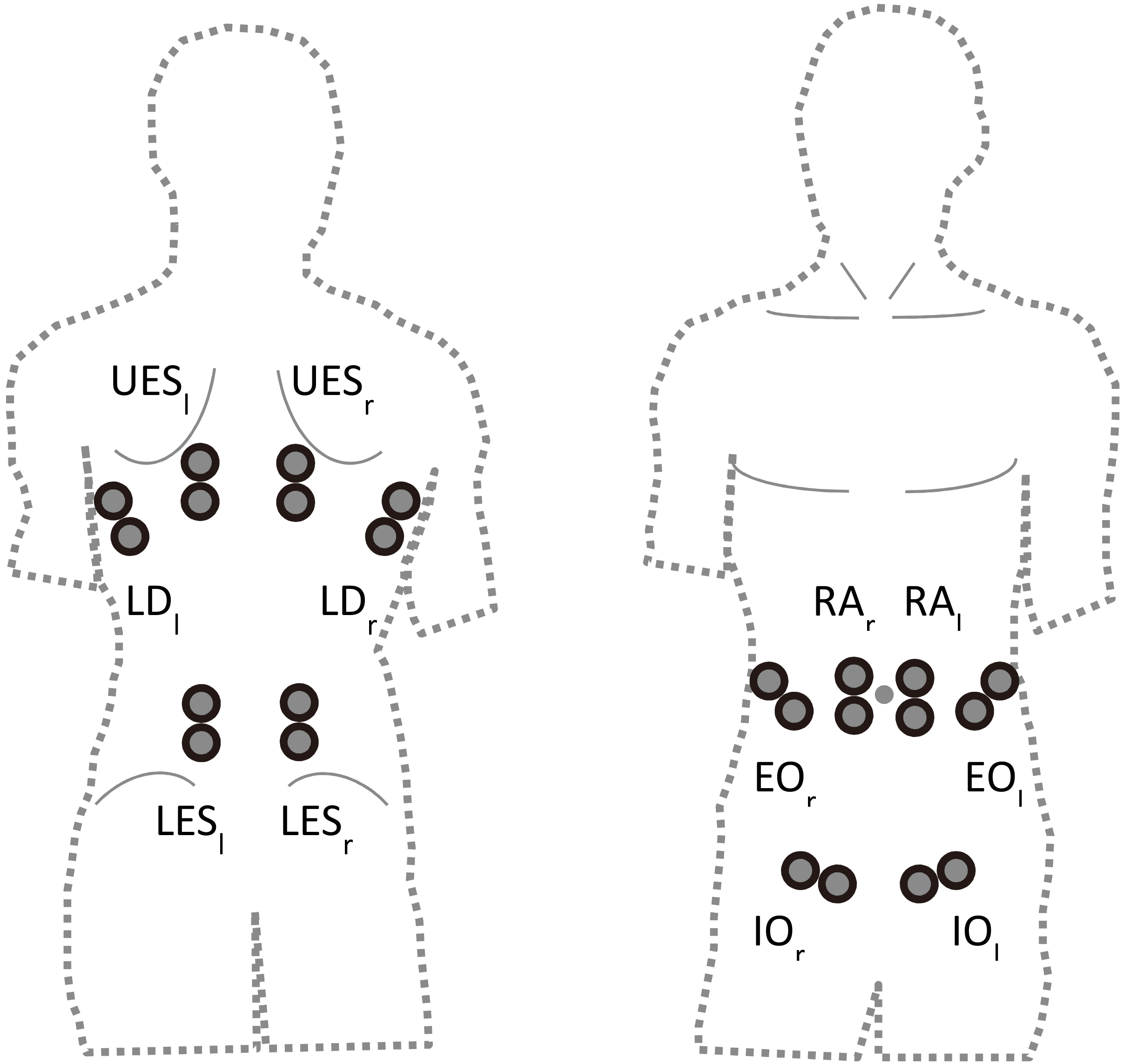
EMG-pattern (EMG-amplitudes MVC normalized [%]) for the 4 muscle groups (V_ri: ventral right; V_le: ventral left; D_ri: dorsal right; D_le: dorsal left) in concentric (con), eccentric (ecc) maximum strength testing and sudden dynamic trunk loading (STL) for trunk rotation (to right side), extension and flexion for the back pain group (BP) and the no back pain group (NBP) (mean values; group difference: post hoc
No interaction between group and muscle/condition for rotation, extension or flexion (
All non-digital data were documented in a handwritten case report form (CRF) and transferred to a database (JMP Statistical Software Package 8, SAS Institute
Results
The anthropometrics, sex, training data and sport discipline (
Trunk loading – peak torque
Overall, athletes with BP showed significantly lower peak torque for concentric, eccentric and STL condition in trunk flexion (BP: 67–72% peak torque of NBP;
Results (mean 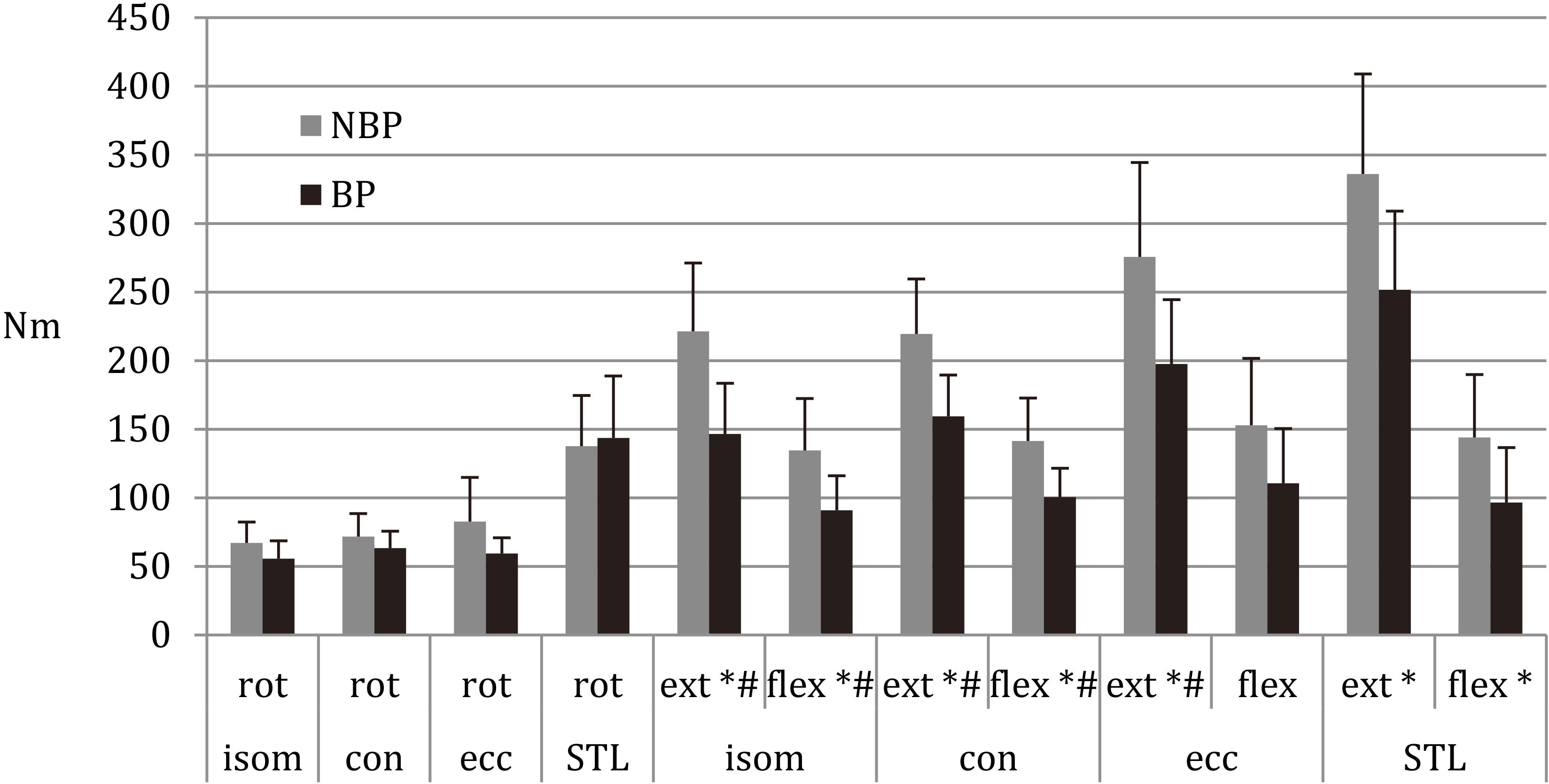
Overall, normalized EMG-RMS of athletes with BP were higher for grouped muscles (D_ri; D_le; V_ri; V_le) during concentric, eccentric and STL trunk rotation, trunk flexion and extension compared to athletes without back pain NBP. Furthermore, these group differences were highest in trunk rotation (ipsilateral side) and extension (dorsal muscles; power: 0.874/0.783/0.449 con/ecc/STL) and smallest for trunk flexion (ventral muscles) (Table 2). These differences were statistical significant for the dorsal muscles in rotation and in extension (
EMG-pattern (EMG-amplitudes MVC normalized [%]) for 12 muscle (Mm rec. abd. (RA), obl. ext. abd. (EO), obl. int. abd. (IO), latis. dorsi (LD), erec. spinae thoracic (T9; UES)/lumbar (L3; LES) of left (l) and right (r) sides) in concentric (con), eccentric (ecc) maximum strength testing and sudden dynamic trunk loading (STL) for trunk rotation (to right side), extension and flexion for the back pain group (BP) and the no back pain group (NBP)(mean values).
The purpose of this study was to evaluate trunk strength capacity and neuromuscular activity of the trunk muscles during isokinetic and sudden trunk loading in adolescent athletes with and without back pain. Main findings are, firstly, a lower trunk strength capacity in adolescent athletes with back pain compared to those without back pain, present in all test conditions (ISO and STL) in flexion and extension, but not for rotation. Secondly, an altered neuromuscular activation pattern in adolescent athletes with back pain compared to no back pain athletes is existent, showing increased EMG amplitudes with statistical significant differences of the dorsal muscles for all loading conditions.
A reduced trunk strength capacity in this specific cohort of adolescent elite athletes with back pain is in line with evidence for untrained adult back pain patients but in contrast to previous findings in adult athletes [11, 12, 31]. Differences in the analyzed adolescent athletes were primarily present for trunk extension and partly for trunk flexion. Trunk rotation did not reveal any group differences between the young athletes with and without back pain. For most of the investigated adolescent athletes, the identified muscles are the prime movers of the trunk in their specific sports discipline (rowing, canoeing). Even negative effects on sports performance could be speculated. Furthermore, the sudden trunk loading showed higher peak torque values and therefore, probably results in higher spine loading compared to the isokinetic testing without perturbation. The group differences might be discussed as a reduced maximum strength capacity in young back pain athletes. Moreover, a reduced sudden loading counteracting capacity in adolescent back pain athletes could be derived by the presented results. Hence, it could be speculated that maximum voluntary contraction and (subconscious) compensation reaction (STL) is associated with back pain in youth athletes representing reduced core stability [2, 3]. The novel STL correspond very well with the concept of core stability by transferring the valid “static” perturbation tests into dynamic maximum loading tasks, but seems to reflect rather specific additional information for the neuromuscular trunk pattern [4]. As an explanatory model for the reduced peak torque values, increased activation pattern of agonistic and antagonistic muscles (co-contractions) and/or pain inhibition (BP) might play a role. Biomechanical studies show for the force activation relationship in adults a non-linear coherence. In contrast, accounting for antagonistic muscle activation leads to a rather linear coherence. Nevertheless, the applicability of these isometric results in adults to our dynamic tests are unclear [32]. Possible strength difference between the groups before pain development (BP) is unknown due to the cross-sectional study design. Besides, weekly training amount is slightly higher in athletes without (NBP) compared to athletes with BP not being statistically significant. However, the amount could be discussed as clinically relevant and therefore influencing back pain in adolescent athletes.
Even adolescent athletes with BP showed an altered neuromuscular activation pattern comparable to reported results for (untrained) adults [33]. Increased MVC normalized EMG activity predominantly for the dorsal but also for the ventral muscles might be a compensation pattern supporting trunk stability and/or an inefficient neuromuscular control since peak torque showed reduced values. Additionally, the higher EMG amplitudes for the BP group, showing values even above 100%, might be discussed with the concept of high pain inhibition during isometric contractions [34, 35, 36]. In comparison, dynamic contraction might have less back pain inhibition [37]. Finally, previous studies on adults show a similar to lower EMG amplitude during isokinetic compared to isometric testing supporting our data on adolescent athletes [38]. A detailed qualitative view on the 12 single muscles shows a specific trunk EMG pattern for the different test conditions (con, ecc, STL; rotation, extension, flexion). It could be derived that this specific EMG patterns indicate a need for complex and sports related test situations to distinguish between adolescent and adult athletes with and without BP and therefore, detect (trunk strength and neuromuscular) deficits.
In detail, back pain seems to highly influence the activation pattern of the dorsal muscles in adolescent athletes. In contrast, the ventral muscles do not show as many alterations. However, these results are debatable with regard to published results mainly known from adults. It nevertheless could help to address specific training interventions [2, 39, 40]. Therefore, exercises involving the erector spinae as well as the transverse trunk muscles possibly have a specific relevance. Hence, strengthening of the rectus abdominis might be discussed less important for adolescent BP athletes in the analyzed sports. Therefore, it could be speculated that exercises with high intensity and perturbations during trunk rotation, extension/flexion and movement combinations are required to address the identified strength and neuromuscular control deficits. In addition, this might optimize transverse and multidimensional muscle action.
Finally, some methodological concerns need to be discussed. Regarding EMG analysis, the used MVC normalization procedure is related to some limitations. This inter-individual ratio can already be influenced by pain in the reference (MVC) measure [41]. The higher EMG amplitudes (BP) during the dynamic tests might depend on one hand in the present pain level of the BP group during the MVC measurement. On the other hand, the single MVC testing on the dynamometer possibility did not challenge 100% (e.g. m. latissimus dorsi) all muscle [42]. The results might be influenced by the rather low load depended acute pain intensity threshold used for categorization in BP and NBP. However, this insured pain related training or competition absence and deconditioning. Therefore, this method is common, but is limited in this study to the recent pain, leaving chronic pain aspects and deconditioning factors unknown [43, 44]. The tests used only partially reflect the different strength demands these adolescent athletes are faced within their sport disciplines (canoeing/rowing/triathlon) and e.g. fatigue as an additional important factor could not be addressed by this study. Nevertheless, maximum strength capacity does determine other force dimensions and is considered to be a good indicator of muscular performance. The small sample size should be taken into account for interpretation of the results. On the other hand, the study has its strength in the very specific and well-matched cohort of adolescent elite athletes (BP, NBP) tested in highly standardized, high intense and novel trunk loading situations in sagittal and transverse plane with clinically relevant differences between BP and NBP. Besides, concerning the investigated athletes performing rowing, canoeing and triathlon, the applicability to other sports needs to be proven in future investigations.
Conclusion
In conclusion, this investigation identified partly reduced strength as well as increased neuromuscular activity of the trunk in highly dynamic concentric, eccentric and sudden trunk loading situation already present in adolescent elite athletes with back pain. The specific compensation pattern and inefficient neuromuscular and strength pattern could lead to the idea of recommending specific exercise interventions facilitating optimal production and control of the trunk forces, motion and stability. Indeed speculative, but sports related exercises to strengthen the trunk muscles and to address neuromuscular control as well as efficacy in high intensity loading situation could be derived. If applicable, strength exercises should be combined with sensorimotor or sudden loading portions. However, this approach and these suggested exercise recommendations will need final validation in the context of elite athletes.
Footnotes
Acknowledgments
This study was supported by a research grant from the National Institute of Sport Science of Germany (grant no. BISp IIA 1-080126/09-13).
Conflict of interest
None to report.