



Abstract
BACKGROUND:
Due to the extended use of smartphones, people spend a lot of time on these devices while lying down.
OBJECTIVE:
The purpose of the present study was to compare the differences in neck muscle activity of participants while they watched videos on a smartphone in four different lying positions (supine (SUP), prone on elbows (PE), side lying (SIDE), and 45
METHODS:
Twenty-three healthy volunteers (22.4
RESULTS:
The right and left SCM and CES had significantly different muscle activities depending on the lying positions. The SCM activity had a significantly greater asymmetry in the 45-SIDE position, while the CES activity had a significantly greater asymmetry in the SIDE and 45-SIDE positions. Moreover, the UT activity had a significantly greater asymmetry in the SUP, PE, and SIDE positions.
CONCLUSIONS:
Neck muscle activity and asymmetry were the lowest in the SUP position relative to the other positions. Therefore, lying down in the SUP position may minimize neck muscle activation while using a smartphone.
Introduction
The use of smartphones is rapidly increasing due to the digital transformation of society [1, 2, 3, 4]. According to a recent survey, the smartphone usage rate in 2019 was 80.06% in the South Korean population [5]. Since smartphone technology has continuously advanced, smartphones have become an indispensable commodity in the modern society [6]. People use smartphones not only to communicate but also to navigate the Internet and for entertainment [6, 7, 8].
General characteristics of the participants
General characteristics of the participants
Values were presented as mean (standard deviation).
The occurrence of musculoskeletal disorders has been increasing due to the growing use of smartphones [1, 3, 6]. According to an epidemiologic study conducted in South Korea, 18.8% of smartphone users experienced musculoskeletal symptoms in more than one part of the body, particularly in the neck [9, 10]. Previous studies have reported that a poor body posture while using a smartphone is a risk factor for musculoskeletal disorders. The head and neck were particularly affected because 82.74% of users reported keeping a flexed neck posture during smartphone usage [3, 4]. Lee et al. assessed the head flexion angle while using a smartphone and reported that the participants maintained an average head flexion angle of 33
With the development of smartphones, people now spend most of their day using these devices. According to a survey, people spend an average of 6.5 h a day on their smartphones [12]. In addition, a survey on the frequency of smartphone usage throughout the day showed that approximately 76% of the participants used their smartphones while lying down before going to sleep, and 72% use their device immediately after waking up in the morning [12]. Most people lie either in the supine (SUP), prone or side lying (SIDE) positions while they sleep and rest, with the SIDE position being the most common [13]. When lying down, neck muscles such as the sternocleidomastoid (SCM) and the anterior scalene (AS) are affected by the lying position [14, 15, 16]. Santander et al. examined the muscle activity of the SCM in the SIDE position depending on the height of the pillow. They reported that the muscle activity of the contralateral side of the SCM increased relative to that of the ipsilateral SCM in the SIDE position, and the contralateral SCM activity increase was greater with low height pillows. Additionally, Lee et al. reported that the muscle activity of the AS and UT was influenced by different supine positions.
The altered neck muscle activity due to the extended use of smartphones while lying down has increased the chances of developing neck musculoskeletal disorders. Therefore, we assessed the neck muscle activity during smartphone usage while lying down. To the best of our knowledge, no such study has been conducted yet. Thus, this study compared the differences in neck muscle activity while participants watched videos on a smartphone in four different lying positions (SUP, prone on elbows [PE], SIDE, 45
Participants
The G*Power 3.0 program (Franz Faul, Kiel University, Kiel, Germany) was used to determine the number of participants in this study. The effect size was 0.89 based on a pilot study that included five participants. A total sample size of 20 was required based on a priori analyses with a power of 0.8, set at
Experimental equipment
Surface electromyography
Surface electromyography (EMG) (Noraxon USA Inc., Scottsdale, AZ, USA) was used to measure neck muscle activity while using a smartphone in each lying position. The activities of the right and left SCM, AS, CES, and UT muscles were assessed. Before attaching the electrodes, the attachment site was shaved and cleaned with alcohol. Bipolar Ag/AgCl disposable electrodes were attached in parallel to the muscle fibers. The size of the electrode was 4.6 cm (width)
Procedures
In this study, the participants used the Samsung Galaxy S8 to watch videos in four different lying positions (SUP, PE, SIDE, and 45-SIDE). The size of this device was 66.8 (width)
After these measurements were performed, the reference voluntary contraction (RVC) value was calculated to normalize the EMG data. To estimate the RVC value for the neck muscles, the participants were seated, with the neck aligned, and the researcher pushed the participant’s head with a force of 30 N in the forward, backward, left, and right directions [19]. To measure the RVC of the right and left CES, the researcher pushed the subject’s head from the back to the front. For the RVC measurement of the right and left AS, the researcher pushed the subject’s head from the front to the back. Additionally, resistance was applied from the left to the right side for measuring the RVC of the right SCM, and from the left to the right side for measuring the RVC of the left SCM. The 30 N force was maintained using a hand-held dynamometer showing real-time values. To measure the UT RVC value, the participants lifted both arms to shoulder height [20]. Each data point was measured twice for 5 s. The mean value of the two measured data points was used for the analysis.
Analysis of neck muscle activity while using a smartphone in four lying positions
Analysis of neck muscle activity while using a smartphone in four lying positions
Values were presented as mean (standard deviation). Rt: right; Lt: left; SCM: sternocleidomastoid; AS: anterior scalene; CES: cervical erector spinae; UT: upper trapezius; SUP: supine; PE: prone on elbows; 45-SIDE: 45
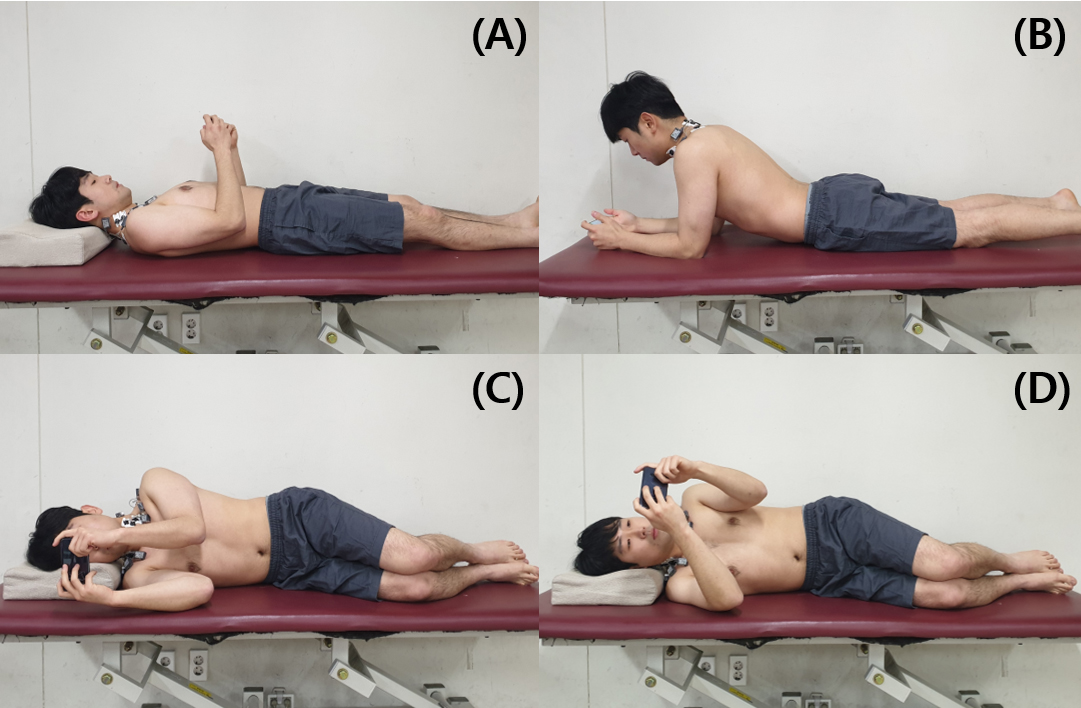
The four lying positions assessed in this study were the SUP, prone, and SIDE positions, which are usually preferred by people [13]. The prone position was modified to PE to comfortably watch the video on the smartphone, and the SIDE position was measured in two forms to reflect real-life preferences. People have reported using their smartphones in the lateral decubitus position and sometimes lying sideways with their bodies turned to the ceiling in an oblique direction to use both hands to operate the smartphone. The oblique SIDE position consisted of having the head turned 45
SUP: The participants laid on their back with their heads supported by pillows. The height of the pillow was adjusted to align the cervical curve (without flexion and extension). The subjects looked down without lifting their heads and placed both arms beside their chest with the smartphones held with both hands and with their elbows flexed at 90 PE: The upper arms were positioned vertically below the shoulders. The forearms were placed on the table in the prone position. The participants held the smartphone with both hands and watched the video (Fig. 1B).
Four different lying positions while using a smartphone (A) supine, (B) prone on elbows, (C) side lying, and (D) 45 SIDE: The participants laid on their right side, with both legs bent forward. The height of the pillow was adjusted so that the cervical spine was parallel to the thoracic spine without bending the neck sideways. The cervical alignment was confirmed using a goniometer before starting the test. The participants extended their arms forward with slight elbow flexion and held the smartphone with both hands. The smartphone was adjusted to the eye level (Fig. 1C). 45-SIDE: In the “SIDE” position, the participants turned their head 45
Statistical analyses were performed using the SPSS software for Windows (version 24.0; SPSS, Inc., Chicago, IL, USA). The normal distribution of variables was assessed using the Shapiro-Wilk test. One-way repeated measures analysis of variance (ANOVA) was used to compare neck muscle activity in the four lying positions (SUP, PE, SIDE, and 45-SIDE). The level of significance was set at
Results
Twenty-three healthy adults who volunteered met none of the exclusion criteria participated in this study. This was a single group study with a repeated measure design. All 23 participants completed the study.
Result of Fisher’s least-significant-difference test between the different lying positions
Result of Fisher’s least-significant-difference test between the different lying positions
Rt: right; Lt: left; SCM: sternocleidomastoid; AS: anterior scalene; CES: cervical erector spinae; UT: upper trapezius; SUP: supine; PE: prone on elbows; 45-SIDE: 45
The result of post hoc analysis between lying positions of the right and left sternocleidomastoid (SCM) muscle activity (%RVC). RVC: reference voluntary contraction; SUP: supine; PE: prone on elbows; SIDE: side lying; 45-SIDE: 45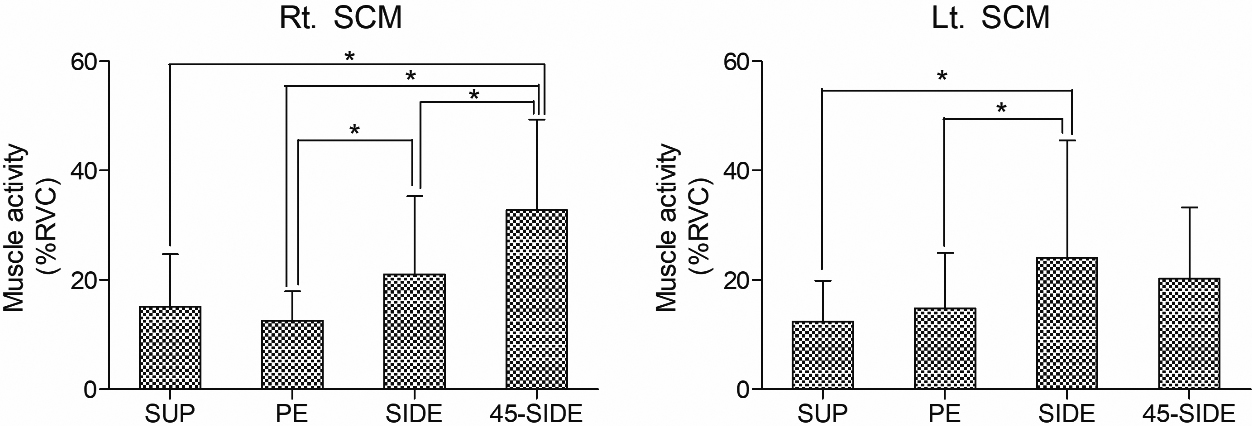
Results of the neck muscle asymmetry
SCM: sternocleidomastoid; AS: anterior scalene; CES: cervical erector spinae; UT: upper trapezius; SUP: supine; PE: prone on elbows; SIDE: side lying; 45-SIDE: 45
The result of post hoc analysis between lying positions of the right and left cervical erector spinae (CES) muscle activity (%RVC). RVC: reference voluntary contraction; SUP: supine; PE: prone on elbows; SIDE: side lying; 45-SIDE: 45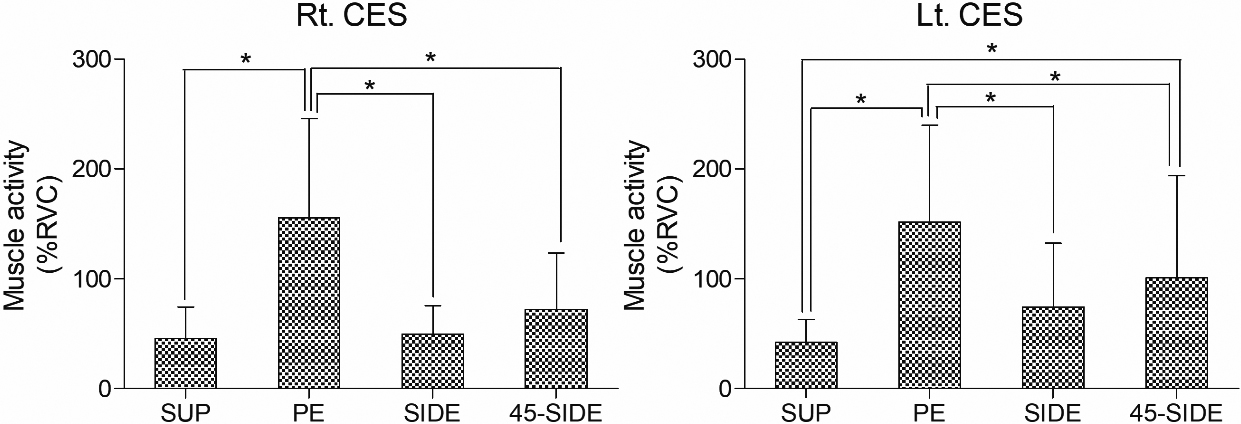
This study showed the significant main effects of using a smartphone in various lying positions on the right and left SCM and CES muscles (Table 2). Post-hoc analysis on postural comparisons of right and left SCM and CES muscles showed significant main effects (Table 3). The activity of the right SCM muscle significantly increased in the 45-SIDE position compared to the SUP (
The asymmetry of the right and left neck muscles according to each position
Based on the results of the comparison of neck muscle asymmetry between the right and left sides among the different positions, the activity of the SCM muscle had a significantly greater asymmetry in the 45-SIDE position (
Discussion
This study investigated the differences in neck muscle activity while using a smartphone in four different lying positions (SUP, PE, SIDE, and 45-SIDE). The results showed that the activity of the right and left SCM and CES muscles significantly differed in various lying positions. In addition, the activity of the SCM muscle had a significantly greater asymmetry in the 45-SIDE position, and the activity of the CES muscle had a significantly greater asymmetry in the SIDE and 45-SIDE positions. Moreover, the activity of the UT muscle had a significantly greater asymmetry in the SUP, PE, and SIDE positions.
The PE position showed increased activity of the right and left CES muscles and decreased activity of the right and left SCM muscles. The SCM is a neck flexor and the CES is a neck extensor that prevents neck flexion [20]. In the PE position, the subject’s head is unsupported and faced down, such that the gravitational moment acts in the direction of the cervical flexion. Decreased SCM muscle activity and increased CES muscle activity reflect actions against gravity to prevent neck flexion. Previous studies that measured neck muscle activity during smartphone usage while sitting with cervical flexion also reported increased activity of the CES [1, 11]. In addition, previous studies reported increased activity of another neck extensor, the UT, while using a smartphone in a sitting position with cervical flexion [1, 7, 8]. In this study, the PE position did not show a significant increase in the UT activity. The UT attaches to the shoulder girdle to support the weight of the upper limbs and to control shoulder movement [1]. The shoulder-stabilizing role of the UT can be limited by providing arm support [21]. In our study, the PE position demanded less effort from the UT, since the upper limbs and smartphones were supported by the bed. In addition, in the PE position, the trunk rests comfortably on the slightly elevated shoulders, and the UT is relaxed and loosened. Because of a length-tension relationship, it was difficult for the loosened UT to produce a force, and the contribution of the CES to control cervical alignment increased.
In the SIDE position, in which the posture is turned to the right, the muscle activity of the left SCM was increased. Similarly, Santander et al. assessed the SCM activity in the SIDE position and reported an increase in the muscle activity of the contralateral SCM in this position [14]. In the SIDE position, the right-side bending moment was applied to the head due to gravity. Thus, the left SCM was activated to produce a left-side bending moment. The activity of the left UT and CES muscle also increased asymmetrically relative to the right side in the SIDE position. The CES and UT muscles contribute to ipsilateral neck lateral bending [20]. Increased CES and UT activity produces the contralateral side bending force against the gravitational moment, like the SCM. In addition, the UT attaches to the shoulder girdle to support the weight of the upper limbs [1]. In the SIDE position, the right arm was resting on the bed, but the left arm was active. Therefore, the muscle activity of the left UT increased to support the weight of the arm.
In the 45-SIDE position, the participants rotated their neck 45
This study also investigated the activity of the AS muscle. The AS is a neck muscle that contributes to neck flexion, ipsilateral side bending, and contralateral rotation, similar to the SCM [20]. However, unlike the SCM activity, the AS muscle activity does not significantly differ depending on the lying position. In this study, the cervical spine was aligned by adjusting the pillow height during the task. This effort would have reduced the demand for the activation of neck muscles to maintain cervical alignment. The AS muscle is a relatively small and weak muscle compared to the SCM. Consequently, no difference in the activity of the AS muscle was observed probably due to the small contribution of this muscle to cervical spine alignment, which was maintained by the SCM.
The SUP position required the lowest neck muscle activity among the four positions assessed in this study. In the SUP position, the participants used a pillow to support their weight of the heads and the pillow height was adjusted to maintain cervical spine alignment. In addition, to reduce the load on the upper extremity, both elbows were placed at the side of the chest, and the smartphone angle was adjusted using the finger. Thus, among the four positions in this study, the SUP position had the least neck muscle activity while watching videos using a smartphone. Several previous studies have reported that neck disability is associated with prolonged increased activation of superficial neck muscles such as the SCM, AS, CES, and UT, and the resulting fatigue [11, 22, 23, 24]. As the use of smartphones has become more common in everyday life, maintaining a body posture that minimizes superficial neck muscle activation while using a smartphone has become necessary. The results of this study suggest that the SUP position is the optimal for minimizing superficial neck muscle contraction among the four assessed lying positions.
This study also showed that UT muscle asymmetry significantly increased in the SUP and PE positions, which were symmetric in this study. The participants were instructed to symmetrically hold the smartphone with both hands to watch the videos. The results showed that the activity of the left UT muscle increased relative to that of the right UT in both the SUP and PE positions. This unexpected result might have been affected by the dominant hand used while operating the smartphone. All 23 participants in this study were right-handed and predominantly used their right hand to touch the smartphone. They mostly used their left hand to support the smartphone and the right hand to operate it. The UT muscle is related to shoulder girdle stabilization as well as the control of neck movement [1]. Thus, left UT activity probably increased to support the arm while holding the smartphone and the muscle activity increased asymmetrically [1], although postural asymmetry was not visually confirmed during the experiment. To test this hypothesis, further studies involving left-handed participants are required.
The present study had several limitations. First, our findings cannot be generalized to individuals of different age groups because all participants in this study were young. Second, muscle activity only while watching a video on a smartphone was assessed. Thus, further studies on different functions of smartphones, such as texting, web browsing, and gaming, should be conducted. Third, this study only assessed four lying positions, although people use smartphones in different lying positions, such as the half supine position. Additional research on different lying positions is needed. Fourth, surface EMG has a limitation in collecting EMG signals of the AS accurately due to its small size and deep location. A needle EMG study should be considered to minimize potential crosstalk between the SCM and AS. Furthermore, the gaze direction and eye position have been reported to affect neck muscle activity. Therefore, studies to determine how eye movement affects the lying position while using a smartphone are needed.
Conclusion
This study examined the differences in neck muscle activity while using a smartphone in different lying positions. In the PE position, the muscle activity of the CES was significantly increased. In the SIDE position, the muscle activity of the left SCM was increased. In the 45-SIDE position, the muscle activity of the right SCM and left CES was increased due to neck rotation. Among the four positions, the neck muscle activity was the lowest in the SUP position. Therefore, lying in the SUP position may minimize neck muscle contraction when using a smartphone.
Footnotes
Acknowledgments
We would like to thank the study participants. We would also like to thank the researchers at the Kinetic Ergocise based on Movement Analysis laboratory for their assistance with this study. In addition, we would like to thank Editage (www.editage.co.kr) for English language editing.
Conflict of interest
The authors declare that they have no known competing financial interests or personal relationships that could have appeared to influence the work reported in this paper.
Funding
This research did not receive any specific grant from funding agencies in the public, commercial, or not-for-profit sectors.