



Abstract
BACKGROUND:
Many studies have compared muscle length and muscle activity for low back pain. However, compensatory movement for non-specific low back pain has not yet been studied sufficiently.
OBJECTIVE:
The purpose of this study was to compare the length of the hip flexor, lumbar extensor endurance and the muscle activity of the erector spinae and gluteus maximus during hip extension, and the compensatory movement of the lumbar in people with or without nonspecific chronic low back pain.
METHODS:
In this case-control study, 16 participants with non-specific chronic LBP and 17 without LBP were included. Hip flexor length was assessed by the modified Thomas test. Lumbar extensor endurance was assessed by the modified Biering-Sorensen test. Muscle activity of the erector spinae and gluteus maximus during hip extension was measured using a Delsys-Trigno wireless EMG system. Compensatory lumbar movements during hip extension were measured using a digital inclinometer.
RESULTS:
Muscle activity of the erector spinae and compensatory lumbar movements were significantly higher in the LBP group. (
CONCLUSIONS:
Shortened hip flexors, low gluteus maximus activity, and high erector spinae activity during hip extension, lumbar extensor weak endurance, lumbar compensatory movement are potential factors for non-specific LBP.
Introduction
Low back pain (LBP) refers to pain confined between the 12th rib and the inferior gluteal muscle, with or without leg pain [1]. Additionally, LBP includes activity restriction lasting for at least 1 day and pain in one or both legs [2]. LBP is a major public health problem worldwide, with a very high lifetime prevalence of 84% [3]. Additionally, the recurrence rate of LBP with limited activities in daily life is 80%, 5%–15% of which leads to chronic LBP [4].
LBP can be classified into specific and non-specific types according to the mechanism of occurrence. Specific LBP is defined as symptoms due to specific pathological mechanisms including herniated nucleus pulposus, infection, osteoporosis, rheumatoid arthritis, fractures, or tumors [5]. Non-specific LBP is defined as symptoms without a clear pathological cause and has a high incidence of approximately 90% of all patients with LBP [6]. LBP with symptoms persisting for
In particular, among the various causes of non-specific chronic LBP, problems with control of muscle contraction around the lumbar spine, decreased range of motion, weakened muscle strength, and decreased muscle endurance were the most important [8]. Problems with the control of muscle contraction around the lumbar-pelvic region can reduce the stability of the lumbar spine and overload the joints, resulting in persistent and repeated pain [9]. Furthermore, problems with muscle contraction control can result in changes in movement control [10]. Hip extension occurs when walking or extending the trunk from trunk flexion. Problems with controlling muscle contraction lead to excessive contraction of the erector spinae and less contraction in the gluteus maximus [11]. This causes a change in movement control by causing anterior tilting of the pelvis and excessive extension of the lumbar spine [12]. The shortening of the hip flexor muscle can cause LBP by increasing the load on the posterior part of the lumbar spine, thereby causing excessive anterior bending of the lumbar spine [13]. This is mainly due to the characteristics of modern sedentary lifestyles; the anatomical attachment site of the hip flexor muscle becomes closer, resulting in shortened adaptability.
There is a tendency for muscle recruitment to be delayed or lost in the gluteus maximus and lumbar-pelvic stabilizing muscles in patients with non-specific chronic LBP [14]. In such patients, a decrease in the muscle activity of the gluteus maximus during hip extension is associated with an increase in the muscle activity of the erector spinae [15]. This increase in the compensatory movement of the lumbar spine causes excessive contraction of the erector spinae, increasing tension and causing muscle fatigue [16].
Although there have been many studies on the length of the hip flexor and the muscle activity of the erector spinae and gluteus maximus during hip extension, they involved wide age ranges of participants and research on non-specific chronic LBP groups is limited [17, 18, 19]. Additionally, the number of other variables for the adjacent joints and muscles related to hip flexor length was small. The muscle activity of the erector spinae and gluteus maximus for hip joint extension showed inconsistent results. Therefore, it is necessary to comprehensively compare and analyze the differences between healthy individuals and patients with non-specific chronic back pain with the factors that cause LBP as measured in previous studies.
Methods
This was a case-control study. The measurement point was studied cross-sectionally. Hip flexor length, muscle activity of the erector spinae and gluteus maximus, endurance of the erector spinae, and compensatory lumbar movement in participants with and without non-specific chronic LBP were compared.
Participants
In total, 36 participants were recruited for this study. 19 participants were included in the LBP group and 17 were included in the non-LBP group. Two patients who underwent orthopedic surgery of the lumbar spine and one who experienced radiating pain in the legs were excluded according to the exclusion criteria. Sixteen participants were finally recruited into the LBP group. Seventeen participants were recruited into the non-LBP group. The participants in the LBP group were inpatients or outpatients in the physical therapy room of Jaseng Hospital. Non-LBP group participants were employees and students of Masan University, through notices on bulletin boards within the school. The inclusion criteria for the LBP group were 1) age between 20 and 40 years, with a diagnosis of non-specific LBP by a doctor, and 2) back pain for at least 6 weeks in the past 12 weeks. The inclusion criterion for the non-LBP group was 1) age between 20 and 40 years without back pain. The exclusion criteria in both groups were 1) complications including cancer or infection; 2) history of orthopedic surgery on the lumbar bone, pelvis, or hip joint; 3) neurological symptoms including radiating pain, paresthesia, and muscle paralysis; 4) inflammatory diseases including tuberculosis or rheumatism; and 5) pregnant women. Participants were provided an explanation of the procedure and purpose of the study and signed the consent form. This study was conducted from June 17, 2020 to September 30, 2020. All procedures were approved by the Kyungnam University Research Ethics Committee (no. 1040460-A-2020-026). The study was registered on the Clinical Research Information Service of South Korea (no. KCT0006548).
Procedure
Participants reported pain intensity and the Oswestry Disability Index (ODI) via a survey. Hip flexor length was measured using the modified Thomas test. The muscle activity of the erector spinae and the gluteus maximus during hip joint extension was measured using the Delsys-Trigno wireless EMG system. Compensatory lumbar extension and rotation were measured using a digital dual inclinometer (Dualar IQ, ItechM, USA) when the hip joint was extended. The Biering-Sorensen test was conducted to measure the endurance of the erector spinae. All participants took all measurements during the afternoon time. Differences in measured items between the two groups were compared.
Measurements
Pain intensity
Pain was averaged over 24 hours and measured using a numeric pain rating scale. Participants were asked to select and indicate their pain level from 0 (no pain) to 10 (worst pain imaginable). The test-retest reliability ICC was 0.61–0.77 and the validity ICC was 0.85 [20].
Korean version of the ODI
Functional disability was measured using the Korean version of the ODI, which was developed through cross-cultural adaptation of the ODI, a commonly used measuring tool for LBP dysfunction. It comprised nine items with a total score of up to 45 points: current pain level, self-management, lifting, walking, sitting, standing, sleeping, social life, and travel and movement. The reliability ICC was 0.84 and the test-retest reliability was 0.9167 [21].
Hip flexor muscle length
To measure the length of the hip flexor muscle, a modified Thomas test was performed, using a digital dual inclinometer (Dualar IQ, ItechM, USA). The participant was seated close to the edge of the treatment table with the hand wrapped around the knee, which was brought to the chest, and then slowly laid down on the treatment table. The participant’s lower back was flat on the treatment table, and while the participant fixed one leg with his/her hand, the induction and abduction angle of the contralateral hip joint was maintained at 0
Measurement of hip flexor length.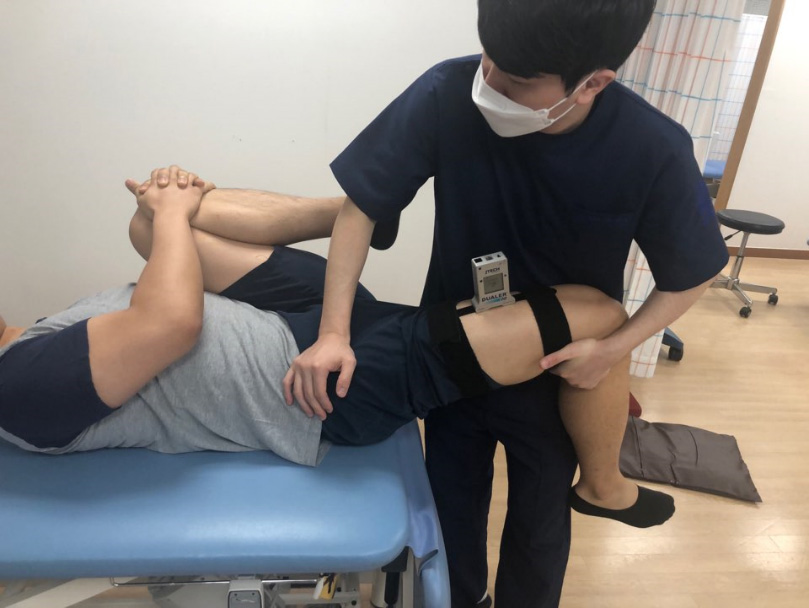
In this experiment, the muscle activity of the dominant erector spinae and gluteus maximus was measured using a Delsys-Trigno wireless EMG system (Delsys Inc., Boston, MA, USA) when the hip joint was extended by 10
Measurement of erector spinae and gluteus maximus muscle activity during hip extension.
The erector spinae were measured by placing both hands next to the prone body and extending the waist to the maximum range of motion. At that time, the examiner applied resistance to the patient’s middle back. The gluteus maximus muscle was measured by applying resistance to the distal side of the thigh when the knee was bent to 90
A modified Biering-Sorensen test was performed to measure the endurance of the erector spinae. Participants were asked to take the prone position on the edge of the treatment table with both upper anterior superior iliac spines aligned with the edge of the treatment table, and to take a ready position by supporting the upper body on a chair while fixing the center of the thigh and calf with a strap. At the start command, the participant folded both arms to the chest to maintain the neutral position of the spine in a crossed state, and the examination commenced. The holding time was measured using a smartphone stopwatch, and it was stopped when it was difficult to endure any longer. To ensure the safety of the participant, the experiment was stopped when the bending and extension became more than 5
Characteristics of the study participants
Characteristics of the study participants
CLBP: Chronic low back pain, NPRS: Numeric pain rating scale, KODI: Korean Oswestry disability index.
To measure the compensatory lumbar movement, the trunk, pelvis, and legs were aligned in the prone position, and then a smartphone goniometer application (G-Pro, 5FUF5 co., USA) was used to determine when the dominant hip joint extension was 10
Measurement of erector spinae endurance.
Measurement of compensatory lumbar movement.
Comparison of the variables in the study participants
CLBP: Chronic low back pain, MVIC: Maximal voluntary isometric contraction, ES: Erector spinae, GM: Gluteus maximus.
SPSS 21.0 was used for the statistical analysis in this study. All data were tested for normality using the Kolmogorov-Smirnov test. An independent
Results
The general characteristics of the study participants are listed in Table 1.
The length of the dominant hip flexor muscle was 18.18
The muscle activity of the erector spinae was 28.61 (%MVIC) in the LBP group and 24.56 (%MVIC) in the non-LBP group, which was significantly higher in the LBP group than in the non-LBP group (
The muscular endurance of the erector spinae in the LBP group was 39.75 s and 71.52 s in the non-LBP group, which was significantly lower in the LBP group than in the non-LBP group (
The amount of compensatory lumbar extension change in the LBP group was 3.31
Discussion
In this study, the length of the hip joint flexor muscle, muscle activity of the erector spinae and gluteus maximus when the hip joint was extended by 10
The length of the hip flexor muscle was significantly shorter in the LBP group in both the dominant and non-dominant sides. During hip joint extension, the muscle activity of the erector spinae was significantly higher in the LBP group, and the muscle activity of the gluteus maximus was significantly lower in the LBP group. The muscular endurance of the erector spinae was significantly lower in the LBP group. Compensatory lumbar extension and rotation were significantly higher in the LBP group.
The flexibility of the hip joint flexor muscles was significantly reduced in students with non-specific chronic LBP, and hip extension during walking was significantly decreased compared to students without LBP [28]. This is because the extension angle of the hip joint and flexibility of the flexor muscles affect the increase in the anterior pelvic tilt, and the uncontrolled movement of the lumbar vertebrae induces mechanical stress [28]. In this study, the length of the hip flexor muscle was significantly decreased in the LBP group compared to that in the non-LBP group. As in a previous study [28], the compensatory movement of the lumbar-pelvis may have occurred due to the shortening of the hip flexor muscle and caused LBP.
The decrease in gluteus maximus muscle activity during hip extension movement was significantly related to an increase in erector spinae muscle activity [15]. However, The female patients with non-specific chronic LBP had higher extensor spinal muscle activity than the non-LBP group, but there was no significant difference in gluteus maximus muscle activity [18]. This may be different from the results of this study because the length of the hip flexor muscle was not measured in the previous study [18] and was not explained in relation to the erector spinae and gluteus maximus during hip extension. Therefore, since the length of the hip flexor muscle was significantly shorter in the LBP group than in the non-LBP group, the high activity of the erector spinae and low activity of the gluteus maximus may have served to compensate for this [12].
A study reported that patients with LBP had a significantly higher proportion of type 2 fibers in their erector spinae than non-LBP participants. The higher the proportion of type 2 fibers, the higher the muscle fatigue, which has been suggested as a potential risk factor for LBP [29]. The endurance of the erector spinae in patients with non-specific chronic LBP was lower than that in the non-LBP group [30]. In this study, the endurance of the erector spinae was significantly lower in the LBP group than in the non-LBP group. The compensatory movement of the lumbar spine may cause excessive contraction of the erector spinae and increase muscle fatigue [31]. Therefore, enhancement of the muscular endurance of the erector spinae can be considered as a factor in the treatment of patients with non-specific chronic LBP.
A strong positive correlation between hip extension and lumbar rotation in patients with non-specific chronic LBP [32]. This is because if the mobility of the hip joint decreases, the load on the lumbar vertebrae may increase, which may increase the compensatory movement of the lumbar vertebrae. In this study, the compensatory lumbar extension and rotation were significantly increased in LBP group compared to the non-LBP group during hip joint extension. The limitation of the range of motion of the hip joint may be due to the shortening of the hip flexor muscle, and to compensate for this, compensatory movements occur in the adjacent lumbar-pelvis, causing pain [12]. In this study, the muscle activity of the gluteus maximus, the agonistic muscle of hip extension, was lower than that of the extensor vertebrae, so compensatory lumbar extension and rotation may have occurred. The lumbar lordosis during hip extension significantly increased in the non-specific chronic LBP group compared to the non-LBP group, which may be due to the fear-avoidance response of the pelvis [12]. Because the participants in the LBP group in this study experienced LBP for more than 6 weeks in the past 12 weeks, they may have been affected by the fear-avoidance reaction, and it is necessary to study psychological factors together in the future.
The limitations of this study are that it is difficult to generalize the results to all age groups since the age range was 20 to 40 years, and the characteristics of each group are unknown because the male-to-female ratio was not constant and gender differences were not analyzed. In addition, the difference in length between the dominant and non-dominant sides could not be analyzed because the intragroup differences in hip flexor length were not compared. Finally, since measurements were obtained during hip extension in the prone position, they cannot be generalized to daily functional movements. Future studies are needed to analyze gender differences in patients with non-specific chronic LBP and differences in hip flexor length, compensatory lumbar movement, and lumbar-pelvic muscle contraction patterns during gait or functional movement.
Conclusion
This study aimed to identify the effects of pain intensity, functional disability, hip flexor length, erector spinae, and gluteus maximus muscle activity, erector spinae muscle endurance, and compensatory lumbar extension and rotation during hip extension in nonspecific chronic LBP. Pain intensity and the ODI scores were significantly higher in the LBP group. Both hip flexor lengths in the dominant and non-dominant legs were significantly shorter in the LBP group. When the hip joint was extended, the muscle activity of the erector spinae was significantly higher in the LBP group. The muscle activity of the gluteus maximus and endurance of the erector spinae were significantly lower in the LBP group. Compensatory lumbar extension and rotation were significantly higher in the LBP group. With the results of this study, to treat patients with non-specific chronic LBP, a specific treatment strategy that can control the length of the hip flexor muscles and enhance the endurance of the erector spinae, as well as control the proper movement of the lumbar-pelvis and muscle contraction (which is thought to have a more positive effect on chronic LBP patients) can be developed.
Footnotes
Conflict of interest
The authors have no potential conflict of interest to declare.
Funding
This research did not receive any specific grant from funding agencies in the public, commercial, or not-for-profit sectors.