



Abstract
In this paper, a parametric study that investigated geometrical parameters of reinforced concrete box culverts (RCBC) is presented. Dead and live loads, which act on RCBC, and derivation of vehicle load formulas were explained. These formulas were verified by comparison with experimental studies. Span width, culvert height and fill depth effects on RCBC design were investigated by creating a number of 88 2D finite element culvert models. An Excel sheet was developed by using VBA and CSI API to establish SAP2000 models and to generate analysis results. Analysis results revealed that while vehicle load was predominant for fills that did not have a depth value greater than 1 m, vertical earth load was predominant beyond this value. Minimum values of internal forces and base soil pressures occurred at 0.7–1.0 m fill depth range. It is concluded that span width and fill depth parameters have an important effect on internal forces of RCBC models. This research also reveals that using multiple cell RCBC instead of using wider span width in single cell RCBC is more reliable due to much lower internal forces and base soil stresses.
Introduction
Reinforced concrete box culverts (RCBC) are often used under roads for the conveyance of water and used at road-pipeline crossings to ensure safety of pipelines. A typical culvert is embedded in soil and subjected to earth and vehicle loads. RCBC can have either single cell or multiple cells and can be categorized by the construction type as cast-in-place or precast [1].
The current American Association of State Highway and Transportation Officials Standard Specifications for Highway Bridges (AASHTO SSHB) is mainly used for analysis of RCBC [2]. Although there is a great deal of experimental study that investigates effects of loads on RCBC, there are a few studies that investigate theoretical effects of geometrical parameters on RCBC. Understanding the effects of these parameters is important for achieving more economical and reliable designs.
The main objective of this study is to investigate the theoretical effects of geometrical parameters such as span width, culvert height and fill depth on RCBC design through an extensive parametric analysis. Another objective is to explain the derivation of vehicle load distribution formulas, analysis and design procedures of RCBC in detail.
Literature review
Previous studies have shown that results of experimental studies on culverts have been in a good agreement with AASHTO SSHB analysis methods. Some of essential experimental studies are referred here.
Abdel-Karim et al. [3] conducted a full-scale experiment of a double cell reinforced concrete box culvert and investigated live load distribution through soil. Experimental live load tests indicated that live load distribution in longitudinal and transverse direction is nearly same and they recommended that usage of live load distribution over a square area can be continued. They also found that after 8 ft. (2.44 m) of fill depth live load effect decreased considerably and thus AASHTO’s distinction between single and multiple RCBC is inessential for live load distribution. In the tests, AASHTO’s 1.75 vehicle load distribution factor was validated regardless of fill depth [3].
Chen et al. [4] also conducted a full-scale experiment to address the issue of vertical earth pressures not being accurately estimated. They also conducted a finite element model for comparison. The study concluded that overburden pressure calculated by the AASHTO SSHB method is accurate and in a good agreement with the test results. They also found that height of the backfill, width of the trench, slope angle of the trench, stiffness and dimensions of the culvert, and the material properties of the backfill and the foundation soil affect the vertical earth pressure on the culvert [4].
Pimentel et al. [5] conducted an experiment of a reinforced concrete box culvert with 9.5 m embankment depth. A nonlinear finite element model was also used to investigate nonlinear and elastic behaviour of concrete box culvert. After finding experimental results and finite element analysis results were close, a parametric study was done to evaluate soil-structure interaction and failure mechanism of concrete box culverts. Soil interaction analysis results showed that soil-interaction factor varies between AASHTO compacted side fill and uncompacted side fill interaction factors. This study also indicated that overburden pressure caused by fill depth is greater than the normal weight of embankment above the culvert [5].
Wood et al. [6] performed analyses of two production-oriented culvert load-rating demand models by using live-load test data from three instrumented RCBC under four different soil depths. A two-dimensional (2D) structural-frame model (named as Level 1) with simple supports and uniform reaction loads as base soil and a 2D soil-structure interaction model (named as Level 3) were used as demand models. Increasing model sophistication generated higher precision and accuracy for predicted moments, as expected. However, Level 1 model had high precision and accuracy for predicting moment values at the top exterior wall corners and the top midspans of culverts, too. Predicted moment demands for bottom slabs and corners were conservative in both model groups. However, increasing model sophistication of Level 1 group by adding linear springs as base soil could improve precision and accuracy for predicted moments at bottom slabs and corners [6].
Orton et al. [7] conducted a full-scale experiment of 10 existing reinforced concrete box culverts and investigated the effects of live load (truck loads) on reinforced concrete box culverts. Fill depths of the culverts were ranging from 0.78 m to 4.04 m and span widths were greater than 6 m (20 ft.). They used 12 reusable strain transducers and 12 linear variable displacement transducers to measure strain and displacement values. Experimental live load tests indicated that the live-load effect decreased significantly with increasing fill depth. They also found that the 2012 AASHTO LRFD bridge design specifications predicted strains and displacements overly conservative when compared with the field data for fill depths less than 2.4 m (8 ft) [7].
Culvert models and parameters
Material properties
The embankment used for the sides and above culverts was assumed to have γ= 18 kN/m3 unit weight and Φ= 30° friction angle. To model base soil, springs with 30×103 kN/m3 stiffness constant were used. The concrete used to model the culverts had 25 MPa characteristic compressive strength, 30 GPa modulus of elasticity and 0.2 Poisson’s ratio.
Geometry
A typical reinforced concrete box culvert model and geometric symbols used in this study are shown in Fig. 2. Z is fill depth above the culvert, which is measured between the outer face of top slab and top of the fill. S is effective span width of the culvert, which is measured between centers of exterior walls. BC is top slab width of box culvert, which is measured between the outside faces of exterior walls. HC is effective height of the culvert, which is measured between centers of top and bottom slabs. t is section thickness of the culvert elements. Section thickness (t) for culverts is assumed to have minimum value of 15 cm and calculated as one twenty of span width (15 cm ≤ S/20). Section thickness for each model is constant for slabs and walls. Design length (L) of culvert models was kept constant as 1 m for all models.
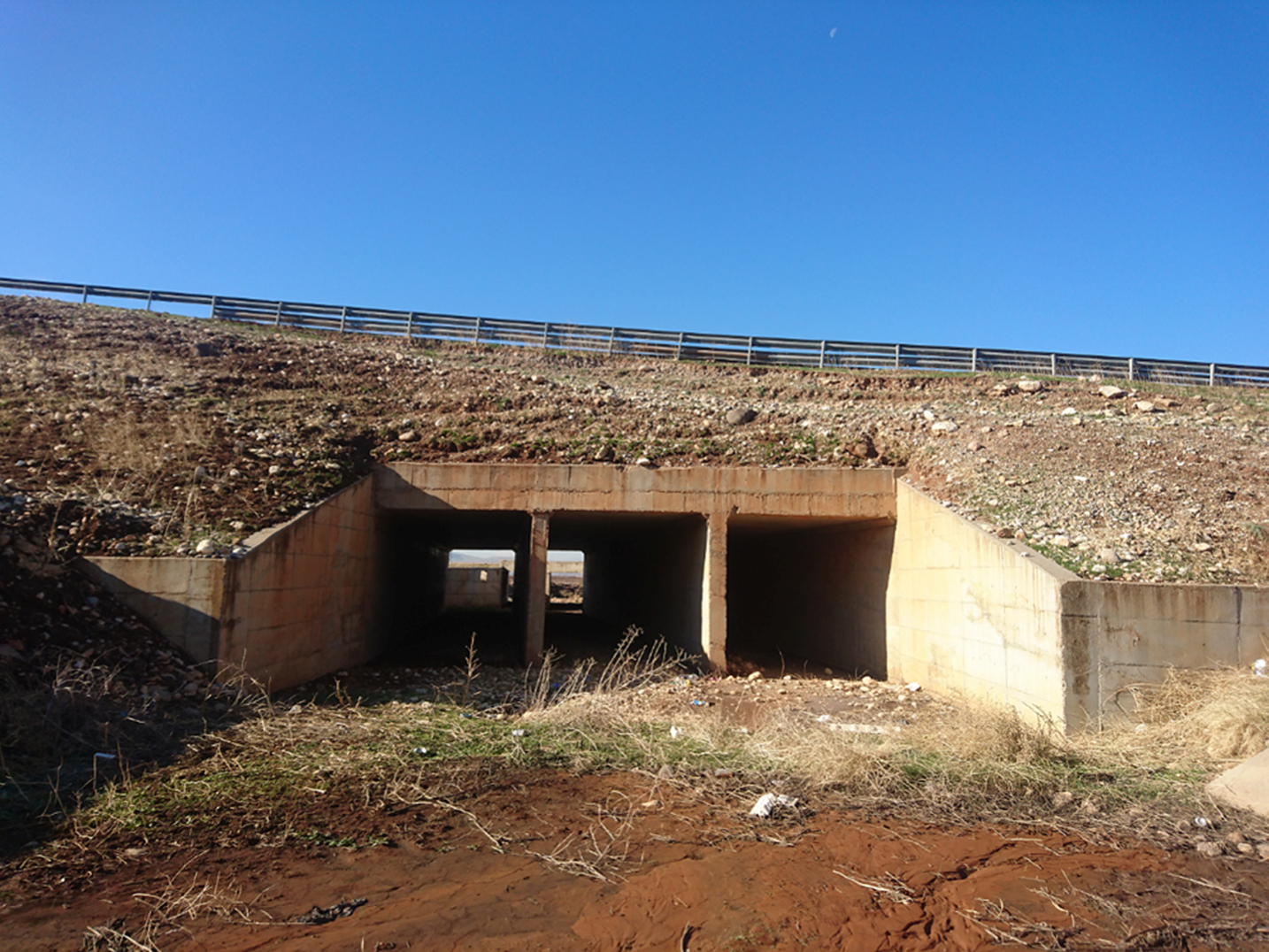
Picture of a typical reinforced concrete box culvert (image by Mesut Kuş).
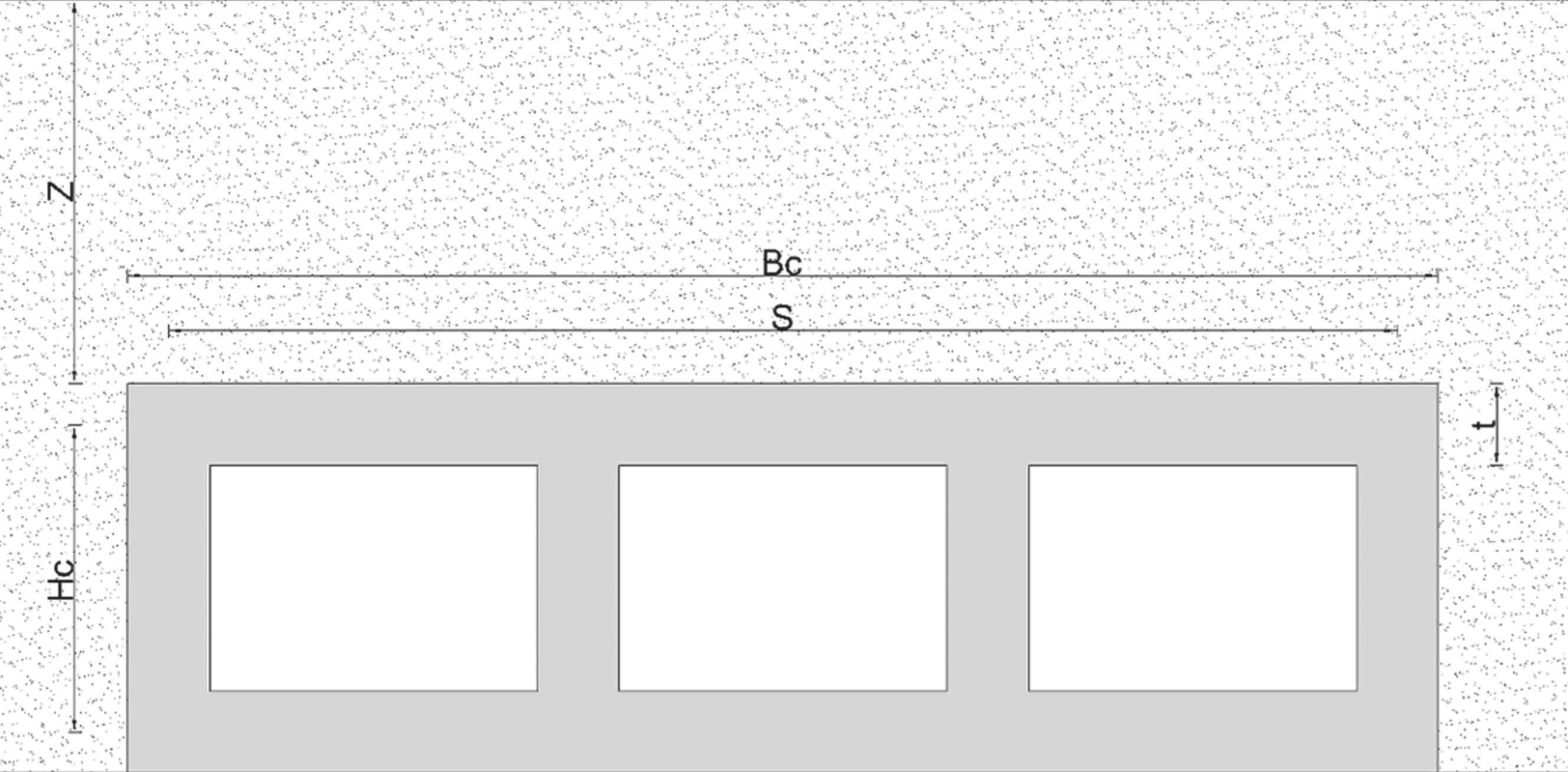
Typical reinforced concrete box culvert model and symbols.
As shown in Table 1, three model groups and 88 models were used for the analysis. In the first group, one cell concrete box culverts were considered. First model group consisted of four cases, which were categorized according to the fill depth. 0.50 m, 0.70 m, 1.50 m, and 3 m of fill depths were considered for Case I, Case II, Case III and Case IV, respectively. 2.40 m of constant culvert height was used for first group. Span width was changed between 0.60 m and 9.60 m.
Parameters of reinforced concrete box culvert models
The second group was similar to the first group; however, in this group, culvert height was changed between 0.60 m and 4.00 m with a constant 1 m span width and a constant 15 cm section thickness.
In the third group, multiple numbered culvert cells were considered. 9.60 m constant span width and 2.40 m constant culvert height were used. Since the span width was constant, section thickness was constant too, and calculated as 48 cm (960/20). The one cell culvert with these dimensions was considered as Case I for the third group and this culvert was divided into double cells and triple cells, which were named as Case II and Case III, respectively. For the third group, fill depth was changed between 0 m and 5 m.
Figure 3 shows the static model and load types considered for concrete box culverts. Dead loads consist of vertical and lateral earth pressures and self weight of the culvert. AASHTO HS20 vehicle load and lateral surcharge load were applied as live load. Base soil was modeled by using linear springs.
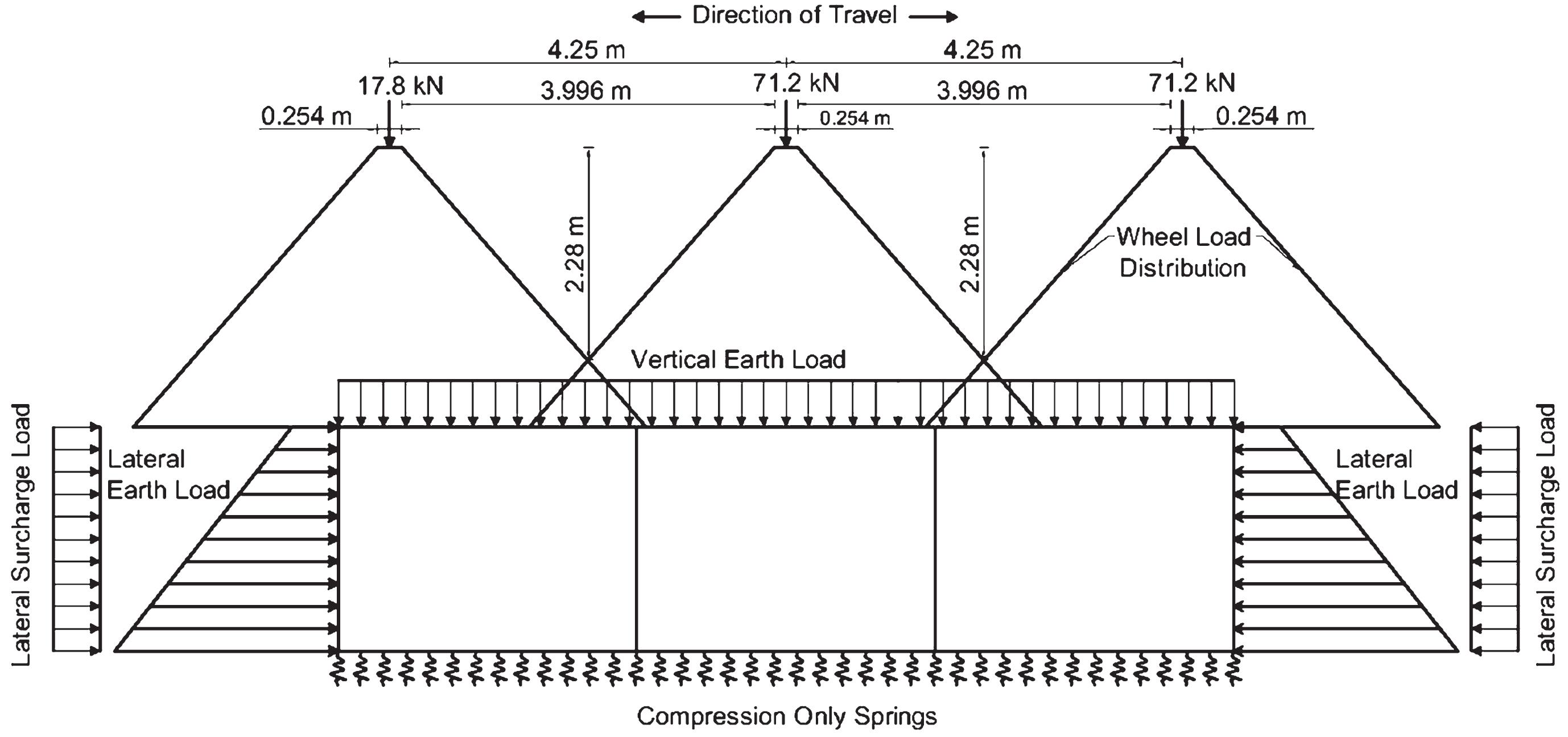
Static model and loads for concrete box culverts.
Vertical earth pressure
The fill depth above culverts is an important factor that affects the design of reinforced box culverts since it affects both fill weight and distribution of vehicle loads. Previous studies have shown that overburden pressure caused by fill depth is greater than the normal weight of embankment above the culvert [4, 5]. Therefore, the AASHTO SSHB uses different soil-interaction factors according to the embankment installation type as stated in Articles 16.6.4.2.1 and 16.6.4.2.2 [2]. In this study, embankment installation type with compacted side fills was considered.
As stated in the AASHTO SSHB Article 16.6.4.2, the total overburden pressure WE on the box culvert is calculated as: [2]
Vertical earth load was applied to the top slab of culvert as uniformly distributed load as shown in Fig. 3.
Soil at the sides of box culvert was considered at rest condition. The following equation was used to calculate at rest earth coefficient: [8]
Since friction angle was taken Φ= 30° in the culvert models, K0 was calculated as 0.5 by using Equation 4. As shown in Fig. 3, lateral earth load was modeled as trapezoidal load, which starts from the center of top slab and finishes at the center of bottom slab. Lateral earth pressure at the start point EP1 and lateral earth pressure at the end point EP2 were calculated by using the following equations for 1 m design length:
The self weight of concrete box culvert was also considered in the analyses. Concrete members were modeled with 25 kN/m3 unit weight.
Live loads
Vehicle load
AASHTO HS20 vehicle loading was considered at this study. AASHTO HS20 truck has two different sizes of wheels. These are single wheel with 0.254 m×0.254 m (10 inches×10 inches) dimensions and dual wheel with 0.254 m×0.508 m (10 inches×20 inches) dimensions as shown in Fig. 4 [9]. Front wheels have 17.8 kN load while middle and rear wheels have 71.2 kN load as shown in Fig. 3. These wheel loads are applied as uniformly distributed load and moved all together along the span until wheel load projection of the first wheel leaves the span.

Spacing and dimensions for HS20 truck wheels and axles [9].
There are two main equations for the distribution width of wheel loads. The first one is stated in AASHTO SSHB Article 16.7.4.1 and 3.24.3.2. When the fill cover is equal or less than 0.6 m (2 ft.), wheel loads shall be distributed over a distribution width calculated by the following equation: [2]
The second main distribution width equation is for embankments, which have depth greater than 0.6 m. ASTM C890-13 in Article 5.2.3.1 states that when embankment separates the truck wheels and top surface of the culvert, wheel loads shall be distributed over a rectangle area as shown in the following equation: [9]
To formulate distribution areas, situations where load area intersections occur must be defined first. Since wheel spacing is less than axle spacing, the first intersection occurs between two wheels that are at the same axle as shown in Fig. 5. First critical fill depth can be calculated as 0.74 m from the following geometric calculation knowing that the total slope of load projection lines is 1.75.
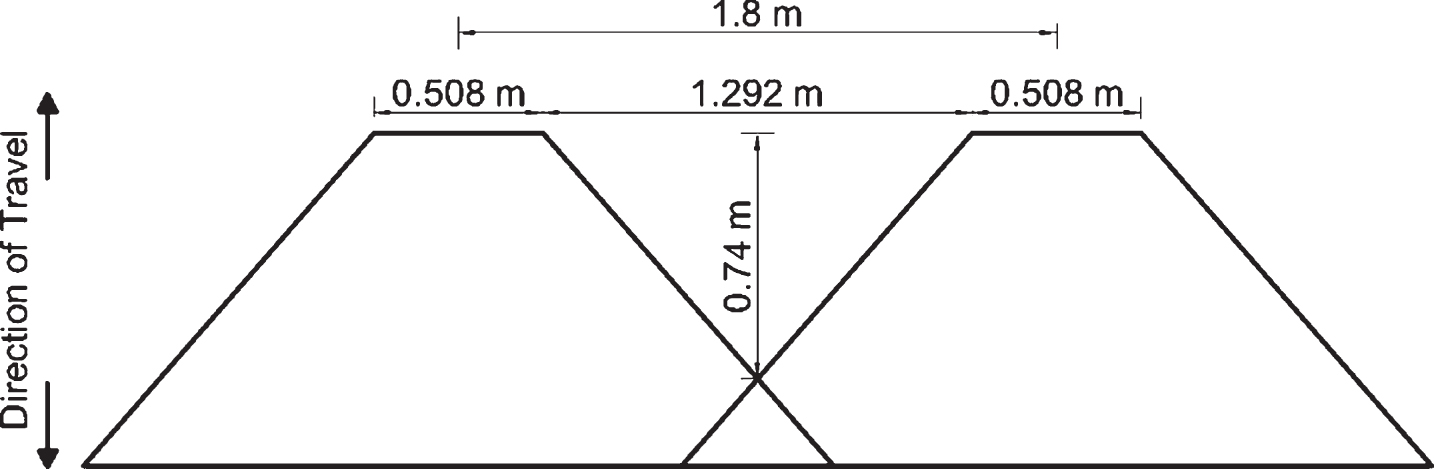
Wheel spacing and load projection for HS20 truck.
The second intersection occurs between two axles as shown in Fig. 3. Calculation of the second critical fill depth ends up 2.28 m with the same method:
After defining critical fill depths for load projections, distribution areas can be defined. The second distribution case is valid for 0.6 m <Z <0.74 m. In this interval of fill depth, no intersection occurs between wheel load projections yet. The second distribution width and length are shown in the following equations:
The third distribution case is defined for 0.74 m ≤ Z ≤ 2.28 m. In this interval of fill depth, while intersection occurs between wheels, intersection of different axles has not occurred yet. Thus, distribution width is not changed for this case. Since load projections of two wheels at the same axle overlap, distribution lengths for this case include wheel spacing (1.8 m) and wheel lengths. For the same reason two wheel loads are included in uniformly distributed vehicle load equations. Third distribution width and lengths are shown in the following equations:
Uniformly distributed vehicle loads for the third case are shown in the following equations:
The forth distribution case is defined for 2.28 m <Z and divided in four sub cases. Since fill depth is greater than the second critical fill depth, all wheel load projection areas overlap. Span width of concrete box culvert is an important factor for this case to determine count of axles, which are in vertical projection of the span. Axles that are not in vertical projection of the span width are not considered for loading. For practicality, dual wheel length was considered when calculating distribution length in forth case and its sub cases as expressed in the following equation:
If effective span width S is less than or equal to axle spacing (S ≤ 4.25 m), only one axle and two wheels at this axle are considered for loading. This case is a sub case and named as 4A. Since only one axle is considered, maximum wheel load is used for uniformly distributed vehicle load. As stated in the ASTM C890-13 Article 5.2.3.4, only portion of distributed vehicle load in range of span is considered for loading by reason of distributed load area exceeds top surface of culvert in this sub case [9]. Therefore, distribution width equation is used for only calculation of distributed load value for this sub case and vehicle load is distributed over whole span width knowing that span width is smaller than distribution width. Distribution width and uniformly distributed vehicle load are defined in the following equations for sub case 4A:
When effective span width S is less than or equal to two axle spacing and greater than one axle spacing (4.25 m <S ≤ 8.5 m), two axles and four wheels at these axles are considered for loading. This sub case is named as 4B. Since front axle has not been considered yet, maximum wheel load is used for uniformly distributed vehicle load. Distribution width for this sub case contains axle spacing (4.25 m) due to inclusion of two axles. Vehicle load is distributed over whole span width in this sub case for the same reason as explained in sub case 4A. Distribution width and uniformly distributed vehicle load for sub case 4B are defined in the following equations:
When effective span width S is greater than two axle spacing (8.5 m <S), three axles and six wheels at these axles are considered for loading. This case is named as 4C. Four maximum and two minimum wheel loads are used for uniformly distributed vehicle load. Distribution width for this sub case contains two axle spacing (8.5 m) due to inclusion of three axles. Distributed vehicle loads are much smaller in forth case as shown in Fig. 6. For this reason and practicality, although effective span width can be greater than calculated distribution width, vehicle load is distributed over whole span width in this sub case, too. Distribution width and uniformly distributed vehicle load for sub case 4C are defined in the following equations:
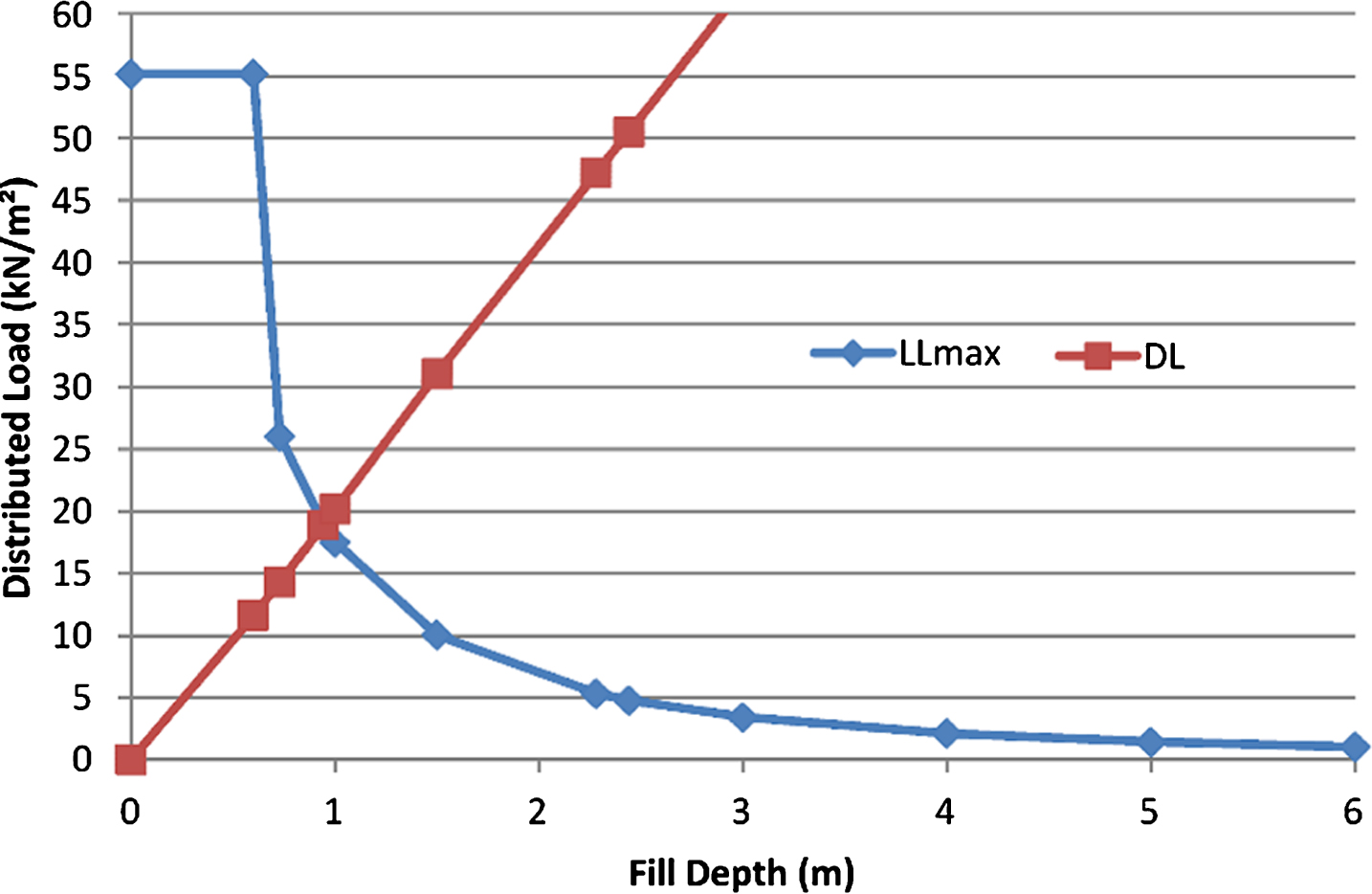
Vertical earth load and maximum distributed vehicle load variation for span width of 1.5 m.
Distribution areas and distritubed vehicle load formulas for all cases are summarized in Table 2.
Distribution width, length and distributed vehicle load formulas
After determination of distribution areas and distributed vehicle loads, an example graph of maximum uniformly distributed vehicle load variation with respect to fill depth was drawn in Fig. 6. As it can be seen in Fig. 6, vehicle load was at its maximum value and constant for the first case. After the first case, vehicle load was decreasing dramatically. Vertical earth load and vehicle load had the same value at fill depth of about 1 m. According to AASHTO SSHB Article 6.4.2, the effect of vehicle load can be ignored over 2.44 m (8 ft.) fill depth [2]. At this depth of fill, LLmax had a value of 4.79 kN/m2 while DL had a value of 50.51 kN/m2 as shown in Fig. 6. In other words, distributed vehicle load was 9.48 percent of distributed overburden load at 2.44 m fill depth. In this study vehicle load was not neglected at any depth of fill value.
Vehicle load formulas compared with two experimental studies for verification. In the first study, Abdel-Karim et al. [3] placed pressure sensors on top of a double cell reinforced concrete box culvert with 3.66 m×3.66 m cell dimensions. A test truck which had two axles and had 50.71 kN rear, 9.34 kN front wheel loads was used for the tests. The axles were spaced approximately 4.25 m on center. The culvert was covered with different height of fills. A zero reading was performed at each fill level to indicate vertical earth pressure, and then the testing truck crossed the culvert. They measured vehicle and soil fill load separately by this way [3].
To use these test data for verification, span width of the culvert was needed. Since researchers didn’t give slab width or wall thickness values of the culvert in the study, the culvert was assumed to have 0.18 m (3.66/20) wall thickness and 7.86 m (2*3.66+3*0.18) span width. The test truck wasn’t an AASHTO HS20 truck. Since it was shorter and missing one rear axle, Equation 26 was modified as (2*Pmax+2*Pmin)/(E4B*L4). Test results of the study and calculated vehicle load values by using Table 2 formulas are shown in Table 3 and Fig. 7. Both unmodified and modified calculations are given, and they are named as LLmax-HS20 and LLmax-Test Truck, respectively.
Vehicle load results based on field data and calculated values
Vehicle load results based on field data and calculated values
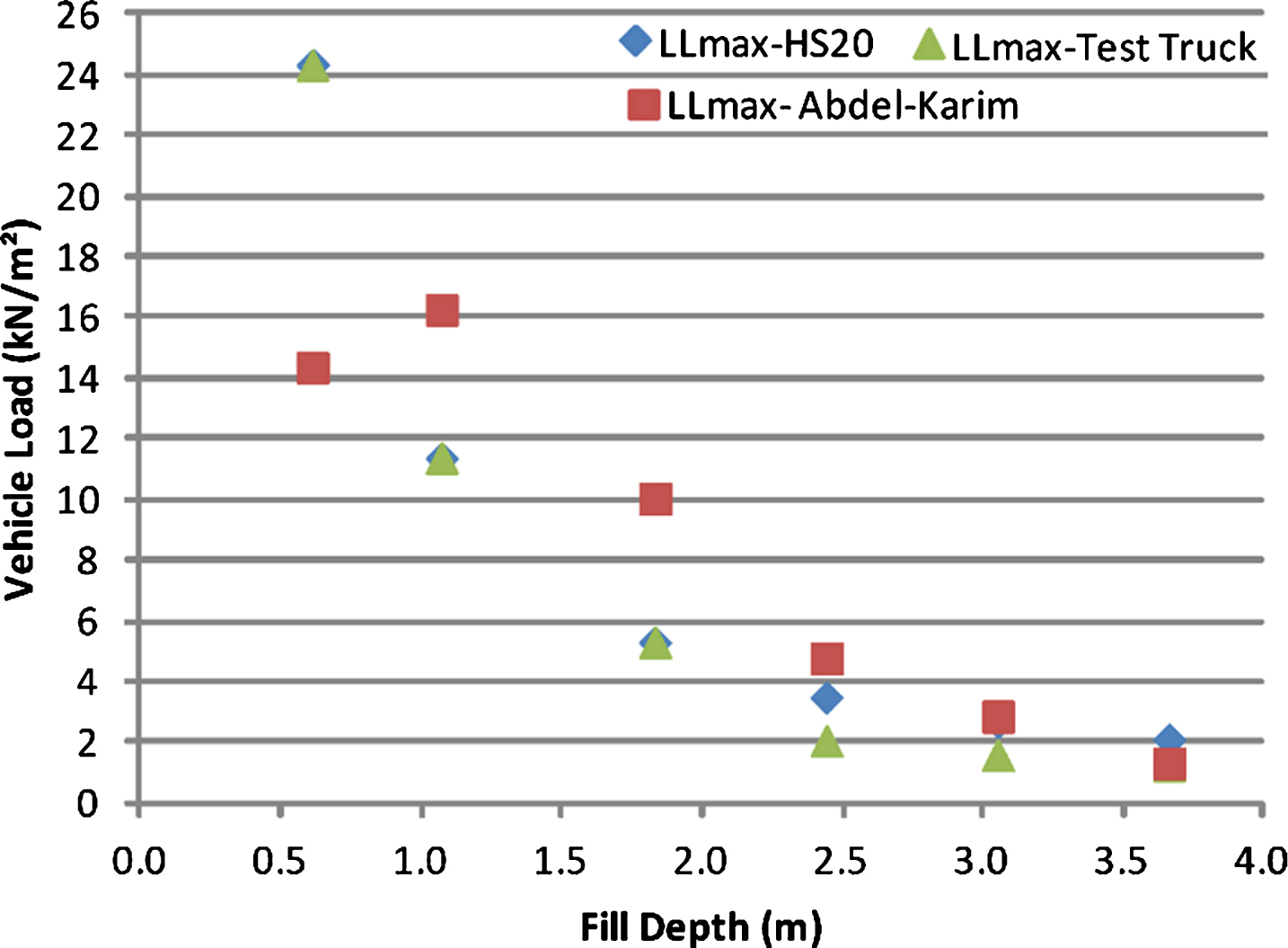
Comparison of vehicle load based on field data and calculated values.
There was a sharp decline in vehicle loads as fill depth was increased except for 0.61 m (2 ft.) fill depth as Abdel-Karim et al. [3] pointed out. In their opinion, this reduction in vehicle load reading was due to a misplacing of rear axles according to measurement instrument. The calculated vehicle loads were generally smaller than the test results. It is important to note that test results represent peak vehicle load values occurred over top slab, in spite of that calculated vehicle loads represent a single uniformly distributed load value for each fill depth level. Therefore, this difference between peak test load values and calculated load values can be expected.
In the second study, Orton et al. [7] placed 12 reusable strain transducers and 12 linear variable displacement transducers under top slabs of 10 existing reinforced concrete box culverts. They compared test results with RS3 software, The AASHTO (2002) Load Factor Design (LFD) and The 2012 AASHTO LRFD bridge design specifications. A test truck which had two rear axles and one front axle and had approximately 40 kN rear wheel loads was used for the tests. The rear axles were spaced 1.20 m on center [7]. Detailed data and results for the study were taken from report which Orton et al. [10] prepared for Missouri Department of Transportation [10].
The test truck wasn’t an AASHTO HS20 truck in this study, too. The front axle was assumed to be located approximately 4.25 m ahead the nearest rear axle. The distance of the farthest axles of the truck was assumed to be 5.45 m (1.2+4.25). Therefore, 0.254+1.75*Z+1.2 equation was used as distribution width and (4*Pmax)/(E*L) was used as wheel load equation when the fill depth values were below the 2.28 m or span width not exceeding 5.45 m. After the 2.28 m fill depth and when the span width values were exceeding 5.45 m, 0.254+1.75*Z+5.45 equation was used as distribution width and (4*Pmax+2*Pmin)/(E*L) was used as wheel load equation. Although researchers didn’t use front wheel load for vehicle load calculations, it is necessary to use Pmin values for predicting more accurate results. Thus it was assumed that the front wheel load was the one quarter of the rear wheel load and calculated as Pmin = 10 kN. Modifying vehicle load distribution length equations wasn’t required, since the truck had the same wheel spacing (1.8 m) with HS20 truck. Test results of the study and calculated vehicle load values by using Table 2 formulas are shown in Table 4 and Fig. 8. Modified distribution width values are named as E-Test Truck. In the results, LLmax-strain and LLmax-displacement represent calculated vehicle load values from strain instrument and displacement instrument, respectively.
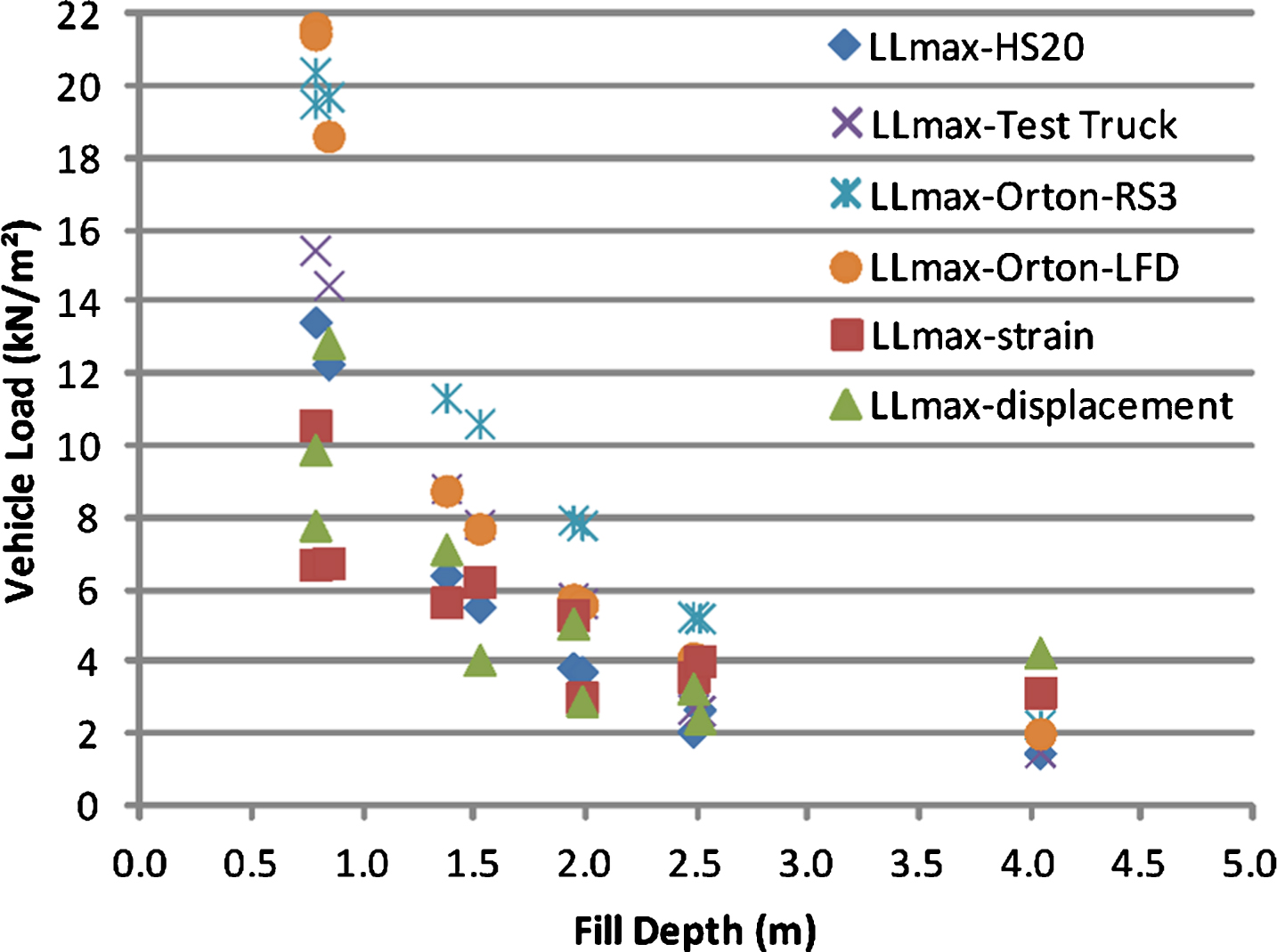
Comparison of vehicle load based on RS3, LFD, field data and calculated values.
Vehicle load results based on RS3, LFD, field data and calculated values
In the study, the design results were close to the RS3 results, while the loads calculated from the field measurements were considerably smaller than both the RS3 and design values, especially at shallower fill depths. It was seen that load values calculated for the test truck from vehicle load formulas presented in the current study were closer to the loads from field data for much cases. Four LLmax-Test Truck result values were greater than the results of LFD method from the study, but the difference between these four results were ranged from 0.5% to 1.6%. Interestingly, HS20 truck results gave almost the same results with the load results from field data. This was owing to the fact that the test truck formulas contains 4*Pmax for all cases while the HS20 truck formulas contains wheel loads ranging from 1*Pmax to 4*Pmax. Thus the HS20 truck formulas created smaller values than LLmax-Test Truck results.
It is also important to note that in the first study, Abdel-Karim et al. [3] placed pressure sensors on the top of the culvert while in the second study Orton et al. [7] placed strain transducers and linear variable displacement transducers under the top slabs of the culverts. Placing measurement instruments under the top slabs can cause obtaining more distributed values than placing measurement instruments on the top of culverts. Since concrete slab would distribute vehicle loads, reading exact peak values is not possible from measurement instruments under the top slabs. Therefore, because of this distribution effect, some low values can be expected from measurement instruments under the top slabs. In conclusion, formulas generated in the current study for the test trucks were consistent with the test results of both studies.
AASHTO SSHB also specifies an impact factor for live loads acting on span to consider dynamic, vibratory and impact effects in Article 3.8.2.3 [2]. Impact factor values for culverts are listed in Table 5.
Impact factor table [2]
Impact factor table [2]
According to the AASHTO SSHB Article 3.20.3, minimum 0.6 m (2 ft.) lateral earth pressure shall be applied to exterior walls of the culvert, when traffic can come from a distance equal to one half of the culvert height [2]. Live load surcharge was not considered for depth of fill values greater than 2.44 m (8 ft.) as stated in the ASTM C890-13 Article 5.5.2 [9]. Live surcharge load was calculated from the following equation as stated in the AASHTO SSHB Article 5.5.2: [2]
The following load combinations were used in the analysis of culvert models to evaluate maximum internal forces:
The first two combinations are listed in the AASHTO SSHB Table 5.22.1A [2]. No load factors were used in the third combination except the impact factor.
The modelling process was automated by developing a Microsoft Excel sheet by using VBA and Computers and Structures Inc. Application Programming Interface [11]. 2D structural-frame finite element analysis method has high precision and accuracy for predicting moment values at the top exterior wall corners and the top midspans of culverts [6]. Thus, 2D structural-frame linear finite element analysis method was used in this study to analyze large quantities of culvert models efficiently. Springs that were used to model base soil were placed with 25 cm or lesser spacing and this spacing value was calculated as one fifteen of span width (S/15 ≤ 25). Vehicle loads were moved step by step and distributed vehicle loads were moved each step by a value equals to spring spacing. Locations of distributed vehicle loads were checked at each step and only portion of distributed vehicle load that was in the range of the span was considered for loading. An example vehicle loading step is shown in Fig. 9.
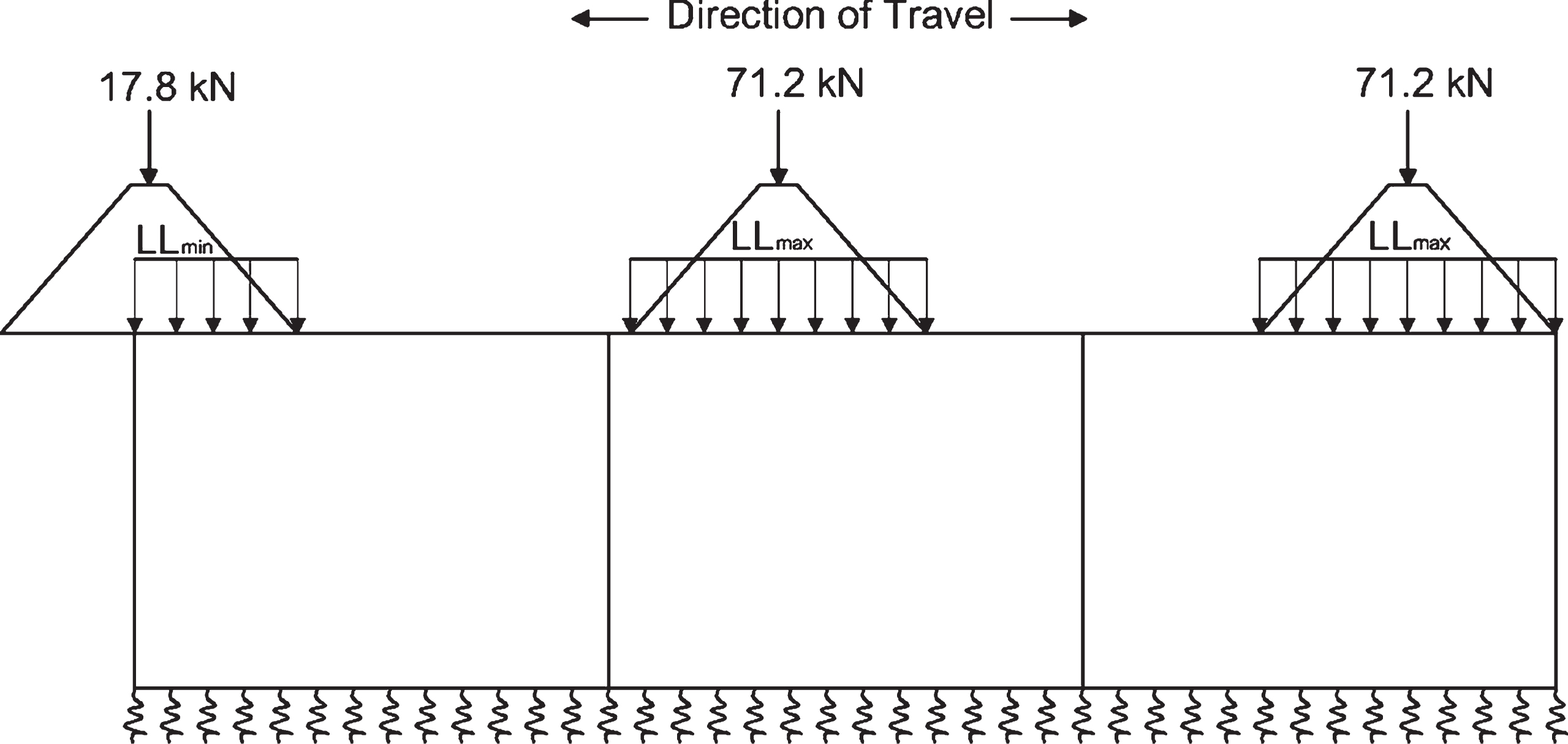
Wheel load projections and equivalent distributed vehicle loads.
After typing material properties and section properties in the Excel sheet, loads and 2D finite element structural-frame model were automatically created in SAP2000 version 17.2.0 [12]. With the completion of analysis, results were transferred from SAP2000 to the Excel sheet. Maximum and critical internal forces and soil stress were gathered in a table and base soil stress diagram was drawn automatically.
An example moment diagram, which was produced for a double cell RCBC by SAP2000, is shown in Fig. 10. As it can be seen in this figure, while positive moment occurrence was clear at base and top slabs, positive moment did not occur for much cases at wall sections.
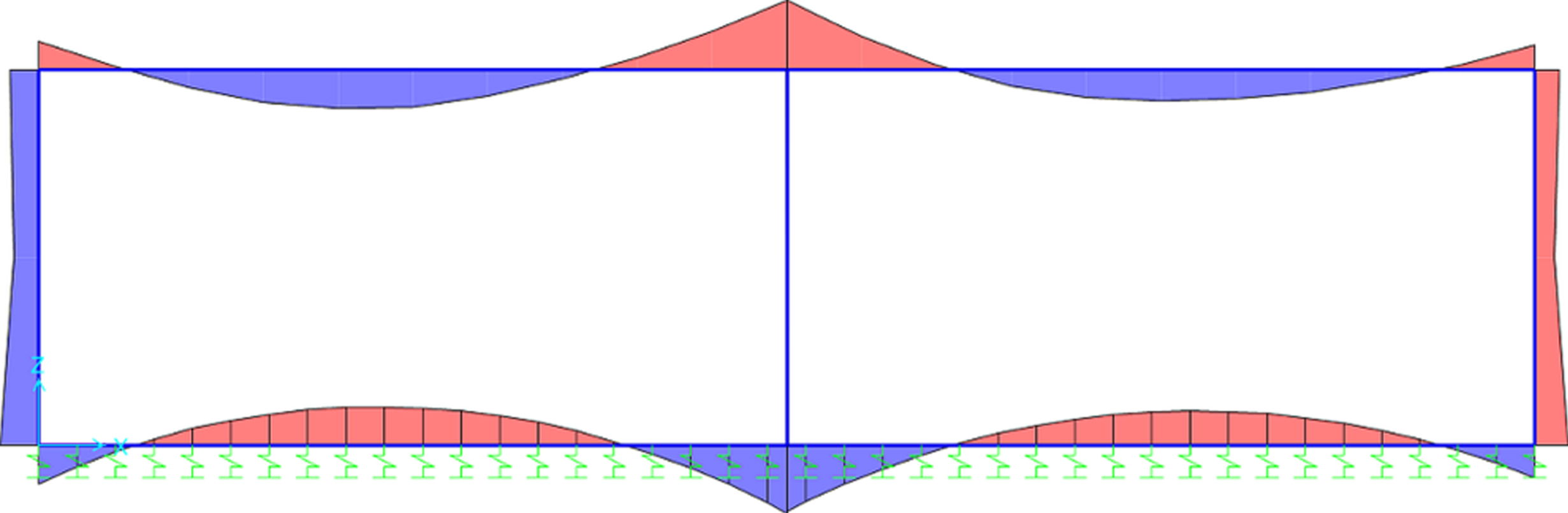
Moment diagram for a double cell RCBC.
Table 6 shows the analysis results of box culvert models. Maximum and critical internal forces and soil stress are shown in this table where Mt, Mw, and Mb are the maximum moment results of top slab, walls and base slab, respectively. Vt, Vw, and Vb are maximum shear force results of top slab, walls and base slab. qs shows maximum base soil stress results. Negative moment was considered for walls and base slab, positive moment was considered for top slab in Table 6 and in figures that show moment graphs. Moments that produce tension in the bottom fibers of slabs and in the inner fibers of walls were taken into account as positive moment.
Analysis results of RCBC models
Figure 11 shows the variation of maximum moment and shear force, which were occurred at top slab and maximum base soil stress with respect to span width. As expected internal forces were increasing as span width was increasing. Internal forces of Case II had lowest values at over 4 m span width. Although fill depth was 3 m for Case IV and 0.5 m for Case I, internal forces of Case IV were lesser than internal forces of Case I at 0.6 m to 4 m span width range. This was due to the fact that Case I had a greater distributed vehicle loads. After 4 m span width value, while Case I had limited vehicle load distribution width (E1 <2.13 m), Case IV vehicle loads were distributed over whole span width. Thus, Case IV internal forces overtook internal forces of Case I after 4 m span width with contribution of 3 m fill depth.
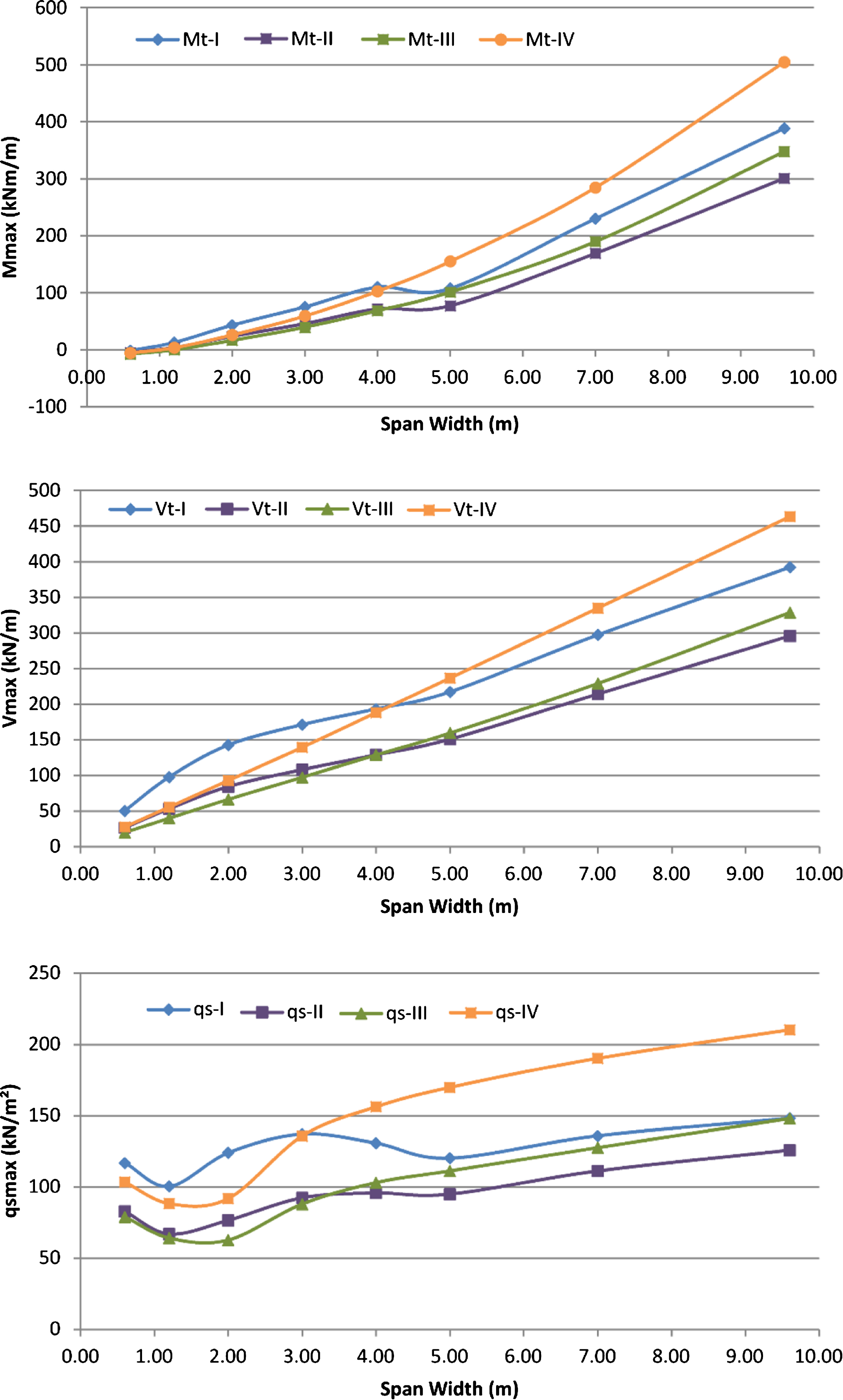
Internal forces and base soil stress with respect to span width.
The same trend is valid for base soil stress graph, but slope of this graph is increasing more slowly than internal forces. Increasing base area of the culvert as span width increasing caused to limited increase in base soil stress. As base soil stress is inversely correlated with base area of structures. After 3 m span width value, base soil stress of Case IV overtook base soil stress of Case I.
Figure 12 shows the variation of maximum moment and shear force which were occurred at exterior walls and maximum base soil stress with respect to culvert height. Since increment at culvert height caused lateral earth pressure to increase according to Equation 6, internal forces at exterior walls were increasing, too. Similar to Fig. 11, moments of Case IV were lesser than moments of Case I at 0.6 m to 2 m culvert height range. This is due to the fact that Case I had a greater distributed vehicle loads and moment continuity between top slab and walls increased moment values at walls. Besides, soil pressures of Case IV were lesser than soil pressures of Case I at all culvert height values. In contrast to these trends, shear force values of Case IV were greater than other cases, because shear forces at walls were affected directly by the lateral earth pressure.
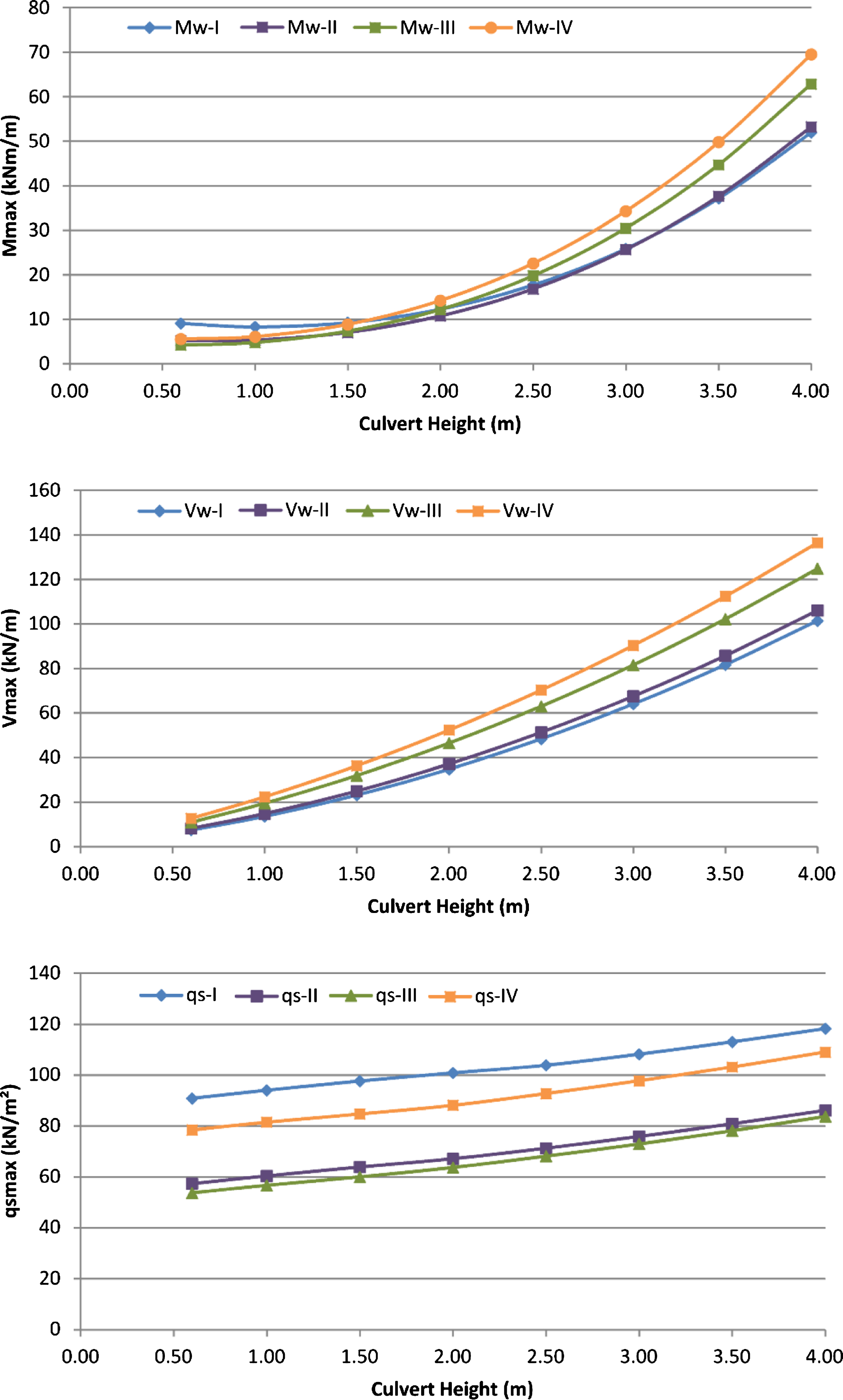
Internal forces and base soil stress with respect to culvert height.
Variation of maximum moment, shear force and base soil stress with respect to fill depth is shown in Fig. 13. Internal forces were increasing generally with the increment of fill depth for one cell, double cell and triple cell culvert models. Internal forces were decreasing after 0.60 m fill depth since distributed vehicle load starts to decrease sharply at this fill depth as shown in Fig. 13. Internal forces and base soil pressures reached their minimum values at 0.70–1.0 m fill depth range. After 1 m of fill depth, as vertical earth load was overtaking vehicle load, internal forces were starting to increase again. Double and triple cell culvert models had close results while one cell culvert models had greater internal forces. Slopes of internal force graphs for one cell culverts were much greater than slopes of internal force graphs for double and triple cell culverts.
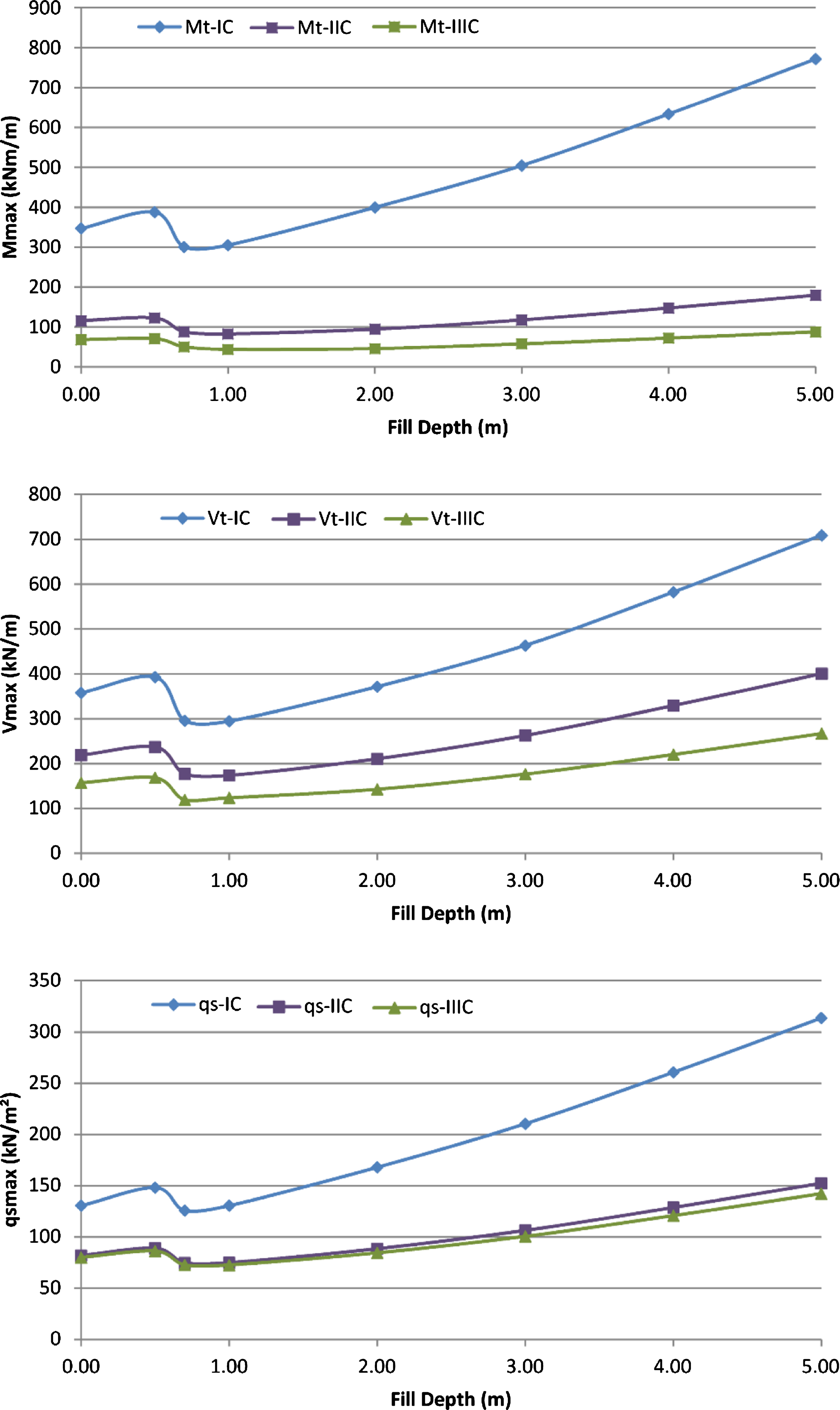
Internal forces and base soil stress with respect to fill depth.
In this study, derivation of vehicle load distribution formulas are explained in detail and verified by comparison with experimental studies. Analysis and design procedures of RCBC were explained. 88 finite element culvert models were created by using SAP2000. A Microsoft Excel sheet was developed by using VBA and CSI API to create SAP2000 models automatically. Effects of span width, culvert height and fill depth on RCBC design were investigated.
It was observed that span width is an important parameter for RCBC as it dramatically increased internal forces and base soil pressures of culvert models in the first model group.
It can be concluded that culvert height is an effective parameter for internal forces of wall members from the second model group results. However, it is not effective for base soil pressures, since it did not affect base soil pressures significantly. Therefore, it can be observed that culvert height is not an important parameter unlike span width or fill depth for culvert design.
The third model group results indicated that fill depth has an important effect on both internal forces and base soil pressures. The results for the third model group showed that vehicle load has a significant effect on the internal forces of culverts especially at lower fill depth values and while vehicle load was predominant for fills that did not have a depth value greater than 1 m, vertical earth load was predominant beyond 1 m fill depth. Since minimum values of internal forces and base soil pressures occurred at 0.70–1.0 m fill depth range, it can be concluded that designing RCBC with a fill depth value in the range of 0.70–1.00 m is preferred for more economical and reliable designing.
Adding interior walls to wider single cell culvert models for obtaining multiple cell culverts greatly decreased internal forces and base soil pressures. Even analysis results of double cell culverts were much smaller than the results of single cell culverts. Since moment results of multiple cell RCBC were lower, multiple cell RCBC need lesser reinforcement area. It must also be noted that equal section thicknesses were used to create same conditions for single, double and triple cell culvert models in the third model group. However, section thickness can be reduced for multiple cell culverts in practice since their actual effective span width values are smaller than single cell culverts. Besides, single cell RCBC can need base soil improvements due to higher base soil pressures. Therefore, using multiple cell culverts instead of using wider span width in single cell culverts is a more reliable choice because of lesser reinforcement area, smaller section thickness and lower base soil pressure.