



Abstract
In order to clarify the influence of water on the natural vibration of bridge with complex piers, based on a continuous beam with 4-column pier, the numerical analysis model is established. Single column circular pier is taken to discuss the range of waters. Then the influences of water on the natural vibration are analyzed. The research shows that waters reduce the natural frequency. When waters area width is less than 10 m, the natural frequency of the pier decreases. And the first-order longitudinal bending frequency is reduced by 3.36%. When waters area width is more than 10 m, the vibration frequencies tend to be stable gradually. Therefore, the waters 10 m can be regarded as an infinite boundary. The natural frequencies of single column pier and 4-column pier decrease with the increase of water depth. When the water depth is less than 10 m, the changes of natural frequency of the first four orders of single column pier are relatively small, and the changes of 5–10 order natural frequency are large. The maximum effect of the first ten orders is 14.84%. The natural vibration frequency of the bridge decreases gradually with the increase of water depth. The maximum effect of the first five orders is 3.33%.
Introduction
The natural vibration characteristics of bridge are the basis of its seismic design, wind resistance design, response spectrum and harmonic response analysis. Some bridges are in the perennial water environment. When analyzing the dynamic characteristics of the bridge, usually only the impact of water or waves on the pier is considered, the interaction effect between the water and the pier in the vibration process is ignored [1, 2]. That is, the vibration of the water attached to the pier and its influence on the dynamic characteristics of the pier and even the whole bridge is not considered. Existing studies showed that water reduced the natural vibration frequency of bridge structure [3–6], and the seismic response may be underestimated without considering the pier-water interaction [7–11]. In addition, researchers had studied the wave force on the bridge pier across the sea [12]. Some scholars had discussed the dynamic response of bridge with double cylindrical piers under the action of water flow [13]. Some studies give suggestions on the design of main pier foundation of bridges in the reservoir [14]. There are also some researches on the water pressure of pile foundation [15–17]. However, most of studies are aimed at conventional regular shape piers or pile groups. With the development of construction technology, complex piers in water appear. In order to clarify the influence of pier-water interaction on the natural vibration characteristics of the bridge with complex piers in water, a bridge with 4-column pile-column frame pier that across the Xiaolangdi Reservoir of Yellow River is taken as the research object. Based on the fluid element method, the bridge (pier) -water interaction analysis model is established by ANSYS. The single column circular pier of 4-column pier is taken to discuss the waters’ range. Then the influences of water on the natural vibration of single 4-column pier and the whole bridge are analyzed.
Bridge project, simulation method and numerical model
Bridge project
The bridge is a prestressed concrete continuous beam with 4-column pile-column frame pier across Xiaolangdi Reservoir of Yellow River. Span’s arrangements are (60 + 13×100 + 60)m. The main beam section is single box single chamber. The beam’s heights at the beam root, the mid span and side pier are 6.3 m and 2.8 m respectively. The top width of beam is 16.25 m, the top plate overhanging length is 4 m, and the bottom width is 8.25 m. The beam’s height and bottom plate’s thickness change according to quadratic parabola. The thickness of concrete cushion cap is 4 m. The piers adopt 2×2 pile column frame piers (Fig. 1). The serial numbers of the four piers are shown in section B-B of Fig. 1. The site construction photos are shown in Fig. 2.
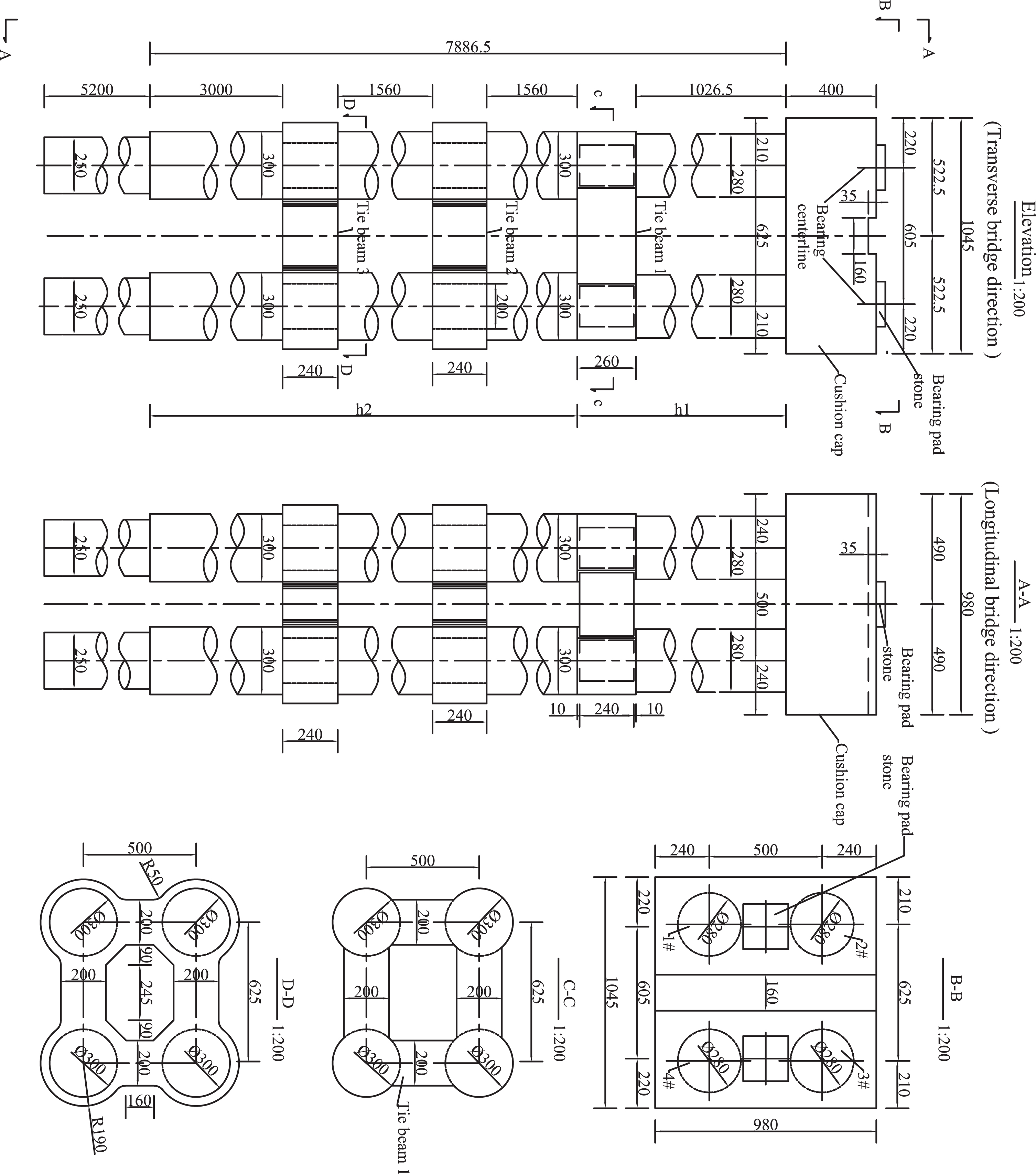
Four-column pier structure (unit: cm).
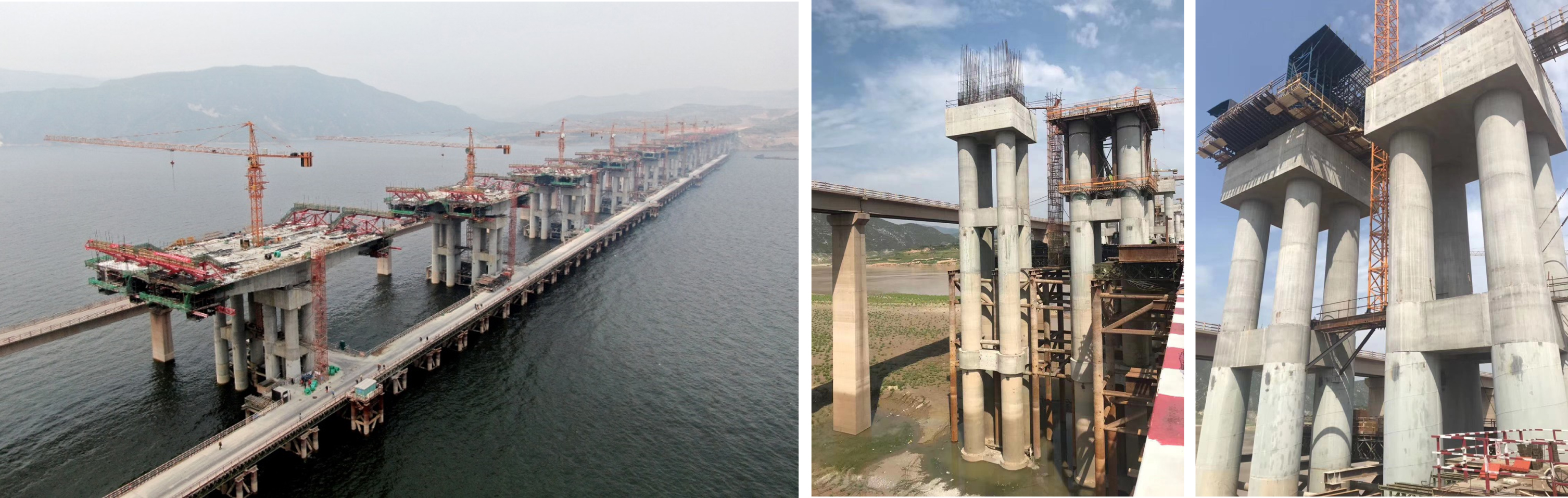
Site construction photos of water storage and water free state.
The highest pier is 78.865 m, which has a h1 segment with length of 12.865 m and diameter of 2.8 m, constructed by formwork erection. The h2 segment of the pier is 66 m long and 3 m diameter, which is constructed with steel casing. Three tie beams with thicknesses of 2.4 m, 2.4 m and 2.6 m are set at 82 m, 100 m and 118 m away from the pile bottom. The foundation integrated with the pier is four (2×2) bored cast-in-place rock piles with diameter 2.5 m and length 52 m. The distance between two piles in the transverse and longitudinal direction are 6.25 m and 5 m respectively.
For the purpose of this paper, considering the computational efficiency and capacity, the original design is reduced from 15 spans to 5 spans. The height of all piers is 78.865 m. The reduced structure is shown in Fig. 3.

Schematic diagram of 5-span continuous beam.
Pier-water interaction belongs to fluid-solid coupling analysis, and its important feature is the interaction between two-phase media. Hydrodynamic pressure is generated by fluid-structure coupling. Common calculation methods include Morison equation, radiation wave method, fluid element method and design code method [18]. The comparisons of the above four methods are shown in Table 1.
Comparisons of fluid structure coupling analysis methods
Comparisons of fluid structure coupling analysis methods
Among them, the fluid element method is accurate, suitable for small fluid deformation and fluid velocity far less than sound velocity, and suitable for any section. This method has corresponding solution modes in finite element analysis software. For example, there are Block Lanczos method, PCG Lanczos method, reduction method, unsymmetric method, etc in ANSYS software. Among these methods, unsymmetric method uses reduced matrix, which has high computational efficiency. So considering the calculation efficiency and purpose, the fluid element method is used to simulate the pier-water interaction, and the unsymmetric method is used to solve the natural vibration characteristics of the structure. The realization of the modal analysis method in ANSYS can be set through the modal analysis menu option: MainMenu > Solution>Analysis Type > Analysis Options ⟶ Mode extraction method: Unsymmetric; No. of modes to extract: 6; NMODE No. of modes to expand: 6⟶OK, as shown in Fig. 4.
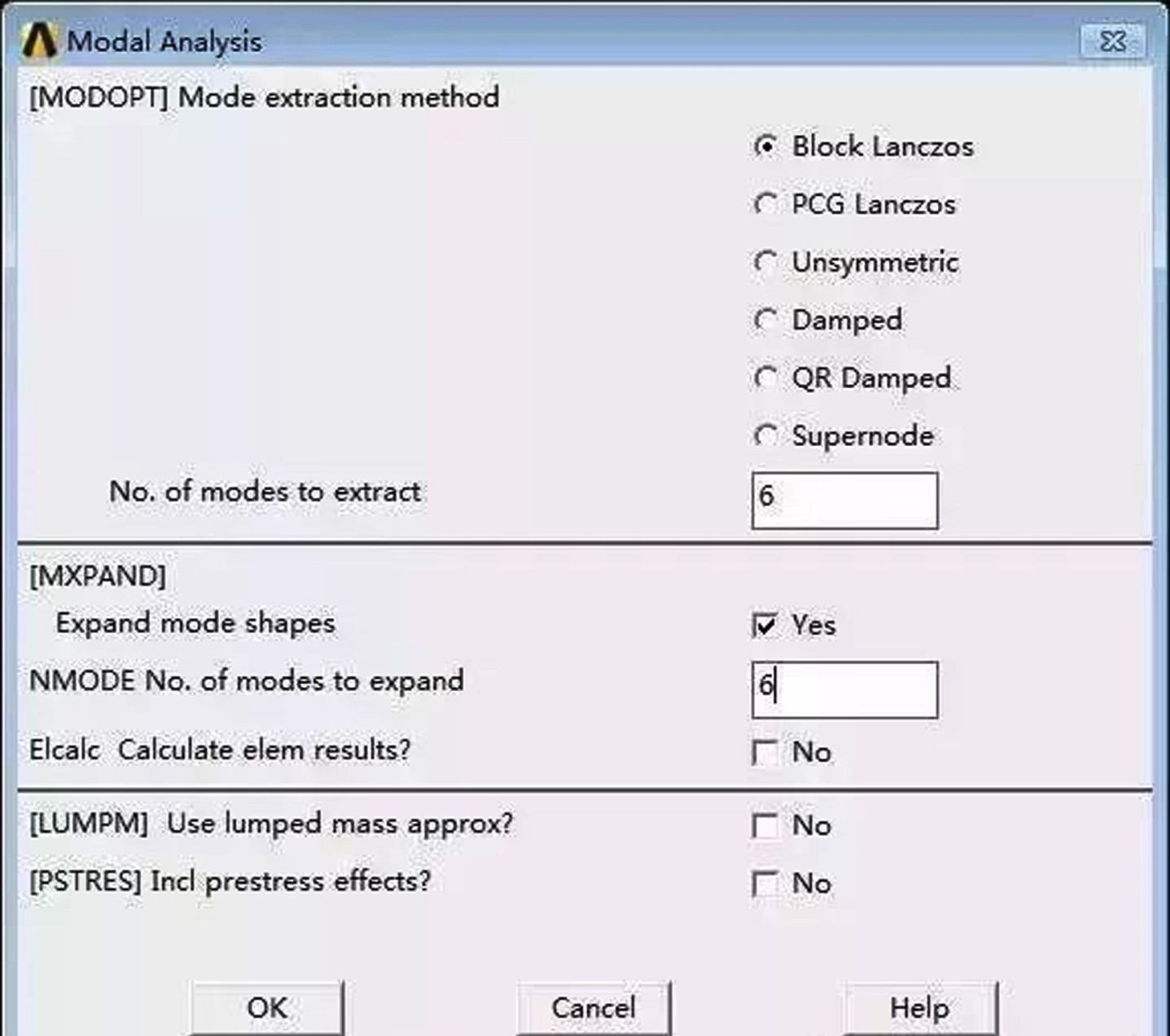
Setup menu of modal analysis method in ANSYS.
For ANSYS simulation of fluid-structure interaction, mesh generation, fluid-structure coupling interface definition, boundary condition setting and modal analysis solver are the four most important links. Among them, the definition of coupling interface is related to whether the fluid action can be transferred to the solid structure. Only when the fluid force is transferred to the solid can the fluid-structure interaction analysis be carried out. The SFI interaction method is used in the fluid-structure interaction analysis of ANSYS. The operation steps are: (1) Firstly, the solid structure and flow field properties are given respectively; (2) Select all nodes on the solid structural elements; (3) Then select the elements that contain these nodes (including both solid structure and elements that share nodes with solid structure on the flow field); (4) Then select the elements in reverse (i.e. other flow field elements, excluding (3) selected elements); (5) Change the element’s type of the selected elements in (4); (6) Select the interface between fluid and solid, and use SFI method to mark the fluid-solid interface (the command flow is sf, ouhermian, fsi, 2), so that the fluid-solid interface is marked successfully. Then, the boundary conditions are set and modal analysis can be carried out.
Ref. [19] studies the first five orders frequencies of piers with diameter 2.0 m and height 5.0 m when the water depth is 0 m and 2.5 m. To discuss the influence of mesh sizes on the calculation, using above method, the first five orders frequencies of the analysis model with different mesh sizes are respectively analyzed by referring to Ref. [19]. Table 2, 3 show the deviation comparison.
Comparison of mesh sizes to the first five orders frequencies under no-water
Comparison of mesh sizes to the first five order frequencies in waters
It can be seen from Table 2, 3 that under anhydrous state, when the mesh sizes are≤0.7 m, the deviations between the first three frequencies and the calculation example are less than 1%, which can be considered as no deviation, and the fourth and fifth frequencies are basically no deviation when the mesh size is less than 0.5 m. For the state with water, the deviations of the first three frequencies are less than 1.00%. When the mesh size is less than 0.5 m, there is basically no deviation of the fourth and fifth frequencies. This shows that the deviation of analysis results is getting smaller and smaller with the increasing density of mesh, regardless of whether there is water or no water. However, the finer the mesh, the larger the elements number. To ensure the calculation efficiency, the maximum mesh size is 0.4 m in this paper.
Based on the fluid element method [8], considering the fluid-structure coupling effect, the bridge-water interaction analysis model is established by ANSYS. The main beam, pier and tie beam adopt Solid95 element. Main beam elastic modulus ES is 3.55×10¹⁰ Pa, mass density is 2600 kg/m3, Poisson ratio is 0.2. The elastic modulus Eh of pier column is 3.0×10¹⁰ Pa, mass density is 2440 kg/m3, Poisson ratio is 0.2. The water flow adopts Fluid130 element. Referring to the hydrological data of Xiaolangdi Reservoir, the water density is 1025 kg/m3, dynamic viscosity coefficient is 1.05×10⁻³m2/s, sound velocity in water is 1460 m / s. The maximum water level is 60 m. Pier bottom is fixed. The surface of waters is a free surface. The bottom of waters adopts rigid wall interface. The model has 206776 nodes and 90752 elements, as shown in Fig. 5.
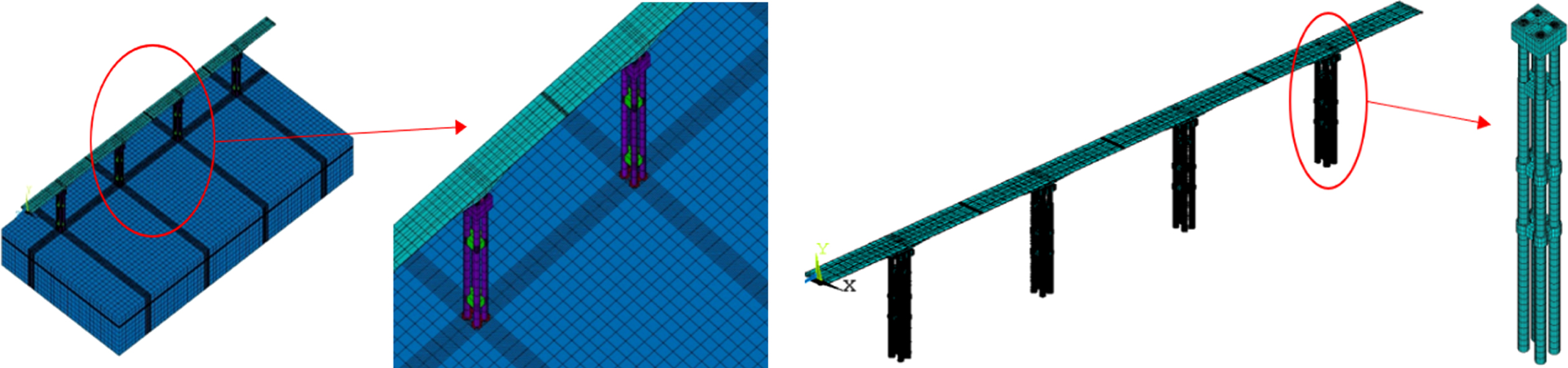
Analysis model of bridge-water interaction.
In order to study the influence of waters area width and water depth of fluid-structure coupling on vibration frequency, a numerical model of single pier is established to analyze.
Influence of waters area width on vibration characteristics
Taking the pier in waters as the center, width of the upstream surface (bridge span direction) is defined as waters range. Considering that the bridge span is 100 m, the waters is centered on the pier, and the maximum width on each side is 50 m. Assuming that waters depth is 35 m, 0 m means there is no water. Limited to space, Table 4 shows the frequencies and mode shapes of the first 6 orders of single column pier in different waters area width.
Vibration characteristics of single pier in different waters area width
Vibration characteristics of single pier in different waters area width
Figure 6 shows the influence of waters on the vibration frequency of pier. Set the frequency influence coefficient Rf = (vibration frequency of structure with water - vibration frequency of structure without water) / vibration frequency of structure without water×100%, the frequency reduction of pier varies with the range of waters (It should be noted that ‘range of water’, refers to the width of the upstream surface of the pier. For this bridge, the main span of the bridge is 100 m. Therefore, for the range of water on each side of the pier along the direction of the bridge, the maximum waters area width can be 50 m. The same goes for the following.) is shown in Fig. 7.
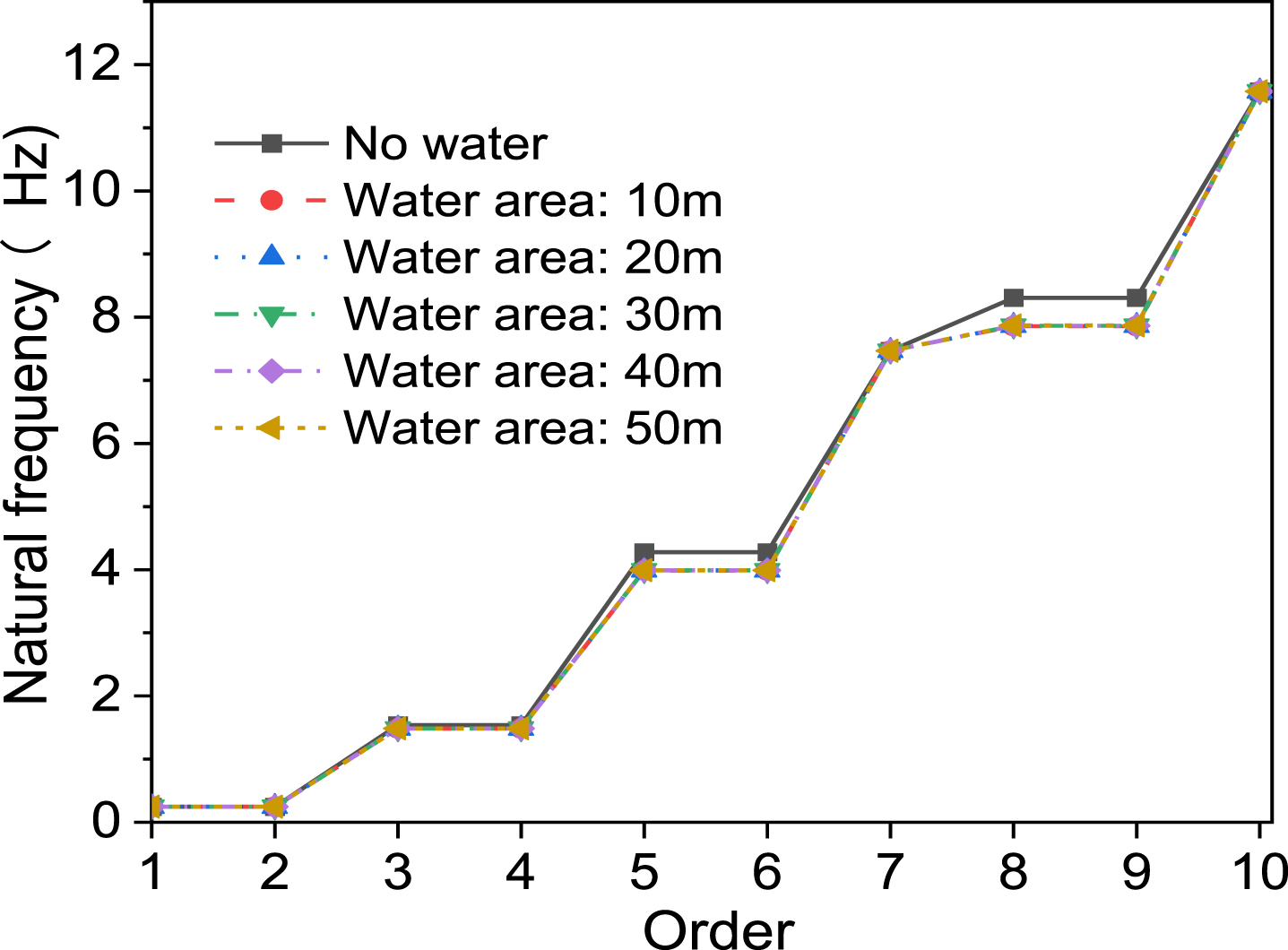
Natural frequency in different waters area width.
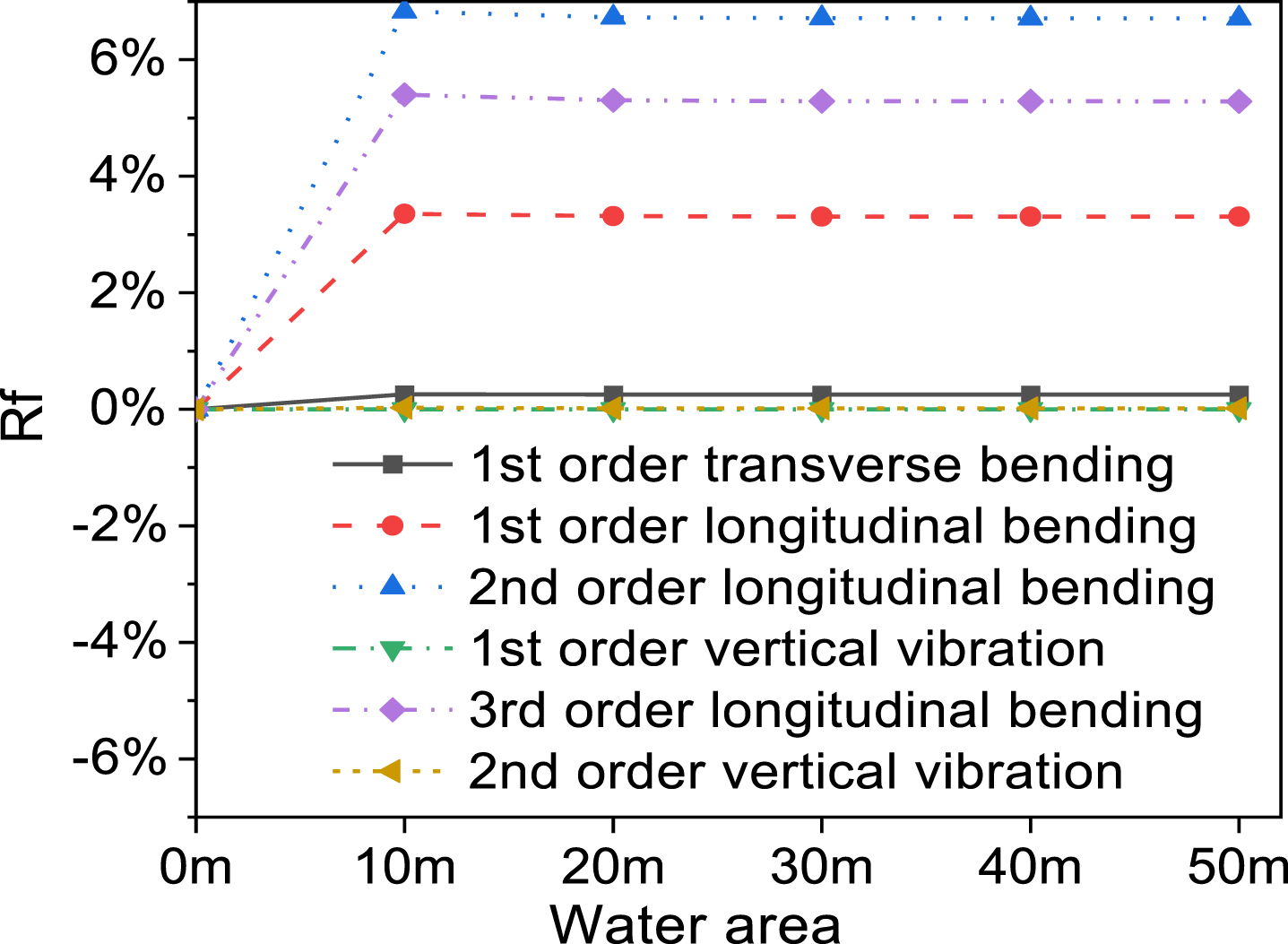
Influence of waters area width on Rf of pier.
It can be seen from Table 4 and Fig. 6 that waters reduces the natural frequency. When waters area width is less than 10 m, the waters reduces the frequency of each corresponding order of pier. When waters area width is more than 10 m, the water increases the vibration frequency of the corresponding order of pier, but it is still less than the vibration frequency of the anhydrous state. The frequency finally tends to be stable, and the fundamental frequency is close to 0.2458 Hz. The vertical vibration frequency of pier is basically unchanged.
It can be seen from Fig. 7 that whether it is the first mode transverse bending or the first three longitudinal bending, Rf of pier increases when waters area width is less than 10 m, and tends to be stable when waters area width is more than 10 m. The maximum reduction of frequency is 6.83%. It can be seen that when the waters area width reache a certain extent, the external waters area width has little effect on the vibration characteristics of pier. That is, if the waters area width is larger than the range, it can be regarded as an infinite boundary. Then the numerical analysis takes that the waters area width does not affect the vibration characteristics of pier. In this paper, the main span is 100 m, so the vibration characteristics of two adjacent piers are not affected by waters between spans.
The above analysis shows that the influence of waters on the frequency of pier is very small and can be ignored. The waters area width is 50 m. According to the design, it is considered from no water to 78.865 m of water depth. Table 5 and Fig. 8 show frequencies and vibration modes of pier at different water depths. Figure 9 shows Rf of the first three lateral bending modes of the pier at different water depths.
First 6 orders natural vibration characteristics of pier with different water depths
First 6 orders natural vibration characteristics of pier with different water depths
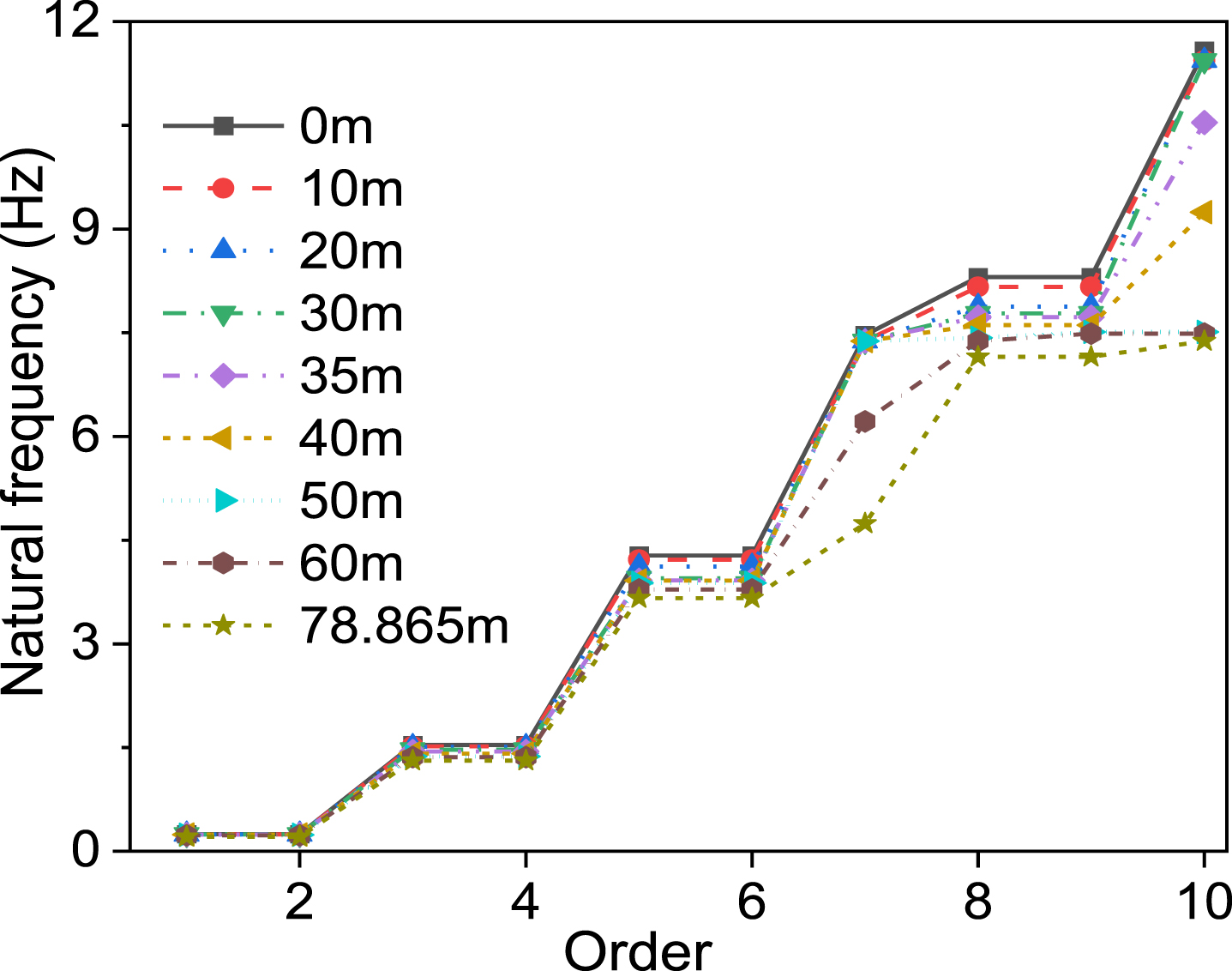
Natural frequency in different water depths.

Influence of water depth on Rf of pier.
It can be seen from Table 5 and Fig. 8 that the frequency of pier decreases with the increase of water depth. The frequency changes of the first four orders are relatively small, and the changes of the fifth to tenth orders are remarkable. With the increase of the order, the frequency decreases more obviously. Due to the influence of water, the frequency of pier decreases. With the increase of water depth, the interference of water on the vibration characteristics of piers increases. Water dissipates the pier vibration energy, resulting in the obvious reduction of the frequency.
It can be seen from Fig. 9 that with the increase of water depth, Rf of the first three modes of longitudinal bending gradually increases. Rf of the first-order longitudinal bending increases approximately linearly, and Rf of the second-order and third-order longitudinal bending changes rapidly at first, then slowly and finally fast. For the first 10 orders frequencies, the maximum Rf is 14.84%.
The pier in this paper is a 4-column pier, and the pier column is equipped with 3 tie beams. Its structure and mechanical behavior are complex, and the fluid-structure coupling effect is more significant. Considering that there is from no water to the maximum water depth (according to the hydrological data and site visit, the maximum water depth is 60 m), the frequency and vibration mode of the first 6 orders of 4-column pier under different water depths are analyzed, as shown in Table 6.
Vibration characteristics of 4-column pier in different water depths
Vibration characteristics of 4-column pier in different water depths
Figure 10 and Fig. 11 respectively show the frequency variation and frequency reduction coefficient Rf at different water depths.
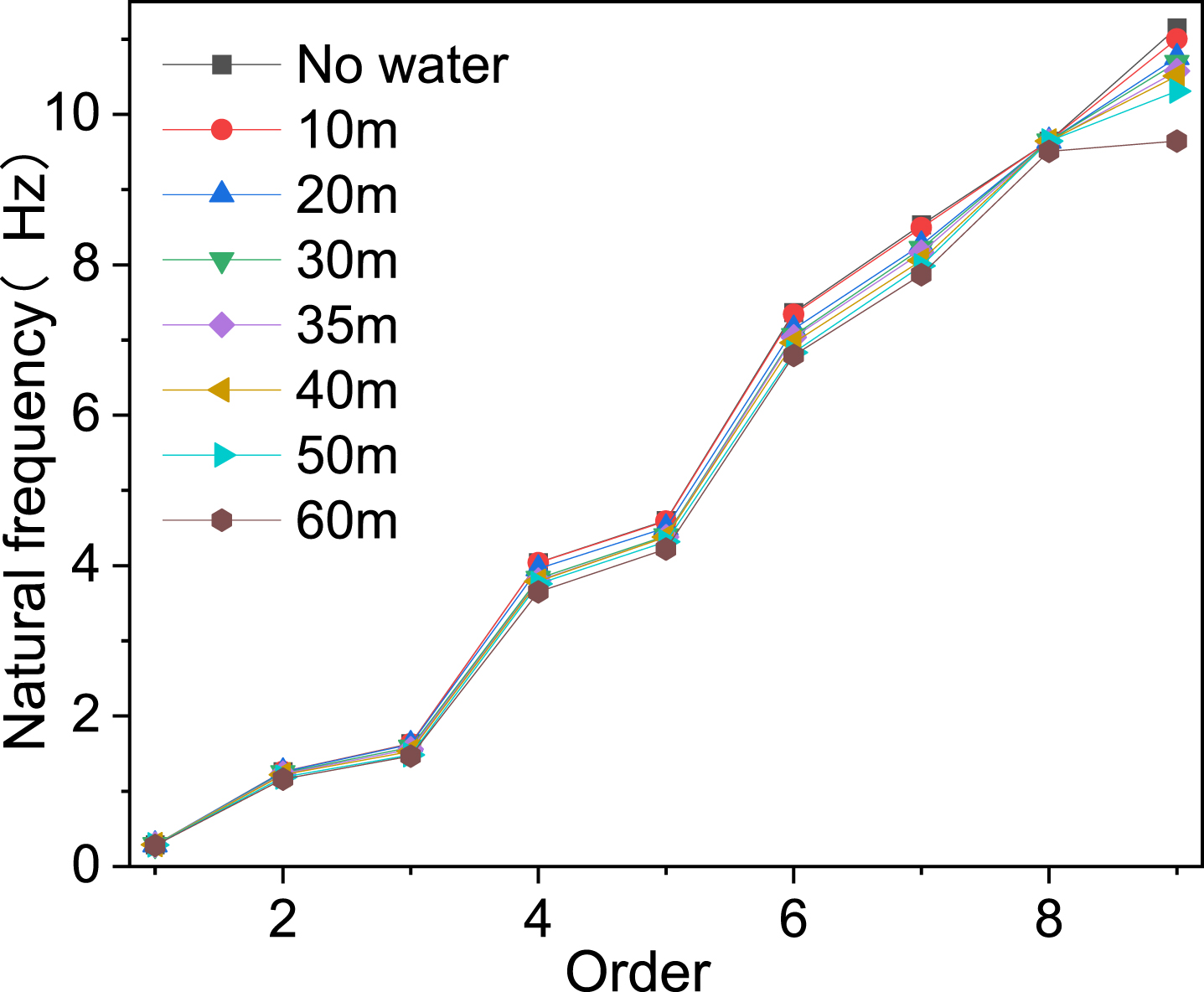
Natural frequency in different water depths.

Influence of water depth on Rf of pier.
With the increase of water depth, it can be seen from Fig. 10 and Fig. 11 that the vibration frequency of pier gradually decreases, and the sixth, seventh and ninth order frequencies decrease significantly. Similar to single column pier, the vertical vibration characteristics of 4-column pier are almost unchanged. Figure 12 and Fig. 13 show the influence of water depth on Rf of the first four longitudinal bending and the first three torsional frequencies, respectively.

Influence of water depth on longitudinal bending Rf.
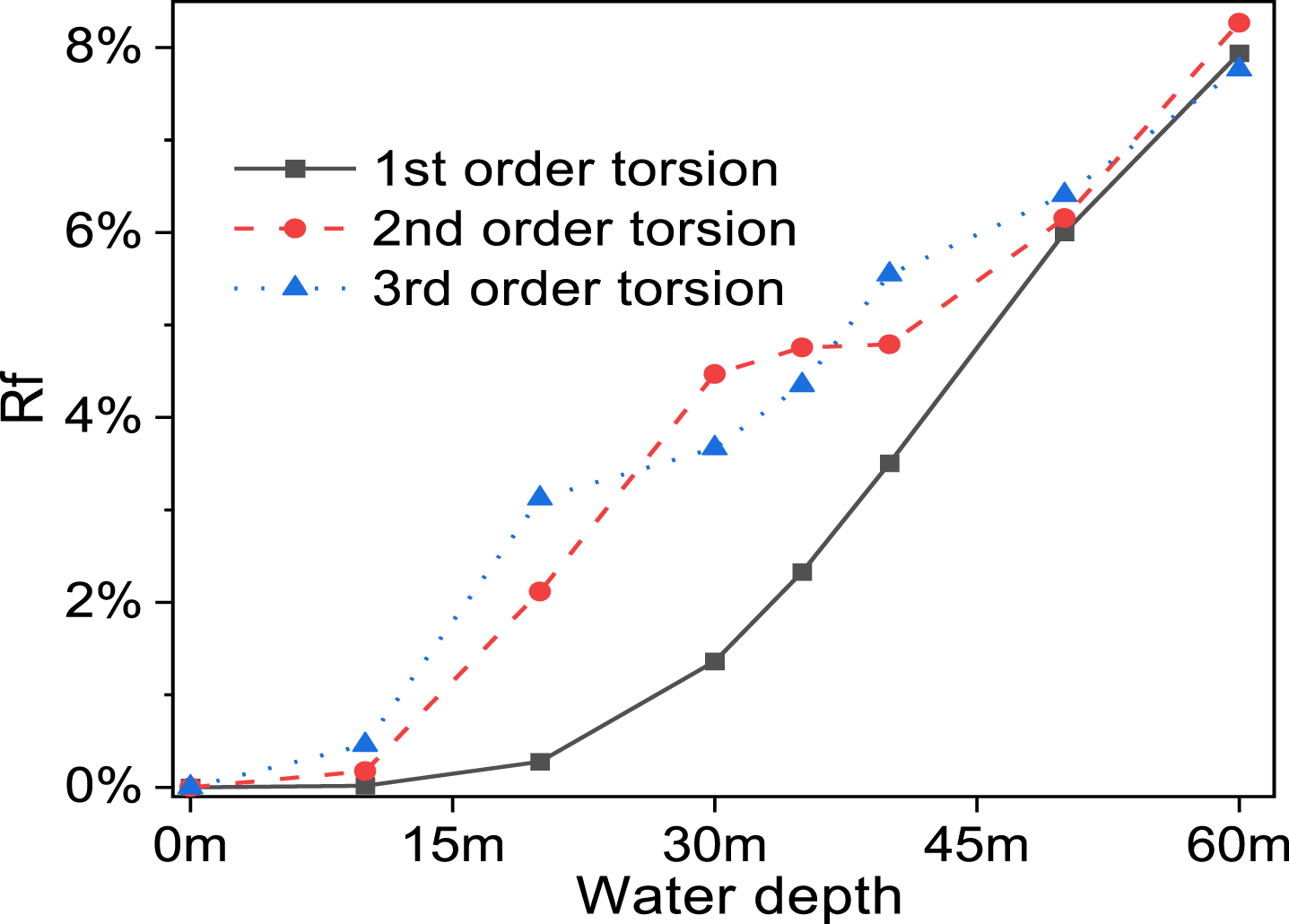
Influence of water depth on torsional Rf.
It can be seen from Fig. 12 and Fig. 13 that when the water depth is less than 10 m, the influence of water on longitudinal bending is relatively small. Rf of longitudinal bending frequency increases with the increase of water depth. When the water depth is less than 10 m, the influence of water on the torsion of pier is relatively small, and Rf of torsion frequency increases with the increase of water depth. There is no inflection point in the variation curve of the first-order torsional frequency Rf with water depth, and the second and third-order torsional frequency Rf changes first steeply, then slowly and then steeply with water depth. For the first 9 orders frequencies, the maximum Rf is 14.03%.
Due to the changes of boundary constraints, mass and stiffness, the natural vibration characteristics of members and structures are different. In order to accurately analyze the influence of waters on the vibration characteristics of bridge structure, the following analyzes the structural vibration characteristics of different water depths for the 5-span continuous beam with 4-column piers, considering the maximum water depth 60 m. The first five orders frequencies and vibration modes of the bridge are shown in Table 7, Fig. 14 and Fig. 15 show the changes of the first five orders frequencies of bridges with different water depths and the influence of water depth on the coefficient Rf of bridge vibration frequencies.
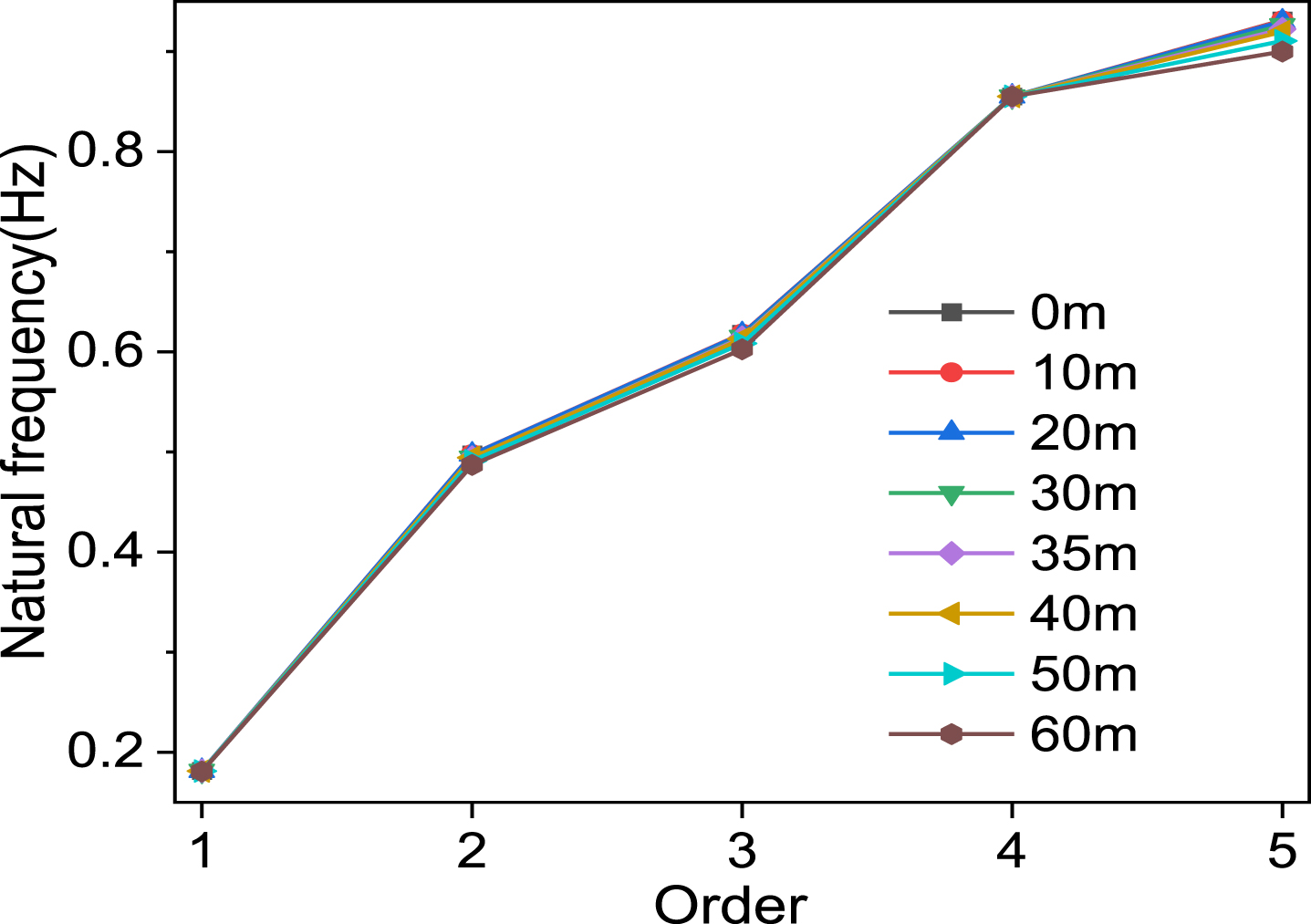
Natural frequency in different water depths.
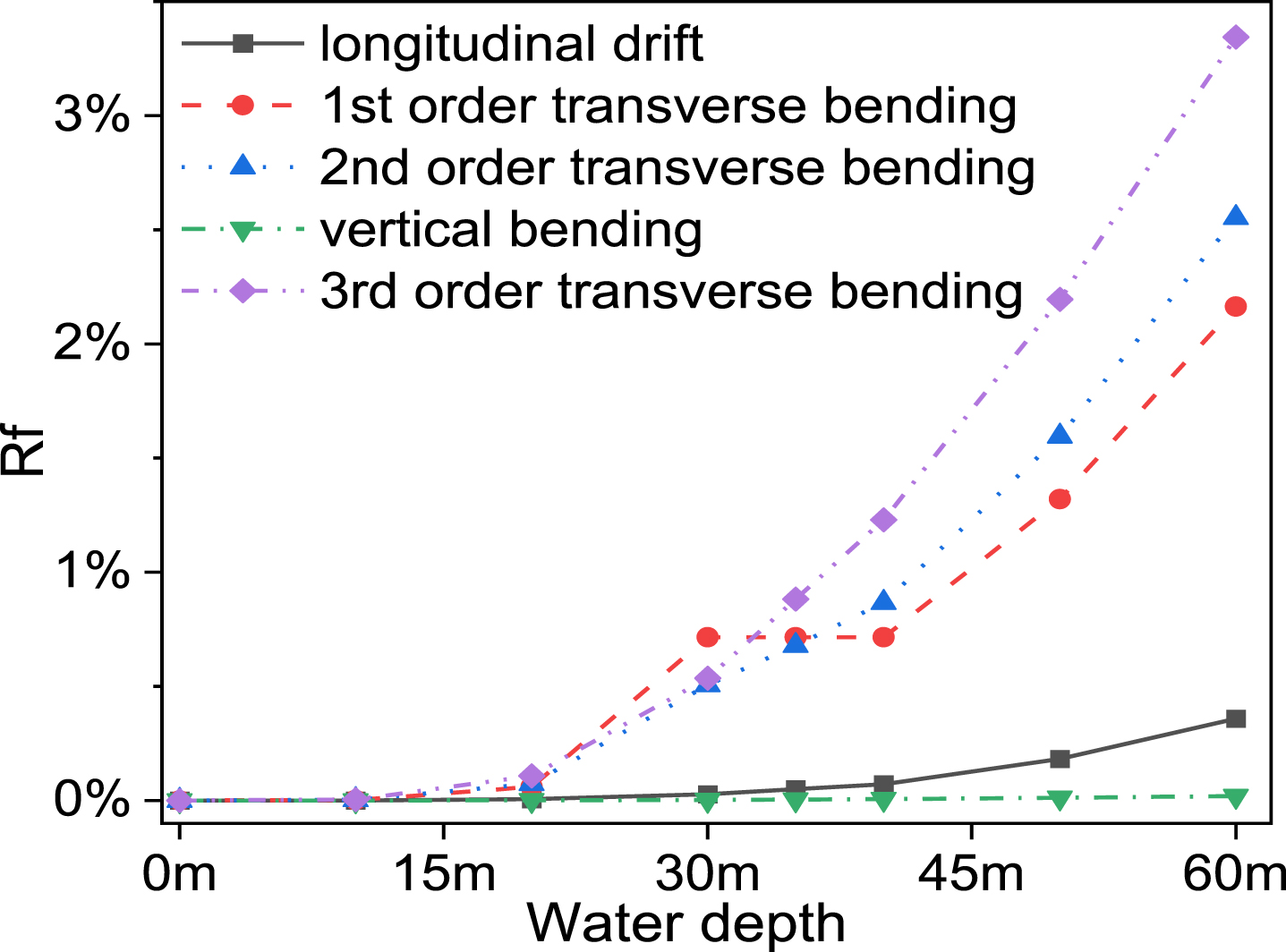
Influence of water depth on Rf.
According to Table 7, Fig. 14 and 15, the vibration frequencies of the bridge decreases gradually with the increase of water depth. This is because the waters area width is certain. With the increase of water depth, the more obvious the disturbance of water to the vibration of the bridge, so the corresponding frequency of each order of the bridge becomes smaller. When the water depth is less than 10 m, the change of bridge vibration frequency is very small, and the change of the first order longitudinal drift frequency is very small. When the water depth is 60 m, Rf is 0.36%. Rf of the first three transverse bending of the bridge changes obviously, in which Rf of the second and third transverse bending increases gradually, Rf of the first transverse bending shows a horizontal trend in the water depth 30–40 m, and if the water depth is greater than 40 m, Rf increases linearly. For the first five orders frequencies, the maximum Rf is 3.33%. The vertical vibration frequency of the bridge is basically unchanged.
Vibration characteristics of bridge with 4-column piers in different water depths
The change of natural vibration characteristics will inevitably affect the seismic response of the bridge. The influence of water on the seismic response of the bridge is discussed below.
In order to ensure the rationality of the selected seismic wave, the following principles should be followed: (1) The site conditions are the same: the site type of the bridge site is Class II site; (2) The seismic wave response spectrum is close to the predominant period of the site: the characteristic period of the site is 0.40 s; (3) The fortification intensity is the same: the seismic fortification category of this bridge is Class B, and the seismic fortification intensity is 8 degrees. Based on the above principles, El-Centro wave is selected for seismic response analysis. El-Centro wave is suitable for Class II site, with a predominant period of 0.38 s, and its peak amplitude is adjusted to meet the requirements of fortification intensity. Considering that the flow direction is perpendicular to the bridge span, only the El-Centro seismic wave that meets the site conditions of the bridge site is used to uniformly excite the bridge in the transverse direction. In the analysis, the internal force response of the pier is taken from a column bottom of Pier 3 (Numbers of the column and pier are shown in B-B of Fig. 1 and 3 respectively.), and the displacement is taken as the pier top of Pier 3. Table 8 shows the internal force and displacement of each pier column of Pier 3 when there is no water and 35 m deep still water.
Figure 16 shows the time history curve of the bending moment at the bottom of 2 # column and the displacement at the top of the pier under the without water condition and the still water condition with a water depth of 35 m.
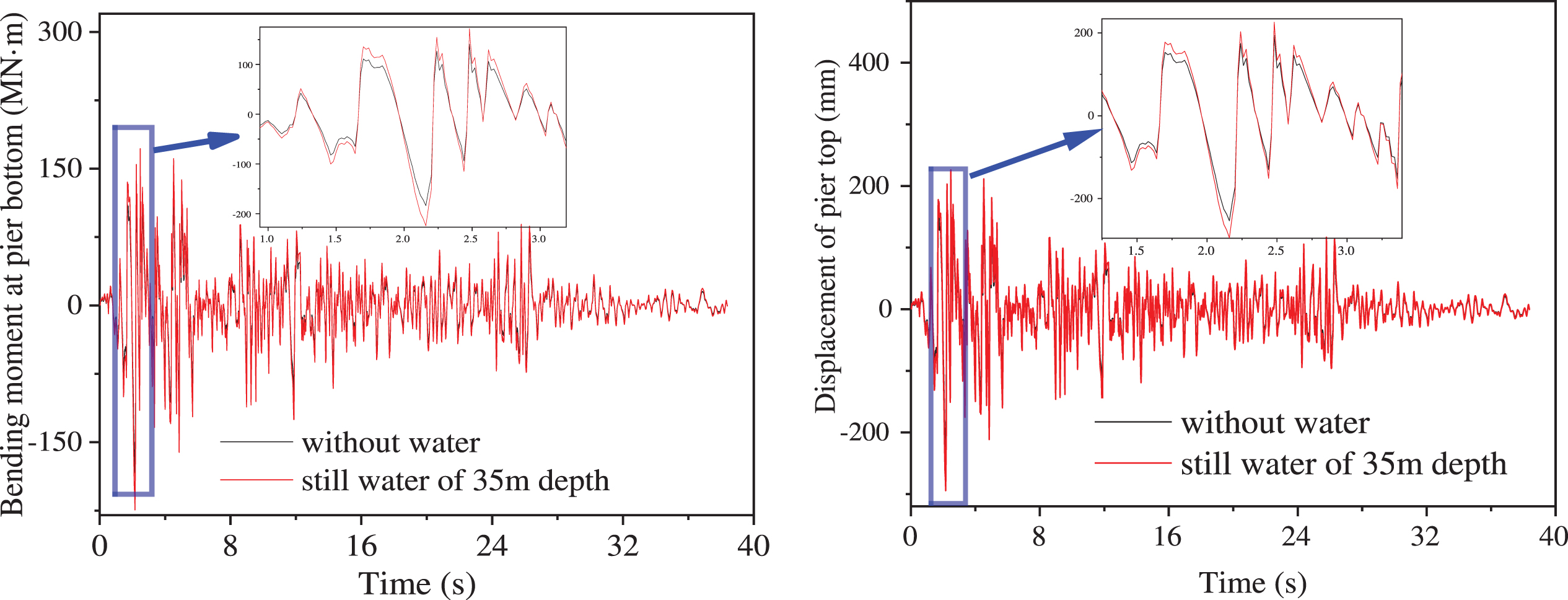
Time history curve of pier bottom bending moment and pier top displacement.
According to Table 8 and Fig. 16, the seismic responses under still water condition are greater than that under without water condition, indicating that water can amplify the seismic response of the structure. The internal force responses of the four columns are different, and the 2# column internal force response is the largest. However, because the pier has three tie beams, the differences of bending moment and shear force at the bottom of each column are very small.
Maximum seismic response of each column under the uniform transverse excitation
In order to characterize the influence of water effect on structural seismic response, the water influence coefficient D = (response of still water – response of without water) / response of without water×100% is introduced. D of the 2# column obtained from Table 8 is shown in Table 9.
Water influence coefficient D of the 2# column
It can be seen from Table 9 that for the above analytical conditions, the maximum influence coefficient of still water on seismic response is 22.0%.
In this paper, the influence of waters on natural vibration characteristics of single-column piers, 4-column pile-column frame piers and their whole bridge structures is studied. The conclusions can be used as a reference for the study of the natural vibration characteristics of 4-column pile-column frame pier bridges. The research shows that the effect of the foundation type is important on the lateral natural frequency, and water has more effect on the natural vibration characteristics of the structure. Finally, the influence of water on the seismic response of the bridge is discussed.
(1) For single column circular pier, 4-column pier and whole bridge structure, pier-water interaction will reduce the vibration frequency of components or structures. When the waters are less than 10 m, the maximum reduction of frequency is 6.83%. When the waters are more than 10 m, the vibration frequency is basically not affected by the waters and can be regarded as an infinite boundary.
(2) For single column circular pier, 4-column pier and the whole bridge structure, the vibration frequency decreases more and more with the increase of water depth. The water depth is less than 10 m, and the water depth has little effect on the vibration frequency of the structure. When the water depth exceeds 10 m, the frequency influence coefficient Rf of each order gradually increases. For the analyzed frequency, the maximum Rf is about 15%.
(3) Whether single column circular pier, 4-column pier or the whole bridge structure, the vertical vibration does not change with the change of waters and water depth. Vertical vibration frequencies are basically unchanged.
(4) For waters without considering the velocity, the waters area width has an impact on the vibration under the condition of certain water depth. However, when the waters reach a certain range, it will no longer affect the vibration characteristics of structures or components. This range can be regarded as the calculation domain of vibration characteristic analysis. In this paper, the natural vibration analysis of the bridge is not affected by the water interference between spans.
(5) For the bridge and the working conditions in this paper, the seismic responses under still water condition are greater than that under without water condition. Water can amplify the seismic response of the structure. The maximum influence coefficient of still water on seismic response is 22.0%.
Declaration of Competing Interest
The authors declare that they have no known competing financial interests or personal relationships that could have appeared to influence the work reported in this paper.
Footnotes
Acknowledgments
This work was supported by Transportation Science and Technology Plan in Henan Province of China (No. 2021J2). The editors and the anonymous reviewers are gratefully acknowledged. Their comments greatly improved the paper.