



Abstract
OBJECTIVE:
This study aims to study the effect of Rho kinase inhibitor fasudil on the expression endothelin-1 (ET-1) and nitric oxide (NO) in rats with hypoxic pulmonary hypertension (HPH).
METHODS:
Twenty-four male SD rats were randomly divided into three groups: control group, model group (HPH group) and HPH+fasudil group. The rat HPH model was established by intermittent hypoxia (IH) at atmospheric pressure. Mean pulmonary artery pressure (mPAP), right ventricular hypertrophy index (RVHI), ET-1 and NO levels, and pulmonary vascular structural changes were observed in all groups.
RESULTS:
MPAP, RVHI and ET-1 levels were significantly higher in HPH group than in control group, while NO was significantly lower than in control group. In addition, mPAP, RVHI and ET-1 were significantly lower in the HPH+fasudil group than in the HPH group. In the HPH group, ET-1 level was significantly and positively correlated with mPAP and RVHI, NO was negatively correlated with mPAP and RVHI levels, and ET-1 level was significantly and negatively correlated with NO level. In the HPH group, pulmonary arteriolar walls were generally thickened, and lumen stenosis was obvious; while after fasudil treatment, pulmonary arteriolar wall thickening and stenosis degree were significantly reduced.
CONCLUSION:
Fasudil can significantly reduce ET-l level and increase NO level in HPH rats, suppressing the development of pulmonary arterial hypertension.
Introduction
Hypoxic pulmonary hypertension (HPH) is the most common and severe complication of left-to-right shunt congenital heart disease and chronic lung disease. It is characterized by increased pulmonary arterial pressure, pulmonary vascular remodeling, and right ventricular hypertrophy; which would aggravate and lead to right heart failure and death, if no treatment is given [1, 2]. At present, its pathogenesis remains unclear; and ideal drugs for its treatment remains unavailable. In recent years, in vitro and in vivo animal studies have revealed that a small G protein Rho kinase inhibitor fasudil can relax and reduce pressure in the pulmonary artery, significantly inhibit the progression of pulmonary vascular contraction and pulmonary vascular remodeling in HPH experimental animals [3], and inhibit endothelial cells from synthesizing and secreting ET-1 [4] and from promote the synthesis and secretion of NO [5]. Furthermore, it improves the balance between ET-1 and NO; and delays the occurrence and progression of pulmonary hypertension. Through the establishment of the HPH model of rats, this study aims to investigate the effect of Rho kinase inhibitor, fasudil, on the expression of ET-1 and NO in HPH rats, and evaluate the possible pathogenesis of HPH.
Materials and methods
Animal groupings and HPH model establishment
Twenty-four healthy male SD rats were selected, and body weights of these rats ranged between 250–300 g (provided by the Animal Experimental Center of Nanjing General Hospital, Nanjing Military Region). The method for establishing the HPH rat model was based on a related literature [6]: low oxygen concentration was set at 10±0.5%, eight hours of low oxygen was provided every day, and six days of low oxygen concentration was provided per week. The duration of the course was a total of 21 days. Rats were randomly divided into three groups (n = 8, each group): (1) model group (HPH group), 2 ml/kg of normal saline was intraperitoneally injected before the administration of low oxygen; (2) HPH+fasudil group, 15 mg/kg of fasudil (Nagoya pharmaceutical factory of Asahi Kasei, Japan; 2 ml per bottle containing 30 mg of fasudil; batch number: ERS11KM; diluted into 2 ml/kg of normal saline) was intraperitoneally injected every day before low oxygen; (3) control group, rats were fed under normal oxygen concentration, normal saline was intraperitoneally injected every day at the same volume and at the same time with the model group.
Determination of the hemodynamic index
After the interventional procedure, and under anesthesia of 40 mg/kg of 2% sodium pentobarbital via intraperitoneal injection, mean pulmonary artery pressure (mPAP) was measured using the right heart catheterization [7]. Then, 6 ml of right external carotid venous blood was withdrawn, centrifuged, and the supernatant was obtained and kept in cold storage. Rats were immediately sacrificed, the heart and lungs were completely taken out, the right ventricle (RV) and left ventricle plus septum (LV+S) were isolated, weighed, and the right ventricular hypertrophy index was calculated: RVHI = RV / (LV+S).
Determination of plasma ET-1 and NO
Plasma ET-1 concentration was measured by radioimmunoassay (endothelin radioimmunoassay was provided by the Radioimmunoassay Institute of Science and Technology Development Center of People’s Liberation Army [PLA] General Hospital), and the concentration of NO was determined using the nitrate reductase method (the NO kit was provided by Nanjing Jiancheng Biological Engineering Institute). All operations were conducted by a specially-assigned person, and procedures were performed strictly according to kit instructions.
Preparation and observation of lung tissue specimens
Ending tissues in the right upper lung were obtained and fixed by 4% paraformaldehyde phosphate buffer overnight, underwent routine paraffin embedding and sectioning, followed by hematoxylin and eosin (HE) staining. Three visual fields were randomly selected for each slide loading rat lung tissue samples, and pathological changes of the small pulmonary artery (100–200 μm in diameter) were observed under light microscopy.
Statistical analysis
All data were expressed as mean±standard deviation (x±SD). The experimental data were statistically analyzed using SPSS 16.0 software. Multi-group comparison was conducted using analysis of variance (ANOVA), and inter-group comparison was conducted using the least significant difference (LSD) test. Correlation analysis was conducted using Pearson’s correlation. P < 0.05 was considered statistically significant.
Results
Comparison of mPAP, RVHI, ET-1 and NO levels among the three groups
Compared with the control group, MPAP, RVHI and ET-1 levels were significantly higher in the HPH group; while NO was significantly lower in the HPH group (P < 0.01). Compared with the HPH group, mPAP, RVHI and ET-1 levels were significantly lower; and NO level was significantly higher in the HPH+fasudil group (Table 1).
Three groups of rats mPAP, RVHI, ET-1, NO level comparison (X±S)
Three groups of rats mPAP, RVHI, ET-1, NO level comparison (X±S)
Compared with the control group, ★P < 0,01; Compared with HPH group, ▴P < 0,01; 1mmHg = 0.133kPa.
Pearson’s correlation analysis results revealed that in the HPH group, rat plasma ET-1 level was significantly positively correlated with mPAP and RVHI (r = 0.780, r = 0.891; P < 0.01, P < 0.01); while plasma NO level was significantly negatively correlated with mPAP and RVHI levels (r = –0.712, r = –0.793; P < 0.01, P < 0.01). Furthermore, plasma ET-1 level was significantly negatively correlated with NO level (r = 0.859, P < 0.01).
Morphological comparison of the small pulmonary artery
Observation under light microscopy: HE stained sections revealed that pulmonary arteriolar walls of rats in the control group were very thin, the continuity of endothelial cells was good, and cells exhibited uniform distribution and thickness. Furthermore, in rats in the HPH group, the continuity of endothelial cells in the small pulmonary artery was damaged, small artery walls were generally thickened, and lumen stenosis was obvious. In the HPH+fasudil group, the thickening and degree of stenosis of pulmonary arteriolar walls were significantly reduced (Fig. 1).
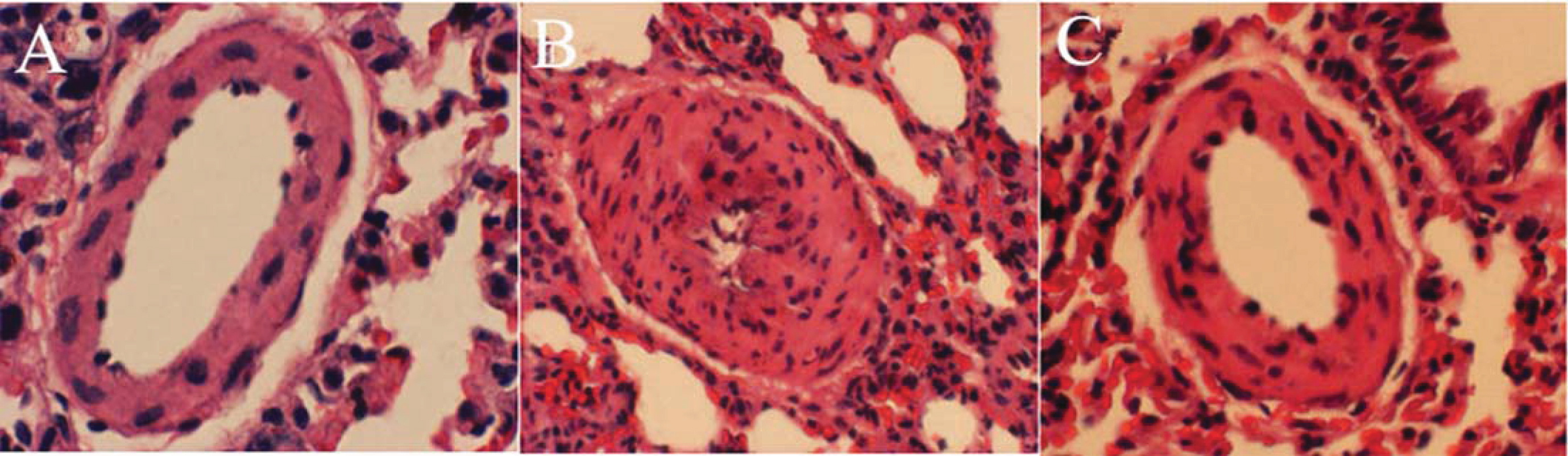
HE stained sections of pulmonary artery in rats (*400). A: Control group. B: HPH group. C: HPH+fasudil group.
Results of this study revealed that after low oxygen was provided for three weeks, pulmonary artery pressure of rats significantly increased. Furthermore, right ventricular hypertrophy was developed, pulmonary arteriolar walls became thickened, and lumen stenosis occurred; suggesting that the HPH model of rats was successfully established. The formation of HPH is a complicated process, which is involved in the comprehensive regulation of genetic, cellular and humoral factors [1, 8]. However, the underlying mechanism remains unclear, at present. In recent years, the role of the Rho/Rho kinase signaling pathway in the pathogenesis of HPH has attracting more and more attention [3, 10]. In particular, fasudil, a selective inhibitor of this signaling pathway, can significantly inhibit the progression of pulmonary vasoconstriction and pulmonary vascular remodeling in HPH animals; suggesting that the abnormal activation of Rho/Rho kinase plays a pivotal role in HPH pathogenesis. Choi et al. found that hypoxia can activate the Rho/Rho kinase signaling pathway, while the abnormal activation of the Rho/Rho kinase signaling pathway is one of the important initiation links in HPH [11, 12].
The Rho/Rho kinase signaling pathway is a common signal transduction pathway in body tissues. It is activated following the activation of a variety of inflammatory mediators and cytokine receptors, and is directly involved in the regulation of actin cytoskeleton configuration in the cells through the kinase cascade reaction [13, 14]. Rho can be activated through a variety of upstream stimulation signals [15, 16] including ET-1, NO, angiotensin II (Ang II), as well as oxidative stress. In addition, previous experiments have confirmed that these stimuli could lead to pulmonary hypertension and pulmonary vascular remodeling. ET-1 is the strongest endogenous angiotonica known to date, which has strong promoting effect on the division of smooth muscle cells. Increasing ET-1 can not only strongly cause contractions in the pulmonary artery, but also promote the hyperplasia of vascular smooth muscles and fibrous tissues; resulting in an increase in pulmonary vascular resistance. In this manner, it is involves in pulmonary vascular remodeling [15, 18]. As a vascular endothelium-derived relaxing factor, NO can selectively relax the pulmonary artery, and inhibit the adhesion and aggregation of platelets; hence, reducing pulmonary artery pressure [15, 19]. As a result, drugs that can inhibit the production of ET-1 and promote the synthesis of NO is expected to become the new direction for the treatment of HPH [20]. As one of the typical Rho kinase inhibitors, fasudil has become a new type of isoquinoline sulfonamide derivative. It blocks the activity of Rho kinase by competing the ATP binding sites in the Rho kinase catalytic region with ATP, and reduce the phosphorylation levels of myosin light chain (MLC) through the regulation of the myosin-binding subunit (MBS) of the myosin phosphatase; relaxing the contracted blood vessels [5, 22].
The results of this experiment revealed that ET-1 levels significantly increased in rats in the HPH group compared with controls, and were significantly positively correlated with mPAP and RVHI. NO levels in the model group rats were significantly lower and were significantly negatively correlated with mPAP and RVHI; while ET-1 level was significantly negatively correlated with NO level. In the formation process of pulmonary artery hypertension, if Rho kinase inhibitor fasudil intervention was given, it could significantly reduce pulmonary artery pressure and the right ventricular hypertrophy index. In addition, pathological changes such as thickened media of the pulmonary arteriole and lumen stenosis were significantly relieved; while ET-1 levels decreased and NO level increased. This suggests that fasudil could decrease pulmonary artery pressure, improve right ventricular hypertrophy, and improve pulmonary vascular remodeling. Its mechanism may be that it suppressed the progression of HPH and relieved pulmonary vascular remodeling and right ventricular hypertrophy, through the direct influence of the contraction of smooth muscle cells, changes in the balance between endothelium-derived relaxing factors (NO for typical) and constriction factors (ET-1 for typical), and regulating the expression of the cell growth gene.
It was found in this study that the application of the Rho kinase inhibitor fasudil to block the Rho kinase signaling pathway could obviously reduce pulmonary artery pressure in HPH rats, reduce pulmonary vascular remodeling and right ventricular hypertrophy, and block the progression of HPH. The mechanism may be that through inhibiting endothelial cells from synthesizing and secreting ET-1, and promoting the synthesis and secretion of NO, it improves the balance of ET and NO; thus, enhancing the endothelium-mediated diastole effect. This suggests that fasudil worked well in the prevention of pulmonary artery pressure and the prevention and treatment of pulmonary vascular remodeling. However, this requires further clinical studies in the future.