



Abstract
The aim of this study was to assess the elasticity of Hashimoto’s thyroiditis in the different processes via supersonic ShearWave™ Elastography (SWE™). Quantitative information is delivered as Young’s modulus value expressed in kilo-Pascal (kPa). 30 healthy female and 30 healthy male individuals aging at 40±20 y had undergone conventional ultrasonography and SWE to determine the influence of gender on elasticity of thyroid. Also 60 female and 60 male patients (mean age, 40±20 y) with Hashimoto’s thyroiditis in different processes underwent conventional ultrasonography and SWE to determine the elasticity of thyroid in Hashimoto’s thyroiditis. Furthermore, the relationship between elasticity values and thyroid peroxidase antibody (TPOAB) in the patients was investigated. We found significant impact of gender on elasticity values of healthy thyroids. Our study showed that increased elasticity values with statistical significance in hyperthyroidism stage, normal thyroid function stage and hypothyroidism were shown. Low degree relationship between elasticity values and TPOAB was found in 60 male patients. However, there was no such correlation in female patients.
Introduction
Hashimoto’s thyroiditis, which is also called chronic lymphocytic thyroiditis, is a common autoimmune disease. Epidemiology find that this disease happened about seven times more common in female than male. Researchers also find that it occurs more commonly in middle age, particularly for male individuals. The thyroid gland in Hashimoto’s thyroiditis is attacked by both a variety of cell- mediated immune process and antibody-mediated immune process [1, 2]. Pathology also shows that enlargement of the thyroid is due to lymphocytic infiltration and fibrosis rather than tissue hypertrophy [3]. As a result, most thyroid gland may become firm, large, and lobulated. Thyroid peroxidase (TPO) is a frequent epitope of autoantibodies and it is most commonly associated with Hashimoto’s thyroiditis. Physiologically in Hashimoto’s thyroiditis, both antibodies against TPO and thyroglobulin (TG) are markedly increased, which can cause gradual destruction of thyroid gland. Accordingly, these antibodies can be detected clinically for diagnosis. However, sometimes these antibodies are not increased and even not present in a small percentage of Hashimoto’s thyroiditis patients. Meanwhile, in a percentage of the population without developing Hashimoto’s thyroiditis these antibodies may be also increased in the blood. So detection of antibodies against TPO and TG, which are not the very specific antibodies, is not enough for diagnosis of Hashimoto’s thyroiditis [4–7].
Ultrasonography is a widely used medical imaging technique for its usability, real-time capability, portability and low cost. Conventional ultrasound examination including 2D, color flow and spectrum, allows the morphological images of organs, but lacks a fundamental and quantitative information on tissue elasticity [8, 9]. Meanwhile, a classical feature of thyroid is hard to get firm consistency upon palpation. Elastography, whose development started about 20 years ago, can detect tissue elasticity quantificationally [10, 11]. As a noninvasive technique, ultrasonography (US)-based elastography, encompasses a variety of approaches such as supersonic shear imaging [12]. With the introduction of elastography(both strain and shear wave elastography), reproducible assessment of tissue consistency has become available [13].
In elastography, an applied pressure can cause the tissue to compress more in softer tissues, whereas hard tissues compress less [14, 15]. This compressibility property is displayed as an image (elastogram), which can be measured by dedicated software [16, 17]. Quantitative information is delivered as Young’s modulus value expressed in kilo-Pascal (kPa). Compared with conventional ultrasound, elastography can provides an additional and clinically relevant information [18, 19]. ShearWave™ Elastography is a new noninvasive and reliable imaging method for the elasticity assessment. Currently, only SWE can produce real-time quantitative information on selected areas of thyroid tissue. Operator-independence of SWE is small and SWE has reproducible assessment of tissue consistency. SWE has been used for the elasticity analysis of different organs, such as liver, thyroid, breast and so on. In thyroid, accumulated evidence showed that SWE was a powerful technique for diagnosis of benign and malignant nodules [20, 21]. However, there are very few research about SWE in Hashimoto’s thyroiditis.
The thyroid gland makes two thyroid hormones, triiodothyronine and thyroxine. According to these hormones levels, thyroid function is divided into hyperthyroidism stage, normal thyroid function stage and hypothyroidism. In this study, we assess the thyroid elasticity of Hashimoto’s thyroiditis in the different processes by the quantitative elasticity value with SWE™. Consequently in our study, we demonstrate that the elasticity of thyroid of Hashimoto’s thyroiditis in different processes has significant changes. Combined with the TPO and thyroid hormones, the thyroid elasticity of Hashimoto’s thyroiditis via SWE™ can be very helpful for the diagnosis and treatment of Hashimoto’s thyroiditis.
Materials and methods
Participants
This study was approved by the Capital Medical University Ethics Committee and registered at Anzhen Hospital ethics Committee. 180 participants were selected from Beijing Anzhen Hospital from October 2013 to October 2014. Each participant confirmed his/her consent by providing a written document showing agreement with Anthen Hospital Ethics Committee before their enrollments. All of these the participants underwent systemic investigations and routine laboratory tests, such as serum thyrotropin (TSH), thyroxine (T4), triiodothyronine (T3) and antibodies against TPO and TG [22], which were used for diagnosing the Hashimoto’s thyroiditis and its different process.
Thirty healthy female and thirty healthy male individuals aging at 40±20 y first underwent conventional ultrasonography, and SWE were also performed to explore the influence of gender on elasticity of thyroid.
Sixty female patients and 60 male patients aging at 40±20 y suffered from Hashimoto’s thyroiditis in the different processes also underwent conventional ultrasonography and SWE to determine elasticity of thyroid in different processes of Hashimoto’s thyroiditis.
Conventional ultrasonography
Conventional ultrasound examinations were performed in all participants using SuperSonic Imagine Aixplorer® ultrafast system (France), which also included the SWE™ imaging Mode. We used the linear-array transducer (frequencies ranged from 4 to 15 MHz). In order to get a complete exposure of the thyroid, all the participants were placed in the supine position, with a pillow to ensure neck extension. Both conventional gray scale imaging and color Doppler ultrasound were first used to examine the thyroid. To reduce the impact on the measurement results, all of the participants underwent conventional ultrasound examinations. Hashimoto’s thyroiditis participants who were not suffered cysts, lesions, tumors, especially large lymph nodes, and especially large or small size thyroid were selected in our study.
SWE elastography
After identification of the target lesion by conventional ultrasonography, operator kept the transducer (frequencies ranging from 4 to15 MHz) stably and perpendicularly without obvious pressure, which could minimize the compression artifact. According to the EFSUMB guidelines, the target lesion should be free of large vessels and other lesions by conventional ultrasonography [23, 24]. Tell the participant to hold breath about 3∼5 s, and then the color signal box was displayed as a colored area. The softer tissue was presented as blue, while the harder tissue was presented as red. When the colored SWE map was stabilized and evenly distributed, the elastogram was saved to the system. Elastographic quantitative measurement using 10-mm region of interest (ROI) (QboxTM; Super Sonic Imagine) was performed (Fig. 1). The mean value in the ROI was recorded. Repeating the process three times, three successive measurements were carried out for each place to calculate the average values [25, 26].
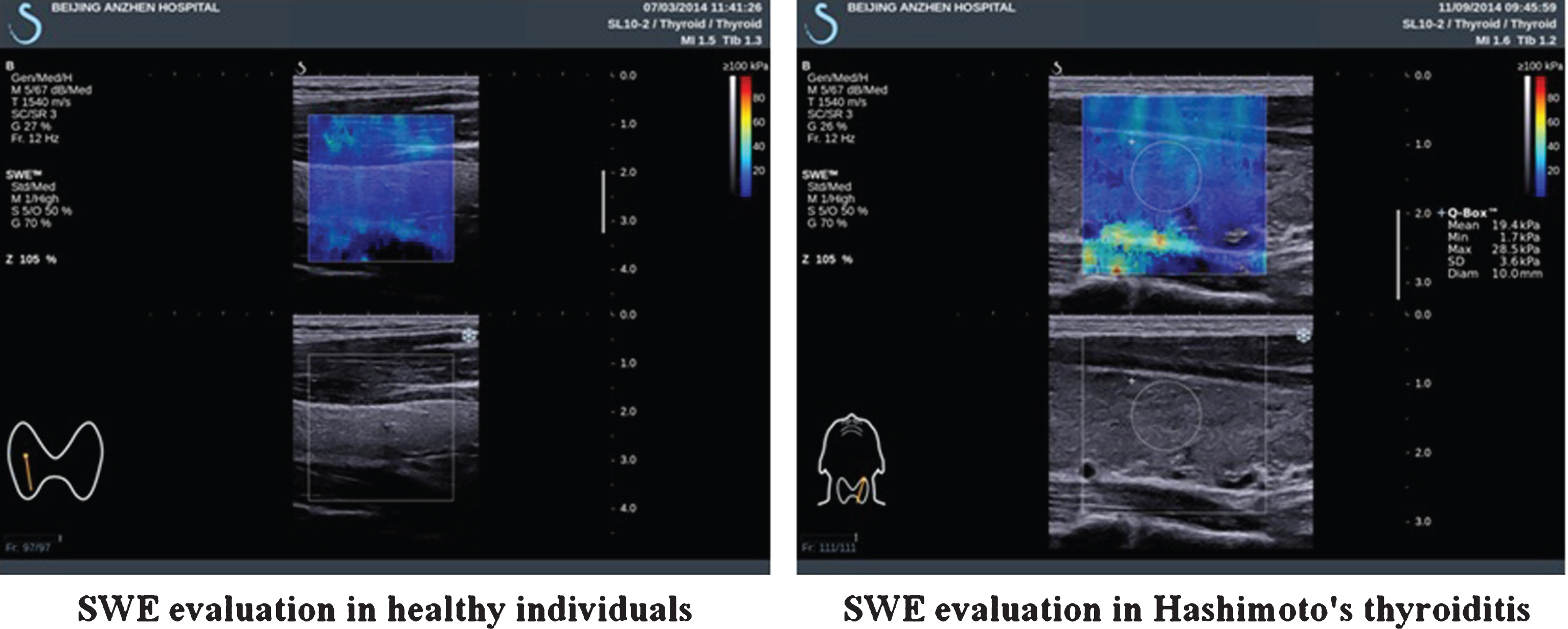
Elasticity of healthy individuals and Hashimoto’s thyroiditis patients in the different processes was assessed by the quantitative elasticity value with supersonic ShearWave™ Elastography (SWE™).
Data processing was performed with SPSS version 13.0 statistical software (IBM Corporation, Armonk, NY). Data were shown as mean±1 SD. Statistical differences of thyroid elasticity between the female and male healthy thyroid and Statistical differences of thyroid elasticity of Hashimoto’s thyroiditis patients in different processes were measured by one-way ANOVA followed by the Bonferroni procedure for multiple-group comparisons. A P < 0.05 was considered statistically significant. Links between thyroid elasticity values in patients and TPO were estimated by correlation analysis.
Results
We found that there is significant impact of gender on elasticity values of healthy thyroid. Elasticity value of female healthy thyroid was significantly higher than that of male healthy thyroid (Fig. 2).
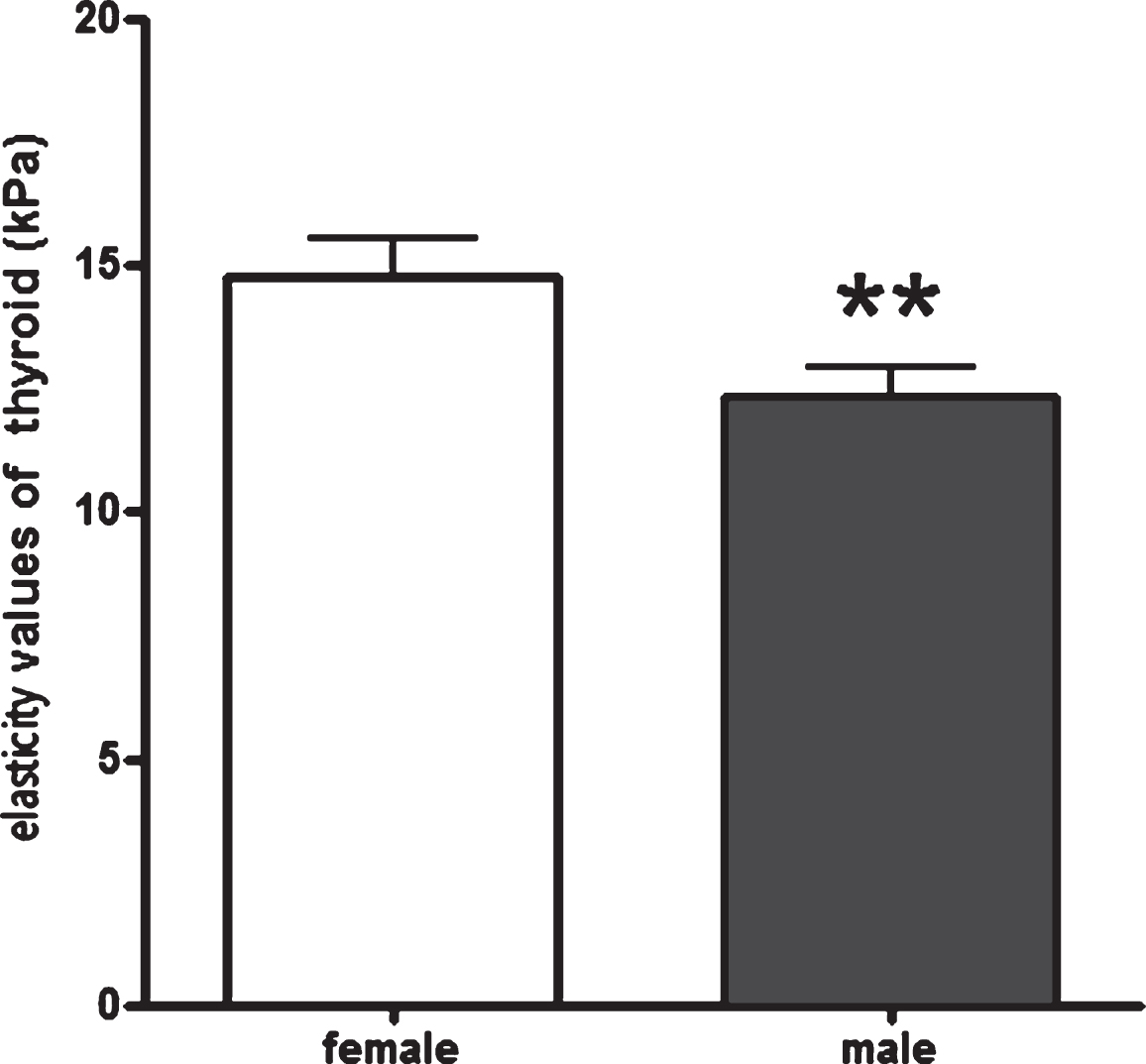
Elasticity value of female healthy thyroid and male healthy thyroid was assessed. Result showed elasticity value of female healthy thyroid was significantly higher than elasticity values of male healthy thyroid.
In 60 female patients suffered from Hashimoto’s thyroiditis, elasticity values in hyperthyroidism stage, normal thyroid function stage and hypothyroidism increased with statistical significance, compared to that in healthy female individuals (Fig. 3).
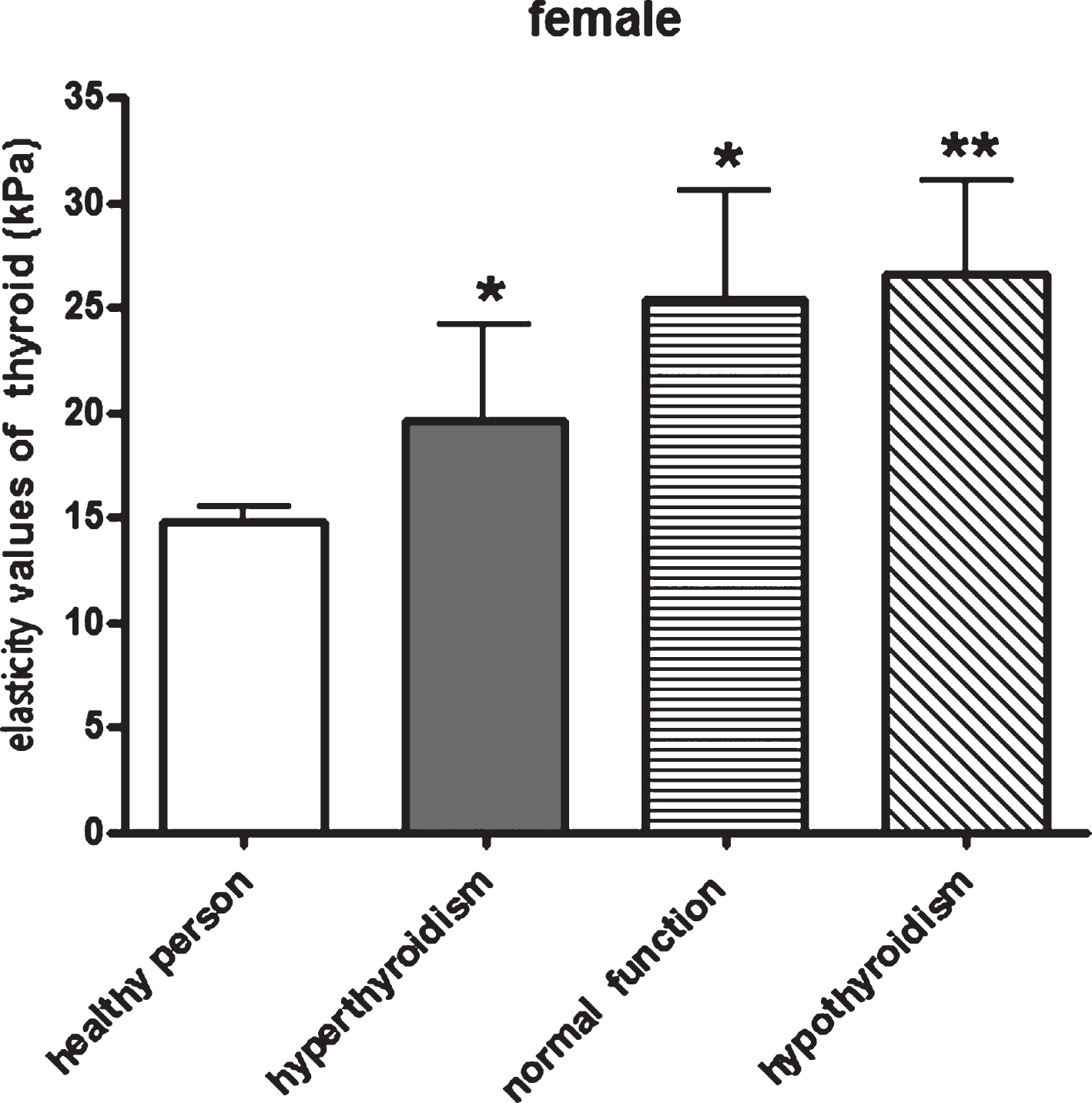
Elasticity value of 60 female patients suffered from Hashimoto’s thyroiditis in the different processes was assessed. Result showed elasticity values in hyperthyroidism stage, normal thyroid function stage and hypothyroidism is increased, which also has statistical significance from healthy female individuals.
In 60 male patients suffered from Hashimoto’s thyroiditis in the different processes, elasticity values in hyperthyroidism stage, normal thyroid function stage and hypothyroidism also increased with statistical significance, compared to that in healthy male individuals (Fig. 4).
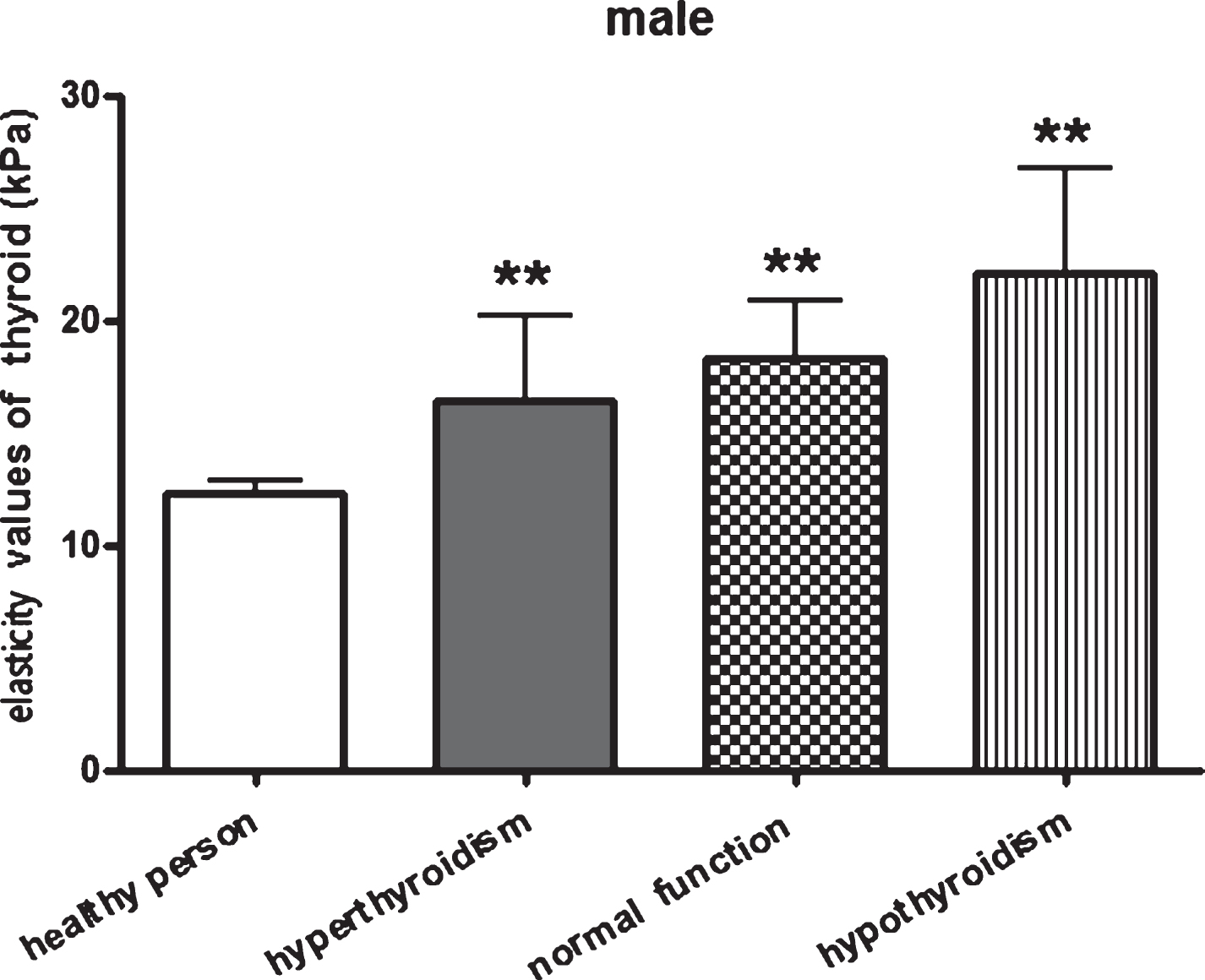
Elasticity value of 60 male patients suffered from Hashimoto’s thyroiditis in the different processes was assessed. Result showed elasticity values in hyperthyroidism stage, normal thyroid function stage and hypothyroidism is increased, which also has statistical significance from healthy male individuals.
There exists low degree relationship between elasticity values and TPOAB in 60 male patients with Hashimoto’s thyroiditis. However, no significant relationship between elasticity values and TPOAB was found in 60 female patients (Tables 1 and 2).
The correlation between elasticity values and TPOAB in 60 female patients suffered from Hashimoto’s thyroiditis in the different processes. The elasticity values was not correlateed with TPOAB levels (r = 0.170, p = 0.193)
The correlation between elasticity values and TPOAB in 60 male patients suffered from Hashimoto’s thyroiditis in the different processes. The elasticity values was low correlated with TPOAB levels (r = 0.462, p = 0.003).
**Correlation is significant at the 0.01 level (2-tailed).
In this study, we demonstrate that the elasticity value of thyroid of Hashimoto’s thyroiditis in different processes increased with disease development using SWE™. Elasticity values measured by SWE can reflect the elasticity of thyroid in Hashimoto’s thyroiditis, which can further provide quantitative information for function of thyroid to guide the diagnosis and treatment of Hashimoto’s thyroiditis.
Discussion
In this study, we detected that the elasticity of thyroid in healthy individuals and patients with Hashimoto’s thyroiditis in the different processes has statistical significance via supersonic SWE™. As a new noninvasive and reliable imaging technique for the assessment of the elasticity of thyroid, SWE™ can further provide quantitative information of thyroid and serves as an instructional basis for the diagnosis and treatment of Hashimoto’s thyroiditis combining with routine laboratory tests and common ultrasonography [27, 28].
Previous research showed that elasticity value of female healthy thyroid was significantly higher than that of male healthy thyroid [29]. In our study, we also found significant impact of gender on elasticity values of healthy thyroid.
In 60 female patients suffered from Hashimoto’s thyroiditis, elasticity values in hyperthyroidism stage, normal thyroid function stage and hypothyroidism stage were significantly increased compared to elasticity values in healthy female individuals. However, due to the limitation of sample size, we were unable to investigate whether there was statistical significance between elasticity values in hyperthyroidism stage, normal thyroid function stage and hypothyroidism stage.
Similarly, in 60 male patients suffered from Hashimoto’s thyroiditis in the different processes, elasticity values in hyperthyroidism stage, normal thyroid function stage and hypothyroidism are also increased. Similarly, due to the limitation of sample size, we were unable to investigate whether there was statistical significance between elasticity values in hyperthyroidism stage, normal thyroid function stage and hypothyroidism stage. However, it will provide us further opportunity to carry out subsequent researches in this field.
In 60 male patients suffered from Hashimoto’s thyroiditis, there existed low degree relationship between elasticity values and TPOAB. However, there existed no significant relationship between elasticity values and TPOAB in 60 female patients suffered from Hashimoto’s thyroiditis. So, which factor is more closely related to elasticity values can be investigated in the future [30–32].
In our research, we detected the elasticity value of thyroid markedly increased in Hashimoto’s thyroiditis with high level of antibodies against TPO. So the elasticity change of thyroid may provide useful information to guide the diagnosis and treatment for Hashimoto’s thyroiditis. However, we were unable to gather enough Hashimoto’s thyroiditis patients with the antibody level not increased and even not present, so the change of elasticity values in the different processes was not detected.
In spite that operator-independence of SWE is small and SWE has reproducible assessment of tissue consistency. Without doubt, there exist limitations in SWE™. A general limit is that experience is needed to obtain reproducible and reliable elasticity readings. In elasticity detection, the transducer was kept in a stable position without obvious pressure, and three successive measurements were carried out for each place to calculate the average values. All the elasticity detection was carried by the same operator to reduce man-made error.
Nowadays elastosonography is an established technique used to assess tissue stiffness, which is a parameter associated with malignancy in most cases although with limited clinical application [33, 34]. Research found that SE and SWE can improve the value of ultrasound for the workup of thyroid nodules with high sensitivity and high specificity [35]. They might reduce diagnostic surgery of thyroid nodules in the future. As the result of our study, the thyroid elasticity is significantly increased in Hashimoto’s thyroiditis, so it has important significance to continue investigation of tissue elasticity change via SWE™ in many organ diseases [36].
Footnotes
Acknowledgments
This project was supported by grants from the Capital Health Research and Development of Dpecial (No. ShouFa2011-2006-02) and Beijing Natural Science Foundation (No. 7112045).
Declaration of conflict of interest
None.