




Abstract
BACKGROUND:
In weightlessness, alterations in organ systems have been reported. The microcirculation consists of a network of blood vessels with diameters of a few μm. It is considered the largest part of the circulatory system of the human body and essential for exchange of gas, nutrients and waste products. An investigation of the microcirculation in weightlessness seems warranted but has not yet been performed.
OBJECTIVE:
In this paper, we outline a study in which we will investigate the possible interrelations between weightlessness and microcirculation. We will induce weightlessness in the course of parabolic flight maneuvers, which will be conducted during a parabolic flight campaign. In this study protocol also an evaluation of a possible influence of parabolic flight premedication on microcirculation will be described.
METHODS:
The microcirculation will be investigated by sublingual intravital measurements applying sidestream darkfield microscopy. Parameters of macrocirculation such as heart rate, blood pressure and blood oxygenation will also be investigated.
RESULTS:
In our pre-study experiments, neither dimenhydrinate nor scopolamine altered microcirculation.
CONCLUSIONS:
As the application of motion sickness therapy did not alter microcirculation, it will be applied during the parabolic flight maneuvers of the campaign. Our results might deepen the understanding of microcirculation on space missions and on earth.
Keywords
Introduction
With a formal Mars program established for the 2030 s by national space agencies, the understanding of human physiology in weightlessness is of utmost interest for adequate planning and conduction of such a complex mission of long duration [1, 2]. In weightlessness, adaptive changes in distinct organ systems have been reported, e.g. osteoporosis-like bone changes of the musculoskeletal system as well as muscular atrophy [3, 4]. Furthermore, impairment of lung function and the immune system have been reported [5, 6]. Still, major complications during space missions might mainly be triggered by unfavorable alterations in the cardiovascular system, leading to life threatening impairment of tissue oxygenation [7–10]. In studies conducted in weightlessness, an increase of cardiac output of up to 41% has been described [11, 12]. In animal experiments with pigs in weightlessness, a change in pulmonary flow was observed and even structural changes of capillaries were documented [6]. Moreover, changes in the baroreceptor reflex and on cerebrovascular auto-regulation have been reported in weightlessness [11–14].
The microcirculation consists of a network of blood vessels of smallest scale, comprising arterioles, venules and capillaries, with diameters ranging from 2 to 100μm. In terms of surface area, it is considered the largest part of the circulatory system of the human body. The primary role of the microcirculation comprises gas exchange as well as exchange of nutrients and waste products. Accordingly, the microcirculation is accountable for adequate tissue oxygenation and cellular organ perfusion [15–17].
Studies concerning hemodynamic changes of the microcirculatory system in zero-gravity are still lacking, partly because a thorough evaluation of the microcirculation warrants special devices. However, new devices have emerged that allow a direct online visualization of the sublingual microcirculatory blood flow [18]. For instance, intravital microscopy has successfully been applied to estimate clinical outcomes of critically ill patients [19–22]. In our opinion, the measurement of the microcirculation in states of weightlessness in the setting of parabolic flight maneuvers seems feasible.
With regard to long duration space missions, further evaluation of the microcirculation in weightlessness seems indispensable to deeper understand the pathophysiological mechanisms involved and identify possible risks for human beings conducting space missions of long duration. The target of this study is to enhance the understanding of the function and autoregulation of the microcirculation in weightlessness. In the course of participation in the Parabolic Flight Campaign in September 2017, the alterations of the microcirculation under these circumstances will be quantified.
The present paper presents the study protocol for this novel experimental approach as well as two necessary pre-study experiments.
Materials and methods
Pre-study experiments
A common side effect of participation in parabolic flight maneuvers is motion sickness. Therefore, the prophylactic administration of an anti-emetic drug is strongly recommended. In this context, dimenhydrinate and scopolamine remain the most frequently applied drugs. Therefore, in a pre-study, we measured the microcirculation after administration of standard doses of these drugs, to assess possible alterations of the microcirculation.
In this context, we measured the sublingual microcirculation of 8 healthy individuals before and one hour after peroral administration of the standard dose of 50 mg Dimenhydrinate. Furthermore, we assessed the microcirculation of 6 healthy individuals before and after the administration of Scopolamine applied subcutaneously (standard dose for male test subjects: 0,175 mg; standard dose for female test subjects: 0,125 mg; with optional additional doses according to medical history of known motion sickness). For each individual at least 3 repetitive measurements were performed before and after drug administration respectively. After the acquisition of the imagery data, the analysis was done offline, applying the certified Microscan®-Analysis Software (AVA, Version 4.3C). According to consensus for ideal analysis reports in this setting, we documented the perfused vessel density (PVD) and the perfused proportion of vessels (PPV) as well as the total vessel density (TVD) as standard variables. Additionally we assessed the number of vessel crossings.
Main study protocol
The main study constitutes an observational study. Prior to inclusion into the study, a medical check-up for airworthiness had to be performed by each subject. All subjects gave their informed consent for inclusion before they participated in the study. The study was conducted in accordance with the Declaration of Helsinki (1975, revised in 2008), and the protocol was approved by the German Ethics Committee of the Medical Faculty of the University Hospital Duesseldorf, Germany (Date of approval: August 14th, 2017; Project Identification code: 2017054297) and by the French Ethics Committee Comite de Protection des Personnes (CPP Nord-Ouest III) of the Medical Faculty of the University of Caen (Date of approval: September 06th, 2017; Project Identification code: 2017-A01185-48).
Inclusion and exclusion criteria
The inclusion criteria were defined as: age >18 years; airworthiness; cardiorespiratory health; spontaneous circulation; accessibility of the sublingual mucosa; signed informed consent.
The exclusion criteria were defined as: history of cardiovascular and respiratory primary diseases or regular intake of medication except oral contraceptives; inaccessible sublingual mucosa e.g. after orofacial trauma or surgery; missing or withdrawal of informed consent; insufficient requirements for airworthiness; positive pregnancy test.
Parabolic flight
The Parabolic Flight campaign will take place from September 04th to September 16th in Bordeaux, France. The experiment will take place aboard the Airbus A 310 Zero-G of the French company NoveSpace. The A 310 Zero-G is a specially equipped aircraft, meticulously designed for the operation of parabolic flight maneuvers. In order to perform the scheduled flight maneuvers, three jet pilots with profound training simultaneously operate in the cockpit, with each pilot assigned to a different specific task, with respect to different components of the dimensions of the flight maneuver (i.e. speed, vertical movement and horizontal movement). During the parabolic flight maneuver (Fig. 1), from its horizontal flight path, the aircraft climbs steeply upward (“pull-up”), to follow a parabolic trajectory thereafter, as the pilots throttle back the propulsive force of the engines. This results in a free fall, during which the passengers experience nearly zero gravity (0 g) aboard, lasting for about 20 seconds. The phase of microgravity is followed by a “pull-out” phase, during which the pilots steer the aircraft back to its horizontal flight path. The phases of pull-up and pull-out comprise states of hypergravity (up to 1.8 g). As the duration of zero-gravity and hypergravity phases differ slightly between each parabola, a protocol of the exact durations will be kept by the pilots. The protocol will be available to all participants at the end of the flight campaign. A typical parabolic flight day has a total duration of approximately 3 hours and includes 31 parabolic flight maneuvers. In total, 12 experimental setups are mounted in the aircraft. The first parabola on each flight day is a test run for all teams on board. After a successful test run, the individual experimental set-ups are released for their measurement procedures, in accordance with each experimental study protocol. Overall, the Parabolic Flight Campaign will cover 4 flight days within the period of 2 weeks. Our group will participate in all 4 flight days. For each flight day, each one of three test subjects will be assigned to 10 parabolic flight maneuvers. For each of the parabolic flight maneuvers, measurements will be performed in different phases of gravity, as one data set per parabolic flight maneuver (Table 1).
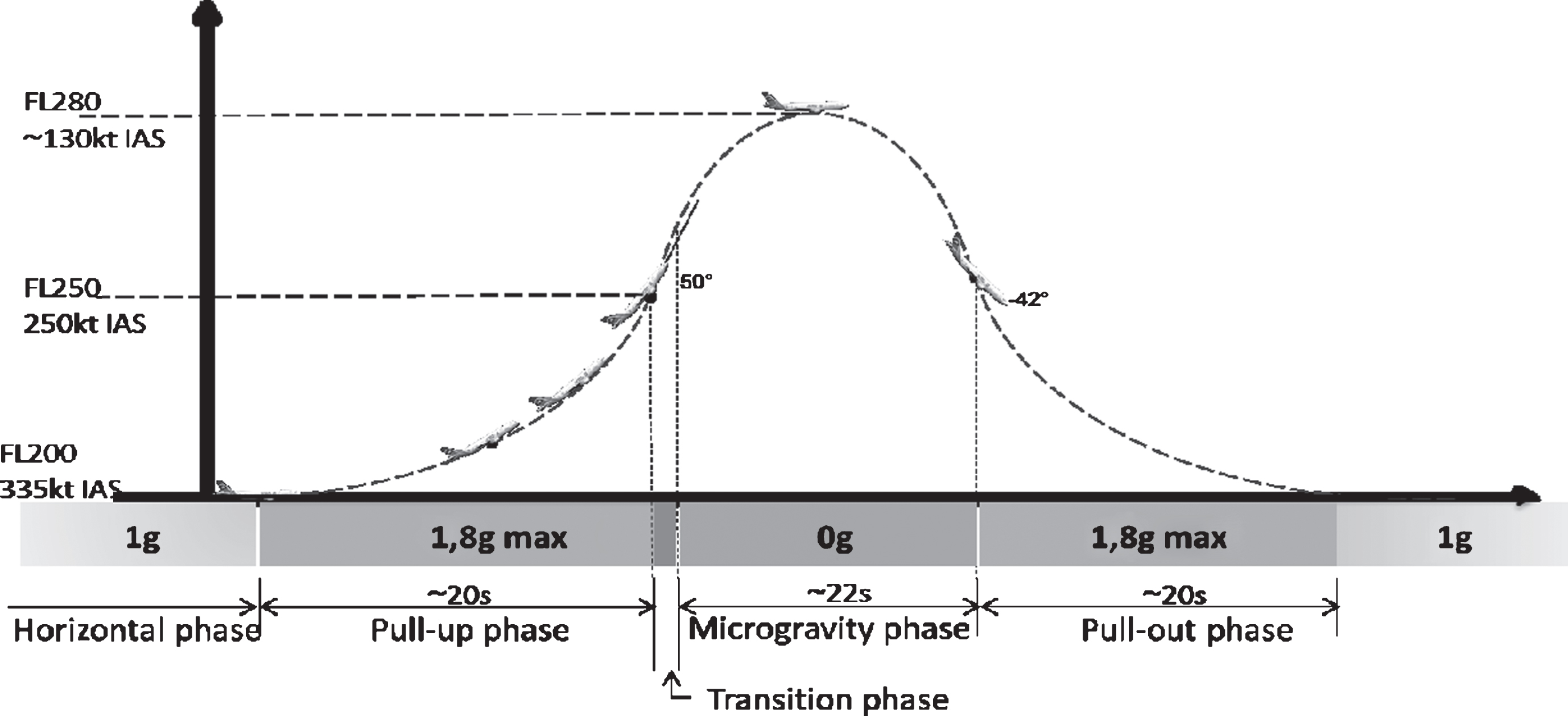
Profile of a parabolic flight maneuver (copyright by NoveSpace, France).
Protocol of measurements of one complete data set, exemplified for 1 test subject
Each data set will comprise measurements of the microcirculation, blood pressure, pulse oxymetry and ECG. Two ECGs will be applied in this study: a standard 12-lead ECG and a Holter-ECG to investigate also changes of autonomic function. Both ECGs will measure heart rate constantly. Additionally, in the Holter-ECG the beginning of each zero-gravity phase will be marked.
Blood pressure, pulse oxymetry and microcirculation will be measured at different time points: Two measurements in normal gravity (1 g), one before and one after the flight of the parabola, and one measurement during zero-gravity (0 g) at the peak of the flight of the parabola (see also Fig. 1).
Experimental setup
In line with the Experimental Safety Data Package (ESDP) of NoveSpace specifically designed for each experiment, all experiments have been prepared with special emphasis on safety during the parabolic flight maneuvers. After the final onboard setup of all experiments, a final security check will be conducted by NoveSpace.
In our experimental setup, all ECG-electrodes will be placed on the test subject before take-off. The Holter-ECG (Schiller medilog AR4 plus DARWIN2 Holter-ECG Professional-Package, Schiller AG, Baar, Switzerland) will be mounted completely before take-off and recording will be activated shortly prior to take-off. Recording will be stopped shortly after landing of the aircraft. The 12-lead ECG (Welch Allyn PC-based resting ECG, Skaneateles Falls, New York, USA) will be connected onboard with the test subject in supine position according to the setup for the measurements of the microcirculation. Accordingly, the recording of the 12-lead ECG will only be elicited during the measurements of the microcirculation.
The study subjects will be lying on the back with the feet in flight course, fixed by one strap over the legs and another one over the pelvis, to diminish free floating during the phases of weightlessness. Similarly, the head of the test subject will be fixed in a special mount (Speedblock head immobilizer, by Laerdal, Stavanger, Norway). The cuff of the blood pressure device (Welch Allyn Connex Pro BP 3400 digital blood pressure device, Skaneateles Falls, New York, USA) will be placed on the right upper arm. The study subject will elicit the measurement of the blood pressure at the beginning of each zero-gravity phase. The pulse oxymeter (Pulox PO-300, Nividion GmbH, Cologne, Germany) will be placed on the test subject’s left index finger. All investigators will be attached to the grounds of the aeroplane by straps, so that safe and reproducible measurements can be conducted.
Visualization of the sublingual microcirculation will be performed by the application of the sidestream darkfield (SDF) imaging technique. The device used in this context is the Microscan® intravital-microscope (Microvision Medical, Amsterdam, The Netherlands), as implemented in our previous studies on microcirculation [23–25]. This device is a CE-licensed (Conformité Européene-licensed) handheld microscope for high-quality imaging approved for the application in human beings and has already served as diagnostic tool in more than 200 clinical trials. The device’s tip carries a microscopic camera that acquires the imagery data of the sublingual capillary network [18]. The measuring process is initialized by placement of the device’s tip towards the sublingual mucosa. On the connected tablet (Microsoft Surface Pro 4, Redmond, Washington, USA), the acquired video data are demonstrated as 2-dimensional AVI-videos (Audio Video Interleave – videos). Representative videos will be recorded and saved. The next step of the analysis entails the application of the software (AVA, Version 4.3C) [18, 26]. The main analysis of the recorded intravital blood flow measurements will be done offline.
The operator of the Microscan© device will be placed in supine position, headwards and in square angle to the study subject, with a hereby optimized view and accessibility to the sublingual mucosa, guaranteeing optimized measurements of the microcirculation. Next to the main operator an assistant will be placed who will operate the tablet connected to the Microscan© device. At the feet of the study subject, a second assistant in charge of documentation of the vital signs (blood pressure, heart rate and oxygen saturation) of the test subject will be positioned.
Schedule and procedures
Each flight day, preparations of the experiments onboard of the aircraft as well as preparations of all participating test subjects start at around 06:00 a.m. From 08:15 a.m., a prophylactic anti-motion sickness therapy is offered on ground, at the NoveSpace medical facility. At 08:45 a.m. the doors of the aircraft are closed. Take-off is scheduled for 09:00 a.m. Each flight day comprises the performance of a total of 31 parabolic flight maneuvers. Between each parabola there is a short break of about 2 minutes. After every set of 5 parabolas, a longer break of 5 minutes will be held. One large break (8 minutes) is scheduled after 15 parabolas.
Statistical analysis
Statistical analysis was performed by using a commercially available software (Graph Pad Prism Software, Version 6, Graph Pad Software, San Diego, California, USA). From the repetitive measurements of each subject, for the different experimental settings the mean values were calculated. For detection of differences between groups, not assuming a Gaussian distribution of the obtained parameters, the Wilcoxon matched-pairs signed rank test was used. A 2-tailed p-value <0.05 was considered statistically significant. Data were presented as mean±SD (Standard Deviation).
Results
Administration of standard doses of the anti-motion-sickness therapy regimens, with dimenhydrinate and scopolamine, respectively, did not alter the microcirculation in healthy subjects. Specifically, there was no significant alteration of the microcirculation per se observed one hour after peroral administration of 50 mg Dimenhydrinate (Fig. 2) nor after the subcutaneous application of gender-specific doses of scopolamine (Fig. 3).
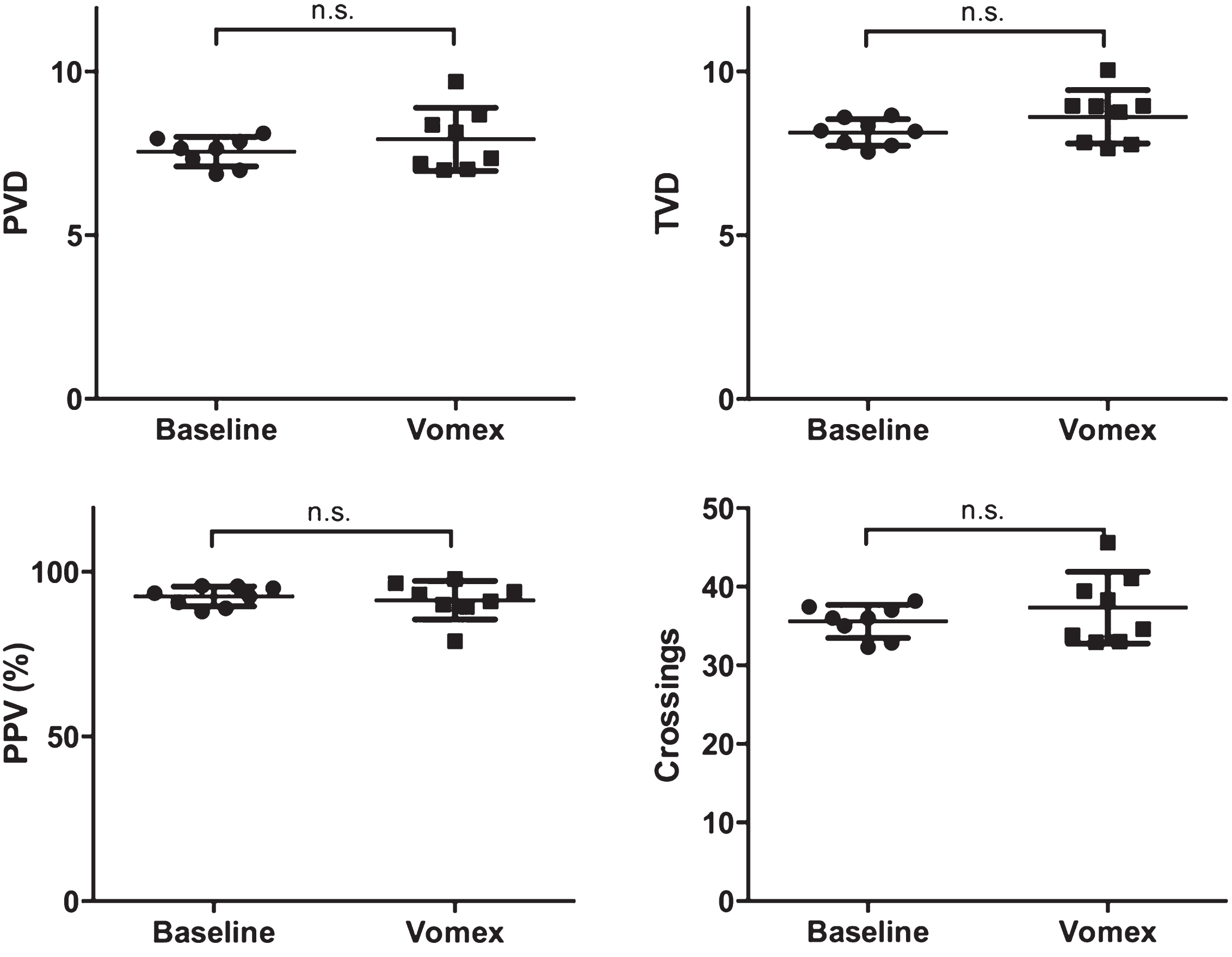
Results of testing the influence of the administration of the anti-emetic drug Dimenhydrinate (Vomex) on the microcirculation, obtained by evaluation of the microcirculation with Sidestream Darkfield (SDF) imaging, for n = 8 (PVD: Perfused Vessel Density, PPV (%): Proportion of perfused vessels, TVD: Total Vessel Density, Crossings: number of crossings of vessels recorded).
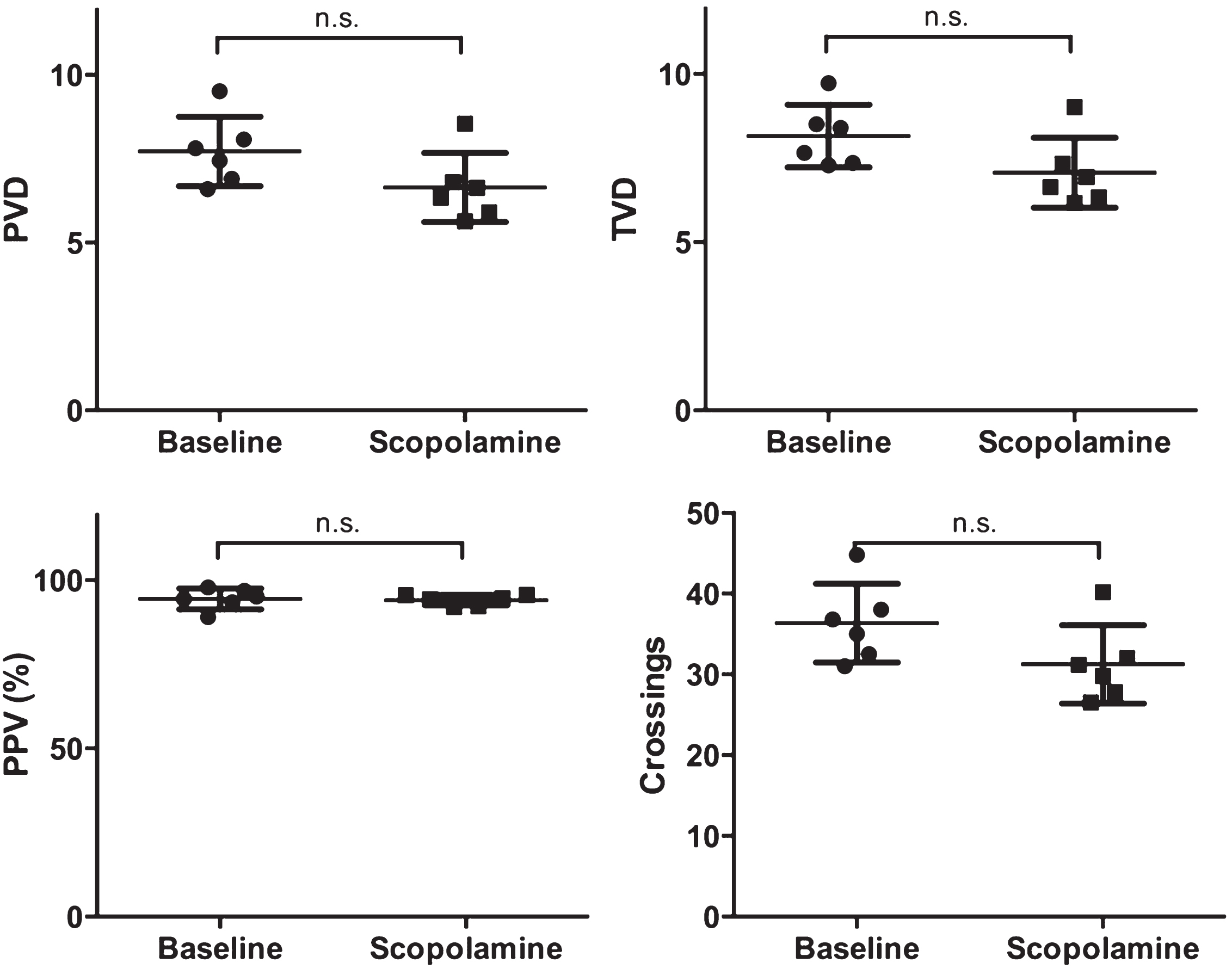
Results of testing of the influence of the administration of the anti-emetic drug Scopolamine on the microcirculation, obtained by evaluation of the microcirculation with SDF-imaging, for n = 6 (PVD: Perfused Vessel Density, PPV (%): Proportion of perfused vessels, TVD: Total Vessel Density, Crossings: number of crossings of vessels recorded).
Microcirculation is essential for tissue oxygenation, organ perfusion, gas metabolism and exchange of nutrients and waste products [15, 16]. In weightlessness, alterations of the macrocirculation are well known. However, data on the microcirculation is scarce.
In our study, we aim at improving the understanding of alterations of the microcirculatory system in weightlessness. Zero-gravity leads to multiple pathophysiological reactions and adaptations in organisms [3, 27]. As a direct consequence of exposure to weightlessness, astronauts experience a number of pathophysiological changes which can lead to serious medical implications [3, 7]. Most immediate and significant is a headward shift of body fluids, as part of the adaptive responses of the cardiovascular system during weightlessness [3, 11]. Furthermore, capillary structural changes have been described in response to weightlessness [6]. As shown with septic patients in previous studies on earth, mortality rates were increased with impaired microcirculation. Interestingly, in this setting, macrohemodynamical variables seemed not to be reliable markers of septic shock recovery. These findings support the assumption that the adequate function of the microcirculation is a prerequisite for adequate organ function. Accordingly, malfunctioning of the microcirculation might cause organ-dysfunctions leading to possible life-threatening dysregulations. With this in mind, the importance of further investigations on the microcirculatory function in weightlessness seems evident, for the prevention of microcirculatory dysfunctions in space missions of long duration [28, 29].
Prior to participation in a parabolic flight, the prophylactic administration of an anti-motion-sickness medication is strongly recommended. In our pre-Campaign-study, we aimed at evaluating potential effects of these drugs on the microcirculation. Our experiments showed no effect of anti-motion sickness therapy on the microcirculation, thereby ruling out a potential influence of the motion sickness therapy on our planned experiments.
The aim of our study during the planned Parabolic Flight Campaign will be to evaluate the microcirculation of healthy subjects in vivo and during parabolic flight maneuvers, to deepen the understanding of cardiovascular response mechanisms during weightlessness. The presented study protocol will be applied in the course of the Parabolic Flight Campaign in France in September 2017. The results observed will certainly enhance health-care on future space missions and might deepen our understanding of microcirculation on earth. Besides, our results might help optimizing both astronauts’ and day-to-day patients’ outcome.
Conclusions
We will thoroughly investigate the interrelations between the microcirculation and weightlessness. Based on our pre-study experiments reported in this paper, the application of motion sickness therapy does not alter the microcirculation and will therefore be applied during the experiments aboard the aircraft, to ensure optimized comfort of our test subjects in the course of the performance of the parabolic flight maneuvers.
The results observed in our investigation of the microcirculation in weightlessness will enhance health-care on future space missions and might deepen the understanding of microcirculation on earth. Our results might therefore optimize both astronauts’ and patients’ outcomes.
Footnotes
Acknowledgments
We would like to thank the German Aerospace center (DLR, Deutsches Zentrum für Luft-und Raumfahrt) as well as the German Federal Ministry for Economic Affairs and Energy for provision of means of support and funding for the conduction of the outlined study. Furthermore, we would like to thank NoveSpace in France as well as all study participants and investigators involved in this project, for their ongoing effort and support.