



Abstract
BACKGROUND:
Microvascular dysfunction is a main contributor to morbidity and mortality worldwide. Sophisticated technical tools (e.g. miniaturized hardware, automated software), along with skilled personnel are the prerequisite for quantitative observations of the microvasculature.
OBJECTIVE:
This review aimed to get an overview about on-going microcirculatory research in developing countries, particularly of the South-East Asia region for the last five years and to project the challenges faced in microcirculation research in developing countries.
METHODS:
Original research articles originating from 194 countries were searched in PubMed database on the field of microcirculation research for the last five years.
RESULTS:
Our findings showed that around 1800 articles have been published from developing countries compared to more than 5000 from developed countries on different aspects of microcirculation. The overall publication per million populations for developing countries was found to be 0.37 where for developed countries it was 3.62.
CONCLUSIONS:
Initiation and execution of sophisticated research in microcirculation is a demand of the time. Such research, initially, may seem unmanageable in developing countries with limited resources and infrastructure settings. Collaborative scientific projects may aid in establishing networks for microvascular research in developing countries.
Introduction
Adequate oxygen supply to every cell of the body represents one of the fundamental goals of the microcirculation. Microvascular dysfunction is a common occurrence in many diseases such as diabetes, cardiovascular diseases, and sepsis [1–5]. Impaired microvascular perfusion has also been observed in preeclampsia during pregnancy [6, 7]. Without early diagnosis and therapy, microvascular dysfunction can lead to major and potentially life-threatening complications.
Methods to study microvascular dysfunction have been established under different medical conditions. A number of technologies including Laser Doppler Flowmetry, Nailfold Videomicroscopy, and Sidestream Dark Field (SDF) imaging have made functional monitoring of microcirculatory perfusion possible at the bedside. Despite advancements in technology regarding quantitative analysis of the microvasculature, microvascular studies have not yet been established as a standard clinical practice. Main reasons are the lack of portable, miniaturized hardware and the need for reliable automated software. In addition, continuous microcirculatory monitoring, required to study treatment effects, is usually not feasible [8, 9].
Although many clinical studies are available from developed countries, developing countries are lagging far behind in microvascular research. In developing countries, significant challenges like limited resource settings and infrastructures, insignificant national budget allocation for research and other funding opportunities etc. are encountered by the researchers [10]. State-of-the-art research facilities are essentials for microcirculation research. Existing, underdeveloped infrastructure often leads to incomplete and inadequate clinical data which makes successful research impossible. In addition, the insignificant number of published papers from developing countries may reduce the interest of the advanced research community to carry out collaborative projects. Low funding opportunity is another disadvantage for research at national as well as international level. Insignificant budget is allocated for the research and development in developing countries, which results in impediment of advancement in health sector [11]. To execute high-quality impactful microcirculation research, expert human resource could play an important role in the design, development and implementation of the research. Unfortunately, lack of expertise is a bigger concern in the field of microcirculation research which involves the use of sophisticated techniques and expertise. Till date, no published literature has ever addressed the commonly faced challenges in microcirculation research in the developing countries. This review presents an overview on different aspects of challenges of microcirculation research in developing countries.
Methods
PubMed was searched for original research articles originating from 194 countries in the field of microcirculation research for the last five years. The search was performed during the months of January and February of 2019, with the last search made on February 15, 2019, to attain the overall perspective of research performed worldwide. The search strategies involved searching the PubMed database using the Medical Subject Heading (MeSH) terms: “microcirculation”, “kidney”, “heart”, “liver”, “diabetes”, “sepsis”.
Results
Table 1 presents the data collected on ratio of publication to million populations on microcirculation research for 109 countries from 2014 to 2019. Amongst the 109, 52 were developed and 57 were developing countries. On average, the ratio of publications per million population for developing countries was 0.37, whereas for developed countries it was 3.62 for the last five years.
Overall PubMed indexed publications per million of population (PPMP) for microcirculation research in different developing (n = 57) and developed countries (n = 52) from January 2014 to February, 2019
Overall PubMed indexed publications per million of population (PPMP) for microcirculation research in different developing (n = 57) and developed countries (n = 52) from January 2014 to February, 2019
St. Lucia, Saint Lucia; Korea, Dem Rep., Democratic People’s Republic of Korea; Macedonia, FYR, former Yugoslav Republic of Macedonia; Iran, Islamic Rep., Islamic Republic of Iran; Lao PDR, Lao People’s Democratic Republic; Egypt, Arab Rep., Arab Republic of Egypt; Congo, Dem. Rep, Democratic Republic of the Congo; Congo, Rep., The Republic of Congo. Population data was based on the World Population Prospectus 2017 by United Nations. The developing and developed countries were listed based on World Population Review 2019 and World Economic Situation and Prospects 2014.
Further continent wise analysis of the total number of publications on microcirculation research indexed in PubMed for the last five years is shown in Fig. 1. The most publications from the developed countries (3291) came from Europe whereas the highest number of reports on microcirculation research from developing countries (1047) was from Asia.
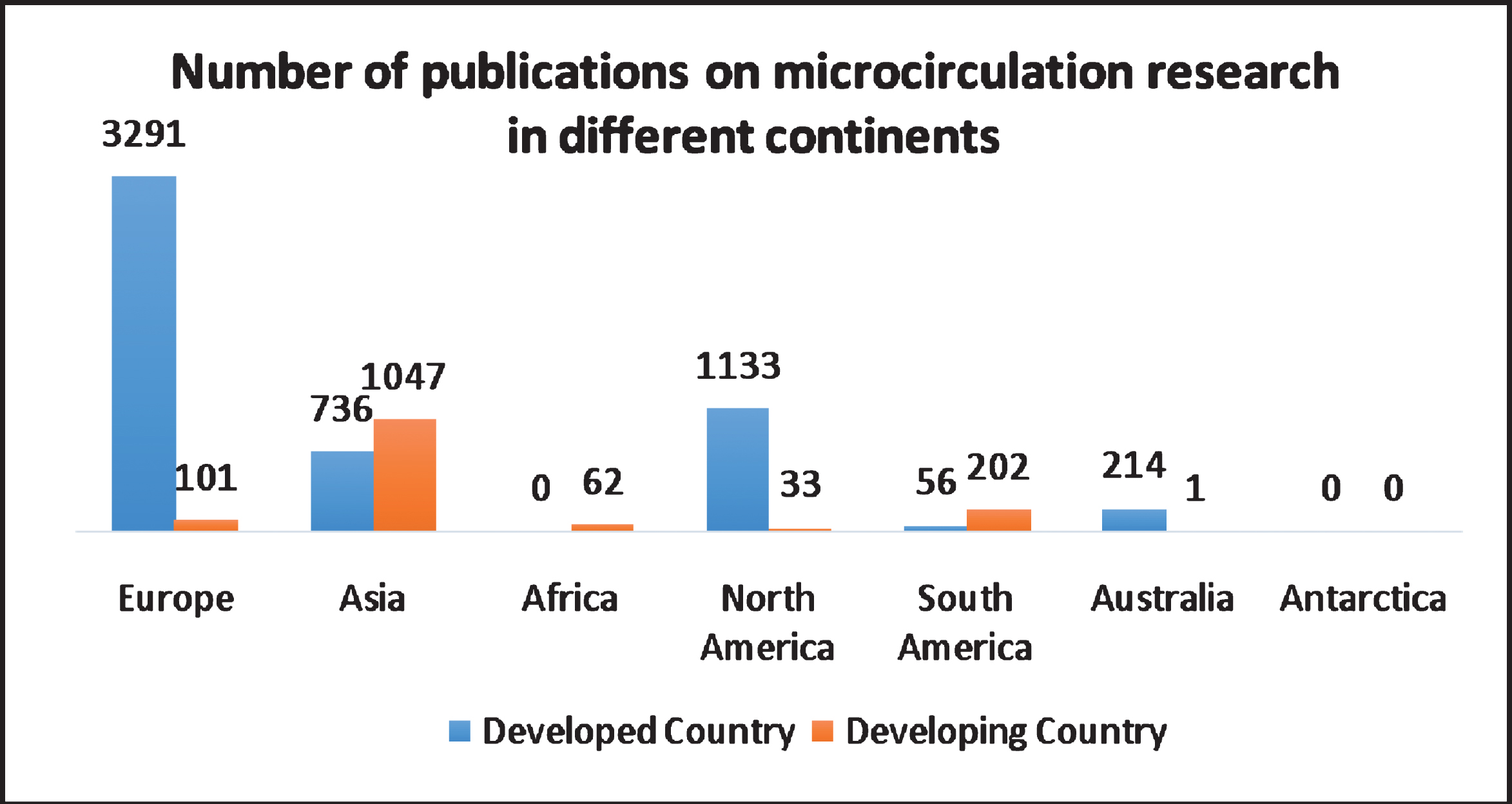
Number of publications on microcirculation research in different continents from January 2014 to February, 2019.
Table 2 presents the number of publications from Asian countries from 2014 to 2019 on microcirculation research. Among the Asian countries, twenty-five published less than 10 articles and three countries published more than 100 articles in last five years.
Number of publications from Asian countries (January, 2014 to February, 2019)
Figure 2 denotes the techniques used to study the microcirculation, diseases related to microcirculatory changes and organs affected by microvascular dysfunction studied by South Asian researchers. The majority of the research work used non-invasive techniques (Fig. 2a) and the most studied diseases for microcirculation were malaria and diabetes (Fig. 2b). The most studied organ system for microcirculation research was blood and cardiovascular system (Fig. 2c).

(A) techniques, (B) diseases and (C) organs focused in microcirculation research conducted and reported by South Asian Researchers from January 2014 to February, 2019.
The literature search in PubMed revealed that the number of research articles published by developed countries in the last five years was higher in comparison with that of the developing countries. To answer the question, why developing countries are behind in carrying out microcirculation research, we identified a number of challenges faced by the developing countries in microcirculation research.
Limited technical infrastructure
In developed countries microcirculation researcher usually have access to sophisticated imaging techniques and modern hard and software to analyze microcirculatory data whereas older hardware and manual analysis methods are often used in developing countries which can give rise to erroneous outcomes.
Routine validation, evaluation and updating of the methods, instruments and available facilities involved play a crucial role in microcirculation research [8, 9]. Different techniques such as orthogonal polarization spectral (OPS), sidestream dark field (SDF) and incident dark field (IDF) imaging have been developed for microcirculatory imaging [4–8]. Such imaging techniques are non-invasive and widely used for superficial tissues such as sublingual and buccal mucosa analysis [12]. Analyzing software is continuously improving with a clear trend to automated approaches [13]. Implementation of such imaging and analyzing techniques is still hardly feasible for the developing countries [14]. For more quantitative analyses such as measuring the proportion of oxygenated and deoxygenated hemoglobin in tissues, sophisticated devices like near-infrared spectroscopy (NIRS) has been developed [15–17]. However, application of such expensive technologies in research is often not feasible in the context of developing countries.
Inadequate hospital resources
Since adequate clinical data are the prerequisites for a successful study, limited hospital resources often hinder high quality clinical studies in developing countries. For example, in angina and cardiogenic shock - two commonly occurring, serious medical conditions in emergency departments, microvascular parameters can be studied along with important biomarkers, e.g. troponin to generate novel scientific data. However, in developing countries, such clinical tests are rarely referred to those patients. As another example, detection of poor peripheral perfusion also plays a vital role for treating children with septic shock [18]. However, the limited resource setting in developing countries makes it difficult to treat these vulnerable patients [19].
Lack of collaborative research between developing and developed countries
The collaboration of the experienced scientists from the field of microcirculation research with the medical faculties of the developing countries can open the door for knowledge exchange, channeling opportunity and resources to conduct quality research on microvascular diseases. The peer scientists from the developing countries can make an impact on collaborative research by providing local data, support, and contextual knowledge and skills [20]. A report published in 2004 states that, developing countries are the hub of only 27% of the total researchers of the world [21]. Integration of this nominal yet prominent portion of the scientists in the international community of the researchers from the developed countries could have a positive influence on the practice of science and research [21]. In addition to the research integration, microcirculation researchers from the developing countries should be brought under the attention of the international research community to attract potential collaborators [22]. A study on the published research on health and medical topics from the year 1991 to 2001 in the Institute for Scientific Information reported that only 1.2% of the total published research works were from South Asian researchers. This is indicative of the limited sharing and conduction of medical research in the developing countries which attributed to the failure of drawing the attention of the advanced research community for collaboration [20, 22]. Nevertheless, in the absence or with limited national funding in the developing countries for research, collaborators from the developed countries might impel the investigators from the partner developing countries to accept the research plan set by the collaborators which could result in a vertical research relationship [23]. Due to such demands from the partnered countries on the participant developing countries, it might impede the process of establishing any estimable project plan. But in long run, high impact research would be much achievable through the development of the equitable research partnership [24].
Low funding opportunities
The low funding opportunity is another major drawback at both institutional and national level for the developing countries. At the national level, government planning for the fiscal years often allocates an insignificant portion of the budget for research and development since other national issues related to electricity, water, transportation etc. are prioritized. Apart from that, the political turmoil, unstable economy and dependency on foreign aid to support the deficient amount of the fiscal budget plan can also contribute towards the unwillingness or inability of the government to fund such intricate research works [25].
Research units at the institutional level are often unsuccessful in the bridging of good understanding and relation with the national policymakers in the developing countries. As a result, the government-funded projects are found to be limited which directs the reliance on international funding on the rise. In addition to these, the key focus of investments in medical universities and colleges is mostly to meet up the basic requirements for patient treatment and care rather than medical research. According to the Global Forum for Health Reports, merely 10% of the research fund is utilized on worldwide health issues and merely 5% of such funding is spent on addressing medical and health research for the developing countries [25, 26]. Lack of coherence, resource allocation and mobilization and most importantly investments have been contributing towards the low medical research output particularly on very sophisticated fields like microcirculation [27]. Above all, every country and government must realize the impact of medical research on improving the life expectancy of their people and bolster the biomedical researcher community to carry out impactful research [28].
Lack of skilled human resources
Disturbances in the microcirculation are early indicators for many different diseases. Microcirculation research has been distinguished as an interplay between theoretical modeling, system biology or otherwise stated as computational modeling, experimental modeling [29, 30]. Since it is an interdisciplinary science, researchers from physics, engineering, medical sciences background have been playing a pivotal role in research [29]. However, in case of developing countries where constricted funding has become one of the major concerns for carrying out such complex research, lack of expert human resources could also be much of a bigger concern [23]. To execute high-quality impactful microcirculation research, senior investigators could play a vital role in the design, development and implementation of the research while training the younger investigators through recruitment in the projects and sustain the research activity on the field of microcirculation research. Unfortunately, this has not been a common scenario especially in the field of microcirculation research which involves the use of sophisticated techniques and expertise. Lack of funding, inappropriate infrastructure, and inappropriate remunerations may drive the researchers on such fields to pursue their research career in the developed countries where ample opportunities are provided. As such, “brain drain” to developed countries has been one of the root causes behind the inadequate number of expert researchers on microcirculation in the developing countries. A number of times different schemes have been planned to promote research-oriented career through research awards and supplementation of researcher’s salary but none of these approaches were systematically evaluated [27, 31]. Intellectual isolation may also play a role in the undeveloped expertise of human resources on microcirculation research though through the use of web services and involvement with national, regional and global networks such isolation can be eradicated.
Additionally, the microcirculation research is not limited to hospital setting or laboratory set up but mostly interplay of both the setups. Expert human resources are indispensable in both the framework and only rudimentary training to develop such skills will not be enough to meet the needs of skilled technicians [29]. Another reason behind the inadequate number of research experts on microcirculation research could be overburdened medical researchers with mundane duty tasks which leaves minimum time and effort to get engaged in research and skill development [32].
Conclusion
The challenges faced in microcirculation research seem formidable in the developing countries but still there are vast opportunities to get involved in research. A number of universities in the developed countries and renowned research groups have been working hand in hand with the researchers from the developing countries to come out with more accessible, easy to operate on resource limited setting techniques and equipment [33]. Leading funding bodies such as Melinda Gates foundation, Welcome Trust, the Elsevier Foundation, International Foundation for Science have supported researchers from science and medical research fields in the developing countries to implement research on the relevant fields. The requirements to execute sophisticated microcirculation research may not be obtainable and manageable in many developing countries with limited resource settings and infrastructure but collaborative research projects could benefit the microcirculation researchers from the developing countries which may aid in fostering research network build-up and improving isolation of the researchers [32]. Liberating the medical researchers from on duty calls and tasks and offering them a research dedicated career with respectful remuneration would be able to enhance the involvement in the microcirculation research [32].