



Abstract
BACKGROUND:
Motorsport karting has developed into a professional international competition. Kart racing poses a unique set of physiologic challenges for athletes who compete in this sport. Until today no major study has evaluated the physical and cardiac challenge in professional kart racing.
OBJECTIVE:
The aim for this study was to measure and analyze heart rate and cardiac rhythm by a mobile, smartphone based ECG (s-patch) on professional kart-race-drivers during actual karting races through annual seasons to test the hypotheses that high g-force and stress could trigger cardiac arrhythmia.
MATERIAL AND METHODS:
ECG-data from kart-drivers were acquired during local races, the ADAC Kart-Masters (KZ2), the German Kart Championship (DSKC) and the European Championship Senior CIK-FIA-Serie and analyzed in this observational study. In total, free practice, qualifying practice and 32 races were assessed during the kart season 2019. Data were interpreted by two independent experienced physicians.
RESULTS:
The average heart rate (HR) during a selected German Kart Championship (DSKC) race in Genk (Belgium) was 169 beats min-1. The longest R-R interval was 0.72 sec. The average HR during a selected European Championship CIK-FIA-race in Lonato (Italy) was 160 beats min-1. The longest R-R interval was 0.74 sec. The average HR during a selected ADAC Kart-Masters (KZ2) races in Wackersdorf (Germany) was 147 beats min-1. The longest R-R interval was 0.86 sec. In total 32 races could be recorded successful. No couplets or bigeminy cycles were detected. In one other kart racer a supraventricular extrasystole and a ventricular extrasystole was detected. Interestingly, kart-drivers were found to have sinustachycardia throughout the races most likely triggered by emotional and physiological stress during speeding.
CONCLUSION:
Professional kart racing drivers had sinustachycardia with heart rates up to 193 beats min-1 during races. This is most likely attributed to a considerably high emotional and physiological stress affecting the cardiovascular system. Episodes of tachycardia positively correlated with mean speed. In the warm-up lap the heart rate was significantly lower in comparison to the race, suggesting that faster driving speed would induce greater cardiovascular stress to professional drivers during actual races. The experimental results showed that the proposed S-patch system provided a good ECG signal quality with accurate measurements even during the kart race and could detect the ECG features of the race in real time. The cardiac interpretation software performs well and is a useful tool to assist clinicians.
Keywords
Introduction
Motorsport has evolved from the recreational level into a high-profile international sport attracting millions of viewers worldwide [1–3]. The major goal of a racing driver is typically to achieve the fastest possible lap time by driving the vehicle at the limit of tire grip in an optimal manner [3–5]. Unlike the extensive body of knowledge on the technological aspects of racecars, comparatively little is known about the physiological changes appearing in race car drivers including cardiac arrhythmias [3, 6–8]. Knowledge of these changes may aid in designing training methods for racing drivers and improve driver-vehicle interfaces for not only motorsport applications but also road vehicles [3, 9–11].
Motorsports karting athletes, by the age of at least 15 years, can drive at a speed up to 165 km/h during races in the KZ class, by using a 125 cc motor with a 6-speed sequential gearbox. The engine power is up to 40 KW in the KZ2 class, at 15,000 rpm revolutions per minute. Depending on the race type the maximum length of a single race is up to 20 minutes. The maximal g-force during races is up to 4 g [12].
Professional and competitive sports training can lead to reversible physiological changes in the heart. These changes can manifest by various electrocardiographic alterations mimicking changes seen in patients with structural heart disease [13]. We undertook this study to assess the prevalence of abnormal Electrocardiogram (ECG) in motorsports karting. The present study measures heart rate (HR) and ECG changes (regular or irregular rhythm, supraventricular or ventricular ectopic beats, morphology of QRS complex) on professional karting drivers during actual karting races through annual seasons to test the hypotheses that faster speed and emotional stress in combination with a high g-force may have an influence on cardiac rhythm and trigger arrhythmias.
Material and methods
ECG-data from kart-drivers were acquired during local races, the ADAC Kart-Masters (KZ2), the German Kart Championship (DSKC) and the European Championship Senior CIK-FIA-Serie and analyzed in this observational study. In total, free practice, qualifying practice and 32 races were assessed during the kart season 2019. Data were interpreted by two independent, experienced physicians.
S-patch cardio
The Wellysis S-Patch Cardio solution is a cloud based, single channel, ECG monitoring solution with a mobile device gateway. The solution uses the latest Sensor, Mobile and Cloud Technologies to take healthcare out of the hospital and follow patients and providers as they go about their everyday lives. The S-Patch is a light weight 11 grams, reusable, ECG monitoring solution compatible with industry standard components. Samsung’s proprietary Bio-Processor is the key component powering the S-Patch. The heart rate (HR) measurement covers a range from 30∼280bpm @250HZ. A single conventional C 2032 battery will be used and allows covering 72 hours for events. The mobile application displays ECG and heart rate in real time and allows for paperless symptom and activity logging. The system needs a full android device support. For ECG-data analysis the Cloud Platform utilizes machine learning to decrease analysis time and allows for convenient provider access to test results. After data collection the Cloud based Technologies stored all data and generate a full cardiac report which can be stored on the system or sent as a PDF.
In the present study an S-Patch Cardio ECG was attached to professional kart driver during actual kart races through annual season to test the hypotheses that the stress during training session and races would induce higher HR and might lead to arrhythmias (Fig. 1A, B).
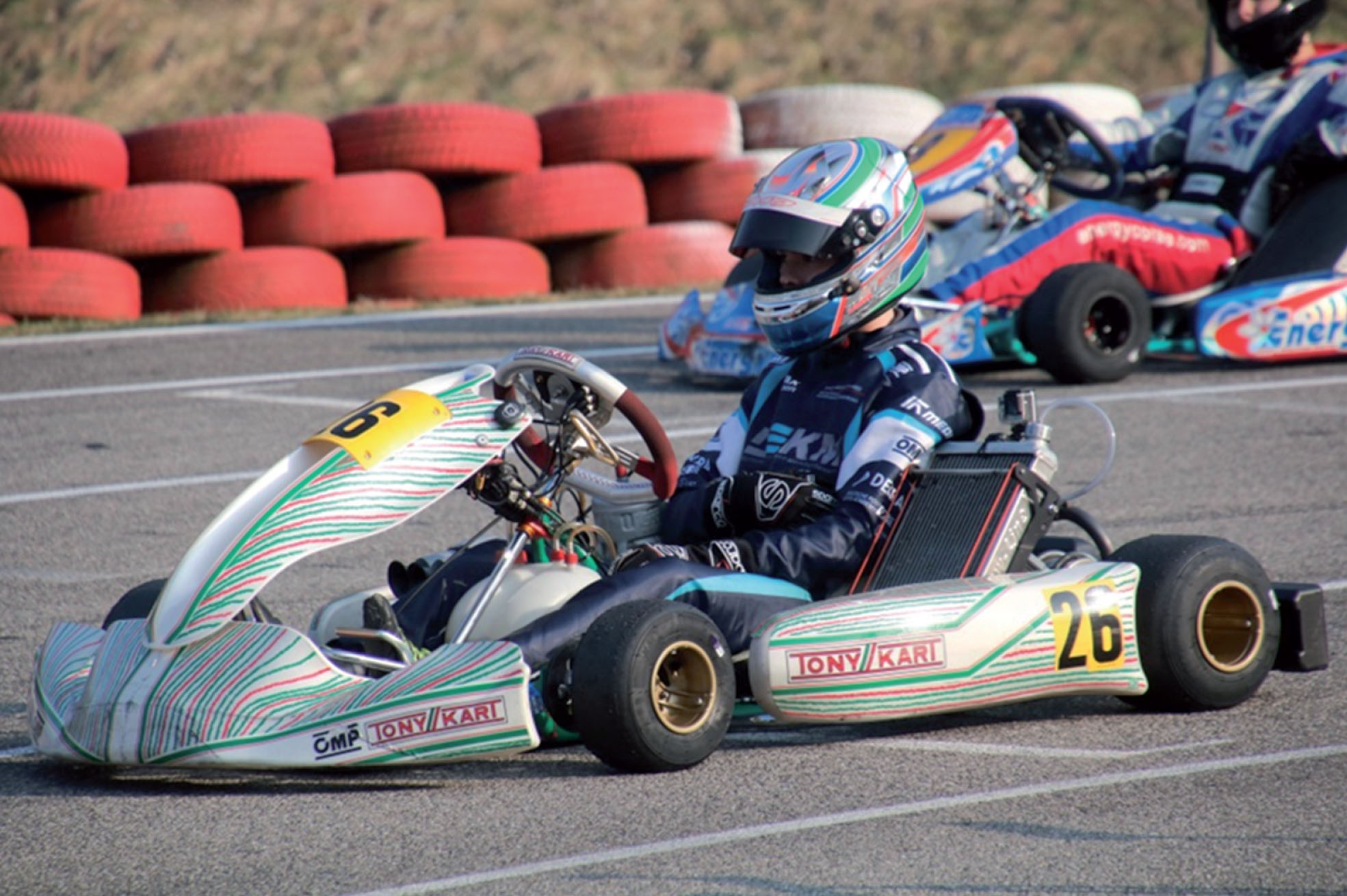
A: Kart-racing is a demanding sport and a speed of up to 165 km/h can be reached during races putting kart-drivers under physiological and emotional stress. One of our drivers is sitting in his Kart ready for the race.
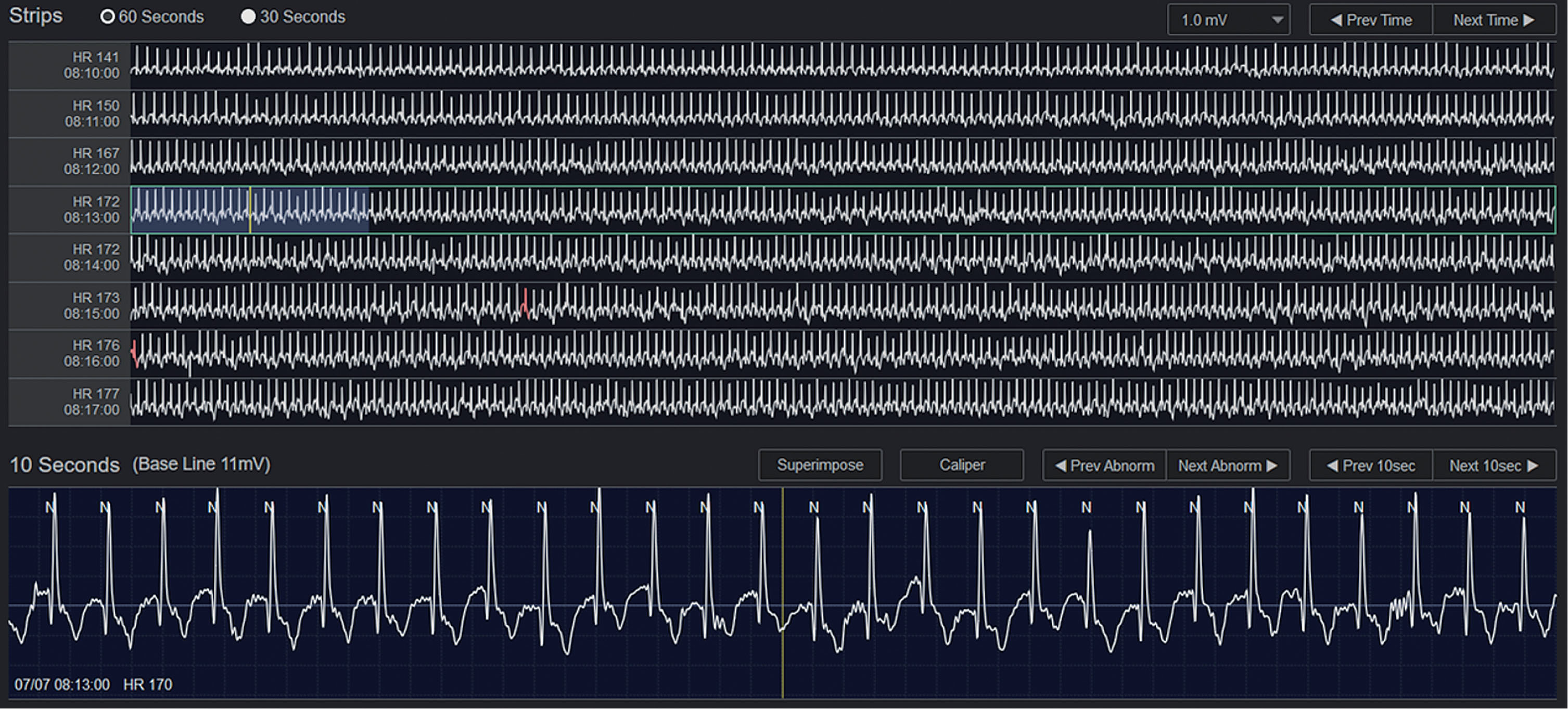
B: ECG of Kart-driver 1 during a race showing sustained sinustachycardia with 170 beats min-1 recorded with the Cardio S-Patch. The ECG shows only mild artifacts considering the shaky surroundings in a racing-kart and the QRS morphology and regularity can be securely assessed.
Each ECG was interpreted for rate and rhythm. Particular attention was paid to R-R interval, QRS duration (milliseconds), regular vs. irregular rhythm and ectopic beats. Standard diagnostic criteria were used to define various ECG abnormalities [14–17].
The purpose of this study was to review the major physiologic challenges of kart racing and summarize what is currently known about athletes in this sport. Further, we wanted to test the S-Patch Cardio ECG device under unfavorable conditions and assess its accuracy in detecting rhythm disturbances.
Our male, healthy athletes were monitored during races with the S-Patch system. Electrodes were positioned on the chest (Fig. 2A). 12-channel resting ECG of driver one showed a normal heart rate, normal conduction times and a normal QRS morphology (Fig. 2B).
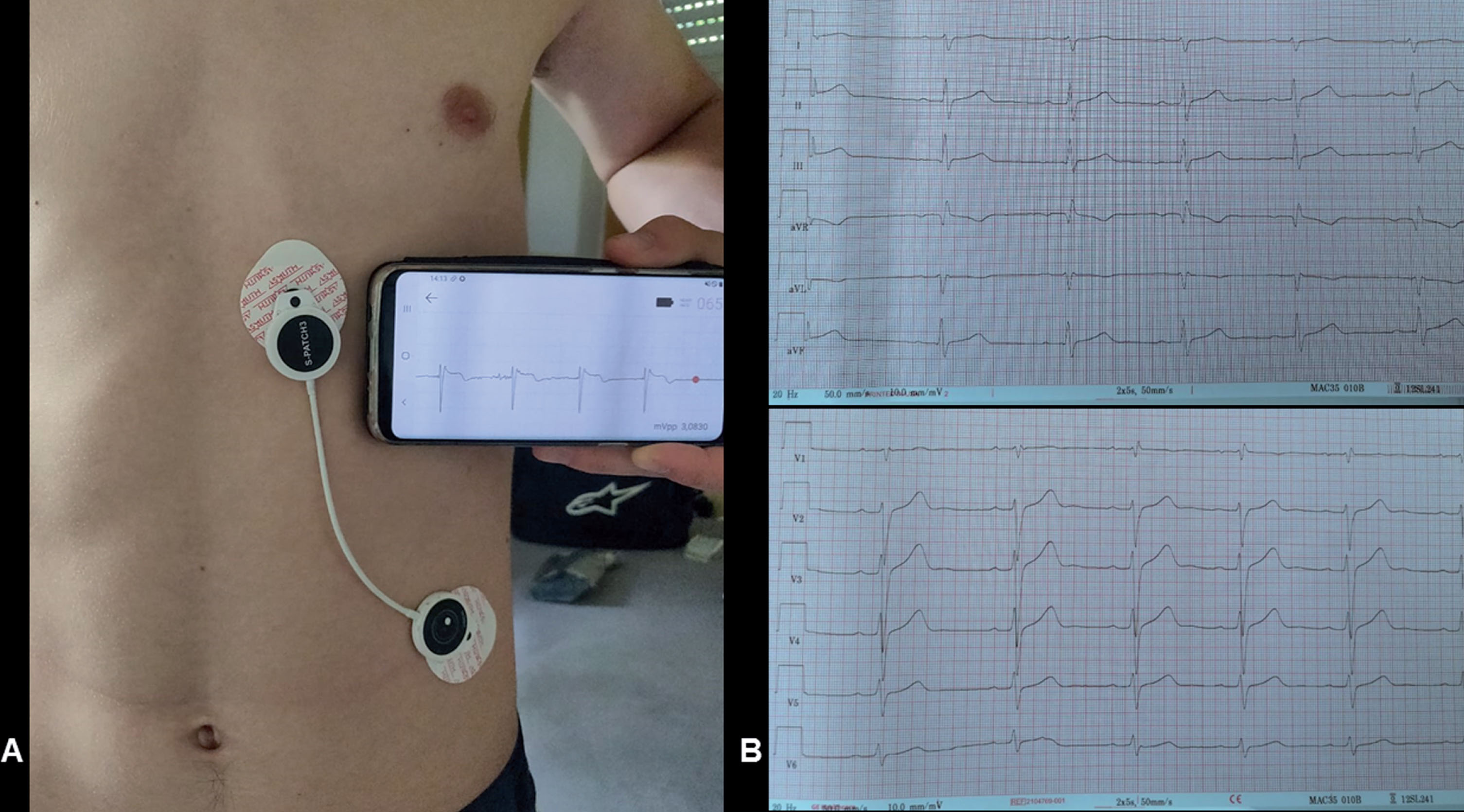
S-Patch Cardio ECG device and normal 12-channel ECG in driver 1. A. Positioning of the ECG electrodes for the S-Patch Cardio ECG lead to analyze the heart rhythm during cart races. B. Normal 12-channel ECG of 16y old male driver 1 showing sinus rhythm with a heart rate of 67 beats min-1, no pathological axis deviation, normal PQ interval, QRS duration and QTc duration.
We detected sinustachycardia in driver one throughout the races (Fig. 3A, B, C).

Sinustachycardia during races in driver 1: A. ECG registered at the beginning of the ADAC-Kart Master Wackersdorf, Germany race showing sinustachycardia with 111 beats min-1. B. In the first phase of the European Championship CIK-FIA-race, Italy sinustachycardia with 172 beats per min-1 was recorded. C. In maximum speed stretches sinustachycardia with over 180 beats min-1 was present in the German Kart Championship (DSKC) races in Genk (Belgium).
The average HR during a selected ADAC Kart-Masters (KZ2) training session in Wackersdorf (Germany) was 124 beats min-1 with a minimum of 71 beats min-1 and a maximum of 184 beats min-1. The longest R-R interval was 1.04 sec.
The average HR during a selected ADAC Kart-Masters (KZ2) races in Wackersdorf (Germany) was 147 beats min-1 with a minimum of 88 beats min-1 and a maximum of 188 beats min-1. The longest R-R interval was 0.86 sec.
The average HR during a selected German Kart Championship (DSKC) training session in Genk (Belgium) was 128 beats min-1 with a minimum of 78 beats min-1 and a maximum of 164 beats min-1. The longest R-R interval was 0.99 sec.
The average HR during a selected German Kart Championship (DSKC) race in Genk (Belgium) was 169 beats min-1 with a minimum of 95 beats min-1 and a maximum of 193 beats min-1. The longest R-R interval was 0.72 sec.
The average HR during a selected European Championship CIK-FIA- training session in Lonato (Italy) was 144 beats min-1 with a minimum of 84 beats min-1 and a maximum of 184 beats min-1. The longest R-R interval was 0.84 sec.
The average HR during a selected European Championship CIK-FIA-race in Lonato (Italy) was 160 beats min-1 with a minimum of 89 beats min-1 and a maximum of 184 beats min-1. The longest R-R interval was 0.74 sec.
We detected sinustachycardia in driver one throughout different races, at the ADAC Kart-Masters (KZ2), at the German Kart Championship (DSKC) and European Championship CIK-FIA-race. In total 32 races could be recorded successfully.
Driver two showed sinustachycardia during races with heart rates similar to driver one (Fig. 4A). In driver two, mild rhythm irregularities such as a singular ventricular extrasystole (VES) or singular supraventricular extrasystoles (SVES) occurred (Fig. 4B, C).
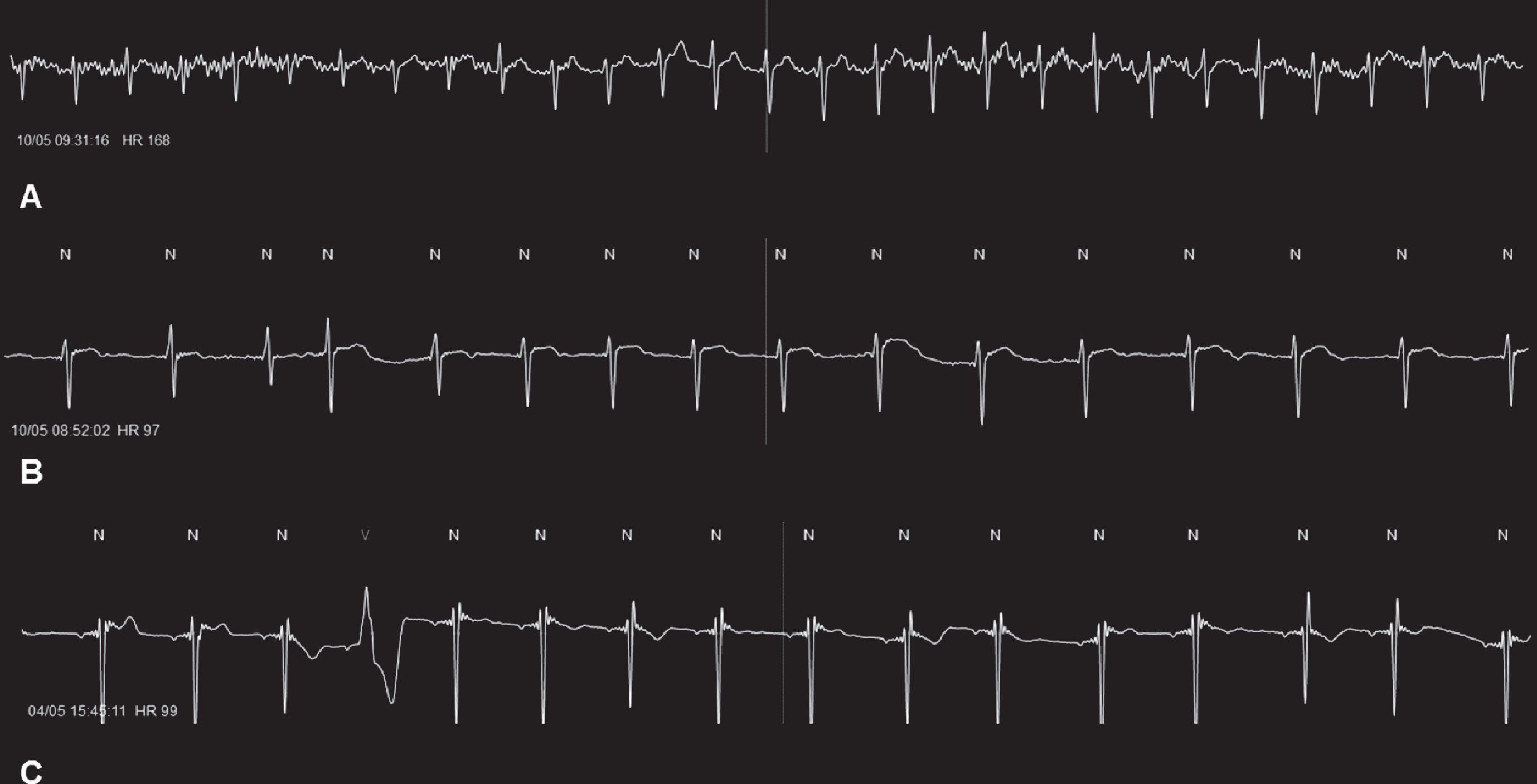
Sinustachycardia and mild rhythm disturbances in driver 2 during kart-races. A. ECG registered at the DKM-Kart Race in Wackersdorf showed sinustachycardia with 168 beats min-1. The shaking surroundings in the kart cause irregularities of the isoelectric line. B. A supraventricular ectopic beat was recorded during a race. Due to the narrow QRS complex the ectopic beat can be securely identified as a supraventricular extrasystole. C. This ECG stretch shows a ventricular ectopic beat during a race. The wide QRS allows to identify the extrasystole as a ventricular extra beat.
Fortunately, no threatening arrhythmias such as ventricular tachycardia, cumulated ventricular ectopic beats, ventricular or supraventricular runs or episodes of atrial fibrillation or atrial flutter have been found in our collective of young and healthy athletic kart-drivers. Further, our drivers did not experience chest pain, dizziness or palpations during races.
In our observational study investigating the heart rhythm and presence of arrhythmias in professional, young athletic kart-drivers, we found that driving a racecar induced sinustachycardia with up to 193 beats min-1. Interestingly, racing at a higher speed was significantly associated with a higher heart rate. These results are in line with previous studies where increased heart rates in racecar drivers have been detected and a correlation with the racing speed has been found [17, 18]. Further, previous studies identified cabin temperature to correlate with oxygen consumption and elevated heart rates [20, 21].
The effect of emotional stress on the cardiovascular system is well known with even life-threatening cardiovascular disease after exceedingly stressful events or episodes [22–24]. The emotional stress while racecar driving has been suggested to contribute to increased HR in previous studies [19, 25]. Our results, showing that the average heart rate is higher in actual races compared to trainings, is in line with these observations. We conclude that emotional stress contributes to a further increase in heart rate and cardiovascular responses in our athletes.
We used a smartphone-based S-patch Cardio ECG device weighting 11 grams, which proved to be appropriate for ECG measurements. Reports showed correct measurements of the heart rate and R-R intervals. The ECG signal is quite crisp despite the shaky environment and QRS complexes can easily be identified and the morphology can be assessed. Errors occurred in the detection of ventricular ectopic beats or ventricular tachycardia with the automatic analysis. In a visual analysis of the recorded ECGs during races we found singular VES and SVES in one of our drivers. No harmful rhythm disturbances such as ventricular tachycardia, cumulated ventricular ectopic beats, ventricular or supraventricular runs or episodes of atrial fibrillation or atrial flutter have been found in our young and healthy athletic kart-drivers. In some ECG recordings the automatically prepared report mistook artifacts for such findings. Thus, a visual review of all ECG reports was necessary.
Conclusion
The cardiovascular system of professional kart-drivers is considerably stressed during races. Kart-drives had sinustachycardia with up to 193 beats min-1 while driving and the high average HR positively correlated with mean speed ratio, suggesting that faster driving speed induces greater cardiovascular stress during actual races. We also found that the average HR was higher in competitive racings than in training, suggesting that emotional stress adds on as a stress factor for the cardiovascular system.
Mild rhythm irregularities such as a singular VES or singular SVES were detected during races. Fortunately, no threatening arrhythmias were found in our young and healthy athletes and no chest pain episodes, dizziness or palpitations occurred.
Our data show an interesting response of the cardiovascular system to speed and emotional stress in professional kart-drivers during races. Fortunately, effects on the heart rhythm in this study were harmless. Sinustachycardia was more pronounced than expected in our drivers, most likely caused by a combination of physiological challenge and emotional stress.
Further, the S-Patch Cardio ECG proved to be a reliable mobile, smart-phone based ECG monitoring device even under difficult conditions in a shaky environment.