




Abstract
Sickle cell anemia (SCA) is a genetic disorder characterized by chronic hemolysis and the presence of erythrocytes with low deformability, which may trigger vaso-occlusive crises. We tested the in-vitro effects of aqueous extract of chives (Allium schoenoprasum L.) on erythrocyte deformability of SCA patients. Blood samples from 6 apparently healthy volunteers and 5 SCA patients were collected into heparin coated tubes. Both apparently healthy and SCA patient blood samples were incubated with 80μg/mL chives plant aqueous extract at 37°C for 60 min and erythrocyte deformability was measured by ektacytometry (3 Pa and 30 Pa; 37°C). Results of incubation of apparently healthy blood samples with plant extract showed that incubation did not alter erythrocyte deformability significantly. However, for SCA blood samples, erythrocyte deformability decreased significantly with plant extract exposure at 3 Pa (p < 0.043) and 30 Pa (p < 0.043). In conclusion, although ex-vivo incubation with plant extract does not fully model gastrointestinal processing of onions, the decrease in SCA erythrocyte deformability following incubation with aqueous chives should stimulate further studies to test the in-vivo effects of this diet in sickle cell mice.
Introduction
Sickle cell anemia (SCA) is a genetic disorder where hemoglobin S (HbS) polymerizes under deoxygenation, leading erythrocyte to sickle (sickling). Sickled erythrocytes have lower deformability, which may cause vaso-occlusive crises and other acute and chronic complications [1, 2]. The reduction in erythrocyte deformability is also at the origin of the increased erythrocyte fragility and enhanced hemolysis [3]. Oxidative stress also plays a key role in the pathophysiology of SCA by participating to the progressive development of vascular dysfunction [4–6]. Oxidative stress also affects red blood cell rheology, such as deformability and aggregation [7].
Nutrition is an important factor which modulates individual health since diet includes various substances, which may have pro- or antioxidant effects. Especially, plants included in diet are important sources of antioxidants [8]. Onions (genus Allium L.) belong to Liliaceae family and are important plants for their food and culinary properties. There are about 500 different species worldwide known for their anti-bacterial, anti-microbial, anti-fungal and anti-cancer properties [9]. Their sulfur containing active substances are advised for cholesterol lowering, anti-diabetic and fibrinolytic properties, which all account for their cardiovascular benefits [10, 11]. In addition garlic was shown to exert an antiaggregation property on platelets and its powder has an impact on cutaneous microcirculation [12, 13]. Ingredients of allium species are accepted as important nutraceuticals [14]. Among allium species, Allium schoenoprasum was studied in detail. A.schoenoprasum leaves has anti-inflammaroty activity [15]. In a study conducted by Stajner et al. [16], all edible parts of A.schoenoprasum plant were shown to have antioxidant activity. Highest activity was found in leaves of A.schoenoprasum that contain steroidal glycosides, which have cytotoxic activity against colon cancer lines [17]. Among the edible allium species, onion, garlic, leek and chives are the best known plants [18]. However there are some reports for untoward effect of some of the allium species. These effects mainly concentrate on hematologic effects. Heinz body hemolytic anemia with eccentrocytosis was reported in dogs following ingestion of Chinese chive (Allium tuberosum) and garlic (Allium sativum) [19]. The authors observed a rise in methemoglobin level and considered this as a result of oxidative damage to erythrocytes by ingredients of those allium plants, a result strengthened by another study [20]. Such hematological untoward effects, mainly hemolytic anemia, were also reported in various different animal species. Untoward effects of onion ingestion were presented in very early times [21, 22].
Since onions are used as a food ingredient in various cultures, evaluation of their effects on SCA patient needs to be assessed. This small study was aimed to investigate the in-vitro effect of aqueous extract of chives (Allium schoenoprasum L.) on erythrocyte deformability of SCA patients.
Materials and methods
Plant extract
Aerial parts of chives samples were powdered and then extracted with distilled water at room temperature for 1 hour. After aqueous extract was obtained, this extract was lyophilized for 24 hours under vacuum conditions. Obtained dry powder was used in experiments. Powder was dissolved in phosphate buffered saline (PBS). Plant extract lyophilizate was added to apparently healthy and SCA patient blood samples to obtain a final concentration of 80μg/mL. This concentration is set according to existing literature concerning ex-vivo incubation of erythrocytes with plant originated extracts [23, 24].
Hemorheological study
Study was conducted in Lyon 1 University and Edouard Herriot Hospital. Ethical permission from local ethics committee was obtained (“Hospices Civils de Lyon—CPP Est” Ethics committee; L14-127). Blood from 6 apparently healthy volunteers and 5 SCA patients was collected into heparin coated tubes. Both apparently healthy and SCA blood samples were incubated with 80μg/mL, chives plant aqueous extract diluted in PBS at 37°C for 1 hour and erythrocyte deformability was measured by ektacytometry (3Pa and 30Pa; 37°C) (LORRCA, Mechatronics, The Netherlands). Erythrocyte deformability was also measured after incubation for 1 hour at 37°C with the vehicle, i.e. in PBS only (control condition). Comparisons were performed between the control condition and the 80μg/mL plant extract condition within each group (apparently healthy individuals or SCA patients). International guidelines for hemorheology were followed [25].
Statistical analysis
Data were evaluated with a Mann-Whitney U test for unrelated samples and with a Wilcoxon test for related samples. Results are expressed as mean±SEM. Statistical significance was defined as p < 0.05. SPSS Windows 20 was used for statistical analysis.
Results
Erythrocyte deformability was decreased at both 3 and 30 Pa in SCA patients compared to apparently healthy individuals (p < 0.001). Results showed that chives plant extract did not significantly change erythrocyte deformability in apparently healthy individuals (p > 0.05). In contrast, erythrocyte deformability significantly decreased with chives plant extract in SCA patients (p < 0.05).
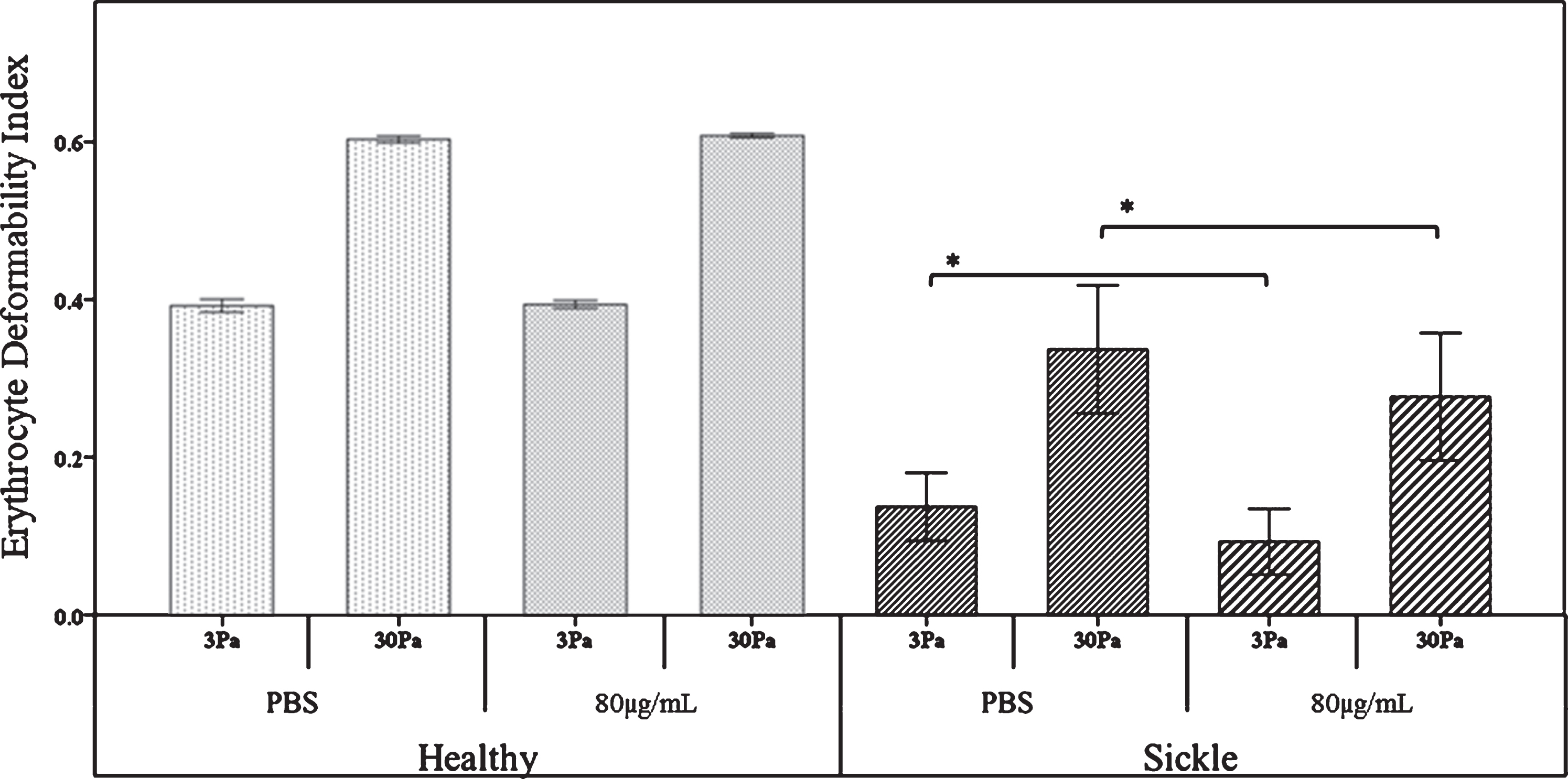
Effects of chives plant aqueous extract incubation on erythrocyte deformability measured at 3 and 30 Pa in apparently healthy individuals and SCA patients. Difference between control (PBS) and chives extract incubation conditions within the SCA group: *p < 0.05.
Our results showed that in-vitro incubation with plant extract slightly impaired erythrocyte deformability in SCA patients but not in apparently healthy individuals. Literature findings on Allium (onion and garlic) species showed that Allium species increased erythrocyte osmotic fragility (especially in vitro), Heinz body formation and concentration of methemoglobin, which was thought to result from oxidative damage to erythrocytes caused by some constituents of these Allium plants [20]. In an experimental study, feeding of dogs with cooked onions for 2 days caused anemia [26]. The authors found a significant decrease in hematocrit after 5 days of ingestion as well as an increase in plasma bilirubin and urobilinogen levels. In addition, a decrease in glucose-6-phosphate dehydrogenase, glutathione and an increase in malondialdehyde level were reported, suggesting increased oxidative stress caused by onion ingestion. Intragastric administration of garlic (5 gr of whole garlic/kg bwt) caused eccentrocytes in dogs [27]. Accumulation of hemosiderin in hepatocytes, Kupffer cells of the liver, macrophages, and renal tubules, as well as anemia, were reported in experimental feeding of white Chinese geese (Threskiornis spinicollis) with green onions [28]. Methemoglobinemia and hemolytic anemia were reported from a herd consumed approximately 20 kg onions/cow/day for 6 weeks [29]. Heinz body formation was reported in cats fed with baby food containing onion powder [30]. Garlic (Allium sativum) skin extract was also shown to exert oxidative stress on erythrocytes [31]. Although sulfates may have various health benefits, the chemical conversion of sulfites into diprop-1-enyl sulfide may cause hemolytic anemia [32]. Indeed, the consumption of onion by different animal species can have several adverse hematological effects and increase oxidative stress. Oxidative stress is chronically increased in SCA patients [3]. Indeed, in a disease where erythrocyte oxidative status is already enhanced, it would not be advised to consume such Allium species in large quantities.
Conclusion
Since this plant is widely used for culinary purposes, our data could bring caution for consideration of them as a diet ingredient in SCA patients. Nevertheless, ex-vivo incubation with plant extract does not fully model gastrointestinal processing of onions and onions effects should be tested in-vivo in sickle cell mice model.
Conflicts of interest
The authors have no conflicts of interest to disclose.