A set A of reals is cofinal if for every real x there is some so that . A pointed tree T is a perfect tree so that for every infinite path , . In 1968, Martin [9] proved the following theorem.
Assume that every game is determined. Then given any set, if A is cofinal, then there is a pointed tree.
Theorem 1.1 builds a significant connection between descriptive set theory and recursion theory. It has been a central goal in descriptive set theory to prove lower bounds on the consistency strength of some descriptive set theory theorems (see, for example, Harrington [4] or Koellner and Woodin [7]). Despite the seemingly simple form of Theorem 1.1, the proof of its consistency relative to requires the existence of infinitely many Woodin cardinals; which is far beyond the strength of . One of the reasons for the importance of Theorem 1.1 is that it was used by Slaman and Steel [18] as a critical tool in their study of Martin’s conjecture, one of the central open problems in recursion theory. We study a natural version of Martin’s theorem and a variant, , before a recursion theory background.
Martin’s pointed tree theorem, , states that given a tree , if is cofinal, then T has a pointed subtree.
Weak Martin’s pointed tree theorem, , states that given a tree , if is cofinal, then T has a perfect subtree.
In this paper, we are mainly interested in the reverse mathematical strengths of these statements.
Reverse mathematics is used to gauge the complexity of mathematical theorems by determining precisely which axioms are needed to prove a given theorem. For example, Martin and Steel [10] proved the conclusion of Theorem 1.1 under the hypothesis that there are infinitely many Woodin cardinals. A typical question in reverse mathematics would be whether this hypothesis is necessary for the proof of a given statement; and in the case of Theorem 1.1 it indeed is, as shown by Koellner and Woodin [7].
When studying reverse mathematics before a recursion theory background one often focuses on second-order arithmetical theories. In other words one focuses on the question of which theorems can be proven assuming only a certain subset of second-order arithmetical axioms. In this context, there exists a group of sets of axioms, the so-called big five (see Simpson [17]). These sets of axioms are distinguished from others in that most of the mathematical theorems whose reverse mathematical strength has been classified so far have turned out to be equivalent to one of these five. This is why most researchers in the area consider the big five systems to be of central importance for the subject, and why they have received much attention. In this paper, we use the big five to measure the strength of and .
Based on Martin’s proof of Theorem 1.1, it seems that for a proof of we need . However, using results from [5] and [12], we show that over we have that is equivalent to . As a consequence, the question arises whether we can prove the same equivalence over weaker axiom systems. We prove that, over , does not even imply . So can be viewed as a natural theorem incomparable with and but “joining” to . However, the question of whether the equivalence can be proven over remains open.
is obviously implied by . It is also related to other classical results in descriptive set theory. The perfect set theorem () says that every uncountable set has a perfect subtree. In the reverse mathematics setting corresponds to , the statement that every uncountable closed set has a perfect subset. A natural analogue of in descriptive set theory is the statement that every cofinal set has a perfect subset (). It turns out (see Solovay [19] and Chong and Yu [2]) that and have the same consistency strength. Obviously also implies . Simpson [17] shows that, over , is equivalent to . However, we prove that is strictly weaker than (and therefore than ) and incomparable with and . Hence we have two mathematical statements which have the same consistency strength but different reverse mathematics strength. Another interesting conclusion is that can be viewed as a natural example of a theorem that is not equivalent to any of the big five.
We also would like to point out the interesting technique used to prove Theorem 4.2, which states that, over , does not imply . It demonstrates a natural application of algorithmic randomness theory to reverse mathematics. In fact, in this article, in all proofs where genericity was used it could be replaced with randomness; we keep the genericity because it simplifies the proofs. However, the use of randomness in the proof of Theorem 4.2 seems necessary since no generic real can be hyperimmune-free.
The article is organized as follows: In Section 2 we review some background knowledge; in Section 3 we investigate and over ; in Section 4 we investigate them over ; and in Section 5 over .
Preliminaries
General notations
For every real , let x be the Turing degree of x.
If Φ is a Turing functional, then we use to denote the finite string computed from oracle x at stage m with use n.
If via a total Turing functional, then we write and say that x is truth-table reducible to y.
We refer the reader to Lerman [8] and Odifreddi [15] for more recursion theoretical background.
Given a tree T, we use to denote the collection of the infinite paths through T. For a finite string σ, let denote the collection of reals extending σ.
A set is dense if for every there is some so that , i.e., τ is an extension of σ.
A real is arithmetically generic, if for every arithmetical dense set there is some n so that either
, or
.
A real x is hyperimmune-free if every x-recursive function is dominated by a recursive function. It is obvious that if x is hyperimmune-free and , then . By Jockusch and Soare’s hyperimmune-free basis theorem [6], every nonempty subset of contains a hyperimmune-free real.
We say that if there is a real in so that . There is a nonempty subset of in which every real x has the property . So by the hyperimmune-free basis theorem there is a hyperimmune-free real .
A partial function is recursively bounded if there is a recursive function so that for every n, . The following result should be well known.
(Folklore).
If, then for every partial recursive functionwhich is recursively bounded, there is a total x-recursive function g extending Ψ.
Let a partial recursive function with a recursive bound f be given. Define a partial recursive function so that
By the -theorem, there is a recursive function h so that
Let be in so that . Define if m is the least number so that if any; otherwise let . Obviously g is a total x-recursive function extending Ψ. □
Note that for every recursive tree and real , if is not empty, then there must be some such that .
We need the following technical lemma to build a perfect tree by projection. For we define the notation as . The motivation behind this lemma and notation is that we will later work with game-theoretic trees, for games with two players making moves alternately.
Suppose that T is a perfect tree so that for every, if, then. Then there is a perfect treeso that for every infinite path, there is some f so that.
Fix a tree T as in the assumption. We T-recursively build a helper tree and the desired tree stage by stage.
At stage 0, let and .
We assume that at stage n, for every , there are extending τ so that there are , extending σ so that .
We claim that the assumption holds at stage 0. Since T is perfect, there must exist two distinct paths , . If we always have then, by the assumption on T, must be equal to , which is a contradiction to the fact that T is perfect. So fix , and some n such that . Write , , and .
At stage , for every leaf , select as defined above and put them into . Also put , into . With the same argument as above for stage 0 the assumption remains true at stage .
Now it is clear that is a perfect tree. Suppose that , then there must be constructed at stages , respectively, so that . Let . Then . Thus is as required. □
Reverse mathematics
We refer to Simpson [17] for the background on reverse mathematics. We recall that is the most basic axiom system for the second-order arithmetical theory. The axioms in the stronger system state that every infinite binary tree has an infinite path. The even stronger system includes all arithmetical comprehension axioms, and ensures that arithmetical transfinite recursion is allowed. Together with , these systems form the famous big five hierarchy.
Given a theory T and a proposition φ, to show that , we will use model-theoretical arguments. A model for the second-order arithmetical language has the form , which is a two-sorted model. The first sort N contains the natural numbers, and the second sort M is the family of subsets of N that exist in the model at hand. In this paper, we will always have and , that is, we only focus on so-called ω-models.
Game theory
We recall the basic game theoretical notions used in this article, and refer to Moschovakis [13] for more details.
Given a set , we define an infinite game with perfect information as follows: The game has two players labelled I and II. The game is played by letting the players choose natural numbers alternately for ω-many steps. Each game generates a real where and are the numbers played by I and II, respectively, at their ith move. If , then I wins the game. Otherwise, II wins.
A strategy is a function . For a set and the corresponding game , if h is I’s strategy and II plays g, then as usual denotes the outcome generated by h and g. If h is II’s strategy and I plays f, then denotes the outcome generated by h and f.
I has a winning strategy h for the game if for every , the real . II has a winning strategy h for the game if for every , the real .
A game is determined if either I or II has a winning strategy. Given a class , says that is determined for every .
The following remarkable connection between game theory and recursion theory was established by Martin. Call a set A of reals Turing-invariant if for every , implies .
Assume every set is determined. Then every set A of reals that is Turing-invariant and cofinal contains an upper cone with respect to Turing reducibility.
says that if an which is Turing-invariant is also cofinal, then it contains an upper cone of Turing degrees.
The connection between game theory and reverse mathematics was initiated by Blass and Steel.
In this article, the theory of algorithmic randomness will only serve as a tool. We refer the reader to Nies [14] and Downey and Hirschfeldt [3] for details on the topic.
Given a Turing machine M, define its Kolmogorov complexity function as
The universal Turing machine U induces an optimal Kolmogorov complexity function up to a constant. That is, for every Turing machine M, there is a constant so that . Usually, U is fixed and the subscript omitted.
For the purposes of this article we use the following definition of randomness which, by a result of Miller and Yu [11], is equivalent to the classical definition of Martin-Löf randomness (see, e.g., Downey and Hirschfeldt [3]): A real is random if for every recursive function with
there is a constant c so that for all n, . In particular, if x is random, then there exists a c such that for all n, . There is a nonempty set that only contains random reals. So if , then x computes a random real.
Over
Suppose thatis a recursive tree so that there is a nonrecursive infinite paththat is Turing-below some arithmetically generic real. Then T has a recursive perfect subtree.
Suppose that T is a recursive tree with a nonrecursive infinite path so that for some arithmetically generic real g.
Let . Clearly, is arithmetical. Since g is arithmetically generic and , there must be some so that for every , and so . Let
Since g is arithmetically generic and is not recursive, there must be some so that for every , . So for every and n, there are , and so that .
Now, by using this property of , it is routine to construct a recursive perfect tree so that the set is also a recursive perfect tree. By the property of , . □
To construct a model satisfying , we have to relativize Lemma 3.1 accordingly.
Given a tree , a real z and an index i, let be a -recursive tree so that
The idea of originates from Harrington and Kechris [5].
Obviously . Note that if is undefined or different from z then no path of the form can be contained in . As a consequence, if , then it holds for every that and .
Over,does not imply.
Choose a sequence of elements of such that is arithmetically generic and such that for all n, is arithmetically generic relative to . Let , where . Obviously , as would guarantee the existence of PA-complete sets, but no such sets can exist in as generics do not compute PA-complete sets (see, e.g., Downey and Hirschfeldt [3, Corollary 2.24.6]).
Now assume we are given a tree T that is cofinal in M. Then there must be some and some n so that . Let j be an index of the second reduction, that is, . On the other hand there must exist some so that . Note that is -arithmetically generic. Then is an -recursive tree such that
for every , and ; and
there is an , for example for some f, so that
Note that is -arithmetically generic. Relativizing Lemma 3.1 to , we apply it to to obtain a -recursive perfect tree . By the property (1) of , S is pointed.
Note that it follows directly from the definition of that if and then . In particular this is true for and . Since S is a perfect tree, by Lemma 2.2, there is an S-recursive perfect tree so that for every , there is some f so that . Note that . Moreover, by property (1), for every , . So is a pointed subtree of T. □
We prove that does not imply .
There is a recursive tree T so thatis countable and cofinal for the arithmetical reals, that is, for every arithmetical real x there exists somewith.
It is well known (see, for example, Sacks [16]) that there is a sequence of uniformly recursive trees so that for every n, contains a unique real of Turing degree . Let . □
does not imply.
Let , where . Obviously, . Let T be as in Lemma 3.3. Then T is cofinal in M. However, T has no perfect subtree. Hence . □
Suppose thatis a recursive tree and thatis a real so that there is some random real. Then for every real, there must be some perfect treeso that.
Suppose that is a -reduction so that . Let be such that for all n we have and let f be a recursive, increasing function such that for all n it holds that . Without loss of generality we assume that for all n.
Let be a recursive tree so that
Note that the condition on the right-hand side is , so that indeed exists. Note furthermore that .
Let g be a recursive function so that and for every n, .
There is anso that for alland everywith, there are two differentextending σ so thatand.
If not, then for every m there is an and some with , and a unique string σ in extending such that . Then we build a Turing machine M as follows: A pair is enumerated into M if and only if
and for some n; and
there is a unique string extending such that for every extending with we have ; and
for the above we have .
Recall that for every n. So if , then . Hence for some constant .
Then for every m, there is an and some such that
This contradicts the choice of . □
Now define a partial recursive function as follows: For every n, and let be the mth finite string τ in for which we detect that . By Proposition 2.1, there is a total z-recursive function f extending φ. For every , let
Then the sequence is z-recursive. By the claim, for every and with ,
; and
if , then ; and
any two different strings in are incompatible.
Now, using these facts, it is easy to z-recursively construct a perfect tree . □
Over,does not imply.
Let be a sequence of hyperimmune-free reals. We can see inductively that such a sequence exists, because we can at step n build an -recursive tree such that all of its paths y have ; we can then apply the hyperimmune-free basis theorem relative to to get .
Let where .
Obviously, but .
Let be a tree that is cofinal in M. We code T into a tree by letting if and only if there are a and a such that . Note that , that is, the Turing degree spectrum of is at least as large as that of T. Furthermore note that
that is, the coding leaves the Turing degree spectrum of the tree unchanged, modulo the computable degree. Therefore is also cofinal in M.
implies that a -random real y exists; since is cofinal, there must be some with in M. Since x is hyperimmune-free, in fact . Fix a number n so that . Applying Lemma 4.1 by relativizing it to , there must be some -recursive perfect tree . Then it is easy to see that there must be some -recursive perfect tree . Thus . □
Note that by Corollary 5.8, over , does not imply .
Over , does imply ?
Over
The following lemma is easy.
Over, if T is a pointed tree, then for every real, there is aso that.
As T is in particular perfect, we can choose a path y such that y encodes x by branching in T according to the bits of x. Then . □
The following important theorem can be used to transfer results about sets to recursive trees.
Over, for everyclass A, there is a recursive tree T so that. Moreover, the proof can be relativized.
Recall the definition of from p. 150. Montalbán and Shore proved the following theorem by combining Theorem 5.2 with a number of classical recursion theory results.
By Theorem 5.3, it is sufficient to prove that implies .
We only prove the lightface version. Given any , cofinal, and Turing-invariant set A, by Theorem 5.2, there is a recursive tree T so that . So is also cofinal. By , T has a pointed subtree . By Lemma 5.1, for every real , there is a so that . Therefore A contains an upper cone of Turing degrees. □
Note that, over , does not imply . This is because has a model that consists only of recursive reals. Then satisfies vacuously, but it contains a recursive tree T consisting exactly of one recursive path. Such a T is then vacuously cofinal, but not perfect. So does not satisfy .
In the following theorem we will show that implies . For this purpose, let be any tree and define the T-recursive tree as follows,
The idea for is again taken from Harrington and Kechris [5].
implies.
Given any cofinal tree T, is clearly also cofinal. By Theorem 2.4, is determined. It is well known (see Martin [9] or Montalbán and Shore [12]) that if is cofinal, then II cannot have a winning strategy. So I has a winning strategy, say w. Let be a real with .
Let S be a w-recursive tree so that . Then
if and , then and . Together with Lemma 2.2 this implies that there is a w-recursive perfect tree ;
for every , we have that and . This implies that is pointed.
Thus implies . □
However, even over , is strictly weaker than .
Over,does not imply.
Let be arithmetically generic and for every n let be arithmetically generic relative to . Let , where . Obviously , but as is not in M.
Now let some tree , which is cofinal in M, be given. Then there must be some real and some n so that and x is not arithmetical in . Fix j such that . On the other hand, there is some so that . Note that is -arithmetically generic. Then is a -recursive tree so that
for every , and ; and
there is an , for example for some f, so that
Note that is -arithmetically generic. Relativizing Lemma 3.1 to , and noting the fact that x is not arithmetical in , we apply it to and obtain that there exists a -recursive perfect tree .
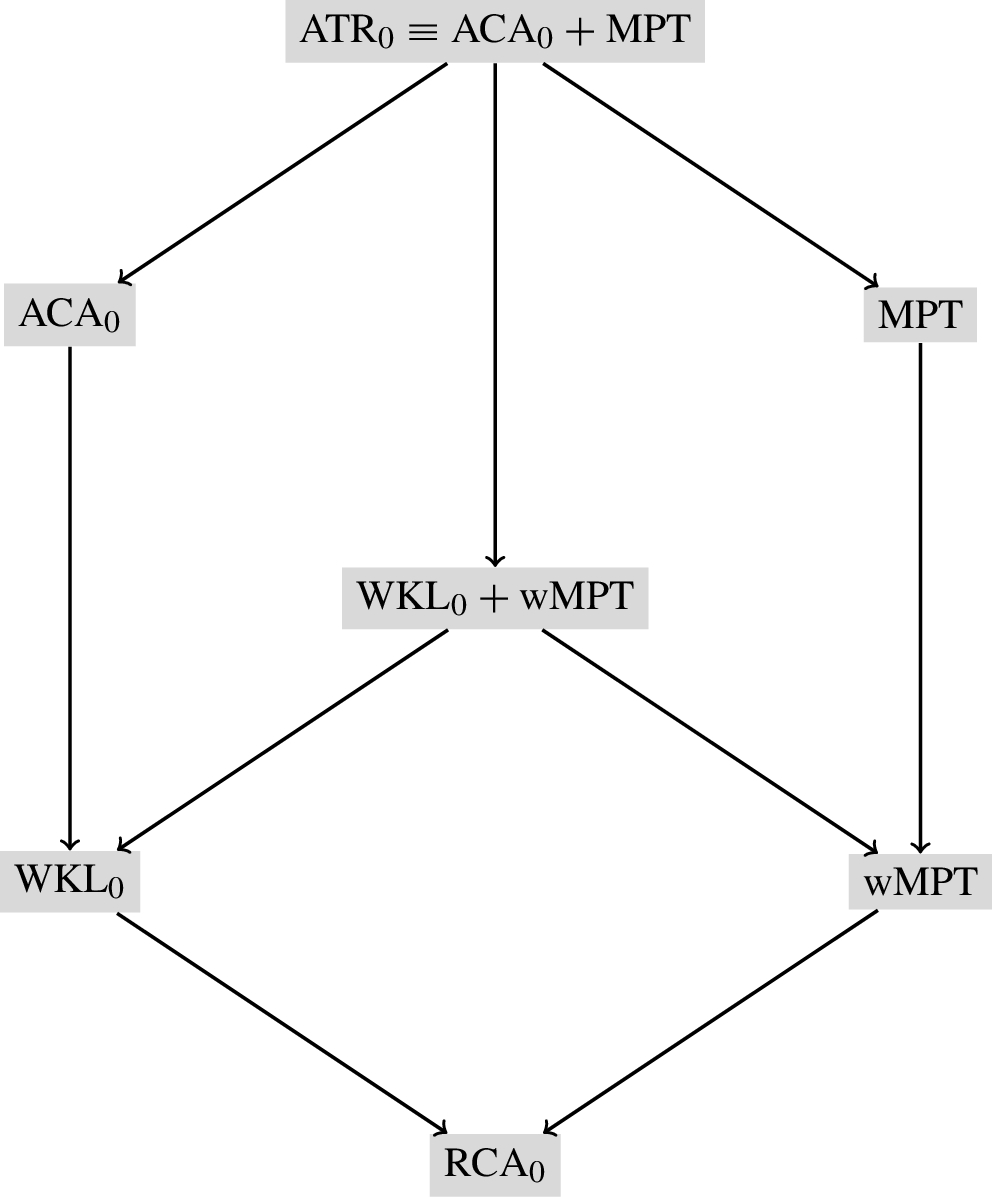
All arrows represent strict implications.
Note that and implies . Using the fact that S is a perfect tree, by Lemma 2.2, there is a -recursive perfect tree so that for every , there is some f so that . Note that . So T has a perfect subtree in M. Thus . □
Over,does not imply.
We remark that by a method similar as in the proof of Theorem 5.7 and by iterating the Turing jump through the recursive ordinals it can be shown that, even over , does not imply .
Figure 1 gives an overview of the obtained results.
Footnotes
Acknowledgements
Rupert Hölzl was supported by and Frank Stephan was partially supported by the Ministry of Education of Singapore through grant R146-000-184-112 (MOE2013-T2-1-062). Liang Yu was partially supported by the National Natural Science Fund of China through Grant 11322112.
References
1.
A.Blass, Complexity of winning strategies, Discrete Mathematics3 (1972), 295–300.
2.
C.T.Chong and L.Yu, Maximal chains in the Turing degrees, The Journal of Symbolic Logic72(4) (2007), 1219–1227.
3.
R.G.Downey and D.R.Hirschfeldt, Algorithmic Randomness and Complexity, Theory and Applications of Computability, Springer, New York, 2010.
4.
L.A.Harrington, Analytic determinacy and , The Journal of Symbolic Logic43(4) (1978), 685–693.
5.
L.A.Harrington and A.S.Kechris, A basis result for sets of reals with an application to minimal covers, Proceedings of the American Mathematical Society53(2) (1975), 445–448.
6.
C.G.JockuschJr. and R.I.Soare, classes and degrees of theories, Transactions of the American Mathematical Society173 (1972), 33–56.
7.
P.Koellner and W.H.Woodin, Large cardinals from determinacy, in: Handbook of Set Theory, M.Foreman and A.Kanamori, eds, Springer, Netherlands, 2010, pp. 1951–2119.
8.
M.Lerman, Degrees of Unsolvability, Perspectives in Mathematical Logic, Springer, Berlin, 1983.
9.
D.A.Martin, The axiom of determinateness and reduction principles in the analytical hierarchy, Bulletin of the American Mathematical Society74 (1968), 687–689.
10.
D.A.Martin and J.R.Steel, A proof of projective determinacy, Journal of the American Mathematical Society2(1) (1989), 71–125.
11.
J.S.Miller and L.Yu, On initial segment complexity and degrees of randomness, Transactions of the American Mathematical Society360(6) (2008), 3193–3210.
12.
A.Montalbán and R.Shore, The strength of Turing determinacy within second order arithmetic, Fundamenta Mathematicae, to appear.
13.
Y.N.Moschovakis, Descriptive Set Theory, 2nd edn, Mathematical Surveys and Monographs, Vol. 155, American Mathematical Society, Providence, RI, 2009.