This paper investigates the effective categoricity of ultrahomogeneous structures. It is shown that any computable ultrahomogeneous structure is categorical. A structure is said to be weakly ultrahomogeneous if there is a finite (exceptional) set of elements such that becomes ultrahomogeneous when constants representing these elements are added to the language. Characterizations are obtained for weakly ultrahomogeneous linear orderings, equivalence structures, injection structures and trees, and these are compared with characterizations of the computably categorical and categorical structures. Index sets are used to determine the complexity of the notions of ultrahomegenous and weakly ultrahomogeneous for various families of structures.
Computable model theory studies the algorithmic properties of effective mathematical structures and the relationships among such structures. The effective categoricity of a computable structure measures the possible complexity of isomorphisms between and computable copies of , and is an important gauge of the complexity of .
This paper will only be concerned with countable structures, countably infinite unless otherwise stated. We say a countable structure (model) is computable if its universe A is computable and all of its functions and relations are uniformly computable. Given two computable structures, we will say they are computably isomorphic if there exists an isomorphism between them that is computable. For a single computable structure , we will say is computably categorical if every computable structure isomorphic to is in fact computably isomorphic to . More generally, we will say two computable structures are isomorphic if there exists an isomorphism between them that is and we will say a computable structure is categorical if every computable structure isomorphic to is isomorphic to and will say that a computable structure is relatively categorical if, for every structure isomorphic to , there is an isomorphism which is relative to the diagram of . More generally, an arbitrary structure is relatively categorical if for any structure isomorphic to there is an isomorphism which is relative to the diagrams of and . For computable structures, the last two notions agree.
A structure is said to be ultrahomogeneous if any isomorphism between finitely generated substructures extends to an automorphism of . Ultrahomogeneous structures were first studied by Lachlan [8] and Fraïssé [7], who defined the age of a structure to be the family of finitely generated substructures of and gave properties which characterized the age of an ultrahomogeneous structure. We define here a new notion of weakly homogeneous structures, where is weakly ultrahomogeneous if there is a finite (exceptional) set of elements of such that any isomorphism between finitely generated substructures becomes ultrahomogeneous when constants representing these elements are added to the language. Csima, Harizanov, Miller and Montalban [5] studied computable ages and the computability of the canonical ultrahomogeneous structures, called Fraïssé limits.
The notion of a computably homogeneous structure is defined in [5], as follows. Given a structure and a tuple from , let denote the substructure of generated by . is said to be computably homogeneous if there exists a computable process which, given a tuple , a map , and , returns a tuple and such that and, if g extends to an embedding of into , then the function h, defined so that and for each i, extends to an embedding of into . We will say that is weakly computably homogeneous if there is a finite tuple of elements of such that is computably homogeneous. It is shown in [5] that if a computable structure is computably homogeneous, then every isomorphism between finitely generated substructures extends to a computable automorphism of . If is locally finite and ultrahomogeneous, then is in fact computably homogeneous.
Here are some simple examples of countable ultrahomogeneous structures. See [11] for more details. The linear ordering of the rationals is the unique ultrahomogeneous countable linear ordering. The age here is just the set of all finite linear orderings. This structure is computably categorical. An equivalence structure is ultrahomogeneous if and only if all equivalence classes have the same size k, ; then the age is the set of all finite equivalence structures with all classes of size . These structures are computably categorical.
An injection structure is a set with a single 1-1 unary function. This function induces a partition of the set into distinct orbits: finite cycles, one-way infinite orbits (ω-orbits), or two-way infinite orbits (-orbits). An injection structure is ultrahomogeneous if and only if it has no ω-orbits. For example, there is the injection structure with infinitely many -orbits, where the age is the set of structures consisting of finitely many -orbits. There is also the injection structure with exactly one orbit of size k for each finite k, where the age is the family of finite injection structures with no more than one orbit of any size k. The injection structure with infinitely many ω-orbits is in fact not computably categorical, but is categorical.
We observe that in the first two examples there are computable models of the countable ultrahomogeneous structure. In the third example, one can have an arbitrary number of orbits of various finite sizes and thus a structure which is not computable.
In this paper, we will closely examine the effective categoricity of ultrahomogeneous structures. In Section 2, we will prove that any computable ultrahomogeneous structure is relatively categorical. We also introduce the notion of weakly ultrahomogeneous structures, where is weakly ultrahomogeneous if there is a finite (exceptional) set of elements such that becomes ultrahomogeneous when constants representing these elements are added to the language. We show that any computable weakly ultrahomogeneous structure is relatively categorical.
In Section 3, we characterize the weakly ultrahomogeneous computable linear orders as those which have finitely many successivities, which is equivalent to being computably categorical. We also show that any countable weakly ultrahomogeneous linear order has a computable copy. The notion of a minimal exceptional set is introduced, and we characterize the minimal exceptional sets for weakly ultrahomogeneous linear orders.
In Section 4, we characterize the countable weakly ultrahomogeneous equivalence structures as those in which all but finitely many equivalence classes have the same size. Here again every such structure has a computable copy, and a computable equivalence structure is weakly ultrahomogeneous if and only if it is computably categorical. The minimal exceptional sets for weakly ultrahomogeneous structures contain exactly one element from each of the exceptional sized equivalence classes.
In Section 5, we characterize the weakly ultrahomogeneous injection structures as those having only finitely many ω-orbits. The minimal exceptional sets contain exactly one member from each ω-orbit. For injection structures, computable categoricity implies weak ultrahomogeneity, which implies categoricity, but neither implication can be reversed.
In Section 6, we consider weakly ultrahomogeneous graphs. It is shown that any countable weakly ultrahomogeneous graph is a disjoint union of graphs and , where has finitely many components, and consists of a finite or infinite number of complete graphs for a fixed . If every vertex of has finite degree, then is weakly ultrahomogeneous if and only if there is some fixed n such that all but finitely many components of are . Since graphs are relational structures, every weakly homogeneous graph is computably categorical. However, there are computably categorical graphs which are not weakly ultrahomogeneous.
In Section 7, we consider weakly homogeneous trees, among the family of countable trees of height . There are many formulations for the study of trees. A tree may be defined by a partial ordering, a binary infimum function, a predecessor function, or a fixed number of successor functions. Miller [13] showed that no computable tree of infinite height can be computably categorical as a partial ordering (or in the infimum framework). Lempp, McCoy, Miller and Solomon [10] characterized the computably categorical trees of finite height, in the partial ordering setting. Calvert, Knight and Millar [3] defined a notion of rank homogeneity for trees in the predecessor formulation, where trees of infinite height can be computably categorical. In the partial ordering formulation, a tree is ultrahomogeneous if and only if it has rank (or equivalently height ). is weakly ultrahomogeneous if and only if the set of elements of rank is finite. We give a characterization of the exceptional sets for a weakly ultrahomogeneous tree . A tree equipped with a predecessor function f is ultrahomogeneous if and only if any two elements of the same height have an equal number of successors. We characterize the weakly ultrahomogeneous trees in general and illustrate this characterization for trees of height .
In Section 8, we consider n-equivalence structures, where a set comes with several equivalence relations, and in particular nested equivalence structures, where those relations are ordered by inclusion. We show that if such a structure is ultrahomogeneous, then each individual equivalence relation is ultrahomogeneous. The converse does not hold in general, but we prove it for nested equivalence structures with all finite equivalence classes. Nested n- equivalence structures turn out to be closely related to trees of height n, as studied by Leah Marshall [12]. Given nested equivalence relations on a set A, let , let be equality, and define the tree to be the set of equivalence classes of A under each , ordered by reverse inclusion, so that A is the root of the tree. Marshall shows that is computably categorical if and only if is computably categorical as a partial order. We show that is ultrahomogeneous if and only if is ultrahomogeneous under predecessor and similarly for weak ultrahomogeneity.
Index sets are an important tool for finding the complexity of a notion. We define index sets for many of the structures studied here and determine the complexity of the index sets corresponding to ultrahomogeneous and to weakly ultrahomogeneous structures. For these results, we use the standard enumeration from Soare [15] of the partial computable functions as and we let the eth computably enumerable set equal the domain of . The set is defined as the union of stages where we assume that, for any s, there is at most one e and one n such that . A set B of natural numbers is said to be complete if B is itself a set and if, for any set A, there is a computable function f such that for all i; similar definitions apply for other definability classes, such as . Some well-known index sets are the complete set and the complete set . We show that the index set associated with weakly ultrahomogeneous structures of several types are complete; this includes linear orders, equivalence structures, and trees under predecessor.
A preliminary version of this paper appeared in [1]. New material in the present paper includes the following. In Section 2, we extend the main theorem for weakly ultrahomogeneous structures which do not have computable copies. In Section 6, we examine ultrahomogeneous injection structures without computable copies. There are two sections of new material, Section 6 on weakly ultrahomogeneous graphs and Section 7 on weakly ultrahomogeneous trees. Section 8 includes new results on weakly ultrahomogeneous n-equivalence structures. The results on index sets for (weakly) ultrahomogeneous structures are also new to this paper. The authors would like to thank the referee for very helpful comments.
Categoricity of ultrahomogeneous structures
In this section, we will show that any computable ultrahomogeneous structure is categorical. Some lemmas are needed. If is an ultrahomogeneous structure and , by composing maps it is easy to see that is also ultrahomogeneous. We also have the following stronger fact:
Letbe isomorphic ultrahomogeneous structures. Letbe finitely generated substructures ofrespectively. Ifis an isomorphism, then there is an isomorphism ofandextending φ.
Let be an isomorphism. Then is an isomorphism of finitely generated substructures of . So it extends to an automorphism . Then is an isomorphism that extends φ. □
Let be the terms of height s starting with the , i.e. the set obtained by starting with the elements of and applying the functions of the structure up to s-many times. Then . While the aren’t structures, we will say that if for any terms of height s and any relation R, we have .
withiff for allwe have. Thus, determining if two finitely generated substructures are isomorphic is.
For the left to right direction, it is clear that the restriction of the isomorphism to any height is an instance of the desired map. The reverse implication follows from the fact that given finitely many terms , they occur by some finite height s. So the terms are in , hence for any relation R we have and so the map is an isomorphism. □
Every ultrahomogeneous structure is relativelycategorical.
Let and be ultrahomogeneous structures and let φ be an isomorphism from to . We want to build an isomorphism θ which is relative to the diagrams of and . We do this with a back-and-forth argument, building increasing partial isomorphisms at each stage and letting . Let . Since , set .
Suppose we have defined for with . Choose the least . There exists a such that and we can choose the isomorphism so it extends by Lemma 2.1. Now search for this b using a -oracle to check whether , call it , and define .
If we have defined for with , we can similarly use a -oracle to find an a such that . Call this , and define .
After constructing , we can see that θ is a bijection since we took the least and at each stage. It is also clear that it is relative to and , since θ is defined using an oracle which is in and . To show that it is an isomorphism, fix an m-tuple such that for each in , and let . Choose any relation R, and any function f of arity m. Then for some n, , so , and since , we have and . □
The complexity of the isomorphism constructed in the theorem is a direct result of the complexity of the problem of determining if two finitely generated substructures are isomorphic. So if this problem is computable for a structure, then that structure is relatively computably categorical. If a structure is relational, then for any finite subset X of the universe we have and checking if two finite structures are isomorphic is computable. Therefore, all relational ultrahomogeneous structures are relatively computably categorical.
More generally, any ultrahomogeneous locally finite structure is relatively computably categorical, where locally finite means that every finitely generated substructure is finite. This is Proposition 4.1(3) of [5]. The converse is false: an injection structure consisting of a single -orbit is computably categorical, but is clearly not locally finite.
Next we introduce a weak version of ultrahomogeneity. Whereas ultrahomogeneous structures have the property that ‘all points look the same’ in a very strong way, the weaker version will allow finitely many elements to look different from the others.
A structure is weakly ultrahomogeneous if there exists a finite set such that for all tuples from A with where each is fixed, this isomorphism of substructures extends to an automorphism of . Call such a set an exceptional set of .
Alternatively, is weakly ultrahomogeneous if there is a finite set of elements of such that is ultrahomogeneous in the extended language with constants for . Thus we can prove the following.
Every weakly ultrahomogeneous structure is relativelycategorical.
Every locally finite weakly ultrahomogeneous structure is relatively computably categorical. In particular, every weakly ultrahomogeneous relational structure is relatively computably categorical.
It is also easy to see that any locally finite weakly ultrahomogeneous structure is weakly computably homogeneous.
If is a finite structure, it is trivially weakly ultrahomogeneous since the universe can be taken to be an exceptional set. Given any exceptional set, we can add finitely many elements to it and obtain another exceptional set. But more interesting are the minimal exceptional sets and the senses in which such sets are unique. To see some instances of this definition, we will look at the weakly ultrahomogeneous analogues of the examples of ultrahomogeneous structures considered in the introduction.
In the remaining sections, we will examine specific families of structures. The goals are to characterize ultrahomogeneous, and weakly ultrahomogeneous structures, and also to compare and contrast these notions with effective categoricity.
Linear orders
We start with a characterization of computably categorical linear orders proved by Remmel in [14]. For a linear ordering and elements , b is said to be the successor of a, and a the predecessor of b if and there is no element x with . When b is the successor of a, the pair is said to be a successor pair, and each of a and b is said to be a successivity. An element is said to be a left endpoint if for all and is said to be a right endpoint if for all . These endpoints are unique if they exist.
(Remmel).
For countable linear orders, the following are equivalent
is computably categorical.
is relatively computably categorical.
has finitely many successivities.
where theare finite chains,are possibly empty andfor.
Next we give a characterization of weakly ultrahomogeneous linear orders.
A countable linear orderis weakly ultrahomogeneous iffhas finitely many successivities.
First, suppose has infinitely many successivities. Let be a finite subset of A; we will show it cannot be an exceptional set. The successivities of occur in finite chains or in subsets of order type (the reverse order of ω), or . If there is a set C of successivities that has order type ω or , choose elements and greater than all such that there are more elements between and than there are between and . Then , but the isomorphism can’t be extended to an automorphism. If C is of order type , we can repeat the argument above by choosing the elements below all in C. Finally, if has infinitely many successivities in finite chains, choose one of these chains containing none of the and from it choose the first element x and the second element y. Then , but the isomorphism can’t be extended to an automorphism. With infinitely many successivities one of these situations must occur, and in any case we see isn’t exceptional, so isn’t weakly ultrahomogeneous.
For the other direction, let be the set of successivities and endpoints of . We claim that this set is exceptional. To see this, suppose with for and for . Also assume that for . So for each , and are in the same copy of , since they bear the same relation to all elements of S. Then use the ultrahomogeneity within each copy of containing some and the identity elsewhere to get an automorphism of the whole structure. □
A computable linear orderis computably categorical iffis weakly ultrahomogeneous.
For any countable weakly homogeneous linear order, there is a computable structure isomorphic to.
Now we consider index sets for linear orderings. The eth computable linear order is given by the eth partial recursive function when is total and is the characteristic function of a linear ordering. It is easy to see that is a set. Let and let .
The index setiscomplete, and in factcomplete relative to.
The index setiscomplete, and in factcomplete relative to.
(a) is a set, since is ultrahomogeneous if and only if it is isomorophic to , that is, if and only if it is dense and without endpoints. For the completeness, we give a reduction f of the complete set to in such a way that for every e. The construction of is in stages as follows (we suppress the subscripts for ease of comprehension). . After any stage s, we will have a linear order . At any stage , we ensure that will have no least element by letting and for all . Similarly at any stage , we ensure that will have no greatest element by letting and for all . Finally, at any stage , we ensure that will be densely ordered, if is infinite, as follows. There are two cases. If an element enters at stage , do the following: Let be the least code for a successor pair in and put between them, so that for , , and for . If no element enters at stage , then make smaller than all elements from as in the case for above.
If is infinite, then it follows from the construction that will be a dense linear ordering without endpoints. If is finite, then after some stage s, no new elements enter , so that the block of successors from to is preserved and will be isomorphic to .
(b) It is easy to see, by quantifying over the finite exceptional set, that is a set. For the completeness, we give a reduction g of the complete set to in such a way that for every e. The construction of is a modification of the construction in part (a). The difference is that in the case , we look for the least code for a successor pair such that both elements have come into by stage .
It follows that for any pair such that b is the successor of a in , either a or b is not in . Thus, if is cofinite, then has only finitely many successivities. On the other hand, if , then it has either a successor or a predecessor when it comes into , and by the new requirement no element is ever put in between. Thus, if is not cofinite, then will have infinitely many successivities. □
Let us say that an exceptional set S for a weakly ultrahomogeneous structure is a minimal exceptional set if no proper subset of S is exceptional. Such as set must exist since exceptional sets are finite. We will try to characterize minimal exceptional sets and determine whether they are unique to a structure, or perhaps unique up to automorphism. Let us say that a is a special point of a linear order is it is either an endpoint or a successivity. Thus the set of special points of a countable weakly ultrahomogeneous linear order is .
For a weakly ultrahomogeneous linear order, the set of all special points is an exceptional set, but this set is not necessarily minimal. A characterization of exceptional sets of special points is as follows.
Letbe a countable weakly ultrahomogeneous linear order. A set ofof special points is exceptional iff it satisfies the following conditions:
does not include any successor pair.
S contains each last element ofand each first element of.
If (i) fails for S, let , with y the successor of x, so that belong to some . Then , but the isomorphism can’t extend since x and y are in different positions in the finite sequence .
If (ii) fails for S, let x witness its failure and let y be an element of the copy of adjacent to x. Then , but the isomorphism can’t extend since x is a successivity and y isn’t.
Now suppose (i) and (ii) hold for S and suppose by φ, where each and is not in S. Any which is a special point is either uniquely between two , or is the unique element greater than or less than all if it is an endpoint. Hence . Any non-special points must be in the same copy of and it follows from the ultrahomogeneity of that we can extend φ to an automorphism. □
Given an exceptional set, a (possibly) smaller exceptional set is obtained by removing all non-special points. So the above proposition says that minimal exceptional sets are sets of special points satisfying the two conditions while no proper subset satisfies them both.
As an example, consider the linear order where . Then both and are minimal exceptional sets. This shows that, while we would like the exceptional sets of a weakly ultrahomogeneous structure to be unique in some way, minimal exceptional sets aren’t necessarily unique and in fact need not even be isomorphic.
Recall that in a structure , an element is definable from a set if is a subset of A definable from S. Let the definable closure of S be . An important fact about definability we will use repeatedly is that if b is definable from S and σ is an automorphism of fixing all elements of S, then σ also fixes b. Looking at definable closures reveals a sense in which minimal exceptional sets are unique.
Letbe a weakly ultrahomogeneous linear order and letbe a minimal exceptional set. Thenis the set of special points of.
Suppose x is in one of the copies of in . Using the ultrahomogeneity of , there is an automorphism of moving x while fixing M. So . Now let x be a special point of ; we may assume . Then x is the unique element satisfying if it is a left endpoint of , similarly for right endpoints, or else it is the unique element satisfying for some . □
Equivalence structures
The effective categoricity of equivalence structures was investigated by Calvert, Cenzer, Harizanov and Morozov in [2]. The character of an equivalence structure indicates the number of equivalence classes of each size. The structure is said to have bounded character if there exists a such that all finite classes have size at most k. It is proved in [2] that an equivalence structure is computably categorical iff has finitely many finite classes, or has finitely many infinite classes, bounded character, and there is at most one k such that there are infinitely many classes of size k. This condition is equivalent to saying that all but finitely many classes of have the same size. For computable equivalence structures, computable categoricity is the same as relative computable categoricity.
A countable equivalence structureis weakly ultrahomogeneous iff all but finitely many equivalence classes ofhave the same size. In this case, a minimal exceptional set contains exactly one element from each of the exceptional equivalence classes.
For one direction, suppose that has infinitely many classes of different sizes and let be a finite subset. Then find elements from classes of different sizes so neither is related to any . Then , but this can’t extend to an automorphism.
Now for the reverse implication. If all but finitely many equivalence classes of are of the same size, let contain exactly one element from each of these exceptional classes. Then suppose via the isomorphism φ so and . Either each pair is in an equivalence class with some , or if not they are in classes of the same size. Then the isomorphism extends to an automorphism as follows.
First, we will explain how the equivalence classes are mapped, and then we will describe what happens to the elements of each class. Fix each exceptional class as well as any classes which do not contain any or . If a nonexceptional class has an , then map to and hence the class to the class . If there are nonexceptional classes with a but no , there must be the same number of nonexceptional classes with an but no . Send each class of the first kind to one of the second kind. Thus we may end up with cycles, say maps to and , so that maps to , and then maps to .
Within each class, do the following. For classes with no or , the class is fixed and we also fix each element of the class. For the nonexceptional classes containing some of the or , we have mapped the and above, and the remaining elements can be mapped arbitrarily. For the exceptional classes containing some of the or , it follows that , thus we can map those elements respecting φ using a cycle decomposition similar to that described above for the nonexceptional classes. Now the remaining elements can simply be fixed.
The claim about the minimal exceptional sets follows since the proof shows such a set is exceptional, and that a finite set disjoint from two classes of different sizes is not exceptional. □
A computable equivalence structureis weakly ultrahomogeneous iffis computably categorical.
For any countable weakly homogeneous equivalence structure, there is a computable structure isomorphic to.
With this characterization of weakly ultrahomogeneous structures and their minimal exceptional sets, we can again investigate their uniqueness properties. Given two minimal exceptional sets, there is an automorphism of the structure sending one to the other by interchanging the two elements in each exceptional class and fixing everything else. However, as opposed to linear orders we don’t have uniqueness of the definable closures.
Letbe a weakly ultrahomogeneous equivalence structure and leta minimal exceptional set. Thenis definable from S iffor x is in an exceptional class of size at most 2.
If isn’t in an exceptional class, there is an automorphism fixing all the exceptional classes but moving x by interchanging with another class of the same size. If x is in an exceptional class of size at most 2, then for some , either or . If x is in an exceptional class of size greater than 2, then contains for some and an element y distinct from x and . In this case, switching x and y and using the identity everywhere else is an automorphism of moving x and fixing S. □
Now we consider index sets for equivalence structures. The eth computable equivalence structure is given by the eth partial recursive function when is total and is the characteristic function of an equivalence relation. It is easy to see that is a set. Let and let .
The index setiscomplete, and in factcomplete relative to.
The index setiscomplete, and in factcomplete relative to.
(a) It is easy to see that is a set. For the completeness, we give a reduction f of the complete set to in such a way that for every e. The idea of the construction is to make every equivalence class have size two if is infinite, and otherwise to have finitely many classes of size two and the rest of size one. The construction of is in stages as follows (we suppress the subscripts for ease of comprehension). with . This ensures that there will always be at least one class of size two. After any stage s, we will have an equivalence structure with finite universe with classes of size two, where , and at least one class of size one; in particular will make up a class of size one. We assume that, for all e and s, and that at most one element comes into at any stage . There are two cases in the construction at stage . First, suppose that a new element comes into at stage , which is the element of . In this case, we look for the least not in a class of size two and make , so that is in a class by itself. Next, suppose that no new element comes into at stage . Then we simply let without adding any pairs to the equivalence relation.
If is infinite, then it follows from the construction that every equivalence class of will have size two, so that is ultrahomogeneous. If is finite, then all but finitely many classes will have size one, but there will be at least one class of size two, so that is not ultrahomogeneous.
(b) It is easy to see, by quantifying over the finite exceptional set, that is a set. For the completeness, we give a reduction g of the complete set to in such a way that for every e.
The construction of is a modification of the construction in part (a). The difference is that we make have a class of size 2 if and only if while each odd number has a class of size 2. At stage 0, we have . After stage s, we have so that
for all , has size either one or two;
for all , if and only if .
At stage , there are two cases.
Case I: If there is an such that , make equivalent to the least odd number not in a class of size two. If , put in a class of size 1 and if , put in a class of size one.
Case II: If , put in a class of size one. If there is an odd number less than in a class of size one, pair that number with . If not, put in a class of size one.
It follows from the construction that, for each n, has size two if and only if and that has size two for every n. If is cofinite, then all but finitely many classes have size two, and hence is weakly ultrahomogeneous. If is not cofinite, then has infinitely many classes of size one and infinitely many classes of size two, and hence is not weakly ultrahomogeneous. □
Injection structures
The effective categoricity of injection structures was studied by Cenzer, Harizanov and Remmel in [4]. It was shown that an injection structure is computably categorical if and only if it has finitely many infinite orbits, and is categorical if and only if it either has only finitely many orbits of type or has only finitely many orbits of type ω. In each case, relative categoricity is the same as categoricity.
An injection structure is ultrahomogeneous if and only if it has no ω-orbits.
Let be an injection structure. Suppose first that has an ω-orbit and let a be the element of this orbit with no predecessor. Then the substructures and are isomorphic but this clearly cannot be extended to an automorphism of .
For the other direction, suppose that has no ω-orbits and let ϕ be an isomorphism mapping to . If belongs to an orbit of finite size k, then the orbit of also of size k and ϕ maps to . If belongs to an orbit of type , then so does and ϕ maps to for each j. This isomorphism can be extended to the entire orbit of by mapping to . Finally, this can be extended to an automorphism of by mapping a to a for elements of any orbits not among the orbits of . □
Next we consider weakly ultrahomogeneous injection structures.
A countable injection structureis weakly ultrahomogeneous iff it has finitely many ω-orbits. In this case, a minimal exceptional set contains exactly one member from each ω-orbit.
Suppose that is an injection structure having only finitely many ω-orbits. Let contain exactly one element from each of the ω-orbits, and assume that via the isomorphism φ. The isomorphism is extended to an automorphism as follows.
First, orbits not containing any or are fixed. If is in a finite orbit of size k, then is also in a finite orbit of size k, and the orbit of is mapped to the orbit of . If there are finite orbits of size k containing some but no , then there must be an equal number of orbits of size k containing some but no , and then we map each class of the first kind to one of the second kind.
If is in a -orbit, then φ maps the sequence to the sequence and this can be extended to the entire orbits. Each ω-orbit must be fixed, since it contains one of the , and φ fixes and respects f.
Now assume has infinitely many ω-orbits, and let be a finite set. In an ω-orbit containing none of the , let be the initial element and . Then , but the isomorphism can’t extend since is in the range of f while isn’t. Thus isn’t weakly ultrahomogeneous.
If a finite set S doesn’t include an element from each ω-orbit, we may repeat the above argument with the orbit not intersecting S to show the finite set isn’t exceptional. The claim about minimal exceptional sets follows. □
It follows that, for computable injection structures, computable categoricity implies weak ultrahomogeneity which implies categoricity. Neither implication can be reversed as witnessed by computable injection structures consisting of only infinitely many -orbits, and of only infinitely many ω-orbits, respectively.
In contrast to the results for linear orders and equivalence structures, there exist ultrahomogeneous injection structures which are not isomorphic to computable structures.
The character for an injection structure is defined by
It is easy to see that K will be the character of an injection structure if and only if it is a subset of such that, for all natural numbers n and k, if then .
For any character K, there is an ultrahomogeneous injection structurewith character K and with an arbitrary finite number of orbits of type. Furthermore,is relatively computably categorical.
For any character K, there is a weakly ultrahomogeneous injection structurewith character K and with an arbitrary finite number of orbits of typeand an arbitrary finite number of orbits of type ω. Furthermore,is relatively computably categorical.
For any character K, there is an ultrahomogeneous injection structurewith character K and with an infinite number of orbits of type. Furthermore,is relativelycategorical.
For any character K, there is a weakly ultrahomogeneous injection structurewith character K and with an arbitrary number of orbits of typeand an arbitrary finite number of orbits of type ω. Furthermore,is relativelycategorical.
In each case, it is clear that such structures exist. The effective categoricity follows from Theorem 2.5 with an additional argument in the second case. That is, for each of the finitely many orbits of type ω, we simply identify the initial elements of each orbit and use this to define the mapping on the orbits of type ω. □
Again in contrast to linear orderings and equivalence structures, injection structures are not always locally finite. Thus it is possible for an ultrahomogeneous computable injection structure to fail to be computably homogeneous. Of course a structure with only finite orbits is locally finite, and therefore a computable injection structure with only finite orbits will be computably homogeneous. A computable structure with finitely many infinite orbits will be weakly computably homogeneous.
However, a structure with infinitely many -orbits may or may not be computably homogeneous.
There is a computably homogeneous injection structure consisting of infinitely many-orbits.
Consider the -chain with universe and function f defined so , , and . Now, for each n, simply multiply each element of this chain by to create infinitely many -orbits. This structure is clearly computably homogeneous. □
There is a computable injection structure, consisting of infinitely many-orbits, such that, for each e, there are infinitely many orbits which are Turing equivalent to.
We will build so that the orbit of is a c.e. set which is Turing equivalent to . The function f will be constructed in uniformly computable stages for , so that . The orbit of an element a under f will be denoted by and the orbit of a under will be denoted by . will have universe . The orbit will consist of together with . Thus if and only if , so that is one-one reducible to . For the other direction, the orbit of as described above is clearly Turing reducible to . The construction of the mapping f is as follows. For each e, begin to build the function f by letting and . At the same time, build auxiliary orbits for each by letting and . When an element i comes into at stage , insert the partial orbit of onto the end of . After that, we resume building by putting after the inserted part, while continuing to include in elements of the form and where as the construction continues.
Details of the construction are as follows. For the sake of simplicity, we fix e and describe the construction of the orbits of , for all i. At stage s, we will have defined f on . Thus at stage 0 we have only . After stage s, will have initial element and final element . We will assume as usual that at any stage , at most one element x enters any c.e. set and that . At stage , extend to as follows. For any such that , simply map to and map to . For the orbit of , first map to . If some comes into at stage , then insert the current orbit of into right after . Next let and, if is not empty, extend by putting the sequence onto the end. Finally, put at the very end of the orbit.
It follows from the construction that, for each , is defined on by stage s, so that the map is computable. It is clear from the construction that each orbit is of type as described above, so that the orbit of is Turing equivalent to . □
There is a computable injection structure, consisting of infinitely many-orbits, which is not weakly computably homogeneous.
Let be the injection structure from Proposition 5.5. Fixing any finite number of orbits, there are still two orbits of different degree so that the isomorphism between these two orbits cannot be extended to a computable automorphism. Hence will not be weakly computably homogeneous. Note that the isomorphism between the two orbits is still partial computable. That is, if we fix elements in the first orbit and in the second orbit and map to , then given x in the orbit of , we can compute so that and then compute . □
Next, we consider definability from exceptional sets for injection structures.
Letbe a weakly ultrahomogeneous injection structure with no orbits of size one, and letbe a minimal exceptional set. Thenis the union of the finitely many ω-orbits of.
Suppose that is not in an ω-orbit. Then the map fixing all ω-orbits and sending otherwise is an automorphism fixing S but moving a. Now suppose a is in an ω-orbit with for some . Then for some we have or . In either case, a is definable from S. □
If there is a unique orbit of size one, then of course this is actually definable in .
Now we consider index sets for injection structures. The eth injection structure is given by the eth partial recursive function when is total and is an injection. It is easy to see that is a set.
Let and let .
The index setiscomplete, and in factcomplete relative to.
The index setiscomplete, and in factcomplete relative to.
(a) Note that is ultrahomogeneous if and only if is onto. It follows easily that is a set. For the completeness, we give a reduction f of the complete set to in such a way that for all e. The idea of the construction is that will consist of a single infinite orbit, which will be of type if and only if is infinite. The construction of is in stages with domain and image a subset of . At stage 0, we let . After stage s, we have defined a partial injection for all . Fix s and let a be the unique number not in the image of and let b the unique element not in the domain of . There are two cases in the construction at stage . If no new element comes into at stage , extend by mapping b to and to . If a new element comes into at stage , then again map b to but now map to a.
If is infinite, then it follows from the second case of the construction that will consist of a single orbit of type , whereas if is finite, then will consist of a single orbit of type ω, Thus is ultrahomogeneous if and only if is infinite.
(b) It is easy to see, by quantifying over the finitely many elements not in the range of , that is a set. For the completeness, we give a reduction g of the complete set to in such a way that for every e. The idea of the construction is to build infinitely many orbits with the ith orbit consisting of , so that the universe will be . The construction will ensure that the orbit of is of type if and otherwise is of type ω. It follows that will be weakly ultrahomogeneous if and only if is cofinite.
The mapping can simply be defined as follows. For each i, there are two cases. First, suppose that . Then for all n. Next suppose that for some m. Then we let for , we let , and for all , we let and . It follows that the orbit of is of type ω if and is of type if . To compute , we just have to check whether and then follow the algorithm above. □
Graphs
It is a well-known theorem proved in [9] that, up to isomorphism, the countable (both infinite or finite) ultrahomogeneous graphs are
The random graph, i.e. the Fraissé limit of the class of all finite graphs.
The -free random graph, i.e. the Fraissé limit of the class of all -free finite graphs.
, disjoint unions of m copies of for .
The lattice graph.
The cycle on 5 vertices.
Complements of these.
Some examples of weakly ultrahomogeneous graphs which aren’t ultrahomogeneous are:
The disjoint union of an ultrahomogeneous graph and a finite graph.
(Equivalence relations) Any graph where all components are complete, there are only finitely many component sizes, and at most one size occurs infinitely often.
Supposeis a countable weakly ultrahomogeneous graph. Thenis a disjoint union ofandfor fixedwherehas finitely many connected components.
We may assume that has infinitely many components. Let . If has infinitely many non-ultrahomogeneous components, find one with no and use the non-ultrahomogeneity of the component to get a partial isomorphism that can’t extend. If among the cofinitely many ultrahomogeneous components there are two kinds that occur infinitely often, find two non-isomorphic components containing no . Choose x from one and y from the other, so but the isomorphism can’t extend. Suppose the isomorphism type of the cofinitely many ultrahomogeneous components isn’t for some n. Find two of these components containing no . Choose from these components such that are in the same component but don’t share an edge and so z is from the other component. Then but it can’t extend. □
If for a graph , a subset of its components form a non-weakly ultrahomogeneous graph, then itself is not weakly ultrahomogeneous. So, in light of Proposition 6.1, to classify weakly ultrahomogeneous graphs it is enough to look at graphs with finitely many infinite components.
Instead of a general classification, we examine a particular class of graphs. Say that a graph is locally finite if every vertex has finite degree, and say that a graph is finitely dominated if there is a finite so for every there is an so . The proposition leads to a classification of locally finite weakly ultrahomogeneous graphs.
Letbe weakly ultrahomogeneous.
can have at most one component not finitely dominated.
Ifhas infinitely many components, every component is finitely dominated.
If C is a component ofnot finitely dominated, there must be a finiteso everyhas distance at most 2 from F.
Suppose has 2 components and which are not finitely dominated. Let be exceptional. Choose and so none of them share an edge with A or with each other. Then , but the isomorphism can’t extend since the component of is mapped to itself but is mapped to y.
Suppose has infinitely many components and a component C not finitely dominated. Let be exceptional. Choose sharing no edge with A or with each other. Then choose y from a component of containing no element of A. Then , but the isomorphism can’t extend.
Suppose there is a component C such that for every finite , there is with distance at least 3 from F. Let be exceptional and let have distance 3 from and have distance 2. Then but the isomorphism can’t extend. Note that since A must intersect each non-ultrahomogeneous component and any connected ultrahomogeneous graph has diameter 2.
□
Letbe a locally finite graph. Thenis weakly ultrahomogeneous iffwhereandis finite.
Clearly a graph of this form is weakly ultrahomogeneous, so assume is weakly ultrahomogeneous. If has infinitely many components, then where and has finitely many components. By the lemma, every component of is finitely dominated, so is finitely dominated. But a finitely dominated, locally finite graph is finite.
Now assume that has only finitely many components. At most on component, C, isn’t finitely dominated. By the lemma there is a finite so every has distance at most 2 from F. So C is finite, along with all the other finitely dominated components, which means that is finite. □
It follows that any locally finite, weakly ultrahomogeneous countable graph has a computable copy.
Since graphs are relational structures, every weakly ultrahomogeneous graph is computably categorical. But unlike for equivalence structures and linear orders, this containment is strict.
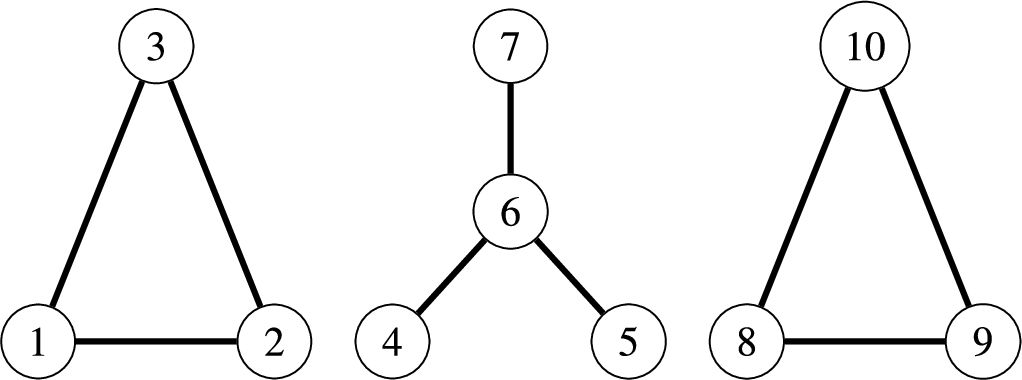
Let be the following computable graph on ω: for each k, let vertices form a and let vertices form a star with center . So the first three components are
This graph can be shown to be computably categorical using a back-and-forth argument, but is not weakly ultrahomogeneous since infinitely many components aren’t ultrahomogeneous.
Trees
The study of trees has played an important role in mathematical logic and computability theory. There are many ways to frame the notion of a tree. We are thinking in this paper of trees which are isomorphic to subtrees of . Some terminology is necessary. For a finite string , denotes the length n of w. The empty string, denoted by ε, is the unique string with length zero. Given two strings v and w, the concatenation is defined by
where and . For , is the string . For any and , the initial segment is . We say w is an initial segment or prefix of v (written ) if for some . This is equivalent to saying that for some . For a string w and , we say that if for .
A subset T of is a tree if it is closed under initial segments. That is, if and , then . For any such tree T, is said to be an infinite path through T if for all n. We let denote the set of infinite paths through T. For any tree T, we say that a node is extendible if there exists such that .
A node such that for any v with , is called a dead end or leaf of T.
More generally, trees can be formulated in terms of a natural partial ordering of ≺ described above, in terms of a binary infimum function, in terms of successor functions, or in terms of a predecessor function. In the partial ordering formulation, we consider a tree as a partially ordered set with least element ε such that, for every , ≺ well-orders the set ; let the height of a in T be defined as the order type of . The height of a tree T is . We will only consider trees of height , which means that is finite for all a. Thus ≺ will induce a natural predecessor function f, where is the supremum of under ≺, so that . There is also a natural meet operation ∧, defined by letting be the supremum of .
In the predecessor formulation, we will consider a tree as a tree equipped with a unary predecessor function and possessing a unique root ε such that to make f total.
For , let denote the tree of extensions of a, that is, . The rank for is defined by recursion as follows:
In particular, for a leaf x of T, . If x is an extendible node of T, then . Also, .
Miller [13] showed that no computable tree of infinite height can be computably categorical as a partial ordering (or in the infimum framework). Lempp, McCoy, Miller and Solomon [10] characterized the computably categorical trees of finite height, in the partial ordering setting. Calvert, Knight and Millar [3] defined a notion of rank homogeneity for trees in the predecessor formulation, where trees of infinite height can be computably categorical. They constructed in particular a computable rank homogeneous tree of Scott rank . This notion was applied by Fokina, Knight, Melnikov, Quinn and Safranski [6], who showed that the class of rank homogeneous trees can be embedded into the class of torsion-free Abelian groups and also into the class of Boolean algebras.
We first consider trees of finite height, as partial orderings. Lempp, McCoy, Miller and Solomon [10] characterized the computaby categorical trees of finite height using the notion of finite type.
A node a of T is of strongly finite type if the set satisfies the following conditions:
There are only finitely many isomorphism types in .
For any successors x and y of a, if embeds into , then either and are isomorphic, or the isomorphism type of appears only finitely often in .
T is of strongly finite type if every node of T is of strongly finite type. The notion of finite type is given by a recursive definition as follows.
A node a of T is of finite type if it satisfies the following: the set satisfies the following conditions:
There are only finitely many isomorphism types in .
Each isomorphism type which appears infinitely often in is of strongly finite type.
For any successors x and y of a, if embeds into , then either and are isomorphic, or the isomorphism type of appears only finitely often in or the isomorphism type of appears only finitely often in .
T is of finite type if every node in T is of finite type. Lempp et al. [10] show that is computably categorical if and only if is of finite type.
It is easy to see that a tree is ultrahomogeneous if and only if it has rank , and likewise for the meet presentation. Note that this is equivalent to saying that T has height . It follows from the result of Miller that if is computably categorical, then it has finite height. Since trees are locally finite, every weakly homogeneous tree must be computably categorical by Theorem 2.5, and hence any weakly homogeneous tree must have finite height. We give a short direct proof of this fact here.
Ifis weakly homogeneous, then T has finite height.
Suppose that T has infinite height and let a finite set S be given. Then let n be the maximum height of any element of S, let b be an element of height of rank and let c be a successor of b. Then there is an isomorphism of to fixing S and mapping b to c, which cannot be extended to an automorphism of T. Hence T is not weakly ultrahomogeneous. □
is weakly ultrahomogeneous if and only if the set of elements which have rankis finite.
Suppose that T is weakly ultrahomogeneous but has infinitely many elements of rank . It follows from Lemma 7.3 that T has finite height. Now let n be the least such that there are infinitely many elements with height n which have rank . Now given a finite set S, choose an element b of height n and rank , which is not in the downward closure of S and let c be a successor of b. Then there is an isomorphism of to fixing S and mapping b to c, which cannot be extended to an automorphism of T. Hence T is not weakly ultrahomogeneous.
For the other direction, suppose that all but finitely many elements of T have rank 0, that is, are leaves of T. Let S be the set of elements which have successors, and suppose that ϕ is an isomorphism from a subtree of T to a subtree of T, where and and for all . For any element x of , x has a predecessor a in S and has no successors. Then must also be a successor of a and have no successors. It follows that any permutation of will be an isomorphism, so that ϕ can be extended to an automorphism of T. □
It follows that every weakly ultrahomogeneous tree has a computable copy. That is, T has a finite subtree S of nodes which have successors and each element of this finite tree has some (possibly infinite) number of successors, which are all leaves of T and this clearly always has a computable representation.
If T has only finitely many elements of height , then certainly it has only finitely many elements of rank , and is therefore weakly ultrahomogeneous. The following example shows that these are not equivalent conditions.
Let . Then only the first two elements have rank , but infinitely many elements have height 2, and T is weakly ultrahomogeneous with exceptional set .
The following result shows that the weakly ultrahomogeneous trees live well inside the class of computably categorical trees.
Every computable weakly ultrahomogeneous treeis of strongly finite type.
Let be a computable weakly ultrahomogeneous tree. Every leaf node is clearly of strongly finite type, so we consider a node such that all nodes with rank less than are of strongly finite type. There are only finitely many isomorphism types of in the whole tree, hence only finitely many in and each is of strongly finite type by assumption. Among the successors of a all but finitely many are leaf nodes, so the second condition will be satisfied. Thus a is of strongly finite type. □
We can characterize exceptional sets for weakly homogeneous trees as follows. For any , let and let .
For any treeand any,is isomorphic toif and only ifand.
is isomorphic to if and only if, for any , and , which is if and only if and . □
Letbe weakly ultrahomogeneous. Then for any, K is an exceptional set forif and only if
forof rank, there existssuch that, and
for anysuch that, eitheror there existssuch thatbut not.
Suppose first that S does not satisfy condition (i) above, and let where there is no element of K above a. Then and since and there is no element of K above a. It follows from Lemma 7.6 that and are isomorphic. This cannot be extended to an automorphism of T since the height of a is less than the height of b. Next suppose that S does not satisfy condition (ii) and let such that and for any , if , then . Again it follows that and , so that and are isomorphic, but there is no extension of this isomorphism to an automorphism of T.
For the other direction, suppose that K satisfies the two conditions. We claim that for any two distinct elements a and b of rank in T, either or . The proof of the claim is in two cases.
First, suppose that a and b are incomparable. Then by condition (i), there exists an element such that but we cannot have since T is a tree. Thus . Next, suppose without loss of generality that . By condition (ii), there are two possibilities. We may have , in which case . Or we have such that but not . In that case, . This proves the claim.
Now let ϕ be an isomorphism mapping to and fixing each element of K. For each of rank , we have some such that and thus by the isomorphism . Thus also has rank . The isomorphism ϕ shows that is isomorphic to , so that and . It now follows from the claim that in fact . Thus we may define our desired automorphism H to be the identity on K and on the subtree of nodes of rank . To complete the definition of H, it suffices to define H on the leaves of T. Fix an element c of T with a nonempty set of leaves in . For any , let . For the remaining elements of , observe that any permutation of these elements may be used to obtain an automorphism of T. So we may use any permutation for H which agrees with for each . □
Now we consider index sets for trees under the partial order presentation. The eth tree is given by the eth partial recursive function when is total and is the characteristic function of a tree. The usual condition for a partial ordering to be a tree is that, for any element a, is well-ordered. This would be a condition, but it can be simplified here by first requiring that is finite, which is a condition, and then checking to see that it is totally ordered. It follows that is a set. Let and let .
The index setiscomplete.
The index setiscomplete relative to.
The index setiscomplete relative to.
(a) We will give a reduction h of the complete set to the complement of as follows. The idea of the construction is to build a descending chain below if and only if for all . Thus if is cofinite, will fail to be a tree; the construction will ensure that it is a tree otherwise. First let the root and for ease of notation let . After stage s, we have a finite tree with for all and such that, for each , if for some k, then there is a finite decreasing chain in . At stage , we first add the elements to and let . Next suppose that a new element m comes into such that, for some j, k and n, with a corresponding chain in and with corresponding chain . Then we insert between these two chains, resulting in a descending chain from of length . Note that if , then the first chain is empty and if , then the second chain is empty. It follows that if is cofinite and includes , then will include an infinite descending chain and hence will not be a tree. On the other hand, if is co-infinite, then for each a, will be finite, and will be totally ordered by the construction, so that will be a tree.
(b) is ultrahomogeneous if and only if there do not exist distinct a and b, both not the root, such that . It follows easily that is a relative to . For the completeness, we define a computable function f such that has an element of height 2 if and only if is nonempty. Note that is complete. To define , simply let 0 be the root, let for all s and, for , let if and only if is nonempty.
(c) is weakly ultrahomogeneous if and only if there is a finite set of elements of rank and a formula may be given by quantifying over these finite sets. For the completeness, we define a reduction g of the complete set to so that for all e. Again let 0 be the root, let for all x and let if an element comes into at stage s. It is clear that is always a tree, and will have finitely many nodes of rank if and only if is finite. □
Next we will consider trees under the predecessor formulation. The notions of ultrahomogeneity turn out to be more complicated here.
First an easy implication connecting the two formulations.
For any tree T, ifis (weakly) ultrahomogeneous, thenis (weakly) ultrahomogeneous. Similarly, ifis computably categorical, thenis computably categorical.
In general, is relational, and is locally finite, so in either case every weakly homogeneous tree is computably categorical. Assume that is weakly ultrahomogeneous and let and be finite isomorphic subtrees of including some fixed finite set S. Then there is an isomorphism between and fixing S. Thus there is an automorphism of extending this isomorphism and this is also an automorphism of . Next assume that is computably categorical and that is computable, and let be a computable tree isomorphic to . Then is also computable, and it follows that there is a computable isomorphism mapping to which also serves as an automorphism of . □
In both cases, the converse fails to hold. For example, consider the tree with ; this tree is homogeneous in the predecessor forumulation but has infinite height and is not computably categorical in the partial order presentation. It is important to note this distinction, that we will be considering trees of possibly infinite height in the predecessor formulation, whereas such trees could not be even weakly ultrahomogeneous in the partial order formulation.
A treewith predecessor function is ultrahomogeneous if and only if, for every n and anyof the same height, a and b have an equal number of successors.
Suppose first that for every any of the same height have an equal number of successors. Then it is clear that automorphism of T may be defined recursively by first permuting the elements of height 1 and then arbitrarily mapping successors of x to successors of for of height n to define ϕ on elements of height . Now given finite isomorphic subtrees and with all elements of height , the isomorphism ϕ may first be extended to an isomorphism on the elements of height , since there will always be an equal number of elements of any height which have not been mapped yet. Then the isomorphism may be recursively extended to an automorphism Φ of T by mapping a successor of x to a successor of .
Suppose next that there is some n and some elements of height n which have a different number of successors, where n is the least for which such elements exist. Then there is an isomorphism of the elements of height mapping a to b by the argument above. But this isomorphism cannot be extended to an automorphism of T. □
Note that under the condition of Proposition 7.10, there must be a function such that every node of height n has exactly immediate successors. An equivalent condition to saying that any two nodes of height n have the same number of successors, is to say that for any n and any two nodes a and b of height n, is isomorphic to .
It follows from the proof of Proposition 7.10 that if and are ultrahomogeneous with the same branching function β, then any isomorphism taking a finite subtree of to a finite subtree of can be extended to an isomorphism from to .
Given a tree T (of possibly infinite height) and a subtree U of finite height with node , let . For example, if and , then and . So consists of the node a and its predecessors, together with all nodes in T extending successors of a which are not in U.
A treein the predecessor framework is weakly ultrahomogeneous if and only if there is a finite subtree S of T such that, for every,is ultrahomogeneous.
Suppose first that is weakly ultrahomogeneous and let S be a finite exceptional tree. Let and let ϕ be an isomorphism between two finite subtrees and of ; extend ϕ to the other elements of S (in particular the immediate successors of a which are in S), by the identity and let and . Then and are finite subtrees of T and, since S is an exceptional set, ϕ may be extended to an automorphism of T which fixes x. It is clear that the restriction of this automorphism to is the desired automorphism of .
Next suppose that S is a finite subtree as specified; we will show that S is an exceptional set. Let ϕ be an isomorphism of two finite subtrees and of T which fixes S. It follows that, for each , and hence the map induced by ϕ on is an isomorphism between and . By assumption, there exist, for each , an automorphism on which extends the map between and . These can be patched together to define an automorphism H of T which preserves S and extends ϕ. That is, when and equals otherwise. □
Let us consider this further for trees of height .
A tree of heightis weakly ultrahomogeneous if and only if all but finitely many nodes of height 1 have an equal number of successors.
Given k such that all but finitely many nodes of height 1 have exactly k successors, let S be the subtree consisting of the root ε together with the set of nodes of height 1 which have a different number of successors. Then consists of ε together with all nodes of height 1 having exactly k successors and each of their k successors. Thus is ultrahomogeneous. For of height 1, , that is a tree of height 1 consisting of x together with all of its successors which is trivially ultrahomogeneous.
For the other direction, suppose that T is weakly ultrahomogeneous, and let S be given by Theorem 7.11 so that is ultrahomogeneous for all . Then will include each node x of height 1 not in S and having no successor in S, together with all of their successors. Since is ultrahomogeneous, it follows that all nodes of height 1 not in S will have the same number of successors, as desired. □
A tree of height 3 is weakly ultrahomogeneous if and only if the following conditions hold:
for each node x of height 1, all but finitely many successors of x have an equal number of successors;
there are fixed h and k insuch that all but finitely many nodes of height 1 have exactly h successors and each of those successors has exactly k successors.
Assuming conditions (a) and (b), let S consist of ε together with the following: Let x be a node of height 1 which does not have exactly h successors, or which has exactly h successors but some of those successors do not have exactly k successors. Then, by (a), fix m such that all but finitely many successors of x have exactly m successors; then put x into S together with each of its successors which do not have exactly m successors. Then consists of ∅ together with all nodes x of height 1 such that x has exactly h successors and each of these has exactly k successors. Thus is ultrahomogeneous.
For of height 1 such that all but finitely many successors of x have exactly m successors, consists of x together with each successor which has exactly m successors, and again is ultrahomogeneous.
For the other direction, suppose that T is weakly ultrahomogeneous, and let the finite subtree S be given by Theorem 7.11 so that is ultrahomogeneous for all . Then will contain each node x of height 1 with no extensions in S, together with all extensions of x. Since is ultrahomogeneous, it follows from Proposition 7.10 that all nodes of height 1 not in S will have the same number (h) of successors,and that each of these successors will have the same number (k) of successors. Next consider of height 1. Then will contain all successors y of x which are not in S, together with all extensions of y. Since is ultrahomogeneous, it follows that all successors of x not in S will have an equal number of successors, as desired. □
Certainly there are computably categorical trees, in either presentation, which are not weakly ultrahomogeneous.
Let T have infinitely many nodes of height 1 with exactly 2 successors and infinitely many with exactly 3 successors, and then let each node of a pair of successors have exactly 4 successors and each node of a triple of successors have exactly 1 successor. It can be checked that this tree is of strongly finite type and is therefore computably categorical. On the other hand, T is not weakly ultrahomogeneous in either presentation.
As for injection structures, there are continuum many ultrahomogeneous trees .
For any function, there is an ultrahomogeneous treewith branching function β and furthermoreis relatively computably categorical.
A tree T is said to be rank-homogeneous [3] if it satisfies the following conditions for all and all of height n:
for all ordinals , if some b of height has rank , then a has infinitely many successors of rank σ.
If , then a has infinitely many successors of rank ∞.
Suppose T andare rank homogeneous trees such thatfor all n. Then T andare isomorphic.
(CKM).
If T is a rank-homogeneous tree, then for any tuplesand, there is an automorphism of T takingtoif and only if the function taking totoextends to a rank-preserving isomorphism from the finite subtree generated byto the finite subtree generated by.
Despite this close analogy with the notion of ultrahomogeneity, rank-homogeneous trees are not necessarily ultrahomogeneous. For example, consider the tree T containing all nodes of length 1 and such that has exactly n immediate successors for each m and n. Then T is certainly rank homogeneous, but is not weakly ultrahomogeneous.
On the other hand, consider the tree T which has only two nodes and of height 1 and then has all possible successors of these. Then T is ultrahomogeneous but is not rank-homogeneous.
Finally we consider index sets for trees under the predecessor presentation. The eth tree is given by the eth partial recursive function when is total and is the predecessor function of a tree. For a tree with predecessor function f, for any element a, , and this set is ordered by having . Hence is a tree provided that
It follows that is a set.
Let , and let .
The index setiscomplete relative to.
The index setiscomplete relative to.
(a) is ultrahomogeneous if and only any two elements of the same height have an equal number of successors. It is computable to test whether a and b have the same height, by computing and for and checking that the least n such that is also the least n such that . Now a has successors if and only if there exist k distinct elements such that for each i, which makes this a relation of . Next we see that a and b have an equal number of successors if and only if, for each k, a has successors if and only if b has successors, making this a relation. Quantifiying over a and b of the same height, we obtain a characterization of ultrahomogeneity.
For the completeness, we define a computable function g such that is ultrahomogeneous if and only if is infinite, and is always a tree. Let 0 be the root of and have immediate successors 1 and 2. Then at each stage , give 1 an additional successor, and give 2 an additional successor if and only if a new element enters . Then 1 and 2 have the same height, and 1 has infinitely many immediate successors, but 2 will have infinitely many immediate successors if and only if is infinite.
(b) is weakly ultrahomogeneous if and only if there is a finite subtree T of such that is ultrahomogeneous for each ; this gives a form. For the completeness, we define a reduction h of the complete set to so that for all e. Again let 0 be the root, but now let 0 have infinitely many immediate successors, , for each n. For each n, the construction will give the node immediate successors, and in addition a total of immediate successors if and only if all belong to . Thus if is cofinite and contains , then the nodes will all have infinitely many successors. The tree T can consist of the root together with the finitely many nodes which have only finitely many successors. Note that in every immediate successor of 0 has infinitely many extensions, so that is ultrahomogeneous.
If is co-infinite, then the nodes of the form all have finitely many immediate successors, but the number of successors will grow with n, so that for any finite subtree T, will not be ultrahomogeneous. □
n-Equivalence structures
In this section, we study a generalization of equivalence structures allowing for more than one equivalence relation on the universe.
For , an n-equivalence structure is a structure where each is an equivalence relation on A. An n-equivalence structure is nested if for we have , i.e. as subsets of . For , we let denote the equivalence class of a under . Thus for a nested equivalence structure, implies that , so that the classes are partitioned by . There is an implicit equivalence relation , so that for all a.
For example, consider the relation on a given family of structures defined by if and only if and satisfy the same sentences of quantifier rank n. This plays an important role in mathematical logic.
It is easy to see that if an n-equivalence structure is ultrahomogeneous, then each individual equivalence structure must be ultrahomogeneous. In general, this condition is not sufficient. It must at least be the case that for any a and b, the intersections and have the same cardinality. For example, let have classes and and classes , and . Then and are ultrahomogeneous, but is not ultrahomogeneous since but . The other direction for nested structures is considered below.
In [12], Leah Marshall describes an effective correspondence between nested n-equivalence structures and certain trees of finite height where the branching of the tree reflects the containment of equivalence classes. This correspondence allows many effective properties to be transferred between nested n-equivalence structures and trees of finite height.
For any n-equivalence structure , let , let be equality, and define the tree as follows. The universe of is the set and the partial ordering is inclusion. This means that for each a and , is the predecessor of .
Marshall shows that a representation of can be computed from so that the mapping from a to is also computable from . Recalling the definition of trees of finite type from Section 7, here is a key result of [12].
Letbe a computable n-equivalence structure andits corresponding tree of finite height. Then the following are equivalent:
is computably categorical.
is relatively computably categorical.
is computably categorical.
is relatively computably categorical.
is of finite type.
We can characterize the ultrahomogeneous nested equivalence structures for using this correspondence with trees.
Letbe a nested n-equivalence structure and letandbe equality. Then the following are equivalent.
is ultrahomogeneous.
For eachthere existssuch that everyclass is partitioned intomanyclasses.
is ultrahomogeneous in the predecessor representation.
: Suppose that is ultrahomogenous but the second condition fails. Then for some there are two classes such that contains more classes than . For and we have but the isomorphism can’t extend since such an automorphism would have to send to .
: Assuming (2), it follows that each node of has exactly immediate successors. Thus is ultrahomogeneous by Theorem 7.10.
: Assume that is ultrahomogeneous and let θ be an isomorphism mapping a finite subset B of A to a finite subset C. This induces an isomorphism mapping the finite subtree of to such that . To check that this is an isomorphism, note first that, for all , and . Then for each i, is the predecessor of in and is the predecessor of , so that preserves the predecessor function on . Since is ultrahomogeneous in the predecessor framework, may be extended to an automorphism of . Now define the automorphism ϕ on so that, for each a, if and only if , so that . Since is the predecessor of , it follows that is the predecessor of , which is . Proceeding by induction, we see that for all i. Then for each and all , we have
which shows that ϕ is an automorphism of . □
Ifis a nested ultrahomogeneous equivalence structure such that all equivalence classes are finite, thenis ultrahomogeneous if and only if eachis ultrahomogeneous.
Suppose that each is ultrahomogeneous, so that all classes have the same finite size . It follows that each class is partitioned into exactly many classes. Conversely, if is ultrahomogenous, then by Theorem 8.4, there exist such that each class is partitioned into many classes. For , it follows that each class has size . Then by induction, we see that for , each class has size . Thus is ultrahomogeneous for . □
Here is an example which shows that the finiteness condition is necessary in Corollary 8.5
Let be congruence modulo 2 over the natural numbers, which partitions ω into two infinite classes, the odd numbers and the even numbers. Now let partition the even numbers modulo 3 and partition the odd numbers modulo 5. Then each class is also infinite, so that both and are ultrahomogeneous. But is not ultrahomogeneous, since is partitioned into 3 subclasses, whereas is partitioned into 5 subclasses.
Unlike in the ultrahomogeneous case, it is not the case, even for a weakly homogeneous nested equivalence structure, that each individual equivalence relation must be weakly ultrahomogeneous.
Let where has two infinite classes B and C, while partitions B into two element classes and C into three element classes. So is not weakly ultrahomogeneous. Now let be our exceptional set with and suppose . Since the isomorphism respects the partition and both of are ultrahomogeneous, the isomorphism extends on B and C separately, hence it extends to an automorphism of .
The above example indicates a property of 2-equivalence structures ensuring they are weakly ultrahomogeneous. This property leads to the following characterization, again using the connection with trees.
Letbe a nested n-equivalence structure and letandbe equality. Thenis weakly ultrahomogeneous in the predecessor representation if and only ifis weakly ultrahomogeneous.
Suppose that is weakly ultrahomogeneous with exceptional subtree S and let contain a representative c for each leaf x of S. Now let θ be an isomorphism mapping a finite subset B of A to a finite subset D with for each . This induces an isomorphism mapping the finite subtree of to such that for all and such that . preserves predecessors as seen in the proof of Theorem 8.4 above. Since is weakly ultrahomogeneous in the predecessor framework, with exceptional set S, it follows that may be extended to an automorphism of . Then as in the proof of Theorem 8.4, we may extend θ to an automorphism ϕ on so that, for each a, if and only if , so that .
Suppose next that is weakly homogeneous with exceptional set C and let . Let . By Theorem 7.11, it suffices to show that is ultrahomogeneous. Suppose by way of contradiction that is not ultrahomogeneous. Then there are extensions and of x with and such that is partitioned into h many classes and is partitioned into k many classes. We claim that . That is, by the definition of , we have for any , and we have and . But this partial isomorphism cannot be extended to an automorphism since . □
For nested 2-equivalence structures, Theorem 8.6 and Proposition 7.13 lead to the following characterization.
Letbe a nested 2-equivalence structure. Thenis weakly ultrahomogeneous if and only ifsatisfies the following conditions:is weakly ultrahomogeneous,restricted to each-class is weakly ultrahomogeneous, and there aresuch that all but finitely many of the restrictions are ultrahomogeneous with h many 2-classes of size k.
Since n-equivalence structures are relational, every weakly ultrahomogeneous n-equivalence structure is computably categorical. But unlike for equivalence structures and linear orders, this containment is strict even for nested 2-equivalence structures.
Let be a computable nested 2-equivalence structure where has infinitely many classes of size 2 and is such that infinitely many -classes are split into -classes of size 1 and infinitely many -classes contain a single -class of size 2. Given , find . Asking if will then let us computably determine which type of -class x belongs to. Then via a back and forth construction we see that is computably categorical. But is not weakly ultrahomogeneous since two types of restrictions appear infinitely often.
Conclusion
In this paper, we have introduced the notion of a weakly ultrahomogeneous structure and examined several types of countable ultrahomogeneous and weakly ultrahomogeneous structures. We observed that countable ultrahomogeneous linear orderings and also countable ultrahomogeneous equivalence structures all have computable models. We showed that for computable linear orders and computable equivalence structures, the weakly homogeneous structures are exactly the computably categorical structures. For computable injection structures, we observed that there are continuum many ultrahomogeneous structures with no computable copy, and there are ultrahomogeneous structures which are not computably categorical, although every computably categorical structure is weakly ultrahomogeneous. We proved that any computable weakly ultrahomogeneous structure is categorical .We also showed that there are continuum many ultrahomogeneous trees under predecessor and that all are relatively computably categorical. We made a connection between trees under predecessor and nested equivalence structures.
For these structures, we used index sets to determine the complexity of the property of being ultrahomogeneous, and the complexity of the property of being weakly ultrahomogeneous.
We introduced the notion of a minimal exceptional set for weakly ultrahomogeneous structures. We gave characterizations of these sets for linear orders, equivalence structures, and injection structures. We also looked at the set of elements definable from the minimal exceptional set.
Future research topics include the study of other structures such as vector spaces, Boolean algebras, Abelian p-groups, and partial orderings. One goal is to classify the weakly ultrahomogeneous structures. A second goal is to determine the effective categoricity of computable weakly ultrahomogeneous structures.
Footnotes
Acknowledgement
This research was partially supported by NSF DMS-1362273.
References
1.
F.Adams and D.Cenzer, Computability and categoricity of ultrahomogeneous structures, in: Language, Life, Limits: Proc. CiE 2014 (Computability in Europe), A.Beckmann, E.Csuhaj-Varju and K.Meer, eds, Springer Lecture Notes in Computer Science, Vol. 8493, 2014, pp. 1–10.
2.
W.Calvert, D.Cenzer, V.Harizanov and A.Morozov, Effective categoricity of equivalence structures, Annals of Pure and Applied Logic14(1) (2006), 61–78. doi:10.1016/j.apal.2005.10.002.
3.
W.Calvert, J.F.Knight and J.Millar, Computable trees of Scott rank and computable approximation, J. Symbolic Logic76 (2006), 283–298. doi:10.2178/jsl/1140641175.
4.
D.Cenzer, V.Harizanov and J.B.Remmel, Computability theoretic properties of injection structures, Algebra and Logic53 (2014), 39–69. doi:10.1007/s10469-014-9270-0.
5.
B.Csima, V.Harizanov, R.Miller and A.Montalban, Computability of Fraisse limits, J. Symbolic Logic76 (2011), 66–93. doi:10.2178/jsl/1294170990.
6.
E.Fokina, J.F.Knight, A.Melnikov, S.M.Quinn and C.Safranski, Classes of Ulm type and coding rank-homogeneous trees in other structures, J. Symbolic Logic76 (2011), 846–869. doi:10.2178/jsl/1309952523.
7.
R.Fraisse, Theory of Relations, North-Holland, Amsterdam, 1986.
8.
A.H.Lachlan, Homogeneous structures, in: Proceedings of the International Congress of Mathematicians, Berkeley, CA, 1986, Vol. 1, Amer. Math. Soc., Providence, RI, 1987, pp. 314–321.
S.Lempp, C.McCoy, R.Miller and R.Solomon, Computable categoricity of trees of finite heights, J. Symbolic Logic70 (2005), 151–215. doi:10.2178/jsl/1107298515.
11.
D.Marker, Model Theory: An Introduction, Springer, New York, 2002.
12.
L.Marshall, Computability-Theoretic Properties of Partial Injections, Trees, and Nested Equivalences, Ph.D. dissertation, George Washington University, 2015.
13.
R.Miller, The computable dimensions of trees of infinite height, J. Symbolic Logic70 (2005), 111–141. doi:10.2178/jsl/1107298513.